

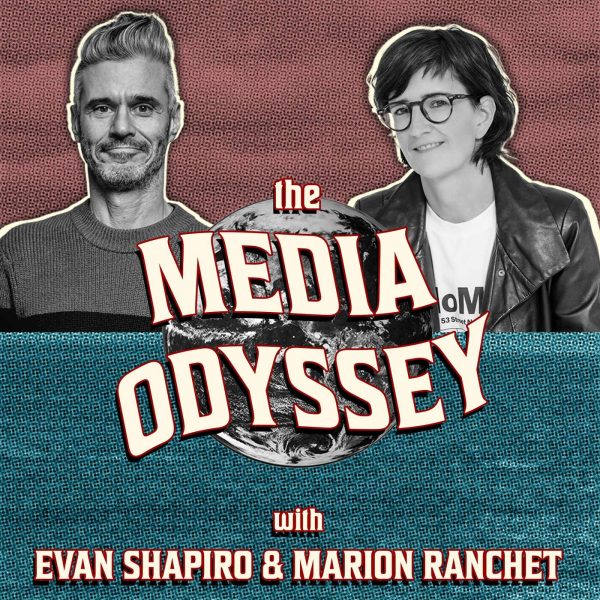
The Media Odyssey
- Folgen
- 111
- Erscheint
- wöchentlich
- Letzte Folge
- 12. Nov. 2026
Über den Podcast
Each week, two of media’s most influential thinkers, Evan Shapiro & Marion Ranchet, take on the hottest media topics with their hottest takes, helping their audience chart a course through the maelstrom that is today’s Media Odyssey. Based in the US, Evan Shapiro is the Media Industry’s official Cartographer, known for his well-researched and provocative analysis of the entertainment ecosystem in his must read treatises on Media’s latest trends and trajectories. Marion Ranchet, French expat based in Amsterdam, has become the industry’s go-to expert in all things streaming, building a following for turning even the most complex problems into easily digestible and actionable insights. Ranchet and Shapiro are known for their sharp-yet-accessible content on Media consumption, audience trends, and the shifting fundamentals of the business itself. Even during the toughest of topics, they each make talking about Media fun. Together every week, these two will offer entertaining, often humorous, and always educational content on today’s Media Odyssey.
Mitwirkende
Folgen 111
NEW DEALS, NEW FORMATS, AND A BIGGER SALES HOUSE AT CHANNEL 4
Channel 4 is about to become the UK's biggest TV sales house, and its Chief Commercial Officer says the friction of broadcast TV is a superpower. Rak Patel joins the Media Odyssey Podcast to explain why Channel …
Shownotes
Channel 4 is about to become the UK's biggest TV sales house, and its Chief Commercial Officer says the friction of broadcast TV is a superpower. Rak Patel joins the Media Odyssey Podcast to explain why Channel 4 is partnering with Paramount and Disney+, pushing YouTube to relax its terms, and insisting that YouTube is not TV.
In this episode of the Media Odyssey Podcast, Evan Shapiro and Marion Ranchet talk with Rak Patel, Chief Commercial Officer of Channel 4 and a veteran of Spotify, Microsoft, and the Financial Times. They cover the landmark Channel 4 and Paramount ad-sales deal, the Disney+ partnership, Channel 4's YouTube strategy and 4Studio, vertical video experiments like Guest List, and the ITV and Sky merger. They also discuss the future of public service media, UK TV advertising, and how European broadcasters can compete with big tech.
Key Takeaways:
1. Digital Meets Broadcast
Rak Patel is a first-time TV executive after nearly three decades in media, including seven years at Spotify. He explains what he brought from tech into Channel 4's ad business and why his first big lesson was "don't throw the baby out with the bathwater."2. The Paramount Deal Creates the UK's Biggest TV Sales House
Channel 4 will represent the inventory of Channel 5 and Paramount's linear channels, reaching 38 million UK individuals, or 68% of adults monthly. Rak explains why the deal is not a reactive move, and what's not included.3. Channel 4's YouTube Strategy and Its Asks
Four years into its YouTube partnership, Channel 4 has built 4Studio into a creator destination and is selling YouTube inventory as TV to tap new social budgets. Rak outlines three things he wants from the platform, including a change to its commercial terms.4. Is YouTube TV?
Evan Shapiro and Rak disagree, and Rak shares the UK data behind his answer. He also makes the case that the "friction" of broadcast is what builds audience trust.5. Disney+, the BBC, and a Warning for Advertising
Channel 4's linear channel and content are headed to Disney+ in the new year, and Rak addresses speculation about a BBC deal. He closes with a sobering stat on where UK ad revenue has gone over the last five years.
Thank you to Rak Patel for joining the pod!
Rak Patel - https://www.linkedin.com/in/rak-patel-513b642/
Channel 4 - https://www.linkedin.com/company/channel-4/home/Interested in sponsorship? https://forms.gle/2LCWfX2HBNT8mtpx8
Connect with us on Linkedin:
Evan Shapiro - https://www.linkedin.com/in/eshap-media-cartographer/
Marion Ranchet - https://www.linkedin.com/in/marionranchet/
The Media Odyssey Podcast - https://www.linkedin.com/company/the-media-odyssey-podcast- (00:00) - Welcome and Guest Intro
- (01:15) - Rak Patel Career Journey
- (03:36) - Bringing Digital Thinking to TV
- (05:57) - TV Power and Industry Collaboration
- (09:18) - Channel 4 Future Strategy
- (11:24) - Landmark Paramount Deal
- (12:38) - Deal Scope and Scale
- (15:16) - ITV Sky Merger Questions
- (20:24) - YouTube in Channel 4 Strategy
- (24:57) - Monetization and Selling YouTube
- (26:30) - Brand Safety Rules
- (27:06) - Selling Across Budgets
- (27:35) - Audience First Ecosystem
- (29:09) - CPM Pricing Reality
- (31:17) - Is YouTube TV
- (32:52) - Trust Through Friction
- (35:37) - Betting on Platforms
- (37:05) - Guestlist Vertical Experiment
- (39:36) - Scaling Brand Funded Shows
- (41:40) - BBC and Disney Deals
- (45:44) - Why Partnerships Matter
- (48:24) - Ad Market Warning Signs
- (50:37) - Go For It Closing
Kapitel (23)
TURNING A NONPROFIT INTO A DIGITAL MEDIA POWERHOUSE
Mit Jason Y. Lee
Jubilee Media started with a failed busking attempt in a New York subway station. Ten years later it has 12 million YouTube subscribers and has become a town hall for Gen Z, and a stop for politicians before …
Shownotes
Jubilee Media started with a failed busking attempt in a New York subway station. Ten years later it has 12 million YouTube subscribers and has become a town hall for Gen Z, and a stop for politicians before traditional media.
This episode of the Media Odyssey Podcast features Evan Shapiro and special co-host Jamie Shapiro (sitting in for Marion Ranchet) in conversation with Jason Y. Lee, founder and CEO of Jubilee Media. They cover how Jubilee built viral YouTube formats like Surrounded, Middle Ground, and Spectrum, why YouTube on the TV screen matters, and how a 37-person team produces so much original content. They also discuss the creator economy and brand partnerships, the CNN town hall, and what comes next for Jubilee, including FAST channels, live events, and a new era of audience participation.
Key Takeaways:
1. From Haiti Fundraiser to Gen Z Town Hall
Jason Lee left a consulting job at Bain to start the Jubilee Project, a nonprofit, after a YouTube video raised thousands for Haiti. The 2017 election inspired Jubilee Media as it exists today, a media company built to bring people together in conversation that feels authentic.2. Why YouTube Comes First
Jubilee Media has 12 million YouTube subscribers and reaches roughly 200 to 300 million views a month. Jason says YouTube is the hardest place to build an audience but the stickiest, with Surrounded episodes averaging over 45 minutes of viewing and more people watching on TV.3. Build Formats, Not One-Off Viral Videos
Jason explains why a viral format that produces 100 videos beats a single viral hit, and how hackathons, quick pilots, and a “batting average” mindset drive the process. Fast feedback from digital audiences is the advantage.
4. Low Production Costs, High Authenticity
A team of about 37 puts out at least three original videos a week, and the stripped-down sets came from budget limits, not genius. Evan argues that Hollywood confuses production value with quality.5. Politics, Partnerships, and What’s Next
Jubilee recently co-produced a CNN town hall with Texas Senator-elect James Talarico, and Lee discusses how Jubilee stays nonpartisan and how brand partnerships fit in. He also previews Jubilee Clubs and upcoming live events.Thank you to Jason Y. Lee for joining the pod!
Jason Y. Lee - https://www.linkedin.com/in/jasony-lee/
Jubilee - https://www.linkedin.com/company/jubileemedia/home/
Interested in sponsorship? https://forms.gle/2LCWfX2HBNT8mtpx8
Connect with us on Linkedin:
Evan Shapiro - https://www.linkedin.com/in/eshap-media-cartographer/
Marion Ranchet - https://www.linkedin.com/in/marionranchet/
The Media Odyssey Podcast - https://www.linkedin.com/company/the-media-odyssey-podcast
- (00:00) - Welcome and Guest Intro
- (02:26) - From Haiti to Jubilee
- (06:06) - Scale and Audience Reach
- (07:16) - Platform Strategy and TV
- (08:46) - Building Viral Formats
- (11:01) - MVP Hackathons and Iteration
- (15:18) - Team Structure and Output
- (18:49) - Costs and Authenticity
- (23:03) - CNN Town Hall Collab
- (24:42) - Candidates In The Hot Seat
- (28:07) - Nonpartisan By Design
- (32:18) - Learning From Opposing Views
- (33:50) - How Jubilee Makes Money
- (34:54) - Brand Safety And Guidelines
- (38:25) - Beyond Politics New Formats
- (41:06) - What's Next For Jubilee
- (45:17) - Podcast Wrap And Goodbye
Kapitel
Kapitel werden geladen …
THE SECRET TO HALLMARK'S BILLION-MINUTE FANDOM
Hallmark makes 100 movies a year in two to three weeks each, has a 70,000-person waitlist for its annual cruise, and received 84 million views in its first year on YouTube. The 116-year-old, family-owned brand …
Shownotes
Hallmark makes 100 movies a year in two to three weeks each, has a 70,000-person waitlist for its annual cruise, and received 84 million views in its first year on YouTube. The 116-year-old, family-owned brand shows how fandom, formula, and a “One Hallmark” ecosystem keep audiences loyal across TV, streaming, and live events.
This episode of the Media Odyssey Podcast, recorded live at MIPCOM, features hosts Evan Shapiro and Marion Ranchet with Jon Sichel, head of distribution for Hallmark Media. They discuss Hallmark’s YouTube strategy and the launch of Hallmark Movies on YouTube, the Hallmark+ streaming membership, and the Hallmark Channel turning 25. They also cover the brand’s global expansion and licensing strategy, the Hallmark movie formula, and why sticking to a clear brand identity and putting fans first beats trying to be everything to everyone.
Key Takeaways:
1. YouTube Finds a Younger Hallmark Fandom
Hallmark Movies launched on YouTube in October 2025 and has already seen 84 million views and about 2.6 billion minutes of viewing time. Jon Sichel explains why the audience skews younger than the typical TV viewer.2. One Hallmark: The Fan Flywheel
From 1,000 retail stores to Hallmark+ to a cruise with a 70,000-person waitlist, Hallmark moves fans across every part of its business. YouTube viewers are pointed to Hallmark+, the streaming service, where members get store discounts, free cards, unlimited e-cards, and access to events like a Kansas City Christmas Experience that draws 100,000 visitors. It’s more a membership than a subscription.3. The Playbook Behind 100 Movies a Year
Hallmark makes about 100 movies annually, roughly 40 of them holiday films, shot in two to three weeks each. The company doesn’t spend $30 million per film, and Jon Sichel says tax credits, tight budgets, and a tried-and-true production approach make the volume possible4. Going Global
Hallmark licenses select content to Netflix and Peacock, including earlier seasons of The Way Home, to introduce fans and bring them back to its own platforms. The company is in 145 countries with partners including TF1, Corus, RAI, and Sky, and it mostly dubs its films in over 50 languages. Sichel shares why taking Hallmark+ abroad is a top priority.5. Why Staying Private Matters
Hallmark is family-owned, with the grandsons of founder J.C. Hall still active in running it, and it has declined offers to sell. Sichel says that not reporting to Wall Street each quarter supports a culture of reinvestment and innovation.Thank you to Jon Sichel for joining the pod!
Jon Sichel - https://www.linkedin.com/in/jonathansichel/
Hallmark - https://www.linkedin.com/company/hallmark-channel/
Interested in sponsorship? https://forms.gle/2LCWfX2HBNT8mtpx8
Connect with us on Linkedin:
Evan Shapiro - https://www.linkedin.com/in/eshap-media-cartographer/
Marion Ranchet - https://www.linkedin.com/in/marionranchet/
The Media Odyssey Podcast - https://www.linkedin.com/company/the-media-odyssey-podcast
- (00:00) - Podcast Introductions
- (00:51) - Hallmark Plus Preview
- (01:58) - Hallmark Origin Story
- (03:54) - Hallmark Formula Scale
- (04:50) - YouTube Expansion Strategy
- (07:10) - Fan Flywheel Experiences
- (08:49) - One Hallmark Ecosystem
- (14:15) - Owning Christmas Worldwide
- (17:16) - Global Distribution Plans
- (21:51) - Private Company Advantage
- (27:20) - Playbook Not Formula
- (29:05) - Closing Thanks
Kapitel
Kapitel werden geladen …
WHY BROADCASTERS ARE PARTNERING WITH THE PLATFORM THEY ONCE FEARED
Three years ago RTL Deutschland had no relationship with YouTube. Today, 200 old episodes of a 1996 action series are driving 123% more first video views and 26% more subscriptions on RTL+. This YouTube and RTL …
Shownotes
Three years ago RTL Deutschland had no relationship with YouTube. Today, 200 old episodes of a 1996 action series are driving 123% more first video views and 26% more subscriptions on RTL+. This YouTube and RTL partnership case study shows how legacy TV can monetize its back catalog and grow streaming subscriptions.
This episode of the Media Odyssey Podcast features Evan Shapiro in conversation with Pedro Pina (Vice President of YouTube EMEA) and Stefan Schmitter (CEO of RTL Deutschland). They discuss how RTL treats YouTube as a partner of equals instead of a threat, and why the cannibalization fear doesn’t hold up. They also cover YouTube monetization and revenue share, the Cobra 11 catalog strategy, Ad Alliance and the packaging of YouTube, linear TV, and streaming ad inventory, creator collaborations, and news on YouTube. Together they make the case for a “third golden age of television” built on thinking like a creator.
Key Takeaways:
1. YouTube Is a Partner, Not the Villain
RTL had no YouTube relationship three years ago and now treats it as an additional channel with a clear role, strategy, and room for trial and error. Stephan argues that audiences increasingly live in “bubbles” (YouTube, Netflix, Amazon, TikTok), so a traditional media house needs partnerships to reach younger age groups. On the other hand, YouTube doesn’t produce content, so it only succeeds when its partners do.2. Cobra 11 Turns a Burnt-Out Catalog into a Subscription Funnel
RTL put about 200 full episodes of the action series Cobra 11 (on air since 1996 and sold to 120 countries) on YouTube after they had run out of value in its own ecosystem through repeated reruns. The episodes earned around 30 million views in 365 days from an audience that is 83% male and about 30 years old on average. The content produced 123% more first video views on RTL+ and about 26% more RTL+ subscriptions, and Evan notes it all happens one click away from the YouTube app on the TV screen.3. Ad Alliance Packages YouTube, TV, and Streaming Inventory
RTL’s Ad Alliance sells advertisers a combined package of RTL+, RTL, Sky, and YouTube inventory, pairing RTL+’s female-leaning audience (34 years old on average) with YouTube’s younger male audience. Stephan says revenues are significantly up, with near double-digit millions in incremental money and a clear path with YouTube through 2030. Pedro notes that partners selling their own inventory with their own sales forces achieve higher CPMs, especially on the big screen.4. Experiment, Don’t Abandon Linear, and Build a Creator Flywheel
Pedro’s lessons from the partnership are to be willing to change, to experiment freely on YouTube, and to remember YouTube is not the only solution, since free-to-air and linear TV remain an important chunk of the business. Stephan adds that YouTube’s creator network can supply pre-shows and highlight content RTL cannot produce itself, while creators gain validation by appearing on shows like Let’s Dance and I’m a Celebrity... Get Me Out of Here!5. News on YouTube Reaches Audiences Where They Are
With 52-54% of the world getting news from social video or social media, RTL put its N-TV news channel and short-form videos made with journalistic creators on YouTube, which Schmitter calls part of RTL’s responsibility in the democratic system. Pedro says traditional players leaning in broadens the range of voices heard, citing the BBC becoming the largest English-speaking news channel on YouTube, and notes YouTube’s recommendation systems give authoritative news sources special placement.Thank you to Pedro Pina and Stephan Schmitter for joining the pod!
Pedro Pina - https://www.linkedin.com/in/pedro-pina-06a413/
Stephan Schmitter - https://www.linkedin.com/in/stephan-schmitter-08016038/
YouTube - https://www.linkedin.com/company/youtube/
RTL Deutschland - https://www.linkedin.com/company/rtl-deutschland/
Interested in sponsorship? https://forms.gle/2LCWfX2HBNT8mtpx8
Connect with us on Linkedin:
Evan Shapiro - https://www.linkedin.com/in/eshap-media-cartographer/
Marion Ranchet - https://www.linkedin.com/in/marionranchet/
The Media Odyssey Podcast - https://www.linkedin.com/company/the-media-odyssey-podcast
- (00:00) - Welcome and Setup
- (00:48) - RTL Showcase Reel
- (01:58) - Beyond Cosplaying Digital
- (03:17) - Additive Reach Not Cannibalization
- (05:22) - YouTube Platform Partnership Model
- (08:26) - Cobra 11 Full Episodes Case
- (12:04) - Fandom Flywheel and CTV Monetization
- (14:21) - Ad Alliance and Premium Inventory Sales
- (17:34) - Advertiser One Stop Shop Strategy
- (20:01) - Lessons for Legacy Media Partners
- (24:00) - Creators Meet Broadcast Flywheel
- (25:20) - News on YouTube and Democracy
- (29:07) - Closing Thanks and YouTube Message
Kapitel
Kapitel werden geladen …
FINDING YOUR AUDIENCE FROM THE COUCH TO THE TOILET
Premium streaming lost 89% of the subscribers that signed up for new subscriptions last year, and the audience it’s chasing is watching video in the bedroom, on the bus, and on the toilet. Evan Shapiro’s …
Shownotes
Premium streaming lost 89% of the subscribers that signed up for new subscriptions last year, and the audience it’s chasing is watching video in the bedroom, on the bus, and on the toilet. Evan Shapiro’s keynote makes the case that media has to redefine broadcast and follow the whole consumer.
In this keynote episode of the Media Odyssey Podcast, recorded on stage at Jupiter Festival in Miami, Evan Shapiro unveils the newest Media Universe map and the Creator Ecosphere map. He walks through cross-screen attention data from 23 regions, including why YouTube, TikTok, and vertical video are winning the phone-first audience, how the creator economy is shifting toward the affinity economy, and why the “cannibalization” fear is a myth, using World Cup viewership as proof. He also covers streaming retention, the rise of advertising over subscriptions, vertical premium television, employee-generated content, and how brands and media companies can win by thinking like creators in the user-centric era.
Key Takeaways:
1. The User-Centric Era Is Here, and the Phone Is the Remote Control
81% of the world’s population is 54 or younger, and phones beat television sets for video time by more than two to one in the US and more than three to one in Brazil and Mexico. In the 23 regions surveyed, the bedroom was the top place to watch video, and 75% of the Indian Premier League cricket final was watched on phones.2. YouTube Wins by Serving the Whole Consumer
The new de-duplicated cross-screen attention index (index.eshap.tv) puts YouTube first in the US because it is the only platform on both television sets and phones, with a vertical product. Among under-55s TikTok ranks second, and among under-25s TikTok wins total attention in the US.3. Premium Streaming Is Plateauing as Advertising Overtakes Subscriptions
In the past year SVOD added 175 million subscribers and lost 156 million, a net retention of just 11%. PwC data shows advertising surpassing subscriptions in global revenue for the first time in a long time, which explains why premium streamers are rushing into ads.4. The Cannibalization Myth Doesn’t Hold Up
During the World Cup, CazéTV in Brazil hit 24 million concurrent YouTube streams for the final while 70 million people watched on broadcast at the same time. RTL in Germany reports a 26% increase in paid subscriptions and a 126% increase in sampling from audiences reached on YouTube, and BBC Studios’ Jasmine Dawson says that in every case studied, social distribution is additive.
5. Think Like a Creator
Indie creators on the Affinity 100 list showed three to five times better engagement quality than mega creators. Heinz drove about $45 million in earned media and a 12% sales lift by mocking FIFA’s stadium branding rules, and Kit Kat’s stolen-truck posts reached 128 million people and $224 million in earned media. World of Wonder’s WOW Presents, built on its Drag Race fandom, reports 96% retention.
Interested in sponsorship? https://forms.gle/2LCWfX2HBNT8mtpx8Connect with us on Linkedin:
Evan Shapiro - https://www.linkedin.com/in/eshap-media-cartographer/
Marion Ranchet - https://www.linkedin.com/in/marionranchet/
The Media Odyssey Podcast - https://www.linkedin.com/company/the-media-odyssey-podcast- (00:00) - Opening Banter
- (00:07) - Mapping the Media Universe
- (01:12) - User Centric Era Begins
- (02:30) - Creator Ecosphere Shift
- (02:59) - Who the Consumers Are
- (04:25) - Streaming vs Social Video
- (06:39) - Where People Watch Video
- (09:38) - Phone First Attention Index
- (14:31) - Affinity Economy Explained
- (17:51) - Bluey and No Cannibalization
- (20:08) - Sports Second Screen Fandom
- (22:58) - Vertical Video Explosion
- (24:27) - Brands Acting Like Creators
- (27:18) - Employee Generated Content Wins
- (29:25) - Drag Race Creator Mindset
- (31:27) - Final Takeaways and Close
Kapitel
Kapitel werden geladen …
HOW TO FIX KIDS CONTENT
YouTube built the kids content economy, then broke its own monetization pipeline. Now it's time to fix kids content.This episode of the Media Odyssey Podcast features hosts Evan Shapiro and Marion Ranchet with …
Shownotes
YouTube built the kids content economy, then broke its own monetization pipeline. Now it's time to fix kids content.
This episode of the Media Odyssey Podcast features hosts Evan Shapiro and Marion Ranchet with kids media analyst Emily Horgan (The Kids Streamersphere), breaking down her latest Netflix Kids Content Performance Report. They dig into why Netflix isn't building new kids IP, YouTube's broken monetization pipeline for children's content, and how what's actually working for creators and franchises in a brutally competitive kids' content landscape can be the roadmap to fixing kids content.
Key Takeaways:1. Netflix Is the Stage, Not the Lab
Netflix's recent kids hits (Gabby's Dollhouse, Creature Cases) mostly originated five-plus years ago, and newer breakouts like Ms. Rachel and the digital-first animation flooding Netflix (Sheriff Labrador, ChuChu TV) were built elsewhere, mainly on YouTube. Emily Horgan argues Netflix is "North Starred on streaming" rather than franchise-building, licensing proven IP (Paw Patrol, Peppa Pig, Miraculous Ladybug) rather than developing new characters from scratch.2. YouTube's Kids Monetization Pipeline Is Broken
Advertising revenue for kids content on YouTube has collapsed over the past five years following FTC regulation (COPPA enforcement) and cooling advertiser appetite even though kids content represents roughly 15% of platform usage. This has throttled the pipeline that once produced hits like Cocomelon, making it far harder for "the next Ms. Rachel" to emerge.
3. Old IP Still Dominates (But Legacy Live-Action Is Resurging)
Decade-old Nickelodeon live-action shows like The Thundermans and Sam & Cat continue to perform strongly on Netflix, a trend Emily Horgan's team began tracking closely around the Paramount-Warner Bros merger. Shows like SpongeBob and Bluey show that durable franchises, often 20+ years old, dominate the kids top 10. New entries can take 28 months or more to build an audience.
4. AI's Double-Edged Role in Kids Animation
Studios like Toonstar are using AI-assisted animation to cut production costs to roughly 5% of traditional costs, enabling profitable, creator-led shows and faster turnaround. But the same efficiency is flooding YouTube with low-quality "AI slop," which erodes parental trust that is already weakened among Gen Z parents.5. The Playbook: Build the Audience, Then the Business
The winning model is audience-first, not commission-first. Success shows now need to build direct relationships with fans via YouTube, live events, and merch before pursuing traditional distribution deals. Examples include Steven and Parker (now reaching 30 million weekly viewers across six languages) and Sesame Street's multi-platform windowing strategy between Netflix and YouTube.Thank you to Emily Horgan for joining the pod!
Emily Horgan - https://www.linkedin.com/in/emohorgan/
Kids Media Club Podcast - https://kids-media-club-podcast.captivate.fm/listen
The Kids Kids StreamerSphere - https://thekidsstreamersphere.substack.com/
Interested in sponsorship? https://forms.gle/2LCWfX2HBNT8mtpx8
Connect with us on Linkedin:
Evan Shapiro - https://www.linkedin.com/in/eshap-media-cartographer/
Marion Ranchet - https://www.linkedin.com/in/marionranchet/
The Media Odyssey Podcast - https://www.linkedin.com/company/the-media-odyssey-podcast
- (00:00) - Welcome and Dublin Banter
- (03:10) - Inside the Netflix Kids Report
- (05:36) - Live Action Surprise Hits
- (07:23) - YouTube IP Flood Returns
- (09:35) - Why Netflix Licenses More
- (12:55) - Kids Strategy and Pipeline
- (16:57) - YouTube as the Lab
- (17:56) - Kids Monetization Collapse
- (19:15) - Regulation and Ad Chill
- (22:35) - Co-Viewing and Nostalgia Wins
- (23:28) - Fixing YouTube Kids
- (25:18) - Monetization and Prominence
- (27:57) - Regulation and Responsibility
- (29:46) - Netflix Engagement Shift
- (34:15) - New IP and Revenue Models
- (36:41) - AI Animation Promise and Slop
- (40:01) - Mini SVOD and Superfan Subscriptions
- (43:49) - Creator Entrepreneur Mindset
- (47:16) - Wrap Up and MIPCOM Plans
Kapitel
Kapitel werden geladen …
THE END OF THE PARAMOUNT SAGA AND THE TECH-BROS OF THE APOCALYPSE
An Anthropic engineer warned AI could destroy humanity, but Silicon Valley's sudden AI "safety" panic looks a lot like a marketing campaign.This episode of the Media Odyssey Podcast with Evan Shapiro and Marion …
Shownotes
An Anthropic engineer warned AI could destroy humanity, but Silicon Valley's sudden AI "safety" panic looks a lot like a marketing campaign.
This episode of the Media Odyssey Podcast with Evan Shapiro and Marion Ranchet breaks down how California's attorneys general settled in the Paramount-Warner Bros Discovery merger, what the deal's mandates actually require, and why the AI industry's sudden doomsday messaging conveniently coincides with OpenAI and Anthropic's IPO troubles. Plus a look at how Europe is positioning itself in the AI race.
Key Takeaways
1. The AI "Safety Panic" Marketing Campaign
A former Anthropic engineer's viral tweet warning that AI companies were racing toward "recursive self-improvement" was quickly echoed throughout Sillicon Valley. But the timing argues the timing (right as OpenAI delayed its IPO citing cash problems and Anthropic prepared to raise at a $2 trillion valuation) makes the warnings look more like hype-driven marketing than genuine risk.2 Meta's Muse Shows the Gap Between Hype and Reality
Meta's new AI app Muse became the top downloaded app in app stores days after launch, despite requiring access to users' email, texts, and banking information. But within a single day, security researcher Patrick Wardle hacked his own instance of Muse and planted malware.3. Europe's AI Position: Enterprise Over Frontier Models
Mistral has pivoted away from competing directly with OpenAI and Anthropic on frontier models, focusing instead on enterprise distribution and infrastructure. Marion Ranchet notes Mistral's most recent $3 billion funding round, led by Samsung, values the company at $21 billion, a fraction of Anthropic's and OpenAI's valuations, but Europe is still finding places for its own AI.4. The Paramount-Warner Bros Deal's Mandates
Attorney General Rob Bonta settled the merger under political pressure, securing commitments including 30-32 theatrical film releases per year, a $25 million independent film fund, mandatory separate operation of Paramount and Warner Bros, keeping studio lots, and an independent oversight board to monitor editorial interference at at CNN.5. Massive Layoffs Are Coming
With $81 billion in combined debt against roughly $12 billion in declining EBITDA, and a plan requiring $6 billion in synergies plus 50% EBITDA growth in 36 months, Evan Shapiro estimates around 20,000 layoffs at Warner Bros and Paramount over the next few years.Interested in sponsorship? https://forms.gle/2LCWfX2HBNT8mtpx8
Connect with us on Linkedin:
Evan Shapiro - https://www.linkedin.com/in/eshap-media-cartographer/
Marion Ranchet - https://www.linkedin.com/in/marionranchet/
The Media Odyssey Podcast - https://www.linkedin.com/company/the-media-odyssey-podcast
- (00:00) - Welcome
- (00:32) - Evan Was Wrong
- (01:56) - Regulators Deal Mandates
- (02:11) - Theatrical Quotas and Studio Separation
- (05:08) - News Oversight
- (08:40) - Pluto TV and Ad Strategy
- (12:04) - Job Cuts
- (17:39) - Why Workers Weren't Protected
- (22:34) - AI Doom Tweets
- (27:09) - China Models and Reality Check
- (28:01) - Self Regulation Spin
- (29:07) - Free Models Threat
- (31:32) - Muse Privacy Disaster
- (33:37) - Europe AI
- (40:59) - Hype Versus Reality
- (46:34) - Using AI Wisely
- (49:07) - Commoditized AI Future
- (52:31) - Next Week
Kapitel
Kapitel werden geladen …
THE AFFINITY 100: THE MOST IMPACTFUL CREATORS OF 2026
Blair Imani just beat MrBeast on a brand-new ranking of creator influence and and the metric behind it could change how brands spend their money on YouTube, TikTok, and Instagram.This episode of The Media …
Shownotes
Blair Imani just beat MrBeast on a brand-new ranking of creator influence and and the metric behind it could change how brands spend their money on YouTube, TikTok, and Instagram.
This episode of The Media Odyssey Podcast, recorded outside at IBC, features hosts Evan Shapiro and Marion Ranchet with special guest Shira Lazar. They unpack the newly released Affinity 100, a ranking of the most impactful creators of 2026 built on a new metric called the Affinity Quotient, developed with Whalar Group and Foam.
Key Takeaways:
1. A New Way to Measure Influence
The Affinity Quotient weighs likes and comments, adds shares at double weight, and divides by views to measure engagement per view rather than engagement per post. It captures depth of impact rather than raw reach.2. Blair Imani Tops the List, MrBeast Ranks 85th
Educator and historian Blair Imani (fewer than 1 million total followers) ranked #1, while MrBeast, the world's biggest creator with half a billion followers, landed at 85. The list shows a shift from "creator economy" to the "affinity economy," where depth of engagement matters more than scale.3. Indie and Expert Creators Are Rising
The list highlights "indie creators" and niche experts (a finance guru, a film reviewer, a makeup artist turned inclusivity consultant) showing that creators with as few as 10,000-50,000 highly engaged fans can build sustainable, meaningful businesses.4. Brands Still Chase Follower Counts Despite the Shift
Even as the industry talks about quality over quantity, brand briefs still specify minimum follower counts (e.g., "250K-plus"). Shira Lazar argues B2B and knowledge creators are starting to shift that mindset, since the people following niche experts are often the ones making purchasing decisions.5. The Creator Ecosphere Map Returns in October
Evan Shapiro will unveil the second edition of the Creator Ecosphere Map on October 8th at the inaugural Jupiter Festival in Miami, sponsored by YouTube. The new version will rank roughly 800 creators using the Affinity Quotient across all major platforms, with all underlying data made publicly available for validation.Thank you to Shira Lazar for joining the pod!
Shira Lazar - https://www.linkedin.com/in/shiralazar/
Interested in sponsorship? https://forms.gle/2LCWfX2HBNT8mtpx8
Connect with us on Linkedin:
Evan Shapiro - https://www.linkedin.com/in/eshap-media-cartographer/
Marion Ranchet - https://www.linkedin.com/in/marionranchet/
The Media Odyssey Podcast - https://www.linkedin.com/company/the-media-odyssey-podcast
- (00:00) - Live at IBC Intro
- (00:46) - Affinity Quotient Explained
- (02:34) - Top Creators and MrBeast Context
- (05:08) - Why the List Matters
- (08:08) - Sustainable Creator Playbooks
- (10:43) - Scale vs Trust Debate
- (13:39) - Expert Economy and Diversity
- (15:22) - Next Map and Jupiter Festival
- (16:59) - YouTube Views and Monetization
- (18:59) - Wrap Up and Banter
Kapitel
Kapitel werden geladen …
80% WEEKLY REACH, SHRINKING BUDGETS: EUROPE'S PUBLIC SERVICE MEDIA
Europe's public broadcasters are losing over 5% of their funding on average, and some budgets are being slashed by up to 70%. It's not because of economics, but ideology.This bonus episode, recorded live at SME …
Shownotes
Europe's public broadcasters are losing over 5% of their funding on average, and some budgets are being slashed by up to 70%. It's not because of economics, but ideology.
This bonus episode, recorded live at SME Live 2026 in Amsterdam, features Marion Ranchet with Serge Schick (France Medias Monde), Lieven Vermaele (VRT), Christophe Chantraine (RTBF), and Bastiaan Toering (NPO), discussing the funding pressures and strategic countermeasures reshaping European public service media.
Key Takeaways
1. Public Service Media Reach Is Massive, But Funding Is ShrinkingPSM reaches over 80% of Europeans weekly (close to 70% among 15-24 year-olds) at a cost of just €3.60 per citizen per month. At the same time, average funding fell more than 5% between 2019 and 2024, with some countries like Switzerland cutting budgets by 70% despite no public deficit, reflecting political and ideological pressure rather than economics alone.
2. Broadcasters Are Cutting Costs to Protect Content
RTBF is reducing its workforce by 10% over four years mainly through attrition, cutting a radio station, and some sports rights. VRT is rationalizing its brand portfolio down to three core digital platforms (news, sport, audio-visual) while keeping 65% of its budget tied to content production.3. SVOD and Partnerships Are New Revenue Levers
NPO's NPO+ SVOD service, launched in 2016, has driven a decade of added revenue, and its co-production "Wolven" with Disney+ shows public broadcasters increasingly open to streamer partnerships. This mindset shift wouldn't have happened five years ago, contrasting with France's failed Salto SVOD venture.4. YouTube Strategy Varies by Broadcaster
France Médias Monde treats YouTube as essential reach across 18 markets it can't cover alone, RTBF uses release-window delays to protect its own platform while benefiting from a large audience halo effect outside Belgium, and NPO/VRT build YouTube-native content designed to funnel viewers back to their own platforms.5. Collaboration Across PSM Remains Limited
European public broadcasters still rarely share technology or infrastructure the way commercial groups like RTL or Bedrock do across markets, despite recognizing the need for scale. Efforts like the EBU-backed Public Space Incubator offer a small but promising start.Thank you to all the panelists:
Serge Schick - https://www.linkedin.com/in/serge-schick-447019104/
Lieven Vermaele - https://www.linkedin.com/in/lievenvermaele/
Christophe Chantraine - https://www.linkedin.com/in/christophechantraine/
Bastiaan Toering - https://www.linkedin.com/in/bastiaan-toering/Interested in sponsorship? https://forms.gle/2LCWfX2HBNT8mtpx8
Connect with us on Linkedin:
Evan Shapiro - https://www.linkedin.com/in/eshap-media-cartographer/
Marion Ranchet - https://www.linkedin.com/in/marionranchet/
The Media Odyssey Podcast - https://www.linkedin.com/company/the-media-odyssey-podcast
THE STREAMING PLATFORM RATIO
Streaming platforms are spending anywhere from 9% to 30% of revenue just to run their tech stack and a new study finally puts real numbers behind the guesswork. Don’t miss this special episode recorded on stage …
Shownotes
Streaming platforms are spending anywhere from 9% to 30% of revenue just to run their tech stack and a new study finally puts real numbers behind the guesswork.
Don’t miss this special episode recorded on stage at Streaming Made Easy Live with Jonas Engwall (CEO of Bedrock Streaming), Bjarne Andreas Myklebust (NRK, Norway's public broadcaster), and Rowan de Pomerai (CEO of the DPP). They unpack the new Streaming Platform Ratio study benchmarking 16 European platforms against Netflix, why public broadcasters are outperforming commercial ones on tech efficiency, and the coming wave of premium vertical video.
Key Takeaways:
1. The Streaming Platform Ratio Benchmark
Bedrock and the DPP surveyed 16 mostly-European streaming platforms to measure tech spend as a percentage of streaming revenue, anonymizing all results. They used Netflix as the public baseline and its publicly disclosed tech and development spend comes out to roughly 10% of revenue, a figure that's held steady for the past five to six years.2. Scale Is the Biggest Cost Driver
Platforms with revenue above roughly $100 million showed nearly half the proportional tech cost of smaller platforms. Public broadcasters performed slightly better than commercial players overall because larger organizations benefit from fixed costs spread across more revenue.3. Legacy Broadcasters Are Still Paying Two Bills
NRK reports that traditional DTT distribution still consumes about 90% of its budget, while OTT already accounts for 20-25% of consumption. Public broadcasters that started streaming early (echoing BBC's iPlayer) built in competitive advantages like NRK running three CDNs with annual price competition to control distribution costs.4. Buy, Don't Build
Panelists agreed that most platforms are shifting from CapEx to OpEx, buying software and licensing CDN capacity rather than building in-house infrastructure, since content is where broadcasters create value. The DPP noted that no broadcaster builds its own transmission towers or satellites either, so the same logic should extend to streaming infrastructure.5. Premium Vertical Video Is the Next Wave
Bedrock has rolled out vertical video feeds across three of its four platforms, converting short-form teasers into long-form viewership and subscriptions. NRK is launching a vertical original microdrama series, "21 Days," aimed at younger audiences. European broadcasters are leading here by leaning into vertical.Thank you to Jonas Engwall, Rowan de Pomerai, and Bjarne Andreas Myklebust for coming on the pod!
Bedrock Streaming: https://fr.linkedin.com/company/bedrock-streaming?trk=public_profile_topcard-current-company
Jonas Engwall: https://fr.linkedin.com/in/jonas-engwall
Rowan de Pomerai: https://www.linkedin.com/in/rdepom/
Bjarne Andreas Myklebust: https://no.linkedin.com/in/bmyklebust
Interested in sponsorship? https://forms.gle/2LCWfX2HBNT8mtpx8
Connect with us on Linkedin:
Evan Shapiro - https://www.linkedin.com/in/eshap-media-cartographer/
Marion Ranchet - https://www.linkedin.com/in/marionranchet/
The Media Odyssey Podcast - https://www.linkedin.com/company/the-media-odyssey-podcast
00:00 Live Show Kickoff
01:08 Why Measure Platform Spend
03:21 Streaming Platform Ratio Explained
05:01 Netflix as Baseline Benchmark
06:31 Public Broadcasters and OTT Transition
08:55 Scale Drives Lower Costs
10:12 What the Results Mean
13:20 Europe vs US and Chasing Scale
16:27 Next Steps and Benchmarking Goals
18:47 Build vs Buy and CapEx to OpEx
21:09 Vertical Video and Microdramas
25:10 Premium Vertical Wave in Europe
27:51 Wrap Up and Thanks
- (00:00) - Live Show Kickoff
- (01:08) - Why Measure Platform Spend
- (03:21) - Streaming Platform Ratio Explained
- (05:01) - Netflix as Baseline Benchmark
- (06:31) - Public Broadcasters and OTT Transition
- (08:55) - Scale Drives Lower Costs
- (10:12) - What the Results Mean
- (13:20) - Europe vs US and Chasing Scale
- (16:27) - Next Steps and Benchmarking Goals
- (18:47) - Build vs Buy and CapEx to OpEx
- (21:09) - Vertical Video and Microdramas
- (25:10) - Premium Vertical Wave in Europe
- (27:51) - Wrap Up and Thanks
Kapitel
Kapitel werden geladen …
WE KNOW WHAT MEDIA DID THIS SUMMER
The 2026 World Cup shattered streaming records worldwide, Paramount and Warner Bros are locked in a multi-billion-dollar antitrust standoff, and Meta just settled a landmark child-safety case for $18 billion …
Shownotes
The 2026 World Cup shattered streaming records worldwide, Paramount and Warner Bros are locked in a multi-billion-dollar antitrust standoff, and Meta just settled a landmark child-safety case for $18 billion. The Media Odyssey podcast is back and we know what you did last summer.
This episode marks the Season 3 premiere with hosts Evan Shapiro and Marion Ranchet catching up after their summer break. They cover all the biggest news of the last month including the World Cup's record-breaking viewership clip culture, ESPN’s faulty sports rights math, and Disney’s stale IP. They also discuss how the Paramount-Warner Bros merger battle with 12 state attorneys general suing to block it and Meta's $18 billion child-safety settlement with state AGs.
Key Takeaways
1. The World Cup's Record-Breaking, Clip-Driven Reach
CazéTV in Brazil broke the world concurrent-streaming record five times, peaking at 24 million concurrent streams, while Globo drew 70 million live TV viewers. In the US, TikTok clip culture (24 billion hours watched) dwarfed YouTube's full-match viewership (2.4 billion hours), signaling that conversation and clips now outpace matches themselves.
2. Paramount-Warner Bros Heads Toward Trial
Twelve state attorneys general are suing to block the merger under the Clayton Act, citing monopoly concerns in cable and film. Paramount owes a $7 million-per-day ticking fee starting October 1st and a $7 billion breakup fee if the deal collapses — and Larry Ellison's $40 billion personal backing puts the whole deal at risk.
3. Meta's $18 Billion Child-Safety Settlement
Meta admitted to feeding harmful, addictive content to minors and agreed to structural changes: capped scrolling time, blocked notifications during school hours, and no app access for minors overnight. The hosts debate whether the settlement (the largest child-safety settlement in history) meaningfully changes behavior or just avoids public disclosure of internal wrongdoing.
4. Disney's Aggregation Era
Under new CEO Damaro, Disney has struck a wave of deals including a TikTok content-curation partnership, 15+ European broadcaster deals, and sports rights tie-ups. The bigger challenge remains stale IP (Moana, Toy Story 5, Mandalorian and Grogu underperforming) and whether ESPN's sports-rights spending pencils out as a subscription product.
5. The Vertical Video Market Is Smaller Than Reported
A widely cited $150 billion "vertical market" figure is misleading — $131 billion of it is just social-media ad revenue (Reels, TikTok, Shorts), leaving roughly $19 billion for actual vertical drama apps, none of which are public companies. Meanwhile, subscription fatigue is real: 2025 saw only 11% net subscriber retention industry-wide, down from 33% four years ago, pushing streamers toward ad-supported tiers.
Interested in sponsorship? https://forms.gle/2LCWfX2HBNT8mtpx8
Connect with us on Linkedin:
Evan Shapiro - https://www.linkedin.com/in/eshap-media-cartographer/
Marion Ranchet - https://www.linkedin.com/in/marionranchet/
The Media Odyssey Podcast - https://www.linkedin.com/company/the-media-odyssey-podcast
- (00:00) - Season Three Kickoff
- (00:34) - World Cup Fever Returns
- (05:14) - Creators and Clip Culture
- (08:03) - Halftime Show Backlash
- (09:32) - Ads and Water Breaks Debate
- (11:21) - FIFA Politics and Corruption
- (12:10) - Paramount Viacom Merger Explained
- (21:42) - Meta Teen Harm Settlement
- (26:56) - Meta Settlement Fallout
- (28:55) - Screens and Kids Rules
- (30:43) - Disney+ Comeback
- (32:31) - ESPN Sports Rights Math
- (35:26) - Disney IP Staleness
- (37:59) - Super Apps Go Vertical
- (39:14) - Vertical Video Reality Check
- (42:42) - Streaming Profitability Crunch
- (46:31) - Churnpocalypse Everywhere
- (48:11) - IBC and Farewell
Kapitel
Kapitel werden geladen …
REGIFTED: MY DRAMA AND THE VERTICAL TAKEOVER
Happy Summer Break from The Media Odyssey podcast! What if the future of entertainment fits in your pocket and a six-year-old startup from Ukraine is already building it?Welcome to the Media Odyssey Podcast …
Shownotes
Happy Summer Break from The Media Odyssey podcast!
What if the future of entertainment fits in your pocket and a six-year-old startup from Ukraine is already building it?
Welcome to the Media Odyssey Podcast, recorded live at StreamTV Europe, featuring Bogdan Nesvit, founder of HOLYWATER TECH and the microdrama platform My Drama. What started six years ago as an interactive fiction app has quietly evolved into one of the most data-sophisticated entertainment companies operating today. One that is now partnering with Fox Entertainment and eyeing a full theatrical release.
If you've ever wondered how a media startup goes from zero to 7 million monthly active users without a single piece of traditional distribution, Bogdan doesn't just tell you what HOLYWATER TECH built, he gives raw data and operational transparency you almost never get from a founder.
Beyond content strategy, Bogdan pulls back the curtain on the business model to detail the full transition from microtransactions to subscription, how the platform runs over 1,000 A/B tests per year, and why he believes proprietary user data (not product or AI) will be the defining competitive advantage of the AI era. He also touches on the Fox partnership, the road to ad monetization, and his personal philosophy around meditation, focus, and leadership.
Key Takeaways:
1. Scale is Accelerating Fast
My Drama currently has close to 300 titles on the platform, targeting 500 by the end of 2026 and 1,000 by the end of 2027. Each title contains around 90 one-minute episodes, effectively repackaging a full 90–120 minute film into bite-sized vertical content.
2. The Subscription Model Dominates
The platform fully shifted away from microtransactions with more than 90% of customers subscribing. Subscription users retain at 2x the rate of in-app purchase users and consume 3x more content. Users on an ad-supported tier consume an average of 1.5 hours of content per day, a striking engagement metric.
3. AI Slashes Production Costs and Timelines
Live-action microdrama costs $120K–$250K per title and takes roughly four months to produce. Netflix takes 100 weeks. AI-generated content on the MyMuse platform costs only a few thousand dollars and can be produced and tested in two weeks. Scripts, however, remain 100% human-written.
4. Paid and Organic Impressions Are Needed Together
My Drama generates two billion monthly impressions across Facebook, Instagram, and YouTube using a cliffhanger-driven content preview strategy for a 70/30 paid-to-organic acquisition split. At any given month, the team runs 30,000 unique video ad creatives across Facebook, Snapchat, and TikTok. Despite heavy paid spend, the company is currently profitable and growing more than 2x year-over-year.
5. It’s a Growing Market
The global microdrama market is $11–12B today, projected to reach $25B by 2030. China dominates the current market (the format originated there around 6 years ago). Outside China, the market is much smaller today but is projected to hit ~$10B, mostly driven by the US, by 2030. Holywater is betting that expanding beyond the current five core content tropes into genres like thriller, fantasy, and detective stories is essential to moving microdrama from niche to mainstream.
Thank you to Bogdan Nesvit for joining the pod!
Bogdan Nesvit - https://www.linkedin.com/in/bogdannesvit/
HOLYWATER TECH - https://www.linkedin.com/company/holywatertech/
Interested in sponsorship? https://forms.gle/2LCWfX2HBNT8mtpx8
Connect with us on Linkedin:
Evan Shapiro - https://www.linkedin.com/in/eshap-media-cartographer/
Marion Ranchet - https://www.linkedin.com/in/marionranchet/
The Media Odyssey Podcast - https://www.linkedin.com/company/the-media-odyssey-podcast
- (00:00) - Live Podcast Kickoff
- (00:47) - Meet the Micro Drama Guest
- (01:47) - HOLYWATER TECH Origin Story
- (02:43) - From Books to Vertical Video
- (04:04) - My Drama Scale and Audience
- (05:19) - Micro Episodes and Library Growth
- (06:23) - Monetization Evolution
- (08:56) - Subscription Data and Retention
- (10:10) - Customer Acquisition Playbook
- (13:24) - Organic Social Cliffhangers
- (15:26) - Data Moat and AB Testing
- (16:31) - Market Size and New Genres
- (18:58) - AI Production and Costs
- (26:45) - Fox Partnership and Mindfulness Finale
Kapitel
Kapitel werden geladen …
REGIFTED: HOW DISNEY KILLED BROADCAST WITH KIMMEL
Happy Summer Break from The Media Odyssey podcast! Jimmy Kimmel is at the center of the conversation where politics, free speech, and billion-dollar mergers collide.In this episode of the Media Odyssey Podcast …
Shownotes
Happy Summer Break from The Media Odyssey podcast!
Jimmy Kimmel is at the center of the conversation where politics, free speech, and billion-dollar mergers collide.
In this episode of the Media Odyssey Podcast, hosts Evan Shapiro and Marion Ranchet unpack the dramatic suspension and reinstatement of Jimmy Kimmel—a flashpoint that highlights the collision of politics, regulation, and the crumbling power of broadcast TV. Shapiro explains the FCC’s limited authority, why Chair Brendan Carr’s threats crossed constitutional lines, and how Disney’s rapid cave-in to political pressure triggered a fierce backlash.
The discussion broadens to late-night’s decline, the chilling precedent for free speech in U.S. broadcasting, and the looming wave of media consolidation involving Paramount, Warner Bros Discovery, and possibly Netflix. Marion draws contrasts with Europe’s regulatory environment, where broadcasters face different pressures but free expression is protected in opposite ways.
Key Takeaways:
- The Kimmel Affair and FCC Overreach
Kimmel was suspended after discussing how MAGA has used activist Charlie Kirk’s killing for political gain, despite committing no FCC violation. Shapiro details how FCC Chair Brendan Carr, who is aligned with Project 2025 and pending affiliate mergers, used threats to coerce Disney and affiliates into action. The result: a blatant clash between politics and the First Amendment, costing Disney billions in market value before Kimmel’s reinstatement. - Broadcast’s Dying Grip
The controversy underscored how fragile broadcast TV has become. Kimmel’s late-night audience is under 2 million, dwarfed by his YouTube reach—and by Joe Rogan’s podcast empire. Shapiro argues that Kimmel and others should abandon dying formats and embrace direct-to-consumer platforms where free speech and financial upside are greater. Marion warns that it is not an easy, overnight transition. - Media Oligarchs and Consolidation
The hosts connect Kimmel’s ordeal to broader maneuvers by billionaires like Larry and David Ellison, whose influence over FCC approvals and mergers (Paramount-Skydance, Warner Bros Discovery) shows how free speech is increasingly transactional. Late-night hosts like Colbert and Oliver may be next in line as consolidation reshapes who controls the cultural narrative. - Europe’s Contrasting Path
Marion highlights how European regulators tackle misconduct differently—punishing hosts who spread disinformation or incite harm, rather than silencing dissent. The comparison underscores a widening gap: in the U.S., politics is shrinking the space for speech on broadcast, while in Europe, regulation is trying to protect it.
Interested in sponsorship? https://forms.gle/2LCWfX2HBNT8mtpx8
Connect with us on Linkedin:
Evan Shapiro - https://www.linkedin.com/in/eshap-media-cartographer/
Marion Ranchet - https://www.linkedin.com/in/marionranchet/
The Media Odyssey Podcast - https://www.linkedin.com/company/the-media-odyssey-podcast
- The Kimmel Affair and FCC Overreach
REGIFTED: INSIDE THE MIND OF A CREATOR WUNDERKIND
Happy Summer Break from The Media Odyssey podcast! 244 million followers and a six-month content calendar: Jordan Schwarzenberger explains why showing up daily is the only strategy that matters. Welcome to The …
Shownotes
Happy Summer Break from The Media Odyssey podcast!
244 million followers and a six-month content calendar: Jordan Schwarzenberger explains why showing up daily is the only strategy that matters. Welcome to The Media Odyssey Podcast.
In this episode, Evan Shapiro and Marion Ranchet break down the Nielsen/MRC measurement crisis that rocked the US advertising industry, then sit down with Jordan Schwarzenberger, CEO and co-founder of Arcade Media and manager of the Sidemen. The conversation reveals how the entire US advertising market transacted on flawed data for a year, while simultaneously showing how creator-led media companies are building sustainable businesses by thinking like traditional media. Rather than defending old systems, Jordan makes the case for why daily content and ritualistic consistency combined with treating YouTube channels as distinct brands is the only path forward.
The episode is a reality check on how broken measurement has become in traditional media, while creator-led companies are professionalizing their operations, building real media plans, and capturing budgets that were previously reserved for legacy broadcasters.
Key Takeaways:
1. Nielsen and MRC Hid Flawed Measurement Data for Nearly a Year
The Media Rating Council discovered problems in Nielsen's methodology almost a year ago but said nothing to the industry. The entire US advertising industry transacted in the Upfront on data they knew was not properly vetted. Sean Cunningham from VAB stated this cost the industry hundreds of millions of dollars.2. BBC Hired Matt Brittin, Ex-President of Google Europe
The BBC hired Matt Brittin, former president of Google in Europe, as their new CEO. This represents a shift toward hiring digital natives to lead public service media organizations. Brittin previously worked in traditional broadcasting before a successful career at Google, making him someone who understands both the BBC culture and big tech.3. The Sidemen Have 244M Followers and a 55-Person Team
The Sidemen have 244 million followers across all platforms and employ 55 people in their entertainment team. They plan content six months in advance, which allows them to sell to brand planners who set budgets quarters ahead. Their goal is to be bought like LabBible and Vice were—on media plans with CPMs and economies of scale. Most creators can't access major advertiser budgets because they lack the planning, consistency, and inventory that media planners require.4. Daily Content and Ritualistic Consistency Are Essential for Success
Weekly podcasts are no longer enough. Audiences now expect daily content to build ritualistic habits. The Daily Wire built 900,000 paid subscribers at their peak by showing up every day with 20-40 minute shows since 2013-2014. Streamers on Twitch and Kick are "winning the most out of anyone." Getting into people's daily habits is the key to building connection in a decentralized, saturated world.5. YouTube Is Underserved and Users Run Out of Quality Content
YouTube production is hard, time-intensive, and resource-heavy compared to podcasts, so creators default to lower-effort formats. There's a massive lack of consistent, regular, high-quality programming that becomes part of users' daily rituals.6. Netflix and YouTube Combined Create the Strongest Media Strategy
Jordan states that the combination of Netflix and YouTube together represents the best media strategy. Netflix provides the premium, appointment-viewing content while YouTube delivers daily touchpoints and ritualistic engagement.7. Individual YouTube Channels Should Be Content-Specific
Channel 4's 4.0 made the mistake of aggregating all content on one channel instead of spinning out individual format channels. YouTube wants to find specific audiences over time, so when a viewer watches one video and doesn't watch the next 10 on an aggregated channel, it signals disinterest to YouTube and hurts the entire channel's performance.Thank you to Jordan Schwarzenberger for joining the pod!
Jordan Schwarzenberger - https://www.linkedin.com/in/jordanschwarzenberger/
Arcade - https://www.linkedin.com/company/wearearcade/
Interested in sponsorship? https://forms.gle/2LCWfX2HBNT8mtpx8
Connect with us on Linkedin:
Evan Shapiro - https://www.linkedin.com/in/eshap-media-cartographer/
Marion Ranchet - https://www.linkedin.com/in/marionranchet/
The Media Odyssey Podcast - https://www.linkedin.com/company/the-media-odyssey-podcast
- (00:00) - Dropping Out for Vice
- (00:33) - Podcast Intro and Headlines
- (00:57) - Nielsen MRC Measurement Scandal
- (02:41) - Dash Panel Shakes the Gauge
- (07:33) - Why Panels Fail Today
- (09:25) - UK Media Leadership Shift
- (10:09) - BBC Picks Ex Google Boss
- (13:59) - Meet Jordan Schwarzenberger
- (15:57) - From Vice to LadBible Rise
- (26:18) - Building Sidemen Into a Company
- (32:17) - YouTube Audience Ceiling
- (32:44) - Netflix Editorial Boost
- (34:04) - Sidemen Netflix Blueprint
- (34:41) - Funding Risk and New IP
- (36:39) - Who Really Gets the Lift
- (38:01) - Monoculture Is Dead
- (43:04) - Creator Access Explained
- (46:33) - Selling YouTube Like TV
- (52:33) - Broadcasters YouTube Mistakes
- (57:27) - Rituals Daily Content Wins
Kapitel
Kapitel werden geladen …
REGIFTED: IS 2026 MEDIA'S DARK AGES
Happy Summer Break from The Media Odyssey podcast! CES isn’t about gadgets anymore, but who controls the interface between audiences, data, and distribution.Welcome back to The Media Odyssey Podcast! From CES …
Shownotes
Happy Summer Break from The Media Odyssey podcast!
CES isn’t about gadgets anymore, but who controls the interface between audiences, data, and distribution.
Welcome back to The Media Odyssey Podcast! From CES, Evan Shapiro and Alan Wolk, Co-Founder and Lead Analyst of TVREV, unpack what this year’s show revealed about the future of media, entertainment, and technology while expanding on their predictions for 2026.
Beyond the hype of AI demos and hardware announcements, the conversation centers on power shifts: who owns how we get information, who controls discovery, and which companies are quietly positioning themselves as the new gatekeepers.
Rather than signaling a breakout moment, CES reinforces a familiar reality. Platforms are consolidating influence, AI is moving into the background, and media companies face shrinking control over how audiences find and engage with content.
Key Takeaways:
1. Media Is Entering a Prolonged Era of “Feudal Fragmentation”
Alan predicts that the monoculture is gone for the foreseeable future, replaced by thousands of disconnected content bubbles with their own truths, celebrities, and norms. This fragmentation isn’t new, but it will deepen through the rest of the decade, making shared cultural moments increasingly rare.
2. There Is No Longer a Single Source of Truth and That Has Consequences
The loss of mass media gatekeepers means audiences now operate from entirely different realities. News can be fully ignored, expertise is routinely dismissed, and misinformation thrives because there is no longer a common reference point for facts.
3. The End of Expertise Is Both Dangerous and Liberating
Traditional experts and institutional authority are losing power, but this also enables creators and outsiders to build massive media businesses without permission. The upside is democratization, the downside is the erosion of trust in skill, craft, and knowledge.
4. Power in Media Is Decentralizing Away from Hollywood
Alan predicts that media power will continue to disperse geographically and structurally. New creator-led studios are emerging in Texas, Brazil, Nigeria, and beyond, attracting talent away from traditional Hollywood centers as production costs fall.
5. Niche Audiences Will Become the Foundation of Sustainable Media Businesses
The era of building new mega-brands is over. Instead, companies and creators will build profitable businesses around passionate, well-defined niche communities. Even if those audiences are invisible to the mainstream.
6. Discovery and Serendipity Are Breaking Down
Algorithmic feeds increasingly show audiences more of what they already like, making it harder for genuinely new ideas to surface. Alan predicts fewer breakout cultural movements and more recycling of familiar formats, sounds, and franchises.
7. Sports Remains the Last True Monoculture
Live sports still cut across bubbles and deliver shared, simultaneous experiences. Alan predicts sports will retain outsized importance for advertisers and platforms, even as niche sports slowly grow and fragment over time.
Thank you, Alan Wolk for joining the pod! https://www.linkedin.com/in/alanwolk/
Interested in sponsorship? https://forms.gle/2LCWfX2HBNT8mtpx8
Connect with us on Linkedin:
Evan Shapiro - https://www.linkedin.com/in/eshap-media-cartographer/
Marion Ranchet - https://www.linkedin.com/in/marionranchet/
The Media Odyssey Podcast - https://www.linkedin.com/company/the-media-odyssey-podcast
- (00:00) - Introduction and Guest Introduction
- (00:45) - First Impressions of CES
- (01:38) - Predictions for the Media Industry
- (02:19) - Descent into Feudal Media
- (02:50) - The Concept of Monoculture
- (06:43) - Fragmentation of Media and Advertising Challenges
- (19:57) - Rise of Decentralized Media Power
- (22:13) - The Downside of Algorithmic Recommendations
- (23:32) - The Loss of Serendipity in Media Discovery
- (24:24) - Challenges in Finding Quality Content
- (25:31) - The Role of Curators in Media Discovery
- (29:21) - The Rise of Niche Audiences
- (32:05) - The Continued Importance of Sports
- (37:14) - The Future of Media and AI's Role
- (39:24) - Advice for Navigating the Changing Media Landscape
Kapitel
Kapitel werden geladen …
REGIFTED: WHO WILL WIN 2026?
Happy Summer Break from The Media Odyssey podcast! The media industry isn’t heading for a clean recovery but bracing for another year of pressure, recalibration, and structural change.Welcome back to The Media …
Shownotes
Happy Summer Break from The Media Odyssey podcast!
The media industry isn’t heading for a clean recovery but bracing for another year of pressure, recalibration, and structural change.
Welcome back to The Media Odyssey Podcast with a special thanks to Spectrum Reach! In this first part of their 2026 predictions, Evan Shapiro and Marion Ranchet lay out what the coming year will likely bring for media, technology, and entertainment. They cover ongoing layoffs, fragile ad markets, the rise of global distribution strategies, and a new phase of AI-driven discovery. 2026 will test which companies have truly adapted and which are still relying on outdated assumptions.
2026 is not a breakout year, but a proving ground, where survival depends on cost discipline, platform fluency, and the ability to monetize audiences directly rather than through legacy intermediaries.
Key Takeaways:
1. 2026 Will Be Another Brutal Year for Media Economics
Evan predicts that advertising markets will remain soft, public service media will continue to face funding pressure, and layoffs will persist across the industry. There will be no broad recovery, only isolated winners and many organizations forced to do more with less.
2. Discovery Will Matter More Than Content Volume
Marion predicts that success in 2026 will be defined by distribution and discoverability, not by how much content companies produce. Media organizations that don’t adapt to YouTube, FAST, social, and AI-driven discovery will struggle to reach audiences at all.
3. The AI Bubble Will Pop
Both predict that generative AI and large language models will reshape discovery, navigation, and search long before they meaningfully change creative workflows. The biggest short-term impact of AI will be invisible but existential for traffic-driven media, but the hype and direct-to-consumer models are unsustainable.
4. GEO Will Undermine Traditional SEO-Based Media Models
Evan predicts that Generative Engine Optimization will replace classic SEO as search engines move from links to answers. Media companies built on referral traffic will see declining reach unless they rethink how their content surfaces in AI-driven environments.
5. FAST Will Become More Crowded and Less Forgiving
Marion predicts continued FAST channel proliferation without equivalent ad growth. The result: more fragmentation, lower yields, and fewer viable players with success limited to brands with strong IP, live content, or true differentiation.
6. Media Companies Will Be Forced to Think Globally by Default
Growth will increasingly come from international audiences, not domestic ones. Both predict that companies without global distribution strategies will hit growth ceilings faster in 2026.
7. Experimentation Will Be a Core Survival Requirement
The final prediction is cultural: organizations that don’t test formats, platforms, and monetization aggressively will fall behind. In 2026, waiting for clarity will be a losing strategy.
Thank you to Spectrum Reach! https://www.linkedin.com/company/spectrum-reach/
Interested in sponsorship? https://forms.gle/2LCWfX2HBNT8mtpx8
Connect with us on Linkedin:
Evan Shapiro - https://www.linkedin.com/in/eshap-media-cartographer/
Marion Ranchet - https://www.linkedin.com/in/marionranchet/
The Media Odyssey Podcast - https://www.linkedin.com/company/the-media-odyssey-podcast
- (00:00) - Introduction and Hosts
- (00:57) - First Prediction: AI Bubble Burst
- (04:03) - Debate on AI's Future
- (10:01) - Second Prediction: Micro Drama Bubble
- (14:22) - Third Prediction: Outcome-Based Advertising
- (17:01) - Fourth Prediction: Midterm Election Advertising
- (19:19) - Fifth Prediction: Social Media Politicians
- (21:51) - Sixth Prediction: New Generation of Media CEOs
- (25:56) - Seventh Prediction: Media Mergers and Acquisitions
- (27:06) - The Largest Leverage Buyout in Corporate History
- (27:21) - The Role of Saudis in American Media
- (27:38) - Mergers and Acquisitions in Advertising
- (29:00) - Cultural Clashes in Mergers
- (29:56) - Netflix's Strategic Moves
- (31:23) - The Future of European Media
- (31:57) - Predictions for Media Mergers
- (34:30) - The Rise of YouTube and Social Media
- (39:09) - The Impact of AI on Media
- (43:18) - The Extinction of Ad-Free Viewing
- (49:55) - Final Thoughts and Predictions
Kapitel
Kapitel werden geladen …
REGIFTED: FRONTLINE PUTS PBS ON YOUTUBE
Happy Summer Break from The Media Odyssey podcast! Public service media isn’t outdated, instead, it’s fighting for relevance, trust, and survival in a fractured global information ecosystem.Welcome back to The …
Shownotes
Happy Summer Break from The Media Odyssey podcast!
Public service media isn’t outdated, instead, it’s fighting for relevance, trust, and survival in a fractured global information ecosystem.
Welcome back to The Media Odyssey Podcast. In this episode, Evan Shapiro and Marion Ranchet sit down with Raney Aronson-Rath, Executive Producer of Frontline and Editor-in-Chief of Documentaries at GBH, for a conversation on the future of public media. From political pressure and funding cuts to platform expansion and audience trust, the discussion explores why public broadcasters must be everywhere audiences are without sacrificing journalistic integrity.
Through Frontline’s transformation into a broadcast-plus-streaming powerhouse, the episode examines how YouTube, social video, theatrical releases, and global distribution have become essential tools for sustaining factual storytelling in an era of misinformation and declining institutional trust.
Key Takeaways:
1. Public Media’s Survival Depends on Platform Expansion, Not Retrenchment
Public broadcasters can no longer rely solely on linear TV. To stay relevant and trusted, they must meet audiences on YouTube, social platforms, streaming, and in theaters. They need to be wherever public conversation is happening.2. YouTube Is Additive, Not Cannibalistic for Public Service Media
Frontline’s experience shows that YouTube doesn’t replace broadcast audiences. In fact, YouTube extends reach over time, attracts younger viewers, and builds long-tail viewership that linear TV alone cannot sustain.3. Streaming Requires a Long-Term Mindset Shift
Unlike broadcast’s appointment viewing, streaming rewards longevity. Frontline films often grow for years, accumulating millions of views with high watch time, forcing teams to think beyond premiere-night metrics.4. Community and Trust Are the Core Competitive Advantages
Public media’s strength isn’t scale but credibility. Building engaged, thoughtful communities around factual content is essential in a media ecosystem flooded with misinformation.5. Short-Form Is Editorial, Not Promotional
To reach younger audiences, Frontline treats social video and shorts as a serious journalistic format with its own language instead of marketing cutdowns of long-form work.6. Global Distribution Is Both a Mission and a Strategy
With one-third of Frontline’s audience outside the U.S., platforms like YouTube enable public media to reach global audiences including countries where traditional broadcasters refuse to air critical journalism, but where audiences need to see it most.7. Public Media Must Be Everywhere Both In Person and Online
From YouTube to theaters to festivals, Frontline Features reflects a belief that storytelling is more powerful when audiences can experience it both collectively and individually.8. The Cost of Absence Is Being Replaced by Worse Information
If trusted public media doesn’t fill digital spaces, misinformation will. The choice isn’t whether to engage platforms like YouTube, it’s whether to leave them to actors with lower standards.Interested in sponsorship? https://forms.gle/2LCWfX2HBNT8mtpx8
Connect with us on Linkedin:
Evan Shapiro - https://www.linkedin.com/in/eshap-media-cartographer/
Marion Ranchet - https://www.linkedin.com/in/marionranchet/
The Media Odyssey Podcast - https://www.linkedin.com/company/the-media-odyssey-podcast
Thank you, Raney Aronson-Rath for joining the pod!
Raney Aronson-Rath: https://www.linkedin.com/in/raney-aronson-0343aa8/
Frontline: https://www.linkedin.com/company/frontline-pbs/
Headshot credit: Michael Buckner/Deadline
- (00:00) - Introduction to the Media Odyssey Podcast
- (00:09) - Public Media Under Pressure
- (00:55) - BBC Controversy and Public Trust
- (02:58) - Challenges Faced by Public Broadcasters
- (04:02) - Public Media Funding Issues
- (04:47) - The Role of Public Media in Democracy
- (05:59) - Public Broadcasting in the US
- (07:25) - Embracing Digital Platforms
- (09:13) - Introducing Raney Aronson from Frontline
- (11:16) - Frontline's Digital Transformation
- (15:43) - Impact of YouTube on Frontline's Reach
- (23:56) - Simultaneous Broadcast and Streaming Strategy
- (26:22) - The Evolution of PBS Viewership
- (27:10) - Leadership and Digital Expansion
- (28:08) - Global Reach and YouTube Strategy
- (29:05) - Commitment to Journalistic Standards
- (31:14) - Frontline Features and Theatrical Impact
- (34:18) - Challenges in Documentary Distribution
- (39:42) - International Co-Productions and Self-Distribution
- (43:44) - The Importance of Public Media
Kapitel
Kapitel werden geladen …
H1 2026 PART 2: BUBBLES, BALLS, & BIG AGGREGATION
Two-thirds of the world watches more video on their phone than on TV, TikTok is beating Netflix in most markets under 55, and traditional media is ignoring 60% of its own audience's attention. It’s The Media …
Shownotes
Two-thirds of the world watches more video on their phone than on TV, TikTok is beating Netflix in most markets under 55, and traditional media is ignoring 60% of its own audience's attention. It’s The Media Odyssey’s season two finale!
Evan and Marion zoom out on the biggest trends of the year so far they haven’t covered yet: the AI investment bubble, the creator economy's growing pains, the state of kids' content, and the measurement crisis at the heart of the streaming and social media landscape. It's one of their most data-rich, openly argumentative episodes of the season.
Part 2 goes deep on Evan's brand-new ESHAP Cross-Screen Attention Index, the first attempt to measure total video attention across screens in eight global markets, and what it reveals about where audiences are actually spending their time in 2025.
Key Takeaways:
1. The ESHAP Cross-Screen Attention Index
Launched at index.eshap.tv, this is the first publicly available tool to measure total video attention across screens in eight global markets (US, UK, Germany, France, Italy, Spain, Brazil, Mexico), cross-collateralizing TV measurement data (Nielsen, Barb, AGF, Kantar), handset data (Sensor Tower, Comscore), and consumer diaries (GWI) to de-duplicate simultaneous screen usage.Key finding: 81% of the global population is under 55 and for that group, the phone, not the TV, is the center of gravity for video consumption.
2. TikTok Is Bigger Than You Think
In almost every market studied, TikTok ranks #2 in total attention among consumers under 55. This means TikTok beats Netflix, Disney, Paramount, NBCU, and Warner Bros. Discovery. In several markets, it beats YouTube among viewers under 34. When TikTok gains share in a market, it takes it from streamers. When YouTube gains share, it takes it from traditional media. These two dynamics are running simultaneously and are why every major streaming platform is now rushing to launch a vertical feed.3. The Phone, the TV, and the Whole Consumer
Evan and Marion's core debate: Evan argues traditional media is failing because it's treating TV and phone as separate businesses rather than a single consumer continuum. The evidence: Obsession and Backrooms were both discovered on social media and are both crushing it at the box office. Saturday Night Live's audience is now on YouTube the next day. France Télévisions opened its entire annual conference by declaring the murder of traditional television.But Marion pushes back, pointing to Channel 4, France Télévisions, and TF1 as examples of European broadcasters already making the move. She argues the platforms, not the broadcasters, are the ones failing to support the transition commercially.
Interested in sponsorship? https://forms.gle/2LCWfX2HBNT8mtpx8
Connect with us on Linkedin:
Evan Shapiro - https://www.linkedin.com/in/eshap-media-cartographer/
Marion Ranchet - https://www.linkedin.com/in/marionranchet/
The Media Odyssey Podcast - https://www.linkedin.com/company/the-media-odyssey-podcast
- (00:00) - Season Finale Setup
- (00:44) - Why Measurement Breaks
- (01:34) - Launching The Index
- (02:06) - Deduplicating Multiscreen Time
- (04:32) - Under 55 Shifts Everything
- (06:17) - Interactive Share Scenarios
- (07:18) - Living Room Vs Real Life
- (10:20) - Quality Of Attention Debate
- (12:05) - Social Drives Culture
- (13:26) - Continuum Not A Binary
- (17:36) - Legacy Media On Platforms
- (20:13) - Monetizing Social Video
- (23:36) - Platform Frustrations
- (25:58) - Check The Methodology
- (26:22) - Built With LLMs
- (27:02) - Season Wrap And Goodbye
Kapitel
Kapitel werden geladen …
H1 2026 PART 1: BUBBLES, BALLS, & BIG AGGREGATION
AI infrastructure is now two-thirds of US GDP with 90% of companies investing in it reporting almost no ROI, and the media industry is frozen in place waiting for a merger that may never close. Happy H1.This is …
Shownotes
AI infrastructure is now two-thirds of US GDP with 90% of companies investing in it reporting almost no ROI, and the media industry is frozen in place waiting for a merger that may never close. Happy H1.
This is the Season 2 finale of the Media Odyssey Podcast (split across two parts) with a deep dive into H1 2026. Evan and Marion zoom out on the biggest trends of the year so far they haven’t covered yet: the AI investment bubble, the creator economy's growing pains, the state of kids' content, and the measurement crisis at the heart of the streaming and social media landscape. It's one of their most data-rich, openly argumentative episodes of the season. Part 1 covers the macro forces reshaping media and the creator economy.
Key Takeaways:
1. The AI Bubble
AI infrastructure investment in the US has reached two-thirds of GDP, driven almost entirely by demand from two unprofitable companies: OpenAI (which lost $38 billion last year) and Anthropic. SpaceX's post-IPO valuation dropped 34%, and a subsequent $25 billion bond offering collapsed shortly after launch. 90% of companies that have made significant AI investments report negligible productivity gains, with costs far outweighing benefits. A correction is coming in the next six months, and it will ripple through the entire media industry.
2. Creators vs. Brands: A Broken Partnership
Creators were the dominant conversation at Cannes Lions. Unilever even committed to having a creator in every zip code. But the economics remain broken: brands consistently undervalue and underpay creators, creator posts are declining in efficacy, and agencies are buying creator platforms (Whalar, Influential) without truly understanding how to use them.
The emerging model to watch: brands acting like creators like the Kit Kat Heist and companies hiring creators in-house rather than as contractors.
3. Kids' Content: Despair With Green Shoots
Streamer commissions for kids' content are down significantly from their peak, YouTube has gutted the economics of kids' content monetization due to regulatory fears, and public broadcasters now fund over 50% of kids' content worldwide. But bright spots are emerging: ToonStar just signed with Fox; Disney partnered with Lumi/Animage on a new JV; and Super Awesome has been handed advertising rights for the under-13 segment on Roblox. BBC Studios' Bluey model (owned IP, fandom-first, multi-platform) remains the clearest template.
Interested in sponsorship? https://forms.gle/2LCWfX2HBNT8mtpx8
Connect with us on Linkedin:
Evan Shapiro - https://www.linkedin.com/in/eshap-media-cartographer/
Marion Ranchet - https://www.linkedin.com/in/marionranchet/
The Media Odyssey Podcast - https://www.linkedin.com/company/the-media-odyssey-podcast
- (00:00) - Welcome and H1 Trends Setup
- (02:21) - AI Bubble Warning
- (05:48) - Media Deals Fallout
- (09:13) - Europe and AI Power
- (13:12) - GenAI SEO Shift
- (15:42) - Attribution and Hiring
- (18:19) - IBC Live Show Plug
- (20:31) - Creators Take Over
- (26:11) - Kids Media Crossroads
- (28:18) - Streamers vs YouTube
- (32:21) - Wrap and Part Two
Kapitel
Kapitel werden geladen …
THE ART OF THE CAREER PIVOT
We’re back with another Media Odyssey LIVE! In this episode, Evan and Marion are joined by former media executives Tony Goncalves and Ami Angelowicz to discuss how to pivot your career after corporate media …
Shownotes
We’re back with another Media Odyssey LIVE! In this episode, Evan and Marion are joined by former media executives Tony Goncalves and Ami Angelowicz to discuss how to pivot your career after corporate media. The panel shares their personal stories of navigating layoffs, “misalignment burnout”, and finding satisfying careers completely in their own control. The conversation dives into building personal intellectual property, actionable daily habits for transition, and why taking a leap of faith on yourself is the best investment you can make.
Key Takeaways:
1. Misalignment Burnout
Ami Angelowicz breaks down "misalignment burnout"—the disconnect between your daily professional activities and your innermost values. She shares how moving into upper management often pulls creatives away from making things, leading to deep dissatisfaction, and why her layoff ultimately served as a turning point to start running her own agenda.2. Optimizing for Freedom
Tony Goncalves discusses his departure from Warner Brothers Discovery and the crucial realization that he needed to separate his personal identity from his corporate title. He emphasizes the importance of explicitly defining what you are optimizing for in your next move: title, money, or freedom.
3. The Creator Pivot & Personal IP
Evan highlights the trap of subverting your personal brand for a corporate one. He advises professionals to start building their personal brand before they actually need it by "shipping value to the universe for free," which eventually attracts organic opportunities.
4. Treating Yourself Like a Startup
Marion shares her strategy for launching her consulting business by viewing herself as a startup. By identifying a specific industry problem—US companies trying to launch in Europe—and creating specific content pillars around it, she positioned herself as the solution and bypassed traditional business development.
5. Daily Habits for Growth
The panel shares actionable strategies for staying sharp during a career transition. Recommendations include waking up curious to research daily, becoming a voracious consumer of new platforms to understand algorithms, and leveraging introspection to maintain momentum and avoid isolation.
Chapters
00:00 Introduction and Welcome to Media Odyssey Live
01:13 Marion and Evan’s Journeys Out of Corporate Media
03:51 Ami on Misalignment Burnout and Launching Laid Off Life
10:05 Tony on Surviving Mergers and Defining Personal Purpose
15:43 Rebuilding Your System and Establishing Personal Branding
19:44 Finding Your Authentic Voice and Editorial Filter
23:18 Marion's Strategy for Building an IP-Based Consulting Business
28:38 Daily Habits to Stay Ahead of the Industry Curve
35:32 The Importance of Introspection, Therapy, and Small Goals
45:21 Final Takeaways: Optimize for Freedom and Invest in Yourself
Interested in sponsorship? https://forms.gle/2LCWfX2HBNT8mtpx8
Connect with us on Linkedin:
Evan Shapiro - https://www.linkedin.com/in/eshap-media-cartographer/
Marion Ranchet - https://www.linkedin.com/in/marionranchet/
The Media Odyssey Podcast - https://www.linkedin.com/company/the-media-odyssey-podcast
MEDIA SHARK WEEK
Comcast is splitting in three, Fox just bought Roku for $22 billion, and the Paramount-Warner merger still hasn't closed. Welcome to Media Shark Week.This episode of the Media Odyssey Podcast is Evan Shapiro …
Shownotes
Comcast is splitting in three, Fox just bought Roku for $22 billion, and the Paramount-Warner merger still hasn't closed. Welcome to Media Shark Week.This episode of the Media Odyssey Podcast is Evan Shapiro and Marion Ranchet's deep-dive into the wave of media mergers reshaping the streaming and broadcasting landscape in real time. Recorded in early July, it covers four major deals in rapid succession: the Comcast-NBCUniversal split, the Sky acquisition of ITV, the Fox-Roku deal, and the stalled Paramount-Warner Bros. Discovery merger. Without guests (or filters), Marion and Evan are comparing notes, disagreeing openly, and calling their shots on what each deal actually means for the future of streaming media, cord-cutting, digital advertising, and the balance of power between legacy media and big tech.
The throughline: vertical integration in media has repeatedly failed not because the theory is wrong, but because the execution never happens. Comcast never integrated NBCUniversal just like AT&T never integrated Warner. The companies that are winning (Fox in particular) are the ones building digital content and advertising flywheels while everyone else is digging holes and filling them back up.
Key Takeaways:
1. The Comcast Three-Way Split
Comcast is splitting into three companies: a connectivity/broadband entity, a spun-off NBCUniversal/Sky entertainment group, and the already-separated Versant. One read: this is a prelude to selling NBCUniversal, with Netflix and Apple as the most likely buyers. The combined Charter-Cox-Comcast broadband entity would control 70–75 million US homes, effectively controlling how most Americans access all streaming content.2. The Sky-ITV Deal
Sky acquired ITV's broadcast network for £1.6 billion, leaving ITV Studios as a standalone content producer through 2032 under an existing supply deal. The combined Sky-ITV package could solve Netflix's ad sales weakness in its two biggest markets (US and UK) in one move. ITV Studios could also be a potential acquisition target for Banijay or others hungry for English-language IP, including Love Island, which had its biggest year in Season 12.3. Fox Buys Roku for $22 Billion
Roku (once valued at $50 billion) sold to Fox at roughly a third off peak valuation. Evan calls Lachlan Murdoch the sharpest traditional media CEO in the US: Fox sold assets to Disney at the top of the market, invested in Tubi, Red Sea Ventures, Holywater, and Whaler, and now controls roughly 50% of US TV screens through Roku. Combined, Tubi and The Roku Channel are larger than Disney streaming. Marion's concern: Fox is too US-focused, Roku needed an international partner, and merging a tech culture with a programming culture almost never works cleanly.4. The Paramount-Warner Merger Stall
The Ellisons targeted a July close and it isn’t going to happen. The UK Culture Minister has intervened, and the attorneys general of California, New York, and other states have filed suit to block the merger of CNN and CBS News. The AGs are playing a long game, and there's no realistic path to closing before the US midterms, which was the Ellisons' primary motivation for the deal in the first place.5. Integration Is the Only Thing That Matters
Every failed deal in this episode (AT&T-Warner, Comcast-NBCUniversal, WBD) failed for the same reason: the companies never actually integrated. Comcast didn't even unify its ad sales departments across NBCUniversal. The Fox-Roku deal has real upside, but only if Fox does the hard work. The pot of gold at the end of the M&A rainbow is real, but only for the companies willing to integrate.Interested in sponsorship? https://forms.gle/2LCWfX2HBNT8mtpx8
Connect with us on Linkedin:
Evan Shapiro - https://www.linkedin.com/in/eshap-media-cartographer/
Marion Ranchet - https://www.linkedin.com/in/marionranchet/
The Media Odyssey Podcast - https://www.linkedin.com/company/the-media-odyssey-podcast
- (00:00) - Welcome and Shark Week
- (00:44) - Comcast Splits NBCU
- (03:19) - Why Integration Failed
- (05:44) - Who Buys NBCU
- (07:03) - Charter Comcast Mega Merge
- (12:02) - Sky Buys ITV
- (17:27) - ITV Studios Next Moves
- (20:15) - Fox Buys Roku
- (23:23) - Roku Risks and Upside
- (32:47) - Paramount Warner Deal Trouble
- (36:15) - Wrap Up and Live Show
Kapitel
Kapitel werden geladen …
VERTICAL PREMIUM TV: THE NEXT BILLION DOLLAR IDEA?
The growing vertical video landscape has potential far beyond microdramas. Two TV veterans just built the studio to take vertical premium all the way with true crime, dating reality formats, scripted drama, and …
Shownotes
The growing vertical video landscape has potential far beyond microdramas. Two TV veterans just built the studio to take vertical premium all the way with true crime, dating reality formats, scripted drama, and a 12-step AI process to get there.
This episode of the Media Odyssey Podcast with Evan Shapiro and Marion Ranchet features Guy Hameiri and Lior Friedman, co-founders of RoseBerry, a vertical premium television studio built on the belief that mobile is the new cable. Guy comes from 25 years in traditional TV production (Survivor, X Factor, Shtisel on Netflix). Lior comes from Amagi and the commercial side of streaming media. Together they're building a start-to-end studio producing originals, repurposing legacy TV catalogs for vertical, and distributing through their own first-party app, Epis.
The episode covers RoseBerry's full model: deals already signed with Fremantle, Banijay, All3Media, and A&E to repurpose existing catalog IP into vertical short-form; a proprietary 12-step AI-assisted conversion tool called Red Snapper; originals; and EPIS as a test-and-learn platformt. The Neighbors case study (an 18-year-old Fremantle soap reformatted for vertical featuring a young Margot Robbie) is presented live on the pod as proof of concept.
Key Takeaways:
1. Beyond Microdrama
The current vertical market is dominated by melodrama tropes with high churn and low retention. RoseBerry is betting on genre expansion including true crime, dating reality, soap, and scripted, to target an underserved audience. Paywall conversion on top-performing shows is already exceeding 50%, with 70% of those converting to subscribers.2. Red Snapper
RoseBerry's proprietary 12-step AI-assisted conversion tool takes horizontal long-form TV and reformats it for vertical. It handles frame cropping, pacing, graphics, storyline focus, and music rights. The process started manually with human editors to establish craft standards, then was automated at scale. It's the core IP that makes repurposing 5,000-episode catalogs commercially viable.3. Epis as a Data Engine
Their app Epis exists primarily as a first-party data platform, not just a distribution channel. It lets RoseBerry track user-level behavior across genres, sessions, and geographies. Subscribers on EPIS are now spending over an hour per session on top-performing content.4. The Library Opportunity
Guy's "10,000 for 10,000" framework is if a rights holder monetizes 10,000 hours of catalog content at $10,000 per hour per year, that's $100 million in new annual revenue from IP that is otherwise sitting dormant. RoseBerry's pitch to Fremantle, Banijay, All3Media, and A&E is a new monetization window for libraries that traditional streaming cannot fully exploit.5. Mobile as the New Cable
Guy's biggest claim: mobile will replace what cable was with movies, series, true crime, and reality available on-demand in vertical format. Netflix, Disney, Peacock, and Paramount are all launching vertical feeds, creating a coming demand for premium vertical content that RoseBerry is positioning to supply.Thank you Lior Friedman and Guy Hameiri for joining the pod!
Thank you Lior Friedman and Guy Hameiri for joining the pod!
Lior Frieman -https://www.linkedin.com/in/lior-friedman-94958939/
Guy Hameiri - https://www.linkedin.com/in/guy-hameiri-/
Interested in sponsorship? https://forms.gle/2LCWfX2HBNT8mtpx8
Connect with us on Linkedin:
Evan Shapiro - https://www.linkedin.com/in/eshap-media-cartographer/
Marion Ranchet - https://www.linkedin.com/in/marionranchet/
The Media Odyssey Podcast - https://www.linkedin.com/company/the-media-odyssey-podcast
- (00:00) - Heatwave and Setup
- (00:42) - Guests Intro and RoseBerry Origin Story
- (05:13) - Why Vertical Needs Premium
- (09:22) - EPIS Platform Explained
- (12:06) - Syndication and Data Flywheel
- (15:46) - Neighbors Vertical Clip
- (18:22) - How Verticalizing Works
- (22:31) - Originals and New Genres
- (24:22) - Dating Reality Trailer
- (24:53) - Love Or Money Twist
- (25:50) - Gamified Tokens Debate
- (28:14) - Vertical TV Goes Mainstream
- (31:13) - Mobile As New Cable
- (32:24) - Proof In The Data
- (35:02) - Quibi To TikTok Shift
- (37:36) - Repurposing At Scale
- (38:46) - Red Snapper Workflow
- (41:18) - Data Driven Windowing
- (43:37) - Wrap Up And Predictions
Kapitel
Kapitel werden geladen …
BLUEY, LEGO, AND CROSS GENERATIONAL FANDOM
Two nearly century-old brands. One brand-new animated series. And a first-of-its-kind partnership that's never been done before.This special episode of the Media Odyssey Podcast was recorded on the Croisette at …
Shownotes
Two nearly century-old brands. One brand-new animated series. And a first-of-its-kind partnership that's never been done before.
This special episode of the Media Odyssey Podcast was recorded on the Croisette at Cannes Lions, hosted inside BBC Studios' headquarters, and features three guests across two breaking news announcements. Jasmine Dawson, SVP of Digital at BBC Studios, returns for what's become an annual tradition on the pod to unveil the Affinity advertising network. Affinity is a five-vertical, fandom-first ad sales operation expanding globally with a major push into the US.
Dan McGolpin, Director of iPlayer and Channels at BBC, joins to announce a new internal BBC Group partnership that will see BBC Studios' digital sales team represent public service BBC YouTube channels outside the UK for the first time.
And Anna Rafferty, SVP Digital Consumer Engagement at the LEGO Group, joins to break the news of a first-of-its-kind Bluey x LEGO co-commissioned content series dropping on YouTube the same day the episode publishes.
The throughline across all three conversations is the same: fandom, trust, and the growing conviction that reaching audiences isn't enough, you have to move them.
Key Takeaways:
1. Affinity's Five Verticals
BBC Studios has launched Affinity, a fandom-first advertising network built across five verticals: Family (anchored by Bluey), Auto (Top Gear), Travel & Food, Entertainment, and Our World (anchored by BBC Earth, built over 10 years across IP including Blue Planet and Big Cats). Each vertical is built around existing trusted BBC IP, with third-party studio IP (Magic Light Pictures' Zog, Acamar's Bing) layered in to deepen the offering.2. The BBC Group YouTube Expansion
BBC Studios and BBC Public Service are launching 50+ new YouTube channels in 2025, roughly half through BBC Studios, half through public service. Dan McGolpin describes a strategic shift from treating YouTube as a marketing tool to actively building communities, particularly for under-25s in the UK. The approach mirrors what BBC Studios has learned about channel specificity: rather than one BBC Sport account, they've spun off a dedicated BBC Football channel, with more sport-specific channels to follow.
3. The Internal BBC Partnership
The first piece of breaking news: BBC Studios' Affinity team will now sell advertising outside the UK for selected public service BBC YouTube channels. This will be the first time the two arms of BBC Group have formally unified their commercial digital strategy. Previously BBC Studios' digital ad operation focused exclusively on BBC Studios content. This expansion means the Affinity network now spans both the commercial and public service sides of the BBC, giving advertisers access to the full depth of the BBC content portfolio on YouTube worldwide.4. The Bluey x LEGO Co-Commission
The second piece of breaking news: a 10-part content series with LEGO brick recreations of fan-favourite Bluey moments, co-commissioned by BBC Studios and the LEGO Group, dropping on YouTube. Anna Rafferty describes it as an editorial co-commission, not just a product partnership: the series was built around the insight that children love to "play their stories," creating a watch-play-build loop designed to deepen engagement across both the Blueyverse and the LEGO universe simultaneously.5. The Fandom Measurement Model
BBC Studios' core KPI is average watch time. Bluey averages nearly 15 minutes of watch time per session, against a portfolio average of 13.3 minutes, both significantly above industry benchmarks. 77% of BBC Studios' viewing happens on CTV — meaning the majority of Bluey and Top Gear consumption is happening on the living room television, with high co-viewing rates that make it especially valuable to advertisers.Thank you Jasmine Dawson, Dan McGolpin, and Anna Rafferty for joining the pod!
Jasmine Dawson - https://www.linkedin.com/in/jasminesdawson/
Dan McGolpin - https://www.linkedin.com/in/dan-mcgolpin-093268123/
Anna Rafferty - https://www.linkedin.com/in/annarafferty/
Interested in sponsorship? https://forms.gle/2LCWfX2HBNT8mtpx8
Connect with us on Linkedin:
Evan Shapiro - https://www.linkedin.com/in/eshap-media-cartographer/
Marion Ranchet - https://www.linkedin.com/in/marionranchet/
The Media Odyssey Podcast - https://www.linkedin.com/company/the-media-odyssey-podcast
- (00:00) - Cannes Lions Kickoff
- (02:06) - Fandom First Results
- (03:24) - New KPIs Hours Watched
- (04:36) - Beyond Bluey Repeatable Playbook
- (05:58) - Affinity Network Five Verticals
- (11:25) - Community Led Bluey Examples
- (17:01) - BBC YouTube Partnership Expansion
- (21:20) - 50 New Channels Plan
- (21:51) - World Cup Banter
- (22:20) - Verticals and Communities
- (23:28) - Operating Model Explained
- (25:07) - US Expansion and Global Ads
- (26:23) - Lego Guest Joins
- (28:00) - Bluey Lego Series Premiere
- (36:44) - Release Strategy and Wrap
Kapitel
Kapitel werden geladen …
AI SLOP, GATEKEEPERS, AND THE KID'S MEDIA CRISIS
Demand for high-quality kids' content has never been higher, but the supply has never been more broken. And YouTube, the most powerful kids' platform on Earth, is running it like an algorithm, not a …
Shownotes
Demand for high-quality kids' content has never been higher, but the supply has never been more broken. And YouTube, the most powerful kids' platform on Earth, is running it like an algorithm, not a network.This live panel episode of the Media Odyssey Podcast, recorded at the Media Universe Summit, features Evan Shapiro and Jamie Shapiro alongside Andy Donner, Head of Partnerships at Common Sense Media, and Sara DeWitt, Senior Vice President & General Manager at PBS Kids. The conversation centers on Evan and Common Sense Media's joint report on the state of the kids' content industry.
The picture it paints is stark with millennial and Gen Z parents demanding more high-quality, trusted kids' content than ever, while streaming platforms have cut series orders by 25%, public media is being defunded, and YouTube Kids remains under-monetized and under-curated despite being the most-watched kids' platform in the world. The panel covers co-viewing trends, the collapse of the independent kids' production ecosystem, the rise of AI slop in children's content feeds, and what it would actually take for a major streamer or YouTube to step up and fill the gap.
Key Takeaways:
1. Supply vs. Demand
Demand for quality kids' content has doubled among parents (70% of whom are now millennials or Gen Z) while the number of series orders from streamers has dropped 25% from its 2022 peak. Streamers figured out kids' content reduces churn but doesn't drive new subscribers, and largely stopped commissioning it. Public broadcasters like PBS, BBC, and ABC Australia now produce 54% of kids' content worldwide.2. The YouTube Kids Problem
88% of parents of kids under seven say their children prefer YouTube over any other platform, yet kids' content represents 15% of total YouTube usage and just 2% of its monetization. YouTube Kids has the lowest co-viewing rate of any major platform and AI-generated slop is regularly making it through content filters. The American Academy of Pediatrics warns YouTube is actively harming children's development.3. The Algorithm Gap
COPPA enforcement removed an estimated $2 billion from the kids' content marketplace, primarily from YouTube. Streamers that stopped commissioning original kids' content are now inadvertently driving young viewers to YouTube. PBS Kids saw 40% YouTube growth simply by launching content globally and allowing international ads, because global distribution signals demand to the algorithm and lifts domestic reach.4. Co-Viewing Is Back and Underserved
Co-viewing has surged since COVID, with the desire to watch content together as a family now ranking as the top thing parents say they don't want to lose from the pandemic period. Research shows kids learn significantly more when a parent or sibling is present. But fragmented subscriptions, too few family-friendly titles, and algorithm-driven autoplay leave a commercial gap for any platform willing to program for the whole family.5. YouTube Needs to Run Kids Like a Network
The panel's clearest call to action: YouTube should treat YouTube Kids as a curated network, not an algorithm. That means human curation, better revenue sharing for kids' content creators, global distribution partnerships, and taking its developmental responsibility seriously. YouTube would make more money doing it, and the goodwill from parents and educators would be commercially valuable in its own right.Thank you Andy Donner and Sara DeWitt for joining the pod!
Andy Donner - https://www.linkedin.com/in/andydonner/
Sara DeWitt - https://www.linkedin.com/in/saradewitt/
Interested in sponsorship? https://forms.gle/2LCWfX2HBNT8mtpx8
Connect with us on Linkedin:
Evan Shapiro - https://www.linkedin.com/in/eshap-media-cartographer/
Marion Ranchet - https://www.linkedin.com/in/marionranchet/
The Media Odyssey Podcast - https://www.linkedin.com/company/the-media-odyssey-podcast
- (00:00) - Introduction to Kids' Content Landscape
- (02:50) - The Supply and Demand Crisis in Kids' Media
- (09:45) - The Co-Viewing Phenomenon and Its Impact
- (14:04) - Legacy Brands vs. New Creators in Kids' Content
- (20:50) - The Role of YouTube and Content Curation
- (24:01) - Monetization Challenges and Opportunities in Kids' Media
Kapitel
Kapitel werden geladen …
THE WHOLE CONSUMER: A CARTOGRAPHER'S BLUEPRINT
59% of people now watch video on their phone first. If your content strategy doesn't account for that, Evan Shapiro has a message for you: you're already losing.This keynote episode of the Media Odyssey Podcast …
Shownotes
59% of people now watch video on their phone first. If your content strategy doesn't account for that, Evan Shapiro has a message for you: you're already losing.
This keynote episode of the Media Odyssey Podcast features Evan Shapiro's live Stream TV Europe presentation. It is a fast, data-driven breakdown of where streaming media, social media, YouTube, and TikTok are headed next. Built on original research from MX8 Labs and Evan's new Cross-Screen Attention Index, the talk argues the media industry is now entirely consumer-driven, and most legacy companies haven't caught up.
Through real-world case studies (Duolingo, Kit Kat, PBS, RuPaul's Drag Race, Toonstar) Evan makes the case for what he calls the "affinity economy": brands and creators win by building loyalty and fandom, not chasing scale.
Key Takeaways:
1. Phone-First Is the Default
59% of consumers age 13+ say their phone is their primary video device — nearly 2x television. For Gen Z, the bathroom ranks third among top video-watching locations.2. YouTube Leads, But Faces Pressure
YouTube ranks #1 in total attention per Evan's new Cross-Screen Index, but Meta overtakes it when Instagram and Facebook are combined. TikTok ranks #2 among under-55s and is bigger than Netflix, Paramount, NBCU, and Warner Bros. Discovery combined.3. Retention Reveals a Loyalty Gap
The average premium streamer has 11% retention, gaining 175 million subscribers last year while losing 156 million. WOW Presents Plus, home to RuPaul's Drag Race has a smaller subscription base, but maintains just 4% churn.4. Fan Engagement Drives Real ROI
Coach's UGC campaign drove a 142% rise in company value. Duolingo's mascot stunt drove its first billion-dollar year. PBS's Frontline now averages tens of millions of YouTube views, with donations up 61%.5. Vertical Video Is a White Space
Disney, Netflix, and Paramount are all launching vertical feeds. Evan argues most vertical content is low-quality leaving room for premium creators willing to treat it as real programming, not marketing.Interested in sponsorship? https://forms.gle/2LCWfX2HBNT8mtpx8
Connect with us on Linkedin:
Evan Shapiro - https://www.linkedin.com/in/eshap-media-cartographer/
Marion Ranchet - https://www.linkedin.com/in/marionranchet/
The Media Odyssey Podcast - https://www.linkedin.com/company/the-media-odyssey-podcast
- (00:00) - Scaling Business Without Overhead
- (03:00) - Understanding the Consumer-Driven Media Landscape
- (05:45) - The Shift in Video Consumption Trends
- (08:51) - The Importance of Mobile and Vertical Content
- (12:03) - Measuring Attention Across Platforms
- (15:07) - The Rise of the Affinity Economy
- (18:03) - Empowering Employees as Creators
- (20:59) - The Future of Content Creation and Distribution
Kapitel
Kapitel werden geladen …
VALERIE'S PLACE WITH VALERIE BERTINELLI
Valerie Bertinelli has been a content creator since she was 12 years old. She just stopped asking permission to make the shows she wants.This episode of the Media Odyssey Podcast features special guest co-host …
Shownotes
Valerie Bertinelli has been a content creator since she was 12 years old. She just stopped asking permission to make the shows she wants.
This episode of the Media Odyssey Podcast features special guest co-host Valerie Bertinelli — television icon, actress, author, and Food Network — alongside Billy Cooper, CEO and co-founder of Visible Things, the direct-to-consumer platform infrastructure company behind Valerie's brand new streaming destination, Valerie's Place.
The episode is equal parts media business case study and candid personal conversation. Billy walks through how Visible Things works as a white-label platform technology that gives legacy talent and creators their own streaming home that Patreon, Substack, and YouTube simply can't replicate. Valerie brings the human side of it: why she got tired of being held hostage by the algorithm on Instagram, TikTok, and YouTube, what it actually feels like to have a real social relationship with fans versus a parasocial one, and how Valerie's Place has already produced moments of genuine connection that no brand deal or Food Network season ever could.
The conversation closes with a broader and surprisingly frank debate on why the economics of legacy television and streaming media are broken — and why Valerie thinks algorithmic fragmentation isn't the real culprit: it's wealth concentration at the very top of the entertainment industry.
Key Takeaways:
1. Own Your Audience
YouTube and social media platforms are top-of-funnel marketing tools, not businesses. Billy's core thesis: when you post on YouTube, the platform's job is to get your audience to watch something else next. Visible Things is built on the opposite logic with a branded destination where the talent owns the subscriber relationship, the email list, and the content IP outright, with no algorithm standing between them and their audience.2. The 1% Math
Valerie has 5 million combined social followers. The Visible Things model targets 1% of that, the 50,000 super fans, paying an average of $7 a month. That's $350,000 a month, or roughly $4 million a year, generated entirely through direct subscription with zero ad revenue, zero network dependency, and zero creative compromise. The platform launched March 1st and built 300,000 followers across social and 50,000 email subscribers within its first six weeks, all organically.3. Legacy IP as a Launch Asset
One of the first moves Visible Things made was licensing back all 172 episodes of Valerie's Home Cooking from Warner Bros. Discovery, content that had effectively disappeared from public availability after the merger. Bringing a beloved, canceled show back to a direct platform isn't just a fan service move; it's an immediate, concrete value proposition.4. Real Social vs. Parasocial
Valerie draws a sharp distinction between parasocial relationships and real social ones where the wall comes down and the connection becomes genuinely mutual. Valerie's Place book club is the clearest example: live Zoom-style sessions where members talk about their own lives, not just Valerie's, and where a fan sending a feather necklace after hearing Valerie mention losing one on a podcast becomes a meaningful moment of human connection.5. The Economics Are Broken at the Top, Not the Bottom
Valerie notes she hasn't matched her per-episode earnings from the last two seasons of One Day at a Time (which ended in 1983) in any project since, including a 14-season Food Network run. Her diagnosis: the problem isn't fragmentation of channels, it's concentration of money at the very top of the industry, with too few people controlling too much of the revenue that content creators actually generate. The direct-to-consumer model isn't just a creative choice, it's the first time creatives have a genuine shot at keeping what they earn.Thank you Valerie Bertinelli and Billy Cooper for joining the pod!
Valerie’s Place - https://valeriesplace.com/
https://www.instagram.com/itsvaleriesplace/
Billy Cooper - https://www.linkedin.com/in/wbcoop/
Visible Things - https://visible-things.com/
Interested in sponsorship? https://forms.gle/2LCWfX2HBNT8mtpx8
Connect with us on Linkedin:
Evan Shapiro - https://www.linkedin.com/in/eshap-media-cartographer/
Marion Ranchet - https://www.linkedin.com/in/marionranchet/
The Media Odyssey Podcast - https://www.linkedin.com/company/the-media-odyssey-podcast
- (00:00) - Valerie Joins the Pod
- (01:43) - Why Valerie's Place
- (03:01) - Authenticity vs Algorithm
- (03:46) - Meet Billy Cooper
- (04:34) - Visible Things Origin Story
- (07:56) - Creators and Legacy Talent
- (10:15) - Platform Pitch Explained
- (11:59) - Book Club Community
- (15:49) - Parasocial to Real Social
- (27:20) - Membership Value Breakdown
- (27:52) - Three New Cooking Shows
- (28:16) - Reheated Behind The Scenes
- (29:08) - Meals For One Vision
- (30:04) - Book Club And Naked Podcast
- (30:37) - Still Hot In Cleveland Reveal
- (32:52) - Lean Production And Fan Economics
- (35:58) - Organic Funnel And Engagement
- (42:41) - Final Questions And Farewell
Kapitel
Kapitel werden geladen …
THE CLIP ECONOMY & HOW TO COVER A WORLD CUP WITHOUT BUYING RIGHTS
1.7 million subscribers. A Global deal. Live Bundesliga rights. And a studio in Brooklyn for the World Cup. The Overlap built it all without owning a single match.This episode of the Media Odyssey Podcast …
Shownotes
1.7 million subscribers. A Global deal. Live Bundesliga rights. And a studio in Brooklyn for the World Cup. The Overlap built it all without owning a single match.
This episode of the Media Odyssey Podcast features Scott Melvin, CEO of The Overlap, the multi-award winning sports channel, for the beginning of the 2026 World Cup. What started as a side hustle for a Sky Sports pundit itching to do long-form conversation has grown into one of the most-watched football content businesses in the UK, now backed by media company Global and expanding its creator network on YouTube and social media.
Scott walks through how The Overlap was built from the cold-open, unscripted format of Stick to Football, to the decision to own the conversation around football rather than chase expensive live rights. He breaks down the platform's growth strategy including the acquisition of Mark Goldbridge's Man United channel (2.2 million subscribers) and That's Football (1.3 million) to shortcut years of audience-building, and the Bundesliga deal that proved social clips outperform live streams by roughly 20x in reach.
The conversation also zooms out into the bigger structural questions around the World Cup and sports media more broadly: is permanently eating into live viewing, whether rights fragmentation is pushing fans toward highlights, and if the 2026 tournament can permanently shift America's relationship with the sport the rest of the world calls football.
Key Takeaways
1. Own the Conversation
Live rights for F1 cost Sky $200 million a year while Netflix paid $10–20 million for Drive to Survive and became the defining F1 content brand for a generation. The Overlap applied the same logic to football: if you can't own the rights, own the conversation around them. For any creator or media company priced out of live sports rights, shoulder content is the viable entry point.
2. Clips Beat Live
During The Overlap's Bundesliga partnership, social clips of live games outperformed the streams themselves by approximately 20x in total reach. Live attendance figures remain strong, but viewing full matches is declining as fragmented rights force fans across multiple paid subscriptions. The World Cup's expanded format will test that tipping point at unprecedented scale.
3. Acquire Audiences, Don't Build From Scratch
It took The Overlap 4.5 years to reach 1.7 million YouTube subscribers. Mark Goldbridge spent 10 years building his channel to 2.2 million. Rather than launch a Man United channel from zero, The Overlap partnered with Goldbridge and acquired his existing audience — effectively skipping 5–7 years of organic growth.
4. Platform Age Beats Talent Age
The Overlap's core panel averages 50 years old, yet its biggest demographic is 18–34. Scott's explanation: YouTube is a young platform, and the platform itself attracts younger audiences — the talent keeps them there.
5. The Post-World Cup Moment
The 1994 US World Cup triggered a brief soccer boom that faded within months. Scott and Evan both see 2026 as structurally different because the internet has made the world smaller, Gen Z and Gen A are more globally oriented, and the Women's World Cup in Brazil follows a year later. Whether the tournament converts casual viewers into long-term fans of MLS and the Premier League will be a closely watched audience metric in sports media over the next 18 months.
Thank you Scott Melvin for joining the pod!
Scott Melvin - https://www.linkedin.com/in/scott-melvin-331071a7/
The Overlap - https://www.linkedin.com/company/the-overlap/
Interested in sponsorship? https://forms.gle/2LCWfX2HBNT8mtpx8
Connect with us on Linkedin:
Evan Shapiro - https://www.linkedin.com/in/eshap-media-cartographer/
Marion Ranchet - https://www.linkedin.com/in/marionranchet/
The Media Odyssey Podcast - https://www.linkedin.com/company/the-media-odyssey-podcast
- (00:00) - World Cup Fever in NYC
- (01:14) - Meet Scott Melvin and The Overlap
- (02:49) - Stick to Football Breakout
- (05:03) - Owning the Conversation
- (07:50) - Bundesliga Rights Experiment
- (10:49) - Clip Culture and Sports
- (13:25) - World Cup Highlights vs Live
- (18:42) - Growing a YouTube Network
- (23:24) - Why Partner with Global
- (25:52) - Who Watches The Overlap
- (26:25) - Platform Over Talent
- (27:48) - No Rules Playbook
- (29:01) - Late Launch Competition
- (30:00) - Club Shirt Banter
- (32:01) - World Cup Without Rights
- (34:17) - Brooklyn Studio Setup
- (34:59) - Why Not Daily Live
- (39:40) - US Soccer After World Cup
- (42:13) - Predictions And Wrap
Kapitel
Kapitel werden geladen …
MEDIA M&A MANIA
Full Disclosure meets Media Odyssey in this crossover episode of The Media Odyssey podcast with Roben Farzad, host of Full Disclosure on NPR and former Wall Street reporter for BusinessWeek and Bloomberg.The …
Shownotes
Full Disclosure meets Media Odyssey in this crossover episode of The Media Odyssey podcast with Roben Farzad, host of Full Disclosure on NPR and former Wall Street reporter for BusinessWeek and Bloomberg.
The episode covers a wide sweep of interconnected stories: the proposed Paramount-Warner merger, the editorial independence implications of foreign money in US media, the GameStop-eBay bid as a case study in social media-driven market manipulation, and the state of M&A activity across the Atlantic.
From Roben's firsthand perspective on the lack of US media coverage of Iran and the effect of Gulf sovereign wealth funds acquiring stakes in major news organizations to a forensic breakdown of the Skydance-Paramount deal, Evan Shapiro, Marion Ranchet, and Roben Farzad discuss the 60 Minutes settlement, the Colbert cancellation, the Bari Weiss hiring, and the White House's reported role in pushing the merger through before a potential political shift in the fall. They close with a frank debate on the future of professional journalism and whether public media, billionaire backstops, or direct-to-consumer Substacks can fill the gap left by a collapsing legacy news industry.
Key Takeaways
1. Foreign Money in US News
Roughly 50% of the Skydance-Paramount acquisition is being funded by foreign interests, including Middle Eastern sovereign wealth funds. Roben notes that editorial independence becomes structurally compromised the moment a controlling financier has geopolitical interests that conflict with the newsroom's reporting mandate.
2. The M&A Math Doesn't Add Up
Global M&A deal volume in media dropped 30% year over year, while total deal value rose 10%. This means fewer but larger bets. Warner Brothers Discovery was valued at roughly $60 billion at merger and shed close to 70% of that value before recovering, driven almost entirely by the Zaslav-engineered auction rather than operational performance.
3. Social Media as Market Manipulation
GameStop CEO Ryan Cohen publicly floated a bid for eBay, a company worth roughly 5x GameStop's market cap, with no serious financing behind it. The move drove GameStop's stock up and forced eBay to respond publicly. Roben frames this as a direct extension of the meme stock playbook: social media reach, combined with extreme wealth, can now move markets in ways that previously required regulated financial instruments.
4. The Merger Approval Odds
Roben puts the probability of the Paramount-Warner merger getting approved at approximately 65%, driven primarily by White House pressure to push it through before a potential political shift after the fall election. Marion is skeptical that EU regulators will independently block it if the US approves, noting that European authorities are increasingly prioritizing survival of local media players over strict competition concerns.
5. The Journalism Funding Problem
The New York Times has reached a $12 billion market cap by building a subscription-driven lifestyle and news bundle. NPR, by contrast, has failed to become a digital native, still relies heavily on pledge drives targeting Boomers and late Gen Xers, and has lost significant talent to for-profit outlets. There is a small but growing tier of independent journalists going direct to consumer as the most promising emerging model, though it leaves out readers who can't afford paid subscriptions.
Thank you Roben Farzad for joining the pod!
Roben Farzad - https://www.linkedin.com/in/robenfarzad/
Full Disclosure Podcast - https://www.npr.org/podcasts/1062190100/full-disclosure
Interested in sponsorship? https://forms.gle/2LCWfX2HBNT8mtpx8
Connect with us on Linkedin:
Evan Shapiro - https://www.linkedin.com/in/eshap-media-cartographer/
Marion Ranchet - https://www.linkedin.com/in/marionranchet/
The Media Odyssey Podcast - https://www.linkedin.com/company/the-media-odyssey-podcast
- (00:00) - Crossover Introductions
- (04:30) - Journalism and Iran Coverage
- (06:38) - Foreign Money and Newsrooms
- (09:37) - Iran Parallels and US Politics
- (14:24) - GameStop Bids for eBay
- (18:10) - M&A Trends and Data Centers
- (20:24) - Europe Consolidation and MFE
- (23:44) - US Mega Merger Skepticism
- (27:47) - Wealth As Power Moat
- (28:54) - Ellison Paramount Quid Pro Quo
- (31:42) - Why Media Won't Cover It and Colbert Profitability
- (34:37) - European View On Mergers
- (37:48) - Will Regulators Approve
- (39:45) - Barry Weiss Incompetence
- (42:08) - Odds, Predictions, and the Future of Journalism Models
- (48:59) - Wrap Up And Farewell
Kapitel
Kapitel werden geladen …
THE FILMTOK EFFECT: BONUS EPISODE
Eight episodes, $25,000, 2 million views. One indie creator just proved you don't need a studio, a streamer, or a greenlight to break into the fastest-growing format in streaming media.This bonus episode of the …
Shownotes
Eight episodes, $25,000, 2 million views. One indie creator just proved you don't need a studio, a streamer, or a greenlight to break into the fastest-growing format in streaming media.
This bonus episode of the Media Odyssey Podcast features Eli Shell, founder of Sidewise Studios and creator of In-House, a vertical comedy series he wrote, funded, and launched entirely on his own. The vertical video market is almost entirely dominated by high-melodrama romantic drama and Eli saw that as a gap, not a template. In-House is a workplace comedy shot in vertical format, built on a minimum viable product mindset borrowed from his years in the Bay Area tech world: shoot a pilot season, put it in front of an audience on TikTok, Instagram, and YouTube Shorts, read the signals, and scale from there.
The episode also zooms out into the broader state of the independent vertical production market from TikTok's emerging role as a serious funder to Peacock's first microdrama slate announcement, and the question of whether Netflix, Disney, and the major streamers will start acquiring independent vertical IP. Eli's answer: we're at the very beginning, the economics are still being figured out, and the creators willing to bet on themselves right now are the ones who'll be best positioned when the market matures.
Key Takeaways:
1. Expand the Genre
The vertical video market today is almost entirely romantic drama which means every other genre is a wide-open opportunity. Eli's workplace comedy In-House attracted talent willing to work at reduced rates specifically because it wasn't another melodrama. For creators and producers looking to enter the vertical space, the least crowded lane is everything that isn't a romance.
2. Minimum Viable Season
Eli spent $25,000 across eight episodes, roughly $3,000 per episode, and treated it explicitly as a minimum viable product, not a finished show. The goal was audience signals, not perfection.
3. Bet on Distribution Diversification
In-House launched simultaneously on TikTok, Instagram, and YouTube Shorts and its 2 million views are an aggregate across all three. In a format this early, no single platform has won, and the audiences don't fully overlap. Multi-platform distribution is the only way to build meaningful reach without a marketing budget.
4. Watch TikTok
TikTok is the sleeping giant in the vertical video and microdrama space. If they decide to fund and distribute vertical series at scale — as the early investment in Issa Rae's Screen Time (80 million views) suggests they might — the existing microdrama apps like ReelShort and DramaBox face a serious existential threat.
5. The Acquisition Window Is Opening
Peacock, Netflix, Disney, and Paramount are all starting to test vertical content, mostly as a discovery tool for now, but the direction of travel is clear. Independent producers who have built proven IP with real audience data are going to be the most attractive acquisition targets when the major streamers decide they want original vertical content at scale.
Thank you Eli Shell for joining the pod!
Eli Shell - https://www.linkedin.com/in/elishell/
Sidewise Studios - https://www.linkedin.com/company/sidewise-studios/
In-House Show - https://elishell.com/projects/in-house/
Interested in sponsorship? https://forms.gle/2LCWfX2HBNT8mtpx8
Connect with us on Linkedin:
Evan Shapiro - https://www.linkedin.com/in/eshap-media-cartographer/
Marion Ranchet - https://www.linkedin.com/in/marionranchet/
The Media Odyssey Podcast - https://www.linkedin.com/company/the-media-odyssey-podcast
- (00:00) - Meeting in the DMs
- (01:11) - Eli’s Career Origin Story
- (02:59) - Discovering Vertical Microdramas
- (05:09) - In House Pitch and Format
- (06:20) - Views Platforms and Self Funding
- (08:20) - Why Make It and Budget Breakdown
- (11:13) - Monetization and MVP Season Two
- (12:17) - Vertical Drama Market Lessons
- (16:00) - Streamers Going Vertical
- (18:51) - TikTok Funding and Genre Expansion
- (20:13) - Wrap Up and Where to Watch
Kapitel
Kapitel werden geladen …
THE NEW PRODUCTION PLAYBOOK
10 billion views. 200+ episodes. A Random House deal and a streamer announcement incoming. Toonstar built it all without asking anyone's permission.Welcome to this episode of The Media Odyssey Podcast with …
Shownotes
10 billion views. 200+ episodes. A Random House deal and a streamer announcement incoming. Toonstar built it all without asking anyone's permission.
Welcome to this episode of The Media Odyssey Podcast with hosts Marion Ranchet and Evan Shapiro featuring John Attanasio and Luisa Huang, co-founders of Toonstar, a next-generation animation studio built from the ground up to produce kids' and family content at the speed of the internet. Veterans of the Warner Bros. who got an early front-row seat to the rise of YouTube and the creator economy, John and Luisa are tacking a simple but radical question: building an animation studio designed for digital-first streaming media distribution.
The episode walks through how Toonstar works from their proprietary AI animation tech Ink and Pixel to their audience intelligence platform Spot, which translates real-time viewing data into storytelling decisions. Together, the two tools form what they call an "agile production loop" that lets them move from greenlight to first episode in 90 days. The centerpiece case study is Steven and Parker, a show born from a creator with a Snapchat filter and 9 million TikTok followers, now sitting at 10 billion lifetime views across five languages, with a Random House graphic novel deal and a streamer announcement imminent.
Key Takeaways:
1. Greenlight Yourself
The traditional development cycle doesn't just cost money, it holds your time hostage. Toonstar's model eliminates the waiting game: pilot on existing creator audiences, read the signals, and go. Find the smallest viable version of your idea, put it in front of an audience, and start there.
2. Production Meets Performance
Most animation studios can't iterate because production and performance data live in separate worlds. Toonstar's agile production loop directly tethers the two with real-time audience signals that inform weekly creative decisions about episode length, character arcs, and cadence.
3. Creator IP as the New Development Pipeline
The franchise IP of tomorrow isn't sitting in a writer's room — it's already in front of an audience on TikTok, YouTube, and Instagram. Parker James had 9 million followers and a character that existed only as a Snapchat filter before Toonstar turned it into a 10-billion-view animated franchise.
4. AI as Throughput, Not Replacement
Toonstar's AI system accelerates every production function without replacing the human creative voice. Writers, visual direction, and character vision remain entirely human. The lesson: build AI tooling around your creative people, not around your budget.
5. The Content Flywheel
YouTube ad revenue and brand sponsorships are the starting point, not the business model. Toonstar's real play is using digital-first distribution to build proven IP that extends into books, merchandise, and streaming deals. YouTube channels should be treated as an IP incubator, not just a distribution platform.
Thank you John Attanasio and Luisa Huang for joining the pod!
John Attanasio - https://www.linkedin.com/in/johnattanasio/
Luisa Huang - https://www.linkedin.com/in/luisahuang/
Toonstar - https://www.linkedin.com/company/toonstarhq/posts/?feedView=all
Interested in sponsorship? https://forms.gle/2LCWfX2HBNT8mtpx8
Connect with us on Linkedin:
Evan Shapiro - https://www.linkedin.com/in/eshap-media-cartographer/
Marion Ranchet - https://www.linkedin.com/in/marionranchet/
The Media Odyssey Podcast - https://www.linkedin.com/company/the-media-odyssey-podcast
- (00:00) - Fail Fast Mindset
- (00:29) - Welcome And Guests
- (01:25) - ToonStar Origin Story
- (04:02) - Tech Driven Production
- (06:33) - Steven And Parker Hit
- (09:38) - Humans Plus AI Workflow
- (12:50) - Data Driven Cadence
- (16:59) - Building Spot Analytics
- (21:08) - HarperCollins Speed Run
- (25:17) - Monetization Flywheel
- (26:59) - Advice To Creators
- (31:59) - Wrap Up And Takeaways
Kapitel
Kapitel werden geladen …
Hier stehen die neuesten 40 von 111 Folgen. Ältere Folgen findest du im Feed des Podcasts.
Ähnliche Podcasts
Mehr Gesellschaft und Kultur-Podcasts


Ist das dein Podcast?
Bestätige es mit einem Eintrag in deinem Feed: Du bekommst hier einen Code, trägst ihn als podcast:txt in den Kanal deines Feeds ein, und wir prüfen ihn. Danach steht dein Podcast als „verifiziert“ bei SoundNode.