

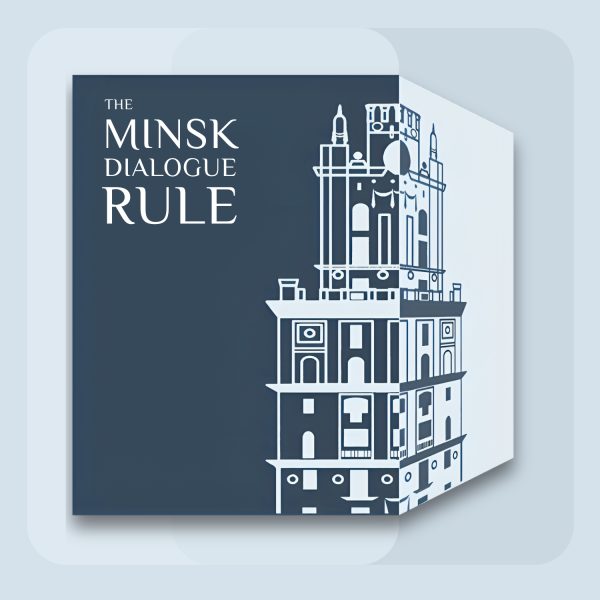
The Minsk Dialogue Rule
- Folgen
- 8
- Erscheint
- alle zwei Wochen
- Letzte Folge
- 31. Okt. 2026
Über den Podcast
The Minsk Dialogue Rule is a podcast that brings together diverse perspectives on international security across the Euro-Atlantic and Eurasian space. It is based on a simple principle: two people who already agree with each other should not enter the same discussion room. Otherwise, another echo chamber is created.
This podcast is brought to you by the Minsk Dialogue Council on International Relations. For more podcasts and research on international security and regional affairs, visit www.minskdialogue.by.
Folgen 8
Yerevan’s Balancing Act: Johnny Melikyan
In this episode, Alisiya Ivanova is joined by Johnny Melikyan, Senior Research Fellow at the Orbeli Center in Yerevan. They discuss the role experts play in shaping Armenia’s foreign policy, why Yerevan is …
Shownotes
In this episode, Alisiya Ivanova is joined by Johnny Melikyan, Senior Research Fellow at the Orbeli Center in Yerevan. They discuss the role experts play in shaping Armenia’s foreign policy, why Yerevan is spreading its bets across many partners, why peace with Azerbaijan remains unfinished, and whether small states will still have room to manoeuvre between great powers.
(00:00) Introduction
(01:20) How working at a think tank makes Johnny a “half-diplomat”
(11:12) The end of Russia’s monopoly in the South Caucasus
(18:13) How is Armenia diversifying its arms supplies?
(19:49) Yerevan’s choices on the Eurasian Economic Union and the CSTO
(23:50) Railways, TRIPP and a possible bigger deal with Moscow
(29:42) Why isn’t Baku ready for a functional peace?
(32:32) Georgia and “de facto” regional cooperation
(40:08) Will great powers let small states keep up their balancing act?
(44:30) Conclusion
Armenia Between Two Security Myths: Alexander Iskandaryan
In this episode, Alisiya Ivanova is joined by Alexander Iskandaryan, Director of the Caucasus Institute in Yerevan, Armenia. They talk about how the end of Russia's security monopoly reshaped the South …
Shownotes
In this episode, Alisiya Ivanova is joined by Alexander Iskandaryan, Director of the Caucasus Institute in Yerevan, Armenia. They talk about how the end of Russia's security monopoly reshaped the South Caucasus, why Armenia is moving from one myth of security to another, the state of "no war, no peace" with Azerbaijan after the Washington deal, why Yerevan now sees "two Bakus", and what it takes for a small state to continue a balancing act in a world that has not yet agreed its new rules.
(00:00) Introduction
(01:16) Why Caucasus research had to move into the Caucasus itself
(05:36) Working across a divided region and funding independent research
(09:33) Three shocks that ended Russia's security monopoly in the South Caucasus
(18:06) "Complementarity" and security myths: what shapes Armenia's threat perceptions?
(25:26) Armenia's three main problems in the South Caucasus
(29:10) Why a treaty with Baku can't bring real peace
(39:12) Can outside players still shape the region?
(43:07) Türkiye: hard realities and diplomatic hopes
(50:26) If not Russia, who is Armenia's security guarantor?
(56:24) Why does Yerevan blame Moscow but keep the Russian military base?
(01:00:00) Why Armenia won't be another Ukraine, and the limits of turning to the EU
(01:07:48) A world without its Versailles: can small states keep up a balancing act?
(01:11:58) Conclusion
Türkiye and the End of Hegemons: Ömer Özkızılcık
In this episode, Alisiya Ivanova is joined by Ömer Özkızılcık, Nonresident Senior Fellow at the Atlantic Council's Syria Project. They talk about the rise of Turkish power in the Middle East, the roots of the …
Shownotes
In this episode, Alisiya Ivanova is joined by Ömer Özkızılcık, Nonresident Senior Fellow at the Atlantic Council's Syria Project. They talk about the rise of Turkish power in the Middle East, the roots of the rivalry with Israel, Ankara’s policy towards post-Assad Syria, Türkiye's balancing act between NATO and Russia, and what a more multipolar order means for regional security.(00:00) Introduction
(01:15) Ömer's path to becoming an analyst
(02:23) What challenges and opportunities does the current security system present for Türkiye?
(06:22) Have Türkiye's top perceived threats changed in recent years?
(08:50) The roots of Türkiye's rivalry with Israel
(13:15) Is there a path forward with Israel?
(17:07) How do Türkiye's neighbours perceive its growing defence budget?
(21:50) The promise of the Mecca Pact and its role for Syria
(27:13) The US role in the Middle East after Trump
(30:38) How does Ankara see its position in NATO?
(31:18) How would Ankara approach a NATO–Russia war?
(35:42) A future security order shaped by middle powers
(39:54) Conclusion
Türkiye Shaping a Multipolar World: Yusuf Erim
In this episode, Alisiya Ivanova is joined by Yusuf Erim, Editor-at-Large and Türkiye analyst at TRT World. They talk about Ankara’s balanced foreign policy, managing threats from Israel and Iran, Türkiye’s …
Shownotes
In this episode, Alisiya Ivanova is joined by Yusuf Erim, Editor-at-Large and Türkiye analyst at TRT World. They talk about Ankara’s balanced foreign policy, managing threats from Israel and Iran, Türkiye’s role in NATO, how to approach Russia, and the projected stability of a multipolar world.(00:00) Introduction
(01:14) Yusuf’s career path and experience covering Belarusian military exercises in 2022
(03:54) Türkiye’s balanced approach to foreign policy
(11:37) What the collapse of the neoliberal order taught Türkiye
(19:22) Can the Mecca Pact ensure collective defence in the region?
(28:18) A post-American Middle East and Ankara’s nuclear deterrence
(39:03) Israel: the stand-off over Syria, reviving confidence-building measures, and the "elections triad"
(45:11) Why NATO can’t afford to alienate Türkiye
(55:51) Iran, Greece, Somalia: a wider tour of Türkiye’s threat map
(01:04:59) Can a multipolar world bring stability, and who will be the winner in it?
(01:16:05) Conclusion
Budapest and the Least-Bad Option: Dr. Attila Demkó
In this episode, Alisiya Ivanova is joined by Dr. Attila Demkó, Head of the Strategic Foresight Programme at the John Lukács Institute in Budapest. They talk about Budapest's view on current regional …
Shownotes
In this episode, Alisiya Ivanova is joined by Dr. Attila Demkó, Head of the Strategic Foresight Programme at the John Lukács Institute in Budapest. They talk about Budapest's view on current regional instability, why Russia isn't the emotional adversary in Budapest, how the minority dispute with Ukraine might be resolved, and stopping the crisis instead of looking for a perfect solution.(00:00) Introduction
(01:18) Attila’s work in academia and the Ministry of Defence, and writing fiction
(03:59) Did all those years at the Ministry make him hawkish?
(06:28) Did the post-Cold War order fail Hungary?
(11:46) What are Hungary's top threats today?
(16:10) Has Hungary now named Russia a threat?
(23:50) What is the “Ukraine threat,” and does the minority deal settle it?
(30:25) Energy security: does Hungary depend on Russia too much?
(35:10) A realistic regional order — and should a ceasefire come first?
(40:07) Conclusion
Budapest in the Surrounding Fires: Dr. Sándor Seremet
In this episode, hosts Alisiya Ivanova and Yauheni Preiherman are joined by Dr. Sándor Seremet of the Hungarian Institute of International Affairs. They talk about how Budapest views threats from Moscow and …
Shownotes
In this episode, hosts Alisiya Ivanova and Yauheni Preiherman are joined by Dr. Sándor Seremet of the Hungarian Institute of International Affairs. They talk about how Budapest views threats from Moscow and Kyiv, the rights of the Hungarian minorities abroad, migration and the Balkans, and Central Europe's priorities in international security.(00:00) Introduction
(01:16) Sándor's work at the HIIA, and why he leans realist
(02:58) Are most Hungarian analysts realists?
(04:07) Did the post-Cold War order fail Hungary?
(08:20) Why doesn't Budapest rank Russia as threat number one?
(12:30) Will Péter Magyar's government change its approach to Moscow?
(16:40) What exactly is the Ukraine threat for Hungary?
(21:49) Will the recently softened rhetoric towards Ukraine yield results?
(27:16) Do the Balkans still register as a threat for Budapest?
(31:19) How did Budapest and Serbia move past the migration crisis?
(34:50) What kind of security order could benefit Hungary?
(40:18) What is the Hungarian debate on regional security?
(42:14) Conclusion and next guest announcement
A Case for Dialogue: Thomas Greminger
In our opening episode, hosts Alisiya Ivanova and Yauheni Preiherman are joined by Ambassador Thomas Greminger, Executive Director of the Geneva Centre for Security Policy and former Secretary General of the …
Shownotes
In our opening episode, hosts Alisiya Ivanova and Yauheni Preiherman are joined by Ambassador Thomas Greminger, Executive Director of the Geneva Centre for Security Policy and former Secretary General of the OSCE.
They talk about whether there is still a place for cooperative security, why deterrence needs to be paired with dialogue, and why giving up is “not an option.”
(00:00) Welcome to the show.
(04:33) Is Ambassador Greminger an optimist or a pessimist?
(09:15) Lessons from an initiative that tried to prevent the war.
(13:37) Is there still a place for a Vancouver-to-Vladivostok vision?
(18:14) Why deterrence without dialogue isn’t enough.
(23:29) How small “islands of cooperation” can rebuild trust.
(28:05) Can the OSCE still play a useful role?
(33:20) Why Ambassador Greminger refuses to give up on dialogue.
(37:11) What’s missing from the way we talk about security.
(40:12) Closing remarks.
Welcome to The Minsk Dialogue Rule
A short welcome episode where Alisiya Ivanova and Yauheni Preiherman of the Minsk Dialogue Council on International Relations introduce the podcast, explain the idea behind its name, and talk about why echo …
Shownotes
A short welcome episode where Alisiya Ivanova and Yauheni Preiherman of the Minsk Dialogue Council on International Relations introduce the podcast, explain the idea behind its name, and talk about why echo chambers are among the core causes of today’s wars and conflicts. They also address the Eurasian-versus-European security debate, explain why perceptions matter, and set out how the series will look for realistic ways forward in regional security.
Ähnliche Podcasts
Mehr Nachrichten-Podcasts



Ist das dein Podcast?
Bestätige es mit einem Eintrag in deinem Feed: Du bekommst hier einen Code, trägst ihn als podcast:txt in den Kanal deines Feeds ein, und wir prüfen ihn. Danach steht dein Podcast als „verifiziert“ bei SoundNode.