

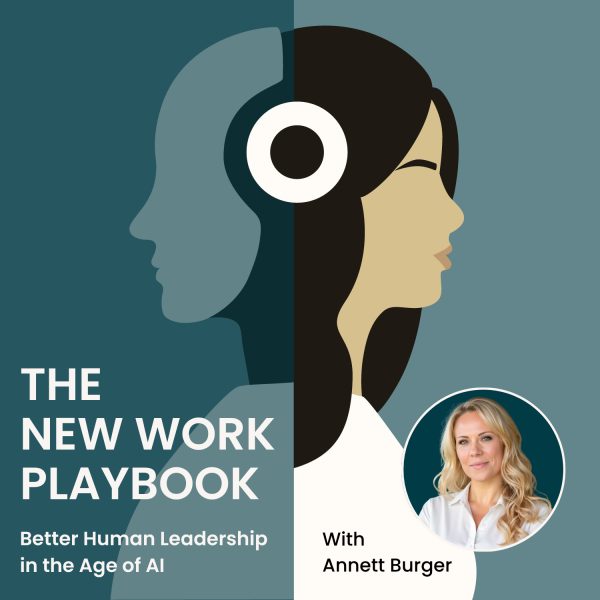
THE NEW WORK PLAYBOOK
- Folgen
- 28
- Erscheint
- alle zwei Wochen
- Letzte Folge
- 24. Nov. 2026
Über den Podcast
Most of what we consider to be leadership is about managing resources, not leading humans. AI is about to make that impossible to ignore. The leadership practices that would actually make work better for us are not new. They've just never been trained and practised well enough. Instead we focused on efficiency, control and output. That's management. Now that AI can handle all of that much better, what's left for us? I think this is the defining question of our time. Instead of asking if AI will replace leaders, we should ask whether we'll finally build the kind of leadership that deserves to stay. The New Work Playbook is a podcast for anyone who believes that work gets better because people matter. Main episodes explore why something matters for leadership in the age of AI. Reflection episodes give you actual practices to improve your leadership. Interviews and conversations with people who already shape the future of work will come in to inspire and shift perspectives. Hosted by Annett Burger, a practitioner with over twenty years of experience in executive search, leadership development, and consulting.
Folgen 28
Becoming Risk Savvy
The Reflection Episode on Handling Ambiguity & Uncertainty In this episode: The Monty Hall problem, and what the game shows about the difference between risk and uncertainty. Practice one, looking for absolute …
Shownotes
The Reflection Episode on Handling Ambiguity & UncertaintyIn this episode:
- The Monty Hall problem, and what the game shows about the difference between risk and uncertainty.
- Practice one, looking for absolute numbers: natural frequencies behind percentages, relative versus absolute risk
- Practice two, the confidence check: two questions and where to use them, plus a confidence quiz to try and why overconfidence keeps being rewarded.
- Practice three, learning by teaching: sharing what we've learned, deepening understanding, thinking AI output through
- Practice four, when to take earned gut feelings seriously: the conditions for trusting it, and when less information works better
Connect with me:
LinkedIn Instagram Website
Sources: Fiorella, L. and Mayer, R. E. The relative benefits of learning by teaching and teaching expectancy. Contemporary Educational Psychology, 2013, 38(4). Gigerenzer, G. Risk Savvy: how to make good decisions. Viking, 2014. Gigerenzer, G. and Hoffrage, U. How to improve Bayesian reasoning without instruction: frequency formats. Psychological Review, 1995, 102(4). Kahneman, D. and Klein, G. Conditions for intuitive expertise: a failure to disagree. American Psychologist, 2009, 64(6). Kennedy, J. A., Anderson, C. and Moore, D. A. When overconfidence is revealed to others: testing the status-enhancement theory of overconfidence. Organizational Behavior and Human Decision Processes, 2013, 122(2). Klein, G. Sources of power: how people make decisions. MIT Press, 1998. Shariatmadari, D. Daniel Kahneman: "What would I eliminate if I had a magic wand? Overconfidence". The Guardian, 18 July 2015. Tetlock, P. E. Expert political judgment: how good is it? How can we know? Princeton University Press, 2005.
Episodes referenced: The Illusion of Certainty & Control
The Illusion of Certainty and Control
Handling Ambiguity & Uncertainty Matters More Than Ever In this episode: What a thirty percent chance of rain actually means, and how a missing reference makes information ambiguous. How big and small …
Shownotes
Handling Ambiguity & Uncertainty Matters More Than EverIn this episode:
- What a thirty percent chance of rain actually means, and how a missing reference makes information ambiguous.
- How big and small percentages can mislead us in positive and negative ways.
- The difference between risk, uncertainty and ambiguity, and why it shapes how we act.
- The turkey illusion, and why past data can create false certainty.
- Why AI adoption without shared meaning amplifies anxiety for the people we lead.
- The illusion of control, and how feeling powerful makes it stronger.
- Confident humility, risk literacy and a positive failure culture as what it takes to lead when nobody can know what comes next.
Resources mentioned: Gerd Gigerenzer et al., “A 30% chance of rain tomorrow”: How does the public understand probabilistic weather forecasts? (2005) Andrew Mauboussin and Michael J. Mauboussin, If you say something is “likely,” how likely do people think it is? (2018) Gerd Gigerenzer, Risk Savvy: How to Make Good Decisions (2014) Gerd Gigerenzer, Walter Krämer and Thomas K. Bauer, “Erfolgreiche” Gesichtserkennung mit Hunderttausenden Fehlalarmen, Unstatistik des Monats (2018) Gerd Gigerenzer et al., Helping doctors and patients make sense of health statistics (2007) P(doom), Wikipedia Frank H. Knight, Risk, Uncertainty and Profit (1921) Ellen J. Langer, The illusion of control (1975) Suzanne C. Thompson, Illusions of control: How we overestimate our personal influence (1999) Nathanael J. Fast et al., Illusory control: A generative force behind power’s far-reaching effects (2009) Nathanael J. Fast et al., Power and overconfident decision-making (2012) Kelly E. See et al., The detrimental effects of power on confidence, advice taking, and accuracy (2011) James R. Meindl, Sanford B. Ehrlich and Janet M. Dukerich, The romance of leadership (1985) Adam Grant, Think Again: The Power of Knowing What You Don’t Know (2021) Florian M. Artinger, Sabrina Artinger and Gerd Gigerenzer, C. Y. A.: Frequency and causes of defensive decisions in public administration (2019) Stephen R. Covey, The 7 Habits of Highly Effective People (1989)
Connect with me: LinkedIn
Getting Out of the Kitchen
The Reflection Episode on Decision Making & Accountability In this episode: Why useful advice still lands as being judged when nobody asked for it, and what it says to someone who felt capable until you spoke …
Shownotes
The Reflection Episode on Decision Making & AccountabilityIn this episode:
- Why useful advice still lands as being judged when nobody asked for it, and what it says to someone who felt capable until you spoke.
- Why outcome bias lowers our ability to draw the right conclusion about the decisions we made.
- Why standing over people's work and demanding accountability produces people who manage how their work looks instead of people who own their work.
- Three practices that help you build an environment where people feel capable, decision making moves closer to the work and people take accountability.
Connect with me: LinkedIn
Sources: Bandura, A. Self-efficacy: toward a unifying theory of behavioral change. Psychological Review, 1977 Baron, J., and Hershey, J. C. Outcome bias in decision evaluation. Journal of Personality and Social Psychology, 1988 Jim Harter and Corey Tatel, "Accountability Is Leadership's Greatest Weakness," Gallup, March 2026 Okposo, K. Accountability must be chosen, not mandated. Harvard Business Review, 29 April 2026
Episodes referenced: Would They Tell You? Psychological Safety The Confidence Check The Confidence Trap
The Blame Machine
Why We Blame People for Decisions They Never Made In this episode: Why we judge decisions by their results, and how outcome bias and hindsight bias shape both our self-perception and how organisations review …
Shownotes
Why We Blame People for Decisions They Never MadeIn this episode:
- Why we judge decisions by their results, and how outcome bias and hindsight bias shape both our self-perception and how organisations review what happened.
- One company, one system, two scenarios: what gets examined when it works, and what gets examined when it doesn't.
- The difference between taking accountability and being held accountable, and why most management advice focuses on the harder-to-justify one.
- The four conditions in organisations and the four human patterns that keep the blame machine running.
- What AI amplifies, why it's the perfect place to put blame, and why leadership has to change the conditions so it doesn't become the norm.
Connect with me: LinkedIn
Sources: Baron, J., & Hershey, J. C. Outcome bias in decision evaluation. Journal of Personality and Social Psychology, 1988, 54(4). Harter, J., & Tatel, C. Accountability is leadership’s greatest weakness. Gallup, 19 March 2026. Edmondson, A. C. Strategies for learning from failure. Harvard Business Review, 2011, 89(4). Orgvue. 55% of businesses admit wrong decisions in making employees redundant when bringing AI into the workforce. Orgvue, 29 April 2025. CNBC. Employers who laid off workers citing AI are already starting to regret it. CNBC, 1 July 2026. Glean Work AI Institute. Work AI Index 2026. Glean, 10 June 2026.
Once, Twice, Culture
The Reflection Episode on Building a Good Team Culture In this episode: Why every team already has norms, and what changes when you define them on purpose. How to run a workshop on defining team norms. What …
Shownotes
The Reflection Episode on Building a Good Team CultureIn this episode:
- Why every team already has norms, and what changes when you define them on purpose.
- How to run a workshop on defining team norms.
- What turns a statement like "we respect each other" into a norm people can see, keep and notice being broken.
- The six leadership actions Edgar Schein identified as carrying the most weight, and what building consistency around these actions means for a leader.
Connect with me: LinkedIn
Sources: Schein, E. H. Organizational Culture and Leadership. Jossey-Bass, 1985. Schein, E. H., and Schein, P. Organizational Culture and Leadership. 5th edition, Wiley, 2017.
Next episode: Decision-making and accountability, and why both have become even more challenging now that AI is part of the work.
The Culture Myth
Culture is Leadership Work In this episode: "Culture eats strategy for breakfast" - a claim Peter Drucker never made and why it's not about the quality of a company culture. Why the stated company values on the …
Shownotes
Culture is Leadership WorkIn this episode:
- "Culture eats strategy for breakfast" - a claim Peter Drucker never made and why it's not about the quality of a company culture.
- Why the stated company values on the wall so rarely match the reality people work in.
- Why culture deserves the same attention as strategy from the start.
- The three layers of Edgar Schein's model and why most of what runs an organisation sits out of sight, even for the people inside it.
- The two forces shaping your team culture: the beliefs you carry about people, and what the group learns when they work together inside the environment you built.
- Why AI adoption is a culture transformation and what lowering your team's fear of learning actually takes.
Connect with me: LinkedIn
Sources: Ouchi, W. G. Theory Z: How American Business Can Meet the Japanese Challenge. Addison-Wesley, 1981. Deal, T. E., and Kennedy, A. A. Corporate Cultures: The Rites and Rituals of Corporate Life. Addison-Wesley, 1982. Peters, T. J., and Waterman, R. H. In Search of Excellence: Lessons from America's Best-Run Companies. Harper and Row, 1982. Schein, E. H. Organizational Culture and Leadership. Jossey-Bass, 1985. Deming, W. E. Out of the Crisis. MIT Press, 1986. Kerr, S. On the Folly of Rewarding A, While Hoping for B. Academy of Management Journal, vol. 18, no. 4, 1975. Sull, D., and Sull, C. Culture 500. MIT Sloan Management Review, 2019.
Episodes referenced: What on Earth is Purpose? The Beliefs Running Your Leadership
Purpose and Direction
The Reflection Episode on Establishing Purpose and Giving Direction In this episode: Why hundreds of thousands of people keep publishing podcasts when every rational measure says they shouldn't, and what that …
Shownotes
The Reflection Episode on Establishing Purpose and Giving DirectionIn this episode:
- Why hundreds of thousands of people keep publishing podcasts when every rational measure says they shouldn't, and what that says about the effort no target has ever bought.
- Practice one, the line of sight: three questions answered on one job, the conversation where you compare your answers with the person doing the work, and bringing back what the people served actually said.
- The difference between sense giving, which is a leader's work, and sense making, which stays with the person doing the job.
- The five sources people draw meaning from, and why knowing which one matters to the person in front of you changes how you invest in them.
- Practice two, five moves for giving direction: agreeing what good looks like, naming what's fixed and what's flexible, being available without hovering, matching support to the person, and protecting your team's focus.
Connect with me: LinkedIn
Sources: Boswell, W. R. Aligning employees with the organization's strategic objectives: out of "line of sight", out of mind. International Journal of Human Resource Management, 2006, 17(9). Grant, A. M., Campbell, E. M., Chen, G., Cottone, K., Lapedis, D., and Lee, K. Impact and the art of motivation maintenance: The effects of contact with beneficiaries on persistence behavior. Organizational Behavior and Human Decision Processes, 2007, 103(1). Gioia, D. A., and Chittipeddi, K. Sensemaking and sensegiving in strategic change initiation. Strategic Management Journal, 1991, 12(6). Dhingra, N., Samo, A., Schaninger, B., and Schrimper, M. Help your employees find purpose, or watch them leave. McKinsey & Company, 5 April 2021.
What on Earth is Purpose?
Good Management Frameworks Don’t Fix Bad Leadership In this episode: Why purpose has become a buzzword with no clear definition, for individuals or for companies. How Drucker's Management by Objectives was also …
Shownotes
Good Management Frameworks Don’t Fix Bad LeadershipIn this episode:
- Why purpose has become a buzzword with no clear definition, for individuals or for companies.
- How Drucker's Management by Objectives was also built on purpose and self-control, and why it got stripped down to numbers and reporting.
- Why Deming said most problems come from the system management builds, not the people doing the work.
- The gap between how much purpose the top leaders feel and how little reaches the front line.
- Sensegiving and sensemaking: the leader translates the why, the individual builds their own meaning, and why no leader can do both.
- Why direction is the heart of management, but gets often reduced to driving and measuring performance, when its real job is guidance.
- Why purpose and direction are one practice, drawing on Self-Determination Theory about what drives motivation at work.
- Why AI is a stress test that reveals what an organisation already believed about its people.
Sources: Hu, J., and Hirsh, J. B. Accepting Lower Salaries for Meaningful Work. Frontiers in Psychology, 14 September 2017. Dhingra, N., Samo, A., Schaninger, B., and Schrimper, M. Help Your Employees Find Purpose, or Watch Them Leave. McKinsey & Company, 5 April 2021. Grant, A. M. The Significance of Task Significance: Job Performance Effects, Relational Mechanisms, and Boundary Conditions. Journal of Applied Psychology, 2008. Deci, E. L., and Ryan, R. M. Self-Determination Theory: A Macrotheory of Human Motivation, Development, and Health. Canadian Psychology, 2008. Drucker, P. F. The Practice of Management. Harper & Row, 1954. Deming, W. E. Out of the Crisis. MIT Press, 1986.
Episodes referenced: The Lazy Human Psychological Safety The End of Why
Listen to Understand
The Reflection Episode on Deep Listening In this episode: A difficult conversation played twice, once with a manager who performs all the right listening moves and misses what matters, and once with a manager …
Shownotes
The Reflection Episode on Deep ListeningIn this episode:
- A difficult conversation played twice, once with a manager who performs all the right listening moves and misses what matters, and once with a manager who listens to understand.
- Why the difference between them comes down to intention, not technique.
- Practice one, the intention check: catching the competing goals that quietly run a conversation before it starts.
- Practice two, four moves for asking better questions: open instead of leading, what instead of why, the three-second pause, and the follow-up.
- How both practices build deeper listening, and stronger connection, at work and beyond it.
Connect with me: LinkedIn
Sources: Brooks, A. W., and John, L. K. The Surprising Power of Questions. Harvard Business Review, May–June 2018. Schein, E. H. Humble Inquiry: The Gentle Art of Asking Instead of Telling. Berrett-Koehler, 2013. Eurich, T. What Self-Awareness Really Is (and How to Cultivate It). Harvard Business Review, 4 January 2018. Covey, S. R. The 7 Habits of Highly Effective People. Free Press, 1989.
Episodes referenced: The Talking Reflex
The Talking Reflex
Listen to Understand, Not to Reply In this episode: The gap between how well managers think they listen and how heard their people actually feel. The three forces behind it: the limits of self-awareness, the …
Shownotes
Listen to Understand, Not to ReplyIn this episode:
- The gap between how well managers think they listen and how heard their people actually feel.
- The three forces behind it: the limits of self-awareness, the lack of honest upward feedback, and a culture that trains leaders to present rather than receive.
- Why active listening so often becomes a performance without the intention to understand.
- What deep listening actually does, drawing on Itzchakov and Kluger's research on high-quality listening.
- The talking reflex and its cost, and why the counter-move is to ask great questions.
- How power, organisational culture, and now AI undermine our capacity and willingness to listen.
- Why listening to understand is becoming one of the most valuable qualities a leader can bring.
Connect with me: LinkedIn
Sources: Itzchakov, G., and Kluger, A. N. The Power of Listening in Helping People Change. Harvard Business Review, 17 May 2018. Eurich, T. What Self-Awareness Really Is (and How to Cultivate It). Harvard Business Review, 4 January 2018. Zenger, J., and Folkman, J. What Great Listeners Actually Do. Harvard Business Review, 14 July 2016. Covey, S. R. The 7 Habits of Highly Effective People. Free Press, 1989. Zao-Sanders, M. How People Are Really Using AI in 2026. Harvard Business Review, 1 June 2026.
Episodes referenced: Authenticity Theatre The Power Paradox
Would They Tell You?
The Reflection Episode on Psychological Safety In this episode: Why your reaction to questions, concerns, mistakes and problems matters. Recovery moves for when your reaction, or someone else's on the team …
Shownotes
The Reflection Episode on Psychological SafetyIn this episode:
- Why your reaction to questions, concerns, mistakes and problems matters.
- Recovery moves for when your reaction, or someone else's on the team, lands badly.
- How to run sessions that turn AI mistakes into collective learning.
- Why rewarding the fastest AI adopters quietly trains people to stop questioning the output.
- The one principle underneath it all, and the two questions to ask yourself about your own organisation.
Listen to the main episode first: Psychological Safety - The Cost of Our Silence. Next episode: The practice we all need to train more - Listening with the intention to really understand.
Connect with me: LinkedIn
Psychological Safety
The Cost of Our Silence In this episode: The Romance of Leadership bias and why coverage of bad bosses misses the responsibility of those who follow them. Sarah Wynn-Williams' Careless People and Karen Hao's …
Shownotes
The Cost of Our SilenceIn this episode:
- The Romance of Leadership bias and why coverage of bad bosses misses the responsibility of those who follow them.
- Sarah Wynn-Williams' Careless People and Karen Hao's Empire of AI — what they reveal about leadership at the edge of what humans can navigate well.
- The Nokia case study from INSEAD: how a culture of fear, driven by the top and kept alive by the people underneath, produced calibrated silence as survival behaviour and destroyed the company.
- Google's Project Aristotle and the five dynamics of team effectiveness.
- Amy Edmondson's foundational research on psychological safety, and what her recent work on AI adoption surfaces about trust ambiguity and workslop.
- The 3M contrast: what learning-mode AI adoption looks like in practice, and why modelling fallibility builds psychological safety.
- Why how we handle AI adoption is no longer a management decision but a leadership decision.
Connect with me: LinkedIn
Sources: Vuori, T. O., and Huy, Q. N. Distributed Attention and Shared Emotions in the Innovation Process: How Nokia Lost the Smartphone Battle. Administrative Science Quarterly, Vol. 61, Issue 1, 2016. Edmondson, A. C. Psychological Safety and Learning Behavior in Work Teams. Administrative Science Quarterly, Vol. 44, Issue 2, 1999. Seth, J., and Edmondson, A. C. How to Foster Psychological Safety When AI Erodes Trust on Your Team. Harvard Business Review, 4 February 2026. Google re:Work. Guide: Understand Team Effectiveness. Duhigg, C. What Google Learned From Its Quest to Build the Perfect Team. The New York Times Magazine, 25 February 2016. Wynn-Williams, S. Careless People: A Cautionary Tale of Power, Greed, and Lost Idealism. Flatiron Books, 2025. Hao, K. Empire of AI: Dreams and Nightmares in Sam Altman's OpenAI. Penguin Press, 2025. Farrow, R., and Marantz, A. Sam Altman May Control Our Future — Can He Be Trusted? The New Yorker, April 2026. ManpowerGroup. 2026 Global Talent Barometer: AI Use Accelerates as Worker Confidence Falls and Job Hugging Takes Hold. Eatough, E., Ferrazzi, K., and Smith, W. : Why AI Adoption Stalls, According to Industry Data. Harvard Business Review, 17 February 2026. Writer. 2026 Enterprise AI Survey.
Episodes referenced: The Confidence Trap The End of Why Authenticity Theatre
Authenticity Theatre
The Closing Episode to Season 1 In this episode: – Why "be more authentic" became one of the most repeated and least useful pieces of advice in leadership. – How the field reached for an already-individualised …
Shownotes
The Closing Episode to Season 1In this episode: – Why "be more authentic" became one of the most repeated and least useful pieces of advice in leadership. – How the field reached for an already-individualised idea of authenticity and ended up with a focus on self-awareness. – The difference between self-referential and relational authenticity. – Why the constraint most leaders are operating under is not an individual flaw but an organisational failure. – Robert Sutton's research on the cost of bad bosses, and why those costs almost never get measured. – A walk-back through the six foundational topics of Season 1 and what each one helps us resist.
Sources: Robert Sutton The No Asshole Rule: Building a Civilized Workplace and Surviving One That Isn't (2007) Robert Sutton Good Boss, Bad Boss: How to Be the Best… and Learn from the Worst (2010) Bill George Authentic Leadership: Rediscovering the Secrets to Creating Lasting Value (2003) Jon Billsberry "Whither authentic leadership? From essentialist essence to constructionist reconstruction" in Management Review Quarterly, December 2025
Episodes referenced: We Are Losing Respect The Power Paradox The Confidence Trap The End of Why Trust: The Broken Spine Daring to Care
Practicing Care
The Reflection Episode on Caring Leadership In this episode: How care propagates through three degrees of social connection. The first practice: Small acts of care in daily life that you can apply immediately …
Shownotes
The Reflection Episode on Caring LeadershipIn this episode:
- How care propagates through three degrees of social connection.
- The first practice: Small acts of care in daily life that you can apply immediately.
- The second practice: A short reflection on four trust dimensions to consider before a difficult conversation.
- Practical countermeasures you can use when one of the trust dimensions has been weak in the past.
- The third practice: Three checks that help you focus and act on what someone needs.
- Why recognising the limits of your responsibility is itself a caring move.
Next episode: Season-closing with Authenticity and the 6 key leadership practices.
Episodes mentioned: Daring to Care Trust: The Broken Spine
Connect with me: LinkedIn
Daring to Care
We Got Lost in Translation by Focusing too Much on Empathy In this episode: The difference between empathy and care. Why most of us have been missing one half of the picture. Daniel Goleman's update on empathy …
Shownotes
We Got Lost in Translation by Focusing too Much on EmpathyIn this episode:
- The difference between empathy and care.
- Why most of us have been missing one half of the picture.
- Daniel Goleman's update on empathy and the third capability most leadership training still doesn't teach.
- Tania Singer's neuroscience on why empathy drains us and why care doesn't.
- Dark empathy and why empathy training makes some leaders more manipulative.
- Nel Noddings on motivational displacement and what care actually requires.
Practices follow in the reflection episode on Thursday.
Resources mentioned: Daniel Goleman, Emotional Intelligence (1995) and his update with Paul Ekman on the three kinds of empathy. Tania Singer's neuroscience research on empathy and compassion. Robert Greenleaf, The Servant as Leader (1970). Nel Noddings, Caring: A Feminine Approach to Ethics and Moral Education (1984). Kim Scott, Radical Candor (2017). Nadja Heym et al., The Dark Empath: A Personality Profile (2021), Nottingham Trent University.
Connect with me: LinkedIn
Rebuilding Trust in Yourself and with Others
The Reflection Episode on Bringing Trust Back in the Age of AI In this episode: Why most of us name honesty as a value but do not really live it. A personal story about kindness I received from a stranger and …
Shownotes
The Reflection Episode on Bringing Trust Back in the Age of AIIn this episode:
- Why most of us name honesty as a value but do not really live it.
- A personal story about kindness I received from a stranger and what it changed in how I move through the world.
- Why most of us trade honesty for comfort in small daily moments, and why breaks trust.
- Two practices for rebuilding self-trust:
- naming what you stand for
- choosing discomfort
- Two practices for building trust with others:
- noticing the commitments you keep
- asking before assuming
Referenced in this episode: The Broken Spine Sabini, Siepmann, and Stein-Seroussi on anticipated embarrassment, Personality and Individual Differences
Next episode: Daring to Care
Connect with me: LinkedIn
Trust - The Broken Spine
Bringing Trust Back in the Age of AI In this episode: Why trust is a volatile value Why even leaders who founded their company on clear principles and values are subject to the same pressures every leader faces …
Shownotes
Bringing Trust Back in the Age of AIIn this episode:
- Why trust is a volatile value
- Why even leaders who founded their company on clear principles and values are subject to the same pressures every leader faces
- Why three of the most common trust-breaking leadership behaviours are not communication failures
- The distinction between self-trust and self-confidence
Can we bring trust back, especially in the age of AI? The episode answers that question. But the answer requires more from us than from the leaders we want to follow.
Referenced in this episode:
The Power Paradox The Confidence Trap Careless Leaders blog article](https://thenewworkplaybook.com/careless-leaders/)) Dario Amodei on 60 Minutes (CBS, 2024) Machines of Loving Grace by Dario Amodei ](https://www.darioamodei.com/essay/machines-of-loving-grace)) Harvard Business Review](https://hbr.org/2025/12/most-employees-dont-trust-their-leaders-heres-what-to-do-about-it))
Next: The reflection episode on Friday gives the practices for keeping self-trust and building trust with others.
Connect with me: LinkedIn
Reclaiming Our Curiosity
The Reflection Episode on Curiosity in the Age of AI In this episode: Why the goldfish attention span claim is fabricated, and where the number actually came from. The same shape behind the ten-percent brain …
Shownotes
The Reflection Episode on Curiosity in the Age of AIIn this episode:
- Why the goldfish attention span claim is fabricated, and where the number actually came from.
- The same shape behind the ten-percent brain myth, and what these stories have in common.
- Why most of us track our successes but never the times we were wrong.
- The Curiosity Journal: a holding place for curiosity that arrives at inconvenient moments.
- "Keep asking": how the surface answer becomes the starting point, not the destination.
- How large language models actually work, and why the shape of your prompt determines what comes back.
- Two practices for sparking curiosity in the people you lead: modelling the not-knowing, and protecting the space.
Mentioned in this episode: Episode 1: The Lazy Human. Episode 4: The Confidence Trap. Episode 5: The End of Why (the main episode this reflection follows).
Next episode: The Broken Spine.
Connect with me: LinkedIn
The End of Why
We Killed Curiosity Long Before AI Arrived In this episode: What curiosity actually is, and why treating it as a personality trait costs organisations more than they realise. A formative experience from a 1995 …
Shownotes
We Killed Curiosity Long Before AI ArrivedIn this episode:
- What curiosity actually is, and why treating it as a personality trait costs organisations more than they realise.
- A formative experience from a 1995 computer science classroom, and what it taught me about how environments shape who stays and who leaves.
- Two CEOs who built people-first cultures during their companies' worst moments, and what their results show.
- The Deloitte research on AI investment that should stop every leader in their tracks.
- What recent research on nearly 2,000 working adults reveals about who is actually losing their thinking to AI.
- What the founding figures of modern AI are actually warning about, and why their voices keep getting absorbed into the fear narrative they're trying to counter.
- Why fear is never a good teacher, and what curiosity offers instead.
- What leaders can do to bring curiosity back into their teams before AI accelerates what was already lost.
Resources mentioned:
- Deloitte AI ROI research (October 2025)
- BCG AI Adoption research
- Research on AI use and confidence in own thinking (Technology, Mind, and Behavior, April 2026)
- Geoffrey Hinton and Yoshua Bengio on AI safety
- Delta Airlines under Ed Bastian's leadership
- LEGO under Jørgen Vig Knudstorp's leadership
Next reflection episode: Reclaiming Our Curiosity.
Connect with me: LinkedIn
The Confidence Check
The Reflection Episode on Practicing Confident Humility In this episode: A quick test to catch your System 1 thinking in real time. Why our success stories rarely tell the whole truth, and what hindsight bias …
Shownotes
The Reflection Episode on Practicing Confident HumilityIn this episode:
- A quick test to catch your System 1 thinking in real time.
- Why our success stories rarely tell the whole truth, and what hindsight bias hides.
- Two reflections to check your own confidence patterns.
- Two practices you can start using this week.
Free download: The Leader's Bias Cheat Sheet](https://thenewworkplaybook.com/explore/the-leaders-bias-cheat-sheet/))
Resources mentioned: Daniel Kahneman, Thinking, Fast and Slow (2011)
Connect with me: LinkedIn
The Confidence Trap
What Happens When We Stop Questioning Ourselves In this episode: Why we naturally associate confidence with competence, and how the attention economy amplifies this. My downhill mountain biking lesson in …
Shownotes
What Happens When We Stop Questioning OurselvesIn this episode:
- Why we naturally associate confidence with competence, and how the attention economy amplifies this.
- My downhill mountain biking lesson in overconfidence.
- The Dunning-Kruger effect, and why expertise can be the moment overconfidence catches us.
- Why leaders are often overconfident in their ability to evaluate other people.
- Why System 1 and System 2 thinking matters in high-stakes decisions like hiring.
- Confident humility and the scientist's mindset as countermeasures to overconfidence.
- Why experts driven by personal excellence should think twice before taking leadership roles.
Free download: The Leader's Bias Cheat Sheet](https://thenewworkplaybook.com/explore/the-leaders-bias-cheat-sheet/))
Resources mentioned: Daniel Kahneman, Thinking, Fast and Slow (2011) Adam Grant, Think Again: The Power of Knowing What You Don't Know (2021)
Connect with me: LinkedIn
The Pull of Power
The Reflection Episode on Handling Power with Care In this episode: Three areas where the pull of power is strongest: Your relationship with feedback, and how power isolates us from honest and critical voices …
Shownotes
The Reflection Episode on Handling Power with Care In this episode: Three areas where the pull of power is strongest: Your relationship with feedback, and how power isolates us from honest and critical voices. How you talk about people who are not in the room. How you handle advantages and favours. Three signs that political games have started reaching you: You rehearse conversations to tell people what they want to hear. …The Power Paradox
Why The Motivation For Power Matters More Than We Think In this episode: Why the motivation to seek power matters more than we think. Two contrasting drivers behind leadership: Power as the goal — advancing …
Shownotes
Why The Motivation For Power Matters More Than We Think In this episode: Why the motivation to seek power matters more than we think. Two contrasting drivers behind leadership: Power as the goal — advancing oneself. Purpose and responsibility — advancing something larger. Why we often don't see the difference in hiring. What the "power paradox" reveals about how power changes behaviour. How even well-intentioned leaders get pulled into unhealthy power dynamics. …Training Your Respect Muscles
The Reflection Episode on Grounded Respect In this episode: How to read your Respect Stacking post-its and find the patterns underneath them. Three foundational daily practices to train your respect muscles …
Shownotes
The Reflection Episode on Grounded Respect In this episode: How to read your Respect Stacking post-its and find the patterns underneath them. Three foundational daily practices to train your respect muscles: Using people's names. Giving full attention. Specific acknowledgement. Two countermeasures for when your triggers hit: The Pause and Flip. The Status Check. Why awareness is a continuous practice. If you tried Respect Stacking, I'd love to hear what you found. …We Are Losing Respect
The Foundational Leadership Capability We Rarely Train In this episode: Why respect isn't politeness, and what makes it collapse under pressure. The IKEA moment that made me rethink how I show up with people …
Shownotes
The Foundational Leadership Capability We Rarely TrainIn this episode:
- Why respect isn't politeness, and what makes it collapse under pressure.
- The IKEA moment that made me rethink how I show up with people.
- Performative versus grounded respect, and why our attention makes the difference.
- Respect Stacking: a three-day exercise to uncover your blind spots.
Resources mentioned:
- Dacher Keltner, The Power Paradox: How We Gain and Lose Influence (2016)
- Christine Porath, Mastering Civility: A Manifesto for the Workplace (2016)
Try Respect Stacking for three days before the reflection episode on Friday. Next episode: The Power Paradox.
Connect with me: LinkedIn
The Beliefs Running Your Leadership
The Reflection Episode: A Guided Audit of Your Leadership Beliefs In this episode: The three statements that uncover what you believe about your role as a leader. Where leadership beliefs come from, and which …
Shownotes
The Reflection Episode: A Guided Audit of Your Leadership Beliefs In this episode: The three statements that uncover what you believe about your role as a leader. Where leadership beliefs come from, and which experiences shaped yours. Why Self-Determination Theory matters: autonomy, competence, and relatedness as the conditions for sustained performance. The cost of solving for your team rather than developing them. How to rewrite a belief once you can see it clearly. …The Lazy Human
How Our Beliefs Shape Our Environment In this episode: Where our beliefs about work and motivation come from. The gap between what organisations expect from people and the environments they give them. Why …
Shownotes
How Our Beliefs Shape Our Environment In this episode: Where our beliefs about work and motivation come from. The gap between what organisations expect from people and the environments they give them. Why employee engagement keeps falling, and what role leadership plays. What happens when modern concepts get bolted onto outdated beliefs. How to start questioning assumptions that might be holding you and your organisation back. Resources mentioned: Douglas McGregor's Theory X and Theory Y. …THE NEW WORK PLAYBOOK
Where Work Gets Better Because People Matter In this episode: Why most organisations still operate on industrial-age beliefs about work. The difference between treating people as resources and seeing them as …
Shownotes
Where Work Gets Better Because People Matter In this episode: Why most organisations still operate on industrial-age beliefs about work. The difference between treating people as resources and seeing them as the reason a business exists. How AI is amplifying the urgency to rethink leadership. Frithjof Bergmann's New Work vision and why it has not stuck. Why "New Work" without "New Leadership" often becomes theatre. …
Ähnliche Podcasts
Mehr Bildung-Podcasts

Ist das dein Podcast?
Bestätige es mit einem Eintrag in deinem Feed: Du bekommst hier einen Code, trägst ihn als podcast:txt in den Kanal deines Feeds ein, und wir prüfen ihn. Danach steht dein Podcast als „verifiziert“ bei SoundNode.