

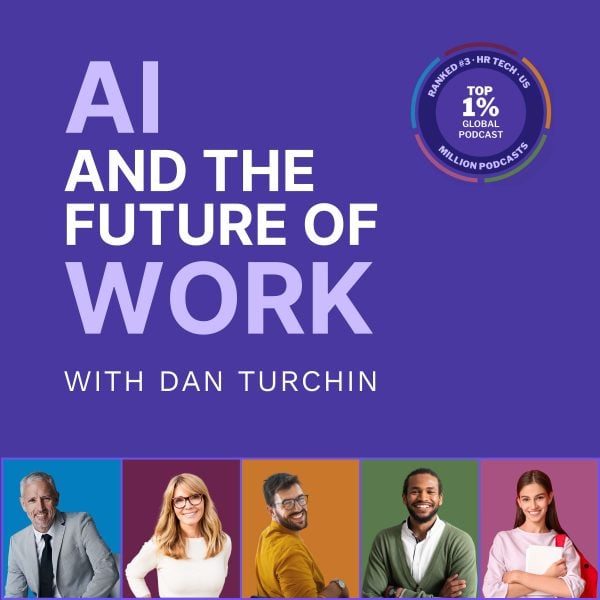
AI and the Future of Work: Artificial Intelligence in the Workplace, Business, Ethics, HR, and IT for AI Enthusiasts, Leaders and Academics
- Episódios
- 391
- Publicação
- várias vezes por semana
- Último episódio
- 23 nov 2026
Sobre o podcast
🏆 Ranked #3, Best Tech Podcasts — Million Podcasts (2026) | Top 1% global podcast. 450+ episodes. 10M+ downloads. Host Dan Turchin, PeopleReign CEO, explores how AI is changing the workplace. He interviews thought leaders and technologists from industry and academia who share their experiences and insights about artificial intelligence and what it means to be human in the era of AI-driven automation. Learn more about PeopleReign, the system of intelligence for IT and HR employee service: http://www.peoplereign.io.
Participantes
Episódios 391
414: Josh Bersin, HR Tech Authority: When AI Hype Meets Reality, Implementation Is the Real Opportunity
Send us Fan MailAI is not about becoming something new. It is about becoming a better version of yourself.What happens when AI hype meets reality? In this episode of AI and the Future of Work, Dan Turchin …
Notas do episódio
AI is not about becoming something new. It is about becoming a better version of yourself.
What happens when AI hype meets reality? In this episode of AI and the Future of Work, Dan Turchin welcomes global HR analyst Josh Bersin back for the third time to talk AI strategy, AI adoption, change enablement, and what HR leaders should do next.
Josh Bersin is the CEO of The Josh Bersin Company and the founder of The Josh Bersin Institute, and one of the most respected global industry analysts in HR and workplace technology. He founded Bersin & Associates, which Deloitte acquired in 2012, and went on to build The Josh Bersin Company, which created Galileo, a generative AI expert assistant for HR leaders that the company bills as the world’s first.
The author of Irresistible, he recently published Superpowered: How AI Unlocks the Superpower of People, Leadership, and Teams, written with Dr. Kathi Enderes. Built on more than 100 case studies, it sets the stage for the superworker, the supermanager, and the supercompany.
Listen now if you are tired of vendor promises and want to hear what Josh is seeing inside companies.
In this conversation, we discuss:
- Why Josh says the AI bubble is starting to burst, and why he thinks a dose of reality is good.
- Why Josh says AI helps most when companies become better versions of themselves, and why he calls bold AI promises vendor selling points.
- How an insurance company and a global bank are approaching AI, and why Josh says institutional knowledge keeps people involved.
- What Josh means by change enablement, and why he says a company’s intellectual property lives in its people.
- How Josh thinks about organizing work beyond functional hierarchies, and what changes when AI can stitch the data together.
- What Josh hears from HR leaders about entry-level hiring and the talent pipeline, and what young employees bring to a company.
Explore the conversation:
00:00 Show intro and listener mailbag
01:54 AI fun fact: The history of the org chart
02:42 Meet Josh Bersin, three-time guest and author of Superpowered
03:47 Agent overload: A flood of immature HR tech
05:05 Is the AI bubble bursting? A reality check on valuations
08:06 What makes a super company? Be a better version of yourself
10:45 Change enablement: Why organizations move slower than technology
13:15 Two real stories: An insurer and a global bank
17:09 Building trust in AI: Training, psychological safety, and Microsoft’s buyouts
21:30 Will the org chart survive? From functional silos to customer teams
26:28 Are entry-level jobs disappearing? What HR leaders are seeing
29:45 Buying AI tools: Incumbent vendors or startups?
36:49 Who wins in HR tech? Tools-first vs. process-first vendors
40:34 Exercising AI responsibly: Narrow agents and networks of specialists
42:39 Gaps in the HR tech landscape: Where the opportunities are
45:05 The chapter Josh would add: The AI bubble bursting
45:58 Where to find Josh Bersin, Superpowered, and Galileo
Resources:
- Subscribe to the AI & The Future of Work Newsletter
- Connect with Josh on LinkedIn or via his website joshbersin.com
- Get Superpowered on Amazon
- Explore Galileo and the Global HR Excellence Certification
- Learn about the history of the org chart: The History of the Organization Chart
- Past episodes with Josh:
- Also mentioned in the episode:
SE 34: Max Wessel, SVP of Product at Workday | Live from Workday Rising 2026
Send us Fan MailMax Wessel is the SVP of Product at Workday, where he leads the applications teams and has spent the last year and a half on the AI transformation of its core applications. He founded his first …
Notas do episódio
Max Wessel is the SVP of Product at Workday, where he leads the applications teams and has spent the last year and a half on the AI transformation of its core applications. He founded his first company at 14, and before Workday he was CEO of Degreed and an Executive Vice President at SAP.
Recorded live from the floor of Workday Rising 2026, this lightning round explores how product work is changing as it gets easier to generate code, and what it takes for people to trust the AI they work with.
Max and host Dan Turchin dig into what it means to run Workday like "the world's largest startup," what generative UI means for the people using it, which decisions still need a person's judgment, and how teams may look different in 18 months.
What You'll Learn
- Why taste, judgment, and accountability matter when it's very easy to generate code
- What generative UI means, and why he doesn't want to chat with his e-commerce sites
- Why people grow suspicious of AI they can't inspect, and what makes it easier for employees to trust it
- Which decisions about pay, hiring, and job opportunities still need a person's judgment, and how Workday's responsible AI board changed what an agent can do
- Why teams may need more polymaths and fewer static job descriptions, and what he tells early career professionals who want to join them
🎙️ Part of our Workday Rising 2026 compilation series. Listen to the full compilation here: https://www.buzzsprout.com/520474/episodes/20074420
Resources
413: Steven Kotler, Author of We Are As Gods, on Information Overload, Identity Collapse, and How Flow Helps Us Reskill
Send us Fan MailSteven Kotler is a New York Times bestselling author and one of the world’s leading authorities on peak performance. He is the founder and executive director of Flow Research Collective, a …
Notas do episódio
Steven Kotler is a New York Times bestselling author and one of the world’s leading authorities on peak performance. He is the founder and executive director of Flow Research Collective, a leading organization researching peak performance, creativity, and human potential.
His latest book, We Are As Gods: A Survival Guide for the Age of Abundance, written with Abundance co-author Peter Diamandis, has been praised by Jensen Huang, Elon Musk, Sam Altman, Ray Kurzweil, and Eric Schmidt.
Steven has spent his career asking what happens when the impossible becomes possible, and what it demands of the people living through it. That makes him a rare voice on how the human brain copes when technology moves faster than evolution.
In this conversation, we discuss:
- Why Kotler links technological abundance to cognitive overload, fractured attention, and a growing struggle to maintain meaning and professional identity.
- What Kotler means by calling flow a cognitive upgrade, and why he sees it as essential to working alongside AI.
- How Kotler connects DARPA research on accelerated learning with the challenge of helping workers build expertise and retrain for AI-enabled work.
- Why Kotler argues that the choice between AI utopia and apocalypse distracts from practical responses to technological disruption.
- What emerging tools for assessing team synchrony and psychological safety could mean for Kotler’s vision of cooperation at scale.
- Why Kotler argues LLMs are more limited than people assume, and what humans in flow bring to the collaboration that those models cannot.
Explore the conversation
00:00 Show intro and listener shoutout
01:52 Meet Steven Kotler, bestselling author and futurist
04:25 Kotler's backstory: Childhood magician and journalist
06:07 Why We Are As Gods: Stewart Brand and the Whole Earth Catalog
10:42 Abundance, meaning, and collapse: Defining the terms
13:54 Why meaning breaks down: The brain as a prediction engine
16:34 The dark side of abundance: Longevity and microplastics
19:47 Do we have the wrong brain for exponential change? Flow as an upgrade
24:35 From information overload to identity collapse
28:12 What do we do about it? Beyond utopia vs. dystopia
30:12 Reskilling at scale: Flow as accelerated learning
33:20 Cooperation at scale: COVID, group flow, and team neurotech
39:35 Where does human end? Cyborgs, counterculture, and speciation
43:38 Can LLMs reach superintelligence? Chips, valuations, and agency
45:11 What is human? Extended cognition and designer babies
49:38 Steven Kotler's why: Big-I impossibles and the future of flow science
56:44 Where to find Steven Kotler
Resources
- Subscribe to the AI & The Future of Work Newsletter
- Connect with Steven on LinkedIn
- Explore books by Steven Kotler
- On How SambaNova CEO Rodrigo Liang Raised More Than $1B to Compete with Nvidia
-
Explore Google Workspace’s new report, Beyond AI Optimism: Closing the Ambition Gap, featuring insights from Dan Turchin on the state of AI adoption and what it takes to turn AI ambition into meaningful results. Download the report here: https://workspace.google.com/ai/business-transformation/
SE 33: John Bruce, VP of People Innovation and Technology at OneDigital | Live from Workday Rising 2026
Send us Fan MailJohn Bruce is the VP of People Innovation and Technology at OneDigital, which started about 25 years ago in employer benefits and has since grown into insurance and HR consulting. He has spent …
Notas do episódio
John Bruce is the VP of People Innovation and Technology at OneDigital, which started about 25 years ago in employer benefits and has since grown into insurance and HR consulting. He has spent about 12 years in the Workday ecosystem, first on large global deployments and then moving in-house so he could stay with the work after launch.
Recorded live from the floor of Workday Rising 2026, this lightning round explores how a company puts AI agents to work without losing sight of the people doing the work.
John and host Dan Turchin dig into how OneDigital keeps people first as it brings in AI, how to talk with employees about automation, and what it meant for the first person in his family to go to college to see his headshot on the wall at Workday Rising.
What You'll Learn
- Why OneDigital calls its AI agents "coworkers," and who is responsible when one does something no one anticipated
- How John's team tries to talk its own agents into breaking the rules, and why that testing has to start again
- What he asks people when automation is about to take over part of their work, and how that conversation went with recruiting coordinators
- Why OneDigital lets every job candidate opt out of AI, even where the law doesn't require it, and what he does about the "ick factor"
- Why he expects automation to take away tasks more than jobs, and the human skill he hopes AI can't replace
🎙️ Part of our Workday Rising 2026 compilation series. Listen to the full compilation here: https://www.buzzsprout.com/520474/episodes/20074420
Resources
David Eagleman, Neuroscientist and Author, on the Brain as a Neural Parliament, AI Hallucinations, and Rethinking Democracy with AI
Send us Fan MailDavid Eagleman is a world-renowned neuroscientist, New York Times bestselling author, and adjunct professor at Stanford University. He is the creator and host of the Emmy-nominated PBS …
Notas do episódio
David Eagleman is a world-renowned neuroscientist, New York Times bestselling author, and adjunct professor at Stanford University. He is the creator and host of the Emmy-nominated PBS documentary series The Brain, as well as the host of the top-ranking science podcast Inner Cosmos. After completing his undergraduate degree in literature, David earned his PhD in neuroscience and conducted postdoctoral research at the Salk Institute under Nobel laureate Francis Crick. A prolific neurotech entrepreneur, he co-founded Neosensory to pioneer sensory substitution wristbands for the deaf and hard of hearing, and has authored landmark books including Incognito and Livewired.
In this episode, David sits down with Dan for a special face-to-face conversation to examine why artificial neural networks simplified the cellular complexity of human neurons, how viewing the brain as a neural parliament explains cognitive decision-making, why the defensive activation theory reveals the evolutionary purpose of dreaming, and what the prospect of AI-driven governance means for the future of democracy.
In this conversation, we discuss:- Why AI’s success forced Eagleman to reconsider whether intelligence requires the biological complexity of the human brain.
- What the brain’s continuous learning and competing internal drives suggest about the limits of LLMs and what might come next.
- Why Eagleman connects AI hallucinations to creative hypothesis-making, and where testing those ideas makes the difference.
- His case for an AI president, how citizen-specific agents might represent voters, and why transparency and explainability would be essential.
- His hypothesis that dreams defend the brain’s visual territory, and how sensory substitution lets deaf users interpret sound through touch.
- Why understanding consciousness remains an open scientific challenge, and how Eagleman hopes AI could accelerate answers to neuroscience’s toughest questions
Explore the conversation
00:00 Show intro and a special face-to-face episode
01:23 Meet Dr. David Eagleman, neuroscientist and author
02:50 From books in New Mexico to neuroscience: Eagleman's backstory
03:47 Can we engineer a brain? Neurons, neural networks, and LLMs
08:48 Continuous learning: how the brain differs from an LLM
10:25 Is recall intelligence? Remixing ideas and AI hallucinations
12:14 Beyond LLMs: the brain as a team of rivals and a neural parliament
17:37 A trillion dollars of compute: is brute force the best path to intelligence?
19:18 Studying with Francis Crick at the Salk Institute
20:23 Should AI help us lead or lead us? The case for an AI president
26:27 Who controls an AI leader? Open source, explainability, and Taylor Swift
29:04 Why we dream: defending the visual cortex from takeover
32:39 Brain plasticity and sensory substitution for the deaf
34:15 A prediction for 2036: at the foot of the mountain
36:12 Consciousness: the biggest open question in neuroscience
38:07 The ten unsolved questions of neuroscience
39:45 How AI could speed up science, and a mid-decade check-in
41:06 Where to find David Eagleman
Resources:
- Subscribe to the AI & The Future of Work Newsletter
- Connect with David on LinkedIn
- Further reading: David Eagleman’s tribute to his mentor, “Remembering a trail blazer – Francis Crick”.
- Other episode mentioned: on Why Stacking Tools Around an LLM Won't Get Us to AGI with Dr. Ben Goertzel, SingularityNET CEO and BGI Labs Founder
-
Pick up a copy of The AI Playbook: Mastering the Rare Art of Machine Learning Deployment by Dr. Eric Siegel, featuring a six-step framework for taking predictive AI initiatives from concept to deployment. Get your copy at https://bizml.com/
SE 32: The Work of Reinventing Work Is Just Getting Started, with Leaders from Workday and OneDigital | Live from Workday Rising 2026
Send us Fan MailAt Workday Rising 2026 in Las Vegas, we joined the Workday executive team and customer community to discuss Workday's vision for AI and the future of work. We went beyond the headlines to …
Notas do episódio
At Workday Rising 2026 in Las Vegas, we joined the Workday executive team and customer community to discuss Workday's vision for AI and the future of work. We went beyond the headlines to understand how one of the world's leading HR tech companies is going through a "re-founding" moment, as co-founder Aneel Bhusri returns as CEO for a second stint at the helm.
In this special compilation episode of AI and the Future of Work, we bring you three conversations recorded live at Workday Rising 2026. This is the first episode of our four-part Workday Rising series.
John Bruce, VP of People Innovation and Technology at OneDigital, shares how his company is putting AI agents to work, from one that gives managers insights about their teams to ACE, a general "coworker" employees go to with their questions. Max Wessel, SVP of Product at Workday, shares how his team decides what to build and the origin story behind the event's big product announcements. Gerrit Kazmaier, President of Product and Technology at Workday, shares Workday's vision for using AI to restore humanness to work.
All three leaders explain why the work of reinventing work is just getting started.
Featured Guests
- John Bruce, VP of People Innovation and Technology at OneDigital. Full episode: https://www.buzzsprout.com/520474/episodes/20111968
- Max Wessel, SVP of Product at Workday. Full episode: https://www.buzzsprout.com/520474/episodes/20145828
- Gerrit Kazmaier, President of Product and Technology at Workday. Full episode: https://www.buzzsprout.com/520474/episodes/20146057
What You'll Learn
- Why OneDigital calls its AI agents coworkers, how each one grows from intern to apprentice to coworker, and which moments, like onboarding, may still belong in Workday itself
- Why John's team has to teach its agents to push back, and the human skill he hopes AI can't replace: the curiosity to find the real problem
- What it means to run Workday like "the world's largest startup," and why taste and judgment matter when it's easy to generate code
- What generative UI means, and why agents still need forms and charts that feel familiar to the people using them
- Why nobody comes home proud of answering 50 emails, and how companies can decide what AI should do, what it can augment, and what should stay innately human
- The future Gerrit hopes for five years from now, and the "bandwidth tax" that keeps so many people from focusing on the work that inspires them
Inspired by something you heard in this episode?Share your favorite insight about how work is being reinvented, and tag us on social.
And don't forget to subscribe to AI and the Future of Work for more conversations with the leaders shaping the future of work.
Other special episodes:
- SE 28: They Might Be Agentic, But We Have Agency: Leaders from Upwork, Axonis, and John Hancock on Where the Human Belongs (Live from Ai4 2026)
- SE 26: Designing AI for Accountability and Harmony with Leaders from Honeycomb, FieldAI, Archetype AI, and Zoom (Live from HumanX 2026 Special Episode)
- SE 27: AI and the Next Generation: What We Can Learn from Them (International Youth Day Special Episode)
- SE 19: AI and Education: How Artificial Intelligence Is Transforming Learning (International Day of Education Special Episode)
- Lessons from Four Unicorn CEOs Disrupting Massive Markets with AI (Special Episode)
- Ethical AI in Hiring: How to Stay Compliant While Building a Fairer Future of Work (HR Day Special Episode)
- AI and Safety: How Responsible Tech Leaders Build Trustworthy Systems (National Safety Month Special)
- Lessons from Leaders: How AI Is Redefining Work and the Human Experience (Labor Day Special Episode)
412: Rahul Vohra, Head of Superhuman Mail: From Onboarding Users by Hand to an AI-Native Productivity Suite
Send us Fan MailRahul Vohra is Head of Superhuman Mail and the founder of the email app formerly known as Superhuman, which he led as CEO until its 2025 acquisition by Grammarly. Grammarly has since taken the …
Notas do episódio
Rahul Vohra is Head of Superhuman Mail and the founder of the email app formerly known as Superhuman, which he led as CEO until its 2025 acquisition by Grammarly. Grammarly has since taken the Superhuman name, and the combined company is building an AI-native productivity suite across Superhuman Mail, Grammarly, Coda, and Superhuman Go to transform enterprise workflows across millions of users and over 50,000 organizations.
A computer scientist and serial entrepreneur, Rahul studied at Cambridge University before launching Rapportive, the first Gmail plug-in to scale to millions of users, which he sold to LinkedIn in 2012. He is also a prominent angel investor whose fund has invested $50 million in more than 120 companies, including Supabase, Mercury, Writer, Placer.ai, and ClassDojo.
In this episode, Rahul draws on more than a decade of building products and a front-row seat to the AI era, to ask whether more capable software leaves humans with less work or far more of it.
In this conversation, we discuss:
- Why relying on traditional product launches leads to unsustainable churn, and how white-glove 1-on-1 onboarding builds a feedback loop that achieves product-market fit.
- How measuring the percentage of users who would be "very disappointed" without a product provides an actionable engine for writing customer-centric roadmaps.
- What Jevons' Paradox reveals about how AI automation surges overall market demand for software engineers, lawyers, and customer support practitioners.
- Why the collapse of software development costs shifts long-term startup defensibility from writing code to cultivating taste, restraint, and distribution.
- How uniting email, writing, and workspace tools into a proactive AI companion eliminates administrative friction while amplifying human creativity.
- What executive advice for professionals facing technological disruption emphasizes about asserting personal agency to become truly AI-native.
Explore the conversation
00:00 Show intro and listener shoutout
02:06 Meet Rahul Vohra, Head of Superhuman Mail
03:21 From Cambridge and Rapportive to an AI-native productivity suite
05:26 Superhuman onboarding and early user feedback
08:44 In-person onboarding, charging from day one, and fixing every bug
11:47 Scaling the Superhuman onboarding into a go-to-market motion
15:02 What product-market fit really means: Graham, Altman, and Andreessen
18:24 The Sean Ellis test and the 40% very disappointed benchmark
20:40 How Rahul chose email as the problem to solve
25:40 Picking a startup problem in the AI era: market, taste, and distribution
28:30 What is easier and harder about building a startup today
29:46 Taste and restraint: the Burbn to Instagram story
30:52 Competition, distribution, and the incumbent advantage
32:00 Human uniqueness and a balanced relationship with AI
36:01 Jevons paradox and AI's impact on jobs
38:28 Coding agents, software engineers, and legal work
40:40 Customer support hiring in the age of AI
42:45 A prediction for 2036
44:57 Advice for workers who feel destabilized by AI
48:57 An invite for part two and where to find Rahul Vohra
Resources
- Subscribe to the AI & The Future of Work Newsletter
- Connect with Rahul on LinkedIn
- First Round Review landmark essay: How Superhuman Built an Engine to Find Product Market Fit
- On How AI Anxiety, Burnout, and Building Trust in the Workplace
-
Help your team turn AI tools into everyday skills with Guild AI Academy. Learn more at guild.com/ai
411: Jeremy Burton, GM of Observability at Snowflake: The Data Layer Was Never a Commodity. It’s the Whole Game
Send us Fan MailJeremy Burton is the General Manager for Observability Business Unit at Snowflake following the acquisition of Observe, the developer-centric observability platform where he served as CEO. A …
Notas do episódio
Jeremy Burton is the General Manager for Observability Business Unit at Snowflake following the acquisition of Observe, the developer-centric observability platform where he served as CEO. A veteran enterprise technology executive with a thirty-year career spanning Silicon Valley, Jeremy previously served as Executive Vice President of Marketing and Corporate Development at Dell, President of Products at EMC, and CEO of Serena Software, with earlier leadership roles at Symantec, Veritas, and Oracle. He has served on Snowflake’s board of directors since 2015 and sits on the McLaren Racing Advisory Board.
In this episode, Jeremy draws on watching customers go from collecting a petabyte of data in a decade to generating one every two days to make the case that without a real data foundation, enterprises will either get the wrong answer from their AI, or burn a fortune getting to the right one.
In this conversation, we discuss:
- Why pointing AI agents at hundreds of terabytes of telemetry burns tokens fast, and what Jeremy says has to change first.
- How an AI agent facing 10 sources of truth can deliver the wrong answer with total confidence.
- Why Jeremy calls the LLM “a new animal in the zoo,” and what that means for anyone trying to monitor AI agents.
- How AI agents are starting to build the knowledge graphs that once took human implementation teams to create.
- Why evals are becoming essential to running an LLM, and what a single model release can do to existing applications.
- What Jeremy would tell his younger self stepping off the plane to meet Mark Benioff, and the career superpower he undervalued.
Explore the conversation:00:00 Intro and AI Fun Fact: Pope Leo XIV's Encyclical and Anthropic's Vatican Address
04:08 Introducing Jeremy Burton, GM for Observability at Snowflake and Former CEO of Observe
07:09 The Observe Origin: Pitching Observability as a Unified Data Problem Natively on Snowflake
10:20 Observability as a Data Problem: Metrics, Logs and Traces
13:39 Snowflake Culture and Leadership Eras
16:58 Joining Snowflake: Running Observe After the Acquisition
18:57 Data Foundation vs. Frontier Models: Balancing CPU and GPU Burn with Context
22:23 Snowflake's AI Strategy: Data Foundation and Sources of Truth
28:11 Non-Human AI Telemetry: Using Knowledge Graphs to Structure Machine Data
32:31 Probabilistic AI and LLM Observability: Why Evals and Harnesses Are Essential
36:14 Future of Work: The "LLM as Modern-Day Tractor" and Software Engineering Practices
41:18 Career Superpowers: The Value of Networks and Relationships in Silicon Valley
43:06 Closing: Where to Connect with Jeremy Burton and Explore Snowflake ObservabilityResources:
- Subscribe to the AI & The Future of Work Newsletter
- Connect with Jeremy Burton on LinkedIn
- AI fun fact article
- On How Ashu Garg, General Partner at Foundation Capital, finds and invests in the future of AI
- Other episodes mentioned on the show: Automate the Work, Amplify the Humanity, with Snowflake's CPO Arnnon Geshuri
-
Learn how Box connects secure enterprise content with AI to power smarter workflows. Visit box.com/ai to learn more.
410: Johanna Jackman, Chief People Officer at Freshworks: Responsible AI Isn’t Slow. It’s Bold, With Human Judgment
Send us Fan MailJohanna "JJ" Jackman is the Chief People Officer at Freshworks, the global cloud-based customer service and IT service management platform serving over 75,000 corporate clients worldwide. With …
Notas do episódio
Johanna "JJ" Jackman is the Chief People Officer at Freshworks, the global cloud-based customer service and IT service management platform serving over 75,000 corporate clients worldwide. With an international career across six countries, JJ began her professional journey in the Australian mining industry before transitioning into high-growth technology.
Prior to joining Freshworks in 2023, she served as Chief People Officer at Airtable, Chief Human Resources Officer at Pure Storage, and Vice President of HR at LinkedIn during its formative scaling era, and currently sits on the Board of Directors at Grafana Labs.
In this episode, JJ sits down with Dan to discuss why modern employee experience requires transitioning from traditional organizational charts to workflow-centric platforms, how HR functions as Customer Zero to eliminate operational friction across enterprise IT and HR services, why executive leaders must share responsibility with employees for continuous AI fluency, and how the convergence of human judgment with digital teammates is redefining workforce planning and career mobility.
In this conversation, we discuss:
- Why evaluating enterprise software transformation requires abandoning rigid organizational charts in favor of end-to-end, workflow-centric employee experiences.
- How serving as "Customer Zero" allows internal people teams to co-design IT and HR service platforms that eliminate administrative friction for global workforces.
- What the creation of dedicated AI enablement roles reveals about shifting corporate strategy from traditional headcount planning to dynamic capability modeling.
- Why fostering organizational resilience requires a mutual commitment between employers and workers to maintain continuous AI fluency and career relevance.
- How enterprise leaders can establish transparent guardrails to ensure autonomous algorithms inform decision-making without supplanting human judgment.
- What a data-driven, structured job search framework teaches early-career professionals about asserting personal agency in an algorithmically filtered hiring market.
Explore The Conversation
00:00 Intro and listener mailbag: Allison in Trenton on special episode 21 and WEF global job trends
02:35 Introducing Johanna "JJ" Jackman, Chief People Officer at Freshworks
04:09 From mining underground to tech executive: Formative lessons in human-centric leadership
06:22 The Freshworks culture trifecta: Manager support, peer collaboration, and goal clarity
08:47 From org charts to workflows: Framing "People Platform as a Service" with IT leadership
12:08 HR as customer zero: Streamlining Lives HR and eliminating friction across the employee journey
15:32 Rewriting the employment contract: Executive role-modeling and shared AI fluency
21:45 Capacity over headcount: "AI in Motion" days and hiring an AI enablement leader
29:48 Responsible AI in HR: Safeguarding human judgment in promotion and performance decisions
33:34 Empowering early-career professionals: Agency, unlearning, and Josh's mathematical job hunt
41:52 The 2031 vision: Digital employee IDs, merging CPO-CIO roles, and remote leadership
45:01 Closing: Where to connect with Johanna "JJ" Jackman and explore FreshworksResources:
- Subscribe to the AI & The Future of Work Newsletter
- Connect with Johanna "JJ" Jackman on LinkedIn
- Other episodes and research mentioned on the show:
-
See why Freshworks was named a Leader in the 2026 Gartner® Magic Quadrant™ for ITSM. Learn more → freshworks.com/dant
409: Ryan Gavin, CMO at Slack: AI Is Single-Player. Slack Is Betting on Multiplayer
Send us Fan MailRyan Gavin is Chief Marketing Officer at Slack, the global collaboration platform used by more than 200,000 organizations across 150 countries. Since joining Slack, Ryan has helped drive a 250% …
Notas do episódio
Ryan Gavin is Chief Marketing Officer at Slack, the global collaboration platform used by more than 200,000 organizations across 150 countries. Since joining Slack, Ryan has helped drive a 250% increase in revenue while championing the launch of Slack's AI-first capabilities and agentic integrations.
A seasoned technology executive, Ryan previously served as Chief Growth Officer at Convoy and held senior leadership roles at Amazon Web Services and Microsoft, where he managed multi-billion-dollar business units.In this episode, Ryan draws on watching hundreds of enterprise AI rollouts up close to make the case that dropping agents into an organization without a strategy doesn't just fail to help, it actively backfires.
In this conversation, we discuss:
- Why single-player AI tools fail to deliver enterprise productivity gains, and how deploying autonomous agents into collaborative, multiplayer environments unlocks hidden software value.
- How a conversational interface connects unstructured team dialogue with structured CRM data, allowing employees to query enterprise systems without opening underlying software tabs.
- What the concept of "headless software" reveals about democratizing access to sales and operational insights across non-technical departments.
- Why transparent, step-by-step reasoning and strict permission inheritance are essential for building trust when introducing AI tools into enterprise workflows.
- How leading organizations elevate Slack from a conventional IT collaboration expense into a core strategic driver for company-wide AI adoption.
- What executive advice for emerging professionals highlights the enduring value of curiosity, creativity, and adaptability in a rapidly changing job market.
Explore the conversation
00:00 Show Intro, a Team Human Success Story, and Meet Ryan Gavin
03:44 Ryan Gavin's Path to Becoming CMO of Slack
04:57 Slack's New Job in the Age of AI Agents
07:53 Designing SlackBot to Strengthen Human Collaboration
12:31 Headless Salesforce and Slack as the New Front Door
16:50 Slack as 2% of Your AI Budget and the Problem With 'Work About Work'
21:37 Trust, Transparency, and the AI Black Box in SlackBot
25:28 From Slash Commands to Every Employee as a Builder
31:40 Winning Share of Wallet in a Zero-Sum AI Budget
35:54 Advice for Workers Who Feel Left Behind by AI
39:35 Where to Find Ryan Gavin and Slack
Resources
- Subscribe to the AI & The Future of Work Newsletter
- Connect with Ryan on LinkedIn
- Other episodes mentioned on the show:
- On How Silvio Savarese, EVP and Chief Scientist at Salesforce, navigated the real challenges of taking AI from the ivory tower to corporate labs (Episode 297)
- On How Kai Nunez, Vice President of Research & Insights at Salesforce, shares the secret to making tech teams own responsibility for AI ethics (Season 2, Episode 47)
-
See why Freshworks was named a Leader in the 2026 Gartner® Magic Quadrant™ for ITSM. Learn more → freshworks.com/dant
SE 31: Kartik Sakthivel, CIO at John Hancock | Live from Ai4 2026
Send us Fan Mail Kartik Sakthivel is the Chief Information Officer at John Hancock, the life insurer that turned 164 years old in April 2026 and is part of Manulife. Before joining, he spent eight and a half …
Notas do episódio
Send us Fan Mail Kartik Sakthivel is the Chief Information Officer at John Hancock, the life insurer that turned 164 years old in April 2026 and is part of Manulife. Before joining, he spent eight and a half years at LIMRA and LOMA, the oldest and largest trade association in financial services, which gave him a view across carriers few technology leaders ever get. …408: Cesar Carvalho, CEO of Wellhub: The Risk Isn't AI. It's How Fast You Grow.
Send us Fan Mail Cesar Carvalho is the co-founder and CEO of Wellhub, the corporate well-being platform connecting millions of employees to top-tier fitness, mindfulness, therapy, nutrition, and sleep partners …
Notas do episódio
Send us Fan Mail Cesar Carvalho is the co-founder and CEO of Wellhub, the corporate well-being platform connecting millions of employees to top-tier fitness, mindfulness, therapy, nutrition, and sleep partners across 18 countries. Since founding the company as Gympass in 2012, Cesar has raised nearly $900 million in venture funding, reached a $2.4 billion valuation, and grown Wellhub to serve over 50,000 corporate clients worldwide. …SE 30: Todd Barr, CEO at Axonis | Live from Ai4 2026
Send us Fan Mail Todd Barr is the CEO of Axonis and has spent his career in high growth software infrastructure, living through the shift from Unix to Linux, the rise of DevOps, and the blockchain era before …
Notas do episódio
Send us Fan Mail Todd Barr is the CEO of Axonis and has spent his career in high growth software infrastructure, living through the shift from Unix to Linux, the rise of DevOps, and the blockchain era before landing in AI. Axonis was built by technical founders with 25 years each in large scale infrastructure across government, defense and intelligence, where sharing the underlying data was never an option. …407: Daniel Chait, CEO at Greenhouse: Inside the Doom Loop Where AI Screens AI-Written Resumes
Send us Fan Mail Daniel Chait is the co-founder and CEO of Greenhouse, the industry-leading hiring software platform designed to help enterprise organizations build fair, structured, and effective recruiting …
Notas do episódio
Send us Fan Mail Daniel Chait is the co-founder and CEO of Greenhouse, the industry-leading hiring software platform designed to help enterprise organizations build fair, structured, and effective recruiting processes. He has been a technology entrepreneur in New York for more than 20 years. He started Greenhouse about 15 years ago on a simple conviction: companies that follow structured hiring practices get better results, and job seekers deserve a process that is fair and transparent. …SE 29: Andrew Rabinovich, former Upwork CTO | Live from Ai4 2026
Send us Fan Mail Andrew Rabinovich is the former CTO of Upwork and has spent 25 years in machine learning and computer vision, long before AI was fashionable. After a PhD in computer vision at UCSD, he worked …
Notas do episódio
Send us Fan Mail Andrew Rabinovich is the former CTO of Upwork and has spent 25 years in machine learning and computer vision, long before AI was fashionable. After a PhD in computer vision at UCSD, he worked at Google. He then spent five years at Magic Leap building mixed reality devices before founding Headroom, a video conferencing company that Upwork acquired. …406: Mahe Bayireddi, CEO of Phenom: AI May Be Replacing Your Job Right Now, But Not the One You'll Have Next
Send us Fan Mail Mahe Bayireddi is the CEO and co-founder of Phenom, the global HR technology platform he launched in 2011 with the mission to help a billion people find the right job. Under his leadership …
Notas do episódio
Send us Fan Mail Mahe Bayireddi is the CEO and co-founder of Phenom, the global HR technology platform he launched in 2011 with the mission to help a billion people find the right job. Under his leadership, Phenom has raised over $160 million, achieved unicorn status, and consistently ranked among the Inc. 5000 fastest-growing private companies. A serial entrepreneur with a deep technical foundation, Mahe previously co-founded SnipSnap and Bijol Health. …SE 28: They Might Be Agentic, But We Have Agency: Leaders from Upwork, Axonis, and John Hancock on Where the Human Belongs | Live from Ai4 2026
Send us Fan Mail Walk the floor at an event like Ai4 and most of the conversation is about what machines can now do on their own. The question that kept surfacing in our conversations was quieter, and harder …
Notas do episódio
Send us Fan Mail Walk the floor at an event like Ai4 and most of the conversation is about what machines can now do on their own. The question that kept surfacing in our conversations was quieter, and harder: where do humans belong when machines can think? In this special compilation episode of AI and the Future of Work, we bring you three conversations recorded live at Ai4 2026 in Las Vegas. This is the first episode of our four-part Ai4 series. …405: Nick Mehta, Former CEO of Gainsight, on Agentic Overload, Machine Consciousness, and Leading with Radical Humility
Send us Fan Mail Nick Mehta is a serial entrepreneur, executive leader, and the former longtime CEO of Gainsight, where he helped define and scale the multi-billion-dollar category of modern Customer Success …
Notas do episódio
Send us Fan Mail Nick Mehta is a serial entrepreneur, executive leader, and the former longtime CEO of Gainsight, where he helped define and scale the multi-billion-dollar category of modern Customer Success. Widely revered across the technology ecosystem as a beloved mentor and a CEO's role model, Nick pairs sharp business instincts with an infectious, human-first leadership style and an insatiable curiosity for philosophy, mathematics, and cognitive science. …404: Ilan Peleg, CEO of Lightrun, on Shifting Observability Left, and Why He Keeps AI Agents Read-Only in Production
Send us Fan Mail Ilan Peleg is the Co-Founder and CEO of Lightrun, the autonomous remediation platform built to debug and fix software problems before they ever reach a customer. Lightrun is one of the fastest …
Notas do episódio
Send us Fan Mail Ilan Peleg is the Co-Founder and CEO of Lightrun, the autonomous remediation platform built to debug and fix software problems before they ever reach a customer. Lightrun is one of the fastest growing companies in the AI observability space, having raised $110 million from elite venture firms including Accel, Insight Partners, and Sorenson Capital. Its technology now runs inside mission critical systems at Salesforce, Citibank, and the New York Stock Exchange. …403: Nancy Wang, CTO at 1Password, on Why Identity Is the Tech Problem of the Decade
Send us Fan Mail Nancy Wang is the Chief Technology Officer at 1Password, where she leads the global engineering team securing the digital safety and identities of millions of prosumers, families, and …
Notas do episódio
Send us Fan Mail Nancy Wang is the Chief Technology Officer at 1Password, where she leads the global engineering team securing the digital safety and identities of millions of prosumers, families, and enterprise workloads. An expert in building highly scalable systems and data protection platforms, she holds seven patents in cloud infrastructure and serves on the boards of early-stage cybersecurity leaders, including Observo AI, which was recently acquired by SentinelOne to power the data…402: Russ Fradin, CEO of Larridin, on the AI Power User Gap and Why Change Management Is the Real Bottleneck
Send us Fan Mail Russ Fradin is the co-founder and CEO of Larridin, the enterprise AI measurement platform that raised $17 million in seed funding led by Andreessen Horowitz, with Bloomberg Beta and Gradient …
Notas do episódio
Send us Fan Mail Russ Fradin is the co-founder and CEO of Larridin, the enterprise AI measurement platform that raised $17 million in seed funding led by Andreessen Horowitz, with Bloomberg Beta and Gradient Ventures. Larridin sells to CIOs and CFOs, and answers a question most companies still cannot answer for themselves: which AI tools are being used, by whom, at what level of proficiency, and where they are actually driving productivity. …SE 27: AI and the Next Generation: What We Can Learn from Them (International Youth Day Special Episode)
Send us Fan Mail Every August 12, the world observes International Youth Day, and this past July 15 marked World Youth Skills Day. Both are good moments to remember what we owe the people entering the …
Notas do episódio
Send us Fan Mail Every August 12, the world observes International Youth Day, and this past July 15 marked World Youth Skills Day. Both are good moments to remember what we owe the people entering the workforce: paths, tools, and advice that inspire them, not warnings that scare them. In this special August compilation episode of AI and the Future of Work, we bring back four former guests whose conversations point to the same idea: AI is not a threat. …Dr. Ben Goertzel, SingularityNET CEO and BGI Labs Founder, on Why Stacking Tools Around an LLM Won't Get Us to AGI
Send us Fan Mail Dr. Ben Goertzel is the researcher most often credited with popularizing the term "Artificial General Intelligence," a phrase he helped bring into wide use when he co-published a book under …
Notas do episódio
Send us Fan Mail Dr. Ben Goertzel is the researcher most often credited with popularizing the term "Artificial General Intelligence," a phrase he helped bring into wide use when he co-published a book under that title in 2005. He is the founder of SingularityNET and the architect behind OpenCog Hyperon, open-source cognitive architectures built on the conviction that large language models alone cannot get humanity to true AGI. …401: Theresita Richard, CHRO at Patagonia: AI Won't Fix Your Culture, It Will Expose It
Send us Fan Mail Theresita Richard is Chief People and Culture Officer at Patagonia, where she is approaching her third anniversary with the company. Before Patagonia, she built her career across some of the …
Notas do episódio
Send us Fan Mail Theresita Richard is Chief People and Culture Officer at Patagonia, where she is approaching her third anniversary with the company. Before Patagonia, she built her career across some of the most recognized names in retail, including Home Depot, Target, Starbucks, and Nordstrom, after starting out as an industrial engineer leading a two-year project on how new technology was reshaping manufacturing work. …400: Wade Foster, Zapier CEO: What Happens When Every Knowledge Worker Gets a Coding Engine
Send us Fan Mail Wade Foster is the CEO and co-founder of Zapier, the workflow automation and AI orchestration platform used by more than 4 million people to connect over 7,000 work apps. Since launching in the …
Notas do episódio
Send us Fan Mail Wade Foster is the CEO and co-founder of Zapier, the workflow automation and AI orchestration platform used by more than 4 million people to connect over 7,000 work apps. Since launching in the Y Combinator Summer 2012 batch, Zapier has automated more than 81 billion tasks, users have built more than 25 million Zaps, and the company has bootstrapped its way to a valuation north of $5 billion. …399: Vasant Dhar, NYU Stern Professor, on the New Divide: Superhuman With AI or Dependent on It?
Send us Fan Mail Vasant Dhar teaches data science at NYU's Stern School of Business and has spent more than 45 years at the frontier of artificial intelligence. He brought machine learning to Wall Street in the …
Notas do episódio
Send us Fan Mail Vasant Dhar teaches data science at NYU's Stern School of Business and has spent more than 45 years at the frontier of artificial intelligence. He brought machine learning to Wall Street in the 1990s and founded SCT Capital Management, one of the first machine learning based hedge funds. He hosts the Brave New World podcast, downloaded more than a million times, where he has interviewed Nobel laureates, technologists, and global thinkers on the implications of AI. …398: Ariel Assaraf, CEO and Co-Founder of Coralogix, on How AI Turns Observability into Business Intelligence
Send us Fan Mail Ariel Assaraf is the CEO and co-founder of Coralogix, a leading observability platform that most recently raised $115 million at a unicorn valuation. He started the company in 2014, and today …
Notas do episódio
Send us Fan Mail Ariel Assaraf is the CEO and co-founder of Coralogix, a leading observability platform that most recently raised $115 million at a unicorn valuation. He started the company in 2014, and today Coralogix serves more than 4,000 customers, monitors more than 500,000 applications, and processes over 3 million events per second. …397: Maryjo Charbonnier, Kyndryl's Former CHRO & Executive Advisor, on Transforming Skills into Visibility with AI
Send us Fan Mail Maryjo Charbonnier is the former CHRO and Executive Advisor at Kyndryl, the world's largest provider of IT infrastructure services , with more than 70,000 employees across roughly 60 countries …
Notas do episódio
Send us Fan Mail Maryjo Charbonnier is the former CHRO and Executive Advisor at Kyndryl, the world's largest provider of IT infrastructure services , with more than 70,000 employees across roughly 60 countries. When Kyndryl was spun out of IBM in 2021 as one of the largest public company spin-offs in history, Maryjo helped build its culture and people strategy from the ground up, which is why she and others have called it the world's largest startup. …396: Trond Undheim, Author of The Platinum Workforce, on Why Knowledge Is Becoming Superfluous and System Awareness Is the Skill That Lasts
Send us Fan Mail Trond Undheim is a futurist, innovation expert, and research scholar at Stanford University whose work spans governments, startups, and leading academic institutions. His ideas have been …
Notas do episódio
Send us Fan Mail Trond Undheim is a futurist, innovation expert, and research scholar at Stanford University whose work spans governments, startups, and leading academic institutions. His ideas have been featured in outlets including Forbes, The Boston Globe, Fast Company, Fortune, and MIT News, and he previously hosted the Futurized podcast. …395: Lev Gonick, CIO at Arizona State University: Why Higher Education Must Disrupt Itself and the New Definition of AI Literacy
Send us Fan Mail Lev Gonick is the CIO at Arizona State University, one of the largest and fastest-growing universities in the United States, with over 200,000 students across campuses in Phoenix, Los Angeles …
Notas do episódio
Send us Fan Mail Lev Gonick is the CIO at Arizona State University, one of the largest and fastest-growing universities in the United States, with over 200,000 students across campuses in Phoenix, Los Angeles, Washington, and 35 partner institutions around the world. He won an ORBIE Award in 2023 as a top large Enterprise CIO, was named a Top 50 Educational Technology Influencer by EdScoop in 2022, and holds a PhD in International Political Economy from York University. …
Aqui estão os 40 episódios mais recentes de 391. Os mais antigos estão no feed do podcast.
Podcasts parecidos
Mais podcasts de Tecnologia




Este podcast é seu?
Confirme com uma entrada no seu feed: você recebe um código aqui, adiciona como podcast:txt no canal do seu feed e nós verificamos. Depois disso, seu podcast aparece como “verificado” no SoundNode.