

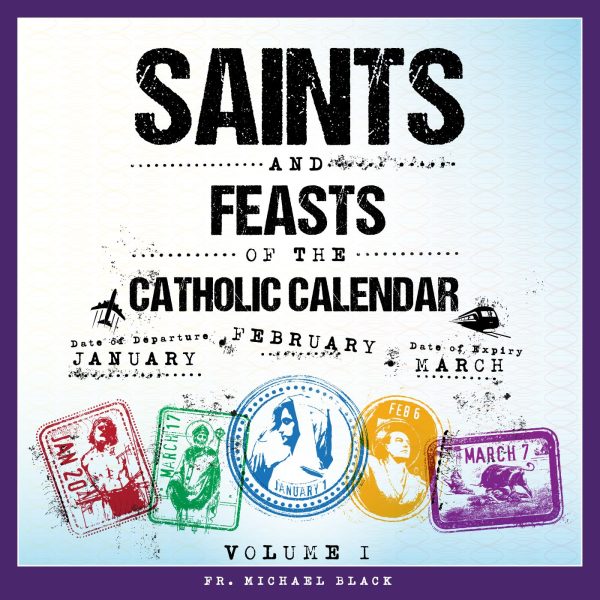
Catholic Saints & Feasts
- Episódios
- 268
- Publicação
- diária
- Último episódio
- 23 nov 2026
Sobre o podcast
"Catholic Saints & Feasts" offers a dramatic reflection on each saint and feast day of the General Calendar of the Catholic Church. The reflections are taken from the four volume book series: "Saints & Feasts of the Catholic Calendar," written by Fr. Michael Black.
These reflections profile the theological bone breakers, the verbal flame throwers, the ocean crossers, the heart-melters, and the sweet-chanting virgin-martyrs who populate the liturgical calendar of the Catholic Church.
Episódios 268
November 23: Blessed Miguel Agustín Pro, Priest and Martyr (U.S.A.)
November 23: Blessed Miguel Agustín Pro, Priest and Martyr (U.S.A.)1891–1927Optional Memorial; Liturgical Color: RedThe proto-martyr of the age of the imageThe emaciated holocaust survivor behind the barbed …
Notas do episódio
November 23: Blessed Miguel Agustín Pro, Priest and Martyr (U.S.A.)
1891–1927
Optional Memorial; Liturgical Color: Red
The proto-martyr of the age of the image
The emaciated holocaust survivor behind the barbed wire, gazing out, bewildered, as the
Allied soldiers walk up to the camp. Click. The slack body of a black man hanging from a stout limb, a thick crowd of whites gathered around. Click. A soldier shooting a young Viet Cong prisoner in the head on the frenetic streets of Saigon in 1968. Click. The President zooming through Dallas in a convertible when… Click. In the age of the image, a camera is always clicking or a device recording the action. Modern reality is experienced through images, lenses, and screens more than words. Like a red-hot iron searing a brand into a hide, a powerful image sizzles as it presses itself into our brains.
The photos of the execution of today’s martyr blister the mind. There are no photos of Polycarp as the flames licked his skin, of Felicity and Perpetua stumbling as the heifer ran them down, or of Kolbe quietly offering his life for a stranger in grim Auschwitz. The indelible photos of Father Pro being shot will have to suffice for all the undepicted others. The high drama of Pro’s last moments must substitute for every Christian stuffed in the trunk, worked to death in the Siberian gulag, or burned at the stake. No last words or gestures were recorded as the terror closed in on them. For so many who were “disappeared,” there were no witnesses, no documents, no legacy, no clicks.
Miguel Pro was born into a middle-class family in North Central Mexico. His family was large, pious, and close in the best Latino tradition. Miguel received his First Holy Communion from Fr. Mateo Correa, who would be executed just a few months before Father Pro for not revealing the confessions of his fellow prisoners. A much loved sister of Miguel’s became a nun, a Christian witness which inspired Miguel to enter a Jesuit seminary. Miguel’s seminary studies in Mexico were interrupted by the spasms of anti-Catholic violence which convulsed Mexico throughout the early twentieth century. He had to flee the country and studied in California, Nicaragua, Spain, and, finally, Belgium, where he was ordained a priest in 1925. The other men ordained with him gave their customary first priestly blessing to their parents after the ordination Mass. Father Miguel’s entire family was in Mexico, so he went back to his room, laid out all his family photos on a table, and blessed the pictures.
Fr. Pro’s first apostolic labors were in Belgium among working class miners. His health was a problem from his youth. He suffered painful bleeding ulcers, which required several marginally successful surgeries to repair. This constant physical discomfort likely hardened his will, deepened his life of prayer, and steeled his body for the heroism to come. Years of faithful attendance at the school of human suffering had braced him. Fr. Pro was a man in full.
In 1926 Father Pro returned to Mexico and began a clandestine priestly ministry in an atmosphere of high tension. Mexico’s lords of evil had a phobia of Catholicism and outlawed its every expression, from the wearing of priestly garb to the public celebration of the Sacraments. Pro was hunted like a bandit. In November 1927, an unsuccessful assassination attempt on the president-elect provided the pretext for punishing Pro, who was guiltless. He was discovered in his hideout. There was no trial, no evidence, no counsel, no defense, no judge, no jury, no verdict, and no sentence. There was just a squalid firing range down the street.
It was November 23. A photographer was sent to capture, for propaganda purposes, Pro begging for mercy. Not a chance! Father Pro briefly knelt in prayer, declined a blindfold, kissed his crucifix, and then stood and spoke in a strong voice: “May God have mercy on you! May God bless you! Lord, you know I am innocent! With all my heart I forgive my enemies! Viva Cristo Rey!” He then elevated his arms like the crucified Savior, a rosary in one hand and a small crucifix in the other when...click, click, click, click. It was 10:38 a.m. Pro is frozen in time. He is forever young. He is not before or after. He is his last seconds. He is those photos. To die is to do something. Blessed Miguel Pro did it as well as anyone ever did. He was beatified in 1988 and his memorial placed one week before the feast of Christ the King.
Blessed Miguel Pro, your gripping last moments sear the mind and pierce the heart. Grant us just an ounce of your ocean of daring, fortitude, and perseverance in living and sharing the faith. Help us to be more like you!November 23: Saint Clement I, Pope and Martyr
November 23: Saint Clement I, Pope and MartyrFirst CenturyOptional Memorial; Liturgical Color: RedPatron Saint of sailors and marble workersPrimacy more than infallibility, service more than authorityOur loving …
Notas do episódio
November 23: Saint Clement I, Pope and Martyr
First Century
Optional Memorial; Liturgical Color: Red
Patron Saint of sailors and marble workers
Primacy more than infallibility, service more than authority
Our loving maternal Church expresses herself through a paternal structure which makes decisions, resolves conflicts, intercedes in disputes, and governs the people who voluntarily gather in her strong embrace. The Marian Church of discipleship is without sin, like the Virgin herself, but the Petrine Church of authority is founded on a heroic, but flawed, man. Because it is rooted in the life of Saint Peter, Church governance is, by its nature, as imperfect as it is necessary. So while the pure Church of Mary awaits discovery in heaven, her pristine beauty is disfigured in this world by her commingling with the oh-so-human Church of Peter. The highest expression of the Church’s authority is the sole office built over the words of Christ Himself—the papacy.
Today’s Memorial commemorates the third successor of Saint Peter, who served as the Bishop of Rome in the last years of the first century. Pope Clement I and his two predecessors are named in Eucharistic Prayer I just after the list of the Twelve Apostles: “Linus, Cletus, Clement…” Though few details of Clement’s life are known, what is known is surpassingly important.
Clement is the very first Apostolic Father and may have been ordained by Saint Peter himself. In about the year 96 A.D., Clement wrote from Rome to the Church in Corinth to resolve some undefined disputes over authority tearing at that congregation. Clement’s letter is one of the most ancient Christian documents after the New Testament itself. It was so significant that in the second century it was read at Mass in Corinth and, in other regions, was considered part of the New Testament Canon!
The tone of Clement’s long letter is fraternal rather than domineering, more like an encyclical than a decree. Pope Clement encourages the faithful to be obedient to their priests and bishops, to be inspired by the example of the martyrs, and to lead lives of high moral virtue. The Church of Corinth could have looked to Saint John the Evangelist for guidance. In the late first century, he was an old man living in Ephesus, a city much closer to Corinth than Rome. But it was the long-dead Peter whose shadow towered over Corinth, not the living John.
Clement’s letter reveals an even-tempered soul, a shepherd eager to preserve the tenuous unity of his flock. The letter is invaluable as a proof of the centrality of the Bishop of Rome from the first chapter of the Christian story. The service of apostolic authority, of an interior organizing principle, is intrinsic to the Gospel itself, not a later addition. The primitive papal primacy exercised by Clement is not the imposition of a foreign power structure on an otherwise dreamy and innocent Church. The proto-Christians of Corinth needed clear, fatherly, instruction as they struggled to implement the Christian revolution in their homes, villages, shops, and town squares. Saint Paul had to write to them twice using strong language. It was evidently not enough, hence Clement’s letter a few decades later.
As the first generations of Christians realized that Christ was not going to return before they died, their understanding of the Church matured. Personal prophecies, individual teachings, and private spiritual gifts had to be incorporated into the broader life of the quickly expanding church. These personal gifts thus became subject to Church approval and to conformity with Scripture and previous teachings. In Clement’s time, the Church, rather than individuals, slowly became the repository of the accumulated wisdom of Christianity. And this early Church was not merely a society of learned men, an association of the perfect, or a cultural enrichment club. It was, and still is, a real Church, and so did what a real church does. The Corinthians, with Clement’s help, knew this essential fact—that to be a Christian and to be a member of the Church was one and the same thing.
Saint Clement, you spoke with fatherly authority to faithful men and women struggling to preserve Christian unity. May your balanced example inspire all in Holy Orders to gather, not scatter, to encourage, not scold, as they teach, preach, and govern in the name of Christ.November 23: Saint Columban, Abbot
November 23: Saint Columban, Abbotc.543–615Optional Memorial; Liturgical Color: WhitePatron Saint of motorcyclists and against floodsHe led the first wave of Irish monks who stormed EuropeThroughout the sixth …
Notas do episódio
November 23: Saint Columban, Abbot
c.543–615
Optional Memorial; Liturgical Color: White
Patron Saint of motorcyclists and against floods
He led the first wave of Irish monks who stormed Europe
Throughout the sixth and seventh centuries, the great gales of Ireland filled the sails of countless boats packed with hardy Irish monks steering toward France. Once on Europe’s northern shores, these men scaled her sandy slopes and headed inland in a kind of recurring theological D-Day. A seemingly endless pilgrimage of Irish scholar-monks went into voluntary exile, left their rainy homeland, navigated the waters, and sunk their roots deep into the soil of post-Roman Europe.
Up and down today’s France, Switzerland, the Low Countries and Germany, Irish monks founded monasteries that plowed furrows, sang chant, grew vines, copied books, hewed wood, forged chalices, raised cattle, taught children, dug wells, consecrated altars, rendered tallow into candles, and preached the sweet love of Christ. The rough local populations were drawn to these monasteries like moths to a flame, creating some of the oldest towns in Europe. Saint Columban, the leader of the first wave of these great builders of Europe, is the avatar of the missionary Irish monk. His ceaseless labors and iron will bent the arc of European history toward Christ.
A monk named Jonas, living one generation after our saint, authored Columban’s Life based on the recollections of Columban’s own brother monks. Columban (or Columbanus) was born in Ireland about the same year that Saint Benedict died in Italy. He was a clever boy who received an excellent education in secular and theological letters. When he left home as a youth to enter a monastery, it was not to a soaring gothic structure of a later, more glorious age. The Irish monks of late antiquity had more in common with the Egyptian ascetics who vanished into the desert than with medieval Benedictines. Irish monasteries were small Christian farms, communes of low-slung buildings formed in a circle around a humble stone chapel.
After Columban distinguished himself for his learning and his severe penances, he received his abbot’s permission to sail to the continent at about the age of forty. A legend of the era told of holy monks who set off from the Emerald Isle in a boat without oars, willing to land and serve wherever God so willed. The boat Columban and his twelve companion monks climbed into had oars and landed on the Brittany coast of France around 585.
For the next thirty years, Columban founded monasteries, attracted countless vocations, introduced private confession to Europe, and impressed all with his self-punishing Irish asceticism. Yet Columban had conflicts with powerful French bishops over his communities’ Celtic dating of Easter, which deviated from the Roman dating, and conflicts over the strange Irish tonsure, so different from the round cutting of the scalp practiced in the rest of the Church. Further tensions with French nobility caused Columban’s arrest and forced exile to Ireland. But the boat transporting him back home met rough seas and returned to its French port. So Columban stayed in Europe and found his way to Northern Italy. His last years were active in refuting the Arianism still thriving among the Italian Goths and in founding the great monastery of Bobbio, where Columban died on November 23, 615. Columban’s disciples founded over one hundred monasteries throughout Central Europe! Columban’s strict monastic Rule was also widely used until it was eclipsed by the more balanced Rule of Saint Benedict.
In around 600, Saint Columban wrote a letter to Pope Saint Gregory the Great professing his docile obedience: “We Irish, though dwelling at the far ends of the earth, are all disciples of Saint Peter and Saint Paul...we are bound to the Chair of Peter.” Columban, who may have been the first man to use the word “Europe” in its modern sense, was the prototype for a thousand unnamed missionaries whose austere resilience and fine minds built Europe one soul, one book, and one monastery, at a time.
Saint Columban, you were an ascetic, a theologian, and a father of Europe. Help all who seek your intercession to be as dynamic as you in rooting the faith in the deepest and richest soil.November 22: Saint Cecilia, Virgin and Martyr
November 22: Saint Cecilia, Virgin and Martyrc. Third CenturyMemorial; Liturgical Color: RedPatron Saint of Music and MusiciansA girl martyr’s mysterious death seizes the imaginationThe First Eucharistic …
Notas do episódio
November 22: Saint Cecilia, Virgin and Martyr
c. Third Century
Memorial; Liturgical Color: Red
Patron Saint of Music and Musicians
A girl martyr’s mysterious death seizes the imagination
The First Eucharistic Prayer, also known as the Roman Canon, is principally a liturgical document. But like so many things liturgical, it also has immense historical value. Only a tiny fraction of the ancient world’s documents have survived. Archives flood, libraries burn to ash, monasteries collapse, castles are sacked, and coastlines erode—the cities perched above them crumbling into the waves, everything lost, as the sea pushes inland. When documents disappear, historians must work from scraps of pottery and marble, or from the detritus of watery shipwrecks, to gather just tiny pieces of the fuller mosaic of what once was. The Catholic Church is a phenomenal exception to culture’s progressive Alzheimer’s. In its law, catechisms, calendar, feasts, buildings, hierarchy, and most especially in its liturgy, the Church’s past is never really past. Catholicism’s collective memory is stored, not in rack upon rack of digital servers in hermetically sealed rooms, but in the minds of its hundreds of millions of adherents. The faithful are the cloud. Priests and religious in particular circulate the living faith, ensuring that it is perpetually churning, flowing, and spreading like a rushing river.
The names of the martyrs listed in the Roman Canon include today’s saint, Cecilia. From one perspective, that is all we need to know. She lived. She was martyred. She was remembered. Cecilia’s name was included in the only Eucharistic Prayer then said at Sunday Mass, presumably because she stood out from the many other martyrs for a particular reason. That reason has been lost. Perhaps a stirring homily, committed to writing, preserved moving details of Cecilia’s life and tragic death. But maybe that homily was converted to cinders and slowly floated away when the enormous library of the Monastery of Cluny burned during the French religious conflicts of the 1500s. Perhaps there was a biographically detailed marble epitaph over Cecilia’s grave in the catacombs. Yet maybe that epitaph was wrenched from the wall by a barbarian plunderer who later used it as a sturdy doorstep for his house in Aachen.
Cecilia’s details are lost, for reasons unknown. But the Roman Canon is not lost, and it gathers together some notable virgin martyrs of the first few centuries: “...Agatha, Lucy, Agnes, Cecilia, Anastasia…” Like flies in amber, their names are preserved, to be heard in hundreds of languages by millions of people every week until the end of time.
Cecilia was likely martyred by cuts to her neck after attempts to steam her to death were unsuccessful. She was then buried in a loculus near the papal crypt in the Catacombs of Saint Callixtus. After being the object of devotion in the catacombs for centuries, Cecilia’s remains were transferred by the Pope in the early 800s to her own Basilica in the Trastevere neighborhood of Rome. During some restoration work on the Basilica in 1599, Cecilia’s body was uncovered and found to be incorrupt. Before contact with the atmosphere caused her fragile, paper-mache like skin to disintegrate, an artist carefully noted what he saw. His sculpture of Saint Cecilia is evocative and justly famous. The marble itself seems to rest in peace. It is not a forward, glorious pose in the Counter-Reformation tradition dominant when the statue was executed. The marble is white, reflecting Cecilia’s purity. The saint’s face and hair are mysteriously covered by a sheet, inviting the mind to wonder. Cecilia’s fingers seem to form a cryptic Christian symbol of the Trinity—Three in One. And her neck is sliced by the stroke of an axe.
The sculptor’s personal testimony is embedded in the floor near his work: “Behold the body of the Most Holy Virgin, Cecilia, whom I myself saw lying uncorrupt in her tomb. I have in this marble expressed for thee the same saint in the very same posture and body.” We don’t know the full story of our saint, but we are certain of her end—a generous act of self gift to Christ.
Saint Cecilia, you died an early death, preserving your virginity and choosing Christ over all others. Be an example to all youth of the true goal of their lives. Help them to seek God first and the good and holy pleasures of life only after Him.Our Lord Jesus Christ, King of the Universe
Last Sunday in Ordinary Time: Our Lord Jesus Christ, King of the Universe Solemnity; Liturgical Color: White or Gold The vastness of creation serves as the Lord’s footstool This last Sunday in Ordinary Time is …
Notas do episódio
Last Sunday in Ordinary Time: Our Lord Jesus Christ,
King of the Universe
Solemnity; Liturgical Color: White or Gold
The vastness of creation serves as the Lord’s footstool
This last Sunday in Ordinary Time is dedicated to the very highest understanding of the nature, role, and purpose of Jesus of Nazareth. Jesus is multifaceted, the deep hues and contours of his personality revealing themselves to different races and ages in different ways. More personally, even inside of just one single life, a Christian can understand Jesus in more subtle and complex ways as that particular Christian matures. Carpenter, Miracle Worker, Son of Mary, Son of God, Prophet, Messiah, Son of David, Good Shepherd, Healer, Preacher, Logos, Lamb of God, etc. Yet all these titles and identities will give way as the world ends, time is fulfilled, and life with God becomes simply life itself. Jesus’ identity will culminate in His Kingship. It will not be a transitional but a terminal identity. The dead will come nose to nose with King Jesus, feeling His hot breath on their cheeks, as He judges them at their life’s end. And the saved will have King Jesus before them in heaven forever as He renders homage to God the Father in the power of God the Holy Spirit.
The feast of “Christ the King” was first established in 1925, and Pope Saint Paul VI expanded its name to “King of the Universe” in 1969. Jesus is not just a King of Hearts. He is more than mankind’s universal Coach, Teacher, or Counselor. By “King of the Universe” the Church is communicating Jesus’ metaphysical scale, that God encompasses all of reality, not just man’s reality. We say in the Nicene Creed that God created all things visible and invisible. So Jesus is King over all the planets, stars, black holes, quasars, and exploding suns in the blackest corners of remote space. He is King over the earth and all its waterfalls, rainforests, mountain peaks, desert plains, and dark sea floors. He lords over all creation because He is its source. Saint Thomas Aquinas taught that God is not the most perfect being inside of creation but being itself. God is reality, not just the most impressive being inhabiting the reality bubble.
This feast is an antidote to the private, or compartmentalized, Jesus who impacts only those spaces in the Christian’s life where He is allowed to enter. Jesus wants to reign in every sphere of our lives, at home, on the factory floor, in the yard, at the office, over drinks, on the sports’ field, in the car, at meals, on the phone, and on and on. His field of action has no borders. From one perspective, this is a challenging, and limiting, spirituality. Such an intrusive, all-encompassing God can make life feel like a cage, where self-expression is constrained by His rules. From another perspective, however, the total reign of God in our lives is freeing. It means that He is not found only in Church. Sunday Mass? Of course. But we need not have our fingers on the rosary to be close to God and Mary at all times. God is found inside of the daily duties that are the stuff of life. This is consoling. We are not distracted from the higher things as we manage a family, earn a living, exercise, raise the kids, or take care of the house. When the Lord is King of Everything, mundanities are not banalities. The world is richer and more alive when our life is an all-inclusive vocation.
The anointed King was a tangible image of the hidden God in Western culture until modern times. Every earthly king was validated by the mighty God King who stood invisibly behind him, the One who benevolently ruled the universe as His own sacred republic. This understanding of God as a Divine Ruler gave a real sense of order, unity, and common purpose to all of reality which is lacking in modern, secular, democratic societies. Today’s feast does not invoke, however, merely an image of Jesus representing someone else’s Kingship but Jesus actually reigning as King. All the baptized should be glad to be subject to such a benevolent monarch.
Christ the King, Your sovereignty over all creation is not heavy. You order all reality toward Yourself and govern Your creatures with justice and humility. Help us to be faithful and subservient to what You desire, so that we can live one day in Your heavenly kingdom.November 21: The Presentation of the Blessed Virgin Mary
November 21: The Presentation of the Blessed Virgin MaryMemorial; Liturgical Color: WhiteMary was likely consecrated to God as a childStillbirths, infant mortality, and mothers’ dying during labor have been …
Notas do episódio
November 21: The Presentation of the Blessed Virgin Mary
Memorial; Liturgical Color: White
Mary was likely consecrated to God as a child
Stillbirths, infant mortality, and mothers’ dying during labor have been among the most predictable human tragedies since time immemorial. Medical progress has only in recent generations dramatically reduced such deaths, albeit unevenly throughout the world. In light of the real dangers of pregnancy and childbirth, the successful birth of a healthy baby has naturally given rise to ceremonies in many cultures thanking God for the precarious gift of new life. Jewish law required the ritual dedication of first-born sons to God in the Temple. It is probable that a similar custom, if not a law, called for Jewish girls to also be so dedicated. It is the likely presentation of the child Mary in such a ceremony that we celebrate today.
The Church does not claim that today’s feast is rooted in Sacred Scripture. There is no direct biblical support for Mary’s Presentation except in the apocryphal “Gospel” of Saint James, a problematic text replete with follies. The lack of textual support is, nevertheless, no reason to doubt the ancient tradition, especially preserved in Eastern Orthodoxy, that Joachim and Anne consecrated Mary, their daughter, to God at the age of three in the Jerusalem Temple. The prophet Samuel was similarly presented by his mother, Hannah. Both Hannah and her namesake, Anne, were long barren and were thus all the more grateful to see the fruit of their unexpected pregnancies.
It is a good and holy thing for Christian parents to proactively dedicate their children to God, or even to invite them to consider a life consecrated to God as priests or religious. While some may consider it an unwise imposition for parents to so explicitly encourage their children to take steps down that holy path, all parents, in fact, are energetic in promoting some level of conformity with their own religious or quasi-religious beliefs. These “beliefs” may be related to the environment, politics, leisure, art, sports, or a thousand other causes or hobbies. Parents always indoctrinate their children. It is intrinsic to their role. The only question is what the content of that indoctrination will be. Ideally, Christian parents hand on to their children their most deeply held beliefs—including their faith in Jesus Christ.
The essence of any sacrifice is to burn, kill, or destroy something of value in order to close the yawning gap between God and man. A sacrifice can be in thanksgiving, to repent of a sin, or in petition for a favor. Primitive priests in cultures across the globe since time immemorial have stood at their rough stone altars on behalf of their people to offer God fatted calves, heifers, sheep, the finest grain, red wine, and even their fellow man. Abraham was willing to offer his very own son to God. Blood sacrifice gradually receded in Judaism, however, to bloodless sacrifice, and eventually to non-sacrificial pathways to God. The age of priests in the Jerusalem Temple sacrificing animals gradually mutated, from the late first century onward, into rabbis in synagogues teaching from books.
To present a child to God, either in a formal ritual or in a private dedication, is to lay that child on a symbolic altar and to say to God: “You create. We procreate. My child is Your child. Do with this child as You will.” Such humble and antecedent submission to the will of God is not an abdication of the duty to form a child in human and religious virtue. It is just to be realistic. Children are gifts, not metaphorically but actually. A child is not a piece of property or an object a parent has a right to possess. No one understands this like the infertile couple. When parents consecrate a child to God, whether at baptism or otherwise, even informally, they are manifesting a willingness to return a gift to its remote source, to please the Maker by giving Him what He already possesses, life itself and all who share in it.
Saints Anne and Joachim, in gratitude for the gift of life, you presented Mary in the Temple. Help all young parents to see in you a model of dependence on God’s providence and may similar consecrations in today’s world prepare saints for the Church of tomorrow.November 20: St. Bernward of Hildesheim, Bishop
November 20: Saint Bernward of Hildesheim, Bishop c.960–1022 Optional Memorial; Not on Universal Calendar; Liturgical Color: White Patron saint of goldsmiths & architects A well-educated and pious bishop …
Notas do episódio
November 20: Saint Bernward of Hildesheim, Bishop
c.960–1022
Optional Memorial; Not on Universal Calendar; Liturgical Color: White
Patron saint of goldsmiths & architects
A well-educated and pious bishop sponsors the practical arts
Some doors in the city of Rome draw people in like huge vertical magnets, pulling groups of pilgrims slowly towards them across broad atriums. The dots of laser pointers dance over the doors of the Basilica of St. John Lateran as guides point and explain how these towering doors once swung open onto the Roman Curia, where senators in white togas stood debating matters of empire. The colossal, sober, bronze doors of the 2nd century Pantheon still hang from its jambs. And the large, intricate, wood paneled doors of Santa Sabina date from the 430s! The eyes of today’s saint, Bernward of Hildesheim, gazed up in wonder at these very same sets of doors when he visited Rome in the year 1001. And while he gazed, he also resolved to carry back just a bit of this Roman elegance, this Roman nobility, this Roman weight, to the cold land, to the far land, he had come from.
St. Bernward of Hildesheim lived at the half-way point between us and Jesus Christ. His life spanned mankind’s crossing from the first to the second millennium. Bernward had an impeccable pedigree, with the branches of his noble family tree extending throughout lower Saxony, in today’s northern Germany. His family lineage, fine education, and personal piety opened doors of power and influence to him throughout his life. He was chosen as the tutor to the most important man of his time and place, Otto III, who became the Holy Roman Emperor. And he was appointed bishop of Hildesheim at a young age in 993 and remained in that position, and in that town, until he breathed his last thirty years later.
Bernward lived long before the founding of the great universities of Europe, in an age when monasteries and cathedrals were Europe’s preeminent centers of learning. A cathedral school, in particular, was the equivalent of an elite prep school today. It was as important to a diocese as the cathedral itself. Bernward attended the cathedral school of Hildesheim as a youth long before becoming bishop of the same diocese.
The academic theology done in Europe’s universities starting in the 1200s created a more disciplined and professional guild of theologians but moved theology to a neutral location. In Bernward’s more feudal age, men learned theology in the beating heart of the church, in the red-hot centers of prayer and apostolic activity where the faithful habitually gathered – in cathedrals and monasteries. Bishops, thinkers, and authors baptized babies, said funeral masses, anointed the sick, sang vespers, and led processions while also studying and writing. Their audience was the faithful. Their forum was the pulpit. University-based theology was severed from the great centers of spirituality so familiar to the first millennium. It was more scientific, yes, but also more dry. St. Bernward was a man of the first millennium. His public was not other academics but his happy people. His theology was both intellectual and practical, with church ideas and church life braided tightly together, as they should be.
Bernward mastered the seven liberal arts common to his age and showed a keen interest in practical craftmanship. He was an energetic bishop who commissioned the building of castles, an abbey, and numerous decorative items for his churches. Inspired by his extended roman visit, he ordered a huge set of bronze doors for his cathedral, known as the Bernward doors. These commanding pieces of functional art, with their simple but expressive figures in deep relief, can still be admired today. They were not made of perishable material. They were made to last and have lasted for half the life of the church.
St. Bernward’s kind disappeared with his epoch. The monastic reforms of Cluny and the later groundbreaking ways of the Franciscan and Dominican Orders spread like wildfire in the 1200s and brought a definitive end to first millennium Catholicism. We remember St. Bernward today because he was a model bishop committed to one diocese and one people in matters practical and spiritual.
St. Bernward, your education, piety, mortification, and practical concern for your faithful have kept the flame of your memory burning in your see city. We seek your divine intercession on behalf of all bishops, that they may emulate your fund of virtues. Amen.November 18: The Dedication of the Basilicas of Saints Peter and Paul, Apostles
November 18: The Dedication of the Basilicas of Saints Peter and Paul, ApostlesOptional Memorial; Liturgical Color: WhiteThe Apostles Peter and Paul are the Patron Saints of the City of RomeThe barque of Peter …
Notas do episódio
November 18: The Dedication of the Basilicas of Saints Peter and Paul, Apostles
Optional Memorial; Liturgical Color: White
The Apostles Peter and Paul are the Patron Saints of the City of Rome
The barque of Peter is tethered to two stout anchors
A cathedral is theology in stone, the medievals said, a truism which extends to all churches, not just cathedrals, and to their sacred web of translucent glass, glowing marble, gold-encrusted wood, bronze canopies, and every other noble surface on which the eye falls. A Church mutely confesses its belief through form and materials. Today’s feast commemorates the dedication of two of the most sumptuous churches in the entire world: the Basilica of St. Peter, the oversized jewel in the small crown of Vatican City, and the Basilica of St. Paul Outside the Walls, a few miles distant, beyond Rome’s ancient walls. The foundations of these two Basilicas are each sunk deep into the blood-drenched ground of first-century Christianity, though today’s impressive structures stand proxy for their long-razed originals. If strong churches reflect a strong God, these Basilicas are all muscle.
The present Basilica of St. Peter was dedicated, or consecrated, in 1626. It was under construction for more than one hundred years, was built directly over the tomb of the Apostle Peter, and considerably enlarged the footprint of the original Constantinian Basilica. That prior fourth-century Basilica was so decrepit by the early 1500s that priests refused to say Mass at certain altars for fear that the creaky building’s sagging roofs and leaning walls would collapse at any moment. The ancient Basilica of St. Paul Outside the Walls was consumed by a mammoth fire in 1823. The rebuilt Basilica was dedicated on December 10, 1854, just two days after Pope Pius IX had formally promulgated the dogma of Mary’s Immaculate Conception. The Basilica’s vast classical elegance is breathtaking—its marbled central nave stretches out longer than an American football field.
The two Basilicas were, for centuries, linked by a miles-long, roofed colonnade that snaked through the streets of Rome, sheltering from the sun and rain the river of pilgrims flowing from one Basilica to the next as they procured their indulgences. Rome’s two great proto-martyrs were like twins tethered by a theological umbilical cord in the womb of Mother Church. The pope’s universal ministry was explicitly predicated upon these two martyrs. Rome’s apostolic swagger meant the Bishop of Rome’s headship was not merely symbolic but actively intervened in practical matters of church governance throughout Christendom. The pope, the indispensable Christian, was often depicted in early Christian art as a second Moses, a law-giver, who received from Christ the tablets of the New Testament for the new people of God.
At intervals of five years, every diocesan bishop in the Catholic Church is obligated to make a visit “ad limina apostolorum”—“to the threshold (of the tombs) of the apostles.” This means they pray at the tombs of Saints Peter and Paul in Rome and personally report to Saint Peter’s successor. These visits are a prime example of the primacy of the pope, which is exercised daily in a thousand different ways, a core duty far more significant than the pope’s infallibility, which is exercised rarely.
There is no office of Saint Paul in the Church. When Paul died, his office died. Everyone who evangelizes and preaches acts as another Saint Paul. But the barque of Peter is still afloat in rough seas, pinned to the stout tombs which, like anchors, hold her fast from their submerged posts under today’s Basilicas. A church is not just a building, any more than a home is just a house. A church, like a home, is a repository of memories, a sacred venue, and a corner of rest. On today’s feast, we recall that certain churches can also be graveyards. Today’s Basilicas are sacred burial grounds, indoor cities of the dead, whose citizens will rise from beneath their smooth marble floors at the end of time, like a thousand suns dawning as one over the morning horizon.
Holy martyrs Peter and Paul, your tombs are the sacred destinations of many pilgrimages to the eternal city. May all visits to the Basilicas dedicated to your honor deepen one’s love and commitment to Mother Church.November 18: Saint Rose Philippine Duchesne, Virgin
November 18: Saint Rose Philippine Duchesne, Virgin1769–1852Optional Memorial; Liturgical Color: WhitePatron Saint of perseverance amid adversityBorn into a refined French family, her life ended in hardship on …
Notas do episódio
November 18: Saint Rose Philippine Duchesne, Virgin
1769–1852
Optional Memorial; Liturgical Color: White
Patron Saint of perseverance amid adversity
Born into a refined French family, her life ended in hardship on the American prairie
Today’s saint was born into a large, refined, educated Catholic family situated in an enormous home in the venerable city of Grenoble, France. Rose’s parents and extended family were connected to other elites in the highest circles of the political and social life of that era. Despite this favored parentage, Rose would leave the world and all the advantages she inherited to become a hardscrabble missionary nun serving rough settlers and Indians in the no man’s land of the American plains. Saint Rose was named after the first canonized saint of the New World, Saint Rose of Lima. As a child, her imagination had been fired by hearing about missionaries on the American frontier. She dreamed of being one of them, yet her path to becoming a pioneer missionary would be circuitous.
When Rose felt the call to a contemplative religious life as a teen, she joined, against her father’s wishes, the Order that so many French women of status joined—the Congregation of the Visitation, founded by Saint Jane Frances de Chantal in the early seventeenth century. The massive social upheavals of the French Revolution shuttered her Visitandine convent, though, and she spent years living her Order’s rule privately outside of a convent as her country disintegrated into chaos. After the revolution, when religious life was no longer illegal, Rose tried to re-establish her defunct convent by personally purchasing its buildings. The plan didn’t work, and Rose and the few remaining sisters united themselves to a new French Order, which would later be known as the Religious Sisters of the Sacred Heart.
Saint Rose was destined to be a holy and dedicated nun in her Order’s schools. But in 1817, a bishop serving in the United States came to France on a recruitment tour, as so many bishops did in the first half of the nineteenth century. The bishop visited Rose’s convent in Paris, and Rose’s childhood dreams were rekindled. After receiving permission from her superiors, in 1818 Rose boarded a ship with four other sisters for the two-month sea voyage to New Orleans, U.S.A. The second act of her life was starting at age forty-nine. From this point forward, her life was replete with the physical hardships, financial struggles, and everyday drama typical of the French and Spanish missionaries who brought the faith to the ill-educated pioneers and Indians on the edge of the American frontier.
Rose and her troupe of sisters had to take a steamboat up the Mississippi River to Missouri after the bishop’s promises of a convent in New Orleans came to nothing. In remote Western Missouri, Rose began a convent in a log cabin and then started a school and a small novitiate. The people were poor, the settlers generally unschooled, the weather cold, the food inadequate, and life hard. Rose struggled to learn English. Yet after ten years, the Sacred Heart Sisters were operating six convents in Missouri and Louisiana. In 1841, the Sisters began to serve Potawatomi Indians who had been harshly displaced from Michigan and Indiana into Eastern Kansas. At seventy-one years old, Rose joined this missionary band to Kansas not for her practical usefulness but for her example of prayer. Saint Rose prayed so incessantly that she was on her knees before the tabernacle when the Indians went to sleep and kneeling there when they woke up, still praying. Wondering at this, some children put pebbles on the train of her habit one night. The next morning the pebbles were still there. She hadn’t budged an inch all night long! The Potawatomi called her “She Who Prays Always.” Howling cold and the rigors of frontier life forced Rose to return to a more humane convent existence for the last quiet years of her life. She was beatified in 1940 and canonized in 1988.
Saint Rose, you persevered heroically in your vocation despite serious challenges. Inspire all religious to continue in their unique vocations despite setbacks, and to unite, as you did, a quiet contemplative soul with a missionary’s courage and drive.November 17: Saint Elizabeth of Hungary, Religious
November 17: Saint Elizabeth of Hungary, Religious1207–1231Memorial; Liturgical Color: WhitePatron Saint of the Third Order of Saint FrancisA faithful wife loses her husband and becomes a FranciscanThe marriage …
Notas do episódio
November 17: Saint Elizabeth of Hungary, Religious
1207–1231
Memorial; Liturgical Color: White
Patron Saint of the Third Order of Saint Francis
A faithful wife loses her husband and becomes a Franciscan
The marriage of today’s saint was not any less happy for being arranged. Elizabeth of Hungary’s parents betrothed her at the age of four to a young German nobleman named Ludwig and sent her away as a child to live in his family’s court. Elizabeth wed Ludwig when she was fourteen and he twenty-one. Only in a post-industrial age have the teenage years been understood, in some countries but not all, as a time of self-discovery, boundary pushing, rejection of tradition, and excuse for total confusion. Puberty, not the entire span of the teen years, was historically understood as the passage to adulthood, responsibility, and a professional life. It was typical of her era, and of many other eras too, that Elizabeth would marry at fourteen. She was ready and became a contented, serious, and successful wife and mother, bearing three children, while still a teen.
Before Ludwig left on Crusade in 1227, he and Elizabeth vowed never to remarry if one were to die before the other. Then Ludwig died on his way to the Holy Land. Elizabeth was distraught but fulfilled her promise. So at the age of twenty, her already pious and prayerful soul waded into deeper Christian waters. Her mortifications became more rigorous, her financial generosity more total, and her prayer time more all consuming. Most of all, Elizabeth’s life now began to revolve almost uniquely around the poor, the aged, and the sick. She opened a hospice near a relative’s castle and there welcomed anyone in need.
Elizabeth also fell under the spell of a charismatic and over-bearing spiritual director who insisted that she make the most severe emotional and physical sacrifices in her quest for perfection. As a sign of her commitment to the poor, and to aid her in conquering herself, Elizabeth took the habit of a Third Order Franciscan in 1227. Franciscanism was spreading like wildfire throughout Europe, and Elizabeth was not the only noblewoman far from Assisi to be drawn to the message of Saint Francis so soon after his death. A native Hungarian, who came in search of Elizabeth in Germany at this time, was shocked to find her dressed in drab grey clothes, poor, and sitting at a spinning wheel in her hospice. He begged Elizabeth to return to her father’s royal court in Hungary. She refused. She would stay near the tomb of her husband, stay near her children, now in the care of nuns and relatives, and stay close to the poor whom she loved so much.
Most likely worn out by her austerities and near constant contact with the sick, Elizabeth died at the age of twenty-four on November 17, 1231. Miracles were attributed to her intercession soon after her burial, and testimonies to her holiness were collected so rapidly that she was canonized by the pope just four years after her death. In 1236 a shrine was dedicated to her memory in Marburg, Germany, and her remains were transferred there amidst great ceremony. Pilgrims continued trekking to her shrine throughout the middle ages, until a Lutheran prince, full of dissenting Protestant spit and vinegar, removed Elizabeth’s relics from her shrine in 1539. They have never been recovered.
Saint Elizabeth of Hungary, we seek your heavenly intercession on this date of your early death. Help all young mothers to persevere in their vocations and all young widows to not despair but to be confident as they walk forward in life, knowing that Christ is at their side.November 16: Saint Margaret of Scotland
November 16: Saint Margaret of Scotland c. 1045–1093 Optional Memorial; Liturgical Color: White Patron Saint of Scotland, large families, and parents who have lost children A foreign-born royal becomes queen …
Notas do episódio
November 16: Saint Margaret of Scotland c. 1045–1093 Optional Memorial; Liturgical Color: White Patron Saint of Scotland, large families, and parents who have lost children A foreign-born royal becomes queen and inspires by her refinement and devotion In the early eleventh century, a Danish Viking named Canute reigned as King of England. Canute exiled his potential rivals from an Anglo-Saxon royal family. …November 15: Saint Albert the Great, Bishop and Doctor
November 15: Saint Albert the Great, Bishop and Doctor c. 1206–1280 Optional Memorial; Liturgical Color: White Patron Saint of natural scientists He knew everything, taught Aquinas, and placed his complex mind …
Notas do episódio
November 15: Saint Albert the Great, Bishop and Doctor c. 1206–1280 Optional Memorial; Liturgical Color: White Patron Saint of natural scientists He knew everything, taught Aquinas, and placed his complex mind at the Church’s service Saint Francis de Sales wrote that the knowledge of the priest is the eighth Sacrament of the Church. If that is true, then today’s saint was a sacrament unto himself. There was little that Saint Albert did not know and little that he did not teach. …November 13: Saint Frances Xavier Cabrini, Virgin (USA)
November 13: Saint Frances Xavier Cabrini, Virgin (USA) 1850–1917 USA Memorial; Liturgical Color: White Patron Saint of immigrants and hospital administrators Indomitable and charismatic, she moved mountains …
Notas do episódio
November 13: Saint Frances Xavier Cabrini, Virgin (USA) 1850–1917 USA Memorial; Liturgical Color: White Patron Saint of immigrants and hospital administrators Indomitable and charismatic, she moved mountains for God The hurricane of apostolic activity that was Mother Cabrini motored powerfully over the Atlantic Ocean, gathered force as it swept into the American heartland, and then rested there, perpetually oscillating, for almost three decades. …November 12: Saint Josaphat, Bishop and Martyr
November 12: Saint Josaphat, Bishop and Martyr 1580–1623 Memorial; Liturgical Color: Red Patron Saint of reunion between Orthodox and Catholics A holy bishop is murdered for unifying East and West Saint …
Notas do episódio
November 12: Saint Josaphat, Bishop and Martyr 1580–1623 Memorial; Liturgical Color: Red Patron Saint of reunion between Orthodox and Catholics A holy bishop is murdered for unifying East and West Saint Josaphat died for something few in his era died for—ecumenism. In fact, the word ecumenism did not even exist when Josaphat was martyred. Josaphat was born in Ukraine but grew to manhood working a trade in Vilnius, Lithuania. …November 11: Saint Martin of Tours, Bishop
November 11: Saint Martin of Tours, Bishop c. 336–397 Memorial; Liturgical Color: White Patron Saint of France, soldiers, and conscientious objectors He gave away half of his cloak and then all of his life Many …
Notas do episódio
November 11: Saint Martin of Tours, Bishop c. 336–397 Memorial; Liturgical Color: White Patron Saint of France, soldiers, and conscientious objectors He gave away half of his cloak and then all of his life Many great and holy men and women are unknown to history because they lacked the one crucial ingredient to become well known—a biographer. Today’s saint was one of the fortunate ones. …November 10: Saint Leo the Great, Pope and Doctor
November 10: Saint Leo the Great, Pope and Doctor Late Fourth Century–461 Memorial; Liturgical Color: White Patron Saint of popes and confessors A Pope vigorously exercises his universal ministry and defines …
Notas do episódio
November 10: Saint Leo the Great, Pope and Doctor Late Fourth Century–461 Memorial; Liturgical Color: White Patron Saint of popes and confessors A Pope vigorously exercises his universal ministry and defines Christ’s divinity History has so far conferred on just two popes the title of “Great,” and today’s saint is one of them. Leo the Great’s origins are obscure, so nothing is known with certainty of his early life. …November 9: Dedication of the Lateran Basilica
November 9: Dedication of the Lateran Basilica Feast; Liturgical Color: White A venerable basilica is the mother of all churches In the eighth chapter of his Confessions, Saint Augustine relates the story of an …
Notas do episódio
November 9: Dedication of the Lateran Basilica Feast; Liturgical Color: White A venerable basilica is the mother of all churches In the eighth chapter of his Confessions, Saint Augustine relates the story of an old and learned Roman philosopher named Victorinus. He had been the teacher of many a Roman senator and nobleman and was so esteemed that a statue of him was erected in the Roman Forum. …November 4: Saint Charles Borromeo, Bishop
November 4: Saint Charles Borromeo, Bishop 1538–1584 Memorial; Liturgical Color: White Patron Saint of bishops, cardinals, and seminarians A young nobleman becomes a Cardinal, exemplifies holiness, and reforms …
Notas do episódio
November 4: Saint Charles Borromeo, Bishop 1538–1584 Memorial; Liturgical Color: White Patron Saint of bishops, cardinals, and seminarians A young nobleman becomes a Cardinal, exemplifies holiness, and reforms the Church Today’s saint was born in a castle to an aristocratic family. His father was a count, his mother a Medici, and his uncle a pope. This last fact was to determine the trajectory of Charles Borromeo’s entire life. Pope Pius IV (1559–1565) was the brother of Charles’ mother. …November 3: Saint Martin de Porres, Religious
November 3: Saint Martin de Porres, Religious 1575–1639 Optional Memorial; Liturgical Color: White Patron Saint of mixed-race peoples and barbers A humble, mixed-race Dominican brother works miracles Today’s …
Notas do episódio
November 3: Saint Martin de Porres, Religious 1575–1639 Optional Memorial; Liturgical Color: White Patron Saint of mixed-race peoples and barbers A humble, mixed-race Dominican brother works miracles Today’s saint was born in colonial Lima, Peru, to a well-connected Spanish father and a black Panamanian mother who had been a slave. …November 2: The Commemoration of All the Faithful Departed (All Souls Day)
November 2: The Commemoration of All the Faithful Departed (All Souls Day) Commemoration; Liturgical Color: White, Violet, or Black The earthly Church prays for the Church in Purgatory in hope of a reunion in …
Notas do episódio
November 2: The Commemoration of All the Faithful Departed (All Souls Day) Commemoration; Liturgical Color: White, Violet, or Black The earthly Church prays for the Church in Purgatory in hope of a reunion in Heaven Every country has a civic feast day dedicated to soldiers who died for the nation. …November 1: All Saints
November 1: All Saints Solemnity; Liturgical Color: White Heaven is populated with holy people known to God alone Martyrs were so revered in the early Church that their places and dates of death were sanctified …
Notas do episódio
November 1: All Saints Solemnity; Liturgical Color: White Heaven is populated with holy people known to God alone Martyrs were so revered in the early Church that their places and dates of death were sanctified by the candles, prayers, and votive offerings of the faithful, grateful for their witness. So many were the martyrs, though, that by the early fourth century it became impossible to solemnize each individually on the Church’s crowded calendar. …Georgia Martyrs: Beatification October 31, 2026
Georgia Martyrs Beatification: October 31, 2026 St. Francis Would Be Proud Polyandry, or a woman taking multiple husbands, is an obscure marital custom. In the few remote Himalayan villages where it may be …
Notas do episódio
Georgia Martyrs Beatification: October 31, 2026 St. Francis Would Be Proud Polyandry, or a woman taking multiple husbands, is an obscure marital custom. In the few remote Himalayan villages where it may be practiced, brothers marry the same woman to protect rights to family property. Polygamy, or a man taking multiple wives, has always been, and is still, found globally, typically in higher social strata. Only high-status men of exalted power and wealth can take more than one wife. …October 28: Saints Simon and Jude, Apostles
October 28: Saints Simon and Jude, Apostles First Century Feast; Liturgical Color: Red Patron Saints of hopeless causes (Jude) and tanners (Simon) The Apostles laid the foundation for the household of faith …
Notas do episódio
October 28: Saints Simon and Jude, Apostles First Century Feast; Liturgical Color: Red Patron Saints of hopeless causes (Jude) and tanners (Simon) The Apostles laid the foundation for the household of faith There is often a crosshatch of bloody scratches on the right cheek of statues of the suffering Christ in Latin America. It’s called the “Judas Kiss,” a reminder of Judas Iscariot’s act of both affectionately greeting Christ and betraying Him in one sinister gesture. …October 24: Saint Anthony Mary Claret, Bishop
October 24: Saint Anthony Mary Claret, Bishop 1807–1870 Optional Memorial; Liturgical Color: White Patron Saint of textile merchants, the Catholic press, and vocational educators A tireless bishop founds an …
Notas do episódio
October 24: Saint Anthony Mary Claret, Bishop 1807–1870 Optional Memorial; Liturgical Color: White Patron Saint of textile merchants, the Catholic press, and vocational educators A tireless bishop founds an Order and moves mountains Today’s saint was a finely tuned, high-octane engine of evangelization. Anthony Claret was from Catalonia, the region around Barcelona, Spain. …October 23: Saint John of Capistrano, Priest
October 23: Saint John of Capistrano, Priest 1386–1456 Optional Memorial; Liturgical Color: White Patron Saint of military chaplains and jurists A worldly man becomes a Franciscan and a great preacher Today’s …
Notas do episódio
October 23: Saint John of Capistrano, Priest 1386–1456 Optional Memorial; Liturgical Color: White Patron Saint of military chaplains and jurists A worldly man becomes a Franciscan and a great preacher Today’s saint, like Saints Francis of Assisi, Maximilian Kolbe, Jerome Emiliani and many other male saints, was a prisoner of war. And just like all the others, imprisonment changed John of Capistrano forever. …October 22: Saint John Paul II, Pope
October 22: Saint John Paul II, Pope 1920–2005 Optional Memorial; Liturgical Color: White Patron Saint of World Youth Day Fully prepared, possessing every skill, a pope for the ages makes maximum impact …
Notas do episódio
October 22: Saint John Paul II, Pope 1920–2005 Optional Memorial; Liturgical Color: White Patron Saint of World Youth Day Fully prepared, possessing every skill, a pope for the ages makes maximum impact Thirty-three years after the dark cloud of communism had settled over Eastern Europe, on a crisp autumn night, heavy bells across Poland began to sway and toll in their high towers. Their clangs peeled down the valleys, thundered through the town squares, and reverberated off every city street. …October 20: Saint Paul of the Cross, Priest (U.S.A.)
October 20: Saint Paul of the Cross, Priest (U.S.A.) 1694–1775 Optional Memorial; Liturgical Color: White Patron Saint of Ovada, Italy, and founder of the Passionists He was a marathoner whose “runner’s high” …
Notas do episódio
October 20: Saint Paul of the Cross, Priest (U.S.A.) 1694–1775 Optional Memorial; Liturgical Color: White Patron Saint of Ovada, Italy, and founder of the Passionists He was a marathoner whose “runner’s high” lasted a lifetime After unsuccessfully living the life of a soldier, today’s saint left the military to live a secluded life of prayer for over five years. But then in 1720, he received a vision instructing him to found a Congregation devoted to Christ’s passion. …October 19: Saints Jean de Brébeuf and Isaac Jogues, Priests, and their Companions, Martyrs (U.S.A.)
October 19: Saints Jean de Brébeuf and Isaac Jogues, Priests, and their Companions, Martyrs (U.S.A.) Saint Jean: 1593–1649; Saint Isaac Jogues 1607–1646; Frs. Gabriel Lalemant, Noel Chabanel, Charles Garnier …
Notas do episódio
October 19: Saints Jean de Brébeuf and Isaac Jogues, Priests, and their Companions, Martyrs (U.S.A.) Saint Jean: 1593–1649; Saint Isaac Jogues 1607–1646; Frs. Gabriel Lalemant, Noel Chabanel, Charles Garnier, Anthony Daniel; and laymen René Goupil and Jean de Lalande Memorial; Liturgical Color: Red Patron Saints of North America, co-patrons of Canada French priests and laity leave hearth and home to be slaughtered on the edge of nowhere Deep in the dense and endless forests of Iroquois…October 18: Saint Luke, Evangelist
October 18: Saint Luke, Evangelist First Century Feast; Liturgical Color: Red Patron Saint of artists, physicians, and surgeons A disciple of Christ gives the Church two foundational works Saint Luke was one of …
Notas do episódio
October 18: Saint Luke, Evangelist First Century Feast; Liturgical Color: Red Patron Saint of artists, physicians, and surgeons A disciple of Christ gives the Church two foundational works Saint Luke was one of the four Evangelists but not one of the Twelve Apostles. Like Saint Mark, Luke was not among that select group who walked step by step alongside Jesus as he journeyed through Palestine. …October 17: Saint Ignatius of Antioch, Bishop and Martyr
October 17: Saint Ignatius of Antioch, Bishop and Martyr c. Mid First Century–c. 110 Memorial; Liturgical Color: Red Patron Saint of the Church in Eastern Mediterranean and North Africa An early Bishop-martyr …
Notas do episódio
October 17: Saint Ignatius of Antioch, Bishop and Martyr c. Mid First Century–c. 110 Memorial; Liturgical Color: Red Patron Saint of the Church in Eastern Mediterranean and North Africa An early Bishop-martyr elaborates on Catholic theology Although not the most famous Saint Ignatius in the Church, today’s saint was the first to offer a theology of martyrdom. …
Aqui estão os 40 episódios mais recentes de 268. Os mais antigos estão no feed do podcast.
Podcasts parecidos
Mais podcasts de Religião e espiritualidade



Este podcast é seu?
Confirme com uma entrada no seu feed: você recebe um código aqui, adiciona como podcast:txt no canal do seu feed e nós verificamos. Depois disso, seu podcast aparece como “verificado” no SoundNode.