

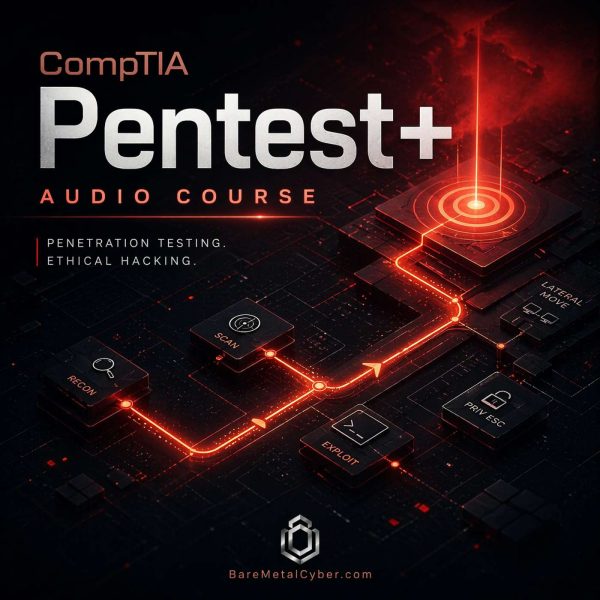
Certified: The CompTIA PenTest+ (Plus) Audio Course
- Episódios
- 97
- Formato
- Série – ouça desde o começo
- Último episódio
- 6 jan 2026
Sobre o podcast
This PrepCast series is a comprehensive, audio-first preparation program designed to help learners build the judgment, terminology fluency, and decision-making skills required for modern penetration testing scenarios. Rather than focusing on tools, commands, or hands-on labs, the series emphasizes how to think like a tester under real-world constraints: interpreting scope and rules of engagement, selecting safe and defensible next steps, validating findings responsibly, and communicating risk in clear business-aligned language. Each episode is structured to reinforce engagement flow, from planning and reconnaissance through exploitation decisions, post-exploitation considerations, and professional reporting. Across the full sequence, listeners develop a repeatable mental framework for analyzing technical situations, prioritizing actions, avoiding common traps, and translating observations into meaningful outcomes. The series mirrors how security work is evaluated in practice, where correctness depends not only on technical knowledge, but also on ethics, authorization, safety, and impact. By the end of the program, learners are equipped to recognize patterns quickly, justify decisions confidently, and apply consistent reasoning that transfers directly to both certification scenarios and real penetration testing engagements.
Episódios 97
Episode 96 — Final Exam Readiness Drill (Audio Practice)
This episode provides a structured audio drill designed to improve decision speed and consistency by repeatedly practicing the same recognition and selection steps used in scenario questions. You’ll learn to …
Notas do episódio
This episode provides a structured audio drill designed to improve decision speed and consistency by repeatedly practicing the same recognition and selection steps used in scenario questions. You’ll learn to identify the phase from clue words, classify the asset type, extract constraints like scope and safety, and choose the smallest next action that increases certainty or supports a defensible outcome. We’ll cover common pitfalls such as ignoring constraints, skipping validation, overthinking simple cues, and selecting actions that assume missing access, and you’ll practice eliminating tempting wrong options by articulating why they do not fit the scenario. The drill emphasizes explaining your reasoning out loud, because being able to justify your choice strengthens recall and reduces careless mistakes under time pressure. By the end, you’ll have a repeatable daily practice loop that reinforces core concepts across engagement management, reconnaissance, vulnerability validation, exploitation decisions, and reporting logic in a way that transfers to real work situations where rapid, defensible judgment is required. Produced by BareMetalCyber.com, where you’ll find more cyber audio courses, books, and information to strengthen your educational path. Also, if you want to stay up to date with the latest news, visit DailyCyber.News for a newsletter you can use, and a daily podcast you can commute with.
Episode 95 — Executive Summary That Doesn’t Suck
This episode teaches you to write executive summaries that drive decisions by focusing on top risks, business impact, and clear actions, rather than repeating technical logs. You’ll learn how to state outcomes …
Notas do episódio
This episode teaches you to write executive summaries that drive decisions by focusing on top risks, business impact, and clear actions, rather than repeating technical logs. You’ll learn how to state outcomes plainly, what was possible, why it matters, and what should happen next, while avoiding jargon and defining necessary terms in natural language. We’ll cover how to prioritize a small number of high-impact findings, how to balance confidence by distinguishing confirmed versus likely statements, and how to recommend both short-term containment and long-term prevention. You’ll practice summarizing a complex attack path into a few crisp risk statements backed by one proof point each, and you’ll learn how to align the summary with deeper sections so stakeholders see a consistent story from top to bottom. By the end, you’ll be able to select summary-focused answers correctly and produce executive summaries that leadership can act on immediately without needing translation or clarification. Produced by BareMetalCyber.com, where you’ll find more cyber audio courses, books, and information to strengthen your educational path. Also, if you want to stay up to date with the latest news, visit DailyCyber.News for a newsletter you can use, and a daily podcast you can commute with.
Episode 94 — Building the Attack Narrative
This episode teaches you to build an attack narrative that connects technical actions to business meaning, turning scattered steps into a coherent story that supports prioritization and remediation. You’ll …
Notas do episódio
This episode teaches you to build an attack narrative that connects technical actions to business meaning, turning scattered steps into a coherent story that supports prioritization and remediation. You’ll learn a simple structure, initial access, expansion, impact, and recommendations, and how to keep chronology clear so stakeholders understand what happened first and why each step mattered. We’ll cover linking cause to effect, showing how a weakness enabled access and how access enabled impact, while also documenting constraints and safer choices to demonstrate professional discipline. You’ll practice turning a sequence of actions into outcome-focused language, integrating evidence points without drowning the reader in tooling detail, and tailoring the narrative for leadership versus technical implementers. By the end, you’ll be able to produce narratives that defend your conclusions, help teams fix root causes, and prevent common report failures like listing tools instead of explaining outcomes and risk. Produced by BareMetalCyber.com, where you’ll find more cyber audio courses, books, and information to strengthen your educational path. Also, if you want to stay up to date with the latest news, visit DailyCyber.News for a newsletter you can use, and a daily podcast you can commute with.
Episode 93 — Cleanup and Restoration
This episode focuses on cleanup and restoration as the final responsibility of a disciplined engagement, ensuring systems are left stable and risk is not increased by lingering artifacts. You’ll learn what …
Notas do episódio
This episode focuses on cleanup and restoration as the final responsibility of a disciplined engagement, ensuring systems are left stable and risk is not increased by lingering artifacts. You’ll learn what kinds of artifacts often remain, such as test accounts, temporary configurations, files, tasks, and other changes, and why maintaining a running change list throughout the engagement makes cleanup both safer and more complete. We’ll cover coordination needs with system owners before removing items, rollback thinking to revert safely and verify stability, and evidence preservation considerations so required proof is retained while risky access paths are removed. You’ll practice scenario decisions where a test account or configuration change must be reversed, choosing actions that minimize disruption and avoid removing something that was not yours to change. By the end, you’ll be able to select cleanup-oriented answers that reflect professional responsibility, document what was restored, and escalate appropriately when complete restoration is not possible under the constraints given. Produced by BareMetalCyber.com, where you’ll find more cyber audio courses, books, and information to strengthen your educational path. Also, if you want to stay up to date with the latest news, visit DailyCyber.News for a newsletter you can use, and a daily podcast you can commute with.
Episode 92 — Data Handling and Evidence
This episode teaches evidence handling as a core professional competency that protects clients, supports defensible findings, and reduces harm while still documenting meaningful risk. You’ll learn what counts …
Notas do episódio
This episode teaches evidence handling as a core professional competency that protects clients, supports defensible findings, and reduces harm while still documenting meaningful risk. You’ll learn what counts as evidence in practice, such as observed behavior, logs, configuration excerpts, and limited screenshots, and how to apply the minimum necessary principle so you avoid collecting sensitive data you do not need. We’ll cover secure storage concepts like encryption and access control, chain-of-custody thinking for tracking who accessed evidence and when, and redaction and masking approaches that preserve meaning while protecting identities and regulated information. You’ll practice scenario reasoning where you must prove access without copying datasets, deciding what to capture, how to label context and confidence, and how to share sensitive material only with approved recipients. By the end, you’ll be able to select evidence-related answers that align with confidentiality, integrity, and professionalism, and write findings that are reproducible for remediation teams without turning documentation into an exposure event. Produced by BareMetalCyber.com, where you’ll find more cyber audio courses, books, and information to strengthen your educational path. Also, if you want to stay up to date with the latest news, visit DailyCyber.News for a newsletter you can use, and a daily podcast you can commute with.
Episode 91 — Staging and Exfiltration Concepts
This episode explains staging and exfiltration as controlled data-handling decisions that must balance evidence needs, confidentiality, monitoring, and engagement constraints. You’ll learn staging as the …
Notas do episódio
This episode explains staging and exfiltration as controlled data-handling decisions that must balance evidence needs, confidentiality, monitoring, and engagement constraints. You’ll learn staging as the process of collecting, organizing, and preparing proof in a way that supports reporting, and exfiltration as moving data out through a chosen channel, where the “best” option depends on restrictions, detection risk, and the principle of minimum necessary data. We’ll cover why compression and encryption matter for protecting confidentiality, how different channel types can be inferred from scenario cues, and why many questions test whether you will demonstrate impact with small, representative samples rather than copying large sensitive datasets. You’ll practice reasoning through scenarios with tight monitoring, limited time windows, and strict rules, selecting safer proof approaches and mitigations that reduce future risk, such as improving egress controls and monitoring. By the end, you’ll be able to choose defensible actions that prove access without creating unnecessary exposure, and describe the risks and controls clearly in professional reporting language. Produced by BareMetalCyber.com, where you’ll find more cyber audio courses, books, and information to strengthen your educational path. Also, if you want to stay up to date with the latest news, visit DailyCyber.News for a newsletter you can use, and a daily podcast you can commute with.
Episode 90 — Common Lateral Paths (SMB/RDP/SSH/WinRM/WMI)
This episode teaches you to interpret common movement-enabling services conceptually so you can recognize what open ports and service clues imply about possible access paths and risk. You’ll learn how file …
Notas do episódio
This episode teaches you to interpret common movement-enabling services conceptually so you can recognize what open ports and service clues imply about possible access paths and risk. You’ll learn how file sharing, remote desktop, secure shell, and remote management interfaces enable remote interaction when credentials and policies allow, and why exposure of these services often signals segmentation and hardening opportunities. We’ll cover how to prioritize which service is most relevant in a scenario based on risk, leverage, and constraints, and how to avoid the trap of assuming availability equals authorization or safety. You’ll practice reasoning through environment descriptions that include reachable management services, choosing the safest next action for confirmation and the most effective mitigation such as restricting management exposure, enforcing strong authentication, and tightening role-based permissions. By the end, you’ll be able to explain these movement paths clearly, select answers that match prerequisites and constraints, and describe resulting capability changes in reporting language without relying on command detail. Produced by BareMetalCyber.com, where you’ll find more cyber audio courses, books, and information to strengthen your educational path. Also, if you want to stay up to date with the latest news, visit DailyCyber.News for a newsletter you can use, and a daily podcast you can commute with.
Episode 89 — Pivoting Concepts
This episode explains pivoting as extending reach through a controlled foothold to access networks or services that are not directly reachable from your original position. You’ll learn why pivoting becomes …
Notas do episódio
This episode explains pivoting as extending reach through a controlled foothold to access networks or services that are not directly reachable from your original position. You’ll learn why pivoting becomes necessary when segmentation blocks direct paths, how it differs from lateral movement by enabling new routes rather than simply switching hosts, and what risks pivoting introduces in terms of complexity, accidental exposure, and stability. We’ll cover how to reason about pivot decisions under constraints, including documenting the path, limiting scope, and choosing validation steps that confirm reachability without overreaching into unauthorized networks. You’ll practice scenario reasoning where a foothold can access an internal management interface or sensitive service, selecting the safest next step and the most meaningful evidence to support a finding. By the end, you’ll be able to describe pivoting in plain language, decide when it is justified, and connect pivot opportunities to segmentation and monitoring improvements in remediation recommendations. Produced by BareMetalCyber.com, where you’ll find more cyber audio courses, books, and information to strengthen your educational path. Also, if you want to stay up to date with the latest news, visit DailyCyber.News for a newsletter you can use, and a daily podcast you can commute with.
Episode 88 — Lateral Movement Logic
This episode teaches lateral movement as a purposeful decision process that depends on objectives, prerequisites, and trust boundaries, not as a default “keep moving” mindset. You’ll learn the prerequisites …
Notas do episódio
This episode teaches lateral movement as a purposeful decision process that depends on objectives, prerequisites, and trust boundaries, not as a default “keep moving” mindset. You’ll learn the prerequisites that enable movement, such as reachability, credentials, and suitable services, and how crossing boundaries changes both impact and risk. We’ll cover how to decide between moving to another system versus deepening evidence on the current host, how to choose the smallest action that increases capability responsibly, and how to maintain an audit trail while minimizing changes. You’ll practice scenario interpretation where movement is tempting but may violate scope, increase disruption, or add little value, and you’ll learn to select next steps that remain defensible and aligned with engagement goals. By the end, you’ll be able to articulate why movement was or was not justified, describe the path and prerequisites clearly, and propose remediation that addresses boundary weaknesses and credential hygiene. Produced by BareMetalCyber.com, where you’ll find more cyber audio courses, books, and information to strengthen your educational path. Also, if you want to stay up to date with the latest news, visit DailyCyber.News for a newsletter you can use, and a daily podcast you can commute with.
Episode 87 — Credential Reuse and Expansion
This episode focuses on how credential reuse turns a single discovery into broad access, and how to reason about expansion safely under scope, safety, and evidence-handling constraints. You’ll learn reuse as …
Notas do episódio
This episode focuses on how credential reuse turns a single discovery into broad access, and how to reason about expansion safely under scope, safety, and evidence-handling constraints. You’ll learn reuse as the same credential working across multiple systems or services, why shared accounts and service credentials create outsized risk, and how to decide which validation attempts are justified and which are reckless. We’ll cover how credential expansion supports lateral movement decisions, how to prioritize high value targets without spraying indiscriminately, and how to handle credentials responsibly through minimal exposure, secure storage, and strict documentation. You’ll practice scenario reasoning where one credential grants access to multiple resources, selecting the next step that increases certainty and impact while respecting authorization boundaries, then choosing mitigations such as unique credentials, strong authentication, and improved credential hygiene. By the end, you’ll be able to describe reuse clearly, justify controlled validation actions, and recommend practical changes that reduce systemic reuse risk. Produced by BareMetalCyber.com, where you’ll find more cyber audio courses, books, and information to strengthen your educational path. Also, if you want to stay up to date with the latest news, visit DailyCyber.News for a newsletter you can use, and a daily podcast you can commute with.
Episode 86 — Persistence Families
This episode teaches persistence as a risk and control topic, focusing on the main ways long-term access is maintained and how those mechanisms show up in scenario descriptions. You’ll learn persistence …
Notas do episódio
This episode teaches persistence as a risk and control topic, focusing on the main ways long-term access is maintained and how those mechanisms show up in scenario descriptions. You’ll learn persistence families such as account-based persistence, scheduled tasks, services and startup behaviors, configuration and registry changes, and hidden web-based access points, emphasizing the shared idea of surviving reboots, logouts, and routine changes. We’ll cover why persistence can increase operational risk and detection exposure, why it is not automatically appropriate during testing unless authorized, and what mitigations reduce opportunity through least privilege, monitoring, and change control. You’ll practice interpreting a scenario where suspicious automated execution appears, identifying what persistence family is likely involved and what evidence and reporting language matter most. By the end, you’ll be able to classify persistence mechanisms, choose defensive recommendations that fit the mechanism, and avoid the trap of treating persistence as a default step rather than an authorization-dependent action with serious consequences. Produced by BareMetalCyber.com, where you’ll find more cyber audio courses, books, and information to strengthen your educational path. Also, if you want to stay up to date with the latest news, visit DailyCyber.News for a newsletter you can use, and a daily podcast you can commute with.
Episode 85 — Post-Exploitation Goals
This episode explains what to do after gaining access in a way that remains controlled, authorized, and focused on demonstrating meaningful impact rather than maximizing chaos. You’ll learn post-access goals …
Notas do episódio
This episode explains what to do after gaining access in a way that remains controlled, authorized, and focused on demonstrating meaningful impact rather than maximizing chaos. You’ll learn post-access goals such as confirming what you can reach, understanding privilege boundaries, identifying high value assets, and collecting evidence that supports a defensible finding while minimizing data exposure and system change. We’ll cover restraint principles, when to stop due to scope or stability limits, how to decide whether lateral movement is justified, and why installing persistence or collecting large datasets often violates professional expectations unless explicitly authorized. You’ll practice scenario reasoning where access exists but constraints restrict expansion, selecting the best next action to prove impact with minimal harm and strong documentation. By the end, you’ll be able to choose post-exploitation actions that align with engagement objectives, protect confidentiality, and translate cleanly into an attack narrative and remediation recommendations. Produced by BareMetalCyber.com, where you’ll find more cyber audio courses, books, and information to strengthen your educational path. Also, if you want to stay up to date with the latest news, visit DailyCyber.News for a newsletter you can use, and a daily podcast you can commute with.
Episode 84 — Automation and BAS Concepts
This episode teaches automation and breach-and-attack simulation concepts as structured ways to improve repeatability, measurement, and control validation without relying on ad hoc testing. You’ll learn why …
Notas do episódio
This episode teaches automation and breach-and-attack simulation concepts as structured ways to improve repeatability, measurement, and control validation without relying on ad hoc testing. You’ll learn why automation matters for consistency, how repeated checks make trends visible across time, and how simulation approaches can evaluate detection and response readiness by generating controlled activity that should trigger alerts. We’ll cover the importance of strict scope controls, safe timing windows, clear stop conditions, and governance so automated activity produces insight without disrupting operations or violating boundaries. You’ll practice interpreting scenarios where automated checks reveal gaps in monitoring coverage or inconsistent control behavior, then select next steps that turn results into remediation, improved procedures, and stronger measurement. By the end, you’ll be able to describe automation outcomes clearly in reporting language, avoid the trap of generating noise without insight, and choose answers that emphasize controlled testing, learning, and iterative improvement. Produced by BareMetalCyber.com, where you’ll find more cyber audio courses, books, and information to strengthen your educational path. Also, if you want to stay up to date with the latest news, visit DailyCyber.News for a newsletter you can use, and a daily podcast you can commute with.
Episode 83 — AI-Related Attacks (High-Level)
This episode explains AI-related risks in scenario-friendly terms by treating them as input manipulation, access control, and data exposure problems rather than as mysterious model magic. You’ll learn prompt …
Notas do episódio
This episode explains AI-related risks in scenario-friendly terms by treating them as input manipulation, access control, and data exposure problems rather than as mysterious model magic. You’ll learn prompt injection as crafted input that changes system behavior, data leakage as unintended disclosure of sensitive context or training-related information, and model manipulation as steering outputs toward unsafe or misleading outcomes. We’ll cover supply chain concerns such as untrusted models or components, access boundaries for who can query systems and what they can retrieve, and why logging and retention require special care because prompts and outputs may contain sensitive data. You’ll practice reasoning through scenarios where an assistant reveals private instructions or sensitive information, deciding what the most likely weakness is, how to validate behavior responsibly, and what mitigations fit, such as input controls, output filtering, tighter access controls, and reduced sensitive context exposure. By the end, you’ll be able to describe AI risks clearly, avoid treating them as purely quality issues, and choose answers that emphasize governance, boundaries, and practical controls. Produced by BareMetalCyber.com, where you’ll find more cyber audio courses, books, and information to strengthen your educational path. Also, if you want to stay up to date with the latest news, visit DailyCyber.News for a newsletter you can use, and a daily podcast you can commute with.
Episode 82 — Specialized Systems: OT, NFC, RFID, Bluetooth
This episode introduces specialized environments and technologies that appear in scenario questions as constrained systems with unique risks and operational expectations. You’ll learn OT constraints at a high …
Notas do episódio
This episode introduces specialized environments and technologies that appear in scenario questions as constrained systems with unique risks and operational expectations. You’ll learn OT constraints at a high level, emphasizing that safety and uptime drive conservative choices, then shift to NFC and RFID as short-range identity and access technologies where cloning, weak authentication, and replay become realistic threats. We’ll also cover Bluetooth risk patterns such as weak pairing, over-discoverability, spoofing behavior, and privacy leakage through device identifiers, along with how these weaknesses can expose sensitive context or enable unauthorized interaction. You’ll practice interpreting scenarios involving badge systems, proximity access, or Bluetooth broadcasts, choosing safe, authorized next steps and practical mitigations like stronger authentication, reduced discoverability, secure pairing policies, and radio hardening. By the end, you’ll be able to select answers that respect constraints, describe risk in plain language, and recommend controls that fit the technology and environment rather than applying generic IT assumptions. Produced by BareMetalCyber.com, where you’ll find more cyber audio courses, books, and information to strengthen your educational path. Also, if you want to stay up to date with the latest news, visit DailyCyber.News for a newsletter you can use, and a daily podcast you can commute with.
Episode 81 — Mobile Attack Concepts
This episode explains mobile risk through a practical lens, focusing on how apps handle data, permissions, communication, and device posture rather than on device-specific tooling. You’ll learn where mobile …
Notas do episódio
This episode explains mobile risk through a practical lens, focusing on how apps handle data, permissions, communication, and device posture rather than on device-specific tooling. You’ll learn where mobile apps commonly expose sensitive information, such as unencrypted local storage, caches, logs, and backups, and how excessive permissions can expand what an attacker can access or manipulate. We’ll cover insecure communications issues like weak transport protections and unsafe certificate handling, along with authentication and session risks when tokens are stored insecurely or reset flows are weak. You’ll practice scenario reasoning where an app stores sensitive content locally, where a device posture like rooting changes threat assumptions, or where backend dependencies introduce additional risk, then select the best validation approach and remediation guidance. By the end, you’ll be able to describe mobile findings clearly, prioritize fixes like secure storage and least privilege permissions, and avoid common traps such as focusing only on the device while missing the app’s backend trust and authorization design. Produced by BareMetalCyber.com, where you’ll find more cyber audio courses, books, and information to strengthen your educational path. Also, if you want to stay up to date with the latest news, visit DailyCyber.News for a newsletter you can use, and a daily podcast you can commute with.
Episode 80 — Social Engineering Patterns
This episode teaches social engineering as a predictable set of persuasion patterns that exploit trust, urgency, and process gaps to bypass technical controls. You’ll learn how tactics like phishing, vishing …
Notas do episódio
This episode teaches social engineering as a predictable set of persuasion patterns that exploit trust, urgency, and process gaps to bypass technical controls. You’ll learn how tactics like phishing, vishing, smishing, spearphishing, and whaling differ by channel and targeting, and how pretexting uses believable stories to extract actions, credentials, or approvals. We’ll cover scenario cues that indicate the attacker’s trigger, such as authority, urgency, curiosity, or helpfulness, and why strong verification workflows matter more than generic awareness training. You’ll practice reasoning through scenarios involving helpdesk resets, requests for sensitive information, and link-driven credential harvesting, selecting the best defensive next step and the most effective long-term mitigation such as tighter procedures, reduced override capability, and monitoring of anomalous requests. By the end, you’ll be able to describe social engineering risks clearly, choose answers that emphasize verification and process, and connect human-focused weaknesses to actionable control improvements. Produced by BareMetalCyber.com, where you’ll find more cyber audio courses, books, and information to strengthen your educational path. Also, if you want to stay up to date with the latest news, visit DailyCyber.News for a newsletter you can use, and a daily podcast you can commute with.
Episode 79 — Wireless Attack Patterns
This episode explains common wireless attack patterns as trust and configuration problems, helping you interpret scenario clues without needing hands-on tooling. You’ll learn concepts such as evil twin networks …
Notas do episódio
This episode explains common wireless attack patterns as trust and configuration problems, helping you interpret scenario clues without needing hands-on tooling. You’ll learn concepts such as evil twin networks that mimic trusted names, deauthentication behavior that forces reconnects, weak pairing and legacy configurations that reduce protection, and captive portal tricks that harvest credentials. We’ll cover availability risks like jamming in a conceptual, safety-aware way, and emphasize that many questions focus on recognizing indicators and selecting safer defensive actions rather than performing interference. You’ll practice scenario reasoning where duplicate network names appear, where users report repeated disconnects, or where unexpected login prompts occur, then choose the most likely pattern and the most effective mitigation like stronger authentication, improved monitoring, and user training. By the end, you’ll be able to classify wireless threats correctly, avoid assumptions based on signal strength alone, and recommend practical controls that reduce wireless exposure. Produced by BareMetalCyber.com, where you’ll find more cyber audio courses, books, and information to strengthen your educational path. Also, if you want to stay up to date with the latest news, visit DailyCyber.News for a newsletter you can use, and a daily podcast you can commute with.
Episode 78 — Cloud Attack Patterns: Storage and Metadata
This episode teaches two major cloud risk themes, exposed storage and metadata access, and how each can lead from data leakage to broader compromise. You’ll learn common storage exposure patterns such as public …
Notas do episódio
This episode teaches two major cloud risk themes, exposed storage and metadata access, and how each can lead from data leakage to broader compromise. You’ll learn common storage exposure patterns such as public access, weak sharing controls, and mispermissions, and how to reason about impact in terms of confidentiality, compliance, and operational consequences. We’ll cover metadata services as internal endpoints that can reveal credentials and configuration to workloads that should not have that visibility, and why metadata reachability becomes dangerous when combined with permissive network paths and weak instance hardening. You’ll practice scenario interpretation where a workload can reach metadata unexpectedly or where public storage appears, selecting safe validation steps and prioritizing mitigations like blocking metadata access, tightening storage policies, enforcing safer defaults, and improving monitoring. By the end, you’ll be able to choose the best explanation and remediation for these patterns without confusing “public by design” with “public by mistake,” and document risk with clear, actionable control recommendations. Produced by BareMetalCyber.com, where you’ll find more cyber audio courses, books, and information to strengthen your educational path. Also, if you want to stay up to date with the latest news, visit DailyCyber.News for a newsletter you can use, and a daily podcast you can commute with.
Episode 77 — Cloud Attack Patterns: Identity First
This episode explains why cloud compromise often begins with permissions and trust relationships rather than with traditional network exploits, and how to recognize identity-first attack patterns from scenario …
Notas do episódio
This episode explains why cloud compromise often begins with permissions and trust relationships rather than with traditional network exploits, and how to recognize identity-first attack patterns from scenario cues. You’ll learn the key identity components in cloud environments, users, roles, policies, keys, and trust relationships, and how overprivileged roles expand blast radius far beyond a single service. We’ll cover common failure modes such as long-lived keys, overly broad policies, weak separation of duties, and role assumption paths that allow privilege escalation, along with safe validation thinking that confirms what actions are permitted without causing disruption. You’ll practice interpreting a scenario where a service role can modify permissions or access sensitive resources, deciding what the most important risk is and what control change best reduces it. By the end, you’ll be able to describe identity-driven cloud risk clearly, prioritize least privilege and trust hardening, and select answers that align with practical cloud governance and defensible reporting. Produced by BareMetalCyber.com, where you’ll find more cyber audio courses, books, and information to strengthen your educational path. Also, if you want to stay up to date with the latest news, visit DailyCyber.News for a newsletter you can use, and a daily podcast you can commute with.
Episode 76 — Web Attack Mini-Scenarios
This episode uses short web-focused scenarios to practice identifying the most likely weakness and choosing the safest next validation step when multiple explanations could fit. You’ll apply a drill method that …
Notas do episódio
This episode uses short web-focused scenarios to practice identifying the most likely weakness and choosing the safest next validation step when multiple explanations could fit. You’ll apply a drill method that starts with the clue and context, then tests your ability to distinguish injection from access control failure, session weakness from authentication failure, and SSRF-like behaviors from user-driven request abuse. We’ll cover scenario patterns involving unusual query behavior, object identifier changes, session persistence after logout, and URL fetch features that hint at internal reachability, emphasizing minimal evidence collection and careful documentation. You’ll practice explaining why tempting alternatives are wrong, such as choosing an aggressive action before confirming authorization boundaries or assuming impact without proof. By the end, you’ll be able to convert web symptoms into structured reasoning, select validation actions that protect stability, and describe findings in language that ties behavior to user impact and actionable remediation steps. Produced by BareMetalCyber.com, where you’ll find more cyber audio courses, books, and information to strengthen your educational path. Also, if you want to stay up to date with the latest news, visit DailyCyber.News for a newsletter you can use, and a daily podcast you can commute with.
Episode 75 — Deserialization and File Inclusion Concepts
This episode explains two high-impact weakness patterns that often appear as “strange behavior” clues in scenarios, unsafe deserialization and file inclusion, and teaches you to reason about them without …
Notas do episódio
This episode explains two high-impact weakness patterns that often appear as “strange behavior” clues in scenarios, unsafe deserialization and file inclusion, and teaches you to reason about them without relying on exploit mechanics. You’ll learn deserialization as turning structured data into objects in a way that can trigger unintended behavior when the data is attacker-controlled, and file inclusion as loading files or templates based on user input, potentially allowing reading sensitive files or executing unintended code paths. We’ll cover clue patterns such as error traces, unexpected file content exposure, path manipulation behavior, and suspicious parameter-driven template loading, along with safe validation thinking that demonstrates the condition without causing disruption. You’ll practice mapping these weaknesses to realistic impacts like information disclosure, authorization bypass, and remote code execution potential, then selecting mitigations such as strict allowlists, safer data formats, and removing dynamic file loading where not required. By the end, you’ll be able to identify likely deserialization versus inclusion scenarios, articulate risk clearly, and recommend controls that address root cause rather than superficial filtering. Produced by BareMetalCyber.com, where you’ll find more cyber audio courses, books, and information to strengthen your educational path. Also, if you want to stay up to date with the latest news, visit DailyCyber.News for a newsletter you can use, and a daily podcast you can commute with.
Episode 74 — SSRF vs CSRF (And Why They Differ)
This episode clarifies two easily confused concepts by focusing on the key difference, who initiates the request and whose authority is being abused. You’ll learn SSRF as the server making unintended requests …
Notas do episódio
This episode clarifies two easily confused concepts by focusing on the key difference, who initiates the request and whose authority is being abused. You’ll learn SSRF as the server making unintended requests to internal or restricted resources because it accepts attacker-controlled URLs or destinations, and CSRF as a victim user’s browser being tricked into sending state-changing requests using the user’s existing trust. We’ll cover scenario cues such as URL fetch features, link previews, and internal address reachability for SSRF, and missing anti-forgery controls on actions like transfers, profile updates, or administrative changes for CSRF. You’ll practice selecting the correct vulnerability based on the described behavior, then choosing remediation concepts that fit, such as strict allowlists and network controls for SSRF, and anti-forgery tokens, same-site protections, and reauthentication for CSRF. By the end, you’ll be able to explain the difference in plain language, avoid acronym confusion, and select answers that match both the weakness and the most effective control. Produced by BareMetalCyber.com, where you’ll find more cyber audio courses, books, and information to strengthen your educational path. Also, if you want to stay up to date with the latest news, visit DailyCyber.News for a newsletter you can use, and a daily podcast you can commute with.
Episode 73 — Access Control Failures: IDOR and AuthZ
This episode teaches you to recognize access control failures as authorization problems, not authentication problems, and to identify the IDOR pattern that repeatedly appears in real applications and scenario …
Notas do episódio
This episode teaches you to recognize access control failures as authorization problems, not authentication problems, and to identify the IDOR pattern that repeatedly appears in real applications and scenario questions. You’ll learn authorization as the server-side decision about what a user is allowed to access or do, and IDOR as the specific case where changing an object identifier grants access to another user’s data or actions because checks are missing or inconsistent. We’ll cover function-level authorization failures where non-admin users can invoke admin behaviors, clue patterns like predictable identifiers and inconsistent error handling, and safe validation approaches that compare two roles or two objects without causing destructive changes. You’ll practice scenario interpretation where an order number, document ID, or account reference is modified, deciding what evidence is needed to prove unauthorized access and what remediation fits, such as deny-by-default checks and centralized authorization enforcement. By the end, you’ll be able to classify access control scenarios correctly, avoid the trap of focusing on login strength, and communicate impact and fixes in clear, practical language. Produced by BareMetalCyber.com, where you’ll find more cyber audio courses, books, and information to strengthen your educational path. Also, if you want to stay up to date with the latest news, visit DailyCyber.News for a newsletter you can use, and a daily podcast you can commute with.
Episode 72 — XSS Types and Outcomes
This episode explains cross-site scripting as executing attacker-controlled script in a user’s browser context, then teaches you to distinguish reflected, stored, and DOM-based XSS from scenario cues. You’ll …
Notas do episódio
This episode explains cross-site scripting as executing attacker-controlled script in a user’s browser context, then teaches you to distinguish reflected, stored, and DOM-based XSS from scenario cues. You’ll learn reflected XSS as immediate response-based reflection, stored XSS as persistence that affects multiple users over time, and DOM-based XSS as browser-side logic creating the weakness during runtime. We’ll cover practical outcomes like session theft, user action manipulation, and in-app phishing, and why safe confirmation uses benign proof rather than harmful payloads. You’ll practice interpreting scenarios involving comments, profile fields, search parameters, or client-side scripts, then choosing the most likely XSS type and the best mitigation concepts, including output encoding, careful input handling, and content security policy as a defense-in-depth layer. By the end, you’ll be able to select answers that match the right XSS type, articulate the user impact clearly, and recommend fixes that address root cause rather than simply blocking characters. Produced by BareMetalCyber.com, where you’ll find more cyber audio courses, books, and information to strengthen your educational path. Also, if you want to stay up to date with the latest news, visit DailyCyber.News for a newsletter you can use, and a daily podcast you can commute with.
Episode 71 — Injection Families (SQL/Command/Template)
This episode teaches injection as a single core idea, untrusted input becomes an unintended instruction, then breaks that idea into the most common families you must distinguish in scenarios. You’ll learn how …
Notas do episódio
This episode teaches injection as a single core idea, untrusted input becomes an unintended instruction, then breaks that idea into the most common families you must distinguish in scenarios. You’ll learn how SQL injection manipulates database queries, how command injection triggers operating system execution, and how template injection abuses server-side rendering logic, with a focus on clue patterns like unexpected output, error behavior, and response timing rather than tool syntax. We’ll cover how impacts differ, from data disclosure and authorization bypass to system-level control, and why safe confirmation requires the smallest, least disruptive test that demonstrates control of interpretation. You’ll practice deciding which family fits a scenario based on symptoms, then selecting remediation concepts like parameterization, strict input handling, output encoding boundaries, and least privilege for service accounts. By the end, you’ll be able to classify injection scenarios accurately, avoid confusing encoding issues with true injection, and communicate findings in a way that supports practical fixes rather than generic warnings. Produced by BareMetalCyber.com, where you’ll find more cyber audio courses, books, and information to strengthen your educational path. Also, if you want to stay up to date with the latest news, visit DailyCyber.News for a newsletter you can use, and a daily podcast you can commute with.
Episode 70 — Web Attack Surface: Inputs, Auth, Sessions
This episode builds a structured understanding of web attack surface by focusing on inputs, identity flows, session handling, and authorization boundaries, which together explain most real-world web failures …
Notas do episódio
This episode builds a structured understanding of web attack surface by focusing on inputs, identity flows, session handling, and authorization boundaries, which together explain most real-world web failures. You’ll learn how user-controlled inputs appear in parameters, headers, forms, and uploads, how authentication flows include login, MFA, reset, and SSO entry points, and how sessions and tokens represent continuing trust that can be stolen or mismanaged. We’ll cover authorization as the server-side logic that determines what a user can access or modify, including object-level and function-level boundaries, and why access control failures often matter more than flashy injection in practical impact. You’ll practice mapping a web feature end to end from public entry to protected actions, identifying where safe validation should focus first and how to avoid common traps like testing only one role or missing business-logic workflows. By the end, you’ll be able to interpret scenario clues about web behavior, select the best next test action, and describe findings in language that ties the weakness to user impact and clear remediation steps. Produced by BareMetalCyber.com, where you’ll find more cyber audio courses, books, and information to strengthen your educational path. Also, if you want to stay up to date with the latest news, visit DailyCyber.News for a newsletter you can use, and a daily podcast you can commute with.
Episode 69 — Host Attack Mini-Scenarios
This episode uses short host-focused scenarios to practice choosing the best next step after initial access, when decisions about enumeration, escalation, and credential handling must be made carefully. You’ll …
Notas do episódio
This episode uses short host-focused scenarios to practice choosing the best next step after initial access, when decisions about enumeration, escalation, and credential handling must be made carefully. You’ll apply a drill method that starts by identifying your current privilege level and constraints, then selects the smallest action that increases capability or certainty without creating unnecessary change. We’ll cover scenarios where user access suggests deeper local discovery, where service configuration hints at escalation, where credentials appear and must be handled responsibly, and where built-in tools signal living-off-the-land opportunities that alter detection assumptions. You’ll practice explaining why alternative choices are wrong, such as actions that assume missing privileges, collect too much sensitive data, or introduce instability, and you’ll learn what minimal evidence is sufficient to support later reporting. By the end, you’ll be able to reason through host-based decision points quickly, keep actions within boundaries, and translate outcomes into clear findings and remediation guidance. Produced by BareMetalCyber.com, where you’ll find more cyber audio courses, books, and information to strengthen your educational path. Also, if you want to stay up to date with the latest news, visit DailyCyber.News for a newsletter you can use, and a daily podcast you can commute with.
Episode 68 — Evasion and Operational Security
This episode explains evasion and operational security as disciplined choices that manage risk, detection, and stability, rather than as a goal of being sneaky for its own sake. You’ll learn how noisy actions …
Notas do episódio
This episode explains evasion and operational security as disciplined choices that manage risk, detection, and stability, rather than as a goal of being sneaky for its own sake. You’ll learn how noisy actions like rapid probing, repeated authentication attempts, and broad scanning create signals and can trigger controls or disrupt services, and how slower, narrower validation often produces better evidence with less operational impact. We’ll cover how monitoring context changes the best action, why you should choose the smallest step that confirms an assumption, and how to balance caution with the need to produce meaningful outcomes within time constraints. You’ll practice scenario reasoning where aggressive actions risk outages or immediate detection, deciding how to adjust scope, timing, and approach while staying within rules of engagement and documenting decisions for reporting. By the end, you’ll be able to justify safer choices, avoid both extremes of reckless testing and overly timid progress, and communicate operational constraints and rationale in clear, professional language. Produced by BareMetalCyber.com, where you’ll find more cyber audio courses, books, and information to strengthen your educational path. Also, if you want to stay up to date with the latest news, visit DailyCyber.News for a newsletter you can use, and a daily podcast you can commute with.
Episode 67 — Living-off-the-Land Concepts
This episode teaches you to recognize living-off-the-land behavior as a risk pattern where legitimate built-in tools are used to achieve harmful outcomes with lower visibility. You’ll learn why these techniques …
Notas do episódio
This episode teaches you to recognize living-off-the-land behavior as a risk pattern where legitimate built-in tools are used to achieve harmful outcomes with lower visibility. You’ll learn why these techniques matter, how normal administrative utilities and scripting environments can be repurposed for discovery, credential access, persistence, and lateral movement, and why defenders struggle to distinguish maintenance activity from malicious intent without context. We’ll cover scenario cues that suggest suspicious use, such as unusual timing, uncommon parent-child process relationships, unexpected network destinations, and actions that deviate from normal operational patterns, while keeping the focus on behavior rather than tool names. You’ll practice reasoning through a scenario where built-in utilities create tasks, move files, or query sensitive locations, deciding what evidence matters and what mitigations reduce opportunity, such as least privilege, application control, and behavior monitoring. By the end, you’ll be able to describe the concept clearly, avoid assuming legitimacy because a tool is “native,” and select answers that reflect context-based analysis and practical control improvements. Produced by BareMetalCyber.com, where you’ll find more cyber audio courses, books, and information to strengthen your educational path. Also, if you want to stay up to date with the latest news, visit DailyCyber.News for a newsletter you can use, and a daily podcast you can commute with.
Aqui estão os 60 episódios mais recentes de 97. Os mais antigos estão no feed do podcast.
Recomendado por Certified: The CompTIA PenTest+ (Plus) Audio Course




Podcasts parecidos
Mais podcasts de Educação







Este podcast é seu?
Confirme com uma entrada no seu feed: você recebe um código aqui, adiciona como podcast:txt no canal do seu feed e nós verificamos. Depois disso, seu podcast aparece como “verificado” no SoundNode.