

Why Do Teenagers Do Stupid Things?
Notas do episódio
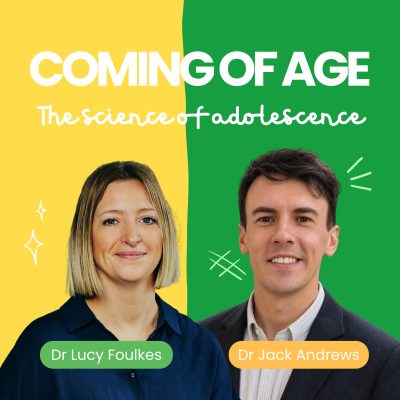
Why do teenagers do things that seem completely reckless, even when they know the risks? In this episode of Coming of Age: The Science of Adolescence, psychologists Lucy Foulkes and Jack Andrews explore what’s really happening when teenagers drink too much, break rules, take risks online or make decisions that leave parents wondering, “What were they thinking?” They reveal why risk-taking can be a surprisingly important part of growing up, and why friends can dramatically change the way a teenage brain responds to risk.
They also explore the risks teenagers are actually more cautious about, from embarrassment and rejection to doing something that could threaten their place in a friendship group. Plus, Lucy and Jack share practical advice for parents on when to draw a firm line, when to allow teenagers room to experiment, and why understanding the psychology behind seemingly “stupid” decisions can help us respond differently.
Get in touch at [email protected]
Research mentioned in this episode:
- Andrews, J. L., Foulkes, L. E., Bone, J. K. & Blakemore, S. J. (2020). Amplified concern for social risk in adolescence: Development and validation of a new measure. Brain Sciences, 10(6), 397.
- Chein, J., Albert, D., O'Brien, L., Uckert, K. & Steinberg, L. (2011). Peers increase adolescent risk taking by enhancing activity in the brain's reward circuitry. Developmental Science, 14(2), F1–F10.
- Ellis, B. J., Del Giudice, M., Dishion, T. J., et al. (2012). The evolutionary basis of risky adolescent behavior: Implications for science, policy, and practice. Developmental Psychology, 48(3), 598–623.
- Gardner, M. & Steinberg, L. (2005). Peer influence on risk taking, risk preference, and risky decision making in adolescence and adulthood: An experimental study. Developmental Psychology, 41(4), 625–635.
- Steinberg, L., Icenogle, G., Shulman, E. P., et al. (2018). Around the world, adolescence is a time of heightened sensation seeking and immature self-regulation. Developmental Science, 21(2), e12532.
Todos os episódios de Coming of Age: The Science of Adolescence