

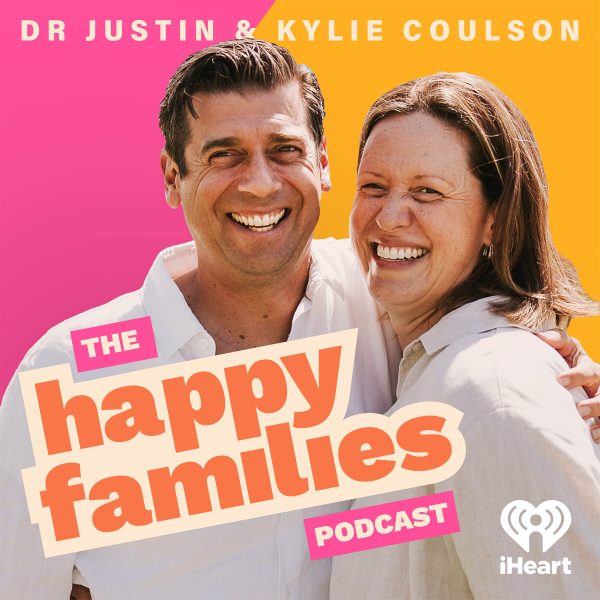
Dr Justin Coulson’s Happy Families
- Episódios
- 1.350
- Publicação
- várias vezes por semana
- Último episódio
- 12 nov 2026
Sobre o podcast
Deciding which parenting advice to follow? Join the thousands of mums and dads who turn to Australia’s most downloaded parenting podcast.
Dr Justin Coulson and his wife Kylie bring real parenting solutions every day, cutting through the noise of modern advice with clear, practical guidance for every step of parenting.
From early childhood challenges to the complexities of the teenage years, each daily episode offers simple, evidence-based strategies to help you feel more confident in your decisions and more connected to your kids.
Episódios 1.350
When Family Conversations Go Wrong, This Is What Matters Most
What do you do when a parenting conversation goes completely off track? Or when one child's big emotions leave the whole family feeling hurt? Justin and Kylie share two very real family moments that didn't go …
Notas do episódio
What do you do when a parenting conversation goes completely off track? Or when one child's big emotions leave the whole family feeling hurt?
Justin and Kylie share two very real family moments that didn't go to plan, but ended with something far more important than getting it right. From failed attempts at the 3 E's to a daughter finding the courage to ask for a hug, this episode explores accountability, unconditional love and why repairing relationships matters more than avoiding conflict.
KEY POINTS:
Why even the best parenting strategies can fall flat when we're frustrated.
How accountability can help children recognise their part in family relationships.
Why a child's big emotions aren't always about you.
The importance of turning towards each other instead of turning away.
How to repair relationships after conflict and hurt feelings.
Why unconditional love doesn't mean ignoring challenging behaviour.
QUOTE OF THE EPISODE:
"Ruptures are inevitable. Repairs, they're not mandatory, but they're not a luxury item if you want your family to flourish."
RESOURCES MENTIONED:
The 3 E's: Explore, Explain and Empower.
Justin Coulson's parenting books.
ACTION STEPS FOR PARENTS:
When a conversation goes sideways, pause and reconnect rather than pushing harder.
Before reacting to your child's big emotions, consider whether something else might be going on.
Make it clear that your love isn't conditional on your child's behaviour.
Model accountability by acknowledging when you've got things wrong.
Choose to turn towards each other and repair the relationship after conflict.
See omnystudio.com/listener for privacy information.
Can AI Predict Which Children Will Struggle With Mental Health?
Could the way your child talks about difficult experiences reveal their future mental health? New research suggests AI might be able to spot warning signs years before depression or anxiety develops. Justin and …
Notas do episódio
Could the way your child talks about difficult experiences reveal their future mental health? New research suggests AI might be able to spot warning signs years before depression or anxiety develops. Justin and Kylie unpack three fascinating studies, including a major new finding on the MMR vaccine and autism, and the surprising reason men temporarily lose their ability to think clearly when talking to attractive women. Yes, really.
KEY POINTS:
How AI identified patterns in children's language that could predict future mental health struggles.
Why feeling socially safe, connected and supported matters when children face adversity.
What a study of 2.56 million children found about the MMR vaccine and autism.
Why the original research linking vaccines to autism was retracted.
The surprising science behind why men can struggle to think clearly when trying to impress women.
QUOTE OF THE EPISODE:
"Resilience is relational. It's about the quality of the connection."
RESOURCES MENTIONED:
Stanford research into AI and childhood mental health, published in Nature Mental Health.
Large-scale MMR vaccine and autism study published in the Pediatric Infectious Disease Journal.
2009 Dutch study exploring the effects of talking to attractive women on men's cognitive performance.
ACTION STEPS FOR PARENTS:
Listen carefully to how your child talks about difficult experiences. Are their stories filled with rejection, exclusion and feeling like they don't belong?
Make connection a priority. Help your child build friendships and relationships with trusted adults.
Encourage activities your child enjoys and looks forward to, whether that's sport, hobbies, music or spending time with family.
Don't rely on ChatGPT or other general AI tools to assess your child's mental health. The research used a specialised tool that is not available as a screening test.
Talk to a health professional if you're concerned about your child's emotional wellbeing.
See omnystudio.com/listener for privacy information.
How to Protect Your Child From Sexual Abuse Without Scaring Them [with Karen Phillip]
What if the person your child needs protection from is someone they already know and trust? Child sexual abuse is an uncomfortable topic, but staying silent can leave children without the knowledge or …
Notas do episódio
What if the person your child needs protection from is someone they already know and trust? Child sexual abuse is an uncomfortable topic, but staying silent can leave children without the knowledge or confidence to speak up. Dr Justin Coulson talks with counselling psychotherapist Karen Phillip, author of I Thought He Was My Friend, about grooming, recognising warning signs, teaching children the difference between secrets and surprises, and helping them find their voice. Learn how to have age-appropriate conversations that keep children safe without making them afraid of the world.
KEY POINTS:
Why children are often harmed by someone they already know and trust.
The difference between secrets and surprises, and why the distinction matters.
How grooming uses trust, threats and secrecy to silence children.
Why children need to know they don't have to be polite when someone makes them uncomfortable.
How to recognise changes in behaviour, including refusing to visit certain people or places.
How to ask open-ended questions and listen without leading your child's answers.
Why conversations about personal safety need to start when children are young.
QUOTE OF THE EPISODE:
"If it's not feeling comfortable for you, then it's not right for you."
RESOURCES MENTIONED:
I Thought He Was My Friend by Karen Phillip
Happy Families: happyfamilies.com.au
ACTION STEPS FOR PARENTS:
Teach your children that surprises are shared, but secrets should never have to be kept.
Remind them they never have to be polite when someone crosses their boundaries.
Start age-appropriate conversations about personal safety from a young age.
Ask open-ended questions such as "What's making you feel uncomfortable?" rather than questions that suggest an answer.
Take changes in behaviour seriously, especially when a child suddenly refuses to visit someone or go somewhere.
Make sure your child knows they can always tell you something, and you will listen without getting angry.
See omnystudio.com/listener for privacy information.
The Surprising Power of Giving Kids a Say - A Homeschool Trip to China
What happens when a child who hates holidays, refuses new foods and struggles with unfamiliar places chooses a trip to China? Kylie shares how giving their 12-year-old daughter a say in the family holiday led …
Notas do episódio
What happens when a child who hates holidays, refuses new foods and struggles with unfamiliar places chooses a trip to China? Kylie shares how giving their 12-year-old daughter a say in the family holiday led to an experience that surprised everyone. From trying unfamiliar food to making new friends and exploring the Great Wall of China, this trip offered some unexpected lessons in parenting, independence and giving kids more control. Discover how to get reluctant kids excited about family holidays without letting them dictate every detail.
Key Points:
Why asking kids what they actually want from a holiday can change their attitude.
How giving children a say builds autonomy and cooperation.
Why a group tour can be a great option for travelling with kids.
Preparing reluctant eaters for unfamiliar food and new experiences.
How hands-on activities make holidays more engaging for children.
Giving kids choices without handing over all the decisions.
Recognising when children need downtime and when they're ready for a challenge.
Quote of the Episode:
"The biggest highlight for me was watching our 12-year-old. It was almost like she was growing up right before my eyes."
Action Steps for Parents:
Ask your child what they don't enjoy about family holidays.
Give them a chance to suggest destinations or activities they'd love to experience.
Find small ways to offer choices, even if they're too young to choose the destination.
Look for hands-on experiences that let kids explore, create and learn.
Talk about unfamiliar food and experiences before you travel.
Allow room for rest and downtime rather than filling every moment.
Consider a group tour if your children enjoy being around other kids.
See omnystudio.com/listener for privacy information.
Why the Smallest Family Rituals Matter Most
Your kids might roll their eyes at you today, but the little things you do as a family could become the memories they treasure for a lifetime. Justin and Kylie share why family traditions matter, how unexpected …
Notas do episódio
Your kids might roll their eyes at you today, but the little things you do as a family could become the memories they treasure for a lifetime. Justin and Kylie share why family traditions matter, how unexpected moments become lasting rituals, and why parenting doesn't always come with the answers. From teenagers who are embarrassed by their parents to a Christmas tradition that nearly got cancelled, this episode is a reminder that the small things often mean the most.
KEY POINTS:
Why parenting doesn't always go to plan, even when you're doing everything right.
Learning to let teenagers grow up without taking their independence personally.
Why family traditions create belonging, identity and lasting memories.
How everyday routines like Sunday dinners can become the traditions children cherish.
Simple ways to create meaningful family traditions without spending money.
QUOTE OF THE EPISODE:
"Traditions often just happen because of what you do with your family on a regular basis."
ACTION STEPS FOR PARENTS:
Think about the little things your family does regularly. Could they already be traditions?
Start a simple ritual, such as Sunday dinner, a family walk or dancing in the kitchen.
Ask your children which family traditions matter most to them.
Don't panic when parenting doesn't go to plan. Keep showing up and give your children room to grow.
See omnystudio.com/listener for privacy information.
Why Smacking Doesn't Work and What Parents Should Do Instead
Is smacking really harmless if you grew up with it? A new Australian study reveals just how many parents still believe physical punishment is acceptable, even when it involves hitting a child with a wooden …
Notas do episódio
Is smacking really harmless if you grew up with it? A new Australian study reveals just how many parents still believe physical punishment is acceptable, even when it involves hitting a child with a wooden spoon or across the face.
Justin and Kylie unpack the research behind smacking, challenge the familiar "I turned out fine" argument and explain why physical punishment doesn't teach children the lessons parents hope it will. More importantly, they share a better way to handle challenging behaviour without hurting your child.
KEY POINTS
What a new Australian study reveals about attitudes towards smacking.
Why "I turned out fine" isn't proof that physical punishment is harmless.
What six decades of research tell us about smacking and children's behaviour.
The links between physical punishment, aggression and mental health struggles.
Why smacking may achieve short-term compliance but doesn't create lasting change.
How to use problem-solving conversations to teach better behaviour.
QUOTE OF THE EPISODE
"Discipline not as an opportunity to hurt our child, but an opportunity to help our child."
RESOURCES MENTIONED
The Fallacy of the 'I Turned Out Fine' Argument The New York Times article by Justin Coulson
Parenting books, articles and free podcast resources at happyfamilies.com.au.
ACTION STEPS FOR PARENTS
Notice when you're reaching for punishment out of frustration.
Wait until everyone is calm before addressing challenging behaviour.
Talk with your child about what went wrong and how to prevent it happening again.
Give your child a chance to help create family rules and solutions.
Focus on teaching the behaviour you want to see, rather than punishing the behaviour you don't.
See omnystudio.com/listener for privacy information.
Bedtime Battles With Older Kids and How to Make Nights Easier [a Listener Q&A]
Bedtime shouldn't end in arguments every night. Justin and Kylie share practical ways to help older kids wind down, stick to routines and take more responsibility for getting enough sleep. From screen time and …
Notas do episódio
Bedtime shouldn't end in arguments every night. Justin and Kylie share practical ways to help older kids wind down, stick to routines and take more responsibility for getting enough sleep. From screen time and dimming the lights to giving teens more control over bedtime, discover how to make evenings calmer and mornings less stressful.
KEY POINTS
Use the Three E's approach: Explore, Explain and Empower to work through bedtime struggles together.
Set consistent evening routines for dinner, showers, homework and getting ready for bed.
Reduce screen time in bedrooms and use dim lighting or music to help everyone wind down.
Slow the evening down with family time and a shared tidy-up.
Give older kids more independence by focusing on getting up on time and managing the consequences of late nights.
QUOTE OF THE EPISODE
“You go to bed when you go to bed. So long as we don't have any problems in the morning, we're all good.”
RESOURCES MENTIONED
Happy Families: happyfamilies.com.au
ACTION STEPS FOR PARENTS
Set aside time this weekend to talk with your kids about what's making bedtime difficult.
Agree on a realistic evening routine that everyone understands.
Check whether screens are keeping your kids awake or making it harder to wind down.
Try dimming the lights and slowing down the pace of the evening.
Give older kids more say in their bedtime while setting clear expectations for getting up in the morning.
See omnystudio.com/listener for privacy information.
The Secrets to a Long, Happy Relationship Revealed
What keeps a relationship strong when life gets hard? Justin and Kylie Coulson unpack 24 years of Australian household data to explore what makes relationships thrive. From sharing the mental and physical load …
Notas do episódio
What keeps a relationship strong when life gets hard? Justin and Kylie Coulson unpack 24 years of Australian household data to explore what makes relationships thrive. From sharing the mental and physical load at home to surviving the stressful years of raising children, discover why relationship satisfaction can dip for decades before reaching its highest point yet.
KEY POINTS
Why sharing the load at home matters more than you might think
How money, housework and parenting pressures affect relationship satisfaction
Why relationships can feel harder during the years of raising children
What changes as couples move into their 40s and 50s
How communication, trust and teamwork help couples stay connected
QUOTE OF THE EPISODE
“When you trust one another, when you believe the other person is going to act in your best interests, and you see that on repeat because they do, that's when people feel high levels of relationship satisfaction.”
RESOURCES MENTIONED
HILDA Survey (Household, Income and Labour Dynamics in Australia)
The Ape That Understood the Universe by Steve Stewart-Williams
A Billion Years of Sex Differences by Steve Stewart-Williams
ACTION STEPS FOR PARENTS
Talk honestly about whether the workload at home feels fair to both of you.
Ask your partner what has been feeling hard lately and listen without getting defensive.
Look for small ways to show your partner they can rely on you.
Remember that you are on the same team, even when you contribute in different ways.
See omnystudio.com/listener for privacy information.
Stop Telling Girls to Put Up With Period Pain [with Anthea Rhodes]
Nine in 10 teens who get periods regularly experience pain, and around half report moderate to severe symptoms. In this episode, Dr Justin Coulson speaks with paediatrician Dr Anthea Rhodes from the Royal …
Notas do episódio
Nine in 10 teens who get periods regularly experience pain, and around half report moderate to severe symptoms. In this episode, Dr Justin Coulson speaks with paediatrician Dr Anthea Rhodes from the Royal Children’s Hospital Melbourne about why so many girls are missing school, sport and social events because of period pain. They unpack the myths parents need to stop believing, how to recognise when pain needs attention, and practical ways to help teens feel supported. Plus, learn why boys need to understand periods too and how families can make these conversations less awkward.
KEY POINTS:
Why period pain shouldn’t be something teens simply have to endure
The signs that pain is interfering with everyday life
Why boys and dads need to understand periods
Practical ways to make period products and support accessible
How to start conversations when teens feel embarrassed asking for help
QUOTE OF THE EPISODE:
“Just because something’s common doesn’t mean there aren’t things that you can do to actually make that better.” Dr Anthea RhodesRESOURCES MENTIONED:
Royal Children’s Hospital Melbourne Teen Health Info and Kids Health Info fact sheets, plus resources from the Pelvic Pain Clinical Network.ACTION STEPS FOR PARENTS:
Ask your teen how their period affects school, sport and friendships.
Take pain seriously, especially when it stops them participating in everyday activities.
Keep period products and suitable pain relief accessible at home and in the car.
Make conversations about periods normal, not embarrassing.
Speak with your GP if symptoms are persistent, severe or not improving.
See omnystudio.com/listener for privacy information.
Paracetamol, Autism and ADHD: What the Latest Research Really Says
Can paracetamol during pregnancy increase the risk of autism or ADHD? Justin and Kylie Coulson unpack four provocative studies challenging what we think we know about pregnancy, relationships, gender …
Notas do episódio
Can paracetamol during pregnancy increase the risk of autism or ADHD? Justin and Kylie Coulson unpack four provocative studies challenging what we think we know about pregnancy, relationships, gender differences and rising neurodevelopmental diagnoses. From a major study examining paracetamol use during pregnancy to the possible reasons autism and ADHD diagnoses are increasing, this episode separates research findings from assumptions and explores what the evidence actually tells us.
KEY POINTS
• What a large study found about paracetamol use during pregnancy and autism or ADHD risk.
• Why men and women may appear to multitask differently.
• How pessimism about relationships may affect young women's expectations for happiness.
• Whether broader diagnostic criteria help explain rising autism and ADHD diagnoses.QUOTE OF THE EPISODE
“Science isn't about convenience.”
RESOURCES MENTIONED
• Prenatal Acetaminophen or Paracetamol Use and the Risk of Autism and ADHD Among Sibling-Matched Cohorts, published in JAMA Internal Medicine.
• Research published in Psychological Research on gender differences in multitasking.
• Suzanne Venker's discussion of heteropessimism on the Modern Wisdom podcast with Chris Williamson.
• Institute for Family Studies article on heteropessimism and relationship outcomes.
• Changes in Genetic Contributions to ASD and ADHD by Year of Diagnosis, published in JAMA Psychiatry.ACTION STEPS FOR PARENTS
• Look at the research behind controversial health claims before accepting or dismissing them.
• Discuss questions about medication during pregnancy with your healthcare professional.
• Focus on finding healthy relationships built on kindness, trust and mutual support.
• Remember that research findings are part of an evolving evidence base, especially when it comes to autism and ADHD.See omnystudio.com/listener for privacy information.
The Truth About Homeschooling and Social Skills [a Listener Q&A]
When school leaves your child overwhelmed, anxious and struggling to learn, is pushing through really the best option? Justin and Kylie Coulson share their experience with homeschooling, the emotional toll of …
Notas do episódio
When school leaves your child overwhelmed, anxious and struggling to learn, is pushing through really the best option? Justin and Kylie Coulson share their experience with homeschooling, the emotional toll of traditional schooling and how to decide what your child needs most. They explore social skills, independence, learning and the importance of helping children feel safe enough to thrive.
Key Points
- How to recognise when traditional schooling isn't working for your child
- Why emotional regulation matters for learning and friendships
The social opportunities children can find outside traditional school
The realities of homeschooling for parents, finances and work
How time at home can help children rebuild confidence and return to school
Quote of the Episode
“How on earth is a child whose emotions are so highly strung in that moment going to learn anything?”
Resources Mentioned
Happy Families: https://happyfamilies.com.au
Action Steps for Parents
Listen to what your child’s behaviour may be telling you about their school experience.
Look into local homeschooling groups and alternative learning options.
Consider your child’s emotional wellbeing alongside their academic and social development.
Build a supportive community where your child can develop friendships, independence and confidence.
See omnystudio.com/listener for privacy information.
Clare Rowe on the Mental Health Industrial Complex
What if all our talk about mental health is making it harder for kids to cope with life? Dr Justin Coulson sits down with educational and developmental psychologist Claire Rowe to unpack the rise of therapy …
Notas do episódio
What if all our talk about mental health is making it harder for kids to cope with life?
Dr Justin Coulson sits down with educational and developmental psychologist Claire Rowe to unpack the rise of therapy speak, the dangers of labelling normal emotions as mental health problems, and why constantly checking in on how our kids feel might not be helping them. Discover how to support children through difficult feelings without teaching them to fear every bump in the road.
Key Points
How therapy speak on social media is changing the way we see ourselves and others
Why labelling children as anxious or sensitive can shape their identity
When mental health labels help and when they go too far
Why taking action and helping others can be more useful than constantly focusing inward
How to build resilience without dismissing children's feelings
Quote of the Episode
“You can do hard things.” Claire Rowe
Resources Mentioned
Rowe and Associates, Sydney
Lucy Foulkes, psychologist and researcher
Sami Timimi, psychiatrist
Abigail Shrier, author
Action Steps for Parents
Talk about feelings using everyday words like worried, sad or disappointed rather than turning every emotion into a label.
Remind your child that difficult feelings are normal and that asking for help is okay.
Encourage them to take small steps through challenging situations instead of automatically avoiding them.
Help them connect with others through family, friendships, sport, hobbies and community.
Let your child know you are there to support them, even when they have a hard day.
See omnystudio.com/listener for privacy information.
Justin Won an Award, But His Biggest Achievement Happened at Home
What matters most when you walk through your front door? Justin Coulson has spent years helping families build happier lives, and his work has now earned him a University of Queensland Vice-Chancellor's Alumni …
Notas do episódio
What matters most when you walk through your front door? Justin Coulson has spent years helping families build happier lives, and his work has now earned him a University of Queensland Vice-Chancellor's Alumni Excellence Award. But the moment that mattered most wasn't the trophy. It was the reminder that strong families change lives, and the most important work we do often happens at home.
Justin and Kylie share the story behind the award, the sacrifices that shaped his career, a hilarious university confession, and the acceptance speech that left a room full of people in tears.
KEY POINTS
Why strong family relationships shape happier, healthier lives
The unexpected path from struggling dad to parenting expert
The people and sacrifices behind Justin's achievement
What research tells us about the lifelong impact of loving caregivers
Why the most important work often happens at home
QUOTE OF THE EPISODE
“The most important work many of us will ever do is not in the office. It's waiting for us when we walk back through our own front door.”
RESOURCES MENTIONED
University of Queensland Vice-Chancellor's Alumni Excellence Awards
Happy Families books and resources at happyfamilies.com.au
ACTION STEPS FOR PARENTS
Make time for connection with your children, even on busy days.
Think about the example you're setting through your relationships.
Recognise the small, everyday things that help your family feel safe, loved and supported.
See omnystudio.com/listener for privacy information.
Rethinking Success After High School
Worried your teenager is falling behind or has no idea what they want to do after school? You’re not alone, and their future is bigger than their grades. Dr Justin Coulson chats with educator and careers expert …
Notas do episódio
Worried your teenager is falling behind or has no idea what they want to do after school? You’re not alone, and their future is bigger than their grades.
Dr Justin Coulson chats with educator and careers expert Dr Jo Winchester about career pressure, gap years, alternative pathways and the changing world of work. They explore how to support neurodivergent kids, take the pressure off big decisions and help young people find a path that fits who they are.
KEY POINTS
Why your child’s ATAR doesn’t define their potential
When a gap year might be the right choice
How to explore careers in a rapidly changing world
Supporting neurodivergent kids without focusing on grades
Helping teenagers make decisions without passing on your anxiety
QUOTE OF THE EPISODE
“The thing that I want you to concentrate on more is, is your child happy? Are they being supported in a loving environment at that school?”
RESOURCES MENTIONED
Dr Jo Winchester for career guidance and free resources
Range by David Epstein
Dark Horse by Todd Rose
ACTION STEPS FOR PARENTS
Take the pressure off choosing a lifelong career right now.
Explore university open days by focusing on the environment and teaching staff, not rankings.
Help your teenager identify their interests, strengths and skills.
Set small, achievable goals if school is a struggle.
Remind your child that their grades are not a measure of their intelligence or future success.
See omnystudio.com/listener for privacy information.
Why Telling Kids to Use Their Words Doesn't Always Work [a Listener Q&A]
Your five-year-old is hitting other children when they're angry, frustrated or feel something is unfair. You've talked about using words, encouraged them to burn off energy and tried everything you can think …
Notas do episódio
Your five-year-old is hitting other children when they're angry, frustrated or feel something is unfair. You've talked about using words, encouraged them to burn off energy and tried everything you can think of. So what actually helps?
Justin and Kylie Coulson explain why young children lash out, how to practise emotional regulation at home and what to do when your child comes home after a difficult day at school. Learn how to set boundaries without shame, build better responses and help your child manage big feelings as their brain develops.
KEY POINTS
Why five-year-olds struggle to control big emotions
How to practise calming strategies before frustration takes over
Why difficult conversations work better when everyone is calm
Helping children find their own solutions to conflict
Responding with compassion while still addressing hitting
How classroom culture and maturity can influence behaviour
QUOTE OF THE EPISODE
“When emotions are hot or high, there's not a lot that soaks in or sinks in.”
RESOURCES MENTIONED
Happy Families: https://happyfamilies.com.au
Send your tricky questions to [email protected]
ACTION STEPS FOR PARENTS
Practise when things are calm. Rehearse taking deep breaths, walking away or asking an adult for help.
Problem-solve together. Ask your child what they could do next time they feel angry or treated unfairly.
Reconnect after school. Offer cuddles, space and understanding before discussing what went wrong.
Keep the boundary clear. Acknowledge their feelings while making it clear that hitting isn't okay.
Give them time to learn. Emotional regulation develops gradually, and children need repeated practice and support.
See omnystudio.com/listener for privacy information.
5 Secrets to Raising Resilient Kids Who Can Handle Hard Things
When your child is anxious, overwhelmed or afraid, should you step in or let them work it out? The answer could change how you parent. Justin and Kylie Coulson share five research-backed ways to build …
Notas do episódio
When your child is anxious, overwhelmed or afraid, should you step in or let them work it out? The answer could change how you parent.
Justin and Kylie Coulson share five research-backed ways to build resilience in children, from listening without rushing to fix things to letting kids tackle challenges, take safe risks and discover what they're capable of. Because raising resilient kids isn't about toughening them up. It's about giving them the support and confidence to face hard things.
KEY POINTS
Why feeling cared for and listened to is the foundation of resilience
How staying calm helps children manage big emotions
When to support your child and when to resist the urge to rescue them
How family identity and purpose help kids through difficult experiences
Why independent activity and safe, risky play build confidence
QUOTE OF THE EPISODE
“Resilience is built as much inside a child as it is built around a child.”
RESOURCES MENTIONED
Happy Families: https://happyfamilies.com.au
Andrew Fuller, Australian psychologist and resilience researcher
Steve Biddulph, parenting expert
Anne Masten, resilience researcher
Peter Gray, play researcher
ACTION STEPS FOR PARENTS
Put your phone down and give your child your full attention when they want to talk.
Take a slow, audible breath before responding to your child's big emotions.
Encourage your child to try something difficult before stepping in to rescue them.
Find small ways for your child to contribute to your family and feel part of something bigger.
Give your child age-appropriate opportunities to explore, play independently and take safe risks.
See omnystudio.com/listener for privacy information.
What Failure Taught Justin About Asking for Help
What happens when you give everything you have and still can’t finish? Justin shares the emotional reality of attempting a 50km charity walk with a 10kg vest, battling an injury and facing the decision to quit …
Notas do episódio
What happens when you give everything you have and still can’t finish? Justin shares the emotional reality of attempting a 50km charity walk with a 10kg vest, battling an injury and facing the decision to quit.
Justin and Kylie reflect on failure, resilience and the courage it takes to admit when you need help. They also share how their Lift the Load challenge raised almost $95,000 for Top Blokes, helping more young men access vital mentoring and support.
KEY POINTS
- Why admitting you need help can be harder than pushing through.
- The difference between resilience and ignoring your limits.
- How asking for help can change the outcome.
- Why we can support others without carrying everything for them.
- How one person's actions can inspire a whole community.
QUOTE OF THE EPISODE
“It's wonderful when you feel strong and capable that you would offer to carry somebody else's load. But there comes a time where you have to recognise when that load is no longer bearable.”
RESOURCES MENTIONED
ACTION STEPS FOR PARENTS
- Show your children that asking for help is a strength, not a weakness.
- Talk about the difference between giving up and recognising when something needs to change.
- Check in with the people around you. Ask how they're really going and listen to the answer.
- Remind your family that supporting someone doesn't mean carrying every burden for them.
See omnystudio.com/listener for privacy information.
When Your Phone Gets Between You and Your Child
Your phone might be getting in the way of your child’s learning, confidence and connection with you. Justin and Kylie Coulson unpack three research findings every parent should know, from the link between heavy …
Notas do episódio
Your phone might be getting in the way of your child’s learning, confidence and connection with you.
Justin and Kylie Coulson unpack three research findings every parent should know, from the link between heavy AI use and lower school test scores to why early puberty may increase anxiety risk in girls. They also explore how being ignored while a parent scrolls can affect a teenager’s sense of security in the relationship.
Discover what the research tells us, where the limits of the evidence lie, and how to give your child more opportunities to feel supported, connected and confident.
KEY POINTS
- AI and learning: Students who frequently use AI chatbots for schoolwork scored lower in science and reading than those who rarely use them. How children use AI matters.
- Early puberty and anxiety: Research links earlier, faster puberty in girls with a higher risk of anxiety symptoms. Supportive relationships may help provide important protection.
- Phone distraction and attachment: Teenagers who feel ignored by a parent’s phone use are more likely to report insecure attachment to that caregiver.
QUOTE OF THE EPISODE
“She needs protective factors in her life.”
RESOURCES MENTIONED
- PISA assessment findings on AI use and student performance, reported by Lucy Carroll in The Australian
- Danish National Birth Cohort analysis on pubertal development and anxiety, published in the Journal of Affective Disorders
- Research examining parental phone use, "phubbing" and adolescent attachment
ACTION STEPS FOR PARENTS
- Encourage your child to use AI to explore ideas and learn, rather than letting it do their thinking or writing for them.
- If your daughter experiences early puberty, focus on supportive relationships, trusted role models and a safe home environment.
- Put your phone away when your child is trying to connect with you. Give them your attention, listen and show them they matter.
- Remember that research showing a link between two things does not automatically prove that one causes the other.
See omnystudio.com/listener for privacy information.
The Side of Justin Coulson You Don’t Usually Hear (Happy Birthday Dr J!)
Behind the parenting advice is a dad, a husband, a son and a grandad who’s still learning as he goes. For Justin Coulson’s birthday, Kylie takes the microphone and asks the questions we don’t usually hear on …
Notas do episódio
Behind the parenting advice is a dad, a husband, a son and a grandad who’s still learning as he goes.
For Justin Coulson’s birthday, Kylie takes the microphone and asks the questions we don’t usually hear on the Happy Families podcast. From the grandmother who made him feel like the favourite to the moment he burst into tears at the news he was becoming a grandad, Justin shares the memories, mistakes and moments that shaped him.
He also reveals the question from one father that changed the way he thinks about parenting. It’s a reminder that being a better parent starts with looking at ourselves.
KEY POINTS
The childhood memories and family relationships that shaped Justin
The overwhelming joy of becoming a grandfather
Why his enthusiasm for research is sometimes mistaken for arrogance
The parenting question he’s never forgotten
The hard-won lessons behind his books
What he hopes to achieve in the year ahead
QUOTE OF THE EPISODE
“How do I be the father that my son needs me to be?”
RESOURCES MENTIONED
Happy Families: https://happyfamilies.com.au
Justin Coulson’s parenting books
ACTION STEPS FOR PARENTS
Ask yourself what kind of parent your child needs you to be right now.
Think about the parenting habits you inherited from your own parents. Which ones do you want to keep, and which ones do you want to change?
Give yourself permission to keep learning. Even the experts have lessons they learn the hard way.
See omnystudio.com/listener for privacy information.
Calmer School Mornings Start the Night Before [a Listener Q&A]
School mornings shouldn't end with tears, frustration and everyone feeling like they've failed. Justin and Kylie answer Emma's question about her two daughters and share practical ways to make getting ready for …
Notas do episódio
School mornings shouldn't end with tears, frustration and everyone feeling like they've failed. Justin and Kylie answer Emma's question about her two daughters and share practical ways to make getting ready for school less stressful.
From preparing the night before to swapping constant instructions for connection, discover how small changes can help your kids feel more capable and get everyone out the door in a better mood.
Key Points
Prepare uniforms, bags, lunches and everything else the night before.
Get up early enough to feel calm and ready to help.
Reduce morning stress by removing unnecessary steps.
Replace constant instructions with connection and offers of support.
Create a simple checklist with your kids so they know what's next.
Make mornings fun with music, games and family routines.
Quote of the Episode
“The more you can do tonight, the less you have to do tomorrow morning.”
Resources Mentioned
The Parenting Revolution by Justin Coulson
Happy Families: happyfamilies.com.au
Action Steps for Parents
Get school bags, uniforms and shoes ready tonight.
Make a simple morning checklist with your kids.
Ask “What's next on your list?” instead of telling them what to do.
Sit with your kids at breakfast and offer help when they need it.
Try a morning playlist to make getting ready more fun.
See omnystudio.com/listener for privacy information.
How to Ruin a Child [with Richard Glover]
What if some of the parenting advice you’ve been given was completely wrong? Richard Glover has spent years digging through Australian parenting manuals, government advice and expert recommendations from the …
Notas do episódio
What if some of the parenting advice you’ve been given was completely wrong?
Richard Glover has spent years digging through Australian parenting manuals, government advice and expert recommendations from the past 100 years. What he found is funny, disturbing and surprisingly reassuring.
From being told not to cuddle a crying baby to warnings that praise would make children arrogant, Richard reveals how generations of parents were taught to ignore their instincts. He also explains why looking back at parenting history can help us stop chasing every new expert theory and trust ourselves a little more.
KEY POINTS
- Why parents were once told not to cuddle crying babies
- How government parenting advice shaped generations of Australian families
- Why harsh parenting keeps coming back in new forms
- What history can teach us about today's parenting trends
- Why parents can be more forgiving of their own childhood experiences
- The simple things children actually need: love, stability and age-appropriate limits
QUOTE OF THE EPISODE
“Children need stability, a sense of order, a sense of rules, and they need a lot of love.”
RESOURCES MENTIONED
How to Ruin a Child by Richard Glover
ACTION STEPS FOR PARENTS
- Be wary of extreme parenting advice that promises one perfect way to raise children.
- Trust your instincts when something feels wrong.
- Give your children clear, age-appropriate boundaries alongside plenty of love.
- Remember that you don't have to get parenting perfect to raise a perfectly decent human being.
See omnystudio.com/listener for privacy information.
Lift The Load Appeal
Today Justin is taking on a gruelling 50km walk carrying a 10kg vest to raise $50,000 for Top Blokes, a mentoring program helping young men build resilience, develop healthy relationships and learn to ask for …
Notas do episódio
Today Justin is taking on a gruelling 50km walk carrying a 10kg vest to raise $50,000 for Top Blokes, a mentoring program helping young men build resilience, develop healthy relationships and learn to ask for help.
After losing his nephew Logan to suicide, this mission is deeply personal.
We need just 600 more people to donate $50 each to reach this target. Can you help lift the load? Donate here!
See omnystudio.com/listener for privacy information.
Is 'Letting Go' the Hardest Part of Parenting?
Parenting gets harder when your kids start needing you less. Justin and Kylie talk about the messy reality of raising children who eventually leave home, make their own choices and face hard things without you …
Notas do episódio
Parenting gets harder when your kids start needing you less.
Justin and Kylie talk about the messy reality of raising children who eventually leave home, make their own choices and face hard things without you beside them. They share a beautiful reminder that resilience rarely looks neat, why the struggle matters, and why the goal of parenting is to make yourself redundant.
They also talk about Justin’s 50K for 50K Lift the Load challenge, raising money to help Top Blokes support boys with mentors and positive models of masculinity.
KEY POINTS
- Resilient kids don’t always look confident. Sometimes resilience looks messy, uncertain and uncomfortable.
- Your child’s struggle isn’t always something you need to fix. Some struggles are where growth happens.
- Kids spell love T-I-M-E. Time with your children still matters when they become adults.
- The goal of parenting is to make yourself redundant. When children no longer need you, they can choose to come back because they want to.
- Raising boys well means giving them positive models of masculinity, kindness, respect and healthy relationships.
- Sometimes doing something meaningful means stepping well outside your comfort zone.
QUOTE OF THE EPISODE
“Make yourself redundant. And the great irony is, if you do it well, because they don’t need you, they come back not because they need you, but because they want to be there.”
RESOURCES MENTIONED
ACTION STEPS FOR PARENTS
- Resist the urge to rescue your child from every uncomfortable experience.
- Give your kids time, even when they’re older and independent.
- When your child is struggling, ask yourself whether they need rescuing or simply need you beside them.
- Look for opportunities to model kindness, respect and healthy relationships.
- Think about one thing you can do tomorrow that strengthens your relationship with your child.
See omnystudio.com/listener for privacy information.
Why Your Kids Stop Telling You Things
The more you monitor your kids, the more they might hide. Research on parental monitoring shows that knowing where your kids are matters far less than creating a relationship where they feel safe telling you …
Notas do episódio
The more you monitor your kids, the more they might hide.
Research on parental monitoring shows that knowing where your kids are matters far less than creating a relationship where they feel safe telling you what is really going on. Justin and Kylie Coulson unpack what the research says about disclosure, surveillance, rules and trust, and share five practical ways to help your kids keep talking when things go wrong.
KEY POINTS
- Why kids' voluntary disclosure tells parents more than surveillance
- How negative reactions can lead to more secrecy
- Why punishment can shut down honesty
- How to respond when your child tells you something difficult
- Why clear reasons and autonomy-supportive rules build trust
- Why covert snooping can make kids sneakier
- How to stay connected as children become more independent
- The difference between emotion for your child and emotion at your child
QUOTE OF THE EPISODE
“Location apps will show you where they are, but only the relationship that you have will tell you how they are.”
RESOURCES MENTIONED
- Stattin and Kerr's 2003 research on parental monitoring and disclosure
- Weinstein and Schabulski's research on autonomy-supportive parenting
ACTION STEPS FOR PARENTS
- Take a breath before reacting when your child tells you something difficult.
- Say, “I’m glad you told me,” before jumping into consequences.
- Focus on solving the problem rather than punishing the disclosure.
- Explain why your rules exist and give your child choices where you can.
- Create regular opportunities to talk without turning every conversation into an interrogation.
- Get curious, not furious.
- Don't rely on covert snooping to find out what your child is doing.
See omnystudio.com/listener for privacy information.
Is Australia’s Social Media Ban Working? Anika Wells on What Comes Next
Australia made global headlines when it introduced a minimum age of 16 for social media. But months on, more than eight in 10 kids are still using age-restricted platforms. Justin Coulson sits down with Federal …
Notas do episódio
Australia made global headlines when it introduced a minimum age of 16 for social media. But months on, more than eight in 10 kids are still using age-restricted platforms.
Justin Coulson sits down with Federal Communications Minister Anika Wells to ask what is happening, why compliance has been so difficult, and what the new Digital Duty of Care could mean for families.
The proposed laws go beyond social media to cover gaming, AI chatbots and other online platforms, with new requirements around harmful content and addictive design features such as endless scrolling and popularity metrics.
KEY POINTS
- Why compliance with the under-16 social media laws has been slower than expected
- Why the responsibility needs to sit with big tech, not exhausted parents
- What the proposed Digital Duty of Care could change
- How AI, gaming, chatbots and other platforms will be covered
- The harmful content and design features the government wants platforms to address
- What age verification means for access to pornography
- Why VPNs and other workarounds make online safety harder
- The early signs that some young Australians are sleeping better, playing more sport and seeing less online bullying
QUOTE OF THE EPISODE
“This is about introducing some basic safety standards to an industry that hasn’t had any.”
Anika WellsRESOURCES MENTIONED
- Australia’s under-16 social media legislation
- The proposed Digital Duty of Care
- eSafety Commissioner research and long-term studies
- Australia’s online pornography age-verification laws
- happyfamilies.com.au
ACTION STEPS FOR PARENTS
- Talk with your kids about why these laws exist rather than making the conversation only about rules.
- Keep an eye on the platforms, games and AI tools your children are using.
- Pay attention to sleep, mood, sport, friendships and offline activities, not just screen-time minutes.
- Use the law as a support when conversations about online safety become difficult.
- Stay informed as the Digital Duty of Care develops.
See omnystudio.com/listener for privacy information.
When School Isn’t Working, Find a Better Path [a Listener Q&A]
What do you do when your 17-year-old refuses to go to school, skips classes and has no idea what he wants to do instead? Justin and Kylie tackle a tricky question from a parent whose son is struggling with Year …
Notas do episódio
What do you do when your 17-year-old refuses to go to school, skips classes and has no idea what he wants to do instead?
Justin and Kylie tackle a tricky question from a parent whose son is struggling with Year 11. They explore vocational schools, apprenticeships, TAFE, distance education and the idea that education doesn’t have to mean sitting in a classroom until Year 12. The goal is to help young people keep learning, contributing and moving forward without forcing them into a path that clearly isn’t working.
KEY POINTS:
- Why school isn’t the only way to get an education
- Vocational schools and hands-on learning
- School-based apprenticeships and TAFE
- Why “earning or learning” is a useful family expectation
- Helping teenagers build character, reliability and practical skills
- Why a 17-year-old doesn’t need their whole future figured out
- Finding purpose through contribution and solving real problems
QUOTE OF THE EPISODE:
“You need to be either full-time earning or full-time learning.”RESOURCES MENTIONED:
- Boys: Building Strong Young Men from the Inside Out by Justin Coulson
- The Industry School
- School-based apprenticeships
- TAFE and vocational education
- Lift the Load 50 for 50 fundraiser for Top Blokes
ACTION STEPS FOR PARENTS:
- Talk to your child’s school about alternative pathways.
- Look beyond university and traditional Year 12 pathways.
- Explore apprenticeships, TAFE, vocational schools and practical training.
- Help your teenager find something that builds skills and a sense of contribution.
- Take the pressure off having their entire future figured out at 17.
- Focus on reliability, communication, initiative and integrity.
See omnystudio.com/listener for privacy information.
The Real Mrs Happy Families (Happy Birthday Kylie!)
It’s Mrs Happy Families’ birthday week, so Justin puts Kylie on the spot with questions she hasn’t seen before. There are childhood confessions, a $2 garage sale bargain, a surprising celebrity crush …
Notas do episódio
It’s Mrs Happy Families’ birthday week, so Justin puts Kylie on the spot with questions she hasn’t seen before. There are childhood confessions, a $2 garage sale bargain, a surprising celebrity crush, competitive board games, laundry, parenting wisdom and one deeply meaningful question about how she hopes her six children will remember her.
Kylie also opens up about setting herself a big goal, learning to value the progress rather than just the number, and the moment she realised she could be proud of herself.
It’s funny, honest and unexpectedly moving.
KEY POINTS:
- Why Kylie thinks her daughter Abby is most like her
- The $2 garage sale find that became a handmade baby quilt
- Why laundry is Kylie’s favourite household job
- Kylie’s surprising running anthem
- The competitive streak Justin insists she has
- The parenting moment that made Kylie most proud
- What Kylie hopes her children remember about her
QUOTE OF THE EPISODE:
“I would rather be 10 kilos lighter at the end of the year and not reach my goal of 20 kilos than to be sitting where I was at the beginning of the year without any hope or a desire to make the changes necessary.”ACTION STEPS FOR PARENTS:
- Ask yourself what you hope your children will remember about you when they are adults.
- Notice the progress you are making instead of focusing only on whether you have reached the goal.
- Ask your children what they love most about you. Their answers might surprise you.
See omnystudio.com/listener for privacy information.
The Digital Duty of Care Is Coming [with Anika Wells]
More than eight in ten Australian kids were still using age-restricted social media platforms months after the under-16 law came into effect. So is the legislation working? Justin speaks with Federal …
Notas do episódio
More than eight in ten Australian kids were still using age-restricted social media platforms months after the under-16 law came into effect. So is the legislation working?
Justin speaks with Federal Communications Minister Anika Wells about what has happened since the social media minimum age law began, why compliance has been slower than expected, and what the new Digital Duty of Care could mean for families.
The proposed laws go much further than social media. They cover AI chatbots, online games, messaging platforms and other digital services, with new responsibilities for tech companies to identify and reduce risks to children.
They also tackle harmful content, addictive design features, algorithmic feeds and the growing challenge of keeping kids safe from pornography and other dangerous material online.
KEY POINTS
- Why more than 80% of children were still using age-restricted platforms
- Why enforcement against big tech takes time
- What the Digital Duty of Care would change for parents
- How AI chatbots, gaming and messaging platforms could be covered
- The harmful content platforms would have to address
- What "safety by design" could mean for kids
- How algorithmic feeds could change
- The challenges created by VPNs and children accessing pornography
- Why group chats and private sharing are harder for parents to monitor
- What the government says is changing for young Australians
QUOTE OF THE EPISODE
"We want you to be able to say, this is the law and you can point to the law to try and address these daily fights that people are having in their home."
ACTION STEPS FOR PARENTS
- Talk with your kids about what they are seeing online, including content shared privately in group chats.
- Check which social media, gaming, messaging and AI platforms your child is using.
- Look at the feed settings on platforms your family uses and understand whether algorithmic recommendations can be changed.
- Keep talking about pornography and harmful online content before your child encounters it.
- Use Australia's changing online safety laws as a starting point for conversations about what is and isn't acceptable online.
See omnystudio.com/listener for privacy information.
Just Do Something - The Ultimate Wellness Hack
What if improving your wellbeing was far simpler than you thought? In this Doctor’s Desk episode, Justin and Kylie unpack a huge new scientific review published in Nature that analysed 183 wellbeing studies …
Notas do episódio
What if improving your wellbeing was far simpler than you thought?
In this Doctor’s Desk episode, Justin and Kylie unpack a huge new scientific review published in Nature that analysed 183 wellbeing studies involving nearly 23,000 people worldwide. The conclusion? You don’t need the perfect routine, expensive programs, or hours of free time to feel better.
You just need to do something.
From exercise and mindfulness to yoga, gratitude, therapy, and simple self-awareness practices, the research shows that consistent small actions have a powerful impact on mental health and happiness. Justin and Kylie also share their own honest experiences of trying to prioritise wellbeing in the middle of busy family life.
If you’ve been waiting for the “right time” to take care of yourself, this episode is your reminder that small steps still count.
KEY POINTS:
- A major Nature study reviewed 183 wellbeing interventions
- Exercise combined with psychological support had the strongest results
- Mindfulness, gratitude, yoga, and compassion practices all improved wellbeing
- Consistency matters more than perfection
- Small actions done regularly can create major emotional shifts
- Parents don’t need hours of free time for self-care to work
QUOTE OF THE EPISODE:
“Don’t overthink the perfect wellbeing routine. Just do something.”RESOURCES MENTIONED:
- Nature systematic review and meta-analysis on wellbeing interventions
- Acceptance and Commitment Therapy (ACT)
- Mindfulness and positive psychology practices
- Boys: Building Strong Young Men from the Inside Out by Dr Justin Coulson
ACTION STEPS FOR PARENTS:
- Choose one simple wellbeing habit you can realistically repeat this week
- Aim for consistency over intensity
- Pair movement with reflection, mindfulness, or connection
- Notice how you feel when you stop prioritising your wellbeing
- Give yourself permission to start small rather than waiting for perfect conditions
See omnystudio.com/listener for privacy information.
Raising Kids Who Can Handle Hard Things [with Ant Williams]
What if protecting our kids too much is actually holding them back? In this powerful conversation, Dr Justin Coulson sits down with extreme athlete, sports psychologist, and author Ant Williams to unpack why so …
Notas do episódio
What if protecting our kids too much is actually holding them back?
In this powerful conversation, Dr Justin Coulson sits down with extreme athlete, sports psychologist, and author Ant Williams to unpack why so many kids struggle with pressure, discomfort, and resilience — and what parents can do differently.
From diving beneath Arctic ice to coaching elite athletes under extreme stress, Ant shares the mindset shifts that help people stay calm, capable, and courageous when life gets hard. Together, they explore the parenting habits that unintentionally weaken resilience, the fine line between support and overprotection, and why kids need opportunities to struggle, fail, and recover.
If your child avoids hard things, melts down under pressure, or constantly says “I can’t”, this episode will change the way you respond.
KEY POINTS
- Why resilience is built through challenge — not comfort
- The difference between being a safety net and a shield
- How parents accidentally reinforce anxiety and avoidance
- Why kids need evidence they can handle hard things
- The long-term risks of wrapping children in cotton wool
- How your reactions to stress become your child’s template
- The simple “fish hook” strategy for staying calm under pressure
- Why modelling courage matters more than preaching confidence
QUOTE OF THE EPISODE
“Our reaction becomes their template.”
RESOURCES MENTIONED
- Let It Be Tough by Ant Williams
- Resilience: Developing strength, calm, & kindness in our kids [a Happy Families Webinar]
ACTION STEPS FOR PARENTS
- Resist rescuing your child from every uncomfortable situation
- Encourage small, manageable challenges that build confidence
- Talk openly about your own fears and how you handle them
- Stay calm during stressful moments — your child is learning from your response
- Focus on supporting your child, not shielding them
- Help kids reflect after setbacks instead of immediately fixing things
See omnystudio.com/listener for privacy information.
Aqui estão os 40 episódios mais recentes de 1.350. Os mais antigos estão no feed do podcast.
Podcasts parecidos
Mais podcasts de Sociedade e cultura







Este podcast é seu?
Confirme com uma entrada no seu feed: você recebe um código aqui, adiciona como podcast:txt no canal do seu feed e nós verificamos. Depois disso, seu podcast aparece como “verificado” no SoundNode.