

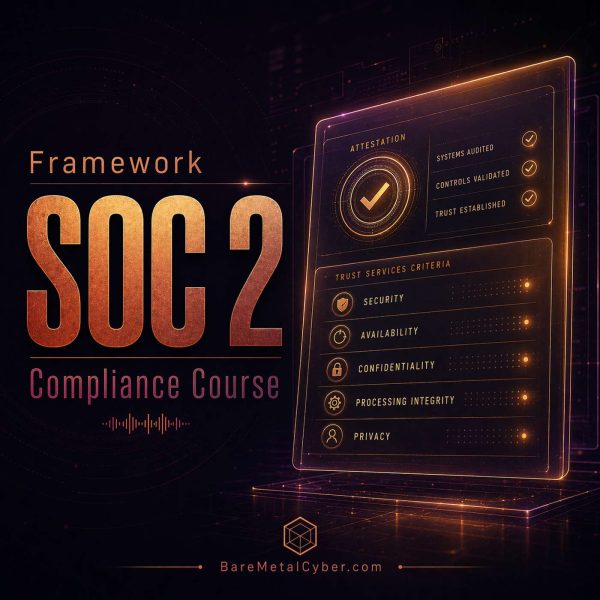
Framework – SOC 2 Compliance Course
- Episódios
- 65
- Formato
- Série – ouça desde o começo
- Último episódio
- 14 out 2025
Sobre o podcast
The **SOC 2 Compliance Audio Course** is your comprehensive, audio-first guide to understanding and implementing the Service Organization Control (SOC) 2 framework from the ground up. Designed for cybersecurity professionals, auditors, and business leaders, this course breaks down the American Institute of Certified Public Accountants (AICPA) Trust Services Criteria into clear, practical lessons that connect compliance theory with daily operational reality. Each episode explores essential concepts such as governance, risk assessment, security controls, and audit preparation—helping you understand how SOC 2 reports demonstrate assurance to customers and regulators. The course takes a structured approach to explaining each trust principle—**Security, Availability, Processing Integrity, Confidentiality, and Privacy**—and how they apply to different types of organizations. Listeners learn how to interpret requirements, design and map controls, gather appropriate evidence, and prepare for external audits with confidence. Real-world examples illustrate how companies build policies, implement technical safeguards, and maintain continuous compliance in dynamic cloud and enterprise environments. Developed by **BareMetalCyber.com**, the SOC 2 Compliance Audio Course turns complex assurance standards into straightforward, usable knowledge. Whether you’re building a program from scratch or refining an existing one, this course helps you gain a clear understanding of how SOC 2 fits into broader governance and risk frameworks—giving you the insight to achieve and sustain trusted, auditable security practices.
Episódios 65
Episode 64 — Pre-Sales Enablement: Using SOC 2 to Accelerate Deals
SOC 2 becomes a sales accelerator when its lessons and artifacts are packaged for fast, consistent buyer due diligence. The exam will expect you to explain how to translate control narratives and evidence into …
Notas do episódio
SOC 2 becomes a sales accelerator when its lessons and artifacts are packaged for fast, consistent buyer due diligence. The exam will expect you to explain how to translate control narratives and evidence into customer-ready answers: a concise overview of scope and criteria selected, a timeline of Type I and Type II coverage periods, and a mapping of common procurement questions to specific report sections. Build a reusable “assurance pack” that includes the attestation report under NDA, a security overview deck, crosswalks to frameworks buyers care about, and a summary of recent improvements that demonstrates a living program. Pre-sales teams must know what the report says—and what it does not—so they avoid over-promising and can route deeper questions to the right owners quickly.
Operationalize enablement through a trust portal, standardized response language, and an intake process that logs questionnaires, shares approved artifacts, and tracks commitments made during calls. Train account teams on confidentiality boundaries, common carve-outs, and how to explain CUECs without implying gaps. Instrument the process: measure cycle time from request to approval, correlate artifact views with deal velocity, and collect recurring questions to refine content and the control environment itself. For audits, this same machinery provides distribution logs, disclosure approvals, and consistency across responses. Done well, SOC 2 moves from compliance cost to growth engine—shortening security review loops, building credibility with procurement and legal teams, and creating a feedback channel that continuously sharpens both security posture and customer experience. Produced by BareMetalCyber.com, where you’ll find more cyber audio courses, books, and information to strengthen your educational path. Also, if you want to stay up to date with the latest news, visit DailyCyber.News for a newsletter you can use, and a daily podcast you can commute with.
Episode 63 — Pentest Scoping, Findings Lifecycle, Remediation Proof
Penetration testing complements SOC 2 by validating the real-world effectiveness of defenses, but its value depends on disciplined scope and a complete findings lifecycle. The exam will expect you to …
Notas do episódio
Penetration testing complements SOC 2 by validating the real-world effectiveness of defenses, but its value depends on disciplined scope and a complete findings lifecycle. The exam will expect you to distinguish between internal and external testing, application and network layers, authenticated and unauthenticated approaches, and rules of engagement that protect production stability. Scope should reflect in-scope systems and data flows, including APIs, mobile apps, and cloud control planes where appropriate. Testing cadence aligns to risk and change velocity, while methodology references recognized standards to ensure repeatability. Most importantly, results must feed into a structured lifecycle that starts with triage and ends with verified closure, demonstrating that detected weaknesses become prioritized, resourced work rather than shelfware.
Operationally, maintain a single register for findings across pentests, bug bounty, and scanning so duplicates are reconciled and ownership is clear. Classify severity with business context, create tickets with exploit details and reproduction steps, and define service-level targets for remediation. Require evidence of fix validation—screenshots alone rarely suffice; show code diffs, configuration changes, and retest artifacts from the tester or an independent validator. Track systemic themes—secrets in repos, missing input validation, misconfigured identity providers—and ship backlog items that eliminate entire classes of defects. For auditors, provide statements of work, tester independence, scope maps, raw and sanitized reports, proof of customer notification when commitments require it, and closure samples that include dates, commit hashes, and retest results, proving an end-to-end loop from discovery to durable risk reduction. Produced by BareMetalCyber.com, where you’ll find more cyber audio courses, books, and information to strengthen your educational path. Also, if you want to stay up to date with the latest news, visit DailyCyber.News for a newsletter you can use, and a daily podcast you can commute with.
Episode 62 — IaC Guardrails & Policy-as-Code (OPA, conftest, SCPs)
Infrastructure as Code accelerates delivery, but it can also scale misconfigurations, so SOC 2 programs enforce guardrails that codify security expectations and make them testable. For the exam, connect IaC to …
Notas do episódio
Infrastructure as Code accelerates delivery, but it can also scale misconfigurations, so SOC 2 programs enforce guardrails that codify security expectations and make them testable. For the exam, connect IaC to CC7 and CC8: baselines live in version control, changes flow through pull requests, and policy-as-code engines such as Open Policy Agent with conftest, cloud service control policies, and organizational policies enforce least privilege, encryption, networking boundaries, and tagging. The objective is to prevent drift pre-merge and pre-deploy, not merely detect it later. Treat guardrails as unit tests for infrastructure: if a template asks for a public bucket or an overly broad role, the check fails and the pipeline blocks, creating repeatable assurance that configuration matches documented standards across accounts, regions, and environments.
Operational success depends on layering controls. Use static checks in repositories, admission controllers in clusters, and cloud-native preventive controls at the org root to deny dangerous patterns globally. Maintain exception workflows with time-boxed waivers, risk justification, and compensating controls so deviations remain visible and temporary. Measure posture with continuous conformance scans and remediate via automated pull requests that propose compliant changes. For evidence, export policy bundles with version hashes, store pipeline logs showing pass/fail with rule IDs, and sample merged changes demonstrating that prohibitions actually prevented misconfigurations. Pair this with periodic “break-glass” reviews of SCP effectiveness and org-wide policy audit trails. The result is a closed loop: codified intent, enforced at build and deploy, verified at runtime, and evidenced with artifacts an auditor can reproduce from the same repositories and pipelines. Produced by BareMetalCyber.com, where you’ll find more cyber audio courses, books, and information to strengthen your educational path. Also, if you want to stay up to date with the latest news, visit DailyCyber.News for a newsletter you can use, and a daily podcast you can commute with.
Episode 61 — Mobile App SDLC & App-Store Release Governance
Bringing mobile applications into SOC 2 scope requires aligning the software development lifecycle with platform-specific governance so releases remain predictable, auditable, and secure. The exam will expect …
Notas do episódio
Bringing mobile applications into SOC 2 scope requires aligning the software development lifecycle with platform-specific governance so releases remain predictable, auditable, and secure. The exam will expect you to articulate how requirements, design, coding, testing, and approval stages translate into control objectives for Apple App Store and Google Play deployments. Key risks include insecure mobile storage, weak authentication, misuse of platform permissions, and leakage through third-party SDKs. Establishing guardrails—secure coding standards, mobile threat models, static and dynamic analysis tailored to iOS and Android, dependency vetting, and certificate pinning where feasible—anchors Security, Confidentiality, and Processing Integrity. Release governance adds a gate over marketing timelines: every build must be traceable to a ticket, a commit, and a signed artifact, with reviewers validating entitlements, privacy disclosures, and analytics settings against documented commitments.
Operationally, treat each store submission as a controlled change. Maintain provable chain-of-custody from source to signed binaries with reproducible build steps, artifact hashes, and notarization or Play Integrity details. Require approvals for permission escalations and link any new data collection to privacy notices, SDK contracts, and telemetry opt-outs. Automate mobile CI/CD to run unit, UI, and security tests, enforce minimum code coverage, scan for secrets, and block releases that lack updated screenshots, age ratings, or privacy labels. After approval, capture store listing diffs, track staged rollout metrics, and monitor crash and abuse signals with rollback plans. Evidence for audits includes release checklists, app privacy labels, entitlement manifests, store console logs, crash and performance dashboards, and samples that show remediation of post-launch issues within defined timelines, proving that governance persists beyond “ship it” moments. Produced by BareMetalCyber.com, where you’ll find more cyber audio courses, books, and information to strengthen your educational path. Also, if you want to stay up to date with the latest news, visit DailyCyber.News for a newsletter you can use, and a daily podcast you can commute with.
Episode 60 — Multi-Cloud Specifics: AWS/Azure/GCP Control Patterns
Operating across Amazon Web Services, Microsoft Azure, and Google Cloud Platform introduces divergent primitives that must still yield consistent control outcomes. The exam will expect you to articulate …
Notas do episódio
Operating across Amazon Web Services, Microsoft Azure, and Google Cloud Platform introduces divergent primitives that must still yield consistent control outcomes. The exam will expect you to articulate pattern-level equivalence: identity and access management, network segmentation, encryption and key custody, configuration baselines, and logging. Map roles and policies across providers so least privilege remains enforceable—federated identities, conditional access, and workload identities should provide a uniform experience. Standardize segmentation through virtual networks, subnets, security groups or network security groups, and per-service firewalling, and document how cross-cloud routing is controlled. For encryption, define who controls keys, how rotations occur, and where customer-managed keys are mandatory. Logging should converge into a central lake with normalized schemas so correlation and alerting are provider-agnostic.
Evidence reflects consistency at scale. Maintain a policy-as-code layer that renders provider-specific templates while enforcing the same guardrails, and run continuous conformance scans to detect drift. Show that baseline images, agent health, and patch pipelines are equivalent across clouds, and that exceptions follow a single approval and remediation process. Where services differ—object storage access models, serverless defaults, or managed database features—document compensating controls and test them during game-days. Use centralized dashboards that segment metrics by cloud but roll up to shared Key Risk Indicators for leadership. For auditors, provide cross-cloud control matrices, sample artifacts from each provider, and diffs that trace a change from ticket to deployment in every environment. The objective is a single posture delivered through multiple platforms, proving that portability does not weaken assurance. Produced by BareMetalCyber.com, where you’ll find more cyber audio courses, books, and information to strengthen your educational path. Also, if you want to stay up to date with the latest news, visit DailyCyber.News for a newsletter you can use, and a daily podcast you can commute with.
Episode 59 — Evidence Retention, Chain-of-Custody, Immutability
SOC 2 programs live and die by the quality and integrity of their records. The exam will expect you to distinguish operational retention (keeping artifacts long enough to support the audit and legal …
Notas do episódio
SOC 2 programs live and die by the quality and integrity of their records. The exam will expect you to distinguish operational retention (keeping artifacts long enough to support the audit and legal obligations) from over-retention that increases exposure. Define retention schedules per artifact type—tickets, logs, access reviews, training attestations, vulnerability scans—and align them with contractual and regulatory requirements. Chain-of-custody begins at creation: record who generated the artifact, when, with what query or tool, and preserve hashes to detect tampering. Store artifacts in append-only or object-lock repositories where feasible, and restrict deletion privileges with multi-party controls. Time synchronization across systems ensures that timelines remain coherent and defensible during walkthroughs.
In practice, automate collection and labeling so evidence is consistent and discoverable, not a scramble at fieldwork. Embed report parameters, query strings, or commit hashes inside the artifact or an attached readme, and use standardized file naming so populations and samples can be reconstructed. For screenshots, pair the image with the exported raw data and capture the system clock to establish context. Monitor for orphaned artifacts lacking metadata, and periodically test recovery of historical evidence to validate availability. When evidence must be redacted, document exactly what was removed and why, preserving verifiability. Close the loop with disposal procedures that prove retention limits are enforced, balancing assurance with data minimization. Done well, retention and custody controls become a quiet backbone: invisible during daily operations but decisive when trust is on the line. Produced by BareMetalCyber.com, where you’ll find more cyber audio courses, books, and information to strengthen your educational path. Also, if you want to stay up to date with the latest news, visit DailyCyber.News for a newsletter you can use, and a daily podcast you can commute with.
Episode 58 — Customer Trust Portals & Controlled Evidence Sharing
Trust portals convert audit artifacts into a curated, self-service experience for customers, reducing email churn and accelerating procurement reviews. For the exam, anchor your design in least privilege and …
Notas do episódio
Trust portals convert audit artifacts into a curated, self-service experience for customers, reducing email churn and accelerating procurement reviews. For the exam, anchor your design in least privilege and purpose limitation: authenticate requestors, validate need-to-know, and gate sensitive materials behind nondisclosure agreements. Publish high-value documents such as the system description summary, current and prior period attestation reports, penetration test letters of attestation, security questionnaires mapped to controls, and policy summaries that omit operational secrets. Apply a documented review workflow so each artifact is sanitized, watermarked, and versioned before release, and ensure all downloads are logged with user identity, timestamp, and artifact hash to support chain-of-custody. Integrate contact paths for clarifications so answers remain consistent and centrally managed rather than ad hoc replies scattered across sales teams.
Operationally, a strong portal is an extension of governance. Tag each artifact with the Trust Services Criteria it supports, link to crosswalk mappings for common frameworks, and expire outdated materials automatically. Use role-based access so customers see only their permitted scope, and enforce multi-factor authentication for portal administrators. Track which artifacts close deals faster and which drive questions, then refine content accordingly. When a customer requests raw evidence, route through a structured review to prevent oversharing of sensitive logs or network diagrams. Maintain an audit trail that includes the approval chain for each publication, the exact bytes shared, and any subsequent revocations. This discipline demonstrates that transparency can coexist with security, turning SOC 2 into an always-on trust channel instead of an annual attachment. Produced by BareMetalCyber.com, where you’ll find more cyber audio courses, books, and information to strengthen your educational path. Also, if you want to stay up to date with the latest news, visit DailyCyber.News for a newsletter you can use, and a daily podcast you can commute with.
Episode 57 — GenAI/ML Services in Scope: Risks, Controls, Evidence
When generative artificial intelligence and machine learning enter scope, the risk profile expands to include data leakage through prompts, model inversion, training data provenance, and integrity of model …
Notas do episódio
When generative artificial intelligence and machine learning enter scope, the risk profile expands to include data leakage through prompts, model inversion, training data provenance, and integrity of model outputs embedded in business processes. The exam will expect a structured approach: classify data permitted for prompts, enforce least-privilege access to models and vector stores, and implement content filters and rate limits to reduce abuse. Treat model artifacts as code with versioning, signatures, and promotion gates, and separate development sandboxes from production inference endpoints. Validate that third-party model providers meet vendor risk requirements and that contractual terms address data use, retention, and deletion. For Processing Integrity, test deterministic wrappers or guardrails around non-deterministic outputs, and define approval paths where model suggestions can affect customer commitments. Record who can change model parameters, upload training data, or enable new plugins, and require peer review for those changes just as you would for code.
Evidence must be exam-ready and reproducible. Produce policy excerpts governing prompt content, redaction, and acceptable use; export access logs showing who invoked which model with what scopes; and retain change records for dataset curation, fine-tuning runs, and model promotion decisions. Capture evaluation reports that measure output quality against defined acceptance criteria and bias tests, and show that failed evaluations block release. For privacy and confidentiality, provide data flow diagrams that highlight where personal or restricted data could enter prompts, and pair that with sanitization proofs and retention settings for provider-side logs. Demonstrate monitoring with alerts on anomalous token usage, unusually large context windows, or restricted category prompts. Finally, maintain a model registry linking versions to controls, datasets, tests, incidents, and rollback plans so auditors can follow a complete chain from design intent through operating evidence in the same way they would for traditional software. Produced by BareMetalCyber.com, where you’ll find more cyber audio courses, books, and information to strengthen your educational path. Also, if you want to stay up to date with the latest news, visit DailyCyber.News for a newsletter you can use, and a daily podcast you can commute with.
Episode 56 — Designing a Metrics & KRIs Program for SOC 2
A metrics and Key Risk Indicators program translates abstract control objectives into observable signals that management can act on throughout the audit period. For exam readiness, understand the progression …
Notas do episódio
A metrics and Key Risk Indicators program translates abstract control objectives into observable signals that management can act on throughout the audit period. For exam readiness, understand the progression from vision to measurement: define objectives tied to the Trust Services Criteria, identify the risks that threaten those objectives, and then select indicators that reveal changes in exposure. Good indicators are specific, directional, and feasible to collect from systems of record such as identity platforms, configuration baselines, ticketing systems, pipelines, and monitoring tools. Tie each metric to an owner, a target, and an escalation path so exceptions trigger documented action rather than quiet dashboard drift. Calibrate cadence and granularity to control frequency—daily signals for patch latency and drift; monthly signals for access reviews and training completion; quarterly signals for risk re-assessment. Establish a data dictionary so definitions remain stable across teams and years, and document the query or report method so an auditor can reproduce the number exactly.
Operational practice turns numbers into governance. Build a scorecard that maps indicators to the Security, Availability, Processing Integrity, Confidentiality, and Privacy criteria, and publish it in management reviews so trends drive prioritization. Use leading indicators, such as mean time to remediate vulnerabilities by severity, to predict availability or confidentiality risk, and lagging indicators, such as incident rates, to validate whether improvements stick. Set thresholds that trigger change freezes, additional testing, or executive review, and record the decision trail in tickets to create exam-ready evidence that governance occurred. When indicators degrade, perform root cause analysis and update control narratives, runbooks, or automation to prevent recurrence. Periodically prune or refine metrics that do not influence decisions, and add new ones as architectures evolve. In this way, the program becomes a living control that sustains assurance between audits rather than a static report produced at year-end. Produced by BareMetalCyber.com, where you’ll find more cyber audio courses, books, and information to strengthen your educational path. Also, if you want to stay up to date with the latest news, visit DailyCyber.News for a newsletter you can use, and a daily podcast you can commute with.
Episode 55 — SRE for Availability: SLOs, Error Budgets, Incident Math
Site Reliability Engineering provides quantitative tools to manage availability as a product feature rather than a vague aspiration. The exam will expect fluency in service level indicators, service level …
Notas do episódio
Site Reliability Engineering provides quantitative tools to manage availability as a product feature rather than a vague aspiration. The exam will expect fluency in service level indicators, service level objectives, and error budgets that translate customer expectations into measurable targets. Define indicators such as request success rate, latency percentiles, and freshness of batch outputs; set objectives that reflect contractual commitments; and derive an error budget that quantifies acceptable unreliability over a period. Incident math connects the dots: mean time to detect, mean time to acknowledge, mean time to resolve, and change failure rate guide engineering choices and escalation policies. When the budget is consumed, freeze risky changes and focus on reliability improvements.
To operationalize, instrument services end-to-end, segmenting metrics by region and tenant. Tie alert thresholds to objectives to avoid noisy dashboards and engineer fatigue. Use blameless postmortems that capture contributing factors, corrective actions, and ownership with deadlines, and track burn-down of availability risks on the roadmap. Integrate capacity and chaos exercises to validate assumptions about redundancy and failover, and publish reliability reports to stakeholders for transparency. Evidence for audits includes objective definitions, historical attainment charts, incident timelines, change freezes when budgets were exceeded, and records of improvements shipped. This rigor shows that availability commitments are governed by math, enforced by process, and realized in system design. Produced by BareMetalCyber.com, where you’ll find more cyber audio courses, books, and information to strengthen your educational path. Also, if you want to stay up to date with the latest news, visit DailyCyber.News for a newsletter you can use, and a daily podcast you can commute with.
Episode 54 — Backup, Restore, and DR Testing at Scale
Backups provide recoverability; restores prove it. The exam emphasizes the difference between having copies and demonstrating business-level recovery within stated recovery time and recovery point objectives …
Notas do episódio
Backups provide recoverability; restores prove it. The exam emphasizes the difference between having copies and demonstrating business-level recovery within stated recovery time and recovery point objectives. At scale, design a tiered strategy: frequent, near-line snapshots for fast rollback; immutable, off-site copies for ransomware resilience; and cold archives for regulatory retention. Catalog critical applications, data classifications, and dependencies so runbooks reflect actual service graphs, not isolated components. Encryption, integrity checks, and access controls must protect backups as rigorously as production systems. Measure backup success with verifiable logs, not just job completion codes—spot-check data correctness and indexability.
Operational credibility comes from testing. Schedule rolling restore drills that validate end-to-end service recovery, not merely file retrieval. Use representative data volumes, rotate scenarios across regions, and test under failure conditions such as missing dependencies or degraded networks. Automate game-day orchestration where possible, capturing timestamps from initiation to customer availability to compare with objectives. Maintain a separation of duties for backup administration and encryption key control, and implement object-lock or write-once storage to resist tampering. Evidence includes restore test reports, exception remediation, dependency maps, and proof of immutable retention policies. Ultimately, demonstrate that recovery is a practiced capability with predictable outcomes, not a theory reserved for emergencies. Produced by BareMetalCyber.com, where you’ll find more cyber audio courses, books, and information to strengthen your educational path. Also, if you want to stay up to date with the latest news, visit DailyCyber.News for a newsletter you can use, and a daily podcast you can commute with.
Episode 53 — Remote Work Security: Home Offices, Travel, Contractors
Remote work extends the security perimeter to living rooms, hotel networks, and partner sites, increasing variability and exposure. The exam will expect coverage of secure connectivity, user authentication, and …
Notas do episódio
Remote work extends the security perimeter to living rooms, hotel networks, and partner sites, increasing variability and exposure. The exam will expect coverage of secure connectivity, user authentication, and environment controls. Standardize on strong multifactor authentication, device compliance checks, and least-privilege access to applications through secure gateways or zero-trust network access. Home office guidance should cover router hardening, guest network separation, and safe use of internet of things devices. For travel, mandate virtual private network or zero-trust policies on untrusted networks and restrict administrative actions. Contractor onboarding must mirror employee rigor: background checks where applicable, contractual security clauses, time-boxed accounts, and segregated access to only the necessary systems and data.
Translate policy into verifiable practice with checklists, training, and technical enforcement. Provide pre-configured kits for remote workers, including privacy screens, cable locks, and instructions for secure disposal of printed materials. Configure data loss prevention to monitor uploads from remote endpoints, require full-disk encryption, and prevent local caching for highly sensitive apps. For contractors, use just-in-time access brokering and maintain separate identity domains where feasible. Evidence includes training attestations, remote asset inventories, connection posture logs, and deprovisioning records after engagement end. Run periodic remote tabletop exercises—lost laptop, border search, or contractor account compromise—to validate readiness and to refine guidance based on real outcomes. Produced by BareMetalCyber.com, where you’ll find more cyber audio courses, books, and information to strengthen your educational path. Also, if you want to stay up to date with the latest news, visit DailyCyber.News for a newsletter you can use, and a daily podcast you can commute with.
Episode 52 — Endpoint & MDM Controls for Distributed Teams
Endpoint security anchors the control environment when users operate outside traditional offices. The exam will expect you to describe a layered model: device enrollment, baseline configuration, patching …
Notas do episódio
Endpoint security anchors the control environment when users operate outside traditional offices. The exam will expect you to describe a layered model: device enrollment, baseline configuration, patching, anti-malware, disk encryption, host firewalls, and telemetry. Mobile Device Management (MDM) and Enterprise Mobility Management platforms enforce these settings consistently across laptops, tablets, and phones. Enrollment gates access to corporate resources; compliance checks verify encryption, operating system version, and security agent health. Role-based profiles differentiate developer workstations from general users, and conditional access ties device posture to authentication so that non-compliant devices cannot reach sensitive applications.
Operational success hinges on automation and visibility. Define golden images and declarative policies, push updates without user intervention, and monitor drift with remediation playbooks. Use attestation where supported to confirm hardware-rooted integrity, and segment local privileges through least-privilege and just-in-time elevation. Evidence for audits includes MDM policy exports, device compliance dashboards, patch cadence reports, and samples proving that lost or stolen devices can be remotely locked and wiped. For privacy, separate personal and work profiles on bring-your-own devices to minimize data collection. Tie endpoint alerts to incident response, correlating device events with identity anomalies. This combination proves not only that endpoints are configured securely at a point in time, but that posture remains healthy across a diverse, distributed workforce. Produced by BareMetalCyber.com, where you’ll find more cyber audio courses, books, and information to strengthen your educational path. Also, if you want to stay up to date with the latest news, visit DailyCyber.News for a newsletter you can use, and a daily podcast you can commute with.
Episode 51 — Secrets Management in Code and Pipelines (Deep Dive)
Secrets management protects credentials, tokens, keys, and connection strings from exposure across source code, build systems, and runtime environments. For exam readiness, understand the lifecycle: creation …
Notas do episódio
Secrets management protects credentials, tokens, keys, and connection strings from exposure across source code, build systems, and runtime environments. For exam readiness, understand the lifecycle: creation, storage, retrieval, rotation, and revocation, with least-privilege access at every step. Hard-coding secrets in repositories is a critical anti-pattern; instead, use dedicated vaults or cloud secret managers that provide versioning, audit logs, and dynamic credentials. Build and deployment pipelines must fetch secrets just-in-time, scoped to the job, environment, and short expiration windows. Favor workload identity over long-lived static tokens, bind secrets to specific principals, and enforce network egress policies to limit where credentials can be used. Treat secrets as high-value assets with monitoring, alerting, and tamper-evident storage, and ensure developers never see production credentials during routine work.
Operationally, integrate pre-commit and continuous integration scanners to block secret leaks, mandate server-side protections in the repository platform, and register allow-lists for false positives. Implement break-glass procedures with multi-party approval, log every read and write, and forward events to your security information and event management platform for anomaly detection. Use environment-specific secret paths, inject at runtime via ephemeral files or memory, and scrub logs to prevent accidental printing. Rotation should be automated in response to personnel changes, repository findings, or incident triggers, with downstream systems updated atomically to avoid outages. In regulated contexts, map controls to confidentiality requirements and demonstrate with evidence: scanner blocks, vault policies, access reviews for secret consumers, rotation transcripts, and post-exposure eradication steps. Produced by BareMetalCyber.com, where you’ll find more cyber audio courses, books, and information to strengthen your educational path. Also, if you want to stay up to date with the latest news, visit DailyCyber.News for a newsletter you can use, and a daily podcast you can commute with.
Episode 50 — Key Management & BYOK/KMS Rotations
Key management underpins encryption controls within the Confidentiality and Privacy criteria. The exam expects understanding of lifecycle governance—key generation, storage, distribution, rotation, and …
Notas do episódio
Key management underpins encryption controls within the Confidentiality and Privacy criteria. The exam expects understanding of lifecycle governance—key generation, storage, distribution, rotation, and destruction. Bring Your Own Key (BYOK) models let customers retain control of cryptographic keys within cloud Key Management Services (KMS). Proper configuration ensures data remains encrypted even from provider administrators. Rotations verify that keys are periodically refreshed and obsolete keys revoked, maintaining cryptographic strength and limiting potential exposure. Poor key hygiene can invalidate otherwise strong encryption practices.
Operationally, organizations use centralized KMS solutions that integrate with identity and access controls to enforce least privilege. Documented procedures define rotation intervals, dual-control approvals for key operations, and logging of every cryptographic event. Evidence includes rotation logs, policy references, and access reviews for key custodians. Automated rotation with verification scripts reduces error and audit effort. For exam purposes, remember that key management bridges technology and governance—security rests as much on policy enforcement and separation of duties as on encryption algorithms. Produced by BareMetalCyber.com, where you’ll find more cyber audio courses, books, and information to strengthen your educational path. Also, if you want to stay up to date with the latest news, visit DailyCyber.News for a newsletter you can use, and a daily podcast you can commute with.
Episode 49 — Data Residency & Sovereignty in SOC 2 Scopes
Data residency defines where data physically resides; sovereignty defines which jurisdiction’s laws apply. The exam tests understanding of how these concepts shape SOC 2 scope, particularly under the …
Notas do episódio
Data residency defines where data physically resides; sovereignty defines which jurisdiction’s laws apply. The exam tests understanding of how these concepts shape SOC 2 scope, particularly under the Availability, Confidentiality, and Privacy criteria. Multi-region hosting and cross-border replication introduce legal and operational complexity. Organizations must document storage locations, backup regions, and applicable laws governing access. Residency determines infrastructure placement; sovereignty dictates legal authority—such as law-enforcement access or data-subject rights. Auditors expect explicit disclosure of regional configurations and transfer safeguards in the system description.
Operational controls include region-specific access restrictions, data-transfer agreements, and encryption key management policies. Cloud providers often supply residency guarantees, but management remains accountable for compliance with governing laws like GDPR or U.S. state privacy acts. Evidence may include data-flow diagrams, regional architecture documentation, and contract clauses addressing jurisdiction. Candidates should emphasize that transparency about residency and sovereignty builds trust and mitigates compliance risk. SOC 2 does not override law—it demonstrates how the organization’s controls uphold those laws in practice. Produced by BareMetalCyber.com, where you’ll find more cyber audio courses, books, and information to strengthen your educational path. Also, if you want to stay up to date with the latest news, visit DailyCyber.News for a newsletter you can use, and a daily podcast you can commute with.
Episode 48 — Beyond the Stamp: Turning SOC 2 into Real Outcomes
Achieving a SOC 2 report should mark the start of continuous improvement, not the end. The exam expects you to articulate how organizations convert audit results into measurable business outcomes: faster sales …
Notas do episódio
Achieving a SOC 2 report should mark the start of continuous improvement, not the end. The exam expects you to articulate how organizations convert audit results into measurable business outcomes: faster sales cycles, improved operational maturity, and stronger customer confidence. SOC 2 findings highlight where governance, automation, and monitoring can evolve. Post-audit retrospectives analyze exceptions, update risk registers, and refine processes. The true value lies in operationalizing lessons—embedding them into design, onboarding, and incident response so compliance becomes part of culture rather than a yearly scramble.
In the real world, “beyond the stamp” means integrating SOC 2 evidence into trust marketing, vendor management, and internal KPIs. Publish sanitized control summaries on customer portals, use findings to justify new tooling investments, and align improvement goals with board-level reporting. Mature organizations treat SOC 2 as a business enabler—reducing customer due-diligence time and proving accountability to regulators and investors alike. For exam mastery, connect these outcomes to governance principles: assurance fuels transparency, transparency builds trust, and trust drives resilience and growth. Produced by BareMetalCyber.com, where you’ll find more cyber audio courses, books, and information to strengthen your educational path. Also, if you want to stay up to date with the latest news, visit DailyCyber.News for a newsletter you can use, and a daily podcast you can commute with.
Episode 47 — Annual Maintenance: Calendars, KRIs, Maturity
SOC 2 compliance is not a one-time milestone but a continuous program requiring annual maintenance. The exam emphasizes how recurring activities—control execution, evidence collection, and management …
Notas do episódio
SOC 2 compliance is not a one-time milestone but a continuous program requiring annual maintenance. The exam emphasizes how recurring activities—control execution, evidence collection, and management reviews—are organized through compliance calendars. These calendars schedule control tasks, audits, policy updates, and risk reviews to maintain readiness year-round. Key Risk Indicators (KRIs) measure performance, identifying drift or degradation before the next audit cycle. Maturity models such as CMMI or ISO 27004 benchmarking help management gauge progress from ad hoc to optimized states. Annual maintenance turns SOC 2 from event-based compliance into operational culture.
Operationally, map each control to a recurring task with ownership, due dates, and system reminders. Track KRIs such as patch timeliness, incident closure rate, and access review completion percentages. Conduct internal mock audits and management reviews at least quarterly to validate evidence health. Mature programs use scorecards or dashboards to visualize trends and prioritize investment. Continuous metrics also inform risk appetite discussions and resource allocation. For exam readiness, stress that ongoing maintenance sustains trust—controls proven once must keep working all year, not just during audit season. Produced by BareMetalCyber.com, where you’ll find more cyber audio courses, books, and information to strengthen your educational path. Also, if you want to stay up to date with the latest news, visit DailyCyber.News for a newsletter you can use, and a daily podcast you can commute with.
Episode 46 — Startup vs Enterprise Right-Sizing
Implementing SOC 2 at a startup differs dramatically from doing so in a large enterprise. The exam expects you to recognize proportionality—controls must be effective and sustainable, not excessive for the …
Notas do episódio
Implementing SOC 2 at a startup differs dramatically from doing so in a large enterprise. The exam expects you to recognize proportionality—controls must be effective and sustainable, not excessive for the organization’s size or risk profile. Startups should focus on policy clarity, automation, and minimal viable control coverage across the Trust Services Criteria. Enterprises, meanwhile, must manage control standardization across teams, geographies, and subsidiaries. The principle is “fit-for-purpose”: a startup’s single cloud account may require lightweight ticket approvals, while a global enterprise demands federated IAM and layered review committees. Both can meet the same criteria if design matches context.
Operational right-sizing begins with risk assessment and resource alignment. Startups benefit from SaaS tools that consolidate monitoring, while enterprises rely on GRC platforms and distributed ownership models. Auditors evaluate consistency and sufficiency, not size. Evidence should demonstrate that every control’s objective is met, whether through manual review or automation. Mature organizations adjust cadence, staffing, and depth over time—maturing from reactive compliance to embedded assurance. For exam purposes, highlight scalability and governance balance: controls should evolve as business complexity grows but never exceed what teams can reliably maintain. Produced by BareMetalCyber.com, where you’ll find more cyber audio courses, books, and information to strengthen your educational path. Also, if you want to stay up to date with the latest news, visit DailyCyber.News for a newsletter you can use, and a daily podcast you can commute with.
Episode 45 — Pairing with Pen Tests, Bug Bounties, SSDF/SLSA
SOC 2 alone does not verify technical vulnerability depth, so many organizations augment it with penetration testing, bug bounty programs, or secure development frameworks such as SSDF (Secure Software …
Notas do episódio
SOC 2 alone does not verify technical vulnerability depth, so many organizations augment it with penetration testing, bug bounty programs, or secure development frameworks such as SSDF (Secure Software Development Framework) and SLSA (Supply-chain Levels for Software Artifacts). The exam expects you to explain how these initiatives complement SOC 2 by addressing code-level and supply-chain assurance. Penetration tests validate the practical effectiveness of security controls, while bug bounties extend detection reach to independent researchers. SSDF and SLSA provide structured methods to integrate security into development and delivery pipelines. Together they enhance defense in depth and evidence credibility.
Operationally, ensure alignment between these activities and SOC 2 criteria. Penetration test scopes should match in-scope systems; findings feed into incident and remediation tracking (CC9). Bug bounty submissions become part of continuous improvement metrics under CC5. SSDF and SLSA frameworks strengthen CC8 by formalizing secure coding, code review, and artifact integrity requirements. Maintain audit-ready documentation: test plans, results, remediation proof, and policy references. For the exam, emphasize that while SOC 2 attests to operational reliability, integrating these complementary programs demonstrates proactive risk management and engineering maturity beyond minimum compliance. Produced by BareMetalCyber.com, where you’ll find more cyber audio courses, books, and information to strengthen your educational path. Also, if you want to stay up to date with the latest news, visit DailyCyber.News for a newsletter you can use, and a daily podcast you can commute with.
Episode 44 — Using SOC 2 to Answer SIG/CAIQ/Customer Questionnaires
SOC 2 reports often serve as primary evidence when responding to security questionnaires like SIG (Standardized Information Gathering) or CAIQ (Consensus Assessments Initiative Questionnaire). The exam expects …
Notas do episódio
SOC 2 reports often serve as primary evidence when responding to security questionnaires like SIG (Standardized Information Gathering) or CAIQ (Consensus Assessments Initiative Questionnaire). The exam expects you to understand how SOC 2 streamlines assurance by providing verified, auditor-tested control information instead of ad hoc self-reports. Many SIG and CAIQ questions map directly to SOC 2 criteria—access control, encryption, incident response, or privacy—allowing organizations to respond consistently. This alignment reduces audit fatigue for both vendors and customers, proving compliance through standardized artifacts rather than duplicative documentation.
In real-world operations, teams maintain a mapping table linking common questionnaire topics to SOC 2 control IDs and report sections. Customer-facing teams should use approved language and share only sanitized excerpts or summaries. For sensitive topics not covered in the SOC 2 scope, provide supplemental documentation. Integrating this process into a trust portal or vendor assessment workflow enhances transparency and responsiveness. For exam readiness, recognize that leveraging SOC 2 this way transforms it from a compliance output into a sales-enablement tool—supporting both trust and efficiency in customer relationships. Produced by BareMetalCyber.com, where you’ll find more cyber audio courses, books, and information to strengthen your educational path. Also, if you want to stay up to date with the latest news, visit DailyCyber.News for a newsletter you can use, and a daily podcast you can commute with.
Episode 43 — Crosswalks: SOC 2 ↔ NIST CSF / ISO 27001 / CIS 18
Crosswalking frameworks allows organizations to reuse evidence across multiple compliance obligations. SOC 2 aligns conceptually with frameworks like NIST Cybersecurity Framework (CSF), ISO/IEC 27001, and CIS …
Notas do episódio
Crosswalking frameworks allows organizations to reuse evidence across multiple compliance obligations. SOC 2 aligns conceptually with frameworks like NIST Cybersecurity Framework (CSF), ISO/IEC 27001, and CIS Critical Security Controls. The exam expects you to explain that each uses different terminology and structure but shares a common foundation: governance, risk management, and continuous improvement. Mapping SOC 2 criteria to these frameworks streamlines audits and reduces duplication. For example, CC6 logical access aligns with ISO control A.9 and CIS Controls 5–6, while CC7 vulnerability management corresponds to NIST PR.IP and CIS Control 7.
Practically, maintain a unified control matrix that links each SOC 2 control to equivalent standards and regulations. This enables efficient evidence sharing during customer reviews and helps plan future certifications. Mature programs automate mapping within GRC tools, tagging controls for multiple frameworks. Crosswalks also highlight coverage gaps—areas where SOC 2 is strong but others require more prescriptive measures. For exam purposes, emphasize that crosswalking enhances efficiency, promotes consistency, and supports strategic compliance roadmaps across industries and regions. Produced by BareMetalCyber.com, where you’ll find more cyber audio courses, books, and information to strengthen your educational path. Also, if you want to stay up to date with the latest news, visit DailyCyber.News for a newsletter you can use, and a daily podcast you can commute with.
Episode 42 — Final Report Reviews & Distribution Practices
Once fieldwork concludes, the auditor issues a draft SOC 2 report for management review. The exam expects you to know how this stage validates accuracy and confidentiality before distribution. Management must …
Notas do episódio
Once fieldwork concludes, the auditor issues a draft SOC 2 report for management review. The exam expects you to know how this stage validates accuracy and confidentiality before distribution. Management must verify that system descriptions, exceptions, and representations are correct and free of sensitive internal information not intended for customers. Distribution controls ensure only authorized stakeholders—typically customers under NDA—receive the report. Versioning and metadata tracking prevent accidental release of outdated or modified copies. Proper final review reflects professionalism and protects both the organization and the auditor.
Operationally, maintain a controlled release process. Store signed reports in secure repositories with restricted access and audit logging. Use watermarking or distribution logs to trace copies and recipients. Publicly share only the report cover letter or summary statements, never the full document without contractual permission. For the exam, highlight that the final review also includes management’s representation letter, confirming responsibility for control design and evidence accuracy. Treat the final report as both a trust instrument and intellectual property—it is the verified result of months of governance discipline. Produced by BareMetalCyber.com, where you’ll find more cyber audio courses, books, and information to strengthen your educational path. Also, if you want to stay up to date with the latest news, visit DailyCyber.News for a newsletter you can use, and a daily podcast you can commute with.
Episode 41 — Handling Exceptions & Deviations
Even mature SOC 2 environments experience exceptions—instances where a control did not operate as intended. The exam expects you to differentiate between design deficiencies, operational deviations, and …
Notas do episódio
Even mature SOC 2 environments experience exceptions—instances where a control did not operate as intended. The exam expects you to differentiate between design deficiencies, operational deviations, and isolated anomalies. Exceptions are not automatic failures; what matters is documentation, impact analysis, and remediation. Management must evaluate whether each exception materially affects the auditor’s opinion or falls within tolerance. Deviations can result from missed reviews, delayed patches, or incomplete training attestations. Transparent handling demonstrates governance maturity: the organization recognizes issues, acts quickly, and learns from them.
Operationally, establish a structured process for exception management. Log every deviation with root cause, severity, and corrective action in a centralized register or ticketing system. Assign ownership and track resolution through closure evidence—such as re-run reports, approvals, or updated configurations. Periodically review trends to identify systemic weaknesses. During audits, provide both initial and follow-up proof, showing that lessons were applied. Mature organizations treat exceptions as opportunities for control improvement rather than compliance failures. For the exam, remember that integrity in reporting—not perfection—is what sustains trust in the attestation process. Produced by BareMetalCyber.com, where you’ll find more cyber audio courses, books, and information to strengthen your educational path. Also, if you want to stay up to date with the latest news, visit DailyCyber.News for a newsletter you can use, and a daily podcast you can commute with.
Episode 40 — Fieldwork Do’s & Don’ts; Request Lists & Walkthroughs
Fieldwork is the active phase of the SOC 2 audit when auditors test controls, review evidence, and conduct walkthroughs. The exam expects familiarity with the rhythm: request list issuance, evidence submission …
Notas do episódio
Fieldwork is the active phase of the SOC 2 audit when auditors test controls, review evidence, and conduct walkthroughs. The exam expects familiarity with the rhythm: request list issuance, evidence submission, clarifications, and interviews. “Do’s” include organizing artifacts before requests arrive, validating timeframes, and rehearsing walkthroughs with control owners. “Don’ts” include submitting incomplete samples, altering artifacts after submission, or guessing when unsure—always clarify. Understanding that auditors test both process and consistency helps you prepare accurate responses and avoid follow-up rounds that prolong fieldwork.
Operationally, maintain a single evidence portal or folder structure that mirrors control IDs and Trust Services Criteria. Label artifacts with control name, period, and owner. During walkthroughs, let the practitioner describe the process, show live system evidence, and reference tickets or dashboards. Keep communication professional and documented—auditors log all interactions as part of workpapers. Post-fieldwork, track open requests or exceptions through closure memos. Real-world success depends on preparation and transparency; when evidence flows cleanly and walkthroughs are coherent, audits conclude faster and with fewer findings. Produced by BareMetalCyber.com, where you’ll find more cyber audio courses, books, and information to strengthen your educational path. Also, if you want to stay up to date with the latest news, visit DailyCyber.News for a newsletter you can use, and a daily podcast you can commute with.
Episode 39 — Readiness Assessments & Gap Closure
A readiness assessment bridges the gap between current state and audit expectations. It is a dry run designed to identify deficiencies in design, documentation, or operation before formal examination begins …
Notas do episódio
A readiness assessment bridges the gap between current state and audit expectations. It is a dry run designed to identify deficiencies in design, documentation, or operation before formal examination begins. The exam expects you to outline its purpose: reduce audit risk, clarify scope, and build a prioritized remediation plan. The assessment reviews policies, control narratives, evidence repositories, and governance structure against Trust Services Criteria. Findings are categorized by severity and mapped to remediation owners and timelines. Unlike the final audit, the readiness phase is consultative, enabling open discussion and iterative improvement without reportable exceptions.
Operationally, readiness outcomes drive your gap-closure roadmap. Teams assign owners for each finding, document corrective actions, and capture proof of completion—policy updates, new automation, or additional training. Progress should be tracked through project management tools with defined acceptance criteria. Successful programs revisit readiness results quarterly to ensure improvements remain embedded, not temporary fixes. When engaging auditors, share readiness outcomes transparently; it builds trust and demonstrates proactive governance. For the exam, highlight how readiness assessments convert uncertainty into structured action—transforming abstract requirements into tangible, auditable reality. Produced by BareMetalCyber.com, where you’ll find more cyber audio courses, books, and information to strengthen your educational path. Also, if you want to stay up to date with the latest news, visit DailyCyber.News for a newsletter you can use, and a daily podcast you can commute with.
Episode 38 — Selecting the CPA Firm & Independence
Choosing the right Certified Public Accountant (CPA) firm is critical because SOC 2 is an attestation engagement requiring auditor independence. The exam expects you to know that the firm must be licensed …
Notas do episódio
Choosing the right Certified Public Accountant (CPA) firm is critical because SOC 2 is an attestation engagement requiring auditor independence. The exam expects you to know that the firm must be licensed, subject to peer review, and experienced in SOC examinations under AICPA standards. Independence means the auditor cannot design or operate your controls, provide management services, or have financial interests that could bias judgment. Selection criteria include industry familiarity, staffing depth, methodology transparency, and the ability to scale with your audit scope. A qualified firm brings not just compliance assurance but credibility in customer and regulator eyes.
In practice, evaluate prospective auditors through interviews, references, and sample deliverables. Look for clear communication about readiness versus examination engagements, sampling methods, and evidence submission tools. Formal engagement letters should define period coverage, criteria selected, and responsibilities of both management and the auditor. Independence should be reaffirmed annually and documented in correspondence. Firms that also offer readiness consulting must demonstrate separation of personnel or entities to avoid conflicts. For ongoing relationships, establish cadence meetings to review scoping changes or control evolutions. The best auditors act as collaborative examiners—objective yet constructive—helping your team mature without compromising independence. Produced by BareMetalCyber.com, where you’ll find more cyber audio courses, books, and information to strengthen your educational path. Also, if you want to stay up to date with the latest news, visit DailyCyber.News for a newsletter you can use, and a daily podcast you can commute with.
Episode 37 — Policy-to-Practice Traceability (Text → Proof → Tests)
Policy-to-practice traceability connects written commitments to measurable evidence. The exam will expect you to map a control statement from the policy, through its implementation procedure, to the proof and …
Notas do episódio
Policy-to-practice traceability connects written commitments to measurable evidence. The exam will expect you to map a control statement from the policy, through its implementation procedure, to the proof and corresponding test result. This linkage ensures that every “shall” or “must” in documentation is supported by a verifiable control, and that every test can trace back to a stated requirement. Traceability matrices or evidence catalogs formalize this relationship, showing auditors that compliance is systematic, not accidental. When done correctly, traceability prevents gaps, contradictions, and over-claims—common sources of exceptions during fieldwork.
Operationally, traceability begins with a control inventory tied to each Trust Services Criterion. Policies define intent; standards and procedures describe how; logs, tickets, or scans supply proof; and internal audits or CCM alerts validate performance. Maintain a repository where each control ID links to its governing text, owner, evidence location, and test schedule. Tools such as GRC platforms or simple spreadsheets can serve if kept current. The “text → proof → test” model creates transparency: auditors can start from any point and navigate the full chain. During readiness reviews, this discipline accelerates closure because deficiencies are easily matched to root causes. In mature programs, traceability also feeds continuous improvement by revealing redundant or outdated controls. Produced by BareMetalCyber.com, where you’ll find more cyber audio courses, books, and information to strengthen your educational path. Also, if you want to stay up to date with the latest news, visit DailyCyber.News for a newsletter you can use, and a daily podcast you can commute with.
Episode 36 — CI/CD & Cloud Proofs: Pipelines, Baselines, Diffs
Continuous Integration and Continuous Deployment (CI/CD) pipelines are now central to SOC 2 evidence collection because they record how code and infrastructure move from development to production. The exam …
Notas do episódio
Continuous Integration and Continuous Deployment (CI/CD) pipelines are now central to SOC 2 evidence collection because they record how code and infrastructure move from development to production. The exam expects you to explain how build pipelines, infrastructure baselines, and configuration diffs demonstrate both control operation and change discipline. Each commit, pull request, and merge approval leaves a traceable log that supports CC8 and CC7 criteria. Automated tests, security scans, and deployment gates act as embedded controls, verifying code integrity and environment compliance before release. Baselines define the approved state of configurations, while diffs document what changed, when, and by whom. Together they create an auditable chain of custody for every modification.
In practice, auditors assess CI/CD evidence through version control repositories, build logs, and deployment histories. Best practice is to export or link proof directly from systems such as GitHub Actions, Jenkins, or GitLab, including build IDs, commit hashes, and approval records. Configuration baselines—often expressed as Infrastructure as Code—allow automated comparison between intended and actual states. “Diff” tools and policy-as-code scanners catch deviations early, providing both corrective action and evidence of detection. For audit readiness, teams should tag releases with approval tickets, retain build artifacts, and document rollback procedures. Demonstrating that code promotion follows defined gates and that deviations are captured through automated baselines proves the organization maintains continuous control rather than one-time compliance snapshots. Produced by BareMetalCyber.com, where you’ll find more cyber audio courses, books, and information to strengthen your educational path. Also, if you want to stay up to date with the latest news, visit DailyCyber.News for a newsletter you can use, and a daily podcast you can commute with.
Aqui estão os 60 episódios mais recentes de 65. Os mais antigos estão no feed do podcast.
Recomendado por Framework – SOC 2 Compliance Course



Podcasts parecidos
Mais podcasts de Educação







Este podcast é seu?
Confirme com uma entrada no seu feed: você recebe um código aqui, adiciona como podcast:txt no canal do seu feed e nós verificamos. Depois disso, seu podcast aparece como “verificado” no SoundNode.