

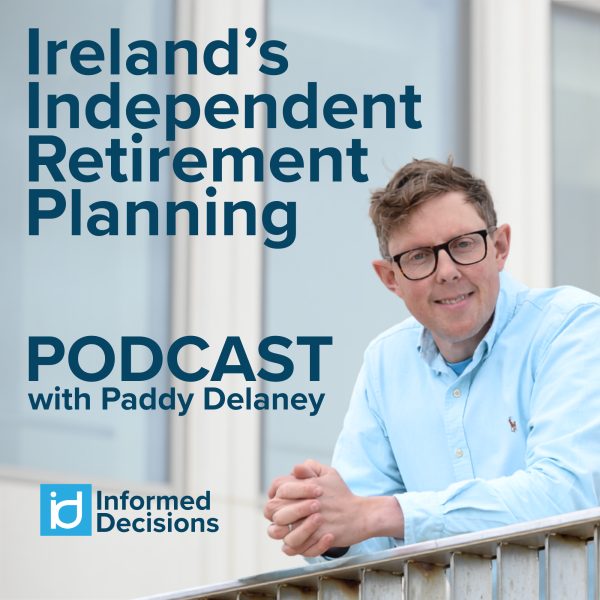
Informed Decisions: Ireland’s Independent Retirement Planning Podcast
- Episódios
- 402
- Publicação
- semanal
- Último episódio
- 9 nov 2026
Sobre o podcast
Informed Decisions is Ireland's award-winning podcast on pensions, retirement planning and financial planning, hosted by Paddy Delaney. Paddy, founder of Informed Decisions, is one of a small number of retirement planners in Ireland who work on a genuinely fee-only basis: no commission from any product provider, no products sold, and nobody but the client paying for the advice. If you are within ten years of retiring and you have built up a substantial pension, the difficult part is no longer saving. It is knowing what to do with what you have. An awful lot of people arrive at that point with a fund value and no strategy, and no clear sense of whose advice is actually on their side. That is what this show is for. Every week, Paddy works through the decisions that really make a difference: current issues in the world of finance that affect your pension in Ireland and fundamental questions that every Irish person should ask themselves when planning their retirement, f.e.: • How much income a pension can realistically sustain in retirement, and for how long • ARF or annuity: what each one actually costs you over twenty years of drawdown • Why the default fund your pension has been sitting in may not be doing what you assume • What Revenue's rules mean in practice: the Standard Fund Threshold, imputed distribution, and the tax on your retirement lump sum • PRSAs, AVCs and company pensions, and which structure suits which situation ABOUT YOUR HOST Paddy Delaney is one of very few independent, fee-only financial planner in Ireland and the voice behind Informed Decisions. He is a Qualified Financial Adviser (QFA) and Retirement Planning Adviser (RPA), also holding the APA designation, and has been publishing this podcast since 2017. His work centres on Irish retirement income planning: ARF drawdown strategy, pension structuring, and tax-efficient income for people approaching or already in retirement. New episode every week and more content on YouTube, too. 📊 Check where you stand with Informed Decisions free 10-minute Retirement Readiness Scorecard: https://www.informeddecisions.ie/pension-calculator 📅 See how we work: https://www.informeddecisions.ie WHO THIS PODCAST IS FOR Business owners, senior professionals and executives across Ireland, typically between 45 and 65, with pension and investment assets built over a career. DISCLAIMER Informed Decisions Limited, trading as Informed Decisions Financial Planning, is regulated by the Central Bank of Ireland. This podcast is for general educational purposes only and does not constitute personalised financial advice. Everyone's situation is different. Always speak to a qualified, independent advisor before making pension or investment decisions. Tax rules and pension regulations change; figures quoted are accurate at time of recording.
Episódios 402
Healthcare Costs in Retirement: What Ireland Should Protect, with Dr Jordan Grumet
We spend thirty years building the pot. We model the returns and the tax, and most of us never model the one variable sitting underneath all of it: our health, and healthcare costs in retirement. This week …
Notas do episódio
We spend thirty years building the pot. We model the returns and the tax, and most of us never model the one variable sitting underneath all of it: our health, and healthcare costs in retirement. This week Paddy is joined again by Dr Jordan Grumet, hospice doctor and author of The Healthcare Heist, to talk about regret, and about what happens to a retirement plan when health doesn't go to plan.
In this episode:
- What hospice patients say about money, and why regret is a gift only while you're young enough to act on it
- Why healthcare, not money, stops so many Americans from retiring early, and what Jordan's own family pays
- How Ireland's two-tier system compares, and why the baseline our taxes pay for is worth protecting
- Health as a "white swan event": the risk you can see coming that can still upend a financial plan
Jordan's book is about the American system, which is not ours. But an awful lot of it travels, and it's worth a listen if you're in your fifties and planning what comes next. Jordan's book recommendation: How to Retire by Christine Benz. Find Jordan's books and podcast at https://jordangrumet.com Paddy's Pension Pieces, the short versions of topics like this, are on our YouTube channel: https://www.youtube.com/playlist?list=PLLryUp4V7EQw 🎙️ Full podcast episode and 📖 Blog: https://www.informeddecisions.ie/post/healthcare-costs-retirement-ireland-jordan-grumet 📊 Want to check where you are? Try our free 10-minute Retirement Readiness Scorecard: https://www.informeddecisions.ie/pension-calculator 📅 Find out how we work: https://www.informeddecisions.ie DISCLAIMER This content is for general educational purposes only and does not constitute personalised financial advice. Everyone's situation is different. Always speak to a qualified, independent advisor before making pension or investment decisions. Tax rules and pension regulations change; figures quoted are accurate at time of recording.
The €2m ARF Cliff: When Forced Drawdown Jumps to 6%
You have over €2m in your ARF? From that point Revenue's imputed distribution in Ireland jumps from 4% to 6%, and it applies to the whole fund, not just the part above €2m. The better your ARF does, the faster …
Notas do episódio
You have over €2m in your ARF? From that point Revenue's imputed distribution in Ireland jumps from 4% to 6%, and it applies to the whole fund, not just the part above €2m. The better your ARF does, the faster Revenue makes you draw it down. This episode is for anyone approaching or in retirement in Ireland with a large pension, especially if you are within touching distance of the line.
In this episode Paddy will go through these topics with you:
- How the ARF imputed distribution works in Ireland: 4%, 5% and the 6% trigger, valued on 30 November and tested per person
- What 6% really costs after tax, with a fictional couple on 2027 rates, and why the extra income can be taxed at roughly 48%
- Why €2m in your pension is not €2m in your ARF, and the quiet ways people end up over the line, from growth to the death of a spouse
- What you can do about it: phasing PRSAs, two names rather than one, minding 30 November and starting drawdown earlier
If you're near the €2m line, on your own or between you, it is worth a look before the next 30 November.
🎙️ Full podcast episode and 📖 Blog: www.informeddecisions.ie/post/arf-2m-cliff-imputed-distribution-ireland
📊 Want to check where you are? Try our free 10-minute Retirement Readiness Scorecard: https://www.informeddecisions.ie/pension-calculator
📅 Find out how we work: https://www.informeddecisions.ie
DISCLAIMER This content is for general educational purposes only and does not constitute personalised financial advice. Everyone's situation is different — always speak to a qualified, independent advisor before making pension or investment decisions. Tax rules and pension regulations change; figures quoted are accurate at time of recording.
Up to 50% Tax Relief. What's the Catch?
Is EIIS in Ireland a useful investment or not? The Employment Investment Incentive Scheme offers higher-rate taxpayers up to 50% income tax relief for investing in Irish SMEs, and every autumn an awful lot of …
Notas do episódio
Is EIIS in Ireland a useful investment or not? The Employment Investment Incentive Scheme offers higher-rate taxpayers up to 50% income tax relief for investing in Irish SMEs, and every autumn an awful lot of people are offered it. Paddy Delaney puts the investor's questions to Stephen Tully of BVP. What Paddy went through in this episode:
- How the EIIS relief tiers work, and why higher relief means higher risk
- How long your money is really tied up, and who EIIS is not suitable for
- Where your money is held, what it costs, and who is paid commission for recommending it
- How gains are taxed, and when the tax relief can be withdrawn
If you are weighing up EIIS before the year end, this episode gives you the questions to ask first before you consider investing. ⚠️ Capital at risk. EIIS investments are high risk and illiquid, and tax relief can be withdrawn. General information only, not personalised financial advice.
🎙️Full podcast episode and 📖 Blog: https://www.informeddecisions.ie/post/eiis-ireland-questions-before-investing
📊 Want to check where you are? Try our free 10-minute Retirement Readiness Scorecard: https://www.informeddecisions.ie/pension-calculator
📅 Find out how we work: https://www.informeddecisions.ie
DISCLAIMER
EIIS investments are high risk. Your capital is at risk and you may lose some or all of it. The shares are illiquid and normally held for at least four years. Tax relief can be withdrawn in certain cases.
This content is for general educational purposes only and does not constitute personalised financial advice. Everyone's situation is different — always speak to a qualified, independent advisor before making pension or investment decisions. Tax rules and pension regulations change; figures quoted are accurate at time of recording.
Should You Buy Bonds Now? Irish Investors and 5% Yields
Should you buy bonds now? If you are an Irish investor and the bond part of your pension or ARF has disappointed for a few years, the 5% yields in the headlines may sound like good news. They are a dollar …
Notas do episódio
Should you buy bonds now? If you are an Irish investor and the bond part of your pension or ARF has disappointed for a few years, the 5% yields in the headlines may sound like good news. They are a dollar number. This episode looks at what bond yields actually mean for someone investing in euro in Ireland. In this episode, Paddy goes through these points:
- Why the same rise in rates that knocked value off bond funds has improved their future returns
- Why the 5% US Treasury yield is not what a euro investor receives, and what euro yields look like in 2026
- What higher yields mean if you are still contributing, and if you are drawing down an ARF under Revenue's imputed distribution rules
- Why the same bond fund is taxed very differently inside and outside a pension
If you hold bonds in your pension or ARF and want genuine clarity on whether they are doing the job they should, this episode is for you. 📖 Read the full blog post and watch us on YT: https://www.informeddecisions.ie/post/should-you-buy-bonds-now-ireland 📊 Want to check where you are? Try our free 10-minute Retirement Readiness Scorecard: https://www.informeddecisions.ie/pension-calculator 📅 Find out how we work: https://www.informeddecisions.ie DISCLAIMER This content is for general educational purposes only and does not constitute personalised financial advice. Everyone's situation is different — always speak to a qualified, independent advisor before making pension or investment decisions. Tax rules and pension regulations change; figures quoted are accurate at time of recording.
US Estate Tax in Ireland: The $60,000 Line on Your US Shares
US estate tax is not only an American problem. If you are an Irish resident holding shares in US companies, whether through vested RSUs or your own investment account, the IRS can charge estate tax on anything …
Notas do episódio
US estate tax is not only an American problem. If you are an Irish resident holding shares in US companies, whether through vested RSUs or your own investment account, the IRS can charge estate tax on anything above $60,000 when you die. A US citizen gets $15m.
Paddy tries to shed a bit of light on the matter and goes through it here:
- Why shares in US-incorporated companies count as US assets, even on an Irish platform
- What US estate tax looks like on $750,000 of employer shares in Ireland: a bill of $235,300
- Why "everything to my spouse" can be the expensive route under the Ireland-US estate tax convention
- The two options, reducing your US exposure or planning your estate around it, and what each one costs
If a big part of your wealth is sitting in RSUs or US shares in Ireland, this episode is for you.
The figures are as at the time the records were made.
🎙️ Full YT episode and 📖 Blog: www.informeddecisions.ie/post/us-estate-tax-ireland-rsus-us-shares
📊 Want to check where you are? Try our free 10-minute Retirement Readiness Scorecard: www.informeddecisions.ie/pension-calculator
📅 Find out how we work: www.informeddecisions.ie
DISCLAIMER This content is for general educational purposes only and does not constitute personalised financial advice. Everyone's situation is different — always speak to a qualified, independent advisor before making pension or investment decisions. Tax rules and pension regulations change; figures quoted are accurate at time of recording.
Budget 2027 Ireland: The €50,000 Tax-Free Investment Account
Budget 2027 in Ireland came with the usual noise about tax bands and credits. If you are within 5 to 10 years of retiring, or already retired, those are rarely the lines that matter. In this Budget special …
Notas do episódio
Budget 2027 in Ireland came with the usual noise about tax bands and credits. If you are within 5 to 10 years of retiring, or already retired, those are rarely the lines that matter. In this Budget special, Paddy Delaney goes through what actually changed for Irish pensions, investments and retirement income.
- The new Investment Account in Ireland: €12,000 a year, the first €50,000 tax-free, 1% a year above that, from 1 July 2027
- Exit tax down from 38% to 35%, capital gains tax down to 31%, and why deemed disposal is still with us
- What the Budget did and did not touch on pensions, including new valuation factors for defined benefit schemes under the Standard Fund Threshold
- And a practical example: €1,000 a month for 8 years, and the difference between €15,400 of exit tax and roughly €2,000 of account charge
If the Budget has you wondering where you actually stand, this episode is for you.
🎓 Free webinar about "Your Money in 2027": Friday 9 October, 12:00, with Alan Purcell: https://www.informeddecisions.ie/webinar
📖 Full Blog: www.informeddecisions.ie/post/budget-2027-ireland-pensions-investing
📊 Want to check where you are? Try our free 10-minute Retirement Readiness Scorecard: https://www.informeddecisions.ie/pension-calculator
📅 Find out how we work: https://www.informeddecisions.ie DISCLAIMER This content is for general educational purposes only and does not constitute personalised financial advice. Everyone's situation is different — always speak to a qualified, independent advisor before making pension or investment decisions. Tax rules and pension regulations change; figures quoted are accurate at time of recording.
Before You Retire in Ireland: 5 Decisions You Can't Undo
It's good to know which decisions can never be undone, before you retire in Ireland. Most of a pre-retirement checklist can be changed next year. Four or five items cannot. In this episode Paddy Delaney …
Notas do episódio
It's good to know which decisions can never be undone, before you retire in Ireland. Most of a pre-retirement checklist can be changed next year. Four or five items cannot. In this episode Paddy Delaney, independent retirement and investment planner, takes them door by door: the €200,000 lifetime limit on tax-free lump sums, the annuity decision, the tax year you crystallise near the Standard Fund Threshold, the pension tax relief that stops with your last payslip, and the order you do it all in.
This episode is for anyone a year or two from retirement who wants to know which doors close for good.
What you'll learn:
- Why the €200,000 tax-free retirement lump sum in Ireland is a lifetime limit across all your pensions, not per pension
- Why an ARF can become an annuity later, but an annuity can never go back
- How the Standard Fund Threshold rising from €2.2m to €2.8m makes the tax year you crystallise matter, and why growth can erase the saving (fictional case study: Maggie, 61, €2.6m)
- How much pension tax relief you can still use at 55 to 59 and at 60 and over, before your last payslip
If you're approaching retirement with a significant pension and want clarity on which decisions to slow down on, this episode is for you.
🎙️ Access all our podcast episodes and our blog
📊 Want to check where you are? Try our free 10-minute Retirement Readiness Scorecard
DISCLAIMER: This content is for general educational purposes only and does not constitute personalised financial advice. Everyone's situation is different. Always speak to a qualified, independent advisor before making pension or investment decisions. Tax rules and pension regulations change; figures quoted are accurate at time of recording.
Trust in Financial Advice: Why Ireland Scores 49 Out of 100
Trust in financial services in Ireland sits at 49%, against a global average of 63%. Paddy Delaney goes through the 2026 Edelman Trust Barometer research on financial services, where Ireland ranks, and what …
Notas do episódio
Trust in financial services in Ireland sits at 49%, against a global average of 63%. Paddy Delaney goes through the 2026 Edelman Trust Barometer research on financial services, where Ireland ranks, and what sits behind the number.
Edelman surveyed almost 34,000 people across 28 countries and publishes a separate report on financial services. Ireland comes in 23rd of 28, inside the distrust band, below the developed-economy average of 53% and well below the global figure.
In this episode, Paddy goes through the following:
- Where Ireland ranks for trust in financial services, and which countries sit above and below
- Why trust in financial services runs at 73% in developing economies and 53% in developed ones
- Which sub-sectors are trusted least, and why banks score higher than financial advisers
- What the tracker mortgage scandal actually cost, and why it is far more recent than most people remember
- The one question to ask any adviser about how they are paid, and what the answer tells you
If you are weighing up financial advice in Ireland, particularly with significant pension or investment assets behind you, this episode is about how to judge who is worth listening to.
🎙️ Full podcast episode and 📖 Blog: www.informeddecisions.ie/post/trust-financial-advice-ireland
📊 Want to check where you are? Try our free 10-minute Retirement Readiness Scorecard: https://www.informeddecisions.ie/pension-calculator
📅 Find out how we work: https://www.informeddecisions.ie
DISCLAIMER This content is for general educational purposes only and does not constitute personalised financial advice. Everyone's situation is different: always speak to a qualified, independent advisor before making pension or investment decisions. Tax rules and pension regulations change; figures quoted are accurate at time of recording.
Prize Bonds Ireland: What the New 1.5% Rate Actually Pays You
The Prize Bond prize fund rate rose from 1.00% to 1.50% this month, the first State Savings increase in about three years. Almost every write-up has described that 1.5% as a return. It is not one. It is the …
Notas do episódio
The Prize Bond prize fund rate rose from 1.00% to 1.50% this month, the first State Savings increase in about three years. Almost every write-up has described that 1.5% as a return. It is not one. It is the size of the prize pool spread across the whole €4.4 billion in issue, and what an individual holder receives is decided by a draw.
In this Episode, Paddy works through the NTMA's own published figures and puts a realistic number on what Prize Bonds are actually worth to a normal holding, then lines them up against what the same State will pay for certainty.
What you'll learn:
- Why the 1.5% prize fund rate is not interest, and what it actually describes
- What the odds look like in practice: 0.067% per bond, and a 59% chance of a year with nothing on a €5,000 holding
- The new State Savings rates: 1.96%, 2.29%, 2.33% and 2.66%, all tax-free, and the one product that pays DIRT
- How to compare any bank rate properly by dividing the gross rate by 0.67
- Why the State Savings guarantee has no €100,000 ceiling, and who that actually matters to
- The trap in locking a 10-year rate, and why "eaten bread is soon forgotten" belongs in this decision
If you are holding Prize Bonds, State Savings or cash on deposit in Ireland and want to know what those balances are really doing, this episode is for you.
🎙️ Full podcast episode and 📖 Blog: https://informeddecisions.ie/prize-bonds-ireland-what-the-rate-means/
📊 Want to check where you are? Try our free 10-minute Retirement Readiness Scorecard: https://www.informeddecisions.ie/pension-calculator
📅 Find out how we work: https://www.informeddecisions.ie
DISCLAIMER This content is for general educational purposes only and does not constitute personalised financial advice. Everyone's situation is different: always speak to a qualified, independent advisor before making pension or investment decisions. Tax rules and pension regulations change; figures quoted are accurate at time of recording.
Inheritance Tax in Ireland: Gift Now or Leave It? - with Mairéad Hennessy from Taxkey.ie
Inheritance tax in Ireland is charged at 33% on anything above €400,000 passing from a parent to a child. The question most families never properly work through is whether to move assets during their lifetime …
Notas do episódio
Inheritance tax in Ireland is charged at 33% on anything above €400,000 passing from a parent to a child. The question most families never properly work through is whether to move assets during their lifetime or leave them until the end. And that decision changes the bill, the timing, and who ends up paying it.
Paddy is joined by Mairéad Hennessy of Taxkey, a firm of independent tax consultants, for a practical conversation about passing wealth on in Ireland.
What you'll learn in this episode:
• Why the tax question is the wrong place to start, and what to work out first
• How the €3,000 small gift exemption works, what makes it fail, and why it is worth far more over time than the figure suggests
• How capital gains tax paid by a parent can be credited against a child's inheritance tax bill and the two-year condition attached to it
• What a business transfer needs in place in the ten years before it happens, and why the child has to be in the room
• Family partnerships: how they work, who they suit, and what they cost you in privacy
• The US Federal Estate Tax exposure sitting in Irish households through employer shares, and the $60,000 threshold behind it
We recorded this just as the roadmap for the taxation of private investments was published; it therefore also provides an initial outlook on the investment account to be introduced in 2027 and its implications for notional disposals.
If you are approaching retirement with a business, property or a portfolio that will have to move at some point, or you are in line to inherit and would rather understand it in advance, this episode is for you.
🎙️ Full podcast episode and 📖 Blog: www.informeddecisions.ie/post/inheritance-tax-ireland-gift-or-inherit
📊 Want to check where you are? Try our free 10-minute Retirement Readiness Scorecard: www.informeddecisions.ie/pension-calculator
📅 Find out how we work: www.informeddecisions.ie
🔗 Mairéad Hennessy, Taxkey: www.taxkey.ie
Book mentioned: Self Employed – The Forgotten Community by Dan O'Donoghue: https://buythebook.ie/product/self-employed-the-forgotten-community/
DISCLAIMER This content is for general educational purposes only and does not constitute personalised financial or tax advice. Everyone's situation is different: always speak to a qualified, independent advisor before making pension, investment or estate planning decisions. Tax rules and pension regulations change; figures quoted are accurate at time of recording.
Should You Retire at a Market All-Time High? Sequence Risk & the Irish ARF
Should you retire with the market at an all-time high? In Ireland, the record level feels dangerous, but it is not the risk that decides your outcome. In this episode, Paddy asks whether retiring at an all-time …
Notas do episódio
Should you retire with the market at an all-time high? In Ireland, the record level feels dangerous, but it is not the risk that decides your outcome.
In this episode, Paddy asks whether retiring at an all-time high is really the risk Irish savers fear, or whether the thing that decides your outcome is something else entirely.
What you'll learn:
• Why all-time highs are common, not a warning: global equities sit at or near record highs on roughly a third of trading days
• What Japan's lost decades really warn against: concentration in one market, not equities themselves
• A sequence-of-returns case study: how two retirees with the same €1.2m and the same average return finished €1.25m apart
• The Irish nuance: why Revenue's imputed distribution makes the buffer inside your ARF matter more than any market call
If you're within a couple of years of drawing down, and the timing has you worried, this episode is for you.
🎙️ Full podcast episode and 📖 Blog: www.informeddecisions.ie/post/should-i-retire-at-all-time-highs-ireland
📊 Want to check where you are? Try our free 10-minute Retirement Readiness Scorecard: https://www.informeddecisions.ie/pension-calculator
📅 Find out how we work: https://www.informeddecisions.ie
DISCLAIMER This content is for general educational purposes only and does not constitute personalised financial advice. Everyone's situation is different. Always speak to a qualified, independent advisor before making pension or investment decisions. Tax rules and pension regulations change; figures quoted are accurate at time of recording. #PensionIreland #RetirementPlanningIreland #SequenceOfReturnsRisk #StockMarketAllTimeHigh #ARFIreland
Planning to 95: Life Expectancy, the Irish ARF and the Real Retirement Lever
Your Irish pension plan probably runs to age 95, but you'll likely live to around 83, and the gap changes your pot far less than you'd expect. In this episode, Paddy digs into the retirement life expactancy in …
Notas do episódio
Your Irish pension plan probably runs to age 95, but you'll likely live to around 83, and the gap changes your pot far less than you'd expect.
In this episode, Paddy digs into the retirement life expactancy in Ireland. He checks on the one age assumption buried in almost every Irish retirement plan, where the default of 95 comes from and what the most recent CSO life tables actually say about how long a 65-year-old really lives.
It's for you if you're approaching or already in retirement with a meaningful pension or ARF, and you've never been asked (or never questioned) the age your own plan is built to.
Using a fictional €1.2m ARF, this piece shows how Revenue's imputed distribution means the closing pot is almost identical whether you plan to 83 or 95 (around €1.25m versus €1.21m). The end age was never really the lever.
What is covered in this Episode:
- Where the default planning age of 95 comes from and the US research (Barron's, TIAA, Stanford) behind "oversaving and underliving"
- What the most recent Irish CSO life tables really say and why they're a floor, not a forecast
- How Revenue's imputed distribution (4%, 5%, 6%) shapes drawdown from an ARF
- Why a €1.2m ARF lands at almost the same value at 83 or 95 and what that means for your estate
- The real lever: what you do with the income you're forced to draw, including a scenario that leaves roughly €283,000 less to Revenue
📖 Blog: www.informeddecisions.ie/post/how-long-should-retirement-plan-last-ireland
📊 Want to check where you are? Try our free 5-minute Retirement Readiness Scorecard: https://www.informeddecisions.ie/pension-calculator
📅 Find out how we work: https://www.informeddecisions.ie
DISCLAIMER This content is for general educational purposes only and does not constitute personalised financial advice. Everyone's situation is different. Always speak to a qualified, independent advisor before making pension or investment decisions. Tax rules and pension regulations change; figures quoted are accurate at time of recording.
72% - One Country: Is Your Irish Pension Actually Diversified?
If you hold an Irish pension or an ARF invested in a global equity index fund, you have almost certainly been told you are diversified: Thousands of companies, dozens of countries, one fund, job done. And it is …
Notas do episódio
If you hold an Irish pension or an ARF invested in a global equity index fund, you have almost certainly been told you are diversified: Thousands of companies, dozens of countries, one fund, job done. And it is true: your global index fund really does hold well over a thousand companies across more than twenty developed markets.
But there is a second truth sitting right beside it. As at the end of June 2026, roughly 72.45% of that same "global" fund is allocated to a single country: The United States. Same fund, same name, same low-cost passive approach and yet quietly a very different animal to the one you bought a decade ago. For anyone drawing an income from an ARF, that second fact matters a great deal more than most people realise.
In this episode, Paddy walks through what has actually happened inside these funds while we have been getting on with things: why a cap-weighted index concentrates all on its own, what the published weightings look like right now, and why the very same allocation means something completely different depending on whether you are still contributing or already drawing an income. He uses a worked Irish example (Seamus, 65, with €900,000 in an ARF held in a single global fund) to show what concentration actually looks like under the bonnet, and where Revenue's imputed distribution quietly turns a concentrated investor into a forced seller.
What you'll learn:
- Why a cap-weighted index quietly concentrates over time, and why nobody writes to tell you
- What a global equity fund actually holds today: 72.45% United States, 26.6% in ten companies, 30.27% in one sector
- Why concentration is a volatility question at 52 and a sequencing question at 65
- What Revenue's imputed distribution does to an investor who is already concentrated
- Why over-correcting, like running to cash, is usually the more expensive mistake of the two
- The one variable in this whole picture you actually control
None of this is an argument against index investing, and it is not a forecast. It is an argument for being able to describe what you own before you decide how you feel about it. Never mind before you decide what to do about it. If you hold an ARF invested in a single global fund and you haven't seen a factsheet in years, this episode is for you.
🎙️ Full podcast episode and 📖 Blog: www.informeddecisions.ie/post/market-concentration-irish-pensions
📊 Want to check where you are? Try our free 5-minute Retirement Readiness Scorecard: https://www.informeddecisions.ie/pension-calculator
📅 Find out how we work: https://www.informeddecisions.ie
DISCLAIMER This content is for general educational purposes only and does not constitute personalised financial advice. Everyone's situation is different. Always speak to a qualified, independent advisor before making pension or investment decisions. Tax rules and pension regulations change; figures quoted are accurate at time of recording.
Should You Take Your Pension Lump Sum at 60? A Worked Irish Case Study
Turning 60 with a significant pension pot and nothing forcing your hand? This episode is a worked case study on the pension lump sum decision at 60 in Ireland: Take the tax-free lump sum now, or leave the fund …
Notas do episódio
Turning 60 with a significant pension pot and nothing forcing your hand? This episode is a worked case study on the pension lump sum decision at 60 in Ireland: Take the tax-free lump sum now, or leave the fund invested and revisit it at 65.
Paddy goes through a study-case: Larry is 60, a senior private-sector executive, with €1.4 million in a defined contribution scheme. He doesn't exist. The numbers do.
What you'll learn in this Episode:
- How the retirement lump sum is actually taxed in Ireland: the first €200,000 tax-free as a lifetime limit across all schemes, the 20% band to €500,000, and the marginal rate above it
- Why an uncrystallised pension carries no mandatory drawdown, and what imputed distribution at 4% from age 61 means once you have crystallised
- What five years of 5% to 6% growth is actually worth in net lump sum terms and why the honest answer is a range, not a number
- Where the Standard Fund Threshold genuinely bites and where it doesn't, including why a threshold rising €200,000 a year to 2029 changes the usual "don't let it grow too big" advice
- The three mistakes that decide most of these cases in practice
If you're approaching retirement with a significant pension pot and you've been assuming 60 or 65 is the moment you have to act, this episode is for you.
🎙️ Full podcast episode and 📖 Blog: www.informeddecisions.ie/post/tfls-at-60-or-wait-ireland
📊 Want to check where you are? Try our free 5-minute Retirement Readiness
Scorecard: https://www.informeddecisions.ie/pension-calculator
📅 Find out how we work: https://www.informeddecisions.ie
DISCLAIMER This content is for general educational purposes only and does not constitute personalised financial advice. Everyone's situation is different — always speak to a qualified, independent advisor before making pension or investment decisions. Tax rules and pension regulations change; figures quoted are accurate at time of recording.
Private Credit in Ireland: Can You Actually Get Your Money Out?
There is a pitch doing the rounds in Irish advice circles at the moment: private markets have finally been democratised, and private credit and private equity are now open to anyone with a decent pension pot …
Notas do episódio
There is a pitch doing the rounds in Irish advice circles at the moment: private markets have finally been democratised, and private credit and private equity are now open to anyone with a decent pension pot. But is it really like that? In this episode, Paddy looks at what is actually being sold, and at the one feature that matters more than anything else in the brochure, because liquidity here is offered, not guaranteed.
Have a listen, if you'd like to get an idea of what these 'zombie funds' in the private markets sector are all about, what your ARF has to do with them, and what considerations there are regarding private loans and equity investments when it comes to your retirement planning.
What you'll learn:
- What an evergreen or semi-liquid fund actually is, and why a redemption window is nothing like selling a share
- Why the value on your statement can lag what is really happening in the underlying businesses by months
- What a zombie fund is, and why roughly 48% of the institutional investors surveyed by Coller Capital already hold one
- Why illiquid assets collide badly with ARF drawdown, where Revenue requires you to draw at least 4% a year from age 61
- The four questions to ask before you sign anything and what a vague answer actually tells you
None of this means private markets are wicked, or that nobody should ever own them. It means a bit of healthy scepticism is no bad thing. If you are approaching or already in retirement and someone has put one of these opportunities in front of you, this episode is for you.
🎙️ Full podcast episode and 📖 Blog: www.informeddecisions.ie/post/zombie-funds-private-markets-ireland
📊 Want to check where you are? Try our free 5-minute Retirement Readiness Scorecard: https://www.informeddecisions.ie/pension-calculator
📅 Find out how we work: https://www.informeddecisions.ie
DISCLAIMER This content is for general educational purposes only and does not constitute personalised financial advice. Everyone's situation is different — always speak to a qualified, independent advisor before making pension or investment decisions. Tax rules and pension regulations change; figures quoted are accurate at time of recording.
Bucket vs. Total Return - Retirement Withdrawal Strategies for Investors in Ireland
If you've built a pension pot of €1m or more, you've almost certainly thought about how you'll invest it in retirement. What a bunch of people haven't thought through properly is how they'll actually take the …
Notas do episódio
If you've built a pension pot of €1m or more, you've almost certainly thought about how you'll invest it in retirement. What a bunch of people haven't thought through properly is how they'll actually take the money out: that decision, not the fund selection, is often what determines whether your ARF supports you comfortably for thirty years, or gives you a fright in year eight.
After his well deserved holiday, in this episode Paddy talks about retirement withdrawal strategies for an Irish ARF: the bucket strategy versus the total return strategy, and why the choice works differently here than in the US or UK research you'll have read. If you're approaching, or already in, retirement with €1m+ in an ARF, and you're not sure whether you have a withdrawal plan or just a fund value, this one is for you.
What you'll learn:
• How the bucket strategy and the total return (guardrails) strategy actually work inside an ARF
• Why Revenue's imputed distribution welds a hard 4% floor under your withdrawals from age 61 (ARF under €2m)
• What a 20% down year does to a €1.2m ARF under each approach and why a hybrid often captures the best of both
• The three most common drawdown mistakes and how to avoid them
If you're approaching retirement with a significant pension pot and want genuine clarity on turning it into a sustainable, tax-aware income, this episode is for you.
🎙️ Full podcast episode and 📖 Blog: https://www.informeddecisions.ie/post/retirement-withdrawal-strategies-drawdown-risk
Check out our new category on YouTube: Paddy's Pension Pieces. Smaller, condensed content of our topics, where Paddy condenses longer topics into shorter clips, covers topics that are hot off the press or shares timeless classics that are always relevant to pension planning.
📊 Want to check where you are? Try our free 5-minute Retirement Readiness Scorecard: https://www.informeddecisions.ie/pension-calculator
📅 Find out how we work: https://www.informeddecisions.ie
DISCLAIMER This content is for general educational purposes only and does not constitute personalised financial advice. Everyone's situation is different — always speak to a qualified, independent advisor before making pension or investment decisions. Tax rules and pension regulations change; figures quoted are accurate at time of recording.
Strategic Giving - Philanthropy in Ireland: A Conversation With Community Foundation CEO, Denise Charlton
Most people spend decades building wealth and never quite get to the second question: not how do I protect this, but what do I actually want it to do? On this episode, Paddy Delaney talks to Denise Charlton …
Notas do episódio
Most people spend decades building wealth and never quite get to the second question: not how do I protect this, but what do I actually want it to do? On this episode, Paddy Delaney talks to Denise Charlton, CEO of Community Foundation Ireland, about strategic philanthropy in Ireland. How it actually works, and where to start.
What you'll learn:
- How a Donor Advised Fund works in Ireland, and why the entry point is lower than most assume (€25,000–€50,000)
- The difference between ad-hoc giving and strategic philanthropy
- How tax relief and Capital Acquisitions Tax exemptions apply to charitable giving in Ireland
- How families bring the next generation into a giving conversation, and how endowments work in perpetuity
If you've built significant wealth and you're starting to ask what it's actually for, this conversation is worth your time.
About the Guest
Denise Charlton is Chief Executive of Community Foundation Ireland, the country's leading philanthropic foundation. Her career spans senior leadership at the Immigrant Council of Ireland and Women's Aid; she was a founder of Marriage Equality, and she currently sits on the board of Cuan, the State's statutory agency for sexual and gender-based violence. You can find Community Foundation Ireland at communityfoundation.ie.
🎙️ Full podcast episode and 📖 Blog: www.informeddecisions.ie/post/strategic-philanthropy-ireland
📊 Want to check where you are? Try our free 5-minute Retirement Readiness Scorecard: https://www.informeddecisions.ie/pension-calculator
📅 Find out how we work: https://www.informeddecisions.ie
DISCLAIMER This content is for general educational purposes only and does not constitute personalised financial advice. Everyone's situation is different — always speak to a qualified, independent advisor before making pension or investment decisions. Tax rules and pension regulations change; figures quoted are accurate at time of recording.
Simplicity Is The Ultimate Sophistication (Replay)
This one was recorded a while back (in 2024), but the argument hasn't dated a day, if anything, it holds up better now than when we first put it out. A of complexity in Irish pension and investment advice isn't …
Notas do episódio
This one was recorded a while back (in 2024), but the argument hasn't dated a day, if anything, it holds up better now than when we first put it out. A of complexity in Irish pension and investment advice isn't there to help you. It's there to help the person selling it. In this episode, Paddy explains why simplicity almost always beats sophistication when it comes to your pension and investment planning, and what a genuinely simple structure actually looks like.
What you'll learn:
● Why financial firms are often incentivised to make your pension and investments more complicated than they need to be
● The real-world cost of sophisticated, structured investment products that underperform
● What a simple, transparent pension and investment structure actually looks like in practice
● The questions worth asking any advisor before trusting them with your retirement assets
If you've ever had a feeling that your own pension or investment structure is more complicated than it needs to be, this episode is for you.
🎙️ Full podcast episode and 📖 Blog: www.informeddecisions.ie/post/simplicity-over-sophistication-pension-planning
And a quick word on something new: alongside the podcast, I've started putting together shorter pieces for YouTube: Paddy's Pension Pieces. Each one built around a single question from a fuller episode or a specific topic I'd like to discuss in shorter time . The first is up now, on what a €1 million pension pot in Ireland actually leaves you with after tax: check out our YT Channel to discover :) More to follow.
📊 Want to check where you are? Try our free 5-minute Retirement Readiness Scorecard: https://www.informeddecisions.ie/pension-calculator
📅 Find out how we work: https://www.informeddecisions.ie
DISCLAIMER This content is for general educational purposes only and does not constitute personalised financial advice. Everyone's situation is different — always speak to a qualified, independent advisor before making pension or investment decisions. Tax rules and pension regulations change; figures quoted are accurate at time of recording.
Sequence of Returns Risk: Same ARF. Same Return. Totally Different Outcome
Two people can retire with the same ARF, the same average return, and the same withdrawal rate and still end up in completely different places. One leaves over €1m to his family. The other runs out of money …
Notas do episódio
Two people can retire with the same ARF, the same average return, and the same withdrawal rate and still end up in completely different places. One leaves over €1m to his family. The other runs out of money before he turns 88. The only difference is the order in which the returns arrived. In this episode, Paddy breaks down sequence of returns risk in Ireland. The risk that gets far less attention than fund performance or pot size, but can matter more than either. What you'll learn: • Why sequence of returns doesn't matter at all while you're still accumulating • Why the first ten years of drawdown can account for roughly 77% of your final outcome • How Revenue's 4%/5%/6% imputed distribution rules interact with this risk in an Irish ARF • Four practical ways to protect your ARF: cash buffers, dynamic withdrawal, portfolio construction, and timing flexibility If you're within a decade of retirement, or already drawing an income from your ARF, this is worth half an hour of your time. Enjoy! 🎙️ Find all the full podcast episode and 📖 Blog here: www.informeddecisions.ie/post/sequence-of-returns-risk-ireland 📊 Want to check where you are? Try our free 5-minute Retirement Readiness Scorecard: www.informeddecisions.ie/pension-calculator 📅 Find out how we work: www.informeddecisions.ie DISCLAIMER This content is for general educational purposes only and does not constitute personalised financial advice. Everyone's situation is different. Always speak to a qualified, independent advisor before making pension or investment decisions. Tax rules and pension regulations change; figures quoted are accurate at time of recording.
Enduring Power of Attorney in Ireland With Áine Flynn: Who Can Act If You Can't?
An Enduring Power of Attorney (EPA) is the planning step most Irish adults never get to. Only around 8% have one, against roughly a third who've made a will. Yet if you lost capacity tomorrow, it's the document …
Notas do episódio
An Enduring Power of Attorney (EPA) is the planning step most Irish adults never get to. Only around 8% have one, against roughly a third who've made a will. Yet if you lost capacity tomorrow, it's the document that decides whether the people you trust can actually act for you, or whether your family ends up in front of the Circuit Court.
Paddy Delaney is joined by Áine Flynn, Director of Ireland's Decision Support Service, for a clear, practical conversation about planning ahead. If you're approaching retirement with assets to protect, this one matters.
For more information about Áine Flynn and the work of Ireland's Decision Support Service: https://www.decisionsupportservice.ie
In this episode:
- Why your next of kin can't automatically step in. And what an EPA changes
- The joint-account trap most couples assume protects them
- What it costs (€30 to register, €90 to activate) and how the DSS process works
- The "holy trinity": Will, EPA and Advance Healthcare Directive, and what each one covers
If you want genuine clarity on protecting yourself and the people you love, whatever happens, this episode is for you.
🎙️ Full episode (video) and 📖 Blog: www.informeddecisions.ie/post/enduring-power-of-attorney-ireland
📊 Want to check where you are? Try our free 5-minute Retirement Readiness Scorecard: https://www.informeddecisions.ie/pension-calculator
📅 Find out how we work: https://www.informeddecisions.ie
DISCLAIMER This content is for general educational purposes only and does not constitute personalised financial or legal advice. Everyone's situation is different — always speak to a qualified, independent advisor (and a solicitor for legal documents) before making pension, investment or estate-planning decisions. Rules and figures change; figures quoted are accurate at time of recording.
Should You Reduce Investment Risk Before Retirement?
As you get closer to retirement, move your money to safer investments. It sounds reasonable. But what if that one piece of conventional wisdom could cost you €80,000 or more? In this episode, Paddy unpacks one …
Notas do episódio
As you get closer to retirement, move your money to safer investments. It sounds reasonable. But what if that one piece of conventional wisdom could cost you €80,000 or more?
In this episode, Paddy unpacks one of the most consequential (and most overlooked) investment decisions you'll make: whether to reduce investment risk before you retire. For a lot of Irish pension holders, this decision has already been made for them automatically, through something called lifestyling often without their knowledge or consent.
Paddy works through the two opposing risks at the heart of the decision: de-risking too early and leaving significant growth on the table in your final accumulation years and sequence-of-returns risk, the single most underappreciated danger in early retirement. Using two scenarios he shows how a default setting can quietly create an €85,000–€100,000 gap, and why the order in which your returns arrive matters more than the average.
You'll come away with a simple three-question framework to bring deliberate, personalised thinking to your own pension, instead of leaving it to a system designed for an average that doesn't exist.
What this Episode covers:
• The two real risks and why most people only know one
• Lifestyling: what your provider may be doing without telling you
• The €85k–€100k cost of de-risking too early
• Sequence-of-returns risk and the retirement 'red zone'
• The bucket strategy as a simple income buffer
• A three-question framework for the ten years before retirement
And if you like to read this episode again, read the full blog post here: www.informeddecisions.ie/post/reduce-investment-risk-before-retirement-ireland
Chapters:
00:00 - The €80,000 question
01:30 - The two real risks
04:00 - Lifestyling explained
07:00 - The real numbers
12:00 - Sequence-of-returns risk
17:00 - The decision framework
21:00 - Mistakes to avoid + ARF considerations
24:30 - Summary & key takeaways
📊 Check out our new Retirement Readiness Scorecard: www.informeddecisions.ie/retirement-readiness-scorecard
📖 Find out how we work at www.informeddecisions.ie
ABOUT THE SHOW
The Informed Decisions podcast is hosted by Paddy Delaney, QFA RPA APA, independent, fee-only retirement planner in Ireland. The podcast and the blog at informeddecisions.ie are educational resources for Irish professionals, business owners, and high-net-worth individuals navigating retirement, tax efficiency, and investment strategy.
DISCLAIMER
This podcast is for general educational purposes only. It does not constitute personalised financial advice. Figures and rules referenced reflect the position as at May 2026 and are subject to change. Always speak to a qualified, independent financial advisor about your specific situation.
Pension Drawdown Above €2M: The €243,000 Timing Decision (SFT Ireland)
If your pension is approaching or has passed €2 million, the question is no longer just how to grow it, it's how to generate income without handing a significant portion to Revenue unnecessarily. The Standard …
Notas do episódio
If your pension is approaching or has passed €2 million, the question is no longer just how to grow it, it's how to generate income without handing a significant portion to Revenue unnecessarily. The Standard Fund Threshold in Ireland rose to €2.2 million in January 2026, and the decisions you make in the next few years will determine how much of that headroom you actually use.
In this episode, Paddy covers the income strategies that matter most at the SFT level.
If your pension is approaching €1.5 million or more, this episode is for you.
• Why timing your Benefit Crystallisation Events can shelter up to €500,000 from Chargeable Excess Tax
• How the lump sum offset mechanism reduces your CET exposure — and what the effective SFT really is in 2026
• What the imputed distribution rules mean when your ARF exceeds €2 million
• How to manage income through the standard rate tax band efficiently
• Why spousal pension planning is one of the most underused strategies at this level
📊 Find out how we work and have a look at our Retirement Readiness Scorecard: https://www.informeddecisions.ie
📖 Read the full blog: www.informeddecisions.ie/post/generating-income-standard-fund-threshold-ireland
ABOUT THE SHOW
The Informed Decisions podcast is hosted by Paddy Delaney QFA RPA APA — independent, fee-only retirement planner in Ireland. The podcast and the blog at informeddecisions.ie are educational resources for Irish professionals, business owners, and high-net-worth individuals navigating retirement, tax efficiency, and investment strategy.
DISCLAIMER
This podcast is for general educational purposes only. It does not constitute personalised financial advice. Figures and rules referenced reflect the position as at May 2026 and are subject to change. Always speak to a qualified, independent financial advisor about your specific situation.
Bonds Aren't Broken. What the 1970s Tell Irish Retirees About Bonds Today
A lot of investors have written off bonds after 2022. In this episode, Paddy Delaney explains why that conclusion is based on a misreading of how bonds work — and what the historical data actually shows. The …
Notas do episódio
A lot of investors have written off bonds after 2022. In this episode, Paddy Delaney explains why that conclusion is based on a misreading of how bonds work — and what the historical data actually shows.
The 10-year US Treasury yield went from under 6% to over 11% during the 1970s. Bonds still returned 5.4% per year. The worst single year was a loss of less than 1%. If bonds survived that rate environment, what does it mean for the environment we are in today?
In this episode:
- How bond returns are calculated (starting yield and duration)
- Why rising interest rates improve your future bond returns, not reduce them
- What the 1970s data shows, using Damodaran historical records
- What this means practically for anyone with bonds in an ARF or occupational pension
- A short note on lifestyling: being moved into bonds automatically is very different from choosing to hold them
This episode is relevant if you are approaching retirement, already in retirement, or reviewing an ARF or pension that includes a bond allocation.
If you would like to talk through your own situation, book a Clarity Call at www.informeddecisions.ie
Full blog post:
www.informeddecisions.ie/post/bonds-arf-retirement-ireland
• All Informed Decisions podcast episodes:
www.informeddecisions.ie/podcast/
ABOUT THE SHOW
The Informed Decisions podcast is hosted by Paddy Delaney QFA RPA APA — independent, fee-only retirement planner in Ireland. The podcast and the blog at informeddecisions.ie are educational resources for Irish professionals, business owners, and high-net-worth individuals navigating retirement, tax efficiency, and investment strategy.
Find Paddy at www.informeddecisions.ie
TIMESTAMPS
00:00 Introduction to Bonds and Market Perceptions
02:43 Understanding Bonds: Their Role and Functionality
05:20 The Impact of Interest Rates on Bond Investments
08:20 Predictability of Bond Returns and Historical Context
11:11 The Mechanics of Bond Funds and Their Advantages
14:01 Current Bond Market Landscape and Future Outlook
17:03 Strategic Considerations for Investors and Pension Holders
19:46 Common Misconceptions and Mistakes in Bond Investing
22:25 Key Takeaways and Final Thoughts
DISCLAIMER
This podcast is for general educational purposes only. It does not constitute personalised financial advice. Figures and rules referenced reflect the position as at May 2026 and are subject to change. Always speak to a qualified, independent financial advisor about your specific situation.
Pension When You Change Jobs in Ireland: The 4 Most Important Decisions for Professionals
"There's a pension somewhere in your name that you haven't looked at in five years." That's a sentence Paddy finds himself saying in client meetings more often than you'd expect. Across a 25-year career, the …
Notas do episódio
"There's a pension somewhere in your name that you haven't looked at in five years."
That's a sentence Paddy finds himself saying in client meetings more often than you'd expect. Across a 25-year career, the typical Irish professional works for three or four different employers — and the result, by the time someone reaches their mid-fifties, is often €100,000 to €500,000 spread across multiple dormant pensions that haven't been reviewed in years.
In this episode, Paddy walks through what he calls the forgotten pension problem: the structural feature of Irish pension administration that means employer-funded pensions don't follow you when you change jobs. He explains the 2-year vesting rule, what it means to be a "deferred member" of a scheme, and the four decisions every senior professional faces when leaving a role with a pension: leave it where it is, transfer to your new employer's scheme, transfer to a Personal Retirement Bond, or transfer to a PRSA.
He also covers two structural changes that took effect at the start of 2026. The first is auto-enrolment "My Future Fund", which launched on 1 January 2026 and now automatically enrols workers earning over €20,000 who aren't already in a workplace pension. The second is a new restriction: transfers from group occupational schemes to personal pension structures (PRSA or PRB) are now only permitted before Normal Retirement Age — a planning point for anyone approaching a late-career exit.
The episode closes with the annual pension audit — three questions Paddy walks through with clients each year to address the forgotten pension problem deliberately rather than letting inertia decide.
TIMESTAMPS
(00:00) Introduction to Forgotten Pensions
(01:53) Understanding the Forgotten Pension Problem
(07:32) Options for Managing Your Pension
(18:26) Recent Changes in Pension Regulations
(27:12) Key Considerations for Senior Professionals
(31:15) Strategies to Address the Forgotten Pension Problem
RESOURCES MENTIONED
• Full blog post (with the four-options framework, 2026 rule changes, and audit checklist):
https://www.informeddecisions.ie/pension-when-you-change-jobs-ireland/
• Companion episode — PRSA vs Company Pension / Master Trust:
https://www.informeddecisions.ie/prsa-vs-company-pension-ireland/
• All Informed Decisions podcast episodes:
https://www.informeddecisions.ie/podcast/
ABOUT THE SHOW
The Informed Decisions podcast is hosted by Paddy Delaney QFA RPA APA — independent, fee-only retirement planner in Ireland. The podcast and the blog at informeddecisions.ie are educational resources for Irish professionals, business owners, and high-net-worth individuals navigating retirement, tax efficiency, and investment strategy.
Find Paddy at https://informeddecisions.ie
DISCLAIMER
This podcast is for general educational purposes only. It does not constitute personalised financial advice. Figures and rules referenced reflect the position as at May 2026 and are subject to change. Always speak to a qualified, independent financial advisor about your specific situation.
PRSA vs Company Pension in Ireland: Which Is Right for You?
After the 22 April IORP II deadline, thousands of Irish directors are now in a pension structure they didn't deliberately choose. Most transitioned from an executive pension to a Master Trust or a PRSA under …
Notas do episódio
After the 22 April IORP II deadline, thousands of Irish directors are now in a pension structure they didn't deliberately choose. Most transitioned from an executive pension to a Master Trust or a PRSA under time pressure. Few sat down to ask whether the resulting structure is actually the one that serves them best.
In this episode, Paddy walks through the PRSA versus Executive Pension / Master Trust decision in detail: Funding mechanics, lump sum comparison, death benefit treatment, and the second decision most people never review: the investment mandate inside the structure.
The episode is anchored to an anonymised client story: a company director in his mid-60s who came to Informed Decisions in early 2023 with a €1.4m pension and one question. Less than three years later, with a different structure and a different investment mandate, that pension is worth over €2m. The estimated cost of taking the "safe" advice he was offered elsewhere: approximately €500,000 of growth.
WHAT'S COVERED
- Why the IORP II deadline forced a structural decision under time pressure
- How PRSA contribution rules changed in 2023 and 2025
- When the Master Trust's salary-and-service formula beats the PRSA's 100 % cap
- How the 1.5× salary lump sum compares to the PRSA's 25 % rule
- Why the PRSA's uncapped death benefit can change estate planning
- How the Standard Fund Threshold (€2.2m → €2.8m by 2029) affects strategy
- Why de-risking at 65 doesn't fit modern Irish retirement timelines
Full written breakdown with comparison table, IORP II timeline, and FAQs: www.informeddecisions.ie/post/prsa-vs-company-pension-ireland
If this episode raised questions about your current contribution strategy is going to get you where you want to go, that's exactly what we work through with clients. Find out more at https://www.informeddecisions.ie
ABOUT
Informed Decisions is an independent, fee-only financial advisory firm in Ireland. Paddy Delaney works with a small number of clients each year, typically business owners and senior professionals approaching retirement, to plan and protect retirement decisions in coordinated, tax-efficient ways.
If today's episode raised questions about your own pension: whether the structure is right, whether the investment mandate has been reviewed, or how to think about both together: visit https://www.informeddecisions.ie to see how we work.
DISCLAIMER
This podcast is for general educational purposes only and does not constitute personalised financial advice. Everyone's situation is different. Always speak to a qualified, independent advisor before making pension or investment decisions. Tax rules and pension regulations change; figures quoted are accurate at time of recording.
Risk and Reward in Retirement: What Ben Carlson's Research Means for Irish Investors - Interview
Most people approaching retirement believe their job is to reduce risk. Get out of equities. Move into something safe. Ben Carlson disagrees — and he has the research to back it up. Ben is Director at Ritholtz …
Notas do episódio
Most people approaching retirement believe their job is to reduce risk. Get out of equities. Move into something safe. Ben Carlson disagrees — and he has the research to back it up.
Ben is Director at Ritholtz Wealth Management in the US, author of Risk and Reward (Harriman House, May 2026), and one of the most widely read financial writers working today. He's spent his career studying every major market crash in modern history: the Great Depression, Japan's lost decades, the dot-com bust, 2008 and what they actually mean for long-term investors.
In this episode, Paddy and Ben talk about Ben's new Book:
- They cover the yin and yang of Risk and Reward
- Why globally diversified investors still came out ahead from financial crises
- The three dimensions of risk tolerance (willingness, need, and ability)
- How to think about drawdown and bucketing, inflation psychology, and the only benchmark that actually matters for someone approaching retirement.
Ben's new book Risk and Reward is available now in Kindle, paperback, and audiobook (read by Ben himself) from Harriman House.
There's a full written article about this Interview with Ben on the blog at http://www.informeddecisions.ie/post/retirement-risk-and-reward-ireland
If this episode raised questions about where you sit on the age-related table or whether your current contribution strategy is going to get you where you want to go, that's exactly what we work through with clients. Find out more at https://www.informeddecisions.ie
DISCLAIMER: This content is for general educational purposes only and does not constitute personalised financial advice. Always speak to a qualified, independent advisor about your own situation.
The Most Consistently Underclaimed Tax Break for Irish High Earners - Pension Tax Relief Explained
Most Irish high earners are claiming roughly half the pension tax relief available to them. Not because the rules are complicated, but because the contribution percentage set years ago has simply never been …
Notas do episódio
Most Irish high earners are claiming roughly half the pension tax relief available to them. Not because the rules are complicated, but because the contribution percentage set years ago has simply never been revised.
In this episode, Paddy walks through
- the age-related contribution limits (15% to 40%)
- the €115,000 earnings cap and what it actually means in practice
- and a real worked example of a director, age 56, on €180k — who could be claiming €16,100 in tax relief every year but isn't.
He also covers the year-end October timing window (you can still reduce last year's tax bill with one decision), five common mistakes that quietly cost high earners thousands, and why the personal contribution question and the structural question, PRSA versus company pension, really need to be looked at together.
There's a full written article with the age-related table, the worked example, and year-end timing details on the blog at www.informeddecisions.ie/post/pension-tax-relief-ireland-explained
Free Webinar: Should You Sell Your RSUs? - A Practical Guide for Tech Employees in Ireland, 20th May 2026: https://www.informeddecisions.ie/webinar/webinar-should-you-sell-your-rsus
If this episode raised questions about where you sit on the age-related table or whether your current contribution strategy is going to get you where you want to go, that's exactly what we work through with clients. Find out more at https://www.informeddecisions.ie
DISCLAIMER: This content is for general educational purposes only and does not constitute personalised financial advice. Always speak to a qualified, independent advisor about your own situation.
Is your ARF built to last? - Safe Withdrawal Strategies
Most ARF holders know their fund value. Most know Revenue requires a minimum annual drawdown. Very few have stopped to ask whether meeting that minimum is actually a strategy, or simply the path of least …
Notas do episódio
Most ARF holders know their fund value. Most know Revenue requires a minimum annual drawdown. Very few have stopped to ask whether meeting that minimum is actually a strategy, or simply the path of least resistance.
In this episode, Paddy explores safe withdrawal rates in an Irish context: the research on real retiree behaviour, why the 4% rule is both useful and misunderstood, and why the sequence of returns in the first five years of retirement carries disproportionate weight on long-term outcomes.
He walks through a concrete sequence-of-return scenario: same starting fund, same average annual return, same withdrawal rate, completely different outcomes and shares a real-life case study of a retired solicitor whose conservative ARF mandate was quietly eroding her fund at a 7% real rate of depletion annually.
Covered in this episode:
- The US Health and Retirement Study findings on actual retiree withdrawals
- Bill Bengen's 4% rule and its Irish limitations
- Sequence of return risk and how a cash buffer changes the equation
- Three common ARF drawdown mistakes and three concrete takeaways.
The imputed distribution sets the floor. It doesn't set the strategy.
Read the full blog post at www.informeddecisions.ie/post/safe-withdrawal-strategy-arf-ireland
DISCLAIMER: This content is for general educational purposes only and does not constitute personalised financial advice. Always speak to a qualified, independent advisor about your own situation.
€2M ARF in Ireland: What You'll Actually Keep — And How to Keep More
You've built a €2 million pension. Now here's the question nobody asked you: how much of it will you actually keep? In this episode, Paddy runs the real numbers on what a €2 million ARF looks like in Ireland in …
Notas do episódio
You've built a €2 million pension. Now here's the question nobody asked you: how much of it will you actually keep?
In this episode, Paddy runs the real numbers on what a €2 million ARF looks like in Ireland in 2026: mandatory drawdowns, income tax, USC, PRSI, and the phased strategy that could save you tens of thousands every year in the early stages of retirement.
What this Episode covers:
- Why a €2M ARF triggers a mandatory €120,000 income. Whether you need it or not
- The real net income after tax: €72,614 at a 39.5% effective rate
- How phasing your drawdown across two crystallisation events drops your annual tax bill from €47,386 to €8,088
- What happens to the deferred pot if it grows at 6% for 8 years, and how that interacts with the Standard Fund Threshold
- The couple scenario: why joint assessment changes everything
- SFT mechanics at each Benefit Crystallisation Event and where the margin gets tight
The numbers are stark. The structure matters. And getting this wrong (or not thinking about it at all) is one of the most expensive planning gaps we see.
Discover the full blog post and show notes on informeddecisions.ie
How Much Money Do You Need to Retire in Ireland?
In this week's episode, Paddy tackles the question he gets asked more than any other: how much do I actually need to retire in Ireland? Well, for an answer to that question, one should make a proper calculation …
Notas do episódio
In this week's episode, Paddy tackles the question he gets asked more than any other: how much do I actually need to retire in Ireland?
Well, for an answer to that question, one should make a proper calculation beforehand, and Paddy is here to help you out by covering the key benchmarks from the Pensions Council report, what they mean in practice, and where they fall short.
Some of the specific points covered in this episode:
- Why the state pension — currently €299.30 per week in 2026 — changes the calculation significantly, and what it means for couples where both partners qualify
- The simple framework for working out your own number: current spending, minus what disappears, plus what increases, minus state pension, divided by 0.04
- Why many couples targeting a comfortable retirement need a private pension pot closer to €300,000–€400,000 than the €1 million figure people often assume
- The healthcare wildcard — private health insurance costs that the benchmarks don't fully capture
- Why the question changes completely for those with €1 million or more in pension assets: it's no longer "do I have enough?" but "how do I structure what I have?"
- The imputed distribution rules every ARF holder needs to understand before drawing down
If you're in your 50s or 60s and haven't yet put a real number on what retirement will cost you, this episode is a practical and reassuring place to start. Enjoy listening!
Aqui estão os 40 episódios mais recentes de 402. Os mais antigos estão no feed do podcast.
Podcasts parecidos
Mais podcasts de Educação






Este podcast é seu?
Confirme com uma entrada no seu feed: você recebe um código aqui, adiciona como podcast:txt no canal do seu feed e nós verificamos. Depois disso, seu podcast aparece como “verificado” no SoundNode.