

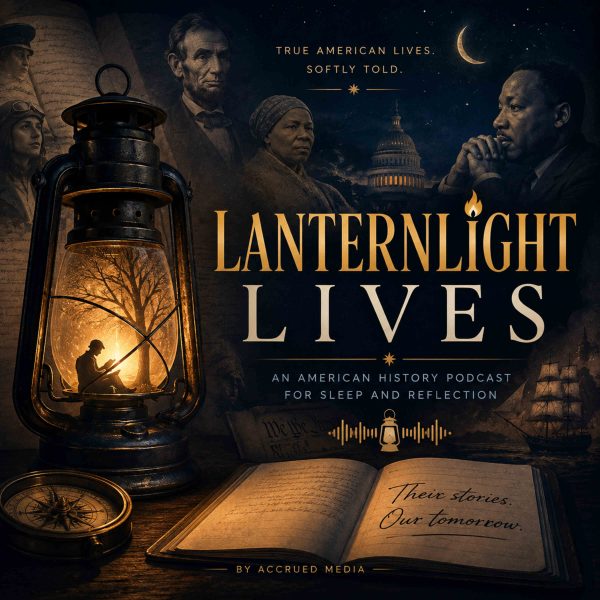
Lanternlight Lives: American History for Sleep
- Episódios
- 549
- Publicação
- diária
- Último episódio
- 13 nov 2026
Sobre o podcast
# Lanternlight Lives: American History for Sleep Discover the fascinating stories of American history as you drift off to sleep. Lanternlight Lives is a relaxing history podcast featuring forgotten Americans, extraordinary biographies, lost stories, historical mysteries, and the events that shaped the United States. Carefully researched storytelling, historical evidence, and a warm, unhurried narration, each episode brings the past to life without the noise of an ordinary documentary. From presidents and pioneers to inventors, explorers, and overlooked figures. True America lives, softly told
Episódios 549
2300 BC: The Bronze Age Collapse That Shook the Ancient Levant
Around 2300 BC, the ancient Levant entered a period of extraordinary upheaval. Powerful cities faced destruction, settlements were abandoned, and established ways of life began to change. Across parts of the …
Notas do episódio
Around 2300 BC, the ancient Levant entered a period of extraordinary upheaval. Powerful cities faced destruction, settlements were abandoned, and established ways of life began to change. Across parts of the ancient Near East, the Bronze Age world was being reshaped.
What happened?
This episode explores the archaeological evidence behind one of antiquity's most fascinating historical transitions. From the ancient city of Ebla to settlements across northern Syria and the wider Levant, we follow the traces of burned buildings, disrupted communities and changing urban landscapes.
We also examine the mysterious 4.2-kiloyear climate event, a prolonged period associated with increasingly dry conditions in parts of the region. Could changing rainfall, pressure on agriculture, political instability and disrupted trade have combined to weaken these ancient societies?
The evidence tells a more complicated story than a single night of destruction. Some cities burned. Others declined, changed their settlement patterns or were abandoned over time. The causes and chronology remain subjects of scholarly debate.
Settle in as we travel back more than four thousand years, exploring the cities, people and unanswered questions of the ancient Levant.
Lanternlight Lives — True American lives, softly told.
A quiet journey into the history of the ancient world, told with care for the evidence and space for reflection.
The Surprisingly Sleepy History of Wrapping Paper: How We Learned to Wrap Gifts
Why do we wrap presents? When did colorful paper, ribbons, and carefully folded corners become part of the pleasure of giving?Settle in for the surprisingly fascinating—and wonderfully ordinary—history of …
Notas do episódio
Why do we wrap presents? When did colorful paper, ribbons, and carefully folded corners become part of the pleasure of giving?
Settle in for the surprisingly fascinating—and wonderfully ordinary—history of wrapping paper.
In this gentle journey through the history of gift-giving, we explore how people across different cultures used paper and cloth to protect, present, and decorate meaningful gifts. From early paper traditions in Asia to the development of decorative gift wrap in the modern Western world, discover how a simple covering became part of the experience of receiving something special.
We also travel to Kansas City in 1917, when a shortage of traditional tissue paper led the Hall brothers to try something unexpected: decorative envelope-lining paper. Customers loved it, helping set the stage for the modern gift-wrapping industry.
Along the way, we consider the traditions, craftsmanship, and small social rituals hidden behind an everyday object most of us barely think about.
So make yourself comfortable, let the day grow quiet, and enjoy this softly told piece of everyday history.
Lanternlight Lives — True American lives, softly told.
Designed for relaxed listening and gentle discovery.
12,800 Years Ago: The Climate Shock That Changed North America Forever
Long before the first great cities, North America was a very different world.Around 12,800 years ago, as the last Ice Age was drawing to a close, the climate shifted dramatically. Temperatures fell, landscapes …
Notas do episódio
Long before the first great cities, North America was a very different world.
Around 12,800 years ago, as the last Ice Age was drawing to a close, the climate shifted dramatically. Temperatures fell, landscapes changed, and the ecosystems that had supported enormous Ice Age animals were transformed.
Among the mysteries of this period is the disappearance of the distinctive Clovis archaeological tradition. Its characteristic stone tools become far less visible in the archaeological record, raising an extraordinary question: what happened to the people who made them?
In this episode of Lanternlight Lives, we journey into prehistoric North America to explore the Younger Dryas, the Clovis people, the disappearance of Ice Age megafauna, and the competing explanations for one of the most fascinating transitions in human prehistory.
Was climate change the decisive force? Did changing environments reshape how people lived and hunted? And what about the controversial theory that an extraterrestrial impact contributed to the upheaval?
Settle in, slow down, and discover a world that existed thousands of years before written history.
Lanternlight Lives — True American lives, softly told.
2200 BC: The Climate Crisis That Shook the Ancient World
Around 2200 BC, the ancient world entered a period of profound change. Across Mesopotamia, Egypt, and the Indus Valley, powerful societies faced mounting pressures as climate patterns shifted, rainfall declined …
Notas do episódio
Around 2200 BC, the ancient world entered a period of profound change. Across Mesopotamia, Egypt, and the Indus Valley, powerful societies faced mounting pressures as climate patterns shifted, rainfall declined in some regions, and the foundations of agricultural life came under strain.
In Mesopotamia, the Akkadian Empire entered a period of decline. In Egypt, the Old Kingdom gave way to political fragmentation. Farther east, the great cities of the Indus Valley began a long transformation.
Could a prolonged climate crisis help explain why so many ancient societies experienced upheaval within a broadly similar period?
In this episode of Lanternlight Lives, we explore the mystery of the 4.2-kiloyear climate event: the environmental evidence, the civilizations affected, and the difficult question of how drought, food production, political power, and human resilience intersected.
Travel back more than four thousand years to a world of ancient cities, forgotten kingdoms, changing rivers, and societies adapting to an uncertain future.
A carefully told journey through ancient history, designed to be listened to slowly and peacefully.
Lanternlight Lives — True American lives, softly told.
Cahokia: The Lost City of North America That Archaeologists Still Can't Fully Explain
Long before European explorers arrived in North America, a remarkable city rose beside the Mississippi River. Its name was Cahokia.Around 1100 AD, Cahokia was one of the largest and most influential urban …
Notas do episódio
Long before European explorers arrived in North America, a remarkable city rose beside the Mississippi River. Its name was Cahokia.
Around 1100 AD, Cahokia was one of the largest and most influential urban centres north of Mexico. Thousands of people lived among enormous earthen mounds, carefully planned plazas, busy neighbourhoods, and an extensive network of settlements. At its height, this extraordinary city may have been home to 10,000–20,000 people.
But within the centuries that followed, Cahokia's population declined, its political and social structures changed, and the great centre was eventually abandoned.
What happened?
Was it prolonged drought, devastating floods, environmental pressure, political instability, social conflict, or a combination of forces? Archaeologists continue to investigate the evidence, and no single explanation accounts for every part of Cahokia's decline.
In this episode of Lanternlight Lives, settle in for a softly told journey into the world of ancient Cahokia. Discover the people who built its monumental mounds, the society that flourished along the Mississippi, and the unanswered questions surrounding one of North America's most remarkable prehistoric cities.
A forgotten city. A powerful civilization. And a mystery written into the earth.
Lanternlight Lives — True American lives, softly told.
Around 200 AD: When Rome, Han China and Other Ancient Powers Began to Fall
Around the year 200 AD, the ancient world was entering a period of extraordinary change. Across Europe and Asia, powerful states were struggling with political instability, territorial pressure, internal …
Notas do episódio
Around the year 200 AD, the ancient world was entering a period of extraordinary change. Across Europe and Asia, powerful states were struggling with political instability, territorial pressure, internal conflict and the challenge of holding vast territories together.
In China, the Eastern Han dynasty was approaching its end. In Persia, the Parthian Empire was nearing its replacement by a new ruling power. Farther east, the Kushan Empire was losing territory and influence. And in the Roman world, pressures were building toward a crisis that would shake the empire during the following century.
These events did not happen all at once, and each society followed its own path. But viewed together, they reveal a remarkable period in which the balance of power across the ancient world was changing.
Tonight, travel through the great political centres of the ancient world and explore the rise, struggles and transformation of the empires that shaped history. Discover how powerful dynasties weakened, why new powers emerged, and how the consequences of these changes reached far beyond their borders.
Settle in, get comfortable, and let the story of the ancient world unfold.
Lanternlight Lives — True American lives, softly told.
The Wari Empire: The Forgotten Power That Ruled the Andes Before the Inca
Long before the Inca built their vast empire across the Andes, another powerful civilization had already transformed the highlands of ancient Peru.They were the Wari.Emerging around the sixth century AD, the …
Notas do episódio
Long before the Inca built their vast empire across the Andes, another powerful civilization had already transformed the highlands of ancient Peru.
They were the Wari.
Emerging around the sixth century AD, the Wari developed an influential state centred in the highlands of present-day Peru. They built major settlements, established administrative centres across distant regions and developed networks that helped connect communities throughout the Andes.
Their influence extended across a remarkable landscape of mountains, valleys and coastlines. Their story reveals a sophisticated society whose political organization, architecture and traditions helped shape the world inherited by later Andean civilizations, including the Inca.
But around the end of the first millennium, Wari political dominance began to unravel. Their great centres declined, regional powers emerged, and the Andes entered a period of profound transformation.
What happened to the Wari? Why did their influence fade? And how much of their legacy survived in the civilizations that followed?
Settle in and journey into the ancient Andes in this calmly told exploration of the Wari Empire — one of the most important civilizations to rise before the Inca.
Lanternlight Lives — True American lives, softly told.
Caral: The 5,000-Year-Old Civilization That Built the First Great Pyramids of the Americas
Long before the Aztec Empire rose to power in Mexico, an extraordinary civilization was already building monumental pyramids along the Pacific coast of South America.Its name was Caral.Located in Peru's Supe …
Notas do episódio
Long before the Aztec Empire rose to power in Mexico, an extraordinary civilization was already building monumental pyramids along the Pacific coast of South America.
Its name was Caral.
Located in Peru's Supe Valley, Caral developed approximately 5,000 years ago and became one of the oldest known urban civilizations in the Americas.
Its extraordinary landscape contained enormous platform mounds, monumental pyramids, sunken circular plazas and carefully organized residential areas. These structures reveal a society capable of coordinating large construction projects and developing sophisticated systems of social and economic organization.
But who were the people behind this remarkable civilization? How did they construct enormous monuments without the technologies of later empires? And why did their once-thriving settlements eventually decline?
In this episode of Lanternlight Lives, journey into the ancient world of Caral-Supe and discover:
The origins of Caral, one of the oldest known urban civilizations in the Americas.
The enormous pyramidal structures and ceremonial plazas of the Supe Valley.
How ancient communities organized monumental construction projects.
The relationship between agriculture, fishing and trade in early Peruvian society.
The mysterious society that flourished thousands of years before the Aztecs and Incas.
What archaeologists have discovered about Caral's architecture and social organization.
The environmental pressures and changing conditions associated with the decline of its settlements.
Before the great civilizations of the Americas became famous, another extraordinary world had already emerged along the coast of ancient Peru.
Its monuments still stand as evidence of humanity's remarkable ability to organize, build and transform the landscape.
Settle in, relax and discover Caral — the ancient civilization that helped shape the earliest chapters of American history.
Lanternlight Lives — True American lives, softly told.
Eridu: The World's Oldest Sacred City and the Lost Origins of Sumerian Civilization
Long before the great cities of Sumer rose to prominence, an ancient settlement was already flourishing in the marshlands of southern Mesopotamia.Its name was Eridu.Located in what is now southern Iraq, Eridu …
Notas do episódio
Long before the great cities of Sumer rose to prominence, an ancient settlement was already flourishing in the marshlands of southern Mesopotamia.
Its name was Eridu.
Located in what is now southern Iraq, Eridu became one of the most important religious centres of the ancient world. Its origins reach back more than 7,000 years, to a time when communities were developing new ways of farming, organizing society and building permanent settlements.
Here, generations of ancient people constructed temples, rebuilt sacred structures and established traditions that would become central to the religious and cultural history of Mesopotamia.
In Sumerian tradition, Eridu was remembered as the first city in the world. The ancient Sumerian King List even identified it as the first seat of kingship, placing its legendary rulers in an age before the Great Flood.
But what was Eridu really like? How did this ancient settlement become such an important religious centre? And why did a city once surrounded by thriving marshlands eventually decline in importance?
In this episode of Lanternlight Lives, journey into the forgotten beginnings of Mesopotamian civilization and discover:
The origins of Eridu, one of the earliest settlements in southern Mesopotamia.
How ancient communities developed permanent settlements in the marshlands of Iraq.
The remarkable sequence of temples built and rebuilt over thousands of years.
Enki, the ancient Sumerian god associated with wisdom, water and creation.
What the Sumerian King List reveals about Eridu's legendary place in history.
How Eridu helped shape the religious traditions of ancient Sumer.
Why environmental changes, shifting waterways and economic pressures contributed to the city's decline.
What archaeological discoveries reveal about humanity's earliest urban societies.
Before the magnificent cities of Uruk and Ur dominated the ancient world, Eridu had already established a remarkable place in Mesopotamian history.
Its ruins preserve the story of a civilization's earliest traditions, the emergence of sacred architecture and humanity's long journey toward organized urban life.
Settle in, relax and travel thousands of years into the past to discover Eridu — the ancient city remembered as the beginning of Sumerian civilization.
Lanternlight Lives — True American lives, softly told.
Stanton Drew: The Buried Prehistoric Monument That May Have Outgrown Stonehenge
Long before Stonehenge became one of the world's most recognizable prehistoric monuments, ancient communities in southwest England were creating extraordinary ceremonial structures of their own.At Stanton Drew …
Notas do episódio
Long before Stonehenge became one of the world's most recognizable prehistoric monuments, ancient communities in southwest England were creating extraordinary ceremonial structures of their own.
At Stanton Drew, in Somerset, archaeologists uncovered evidence of something remarkable beneath the earth: an enormous prehistoric timber monument consisting of nine concentric rings of wooden posts.
Imagine hundreds of massive timber pillars arranged in carefully planned circles, creating a monumental structure that reveals the extraordinary organizational abilities of Britain's Neolithic communities.
Today, much of this ancient wooden structure has disappeared beneath the soil. Its existence is revealed through archaeological surveys that detect the traces left behind by long-vanished posts and surrounding earthworks.
Who built it? How did prehistoric communities organize such an ambitious construction project? What ceremonies or gatherings took place within its enormous circular structure? And why did the monument eventually disappear from the visible landscape?
In this episode of Lanternlight Lives, travel back approximately 5,000 years to explore:
The prehistoric world of Stanton Drew in ancient Somerset.
The discovery of the enormous buried timber monument.
The nine concentric rings of wooden posts revealed by archaeological surveys.
How Neolithic communities organized monumental construction projects.
The relationship between Stanton Drew, Stonehenge and other prehistoric ceremonial sites.
The possible religious, ceremonial and communal purposes of these extraordinary structures.
What buried archaeological evidence reveals about Britain's prehistoric past.
Long before written history, ancient communities were already transforming their landscapes with monumental structures whose original meanings remain partly unknown.
Beneath the peaceful countryside of Somerset lies a remarkable chapter of prehistoric engineering, ancient beliefs and forgotten human achievement.
Settle in, relax and discover the buried monument of Stanton Drew — an extraordinary reminder of what humanity was building thousands of years ago.
Lanternlight Lives — True American lives, softly told.
Before Rome: The Forgotten Civilization That Ruled Before Rome
Long before Rome became the dominant power of the ancient world, another remarkable civilization flourished across the Italian peninsula.They were the Etruscans.Between the Arno and Tiber rivers, in the lands …
Notas do episódio
Long before Rome became the dominant power of the ancient world, another remarkable civilization flourished across the Italian peninsula.
They were the Etruscans.
Between the Arno and Tiber rivers, in the lands that would eventually become Tuscany, Lazio and Umbria, the Etruscans developed wealthy cities, powerful ruling families, extraordinary artistic traditions and extensive Mediterranean trade networks.
Their cities possessed magnificent temples, elaborate tombs, sophisticated metalworking industries and distinctive religious traditions. Their influence extended into early Roman society, shaping aspects of Roman architecture, religion, political customs and culture.
Yet the Etruscans left behind a mystery.
Their language was unlike Latin and most other ancient languages of the region. Much of their literature has been lost, and the historical accounts that survive were largely written by outsiders.
As Rome expanded, Etruscan cities gradually lost their political independence. Their communities were incorporated into the Roman world, their language slowly disappeared, and their distinctive cultural identity was transformed.
How did this extraordinary civilization rise to prominence? What made its cities so powerful? And how did a people who once rivalled Rome eventually become one of antiquity's most overlooked civilizations?
In this episode of Lanternlight Lives, journey into ancient Italy and discover:
The origins and rise of the Etruscan civilization.
The powerful independent city-states of ancient Etruria.
Their remarkable wealth, maritime trade and metalworking expertise.
The mysterious Etruscan language and the writings that survive.
Their extraordinary tombs, temples, art and religious traditions.
How Etruscan culture influenced the development of ancient Rome.
The Roman conquest and gradual assimilation of Etruscan society.
Why so much of their literature and historical identity disappeared.
Before the Roman Empire, before its legendary emperors and mighty legions, there was another civilization whose achievements helped shape the ancient Mediterranean.
Settle in, relax and uncover the forgotten history of the Etruscans.
Lanternlight Lives — True American lives, softly told.
Before Ancient Greece: The Lost Sea Power of the Ancient Mediterranean and the Volcano That Changed Everything
Long before classical Greece became famous for Athens, Sparta and its legendary warriors, a remarkable civilization flourished across the island of Crete.They were the Minoans.More than 3,500 years ago, this …
Notas do episódio
Long before classical Greece became famous for Athens, Sparta and its legendary warriors, a remarkable civilization flourished across the island of Crete.
They were the Minoans.
More than 3,500 years ago, this extraordinary Bronze Age society developed magnificent palaces, sophisticated architecture, vibrant art and extensive maritime trading networks connecting the Aegean with Egypt, Cyprus and the eastern Mediterranean.
At the heart of their world stood magnificent centres such as Knossos, with its elaborate architecture, colourful frescoes and mysterious symbols.
But beyond the prosperity of Minoan Crete, an extraordinary natural disaster was unfolding nearby.
On the island of Thera, now known as Santorini, one of the most powerful volcanic eruptions of the ancient world devastated the thriving settlement of Akrotiri. Enormous quantities of volcanic ash and pumice buried buildings, streets and remarkable works of art, preserving a moment of Bronze Age life beneath the earth.
Could this eruption have contributed to the eventual decline of Minoan power? What happened to their maritime networks, their magnificent palaces and their distinctive culture?
In this episode of Lanternlight Lives, journey into the ancient Mediterranean and discover:
The rise of the Minoan civilization on the island of Crete.
The magnificent palace complexes of Knossos and Phaistos.
How Minoan merchants connected distant Mediterranean societies through maritime trade.
The mysterious writing systems known as Linear A and Linear B.
The catastrophic volcanic eruption of Thera and the destruction of Akrotiri.
How earthquakes, volcanic activity and changing political circumstances affected the Minoan world.
Why Minoan civilization eventually declined and how its cultural influence survived.
Beneath the ruins of ancient palaces and the volcanic landscapes of the Aegean lies the story of a remarkable civilization that helped shape the prehistoric Mediterranean.
Settle in, relax and discover the fascinating world of the Minoans — a lost chapter of ancient history preserved in stone, ash and archaeological memory.
Lanternlight Lives — True American lives, softly told.
Before Egypt and Sumer: The 11,500-Year-Old Monument Built Before the First Cities
Long before the pyramids of Egypt rose above the desert and before the great cities of ancient Sumer emerged, an extraordinary monumental complex was being constructed in the hills of southeastern Anatolia.Its …
Notas do episódio
Long before the pyramids of Egypt rose above the desert and before the great cities of ancient Sumer emerged, an extraordinary monumental complex was being constructed in the hills of southeastern Anatolia.
Its name was Göbekli Tepe.
Dating back approximately 11,500 years, this remarkable archaeological site contains enormous T-shaped limestone pillars, some reaching more than five metres in height, decorated with intricate carvings of foxes, snakes, birds and other wild animals.
But what makes Göbekli Tepe truly extraordinary is the people who built it.
These were communities living during the Pre-Pottery Neolithic period, when hunting and gathering remained important ways of life. They constructed monumental buildings that required remarkable planning, cooperation, engineering and organization.
How did prehistoric communities move and raise these enormous stones without modern machinery? Why did they create such elaborate structures? Were these monuments places of ritual, communal gathering or something we have yet to understand?
In this episode of Lanternlight Lives, journey back more than eleven millennia to explore:
The discovery and archaeological significance of Göbekli Tepe.
The mysterious T-shaped limestone pillars and their extraordinary animal carvings.
How prehistoric hunter-gatherers organized monumental construction projects.
What archaeologists have discovered about the people who lived at the site.
The possible religious, ceremonial and communal purposes of its monumental enclosures.
How Göbekli Tepe challenges traditional ideas about the development of civilization.
What this ancient site reveals about humanity before the first great cities.
Long before kings, written records and monumental pyramids, people were already creating extraordinary structures that brought communities together.
Settle in, relax and travel back to the dawn of monumental architecture, where one of humanity's oldest mysteries still waits beneath the earth.
Lanternlight Lives — True American lives, softly told.
The Lost Cities of the Amazon: The Ancient Civilization Hidden Beneath the Jungle
What if the Amazon rainforest was once home to vast settlements, sophisticated engineering systems and thriving communities that modern history almost overlooked?Long before Christopher Columbus crossed the …
Notas do episódio
What if the Amazon rainforest was once home to vast settlements, sophisticated engineering systems and thriving communities that modern history almost overlooked?
Long before Christopher Columbus crossed the Atlantic, Indigenous societies across the Amazon were transforming the landscape around them.
Beneath the dense vegetation of the rainforest lie the remains of an extraordinary prehistoric world: ancient settlements, enormous earthen platforms, ceremonial centres, interconnected roads, agricultural fields and sophisticated water-management systems.
In Ecuador's Upano Valley, archaeologists have uncovered an extensive network of ancient settlements dating back approximately 2,500 years. Meanwhile, in Bolivia's Amazonian lowlands, researchers have identified remarkable urban landscapes built by the Casarabe culture, including enormous platforms, pyramids, roads, canals and reservoirs.
How did these societies organize their communities? How did they build such extensive landscapes without modern machinery? And why did many of these settlements eventually decline or become abandoned?
In this episode of Lanternlight Lives, journey into the forgotten history of ancient Amazonia and discover:
The extraordinary pre-Columbian settlements hidden beneath the Amazon rainforest.
The ancient cities and interconnected communities of Ecuador's Upano Valley.
The remarkable engineering achievements of the Casarabe culture.
How Indigenous societies transformed forests and wetlands into productive agricultural landscapes.
The ancient roads, canals, platforms and ceremonial structures revealed by modern archaeology.
How LiDAR technology is uncovering settlements hidden beneath dense rainforest vegetation.
What happened to these ancient communities following centuries of environmental and historical change.
The Amazon was never simply an untouched wilderness. It was also a landscape shaped by generations of Indigenous knowledge, ingenuity and human ambition.
Settle in, relax and discover the remarkable lost cities of the Amazon — a hidden chapter of human history waiting beneath the rainforest.
Lanternlight Lives — True American lives, softly told.
Doggerland: The Lost Prehistoric World Swallowed by the North Sea
Before Britain became an island, an extraordinary prehistoric landscape connected it to continental Europe.Its name was Doggerland.Thousands of years ago, where the North Sea now stretches between Britain and …
Notas do episódio
Before Britain became an island, an extraordinary prehistoric landscape connected it to continental Europe.
Its name was Doggerland.
Thousands of years ago, where the North Sea now stretches between Britain and mainland Europe, there were once vast plains, winding rivers, forests, wetlands and rich hunting grounds. This was a living landscape inhabited by prehistoric communities whose lives unfolded across a world that has since disappeared beneath the waves.
But as the great ice sheets melted and sea levels continued to rise, the landscape slowly transformed. Familiar coastlines vanished, ancient hunting grounds became submerged, and the land that once connected entire communities was gradually lost to the sea.
What was life like in this forgotten prehistoric world? Who were the people who inhabited it? And what can the archaeological discoveries beneath the North Sea reveal about humanity's distant past?
In this episode of Lanternlight Lives, discover:
The extraordinary prehistoric landscape of Doggerland.
How ancient hunter-gatherers lived, hunted and travelled across the region.
The rivers, forests and wetlands that once covered the North Sea basin.
How rising sea levels transformed the geography of prehistoric Europe.
The archaeological discoveries revealing evidence of lost human communities.
How Britain gradually became separated from continental Europe.
Beneath the busy shipping lanes and cold waters of the North Sea lies a hidden chapter of human history.
A world that once existed, a landscape that supported human life, and a prehistoric past that archaeology is only beginning to reconstruct.
Settle in, relax and travel back thousands of years to discover Doggerland, the lost world beneath the waves.
Lanternlight Lives — True American lives, softly told.
Before Athens and Sparta: The Rise and Fall of the Mycenaean Warrior Kingdoms
Long before Athens became the birthplace of democracy and Sparta earned its reputation as one of ancient Greece's most formidable military powers, another civilization dominated the Greek mainland.They were the …
Notas do episódio
Long before Athens became the birthplace of democracy and Sparta earned its reputation as one of ancient Greece's most formidable military powers, another civilization dominated the Greek mainland.
They were the Mycenaeans: powerful Bronze Age kingdoms ruled by warrior elites, fortified citadels and wealthy palace administrations.
From the legendary walls of Mycenae to the great palace of Pylos, these ancient kingdoms built a sophisticated world of military power, international trade, royal authority and remarkable engineering.
But around 1200 BC, that world began to unravel.
Great palaces were destroyed. Powerful political systems collapsed. Trade networks fractured, and communities across the Aegean experienced profound upheaval.
What brought these once-powerful kingdoms to their knees? Was it warfare, internal political rivalries, environmental pressures, economic instability, or a combination of forces?
In this episode of Lanternlight Lives, journey into the fascinating world of Mycenaean Greece and uncover:
How the Mycenaean warrior kingdoms rose to power.
The extraordinary fortresses and palaces of Bronze Age Greece.
The military culture and royal dynasties behind Mycenaean society.
The destruction of major palace centres around 1200 BC.
The competing theories behind the collapse of Mycenaean political power.
What survived after the palaces fell and how Greece eventually entered a new historical age.
Before the famous city-states of classical Greece, another world existed — one of kings, warriors, monumental fortresses and forgotten kingdoms.
Settle in, relax and discover the extraordinary story of the civilization that came before Athens and Sparta.
Lanternlight Lives — True American lives, softly told.
Angkor: The World's Largest Medieval City and the Mystery of Its Decline
Deep in the Cambodian jungle lie the remains of a city that once stood among the greatest achievements of the medieval world.Its name was Angkor.At its height, this extraordinary Khmer urban complex covered an …
Notas do episódio
Deep in the Cambodian jungle lie the remains of a city that once stood among the greatest achievements of the medieval world.
Its name was Angkor.
At its height, this extraordinary Khmer urban complex covered an immense landscape of temples, reservoirs, canals, roads and settlements. Its population may have reached hundreds of thousands, making it one of the largest premodern urban centres ever documented.
At its heart stood magnificent monuments, including Angkor Wat — a testament to the power, ambition and spiritual imagination of the Khmer Empire.
But over time, the political centre of this remarkable world shifted. Its population declined, its vast water-management network suffered, and parts of the once-thriving landscape gradually returned to forest.
In 1431, an attack by the neighbouring Kingdom of Ayutthaya became one of the defining events in the traditional story of Angkor's decline. Yet the evidence suggests that the transformation had begun much earlier.
Was it warfare? Political upheaval? Changing trade routes? Drought and devastating monsoon floods? Or a combination of forces that slowly weakened a city built on an extraordinary relationship with water?
Tonight, journey into the ancient Khmer world and discover the rise, grandeur and mysterious transformation of Angkor.
A true story of ancient civilization, forgotten cities and the remarkable people who built a world that time could not entirely erase.
Lanternlight Lives — True American lives, softly told.
Settle in, get comfortable, and let history unfold.
This episode is presented as a calm, carefully researched historical journey. The decline of Angkor remains a subject of scholarly investigation, and no single explanation accounts for every part of its transformation.
1300 AD: Why the Ancestral Puebloans Left Their Ancient Cities
Around 1300 AD, some of the most remarkable settlements in the American Southwest stood nearly empty. Stone villages, carefully built homes, and extraordinary cliff dwellings were left behind as Ancestral …
Notas do episódio
Around 1300 AD, some of the most remarkable settlements in the American Southwest stood nearly empty. Stone villages, carefully built homes, and extraordinary cliff dwellings were left behind as Ancestral Pueblo communities moved away from the Mesa Verde region.
Why did they leave?
For generations, these communities had built homes, grown crops, developed traditions, and adapted to life across the Four Corners region. Then, during the thirteenth century, prolonged drought, pressure on local resources, and social changes contributed to a period of profound migration.
In this episode of Lanternlight Lives, journey into the ancient world of Mesa Verde and explore the people behind its remarkable stone settlements. Discover the story of Cliff Palace, the environmental challenges facing these communities, and the archaeological clues that help explain why families and entire communities moved south.
But this is not simply a story of disappearance. The Ancestral Pueblo people did not vanish. Their descendants live in Pueblo communities today, carrying forward traditions and connections to these ancestral places.
Settle in for a softly told journey through the history, mystery, and enduring legacy of one of North America's remarkable ancient cultures.
Lanternlight Lives — True American lives, softly told.
2300 BC: The Mystery of the Megalith Builders and the Disappearing Stone-Building Traditions
Thousands of years ago, ancient communities across Europe and the wider ancient world moved enormous stones to create extraordinary monuments, burial chambers, temples and sacred landscapes.But as the centuries …
Notas do episódio
Thousands of years ago, ancient communities across Europe and the wider ancient world moved enormous stones to create extraordinary monuments, burial chambers, temples and sacred landscapes.
But as the centuries passed, many of these remarkable building traditions began to change, decline or disappear.
Why did ancient communities stop constructing certain megalithic monuments? What happened to the people who built them? And could environmental changes, population movements, shifting beliefs and the transformation of ancient societies help explain this remarkable chapter of human history?
In this immersive exploration of prehistoric civilizations, we journey through the world of Stonehenge, Newgrange, the megalithic monuments of Atlantic Europe, Malta's ancient temples and other extraordinary achievements of prehistoric engineering.
Discover:
How ancient communities organized themselves to move and position enormous stones.
The mysterious history of Europe's megalithic builders.
Why monumental tomb construction declined in parts of prehistoric Europe.
How climate change and population movements may have transformed ancient societies.
What happened to the traditions that created some of humanity's most extraordinary stone monuments.
Were these ancient building traditions connected by a larger historical transformation, or did different societies follow their own paths?
Join us for a fascinating journey into prehistoric archaeology, forgotten civilizations and the enduring mysteries of the ancient world.
Settle in, relax and let the remarkable stories of humanity's distant past unfold.
Lanternlight Lives — True American lives, softly told.
The 12th-Century Mystery: Why Four Civilizations Faced Crisis Across Four Continents
Imagine a world where powerful civilizations, separated by thousands of miles and oceans, began facing extraordinary challenges within the same broad period of history.Around the 12th century, the great …
Notas do episódio
Imagine a world where powerful civilizations, separated by thousands of miles and oceans, began facing extraordinary challenges within the same broad period of history.
Around the 12th century, the great settlements of Chaco Canyon in North America, the ancient Andean world of Tiwanaku, the Ghana Empire in West Africa, and the Liao Dynasty in East Asia experienced major transformations, political upheaval, or decline.
What was happening across these distant corners of the world? Could prolonged drought, environmental pressures, changing trade routes, political instability, and the fragility of powerful societies help explain these remarkable historical turning points?
In this immersive journey through medieval history, we explore four distant worlds, the civilizations they built, the challenges they faced, and the mysteries that remain.
Discover:
The rise and decline of Chaco Canyon and its remarkable ancestral communities.
The transformation of the ancient Andean world after Tiwanaku.
The changing fortunes of the Ghana Empire and its powerful trade networks.
The fall of the Liao Dynasty and the shifting balance of power in East Asia.
What climate history, archaeology, and human resilience reveal about the rise and fall of civilizations.
Were these events connected by a larger historical pattern, or were they separate stories shaped by different circumstances?
Settle in, slow down, and discover the fascinating stories hidden in the pages of world history.
Lanternlight Lives - True American lives, softly told.
The Times Square Ball: The Engineering Behind New Year’s Eve’s Most Famous Drop | A Sleep Story
Every New Year’s Eve, a glittering sphere descends above Times Square, marking the final seconds of one year and the beginning of another. But behind this familiar spectacle is a fascinating history of …
Notas do episódio
Every New Year’s Eve, a glittering sphere descends above Times Square, marking the final seconds of one year and the beginning of another. But behind this familiar spectacle is a fascinating history of engineering, invention, materials, lighting, and precision.
In this relaxing historical documentary, explore the evolution of the Times Square New Year’s Eve Ball from its first appearance in 1907 as a five-foot iron-and-wood structure illuminated by 100 light bulbs to the remarkable modern designs that combine intricate crystals, advanced lighting, and sophisticated control systems.
Discover the origins of the ball-drop tradition, the structural ideas behind its construction, the transformations that reshaped its appearance, and the technology that makes its annual descent possible.
A quiet journey through American history, mechanical ingenuity, architecture, and the engineering hidden inside one of the world's most recognizable New Year traditions.
Settle in, slow down, and enjoy the story.
Topics: Times Square history, New Year's Eve Ball, structural engineering, mechanical design, crystal construction, lighting technology, American cultural history, and the history of timekeeping.
A relaxing history documentary for sleep, rest, and curious minds.
The Elevator: The Invention That Made Skyscrapers Possible | A Sleep Story
Tonight, rise through the fascinating history of the elevator, the remarkable invention that transformed architecture and made the modern skyscraper possible.Before elevators became a familiar feature of homes …
Notas do episódio
Tonight, rise through the fascinating history of the elevator, the remarkable invention that transformed architecture and made the modern skyscraper possible.
Before elevators became a familiar feature of homes, hotels, offices, and shopping centers, climbing multiple flights of stairs was an unavoidable part of reaching the upper floors of a building. But a series of mechanical innovations would eventually change how people moved through cities.
Discover the early history of lifting machines, the development of passenger elevators, and the engineering breakthrough that helped overcome one of architecture's greatest limitations.
Explore the contribution of Elisha Otis and his famous elevator safety demonstration, the rise of electric elevators, and the extraordinary relationship between vertical transportation and the growth of modern skyscrapers.
Learn how cables, counterweights, pulleys, motors, braking systems, and sophisticated controls work together to move passengers safely through towering buildings.
From nineteenth-century mechanical lifts to the high-speed elevators of modern cities, discover how a seemingly ordinary machine reshaped urban architecture and changed the way humanity builds upward.
This relaxing engineering sleep story explores elevator history, skyscraper development, mechanical engineering, vertical transportation, and the hidden technology behind modern buildings.
Perfect for bedtime listening, nighttime relaxation, or anyone who enjoys calm educational storytelling about inventions, architecture, and industrial history.
Get comfortable, step inside, and let this gentle journey through the history of the elevator carry you into the night.
Tonight's journey: Elevator history, Elisha Otis, elevator safety mechanisms, skyscraper construction, electric elevators, vertical transportation, and modern architecture.
Follow for more relaxing sleep stories about forgotten inventions, engineering, industrial history, and the extraordinary technology behind everyday life.
Good night.
The Escalator: The Endless Machine That Changed the Modern World | A Sleep Story
Tonight, descend into the fascinating history of the escalator, the endless moving staircase that quietly transformed the way people travel through buildings, shopping centers, railway stations, and …
Notas do episódio
Tonight, descend into the fascinating history of the escalator, the endless moving staircase that quietly transformed the way people travel through buildings, shopping centers, railway stations, and cities.
Discover how early mechanical stairways evolved into the familiar escalators found in department stores, airports, subway stations, and commercial buildings around the world.
Explore the inventors, engineers, and industrial pioneers who helped develop this remarkable machine. From early experimental designs and nineteenth-century inventions to the rise of modern escalators, follow the story of an engineering innovation that made vertical transportation part of everyday life.
Learn how escalators move continuously through carefully designed mechanical systems, how their safety features evolved, and how they became essential components of modern architecture and urban infrastructure.
This relaxing engineering sleep story explores escalator history, mechanical engineering, transportation technology, and the hidden machinery behind everyday convenience.
Perfect for bedtime listening, nighttime relaxation, or anyone who enjoys calm educational documentaries about inventions, industrial history, and the extraordinary systems that surround us.
Get comfortable, let the day fade away, and follow the endless journey of the moving staircase.
Tonight’s journey: Escalator history, mechanical stairways, engineering inventions, vertical transportation, modern architecture, shopping centers, and urban infrastructure.
Follow for more relaxing sleep stories about forgotten inventions, industrial technology, history, and everyday objects.
Good night.
The Physics of Chocolate: From Cocoa Bean to Global Delivery | A Sleep Story
Tonight, settle into a relaxing journey through the surprisingly fascinating physics, science, and logistics of chocolate.From the delicate transformation of cocoa beans into smooth chocolate to the complex …
Notas do episódio
Tonight, settle into a relaxing journey through the surprisingly fascinating physics, science, and logistics of chocolate.
From the delicate transformation of cocoa beans into smooth chocolate to the complex systems that transport chocolate around the world, discover the hidden science behind one of humanity’s favorite treats.
Explore how temperature affects chocolate, why cocoa butter behaves in unusual ways, how chocolate melts and crystallizes, and why the perfect chocolate bar requires a remarkable balance of chemistry and physics.
Follow the journey from cocoa plantations and chocolate factories to refrigerated warehouses, transportation networks, and supermarket shelves. Discover how manufacturers and logistics specialists protect chocolate from heat, preserve its texture, and deliver it across continents.
This calming educational sleep story combines the science of chocolate, food manufacturing, transportation logistics, and everyday physics into a gentle nighttime documentary.
Perfect for bedtime listening, relaxation, or anyone who enjoys fascinating science stories told in a peaceful, unhurried style.
Get comfortable, let the world slow down, and drift through the quiet science of chocolate.
Tonight’s journey: Chocolate physics, cocoa butter, temperature, crystallization, chocolate manufacturing, food logistics, cold-chain transportation, and global distribution.
Follow for more relaxing stories about science, technology, history, logistics, and the extraordinary systems behind ordinary things.
Good night.
The Quiet History of Greeting Cards: From Ancient Messages to Modern Paper | A Sleep Story
Tonight, settle into a peaceful journey through the surprisingly fascinating history of greeting cards.Long before colorful birthday cards, holiday greetings, and handwritten messages filled store shelves …
Notas do episódio
Tonight, settle into a peaceful journey through the surprisingly fascinating history of greeting cards.
Long before colorful birthday cards, holiday greetings, and handwritten messages filled store shelves, people found quiet ways to express affection, friendship, gratitude, and good wishes through written words.
Discover how ancient civilizations exchanged messages of celebration, how early paper traditions developed, and how the greeting card gradually evolved into a familiar part of everyday life. From handwritten notes and Victorian-era traditions to the rise of printed birthday cards, Christmas cards, and modern greetings, explore the history of a simple object that has connected people across generations.
This relaxing historical sleep story explores the origins of greeting cards, the evolution of paper communication, the traditions behind sending cards, and the gentle cultural history of human connection.
Perfect for bedtime listening, relaxation, insomnia routines, or anyone who enjoys calm, educational storytelling, this slow-paced journey invites you to discover the extraordinary history hidden inside an ordinary envelope.
Get comfortable, let the world grow quiet, and drift through the gentle history of greeting cards.
Tonight’s journey: Greeting card history, ancient messages, handwritten letters, Victorian traditions, birthday cards, Christmas cards, paper culture, and the evolution of personal communication.
Follow the podcast for more relaxing history stories about ordinary objects, forgotten traditions, everyday inventions, and the fascinating details of human life.
Good night.
The Shipping Container: The Metal Box That Changed the World | A Sleep Story
Tonight, drift into the surprisingly fascinating history of the shipping container, the ordinary metal box that transformed global trade and helped build the modern economy.Discover how a simple steel container …
Notas do episódio
Tonight, drift into the surprisingly fascinating history of the shipping container, the ordinary metal box that transformed global trade and helped build the modern economy.
Discover how a simple steel container revolutionized the movement of goods across oceans, reshaped ports and railways, changed international shipping, and connected distant countries through an extraordinary network of transportation and logistics.
From the early days of cargo handling to the rise of container ships, enormous shipping terminals, and modern supply chains, explore the quiet industrial revolution hidden inside a seemingly unremarkable metal box.
Learn how standardization made global trade faster, how containerization transformed shipping costs and transportation, and how millions of everyday products travel across the world inside these familiar steel structures.
This relaxing historical sleep story takes you through the evolution of shipping containers, maritime transportation, industrial logistics, and the infrastructure that keeps the global economy moving.
Perfect for bedtime listening, relaxation, or anyone who enjoys calm educational storytelling, this slow-paced documentary explores one of the most influential inventions of modern economic history.
Get comfortable, let the noise of the day fade away, and follow the quiet journey of the metal box that changed the world.
Tonight’s journey: Shipping container history, global trade, container ships, maritime transportation, industrial logistics, supply chains, and the modern economy.
Follow for more relaxing history stories about overlooked inventions, forgotten industries, and the ordinary objects that quietly shaped civilization.
Good night.
The 60 Hz Pulse: The Hidden World of the Power Grid | A Sleep Story
Tonight, journey into the quiet, intricate world of the electrical power grid.At the center of modern electricity is a steady pulse: 60 cycles per second. From towering transmission lines and humming …
Notas do episódio
Tonight, journey into the quiet, intricate world of the electrical power grid.
At the center of modern electricity is a steady pulse: 60 cycles per second. From towering transmission lines and humming transformers to distant power stations and the networks that carry electricity into our homes, discover the remarkable systems that keep the modern world illuminated.
Follow the unseen journey of electrical energy through an interconnected web of engineering, infrastructure, and careful coordination. Explore the machines, routines, and quiet complexity behind something we often take for granted.
This relaxing engineering sleep story is designed for nighttime listening, unwinding, and peaceful reflection.
Get comfortable, let the gentle rhythm of the power grid guide you, and drift toward sleep.
Welcome to the hidden world of electricity.
The 3,450 RPM Wash: The Quiet World of Industrial Logistics | A Sleep Story
Settle in for a quiet journey into the hidden world of industrial logistics, where machines turn, systems move, and every component has its place.At the heart of this story is the steady rhythm of 3,450 …
Notas do episódio
Settle in for a quiet journey into the hidden world of industrial logistics, where machines turn, systems move, and every component has its place.
At the heart of this story is the steady rhythm of 3,450 revolutions per minute a number that opens the door to the fascinating world of industrial motors, mechanical motion, washing systems, supply chains, and the everyday engineering that keeps modern industry running.
From the hum of machinery to the careful coordination of materials and processes, discover the remarkable routines behind the industrial world.
This slow, atmospheric industrial sleep story is designed for nighttime listening, relaxation, and unwinding after a long day.
Get comfortable, let the machinery fade into the background, and drift into sleep.
Welcome to a quieter side of industrial history and engineering.
From Straw to NASA: The Complete History of Your Bed | Boring History for Sleep
Tonight, discover the surprisingly fascinating history of something you use every single night: your bed.From humble piles of straw and ancient sleeping platforms to elaborate royal beds, industrial mattresses …
Notas do episódio
Tonight, discover the surprisingly fascinating history of something you use every single night: your bed.
From humble piles of straw and ancient sleeping platforms to elaborate royal beds, industrial mattresses, and the remarkable sleeping arrangements of astronauts aboard NASA spacecraft, this relaxing historical sleep story explores how humanity has slept throughout the ages.
Journey through centuries of ordinary life, discovering how beds evolved alongside civilization, technology, wealth, and changing ideas about comfort.
Explore ancient sleeping habits, medieval beds, the development of mattresses, the invention of modern bedding, and the challenges of sleeping in the extraordinary environment of space.
How did people sleep before mattresses existed? When did beds become symbols of wealth and status? And how do astronauts sleep when there is no floor, no traditional bed, and no gravity pulling them down?
This peaceful episode brings together the history of everyday life, fascinating inventions, and the evolution of human comfort.
No dramatic adventures. No urgent discoveries. Just the wonderfully ordinary history of the place where you spend a third of your life.
Perfect for listeners who enjoy boring history for sleep, relaxing educational stories, bedtime history, and fascinating facts about everyday objects.
Settle in, get comfortable, and let the long history of your bed accompany you toward sleep.
Follow the podcast for more boring history, relaxing stories, and peaceful journeys through the past.
Fire Flowers: How Ancient Alchemists Invented Fireworks | A Sleep Story
Long before fireworks illuminated celebrations around the world, ancient alchemists were searching for something entirely different.Tonight, journey into the fascinating history of fireworks and discover how …
Notas do episódio
Long before fireworks illuminated celebrations around the world, ancient alchemists were searching for something entirely different.
Tonight, journey into the fascinating history of fireworks and discover how experiments in ancient China helped transform the night sky forever.
In this relaxing historical sleep story, explore the mysterious world of ancient alchemy, early chemical discoveries, and the unexpected origins of gunpowder.
Imagine quiet laboratories, curious scholars, strange mixtures, and the remarkable moment when an accidental discovery began a centuries-long journey toward the brilliant fire flowers we know today.
Discover how early Chinese inventors and alchemists contributed to the development of gunpowder, how fireworks evolved across cultures, and how a fascinating scientific discovery became one of humanity’s most beautiful forms of celebration.
This peaceful bedtime story combines the history of fireworks, ancient science, alchemy, and human invention with gentle, immersive storytelling.
Perfect for listeners who enjoy relaxing history, fascinating scientific discoveries, ancient inventions, and bedtime stories for adults.
Settle in, relax, and let the story of fire flowers carry you into the distant past.
🎧 Follow the podcast for more fascinating historical discoveries, relaxing science stories, and peaceful journeys through history.
Aqui estão os 40 episódios mais recentes de 549. Os mais antigos estão no feed do podcast.
Podcasts parecidos
Mais podcasts de História





Este podcast é seu?
Confirme com uma entrada no seu feed: você recebe um código aqui, adiciona como podcast:txt no canal do seu feed e nós verificamos. Depois disso, seu podcast aparece como “verificado” no SoundNode.