

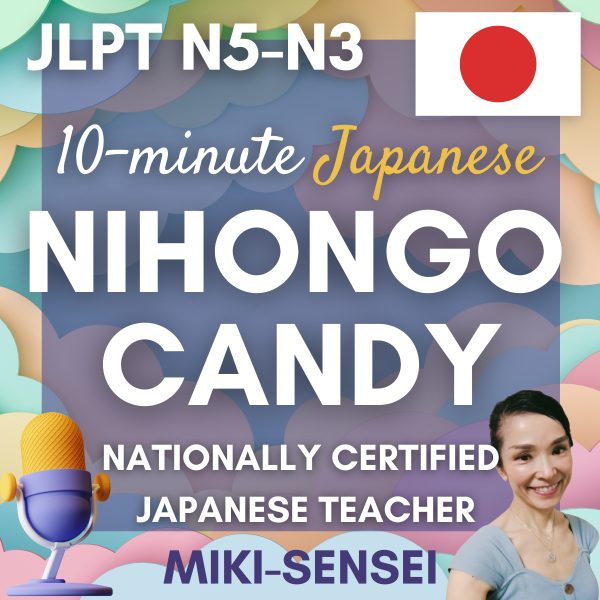
NIHONGO CANDY – Japanese Learning Podcast (JLPT N5–N3)
- Episódios
- 171
- Publicação
- quinzenal
- Último episódio
- 16 nov 2026
Sobre o podcast
Japanese learning made simple, one short lesson at a time. NIHONGO CANDY is a Japanese learning podcast for English speakers at JLPT N5–N3 level, hosted by Miki-sensei, a nationally certified Japanese teacher with over 20 years of experience. Learn Japanese for real life: everyday vocabulary, grammar, and natural phrases for travel, work, and living in Japan, explained in simple English. You can also learn through stories and history, from life in Tokyo to samurai, castles, and ninja. 💻 Private coaching: https://www.welcjp.com/forindividuals
Episódios 171
#171 それ vs あれ: How to Say "That" in Japanese Conversation — JLPT N4 Grammar
Not sure when to say それ (sore) or あれ (are) in a conversation?This is a short Japanese learning lesson for JLPT N4 learners on how to choose between them.You'll learn one simple rule that makes the choice …
Notas do episódio
Not sure when to say それ (sore) or あれ (are) in a conversation?This is a short Japanese learning lesson for JLPT N4 learners on how to choose between them.You'll learn one simple rule that makes the choice easy.Then it's your turn to speak: listen, say it out loud, and try a quick challenge.
🚀 NEXT STEPS FOR YOUR JAPANESE💻Executive Private Coaching (Live):https://www.welcjp.com/forindividuals
📱 LinkedIn:www.linkedin.com/in/mikisasakiwelc
#JapaneseGrammar #JLPTN4 #SoreAre #NihongoCandy #LearnJapanese #JapaneseLearning #JapanesePhrases #SpeakJapanese #JapaneseConversation #JLPTN5 #JLPTN3 #LivingInJapan
#170 How to Say "If" and "When" in Japanese: -たら (tara) JLPT N4 Grammar
Want to say "if" or "when" in Japanese?This is a short Japanese learning lesson for JLPT N4 learners on -たら (tara).You'll learn its two meanings and how to make it.Then it's your turn to speak: listen, say it …
Notas do episódio
Want to say "if" or "when" in Japanese?This is a short Japanese learning lesson for JLPT N4 learners on -たら (tara).You'll learn its two meanings and how to make it.Then it's your turn to speak: listen, say it out loud, and try a quick challenge.
🚀 NEXT STEPS FOR YOUR JAPANESE💻Executive Private Coaching (Live):https://www.welcjp.com/forindividuals📱 LinkedIn:www.linkedin.com/in/mikisasakiwelc
#JapaneseGrammar #JLPTN4 #Tara #NihongoCandy #LearnJapanese #JapaneseLearning #JapanesePhrases #SpeakJapanese #JapaneseConversation #JLPTN5 #JLPTN3 #LivingInJapan
#169 The End of the Sengoku Period: Sekigahara, Osaka and 260 Years of Peace — Learn Japanese Through History (N5–N3)
Every war has an ending. This one took about 150 years to reach it.This is Episode 10, the final episode of our mini-series on Japanese history, made for JLPT N5–N3 learners. In about seven minutes, you'll …
Notas do episódio
Every war has an ending. This one took about 150 years to reach it.
This is Episode 10, the final episode of our mini-series on Japanese history, made for JLPT N5–N3 learners. In about seven minutes, you'll follow the last chapter of the Warring States period: the death of Toyotomi Hideyoshi in 1598, the Battle of Sekigahara (関ヶ原の戦い) of 1600 that was settled in a single day, and Tokugawa Ieyasu becoming shōgun (将軍 / shogun) in 1603 — which still did not end the fighting.
We then move to Osaka Castle, where the rōnin (浪人 / ronin) of Japan gathered around Toyotomi Hideyori. You'll hear how the moats were filled in after the Winter Siege of 1614, how Sanada Yukimura fought his last battle in the Summer Siege of 1615, and how the fall of the castle closed the age of great wars. Finally, we look at what peace looked like: samurai working as officials for the shogunate and their domains, Edo growing into one of the largest cities in the world, and kabuki, ukiyo-e and haiku taking shape in a time without war — 天下泰平 (tenka taihei), peace under heaven.
You'll also learn the expression 天下分け目 (tenka wakeme), used today for the match that decides everything, and five useful everyday words: 気になる (ki ni naru), 埋める (umeru), 決まり (kimari), 仕組み (shikumi), and 表す (arawasu).
This is the last episode of the mini-series. If you haven't heard the earlier episodes yet — Nobunaga, Hideyoshi, Ieyasu, castles, ninja and battle tactics — this is a good time to go back and listen.
💻Executive Private Coaching (Live):https://www.welcjp.com/forindividuals
📱 LinkedIn:www.linkedin.com/in/mikisasakiwelc
#Samurai #JapaneseHistory #SengokuPeriod #SamuraiHistory #AnimeJapanese #BattleOfSekigahara #TokugawaIeyasu #EdoPeriod #NihongoCandy #LearnJapanese #JapaneseVocabulary #JLPTN5 #JLPTN4 #JLPTN3 #JapaneseForTravel #TravelInJapan #SpeakJapanese #JapanesePhrases #LivingInJapan #JapaneseConversation
#168 Battle Tactics: Spears, Signals and Guns — Learn Japanese Through History
One hero, one sword, one duel — that's the battle you know from anime and games. In this episode, we step onto a real Warring States battlefield.This is Episode 9 of our mini-series on Japanese history, made …
Notas do episódio
One hero, one sword, one duel — that's the battle you know from anime and games. In this episode, we step onto a real Warring States battlefield.
This is Episode 9 of our mini-series on Japanese history, made for JLPT N5–N3 learners. In about seven minutes, you'll meet the ashigaru (足軽), the foot soldiers who were the real main players, and see how flags, drums, and the horagai (法螺貝) moved an army of thousands. Then we look at how guns (鉄砲 / teppō / teppou) changed warfare, and what really decided the Battle of Nagashino (長篠の戦い) in 1575.
You'll also learn 先陣を切る (senjin o kiru), a battlefield phrase still used today, and five useful everyday words: 主役 (shuyaku), 並ぶ (narabu), 命令 (meirei), 合図 (aizu), and 組み合わせる (kumiawaseru).
Next episode: The end of the Warring States period — Sekigahara, the Siege of Osaka, and the long peace that followed.
💻Executive Private Coaching (Live):https://www.welcjp.com/forindividuals
📱 LinkedIn:www.linkedin.com/in/mikisasakiwelc
#Samurai #JapaneseHistory #SengokuPeriod #SamuraiHistory #AnimeJapanese #BattleOfNagashino #OdaNobunaga #Ashigaru #NihongoCandy #LearnJapanese #JapaneseVocabulary #JLPTN5 #JLPTN4 #JLPTN3 #JapaneseForTravel #TravelInJapan #SpeakJapanese #JapanesePhrases #LivingInJapan #JapaneseConversation
#167 Ninja: Legend and Truth — Learn Japanese Through History (N5–N3)
Black clothes, throwing stars, secret techniques — that's the ninja you know from anime and games. In this episode we look at what the ninja of the Warring States period were really like.This is Episode 8 of …
Notas do episódio
Black clothes, throwing stars, secret techniques — that's the ninja you know from anime and games. In this episode we look at what the ninja of the Warring States period were really like.
This is Episode 8 of our mini-series on Japanese history, made for JLPT N5–N3 learners. In about seven minutes, you'll learn that a ninja's real job was gathering information (情報 / jōhō / jouhou), why Iga (伊賀) and Koga (甲賀 / Kōka / Kouka) became famous, and where the black costume actually came from — the kabuki (歌舞伎) stage of the Edo period. We also meet Hattori Hanzo (服部半蔵 / Hattori Hanzō / Hattori Hanzou), the "strongest ninja" of games who was in fact a spearman, and whose name still lives on at Tokyo's Hanzomon (半蔵門) subway station.
You'll also pick up five useful everyday words: 情報 (jōhō), 集める (atsumeru), 協力 (kyōryoku), 危険な (kiken na), and 無事に (buji ni).
Next episode: Battle tactics — how huge armies were moved, and how guns changed the way wars were fought.
🚀 NEXT STEPS FOR YOUR JAPANESE💻Systematic Learning (Self-Study)🎁 Podcast Listener Reward: Claim your exclusive discount through the link below:https://www.udemy.com/course/intermediate-japanese-jlpt-n3-course1/?couponCode=SEP26_NIHONGOCANDY💻Executive Private Coaching (Live):https://www.welcjp.com/forindividuals📱 LinkedIn:www.linkedin.com/in/mikisasakiwelc
#Samurai #JapaneseHistory #SengokuPeriod #SamuraiHistory #AnimeJapanese #Ninja #HattoriHanzo #Iga #NihongoCandy #LearnJapanese #JapaneseVocabulary #JLPTN5 #JLPTN4 #JLPTN3 #JapaneseForTravel #TravelInJapan #SpeakJapanese #JapanesePhrases #LivingInJapan #JapaneseConversation
#166 Japanese Castles — Learn Japanese Through History (N5–N3)
Ever walked through a Japanese castle, or seen one in an anime or game? In this episode we look at how the castles of the samurai were built, and why so few of the original ones still stand.This is Episode 7 of …
Notas do episódio
Ever walked through a Japanese castle, or seen one in an anime or game? In this episode we look at how the castles of the samurai were built, and why so few of the original ones still stand.
This is Episode 7 of our mini-series on Japanese history, made for JLPT N5–N3 learners. In about seven minutes, you'll learn the two key parts of a castle — the tenshu (天守 / tenshu), the tall tower, and the ishigaki (石垣 / ishigaki), the stone walls — and meet three castles that still keep their original tenshu, all National Treasures (国宝 / kokuhō / kokuhou): Matsumoto (松本城), Inuyama (犬山城), and Himeji (姫路城), the "White Heron Castle." We finish in the castle town (城下町 / jōkamachi / joukamachi) of Kanazawa (金沢).
You'll also pick up five useful everyday words: 守る (mamoru), 防ぐ (fusegu), 残る (nokoru), 美しい (utsukushii), and 雰囲気 (fun'iki).
Next episode: Ninja — the ones you know from anime and games, and what they were really like.
🚀 NEXT STEPS FOR YOUR JAPANESE💻Systematic Learning (Self-Study)🎁 Podcast Listener Reward: Claim your exclusive discount through the link below:https://www.udemy.com/course/intermediate-japanese-jlpt-n3-course1/?couponCode=SEP26_NIHONGOCANDY💻Executive Private Coaching (Live):https://www.welcjp.com/forindividuals📱 LinkedIn:www.linkedin.com/in/mikisasakiwelc
#Samurai #JapaneseHistory #SengokuPeriod #SamuraiHistory #AnimeJapanese #JapaneseCastles #HimejiCastle #MatsumotoCastle #NihongoCandy #LearnJapanese #JapaneseVocabulary #JLPTN5 #JLPTN4 #JLPTN3 #JapaneseForTravel #TravelInJapan #SpeakJapanese #JapanesePhrases #LivingInJapan #JapaneseConversation
#165 Date Masamune & Sanada Yukimura — Learn Japanese Through History (N5–N3)
Meet two of the most popular heroes of the Sengoku period — the ones you may already know from anime and games. Date Masamune (伊達政宗 / date masamune), the "one-eyed dragon," and Sanada Yukimura (真田幸村 / sanada …
Notas do episódio
Meet two of the most popular heroes of the Sengoku period — the ones you may already know from anime and games. Date Masamune (伊達政宗 / date masamune), the "one-eyed dragon," and Sanada Yukimura (真田幸村 / sanada yukimura), the "greatest warrior in Japan."
This is Episode 6 of our mini-series on Japanese history, made for JLPT N5–N3 learners. In about seven minutes, you'll learn the story behind Masamune's eyepatch and crescent-moon helmet, why Yukimura's bright red armor made him a legend after he nearly defeated Tokugawa Ieyasu, and how the two met just once, on opposite sides at the Siege of Osaka (大坂の陣).
You'll also pick up five useful everyday words: 目立つ (medatsu), 倒す (taosu), 見事な (migoto na), 敵 (teki), and 味方 (mikata). In our "Japanese You Can Still Use Today" corner, we look at nihon-ichi (日本一), "the best in Japan."
Next episode: Japanese castles — the towering keeps and stone walls where the samurai lived.
🚀 NEXT STEPS FOR YOUR JAPANESE💻Systematic Learning (Self-Study)🎁 Podcast Listener Reward: Claim your exclusive discount through the link below:https://www.udemy.com/course/intermediate-japanese-jlpt-n3-course1/?couponCode=JULY26_NIHONGOCANDY💻Executive Private Coaching (Live):https://www.welcjp.com/forindividuals📱 LinkedIn:www.linkedin.com/in/mikisasakiwelc
#Samurai #JapaneseHistory #SengokuPeriod #SamuraiHistory #AnimeJapanese #DateMasamune #SanadaYukimura #NihongoCandy #LearnJapanese #JapaneseVocabulary #JLPTN5 #JLPTN4 #JLPTN3 #JapaneseForTravel #TravelInJapan #SpeakJapanese #JapanesePhrases #LivingInJapan #JapaneseConversation
#164 Takeda Shingen vs Uesugi Kenshin — Learn Japanese Through History (N5–N3)
Takeda Shingen (武田信玄 / takeda shingen) and Uesugi Kenshin (上杉謙信 / uesugi kenshin) were destined rivals who clashed again and again — and yet respected each other deeply.This is Episode 5 of our mini-series on …
Notas do episódio
Takeda Shingen (武田信玄 / takeda shingen) and Uesugi Kenshin (上杉謙信 / uesugi kenshin) were destined rivals who clashed again and again — and yet respected each other deeply.
This is Episode 5 of our mini-series on Japanese history, made for JLPT N5–N3 learners. In about seven minutes, you'll meet the "Tiger of Kai" and the "Dragon of Echigo," follow their Battles of Kawanakajima (川中島の戦い) and the legend of their duel, and learn the meaning of Shingen's famous banner, Fūrinkazan (風林火山 / fuurinkazan) — "as fast as the wind, as quiet as a forest, as fierce as fire, and as still as a mountain."
You'll also pick up five useful everyday words: 宿命 (shukumei), 激しい (hageshii), 悲しむ (kanashimu), 認める (mitomeru), and 尊敬する (sonkei suru). In our "Japanese You Can Still Use Today" corner, we look at the idiom teki ni shio o okuru (敵に塩を送る), "to send salt to the enemy" — helping a rival in trouble, an attitude that reflects the spirit of bushidō (武士道 / bushidō / bushidou), the way of the samurai.
Next episode: Date Masamune (伊達政宗), the "one-eyed dragon," and Sanada Yukimura (真田幸村), called the greatest warrior in Japan.
🚀 NEXT STEPS FOR YOUR JAPANESE💻Systematic Learning (Self-Study)🎁 Podcast Listener Reward: Claim your exclusive discount through the link below: https://www.udemy.com/course/intermediate-japanese-jlpt-n3-course1/?couponCode=AUG26_NIHONGOCANDY💻Executive Private Coaching (Live):https://www.welcjp.com/forindividuals📱 LinkedIn:www.linkedin.com/in/mikisasakiwelc
#Samurai #JapaneseHistory #SengokuPeriod #SamuraiHistory #AnimeJapanese #TakedaShingen #UesugiKenshin #Bushido #NihongoCandy #LearnJapanese #JapaneseVocabulary #JLPTN5 #JLPTN4 #JLPTN3 #JapaneseForTravel #TravelInJapan #SpeakJapanese #JapanesePhrases #LivingInJapan #JapaneseConversation
#163 Who Was Tokugawa Ieyasu? — Learn Japanese Through History (N5–N3)
Who was Tokugawa Ieyasu (徳川家康 / tokugawa ieyasu), the man who waited and finally won all of Japan?This is Episode 4 of our mini-series on Japanese history, made for JLPT N5–N3 learners. In about seven minutes …
Notas do episódio
Who was Tokugawa Ieyasu (徳川家康 / tokugawa ieyasu), the man who waited and finally won all of Japan?
This is Episode 4 of our mini-series on Japanese history, made for JLPT N5–N3 learners. In about seven minutes, you'll follow Ieyasu from his long years as a hostage (人質) to his victory at the Battle of Sekigahara (関ヶ原の戦い, 1600), and see how he opened the Edo shogunate (江戸幕府, 1603) and began about 260 years of peace.
You'll also meet the famous "cuckoo poems" (ホトトギスの句) that capture the very different characters of the three great heroes — Nobunaga, Hideyoshi, and Ieyasu — and pick up five useful everyday words: 手に入れる (te ni ireru), 恵まれている (megumarete iru), 平和な (heiwa na), 性格 (seikaku), and 我慢する (gaman suru). And here's a fun cultural note: even today, Japanese people sometimes compare themselves or others to one of these three men.
Next episode: Takeda Shingen and Uesugi Kenshin (武田信玄と上杉謙信), the destined rivals of Kawanakajima.
🚀 NEXT STEPS FOR YOUR JAPANESE💻Systematic Learning (Self-Study)🎁 Podcast Listener Reward: Claim your exclusive discount through the link below:https://www.udemy.com/course/intermediate-japanese-jlpt-n3-course1/?couponCode=AUG26_NIHONGOCANDY💻Executive Private Coaching (Live):https://www.welcjp.com/forindividuals📱 LinkedIn:www.linkedin.com/in/mikisasakiwelc
#Samurai #JapaneseHistory #SengokuPeriod #SamuraiHistory #AnimeJapanese #TokugawaIeyasu #NihongoCandy #LearnJapanese #JapaneseVocabulary #JLPTN5 #JLPTN4 #JLPTN3 #JapaneseForTravel #TravelInJapan #SpeakJapanese #JapanesePhrases #LivingInJapan #JapaneseConversation
#162 Who Was Toyotomi Hideyoshi? — Learn Japanese Through History (N5–N3)
Who was Toyotomi Hideyoshi (豊臣秀吉 / toyotomi hideyoshi), the man who was born a farmer's son and ended up ruling all of Japan?This is Episode 3 of our mini-series on Japanese history, made for JLPT N5–N3 …
Notas do episódio
Who was Toyotomi Hideyoshi (豊臣秀吉 / toyotomi hideyoshi), the man who was born a farmer's son and ended up ruling all of Japan?
This is Episode 3 of our mini-series on Japanese history, made for JLPT N5–N3 learners. In about seven minutes, you'll follow Hideyoshi from his first job carrying his lord's sandals, to the moment he took over after Nobunaga's death, to the unification of Japan in 1590 — and see what he did with that power, through the land survey (検地 / kenchi) and the sword hunt (刀狩 / katanagari).
You'll also pick up five useful everyday words: 出世する (shusse suru), 気が利く (ki ga kiku), 認める (mitomeru), 工夫する (kufū suru / kufuu suru), and 成しとげる (nashitogeru). In our "Japanese You Can Still Use Today" corner, we look at how 出世する is used at work in Japan today.
Next episode: Tokugawa Ieyasu (徳川家康), the man who took power and became the first shōgun of the peaceful Edo period.
🚀 NEXT STEPS FOR YOUR JAPANESE💻Systematic Learning (Self-Study)🎁 Podcast Listener Reward: Claim your exclusive discount through the link below:https://www.udemy.com/course/intermediate-japanese-jlpt-n3-course1/?couponCode=JULY26_NIHONGOCANDY💻Executive Private Coaching (Live):https://www.welcjp.com/forindividuals📱 LinkedIn:www.linkedin.com/in/mikisasakiwelc
#Samurai #JapaneseHistory #SengokuPeriod #SamuraiHistory #AnimeJapanese #ToyotomiHideyoshi #NihongoCandy #LearnJapanese #JapaneseVocabulary #JLPTN5 #JLPTN4 #JLPTN3 #JapaneseForTravel #TravelInJapan #SpeakJapanese #JapanesePhrases #LivingInJapan #JapaneseConversation
#161 Who Was Oda Nobunaga? — Learn Japanese Through History (N5–N3)
Who was Oda Nobunaga (織田信長 / oda nobunaga), the revolutionary who changed the Sengoku period? This is Episode 2 of our mini-series on Japanese history, made for JLPT N5–N3 learners. In about seven minutes …
Notas do episódio
Who was Oda Nobunaga (織田信長 / oda nobunaga), the revolutionary who changed the Sengoku period? This is Episode 2 of our mini-series on Japanese history, made for JLPT N5–N3 learners. In about seven minutes, you'll follow Nobunaga from the Battle of Okehazama (桶狭間の戦い, 1560) — where a young lord once called a "fool" defeated a huge army — to his revolutionary policies, his dream of tenka fubu (天下布武), and his sudden end at the Incident at Honnō-ji (本能寺の変, 1582). …#160 What Was the Sengoku Period? — Learn Japanese Through History (N5–N3)
What was Japan's Sengoku period (戦国時代 / sengoku jidai), and why does it appear in so many anime, manga, and games? This is Episode 1 of our new mini-series on Japanese history, made for JLPT N5–N3 learners. In …
Notas do episódio
What was Japan's Sengoku period (戦国時代 / sengoku jidai), and why does it appear in so many anime, manga, and games? This is Episode 1 of our new mini-series on Japanese history, made for JLPT N5–N3 learners. In about seven minutes, you'll learn what the Warring States period was, when it began (the Ōnin War of 1467), and the key idea behind it — gekokujō (下剋上), the lower overthrowing those above. …How to Talk About Your Trip in Japanese! 旅行の感想 (ryoko no kanso) Vocabulary | NIHONGO CANDY #159
Want to ask a friend or coworker how their trip was — and share your own travel stories in Japanese? Learn the essential Japanese vocabulary for asking about and talking about a recent trip — including どうだった …
Notas do episódio
Want to ask a friend or coworker how their trip was — and share your own travel stories in Japanese? Learn the essential Japanese vocabulary for asking about and talking about a recent trip — including どうだった (do datta / how was it?), 一番 (ichiban / the most, number one), 最高 (saiko / the best, amazing), 景色 (keshiki / scenery, view), 感動する (kando suru / to be moved, touched), and おすすめ (osusume / a recommendation) — so you can confidently talk about travel with friends and coworkers in Japanese. …How to Describe Numbers in Japanese! 数字を説明する (suuji o setsumei suru) Vocabulary | NIHONGO CANDY #158
Need to explain sales figures, trends, or data in a Japanese meeting or presentation? Learn the essential Japanese vocabulary for describing how numbers change — including 上がる (agaru / to go up), 下がる (sagaru / …
Notas do episódio
Need to explain sales figures, trends, or data in a Japanese meeting or presentation? Learn the essential Japanese vocabulary for describing how numbers change — including 上がる (agaru / to go up), 下がる (sagaru / to go down), 増える (fueru / to increase), 減る (heru / to decrease), 横ばい (yokobai / flat, unchanged), 大きく (ookiku / greatly), わずかに (wazuka ni / slightly), and ほぼ (hobo / almost) — so you can confidently present data and talk about trends in Japanese. …How to Sell Used Items in Japanese! 中古を売る (chuuko o uru) Mercari Vocabulary | NIHONGO CANDY #157
Want to sell your used clothes, books, or electronics in Japan? Learn the essential Japanese vocabulary for selling secondhand items on flea market apps like Mercari (メルカリ) — including 出品する (shuppin suru / to …
Notas do episódio
Want to sell your used clothes, books, or electronics in Japan? Learn the essential Japanese vocabulary for selling secondhand items on flea market apps like Mercari (メルカリ) — including 出品する (shuppin suru / to list an item), 状態 (joutai / condition), and 送料込み (souryou komi / shipping included) — so you can confidently list and sell your things online. …Transitive vs Intransitive Verbs in Japanese! 自動詞・他動詞 (jidoushi/tadoushi) | NIHONGO CANDY #156
Confused about Japanese verb pairs like 開く / 開ける (aku / akeru)? Learn how to use 自動詞 (jidoushi / intransitive verbs) and 他動詞 (tadoushi / transitive verbs) correctly — including the particles が and を — so your …
Notas do episódio
Confused about Japanese verb pairs like 開く / 開ける (aku / akeru)? Learn how to use 自動詞 (jidoushi / intransitive verbs) and 他動詞 (tadoushi / transitive verbs) correctly — including the particles が and を — so your Japanese sounds natural in everyday conversation and at work. 🚀 NEXT STEPS FOR YOUR JAPANESE💻Systematic Learning (Self-Study)🎁 Podcast Listener Reward:Claim your exclusive discount through the link…Just to Be Sure! Master "Nen no Tame" (念のため / Just in Case) for Daily Conversation & Work | NIHONGO CANDY #155
Learn how to use 「念のため」(nen no tame / just in case) to confirm plans and stay on the safe side — naturally, in both casual and professional Japanese. 🚀 NEXT STEPS FOR YOUR JAPANESE💻Systematic Learning …
Notas do episódio
Learn how to use 「念のため」(nen no tame / just in case) to confirm plans and stay on the safe side — naturally, in both casual and professional Japanese. 🚀 NEXT STEPS FOR YOUR JAPANESE💻Systematic Learning (Self-Study)🎁 Podcast Listener Reward:Claim your exclusive discount through the link below:https://www.udemy.com/course/intermediate-japanese-jlpt-n3-course1/?couponCode=JUNE26_NIHONGOCANDY 💻Executive Private Coaching (Live):https://www.welcjp.com/forindividuals 📱 LinkedIn…Is It Worth It? Master "Kachi ga Aru / Kachigaaru" (To Be Worth It / 価値がある) for Recommendations & Life Decisions | NIHONGO CANDY #154
Want to say "this book is worth reading" or "it's worth trying" in Japanese? The phrase 「価値がある」(kachi ga aru / kachigaaru / to be worth it) is essential for giving recommendations, evaluating experiences, and …
Notas do episódio
Want to say "this book is worth reading" or "it's worth trying" in Japanese? The phrase 「価値がある」(kachi ga aru / kachigaaru / to be worth it) is essential for giving recommendations, evaluating experiences, and talking about life choices. In this episode, master its two key patterns (Noun + に価値がある / Verb + 価値がある), learn high-frequency collocations like 価値観 (kachikan / values), 付加価値 (fuka kachi / added value), and 価値判断 (kachi handan / value judgment), and hear the phrase used naturally in a…Talk Competition & Self-Growth: Master "Kyōsō Suru / Kyousou Suru" (To Compete / 競争する) | NIHONGO CANDY #153
Want to say "companies compete in price wars" or "compete with yesterday's self" in Japanese? The verb 「競争する」(kyōsō suru / kyousou suru / to compete) is essential for business, sports, and personal growth …
Notas do episódio
Want to say "companies compete in price wars" or "compete with yesterday's self" in Japanese? The verb 「競争する」(kyōsō suru / kyousou suru / to compete) is essential for business, sports, and personal growth conversations. In this episode, master its meaning, key collocations like 競争相手 (kyōsō aite / rival) and 競争力 (kyōsō ryoku / competitiveness), and hear it used naturally in a relatable workplace monologue.
🚀 NEXT STEPS FOR YOUR JAPANESE💻Systematic Learning (Self-Study)Elevate your Japanese with my structured N3 video curriculum.🎁 Podcast Listener Reward:Claim your exclusive discount through the link below:(https://www.udemy.com/course/intermediate-japanese-jlpt-n3-course1/?couponCode=MAY26_NIHONGOCANDY)https://www.udemy.com/course/intermediate-japanese-jlpt-n3-course1/?couponCode=MAY26_NIHONGOCANDY💻Executive Private Coaching (Live)Elevate your Japanese beyond the basics. Don't just memorize phrases—learn to connect and lead in a Japanese professional environment.👇 Apply for coaching:(https://www.welcjp.com/forindividuals)https://www.welcjp.com/forindividuals
📱 Instagram: https://www.instagram.com/welcjapanese/
☕Ko-fi: https://ko-fi.com/nihongocandy
#NihongoCandy #LearnJapanese #JapaneseVocabulary #JLPTN4 #JLPTN3 #BusinessJapanese #SpeakJapanese #KyousouSuru #JapaneseVerbs #ExpatJapan
Express Tendencies & Appearances: Master "Ppoi" (-ish / -like) | NIHONGO CANDY #152
Want to say "his excuses are childish" or "I've been forgetful lately" in Japanese? Mastering the suffix "-ppoi" (っぽい) is essential for expressing that something has a certain quality, appearance, or a strong …
Notas do episódio
Want to say "his excuses are childish" or "I've been forgetful lately" in Japanese? Mastering the suffix "-ppoi" (っぽい) is essential for expressing that something has a certain quality, appearance, or a strong tendency to happen.
A common hurdle for learners is knowing exactly how to attach it to different types of words. In this quick reflex training, we will practice 8 highly practical phrases covering the 2 essential connection patterns: Noun + ppoi (e.g., childish, cheap-looking) and Verb masu-stem + ppoi (e.g., forgetful, quick-tempered). Train your brain to instinctively use these natural, native-like expressions in both daily life and business settings without overthinking!
🚀 NEXT STEPS FOR YOUR JAPANESE
💻Systematic Learning (Self-Study)Elevate your Japanese with my structured N3 video curriculum.🎁 Podcast Listener Reward:Claim your exclusive discount through the link below:(https://www.udemy.com/course/intermediate-japanese-jlpt-n3-course1/?couponCode=MAY26_NIHONGOCANDY)https://www.udemy.com/course/intermediate-japanese-jlpt-n3-course1/?couponCode=MAY26_NIHONGOCANDY
💻Executive Private Coaching (Live)Elevate your Japanese beyond the basics. Don't just memorize phrases—learn to connect and lead in a Japanese professional environment.👇 Apply for coaching:(https://www.welcjp.com/forindividuals)https://www.welcjp.com/forindividuals
📱 Instagram: https://www.instagram.com/welcjapanese/
☕Ko-fi: https://ko-fi.com/nihongocandy
#NihongoCandy #LearnJapanese #JapaneseVocabulary #JLPTN4 #JLPTN3 #BusinessJapanese #SpeakJapanese #ppoi #ExpatJapan
Sound Like a Native: Master "Mama" (As it is / Leave it as it is) | NIHONGO CANDY #151
Want to say "I left the AC on" or "Please leave it exactly as it is" in Japanese? Mastering the word "mama" (まま) is essential for describing situations where a state or condition remains unchanged.A common …
Notas do episódio
Want to say "I left the AC on" or "Please leave it exactly as it is" in Japanese? Mastering the word "mama" (まま) is essential for describing situations where a state or condition remains unchanged.
A common hurdle for learners is mastering the connection rules, which change depending on whether you are using a verb, noun, or adjective. In this quick reflex training, we will practice 8 highly practical phrases covering the 5 essential connection patterns: Verb-ta form + mama, Noun + no + mama, Adjective + mama, kono mama, and sono mama. Train your brain to instinctively use these structures in both daily life and business settings without overthinking!
💡 Note: This reflex training series will be compiled into a "Master Phrase List (PDF)" after 10 episodes. Stay tuned for the release!
🚀 NEXT STEPS FOR YOUR JAPANESESystematic Learning (Self-Study)Elevate your Japanese with my structured N3 video curriculum.🎁 Podcast Listener Reward:Claim your exclusive discount through the link below:https://www.udemy.com/course/intermediate-japanese-jlpt-n3-course1/?couponCode=MAY26_NIHONGOCANDY
Executive Private Coaching (Live)Elevate your Japanese beyond the basics. Don't just memorize phrases—learn to connect and lead in a Japanese professional environment.👇 Apply for coaching:https://www.welcjp.com/forindividuals
Stay Connected📱📸 Instagram: https://www.instagram.com/welcjapanese/☕ Ko-fi: https://ko-fi.com/nihongocandy
#NihongoCandy #LearnJapanese #JapaneseGrammar #JLPTN4 #JLPTN3 #BusinessJapanese #SpeakJapanese #JapaneseGrammarMama #ExpatJapan
Sound Like a Native: Master "Shika" (Only / No choice but to) | NIHONGO CANDY #150
Want to say "I only have..." or "I have no choice but to..." in Japanese? Mastering the particle "shika" (しか) is essential for expressing limitations and decisions in natural business and daily conversations.A …
Notas do episódio
Want to say "I only have..." or "I have no choice but to..." in Japanese? Mastering the particle "shika" (しか) is essential for expressing limitations and decisions in natural business and daily conversations.
A common hurdle for learners is remembering the golden rule: "shika" must always be followed by a negative verb, even though it translates to "only" or "just" in English. In this quick reflex training, we will practice 8 highly practical phrases covering three key nuances: small quantities, limited scope, and having no other options. Train your brain to instinctively use this structure without overthinking!
💡 Note: This reflex training series will be compiled into a "Master Phrase List (PDF)" after 10 episodes. Stay tuned for the release!
🚀 NEXT STEPS FOR YOUR JAPANESESystematic Learning (Self-Study)Elevate your Japanese with my structured N3 video curriculum.🎁 Podcast Listener Reward:Claim your exclusive discount through the link below:https://www.udemy.com/course/intermediate-japanese-jlpt-n3-course1/?couponCode=MAY26_NIHONGOCANDY
Executive Private Coaching (Live)Elevate your Japanese beyond the basics. Don't just memorize phrases—learn to connect and lead in a Japanese professional environment.👇 Apply for coaching:https://www.welcjp.com/forindividuals
Stay Connected📱📸 Instagram: https://www.instagram.com/welcjapanese/☕ Ko-fi: https://ko-fi.com/nihongocandy
#NihongoCandy #LearnJapanese #JapaneseGrammar #JLPTN4 #JLPTN3 #BusinessJapanese #SpeakJapanese #JapaneseParticles #ExpatJapan
Sound Like a Native: Master "~tōri" & "~dōri" (As expected / On schedule) | NIHONGO CANDY #149
Want to say "as expected" or "on schedule" in Japanese? Mastering the "~tōri" and "~dōri" pattern is essential for natural business and daily conversations.A common hurdle for learners is knowing when to use …
Notas do episódio
Want to say "as expected" or "on schedule" in Japanese? Mastering the "~tōri" and "~dōri" pattern is essential for natural business and daily conversations.
A common hurdle for learners is knowing when to use the voiced "dōri" (like yotei-dōri) versus the unvoiced "tōri" (like itta tōri). In this quick reflex training, we will practice 10 highly practical phrases to help you instinctively choose the correct sound without overthinking!
💡 Note: This reflex training series will be compiled into a "Master Phrase List (PDF)" after 10 episodes. Stay tuned for the release!
🚀 NEXT STEPS FOR YOUR JAPANESESystematic Learning (Self-Study)Elevate your Japanese with my structured N3 video curriculum.
🎁 Podcast Listener Reward:Claim your exclusive discount through the link below:https://www.udemy.com/course/intermediate-japanese-jlpt-n3-course1/?couponCode=APR26_NIHONGOCANDY
Executive Private Coaching (Live)Elevate your Japanese beyond the basics. Don't just memorize phrases—learn to connect and lead in a Japanese professional environment.👇 Apply for coaching:https://www.welcjp.com/forindividuals
Stay Connected📱📸 Instagram: https://www.instagram.com/welcjapanese/☕ Ko-fi: https://ko-fi.com/nihongocandy
#NihongoCandy #LearnJapanese #JapaneseGrammar #JLPTN3 #BusinessJapanese #SpeakJapanese #JapanesePronunciation #ExpatJapan
Stop Making This Mistake! How to Say "Not Yet" in Japanese ("Mada...te imasen") | NIHONGO CANDY #148
Do you say "Mada kaimasen deshita" to mean "I haven't bought it yet"? This is one of the most common mistakes Japanese learners make!In English, "not yet" is often associated with the past, leading many to use …
Notas do episódio
Do you say "Mada kaimasen deshita" to mean "I haven't bought it yet"? This is one of the most common mistakes Japanese learners make!
In English, "not yet" is often associated with the past, leading many to use the Japanese simple past tense ("masen deshita"). However, in Japanese, if an action hasn't happened yet but is expected to happen, it is considered an ongoing state. Therefore, you must use the present continuous form: "Mada... te imasen" (まだ…ていません). Using the past tense sounds like the opportunity has completely passed.
In this episode, we will fix this common mistake once and for all. I will train your reflexes with 10 highly practical sentences for business and daily life, helping you rewire your brain to automatically use the correct "~te imasen" form. Let’s train together so you can sound much more natural and accurate in Japanese!
💡 Note: This reflex training series will be compiled into a "Master Phrase List (PDF)" after 10 episodes. Stay tuned for the release!
🚀 NEXT STEPS FOR YOUR JAPANESE
Systematic Learning (Self-Study)Elevate your Japanese with my structured N3 video curriculum.🎁 Podcast Listener Reward:Claim your exclusive discount through the link below:https://www.udemy.com/course/intermediate-japanese-jlpt-n3-course1/?couponCode=APR26_NIHONGOCANDY
Executive Private Coaching (Live)Elevate your Japanese beyond the basics. Don't just memorize phrases—learn to connect and lead in a Japanese professional environment.👇 Apply for coaching:https://www.welcjp.com/forindividuals
Stay Connected📱
Instagram: https://www.instagram.com/welcjapanese/
☕ Ko-fi: https://ko-fi.com/nihongocandy
#NihongoCandy #LearnJapanese #JapaneseGrammar #JLPTN4 #BusinessJapanese #SpeakJapanese #TeForm #JapaneseMistakes #ExpatJapan
Sound Natural in Japanese: 10 Essential Phrases using "~Mitai desu" | NIHONGO CANDY #147
In Japanese conversations, being too direct can sometimes sound harsh. That’s where "~mitai desu" (みたいです) comes in. Meaning "It seems..." or "It looks like...", this grammar point is an incredibly useful tool …
Notas do episódio
In Japanese conversations, being too direct can sometimes sound harsh. That’s where "~mitai desu" (みたいです) comes in. Meaning "It seems..." or "It looks like...", this grammar point is an incredibly useful tool to convey situations or observations naturally without sounding overly assertive.
In this episode, we will focus on using "~mitai desu" with both present and past plain forms. I’ll train your reflexes with 10 highly practical sentences so you can handle these conversations smoothly, soften your statements, and sound much more sophisticated and conversational in Japanese.
💡 Note: This reflex training series will be compiled into a "Master Phrase List (PDF)" after 10 episodes. Stay tuned for the release!
🚀 NEXT STEPS FOR YOUR JAPANESESystematic Learning (Self-Study)Elevate your Japanese with my structured N3 video curriculum.🎁 Podcast Listener Reward:Claim your exclusive discount through the link below:https://www.udemy.com/course/intermediate-japanese-jlpt-n3-course1/?couponCode=APR26_NIHONGOCANDY
Executive Private Coaching (Live)Elevate your Japanese beyond the basics. Don't just memorize phrases—learn to connect and lead in a Japanese professional environment.👇 Apply for coaching:https://www.welcjp.com/forindividuals
Stay Connected📱 Instagram: https://www.instagram.com/welcjapanese/☕ Ko-fi: https://ko-fi.com/nihongocandy
#NihongoCandy #LearnJapanese #JapaneseGrammar #JLPTN4 #BusinessJapanese #SpeakJapanese #LifeInJapan #ExpatJapan #JapanesePhrases
Small Talk in Japan: 10 Essential Phrases for Hometown & Family | NIHONGO CANDY #146
Do you know how to naturally talk about your hometown and family in Japanese? Mastering small talk is the perfect way to break the ice!When talking about family in Japanese, the key is to understand the tricky …
Notas do episódio
Do you know how to naturally talk about your hometown and family in Japanese? Mastering small talk is the perfect way to break the ice!
When talking about family in Japanese, the key is to understand the tricky difference between talking about your own family (ウチ - uchi) and asking about someone else's (ソト - soto). For example, "my father" is ちち (chichi), but "someone's father" is おとうさん (otosan). Likewise, "my family" is かぞく (kazoku), while "someone's family" is ごかぞく (gokazoku).
I’ll train your reflexes with 10 highly practical sentences so you can handle these conversations smoothly, show your cultural understanding, and build stronger connections in Japan.
💡 Note: This reflex training series will be compiled into a "Master Phrase List (PDF)" after 10 episodes. Stay tuned for the release!
🚀 NEXT STEPS FOR YOUR JAPANESE
Systematic Learning (Self-Study)Elevate your Japanese with my structured N3 video curriculum.🎁 Podcast Listener Reward:Claim your exclusive discount through the link below:https://www.udemy.com/course/intermediate-japanese-jlpt-n3-course1/?couponCode=APR26_NIHONGOCANDY
Executive Private Coaching (Live)Elevate your Japanese beyond the basics. Don't just memorize phrases—learn to connect and lead in a Japanese professional environment.👇 Apply for coaching:https://www.welcjp.com/forindividuals
Stay Connected📱 Instagram: https://www.instagram.com/welcjapanese/☕ Ko-fi: https://ko-fi.com/nihongocandy
#NihongoCandy #LearnJapanese #BusinessJapanese #JapaneseSmallTalk #JapanesePhrases #LifeInJapan #ExpatJapan #SpeakJapanese
Running Late in Japan: 10 Essential Phrases for Delays & Apologies | NIHONGO CANDY #145
Do you know exactly what to say when you are running late in Japan?Punctuality is strictly observed in Japanese business culture, but unexpected delays happen to everyone! When you realize you won't make it on …
Notas do episódio
Do you know exactly what to say when you are running late in Japan?Punctuality is strictly observed in Japanese business culture, but unexpected delays happen to everyone! When you realize you won't make it on time, the key is to immediately communicate your current status, your ETA (Estimated Time of Arrival), and apologize appropriately.
In this episode, we will practice:
Reporting status: いま、まだ しんじゅくえきです (I'm still at Shinjuku station.)
Giving ETA: 5ふんほど おくれます (I'll be about 5 minutes late.)
Apologizing: おまたせして もうしわけありません (I apologize for keeping you waiting.)
I’ll train your reflexes with 10 highly practical sentences so you can handle these stressful situations smoothly and maintain your professional trust.
💡 Note: This reflex training series will be compiled into a "Master Phrase List (PDF)" after 10 episodes. Stay tuned for the release!
🚀 NEXT STEPS FOR YOUR JAPANESESystematic Learning (Self-Study)Elevate your Japanese with my structured N3 video curriculum.🎁 Podcast Listener Reward:Claim your exclusive discount through the link below:https://www.udemy.com/course/intermediate-japanese-jlpt-n3-course1/?couponCode=APR26_NIHONGOCANDY
Executive Private Coaching (Live)Elevate your Japanese beyond the basics. Don't just memorize phrases—learn to connect and lead in a Japanese professional environment.👇 Apply for coaching:https://www.welcjp.com/forindividuals
Stay Connected📱 Instagram: https://www.instagram.com/welcjapanese/☕ Ko-fi: https://ko-fi.com/nihongocandy
#NihongoCandy #LearnJapanese #BusinessJapanese #JapanesePhrases #LifeInJapan #ExpatJapan #SpeakJapanese
Mastering Uncertainty: "かどうかわかりません" vs. "かわかりません" | NIHONGO CANDY #144
Do you overuse "〜どうか" (douka) when saying "I don't know" in embedded Japanese sentences?The rule for expressing uncertainty is actually simple:Yes/No questions: Use "〜かどうか" (e.g., かれが それを すきかどうか …
Notas do episódio
Do you overuse "〜どうか" (douka) when saying "I don't know" in embedded Japanese sentences?
The rule for expressing uncertainty is actually simple:
Yes/No questions: Use "〜かどうか" (e.g., かれが それを すきかどうか わかりません)
Wh-questions (who, what, when, etc.): Just attach "か" (e.g., いつ くにに かえるか わかりません). Using "どうか" here is a common mistake!
In this episode, I’ll train your reflexes with 10 practical sentences so you can instantly distinguish these two patterns and instantly upgrade your speaking accuracy.
💡 Note: This reflex training series will be compiled into a "Master Phrase List (PDF)" after 10 episodes. Stay tuned for the release!
🚀 NEXT STEPS FOR YOUR JAPANESE
Systematic Learning (Self-Study)Elevate your Japanese with my structured N3 video curriculum.
🎁 Podcast Listener Reward:Claim your exclusive discount through the link below:https://www.udemy.com/course/intermediate-japanese-jlpt-n3-course1/?couponCode=MAR26_NIHONGOCANDY
Executive Private Coaching (Live)Elevate your Japanese beyond the basics. Don't just memorize phrases—learn to connect and lead in a Japanese professional environment.👇 Apply for coaching:https://www.welcjp.com/forindividuals
Stay Connected📱 Instagram: https://www.instagram.com/welcjapanese/☕ Ko-fi: https://ko-fi.com/nihongocandy
#NihongoCandy #LearnJapanese #JapaneseGrammar #LifeInJapan #ExpatJapan #SpeakJapanese
Speak Fast & Natural Japanese: Mastering "Toku" and "Toite" Contractions | NIHONGO CANDY #143
Want to sound more natural and less like a textbook? Native speakers constantly shorten words in fast, casual speech. In this episode, we unlock the secret to two of the most common contractions you’ll hear in …
Notas do episódio
Want to sound more natural and less like a textbook? Native speakers constantly shorten words in fast, casual speech. In this episode, we unlock the secret to two of the most common contractions you’ll hear in Japan: "〜とく (toku)" and "〜といて (toite)".
These handy phrases come from "〜ておく (te oku)", which means to do something in advance for future convenience or to leave something as it is. In daily workplace chats or conversations with friends, a formal phrase like "予約しておきます (I will make a reservation)" casually transforms into "予約しとくね".
Mastering these contractions will not only instantly upgrade your speaking fluency but also massively improve your listening comprehension. I’ll train your reflexes with 10 highly practical sentences for daily and business situations—from saying "I think I'll pass for today" to asking someone to "leave the window open."
💡 Note: This reflex training series will be compiled into a "Master Phrase List (PDF)" after 10 episodes. Stay tuned for the release!
🚀 NEXT STEPS FOR YOUR JAPANESE
Systematic Learning (Self-Study)Elevate your Japanese with my structured N3 video curriculum.🎁 Podcast Listener Reward:Claim your exclusive discount through the link below:https://www.udemy.com/course/intermediate-japanese-jlpt-n3-course1/?couponCode=MAR26_NIHONGOCANDY
Executive Private Coaching (Live)Elevate your Japanese beyond the basics. Don't just memorize phrases—learn to connect and lead in a Japanese professional environment.👇 Apply for coaching:https://www.welcjp.com/forindividuals
Stay Connected📱 Instagram: https://www.instagram.com/welcjapanese/☕ Ko-fi: https://ko-fi.com/nihongocandy
#NihongoCandy #LearnJapanese #JapaneseGrammar #LifeInJapan #ExpatJapan #SpeakJapanese
How to Ask for Help Politely in Japanese: Instant Reflex Training | NIHONGO CANDY #142
Don't struggle alone! Navigating life in Japan gets so much easier when you know exactly how to ask for support. In this episode, we master two essential communication tools: the polite and soft request …
Notas do episódio
Don't struggle alone! Navigating life in Japan gets so much easier when you know exactly how to ask for support. In this episode, we master two essential communication tools: the polite and soft request "〜てもらえますか (temoraemasuka)" , and the magic of "〜んですが (ndesu ga)".
In Japanese culture, simply explaining your situation (e.g., "I've lost something" or "This isn't working") often implies a request for help, allowing you to get support smoothly without making direct demands. I’ll train your reflexes with 10 highly practical sentences for daily and business situations—from asking for the Wi-Fi password to checking if something is considered rude.
💡 Note: This reflex training series will be compiled into a "Master Phrase List (PDF)" after 10 episodes. Stay tuned for the release!
🚀 NEXT STEPS FOR YOUR JAPANESE
1. Systematic Learning (Self-Study)
Elevate your Japanese with my structured N3 video curriculum.
🎁 Podcast Listener Reward:
Claim your exclusive discount through the link below:
https://www.udemy.com/course/intermediate-japanese-jlpt-n3-course1/?couponCode=MAR26_NIHONGOCANDY
2. Executive Private Coaching (Live)
Elevate your Japanese beyond the basics. Don't just memorize phrases—learn to connect and lead in a Japanese professional environment.
👇 Apply for coaching:
https://www.welcjp.com/forindividuals
3. Stay Connected
📱 Instagram: https://www.instagram.com/welcjapanese/
☕ Ko-fi: https://ko-fi.com/nihongocandy
#NihongoCandy #LearnJapanese #AskForHelpJapanese #JapanesePhrases #JapaneseGrammar #LifeInJapan #ExpatJapan #SpeakJapanese #BusinessJapanese
Aqui estão os 40 episódios mais recentes de 171. Os mais antigos estão no feed do podcast.
Podcasts parecidos
Mais podcasts de Educação





Este podcast é seu?
Confirme com uma entrada no seu feed: você recebe um código aqui, adiciona como podcast:txt no canal do seu feed e nós verificamos. Depois disso, seu podcast aparece como “verificado” no SoundNode.