

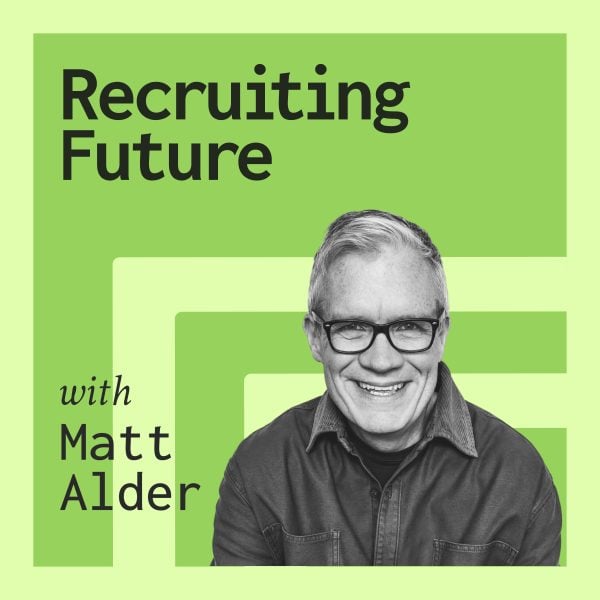
Recruiting Future with Matt Alder – What’s Next For Talent Acquisition, HR & Hiring?
- Episódios
- 923
- Publicação
- várias vezes por semana
- Último episódio
- 20 nov 2026
Sobre o podcast
Talent acquisition is undergoing unprecedented disruption as AI, economic uncertainty, and the ever-shortening lifespan of skills radically reshape recruiting. On Recruiting Future, Matt Alder explores this evolving landscape, using insightful interviews with transformational TA practitioners and forward-thinking experts to spark your imagination and provide the insights you need to shape the future of talent acquisition in your organization. Each episode explores topics such as AI, recruiting automation, recruitment marketing, employer branding, skills-based hiring, assessment, candidate experience, DEI, internal mobility, and the transformation of TA teams. Recruiting Future is an essential resource for everyone involved in hiring. Matt Alder is a globally respected talent acquisition futurist, author, and speaker with over 25 years of experience exploring what’s next in recruiting. Renowned for his expertise in strategic foresight and technology trends, Matt provides a unique perspective that empowers leaders to navigate disruption. His deep industry knowledge and ability to spark meaningful conversations make Recruiting Future a must-listen for talent acquisition and HR professionals everywhere.
Episódios 923
Ep 841: What Candidate Fraud Looks Like In Practice
Candidate fraud is a big topic in talent acquisition at the moment. Many employers assume that people who lie on a resume are trying to get a job they might not be qualified for. What many will not have …
Notas do episódio
Candidate fraud is a big topic in talent acquisition at the moment. Many employers assume that people who lie on a resume are trying to get a job they might not be qualified for. What many will not have considered is that some of these candidates could be working for a criminal group or a foreign state to gain access to an employer's systems and data. So what does a real case look like, and how serious is the risk?
My guest this week is Samantha Swift, who has spent 27 years working in cybersecurity and is now Chief Marketing Officer at Cyberr. In our conversation, she explains how the company caught a deepfake candidate with suspected links to North Korea in its own hiring process. She also talks through where the risk starts, how to spot a deepfake in an interview, and the practical steps TA teams can take to guard against this kind of fraud.
In the interview, we discuss:
- What happened when a deepfake candidate interviewed for a backend engineering role
- The warning signs uncovered by the investigation that followed
- Where the risk starts and how much job descriptions reveal about your technology
- The range of people behind fake candidates, from individuals seeking higher wages to state-backed operations
- Why first conversations should be on video and not by phone
- How fake candidates use early conversations to gather information about a company
- How to spot a deepfake in a live interview
- Why no single test is enough, including a hand in front of the face
- Working with the security team to match checks to the risk of each role
- Where to start if you have not had to think about deepfakes before
Cyberr's video series on the incident:
https://cyberr.ai/guides/hiring-in-the-deepfake-era
Ep 840: Restoring Trust In Hiring
Trust in the hiring process has been eroding for some time. Poor candidate experience, a lack of transparency about how hiring decisions are made, a difficult job market and the belief that AI is rejecting …
Notas do episódio
Trust in the hiring process has been eroding for some time. Poor candidate experience, a lack of transparency about how hiring decisions are made, a difficult job market and the belief that AI is rejecting applications without a human reading them have all left many candidates skeptical of the process. So what can employers do to start rebuilding trust in the process?
My guest this week is Bradley Clark, Head of Talent Acquisition at Article. In our conversation, Bradley shares the practical steps Article is taking to rebuild trust, including how it is being transparent with candidates about its use of AI and what it expects from them in return. He also discusses how employers can get ahead of regulation and the role technology vendors need to play in building trust with candidates.
In the interview, we discuss:
- How trust between employers and candidates broke down
- Why candidates assume AI has rejected them, even when it hasn't
- Separating the reality of candidate fraud from the hype
- Being transparent with candidates about AI at every stage of the hiring process
- Setting clear expectations for how candidates can use AI
- Going further than compliance and getting ahead of regulation
- What should employers expect from their technology vendors?
- Moving interviews from question-and-answer sessions to working sessions
- What does the future look like?
Ep 839: Recruiting From First Principles
A lot of the way recruiting works makes little sense when you step back and look at it. Economists, psychologists and operations researchers have been studying hiring for decades, and much of what they have …
Notas do episódio
A lot of the way recruiting works makes little sense when you step back and look at it. Economists, psychologists and operations researchers have been studying hiring for decades, and much of what they have found never reaches talent acquisition teams. So what can that thinking tell TA leaders about the problems they are dealing with right now?
My guest this week is economist Andrew Marritt. Andrew has been writing some fascinating essays about recruiting on his Substack, Working Ideas, and I wanted to get him on the show to explore them in more detail. In our conversation, he explains what AI has done to the signals in job applications, why cost per hire can lead to the wrong budget decisions, what the evidence says about hiring managers overruling the process, and what hiring might look like if it were rebuilt from first principles.
In the interview, we discuss:
- What economics, psychology and operations research can teach talent acquisition
- Why many of recruiting's problems are nobody's fault
- How generative AI has weakened the signal in job applications
- Ghost jobs and employer brands that all sound the same
- Why cost per hire is the wrong measure for a recruiting budget
- The real cost of cutting structured interviews
- What happens when hiring managers overrule the process
- The evidence on AI interviews
- The questions to ask AI vendors about training data and fairness
- What would hiring look like if it were rebuilt from first principles?
Ep 838: Job Seekers Are Driving Recruiting Innovation
When employers talk about candidates using AI, the conversation is often about bulk applications, cheating or fraud. That conversation misses the sophistication of the technology being built for job seekers …
Notas do episódio
When employers talk about candidates using AI, the conversation is often about bulk applications, cheating or fraud. That conversation misses the sophistication of the technology being built for job seekers, some of which is changing how people find jobs and how they are matched to them. My own view is that the innovation in recruiting is being driven from the candidate side, and will continue to be, which is why TA leaders should know what is going on. So how do these tools work, and how should employers be thinking about them?
My guest this week is Aidan Cramer, Co-Founder and CEO of AIApply, a company building AI tools that help people find and apply for jobs. In our conversation, he explains how AI is being used to match people to roles, what the data shows about AI-assisted applications, where the line is between assistance and cheating, and what an agent to agent future means for employers and recruiters.
In the interview, we discuss:
- What are job seekers doing with AI and what is driving it?
- Bulk apply tools versus tools built around the quality of the match
- Why an AI agent needs to know when not to apply
- How job discovery is moving beyond keyword search to transferable skills
- What the data shows about interview rates for AI-assisted applications
- Does tailoring a resume to beat the ATS make any difference?
- How ATS providers are responding to applications from AI agents
- Where is the line between AI assistance and cheating?
- How sharing more context about a role filters out poor matches before anyone applies
- What does an agent to agent future look like and where does it leave recruiters?
Ep 837: What Has Changed In Executive Hiring?
Executive hiring has always worked differently from the rest of talent acquisition. It relies on long-term relationships, confidential conversations and a high-touch process, which has kept it at a distance …
Notas do episódio
Executive hiring has always worked differently from the rest of talent acquisition. It relies on long-term relationships, confidential conversations and a high-touch process, which has kept it at a distance from many of the changes in recruiting. Over the last five years, AI, shifting market conditions and new expectations of the function have started to change executive hiring too. So how has it adapted, and are there lessons here for TA as a whole?
My guest this week is Simon Mullins from ESIX. In our conversation, Simon shares how in-house executive hiring teams are working with search firms, using AI and taking on a wider role, and where he sees the function going next.
In the interview, we discuss:
- What has changed in executive hiring over the last five years, and what has stayed the same
- Why in-house teams use search firms far less but still see them as strategic partners
- The growing role of executive hiring teams in managing internal talent
- Why involvement in succession planning has more than doubled since 2019
- Where AI is and isn't being used in executive search
- Is AI producing better candidates, or just faster searches?
- The sharp drop in diversity as a stated priority in executive hiring
- Using data to shape role and organization design before a search begins
- What does the future look like?
Ep 836: Continuous Improvement In TA
TA leaders usually know what needs to improve in their function; the hard part is deciding what to do first. AI is adding to the confusion, with an ever expanding vendor landscape and technology that is getting …
Notas do episódio
TA leaders usually know what needs to improve in their function; the hard part is deciding what to do first. AI is adding to the confusion, with an ever expanding vendor landscape and technology that is getting stronger for many use cases while remaining weak in others. So what do the teams that keep improving do differently?
My guest this week is Tony de Graaf, Co-Founder of the Recruiting Excellence Foundation, whose global benchmark measures the maturity of TA functions around the world against a single framework. In our conversation, Tony shares what the benchmark says TA does well and where it falls short, why no region is as far behind as it thinks, how to make sense of the AI vendor landscape, and the one question high-performing teams use to decide what to improve next.
https://www.linkedin.com/in/graaftony/
https://recruiting-excellence.org
In the interview, we discuss:
- Building a global benchmark of TA maturity
- What TA functions already do well, and where the gaps are
- Why so many regions believe they are behind the others
- Narrow AI tools and the time they do and don't save
- Do AI tools pay for themselves?
- Making sense of a confusing vendor landscape
- Personal AI agents and what they really cost
- The one test high-performing TA teams apply to every improvement
- Why improvement is continuous, not a project
- What does the future look like?
Take the Recruiting Excellence assessment and contribute to the next global benchmark:
Ep 835: How AI Is Reshaping Work And Hiring
I recorded four conversations at UNLEASH World in Paris in October, and there was one theme that kept coming up in all of them. My interviewees argued that AI is starting to redesign the work itself, and with …
Notas do episódio
I recorded four conversations at UNLEASH World in Paris in October, and there was one theme that kept coming up in all of them. My interviewees argued that AI is starting to redesign the work itself, and with it how organizations are built, how roles are defined, and how people are hired. Most of them build HR technology for a living, so they see further ahead than most employers, but they obviously have a stake in the future they describe. So what does all of this mean for how companies are run and how they hire?
My guests are Mervyn Dinnen, an analyst and author on HR and talent trends; Allyn Bailey, Senior Director of Corporate Narrative and Executive Communications at SmartRecruiters; Ronni Zehavi, Co-Founder and CEO of HiBob; and Dalit Brosh, Co-Founder and CEO of Glimpse. In our conversations, they discuss why talent acquisition may stop being a separate function, what it takes to put an agent on the org chart, how to assess people for roles that have not been created yet, and why the experience people have at work still decides whether they join and stay.
In the interview, we discuss:
- The missing debate about what should stay human and what should go to AI
- Does talent acquisition still make sense as a separate function?
- Hiring people into the company rather than into a role
- The widening gap between forward-looking and transactional organizations
- Four dimensions of AI change, from employee psychology to government regulation
- Agents on the org chart and what it takes to onboard, govern and review them
- Is the era of the large enterprise over?
- Assessing what people are capable of rather than what they have done
- Measuring learning agility and adaptability to AI
- What will the big HR narrative of 2027 be?
Ep 834: Six Predictions For AI In HR
There is no shortage of predictions about AI in HR and hiring at the moment. Most of them come from analysts, vendors and commentators looking in from the outside. Far more useful, and much harder to come by …
Notas do episódio
There is no shortage of predictions about AI in HR and hiring at the moment. Most of them come from analysts, vendors and commentators looking in from the outside. Far more useful, and much harder to come by, is the perspective of someone actually doing the work, running the transformation and making these changes inside their own organization. That is exactly why I wanted to talk to this week's guest.
My guest is Vic Akosile, Head of AI Transformation and People Strategy at Cloudflare, where he also serves as Chief of Staff to the Chief People Officer. He sent me a set of predictions for AI in HR in 2027, and they make a great framework for understanding what is really changing and what it means for the people doing this work. In our conversation, Vic talks me through those predictions and what each one looks like in practice.
In the interview, we discuss Vic's predictions, including:
- More HR teams will build and maintain their own AI agents and applications
- HR functions will appoint internal AI product leaders
- Businesses will judge AI on much more than time saved or cost avoided
- Employees who get faster with AI will hide that they are using it
- Work design will come before headcount planning
- Recruiters will use live exercises and work samples to assess judgment
- What the longer-term future holds beyond 2027
Ep 833: Deciding What Not To Automate In Hiring
AI can automate a large and growing share of the recruiting process, and within a few years it may be capable of handling almost all of it. For employers, the question is what AI should be doing in hiring, not …
Notas do episódio
AI can automate a large and growing share of the recruiting process, and within a few years it may be capable of handling almost all of it.
For employers, the question is what AI should be doing in hiring, not simply what it could, and that means deciding where people still need to be involved.
Human in the loop is the standard response, but it can amount to little more than a person reviewing and approving what the AI recommends. A recruiter in that position becomes a validator rather than a decision maker, and a process built that way can feel just as impersonal as one with no human in it at all.
Human in the loop is not the same as human agency, where recruiters apply their own judgment, context, and knowledge of the business to the decision.
So how should employers decide not just where people belong in the process, but what they are there to do?
My guest this week is Rob Devlin, founder of Devlin Talent.. In our conversation, Rob explains why the problem has to come before the technology, what human agency looks like in practice, what recruiters should do with the time AI gives back, and how choosing which parts of hiring to keep human can become a competitive advantage.
In the interview, we discuss:
- Starting with the problem, not the product
- What should AI be doing, rather than what could it do?
- Why AI won't fix a broken process
- Using AI to improve the intake meeting
- Human in the loop versus human agency
- What to deliberately choose not to automate
- Six lenses for looking at any AI decision
- Where human conversations create competitive advantage
- What TA leaders can build themselves before buying new technology
- Why the AI decisions being made today are designing the future of work
Round Up September 2026
If you've not listened to Round Up before, it's a short review of the episodes that I've published in the last month to make sure you don't miss out on the valuable insights that my guests are sharing. This …
Notas do episódio
If you've not listened to Round Up before, it's a short review of the episodes that I've published in the last month to make sure you don't miss out on the valuable insights that my guests are sharing.
This month Round Up returns to its live format, and this is a recording of my live conversation with Jim Miller VP of People & Talent at Ashby about four of the episodes published in September 2026
Episodes featured in this Round Up:
Ep 823: How AI Is Disrupting Entry Level Jobs
Ep 824: Is AI Creating Talent Debt?
Ep 825: The Real Risks Of Candidate Fraud
Ep 827: Agent To Agent Recruiting
Ep 832: The Human Side Of AI Readiness
AI is moving from a specialist technology to something employees in large parts of the organization are increasingly expected to be using. Skills, mindsets, and long-established habits are much harder to change …
Notas do episódio
AI is moving from a specialist technology to something employees in large parts of the organization are increasingly expected to be using. Skills, mindsets, and long-established habits are much harder to change than software, which is why meeting that expectation is proving difficult. If the challenge is mainly a human one, AI readiness is as much a matter for HR and talent leaders as for technology teams. …Ep 831: The Talent Employers Are Throwing Away
Redundancies have become a constant feature of the talent market. AI is taking a lot of the blame, but the drivers behind this are much broader. Jobs and skills are changing faster than most organizations can …
Notas do episódio
Redundancies have become a constant feature of the talent market. AI is taking a lot of the blame, but the drivers behind this are much broader. Jobs and skills are changing faster than most organizations can keep track of and the conventional response is to restructure the workforce and then hire in the new skills that are needed. That approach relies on a ready supply of perfectly qualified candidates, and in a fast-moving skills market those candidates are increasingly hard to find. …Ep 830: Is AI Anxiety Holding TA Teams Back?
There is a lot of pressure on talent acquisition to adopt AI, and the discussion about how to do it tends to focus on tools and skills. With layoffs attributed to AI in the headlines, the people in TA teams …
Notas do episódio
There is a lot of pressure on talent acquisition to adopt AI, and the discussion about how to do it tends to focus on tools and skills. With layoffs attributed to AI in the headlines, the people in TA teams have good reason to feel anxious about the technology they are being asked to use. That anxiety makes people less willing to experiment, and addressing it has less to do with the technology than with how leaders handle uncertainty. …Ep 829: What TA Leaders Are Talking About Now
TA leaders have to keep delivering for the business while they use AI to transform how hiring works. At RecFest USA in Nashville, AI was the main topic of conversation, although the people I spoke to talked …
Notas do episódio
TA leaders have to keep delivering for the business while they use AI to transform how hiring works. At RecFest USA in Nashville, AI was the main topic of conversation, although the people I spoke to talked about much more than the technology. So where should TA leaders be focusing their attention? I recorded seven short interviews at the event, and they fall into three themes. …Ep 828: Managing Career Transitions
The world of work is changing quickly, and the way people move between roles is changing with it. Hiring for senior positions looks very different from the way it did even five years ago, while many people …
Notas do episódio
The world of work is changing quickly, and the way people move between roles is changing with it. Hiring for senior positions looks very different from the way it did even five years ago, while many people still approach their own careers with instincts shaped by a market that no longer exists. What does it mean to manage a career well in this environment, and how do the people who navigate transitions successfully approach them differently? My guest this week is Kelly O. …Ep 827: Agent To Agent Recruiting
Recruiting is generating more activity than ever and less connection. Candidates are using AI to produce polished applications at scale, employers are using AI to screen and reach out at scale, and the result …
Notas do episódio
Recruiting is generating more activity than ever and less connection. Candidates are using AI to produce polished applications at scale, employers are using AI to screen and reach out at scale, and the result is a level of noise that is eroding trust on both sides. More automation applied to the same processes will only make this worse. Solving it means rethinking how matching works, with depth of understanding on both sides and transparency and fairness designed in from the start. …Ep 826: Do AI Interviews Work?
AI is becoming more embedded across recruiting tools, but there is a meaningful difference between AI that automates workflows behind the scenes and AI that talks directly to candidates. When AI conducts the …
Notas do episódio
AI is becoming more embedded across recruiting tools, but there is a meaningful difference between AI that automates workflows behind the scenes and AI that talks directly to candidates. When AI conducts the conversation, the stakes are higher; the first interaction shapes how candidates perceive the employer and the role. That is why many talent acquisition teams remain cautious about AI interviews, even as they adopt AI everywhere else. …Ep 825: The Real Risks Of Candidate Fraud
Remote hiring, freely available deepfake tools and harvested identities have created an opportunity that organized criminals are now taking seriously. State-backed operations are training workers to apply for …
Notas do episódio
Remote hiring, freely available deepfake tools and harvested identities have created an opportunity that organized criminals are now taking seriously. State-backed operations are training workers to apply for remote roles using stolen credentials and proxy interviewers. The aim is the salary and access to source code, customer data and intellectual property once they are inside. …Round Up August 2026
If you've not listened to Round Up before, it's a short review of the episodes that I've published in the last month to make sure you don't miss out on the valuable insights that my guests are sharing. This …
Notas do episódio
If you've not listened to Round Up before, it's a short review of the episodes that I've published in the last month to make sure you don't miss out on the valuable insights that my guests are sharing. This month Round Up returns to its live format, and this is a recording of my live conversation with my guest co-host Rhona Pierce from Workfluencer Media, about six of the episodes published during July and August 2026 Episodes featured in this Round Up: Ep 803: AI Native Recruiting Ep 807…Ep 824: Is AI Creating Talent Debt?
Inside most organizations, the pressure has shifted from proving that AI works to showing what it is worth in cost, productivity and headcount. Some workforce plans are now being decided on that basis before …
Notas do episódio
Inside most organizations, the pressure has shifted from proving that AI works to showing what it is worth in cost, productivity and headcount. Some workforce plans are now being decided on that basis before anyone has looked closely at how the work is done. The organizations getting the most from AI are treating it as a question of work design rather than technology. So what does designing work around AI involve, and what does it cost the organizations that skip that step? …Ep 823: How AI Is Disrupting Entry Level Jobs
In software development, AI tools now write much of the code, and at a growing number of organizations junior developers are no longer doing that work themselves. Tech is where the impact on a first job is …
Notas do episódio
In software development, AI tools now write much of the code, and at a growing number of organizations junior developers are no longer doing that work themselves. Tech is where the impact on a first job is clearest, and likely a preview of what other industries will see next. When the tools handle the technical work, what is left requires judgment, collaboration and communication, capabilities that take much longer to develop. …Ep 822: How To Win Investment For Employer Branding
Hi there, welcome to episode 822 of Recruiting Future with me, Matt Alder. Employer branding teams are still under sustained pressure. Budgets have shrunk and headcount has been reduced across many …
Notas do episódio
Hi there, welcome to episode 822 of Recruiting Future with me, Matt Alder. Employer branding teams are still under sustained pressure. Budgets have shrunk and headcount has been reduced across many organizations, even when the hiring the business needs has become more specific and more critical. Despite all of the cuts, some employer brand leaders are still winning investment and influence. …Ep 821: Why Every Employer Brand Sounds The Same
Employer messaging has a sameness problem. Candidates researching potential employers find the same values, the same mission statements, and the same well-meaning phrases wherever they look, which makes …
Notas do episódio
Employer messaging has a sameness problem. Candidates researching potential employers find the same values, the same mission statements, and the same well-meaning phrases wherever they look, which makes choosing between companies harder than it should be. The upside is a genuine opportunity. …Ep 820: What Strategic HR Really Means
The gap between claiming to be strategic and actually operating strategically has real consequences, and nowhere are they clearer than at the top of HR. CHRO turnover is unusually high at the moment, and it …
Notas do episódio
The gap between claiming to be strategic and actually operating strategically has real consequences, and nowhere are they clearer than at the top of HR. CHRO turnover is unusually high at the moment, and it also spikes sharply in the first year under a new CEO. A change at the top usually brings a new thesis about what the business needs, and what the CEO needs from HR shifts with it. …Ep 819: Who Gets The Biggest Job In HR?
The job of Chief People Officer has never been more demanding, and the way organizations decide who gets it is changing fast. Appointment volumes have fallen sharply, boards are rethinking what they value in an …
Notas do episódio
The job of Chief People Officer has never been more demanding, and the way organizations decide who gets it is changing fast. Appointment volumes have fallen sharply, boards are rethinking what they value in an HR leader, and the profile of the people winning the top seats looks different from even two years ago. Experience of having done the job before is no longer the deciding factor it once was, which changes the calculation for everyone with ambitions on the role. …Ep 818: The New Hiring Decision
Skills have been on the HR agenda for decades, but they rarely became the basis for real decisions; frameworks took so long to build that the business had moved on before they were finished. What's different …
Notas do episódio
Skills have been on the HR agenda for decades, but they rarely became the basis for real decisions; frameworks took so long to build that the business had moved on before they were finished. What's different now is that AI agents are starting to handle work that used to require a person, and that changes the question employers need to ask. It's no longer just about who to hire; it's about whether the work needs a human at all. …Decoding the C-Suite: Part 5 The Market
This is the final episode of Decoding the C-Suite, a five part miniseries from Recruiting Future about how leadership really thinks about AI, recorded with the leadership team at SmartRecruiters seven months …
Notas do episódio
This is the final episode of Decoding the C-Suite, a five part miniseries from Recruiting Future about how leadership really thinks about AI, recorded with the leadership team at SmartRecruiters seven months into their acquisition by SAP. Three years into the AI boom, the marketing noise has never been louder. Everything is AI-powered and every vendor makes the same claims. …Decoding the C-Suite: Part 4 - The Product
This is episode four of Decoding the C-Suite, a five part miniseries from Recruiting Future about how leadership really thinks about AI, recorded with the leadership team at SmartRecruiters seven months into …
Notas do episódio
This is episode four of Decoding the C-Suite, a five part miniseries from Recruiting Future about how leadership really thinks about AI, recorded with the leadership team at SmartRecruiters seven months into their acquisition by SAP. AI is moving faster than any buyer can absorb, and that creates a genuine design problem: build for the boldest customers and you lose everyone else, build for the cautious and you fall behind. …Decoding the C-Suite: Part 1 - The Thesis
The organisations genuinely driving AI change in talent all have one thing in common: alignment with the C-suite. Decoding the C-Suite is a five part miniseries from Recruiting Future exploring how leadership …
Notas do episódio
The organisations genuinely driving AI change in talent all have one thing in common: alignment with the C-suite. Decoding the C-Suite is a five part miniseries from Recruiting Future exploring how leadership really thinks about AI. Recorded over one day with the leadership team at SmartRecruiters, seven months into their acquisition by SAP, the series unpacks AI through five lenses: the thesis, the people, the money, the product and the market. …Decoding the C-Suite: Part 3 - The Money
This is episode three of Decoding the C-Suite, a five part miniseries from Recruiting Future about how leadership really thinks about AI, recorded with the leadership team at SmartRecruiters seven months into …
Notas do episódio
This is episode three of Decoding the C-Suite, a five part miniseries from Recruiting Future about how leadership really thinks about AI, recorded with the leadership team at SmartRecruiters seven months into their acquisition by SAP. If you've ever struggled to get AI investment signed off, this episode is for you. …
Aqui estão os 40 episódios mais recentes de 923. Os mais antigos estão no feed do podcast.
Podcasts parecidos
Mais podcasts de Negócios




Este podcast é seu?
Confirme com uma entrada no seu feed: você recebe um código aqui, adiciona como podcast:txt no canal do seu feed e nós verificamos. Depois disso, seu podcast aparece como “verificado” no SoundNode.