

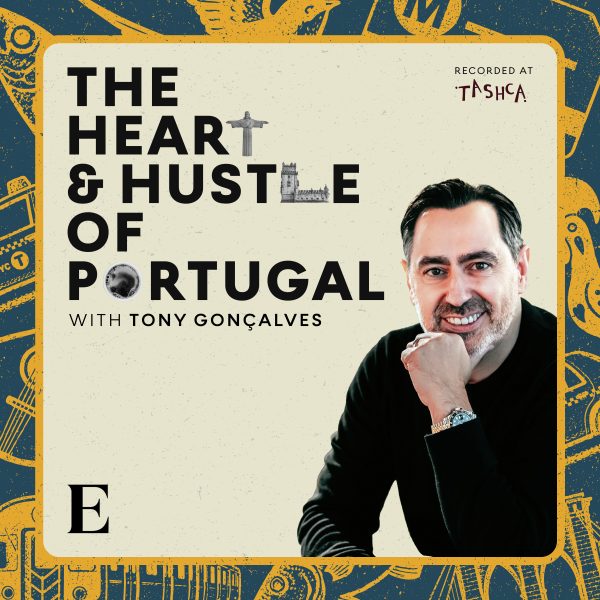
The Heart & Hustle of Portugal
- Episódios
- 100
- Publicação
- semanal
- Último episódio
- 13 nov 2026
Sobre o podcast
Each week, join Tony Gonçalves—a U.S.-based Portuguese immigrant and successful media executive—as he explores the stories of those driving Portugal’s influence on the global stage. From visionary entrepreneurs to cultural pioneers, The Heart and Hustle of Portugal uncovers the unique ways the Portuguese identity thrives worldwide. As Expresso’s first English-language product, this series bridges cultures and connects the global audience to Portugal’s spirit of innovation, passion, and resilience.
Episódios 100
The art of saudade: Isabel Pavão’s creative evolution from Porto to New York
Isabel Pavão, the Portuguese painter who has lived in New York since 1990, believes that the process of making art matters as much as the finished work. In this episode of The Heart & Hustle of Portugal, the …
Notas do episódio
Isabel Pavão, the Portuguese painter who has lived in New York since 1990, believes that the process of making art matters as much as the finished work. In this episode of The Heart & Hustle of Portugal, the artist retraces a path that runs from Porto to Paris and finally to Manhattan, where she arrived as a doctoral student at New York University, backed by a Gulbenkian grant, to study aesthetics, the language used to talk about art.
See omnystudio.com/listener for privacy information.
Katherine Vaz: the American writer who made Portuguese saudade a universal story
In this conversation on “The Heart & Hustle of Portugal” podcast, hosted by Tony Gonçalves, the New York-based author Katherine Vaz recalled how her first novel, published by a major New York house, was advised …
Notas do episódio
In this conversation on “The Heart & Hustle of Portugal” podcast, hosted by Tony Gonçalves, the New York-based author Katherine Vaz recalled how her first novel, published by a major New York house, was advised against using the word “saudade” in its title. She insisted, and the word found its readers.
See omnystudio.com/listener for privacy information.
“You’ve built the most New York thing we’ve seen in years” | Eugenia Oswaldt, Tascha NYC
Eugenia Oswaldt left a corporate career to open up Tashca, a modern eatery in Nolita, New York City. She tells Tony Gonçalves the story of how a visa issue led her to change a lucrative career for the hustle of …
Notas do episódio
Eugenia Oswaldt left a corporate career to open up Tashca, a modern eatery in Nolita, New York City. She tells Tony Gonçalves the story of how a visa issue led her to change a lucrative career for the hustle of opening up a restaurant.
Eugenia had never imagined herself as an entrepreneur until a visa problem and a flight of the imagination set her on the path to Nolita. The Portuguese-French executive, with years in corporate life across Paris, London and New York, left a tech career to open what was meant to be a Portuguese sandwich shop, a plan that never materialized. The space became something else: a platform for private dining, guest chefs, podcast recordings and a sold-out public night every Thursday, which “only Portuguese soul and New York hustle” could have produced.
See omnystudio.com/listener for privacy information.
Nuno Marques: When fado meets piano and a festival becomes a movement
Nuno Marques, the Portuguese pianist who played Carnegie Hall twice and built a festival from scratch, sits down with Tony Gonçalves to explain why he has spent a career carrying Portugal in his hands. Listen …
Notas do episódio
Nuno Marques, the Portuguese pianist who played Carnegie Hall twice and built a festival from scratch, sits down with Tony Gonçalves to explain why he has spent a career carrying Portugal in his hands. Listen to The Heart & Hustle of Portugal.
See omnystudio.com/listener for privacy information.
Laughing in the face of addiction: Filipe Santos’ wild ride from humble beginnings to boss life
Filipe Santos, a Portuguese-American entrepreneur born in Newark, hrecounts a path that began in the tight-knit Portuguese community of his childhood and passed through more than a decade of heroin addiction …
Notas do episódio
Filipe Santos, a Portuguese-American entrepreneur born in Newark, hrecounts a path that began in the tight-knit Portuguese community of his childhood and passed through more than a decade of heroin addiction. Listen to “The Heart & Hustle of Portugal”.
See omnystudio.com/listener for privacy information.
Rita Barros: Chelsea Hotel room 1008, a lifetime of photography
Trained as a translator and interpreter, Rita Barros came to photography almost by accident. It began with a Tom Waits concert, where she took photographs that turned out overexposed but salvageable, and which …
Notas do episódio
Trained as a translator and interpreter, Rita Barros came to photography almost by accident. It began with a Tom Waits concert, where she took photographs that turned out overexposed but salvageable, and which she ended up selling to a journalist when the singer had banned the press. From there came years of concert photography, developing film in her own kitchen and delivering prints by noon the next day, before she tired of a competitive, largely male environment. Of all the musicians she photographed, she singles out Iggy Pop as the most generous subject. Her work turned to the Chelsea itself, with the book “Chelsea Hotel. 15 Years”, dedicated to her neighbors, followed by self-portraits and self-published handmade books.
Rita Barros also recalls the 11 years she and other long-term tenants fought the hotel's new owners to stay, a battle she won, even if she admits the Chelsea Hotel of today has lost much of its earlier character. She now teaches photography at NYU, where she notes growing student interest in analog film, and keeps close ties to Portugal, with regular stays, exhibitions and books. “I don't have to decide whether I'm one or the other, I'm both”, she says, naming warmth as the defining trait of the Portuguese and recommending, for Lisbon, a beer at a garden kiosk, with nothing to avoid.
See omnystudio.com/listener for privacy information.
Ana Miranda turned New York dreams into a global stage for Portuguese culture
After working at the Portuguese mission to the United Nations and trying out journalism, Ana Miranda decided, in 2011, to build something of her own: a platform to show contemporary Portuguese culture abroad …
Notas do episódio
After working at the Portuguese mission to the United Nations and trying out journalism, Ana Miranda decided, in 2011, to build something of her own: a platform to show contemporary Portuguese culture abroad, starting with a short film festival she funded out of her own salary.
Fifteen years later, the organization has taken more than 1,500 Portuguese artists to stages in 37 countries, from Saramago Week and Pessoa in New York to dance programs at Alvin Ailey and a film festival now in its 16th edition. Ana Miranda says the lack of institutional recognition from Portugal remains her biggest frustration. Public support, she notes, has barely changed, and funding came first from companies such as EDP. She argues that culture should be treated as investment, not charity, and points to Brazil, whose telenovelas, music and cinema built its international image, as proof.
The conversation also takes in what Miranda calls a Portuguese habit of envy and self-criticism, a theme she links to the treatment of Cristiano Ronaldo, to whom she says the country owes much of its global visibility. Her view is that the diaspora, with the perspective that distance brings, has a role in pushing Portugal to see its own potential. She names resourcefulness, the Portuguese knack for “making do”, as the defining national trait. Her advice to those chasing a dream is simple: know what the dream is, and the energy follows.
See omnystudio.com/listener for privacy information.
Joey Bats never fried an egg, now he ships pasteis de nata worldwide
Joey Bats put pastéis de nata on the map in NYC, and he did it by refusing to sell people a history lesson. He'd never cooked a day in his life. Engineer, corporate job, bored out of his mind. He got his …
Notas do episódio
Joey Bats put pastéis de nata on the map in NYC, and he did it by refusing to sell people a history lesson. He'd never cooked a day in his life. Engineer, corporate job, bored out of his mind. He got his mother's Bolo de Bolacha recipe first, sold it door to door to restaurants and bodegas, then switched to pastéis de nata because they freeze and travel. Early on, giving away free samples on the street, people heard "Portuguese pastry" and walked. It doesn't look like much. Nobody knew what it was.
Then Joey changed the pitch. He stopped mentioning Portugal. He told people to imagine a warm creme brulee wrapped in a croissant. That one sentence took him from selling a few to selling thousands.
But the bigger opportunity was never inside the diaspora. Joey has a theory about why Portuguese food stayed invisible in America - Portuguese immigrants came to New York, then left for Long Island and New Jersey, away from the cities that shape what the country eats. New York has more Ethiopian restaurants getting written up than Portuguese ones, and there are hundreds of thousands of Portuguese people around this city. Joey built his shops in exactly the cities with that kind of exposure, on purpose.
Ten years, a pandemic, an outdoor shed he built himself with no permit, and now a shop in Boston already doing the same daily numbers his original Chelsea Market spot did on day one.
See omnystudio.com/listener for privacy information.
“Losing one-zero”: Nuno Sousa on running a restaurant like a soccer match
Chef Nuno Sousa reflects on his journey from immigrant worker with three jobs to restaurant owner, and on how New York’s culture of resilience, risk-taking and reinvention shaped both his career and his …
Notas do episódio
Chef Nuno Sousa reflects on his journey from immigrant worker with three jobs to restaurant owner, and on how New York’s culture of resilience, risk-taking and reinvention shaped both his career and his outlook.
The conversation traces the growth of Leitao from a street-food concept inspired by New York’s Smorgasburg market to a restaurant that introduced many American diners to Portuguese dishes such as leitão, francesinha, bacalhau and octopus. Sousa discusses the challenges of presenting Portuguese food outside Portugal, the importance of quality ingredients and hospitality, and the opportunity created by the growing international interest in Portuguese culture, tourism and gastronomy.
Sousa also looks ahead to Galo, his new restaurant project, which aims to showcase Portugal’s regional wines and culinary traditions in a more ambitious setting. Throughout the conversation, he reflects on identity, migration and the values he associates with the Portuguese community: resilience, courage and hard work. The result is a portrait of an entrepreneur using food as a way to represent Portugal on one of the world's most competitive culinary stages.
The synopsis of this episode was created with the help of AI. Read more about Impresa’s use of Artificial Intelligence
See omnystudio.com/listener for privacy information.
Rerelease: Bankrol Hayden on making a hit on his death bed
Hayden Inacio grew up in Modesto, California — Central Valley, agricultural, working class. His grandfather emigrated from Terceira in the Azores, came through the East Coast, and eventually built a dairy. By …
Notas do episódio
Hayden Inacio grew up in Modesto, California — Central Valley, agricultural, working class. His grandfather emigrated from Terceira in the Azores, came through the East Coast, and eventually built a dairy. By the time Hayden came along, the Portuguese was mostly gone: no language, not much culture, just a last name and a grandmother's saying that would end up in a song.
He started rapping at 13. At 16, he was in a near-fatal car crash that killed two people, broke his back, left him on life support for six days, and eventually produced “29” — written from a hospital bed, recorded before he could walk properly, and the song that launched everything. A billion streams, three albums, and a platinum plaque later, he walked into an IPMA pre-party in Providence not really thinking of himself as Portuguese. He left with an award, a cousin pointing at a photo of his avô, and a challenge to record something in the language his mother decided not to teach him.
See omnystudio.com/listener for privacy information.
Rerelease: Richie Campbell finally addresses the elephant in the room
Richie Campbell went to Jamaica at 18 with one contact and no plan. He printed out Patois lyrics at school to learn the language. He learned to compete in Kingston studios before Portugal fully understood what …
Notas do episódio
Richie Campbell went to Jamaica at 18 with one contact and no plan. He printed out Patois lyrics at school to learn the language. He learned to compete in Kingston studios before Portugal fully understood what he was building. Speaking with Tony Gonçalves, one idea prevails: Portugal gave him roots, Jamaica gave him meaning.
His new album is called Elephant in the Room. This is the conversation behind it, recorded live on location at the IPMA.
See omnystudio.com/listener for privacy information.
Nuno Seixas music invites you to sit down and share what’s going on with your life
Nuno Seixas, 24, grew up in Sintra and attended the prestigious Berklee College of Music in Boston. When he came back, he didn’t only bring his music: he brought a bench, a camera and a simple request: sit down …
Notas do episódio
Nuno Seixas, 24, grew up in Sintra and attended the prestigious Berklee College of Music in Boston. When he came back, he didn’t only bring his music: he brought a bench, a camera and a simple request: sit down and share what’s going on in your life. The project “Everyubody’s Going Throug Something” took him through the streets of New York, Pittsburgh or Los Angeles. Nuno believes that behind every face there is a story that needs to be told.
His grandfather hooked him on Frank Sinatra, he took saxophone lessons at 14 and a friend convinced him to submit his application to Berklee. He shared writing sessions with producers that worked with Ed Sheeran (one of his idols), Nina Nesbitt or Shawn Mendes. This year, he recieved the award for Best Videoclip at the IPMA, a notification he recieved in his pajamas, about to go to bed. Nuno is not looking for fame, instead, he is looking for light, hoping that his music reaches someone that needs it. That might be a simple ambition, but it’s the simplest things that touch us more dearly.
See omnystudio.com/listener for privacy information.
Mackenzie Arromba’s songs may be sad, but she’s full of life
Winning two IPMA awards back to back is reserved only for the best. Mackenzie Arromba has done it at only 25. Even more impressive, her first award was for the very first song she wrote: “hate myself for loving …
Notas do episódio
Winning two IPMA awards back to back is reserved only for the best. Mackenzie Arromba has done it at only 25. Even more impressive, her first award was for the very first song she wrote: “hate myself for loving you”. Before the stage, before the photos, before the fame, was a young girl sitting on her bedroom floor turning pain into melody.
Music has been a part of Mackenzie’s life since she was four years old. She recalls how a viewing of “The Phantom of the Opera” turned her into a child who sang everywhere: hockey rinks, grocery stores and, eventually, jazz speakeasies when she was only 7. Songwriting came much later, born after a series of mental health struggles and a relestless search for purpose after leaving university. A chance connection led her to meet Steve Molella, drumme for the canadian band Finger Eleven.
At her core, Mackenzie writes to make people feel less alone — and it shows. She describes herself as a vessel when creating. With the instincts of a true artist and the honesty of someone who has lived through real darkness, Mackenzie Arromba is only getting started.
See omnystudio.com/listener for privacy information.
David Rodrigues is the portuguese culinary creator making culture go viral
He started with a camera, a kitchen, and a mission. Dave, the creator behind “How to Cook Stuff”, has built one of the most-watched Portuguese food and culture channels on the internet by doing something …
Notas do episódio
He started with a camera, a kitchen, and a mission. Dave, the creator behind “How to Cook Stuff”, has built one of the most-watched Portuguese food and culture channels on the internet by doing something deceptively simple: teaching people how to cook Portuguese food in English, with humor, warmth, and an unshakeable love for his heritage. But what looks effortless online is the result of years of consistency, thick skin, and a clear sense of purpose.
We sat down with Dave at the International Portuguese Music Awards, where he was honored as a representative of Portuguese American culture, a recognition that speaks directly to what he has built. Because this was never just about recipes. It was always about identity.
See omnystudio.com/listener for privacy information.
A neuroscientist turned into a fado star: meet Mariana Arroja
A neurocientist walked into a bar in Scotland. She sang fado into an open mic. Everybody loved it. Mariana Arroja’s life changed at that moment: she didn’t plan to become a fadista, but then, the best stories …
Notas do episódio
A neurocientist walked into a bar in Scotland. She sang fado into an open mic. Everybody loved it. Mariana Arroja’s life changed at that moment: she didn’t plan to become a fadista, but then, the best stories rarely go according to plan.
In this conversation with Tony Gonçalves, Mariana talks about the calçada portuguesa, the stone pavements that dress up every sidewalk and walking path of Portugal’s cities, hidden in plain sight. She explains how looking at them differently, after living abroad for so long, led to a song, then a documentary, then a deep friendship with the stonemasons that are keeping a dissapearing art form alive. Home, inspiration and saudade: all in that order.
See omnystudio.com/listener for privacy information.
Nelson Sobral: A black belt with a guitar, Portuguese at heart
Nelson Sobral’s favourite portuguese dish is sopas. The luso-canadian musician never forgets his roots, just take a look at his guitar. Growing up inspired by Kiss, Nelson has become a voice of his own. Growing …
Notas do episódio
Nelson Sobral’s favourite portuguese dish is sopas. The luso-canadian musician never forgets his roots, just take a look at his guitar. Growing up inspired by Kiss, Nelson has become a voice of his own.
Growing up as a first-generation Canadian in Toronto's Little Portugal, Nelson shared how that community shaped him. His mother is from the Azores and his father from the Algarve, so his roots run deep. After some time away, he felt a pull to return to that same neighborhood to raise his own family. He described it as a place where you can still bump into people from your youth: a rare and cherished experience in a big city. It's a testament to the enduring power of community and the comfort of a shared cultural heritage.
Nelson runs a gym named after his firstborn son, Rain. It's a powerful reminder that our passions don't have to be singular, they can coexist and enrich our lives in unexpected ways. He even has a tattoo of Hendrix’s “Voodoo Child” on his arm: a permanent reminder of the power of music.
See omnystudio.com/listener for privacy information.
D.A.M.A. uses their music to protect Portuguese culture
In this episode of Heart & Hustle of Portugal: On Location, the trio that make the band D.A.M.A. sit down with Tony Gonçalves on rehearsal day to talk about what it means to bring the heartbeat of Portugal to …
Notas do episódio
In this episode of Heart & Hustle of Portugal: On Location, the trio that make the band D.A.M.A. sit down with Tony Gonçalves on rehearsal day to talk about what it means to bring the heartbeat of Portugal to the diaspora, and why this community feels like something you can't quite explain but immediately recognise.
They talk about five years of diving deep into the musical traditions of Portugal from north to south, choosing two songs that carry the longing of Alentejo and the joy of Minho onto a stage in Providence, and why it is so important to believe in yourself when no one else does.
See omnystudio.com/listener for privacy information.
Ricardo Farias knows that being Portuguese means pride
Ricardo Farias was born in the United States. He has spent 26 years giving his career to the Portuguese community. Ricardo built the bridge and stayed on his side. Not because he had to. Because he chose to …
Notas do episódio
Ricardo Farias was born in the United States. He has spent 26 years giving his career to the Portuguese community. Ricardo built the bridge and stayed on his side. Not because he had to. Because he chose to.
“When I don't feel nervous, I get nervous” he says to Tony Gonçalves, a day before stepping on the stage of the IPMA, his 11th time hosting the International Portuguese Music Awards. Eleven times on that stage and he still feels the weight of it. That is not anxiety. That is respect for the room.
His inspirations are Walt Disney and Fred Rogers. Not names you'd expect from a Portuguese community TV host and MC, but when you think about what both men did, creating connection, building trust, treating an audience like they matter, it is exactly right. “He showed care and compassion at the same time he was teaching them” Ricardo said about Rogers. “That human approach to this type of work was fantastic.” That is also what Ricardo does. For 26 years and counting.See omnystudio.com/listener for privacy information.
The Manic Boys and Girls Club perform… by not performing
We first met Manic Boys and Girls Club backstage at the International Portuguese Music Awards last year. This time, Fernando and Bela weren’t there as performers. They were there as friends, fans, former …
Notas do episódio
We first met Manic Boys and Girls Club backstage at the International Portuguese Music Awards last year. This time, Fernando and Bela weren’t there as performers. They were there as friends, fans, former performers, and part of the community that keeps coming back year after year.
They sat down with Tony Gonçalves to talk about what they’ve been building since our first conversation, why imperfection has become part of the band’s identity, the difference between creating music in the studio and performing live, and why the moments that go sideways are often the ones people remember most.
See omnystudio.com/listener for privacy information.
Sophia Tavares lost her voice, then ended up on the IPMA stage
Sophia Tavares grew up in Porto, fell in love with music on a 13-hour road trip to Spain, and almost walked away from it all after completely losing her voice. She didn't. And she was nominated for Best New …
Notas do episódio
Sophia Tavares grew up in Porto, fell in love with music on a 13-hour road trip to Spain, and almost walked away from it all after completely losing her voice. She didn't. And she was nominated for Best New Talent at the 2026 IPMA.
In this episode of Heart & Hustle: On Location, recorded at the International Portuguese Music Awards in Providence, Sophia sits down with Tony Gonçalves to talk about the email she almost didn't open, the vulnerability she wants every listener to feel, finding her voice again after losing it, a dream collaboration with Billie Eilish, and what it felt like to land in Boston for the first time and think “I’m home”.
See omnystudio.com/listener for privacy information.
NCIS Star Daniela Ruah Shares a Story She's Never Told Anyone
Daniela Ruah was born in Boston, grew up in Lisbon, and got her big break in New York. She built a career that took her from gymnastics competitions to NCIS: Los Angeles, and never stopped coming back. In this …
Notas do episódio
Daniela Ruah was born in Boston, grew up in Lisbon, and got her big break in New York. She built a career that took her from gymnastics competitions to NCIS: Los Angeles, and never stopped coming back.
In this first episode of Heart & Hustle: On Location, recorded at the International Portuguese Music Awards in Providence, Daniela sits down with Tony Gonçalves on rehearsal day to talk about what it really means to carry a culture with you, the imposter syndrome that never fully goes away, a childhood gymnastics story she'd never told publicly before, and why the IPMA has become something far bigger than a music awards show.
She also talks about mentoring a nervous first-time performer backstage, the difference between talent and luck, life behind and in front of the camera, and what it's like to raise kids who are growing up faster than you're ready for. One of ours. Always one of ours.
See omnystudio.com/listener for privacy information.
Rerelease: Chazz Palminteri's “A Bronx Tale” in Lisbon and a love for sardines
Chazz Palminteri sold out his “A Bronx Tale” in Lisbon, the second time he performed his breakthrough show outside of the United Sates. We revisit his conversation with Tony Gonçalves on the podcast The Heart …
Notas do episódio
Chazz Palminteri sold out his “A Bronx Tale” in Lisbon, the second time he performed his breakthrough show outside of the United Sates. We revisit his conversation with Tony Gonçalves on the podcast The Heart and Hustle of Portugal.
In this episode, Chazz Palminteri reflects on his journey from the Bronx to stages across America — including a run in Las Vegas, where it earned “Show of the Year.”
A fan of Lisbon, Chazz also shares his love for the city’s culture, history, and, yes, sardines, one of his favorite dishes.
See omnystudio.com/listener for privacy information.
Nuno Bettencourt: “Collect your first dollar, you’re no longer a pure artist”, even if you win a Grammy
Nuno Bettencourt, one of the most celebrated guitarists in rock, left the Azores for Massachusetts at four years. The Extreme founder sits with Tony Gonçalves to revisit a journey that took him from his …
Notas do episódio
Nuno Bettencourt, one of the most celebrated guitarists in rock, left the Azores for Massachusetts at four years. The Extreme founder sits with Tony Gonçalves to revisit a journey that took him from his brother’s verdict “you’ll never amount to anything in music” to global stages, a Grammy, and the obsession with craft that still keeps him writing songs in hotel rooms while the tour bus rolls on.
The conversation with Nuno Bettencourt cuts through romantic illusions: for Nuno, the “music business” is a machine that tests the purity of any artist. He dissects the awkwardness of winning a Grammy for “Changes”, the Black Sabbath track YUNGLBUD covered, the pressure to replicate hits like “More Than Words”, and the quiet unhappiness he witnessed in some of the biggest names backstage at huge music festivals around the world.
What anchors this conversation, however, is the Portuguese upbringing that shaped him. He recalls his mother feeding breakfast to seven strangers who had been waiting outside the family home, and the rule that whoever walked through the door sat down to eat, even when there was barely enough. Even when Nuno is loud and disruptive, he speaks not from a place of privilege, but from a place of knowledge.
See omnystudio.com/listener for privacy information.
At 16, Bankrol Hayden almost died, so he wrote a hit song about it
American rapper Hayden Inacio, professionally known as Bankrol Hayden, discusses his music career and cultural identity from his Modesto, California origins, born in a family of Portuguese descent, to gaining …
Notas do episódio
American rapper Hayden Inacio, professionally known as Bankrol Hayden, discusses his music career and cultural identity from his Modesto, California origins, born in a family of Portuguese descent, to gaining prominence in the music industry at a young age, accumulating over a billion streams early in his trajectory.
A central theme of this conversation with Bankrol Hayden focuses on a near-fatal car accident Inacio survived at the age of 16. During his hospital recovery, he wrote the single “29”, a track that served as a major commercial breakthrough and established his artistic focus on themes derived from personal adversity and pain.
The conversation with Tony Gonçalves also highlights Inacio's recent efforts to publicly embrace his Portuguese heritage, a shift that culminated in a victory at the International Portuguese Music Awards (IPMA). Despite not speaking the language fluently, the artist reflects on the legacy of his grandfather, who emigrated from the Azores to the United States. Bankrol still has his best years to come, but, so far, he seems to be doing incredibly well.
See omnystudio.com/listener for privacy information.
Carlão was once either too white or too black: now he functions on love and music
Born in Angola and raised on the south bank of Lisbon, in Almada, by Cape Verdean parents, Carlão, the voice of the emblematic hip-hop band Da Weasel, joins Tony Gonçalves in an earnest and nostalgic …
Notas do episódio
Born in Angola and raised on the south bank of Lisbon, in Almada, by Cape Verdean parents, Carlão, the voice of the emblematic hip-hop band Da Weasel, joins Tony Gonçalves in an earnest and nostalgic conversation about being 50, about legacy and about growing up either too white or too black.
Carlão guides us from the isolation of Almada, on the south bank of Lisbo, where “nothing happened,” to the early rock and hip-hop that shaped him and the decision to finally start writing in Portuguese, pushed by his brother. This was the start of one of the most emblematic bands of Portugal: Da Weasel.
The singer and writer revisits the pandemic’s silence: the void that made it difficult to create and the hunger for emotional connection that fuels his music. Da Weasel’s cross-generational reach becomes a quiet thread, anchored in honesty and the refusal to look away from pain or joy.
For his latest record, “Quinta-Essência - 75/25Carlão” stitched together tracks made with Beatbombers, his brother and Fred Ferreira, adding spoken-word fragments recovered from old notebooks. He closes with a simple map: Angola gave him the cradle, Cape Verde the roots, and Portugal the life—while the national art of “desenrascanço” remains, in his words, the Portuguese answer to almost everything.
See omnystudio.com/listener for privacy information.
Richie Campbell: Portugal gave him the foundation, Jamaica gave him his purpose
For Richie Campbell, music has never been mere entertainment. Reggae offered him a profound sense of resistance and cultural depth that he found lacking in other genres, transforming his craft into a lifelong …
Notas do episódio
For Richie Campbell, music has never been mere entertainment. Reggae offered him a profound sense of resistance and cultural depth that he found lacking in other genres, transforming his craft into a lifelong dedication rather than a fleeting commercial project. As part of a generation that sidestepped traditional radio and record labels, he helped forge an independent collective driven by a quiet defiance—a refusal to be dismissed by an industry that had previously overlooked them. This independence allowed him to protect his creative process, treating songwriting as an organic flow rather than a mathematical formula.
Yet, this unconventional trajectory forged a permanent duality in his life. In Jamaica, Campbell found an immediate sense of home, a sanctuary where the music itself was enough to validate his presence without question. In stark contrast, the Portuguese market demands perpetual reaffirmation. Even as a defining voice in his own country, he operates with the persistent feeling that he must continuously prove his worth to his audience, bridging the gap between local expectations and the uncompromised Caribbean culture he champions.
See omnystudio.com/listener for privacy information.
Pedro Abrunhosa’s legacy is making legacy in a country that had nobody like him before
Pedro Abrunhosa’s career is nothing short of incredible, but his words always speak louder than fame or talent. A man of causes, he is quick to denounce the bombings in Gaza and Iran… in less than 10 minutes …
Notas do episódio
Pedro Abrunhosa’s career is nothing short of incredible, but his words always speak louder than fame or talent. A man of causes, he is quick to denounce the bombings in Gaza and Iran… in less than 10 minutes since the beginning of this conversation. He started as a double bass player, went to New York where he learned discipline and played with all the “cats”, then came back to Porto and, inspired by the sounds of dance music, crafted “Viagens”, a record about “sex, drugs and corruption” that featured Maceo Parker, James Brown’s saxophone player, and mixed sweaty funk with raw ballads that were sung by millions and led to completely sold out shows. He crafted a sound and a vibe that was unheard of, and totally unexpected, in the “grey Portugal” of the early 90s.
That record was a hit, so he did more. His second album “Tempo” was recorded with The New Power Generation, Prince’s band. And it spawned even more hits. He proved that he could do it. And has been doing it for 30 years. But he doesn’t believe in inspiration, that’s for the “rich guys in Beverly Hills houses overlooking the sea”. He is inspired by the world, the good, the bad and the pain. Pedro Abrunhosa navigates his words like he navigates a double bass or the piano his grandfathers had when he was growing up: with seriousness, measured tempo and wisdom.
See omnystudio.com/listener for privacy information.
Joana Vicente: Independent film and the AI revolution
The conversation between Joana Vicente and Tony Gonçalves examines the current strain on the industry: distribution bottlenecks, shrinking financing, and established directors struggling to secure budgets once …
Notas do episódio
The conversation between Joana Vicente and Tony Gonçalves examines the current strain on the industry: distribution bottlenecks, shrinking financing, and established directors struggling to secure budgets once considered routine. Vicente frames technology, including artificial intelligence, as a potential lever for independent cinema. Not as a replacement for creative work, but as a way to preserve ambition within tighter economic limits.
From that context, she introduces Open Cities, a production company built around an accelerator model. The approach is deliberately pragmatic: strong scripts, shorter development cycles, and decision-making that stays in the hands of directors and producers. AI as a tool for better stories, not better factories.
See omnystudio.com/listener for privacy information.
The Legendary Tigerman: from punk rock roots to playing for Joey Ramone
Emerging from Coimbra in the 1990s with Tedio Boys, Paulo Furtado’s early career was marked by confrontation, underground momentum and a rapid leap to international stages, including tours in the United States …
Notas do episódio
Emerging from Coimbra in the 1990s with Tedio Boys, Paulo Furtado’s early career was marked by confrontation, underground momentum and a rapid leap to international stages, including tours in the United States. The shift to a one‑man band came after the exhaustion of group dynamics and a deep attraction to the raw energy of Delta blues and punk. What began almost by accident evolved into an obsessive pursuit of sound, performance and total artistic control, with albums recorded live and a stage presence that carried both risk and solitude. Over time, that intensity softened: Tigerman expanded into collaborations, filmmaking and soundtracks, embracing a broader creative universe while maintaining autonomy over his work.
Fatherhood has recently introduced a new recalibration. Once convinced that art had to be the central force in an artist’s life, Paulo Furtado now acknowledges a different hierarchy, learning to balance creation with care, urgency with presence. The spark, he insists, remains the same — the need to make something new — but it now exists alongside a quieter clarity. Art, he says, saved his life. Today, it continues to shape it, just no longer alone.
See omnystudio.com/listener for privacy information.
Nelson Freitas sold millions of records and created a new sound. Now he’s retiring on a high note
Born in Rotterdam to immigrant parents, shaped by the Cape Verdean culture and global Black music, Nelson Freitas has a career forged through self‑reliance and constant hustle. He helped define ghetto zouk by …
Notas do episódio
Born in Rotterdam to immigrant parents, shaped by the Cape Verdean culture and global Black music, Nelson Freitas has a career forged through self‑reliance and constant hustle. He helped define ghetto zouk by merging zouk melodies with hip‑hop and R&B sensibilities, built his own label when no one believed in the sound, and learned the industry through failure as much as success. For him, artistry has always meant total involvement: sound, image, business, and the long grind of touring.
Now living in Portugal, Freitas says “Legacy” closes a chapter, not out of exhaustion, but clarity. Albums demand an emotional investment he no longer sees reflected in how music is consumed, increasingly reduced to singles and algorithms. He plans to keep creating and touring, but on his own terms. What endures, he suggests, is not the format, but the credibility earned by staying authentic and by carrying more than one world at once.
See omnystudio.com/listener for privacy information.
Aqui estão os 40 episódios mais recentes de 100. Os mais antigos estão no feed do podcast.
Podcasts parecidos
Mais podcasts de Sociedade e cultura







Este podcast é seu?
Confirme com uma entrada no seu feed: você recebe um código aqui, adiciona como podcast:txt no canal do seu feed e nós verificamos. Depois disso, seu podcast aparece como “verificado” no SoundNode.