

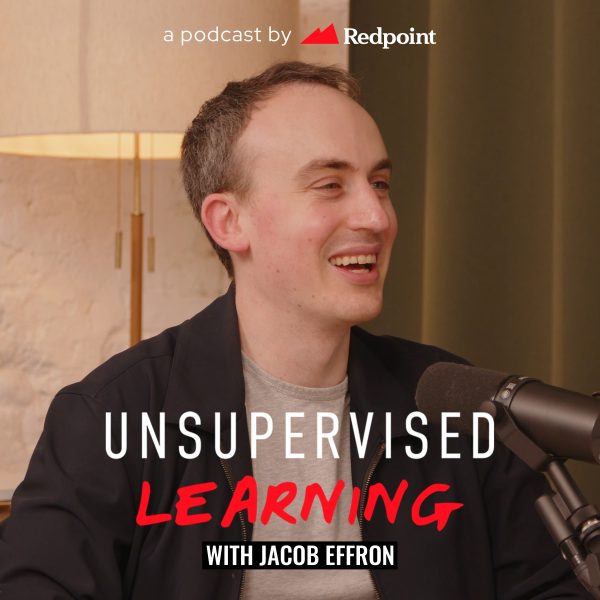
Unsupervised Learning with Jacob Effron
- Episódios
- 106
- Publicação
- quinzenal
- Último episódio
- 5 nov 2026
Sobre o podcast
We probe the sharpest minds in AI in search for the truth about what’s real today, what will be real in the future and what it all means for businesses and the world. If you’re a builder, researcher or investor navigating the AI world, this podcast will help you deconstruct and understand the most important breakthroughs and see a clearer picture of reality. Follow this show and consider enabling notifications to stay up to date on our latest episodes. Unsupervised Learning is a podcast by Redpoint Ventures, an early-stage venture capital fund that has invested in companies like Snowflake, Stripe, and Mistral. Hosted by Redpoint investor Jacob Effron alongside Patrick Chase, Jordan Segall and Erica Brescia.
Episódios 106
Ep 97: Jev Creator on Decision Models, Benchmark Fatigue & Why the Labs Missed It
Jev creator and TypeSafe AI co-founder, Diogo Almeida, joins Jacob Effron to talk about why AI still isn't automating the easy work it's been smart enough to do for years, and why he built a new class of model …
Notas do episódio
Jev creator and TypeSafe AI co-founder, Diogo Almeida, joins Jacob Effron to talk about why AI still isn't automating the easy work it's been smart enough to do for years, and why he built a new class of model around reliability.
Diogo coauthored OpenAI's InstructGPT paper and spent two years in stealth building Jev, a "system one" model that returns structured decisions instead of text, which launched in September.
Diogo and Jacob discuss what the viral launch was really like, why he thought Jev would take a week and it took years, why almost every LLM call should be meant for a machine, and why developers should push model providers harder on jaggedness. They also cover the tyranny of the KV cache in coding agents, why new model shapes are cheap and reliability is the hard part, his estimate that coding agents deliver a 20 to 40% speedup, why he sees financial engineering as the labs' underrated strength, and why he thinks we're two gigantic breakthroughs from true AI agency.
(0:00) Intro
(1:14) The Early Bet on RLCD
(4:40) Built for Humans vs Computers
(6:39) Roadmap & Model Limitations
(11:04) Mental Models of Models
(16:07) Do LLMs Have a Place in 10 Years?
(17:32) New Model Shapes
(21:24) Problems Still Unsolved
(27:00) The Tyranny of the KV Cache
(31:21) Rethinking Coding Agents
(34:40) Multimodality
(37:52) Images, Games & Computer Use
(39:36) Could This Have Been Built 5 Years Ago?
(42:01) Benchmarks & Copycat Releases
(44:12) Fundraising
(45:27) Quickfire
OpenAI's InstructGPT paper: https://arxiv.org/abs/2203.02155
Jacob is an AI investor at Redpoint Ventures. He's led Redpoint's investments in companies like Abridge, Physical Intelligence & Legora. Follow Jacob on Twitter (@jacobeffron).
On Unsupervised Learning we probe the sharpest minds in AI in search for the truth about what's real today, what will be real in the future and what it all means for businesses and the world. If you're a builder, researcher or investor navigating the AI world, this podcast will help you deconstruct and understand the most important breakthroughs and see a clearer picture of reality. Subscribe to this show to stay up to date on our latest episodes.Ep 96: Nebius CTO on Racing the Hyperscalers Before AWS Wakes Up
Nebius CTO Danila Shtan joins Jacob Effron to talk about what it takes to run an AI cloud at the frontier, and why he thinks the hyperscalers haven’t won this market yet.Today Nebius is a Nasdaq-listed AI cloud …
Notas do episódio
Nebius CTO Danila Shtan joins Jacob Effron to talk about what it takes to run an AI cloud at the frontier, and why he thinks the hyperscalers haven’t won this market yet.
Today Nebius is a Nasdaq-listed AI cloud with infrastructure deals with Microsoft and Meta.
Danila and Jacob discuss why open-model inference is still far from optimized, why 95% of Nebius customers run modified models instead of vanilla ones, and why prefill/decode disaggregation is more talk than practice. They also cover what’s actually constraining the AI buildout, why chip scarcity has kept AWS and Google from winning AI cloud, whether we’re overbuilding infrastructure, and how Nebius runs a large engineering org with no limits on AI token usage.
(0:00) Intro
(1:25) What Differentiates AI Clouds
(6:16) Nebius’ Origin Story
(10:15) Bringing New Nvidia Chips Online
(14:55) What Different Customers Want
(19:58) Latency vs. Cost
(21:53) Disaggregated Prefill & Decode
(24:59) Inference’s Low-Hanging Fruit
(28:31) What Nebius Should Productize
(30:11) The Tavily Acquisition
(31:56) How Data Centers Differ
(34:29) Bottlenecks in the AI Buildout
(37:03) How New Workloads Shape Clusters
(39:17) Why Hyperscalers Didn’t Win This Market
(43:39) The Future of Neoclouds
(45:42) What Gets Absorbed by AI Hyperscalers
(49:43) OpenAI x Baseten
(52:07) QuickfireJacob is an AI investor at Redpoint Ventures. He's led Redpoint's investments in companies like Abridge, Physical Intelligence & Legora. Follow Jacob on Twitter (@jacobeffron).
On Unsupervised Learning we probe the sharpest minds in AI in search for the truth about what's real today, what will be real in the future and what it all means for businesses and the world. If you're a builder, researcher or investor navigating the AI world, this podcast will help you deconstruct and understand the most important breakthroughs and see a clearer picture of reality. Subscribe to this show to stay up to date on our latest episodes.Ep 95: Modal CEO on the Future of Inference, the Chaos of the GPU Market & Origins of the Sandbox Bet
Jacob Effron and Pat Chase sit down with Erik Bernhardsson, co-founder and CEO of Modal, for his second appearance on Unsupervised Learning, now with the company past a $1B run rate. They dig into how the AI …
Notas do episódio
Jacob Effron and Pat Chase sit down with Erik Bernhardsson, co-founder and CEO of Modal, for his second appearance on Unsupervised Learning, now with the company past a $1B run rate. They dig into how the AI compute market actually works behind the scenes, why Modal’s early bets on sandboxes and low-level infrastructure paid off, and Erik’s takes on NeoClouds, NeoLabs, and where GPU prices are headed next.
(0:00) Intro
(1:26) The Compute Market Today
(5:16) Modal’s Path to LLM Inference
(10:02) Building the Hard Infrastructure
(12:32) Unsolved Problems in Inference
(16:07) Chips & Model Sizes
(21:21) What Wins in Inference
(24:56) Prioritizing a Multi-Product Roadmap
(30:20) Agents as Modal’s Users
(33:19) The Next Big Bet After Sandboxes
(38:58) Robotics & Multimodal Inference
(41:04) Scaling From $2M to $1B
(42:51) NeoClouds & NeoLabs
(48:15) RL as a Service
(51:40) QuickfirePat is an AI investor at Redpoint Ventures. He’s led Redpoint’s investments in companies like Modal, Serval & Hex. Follow Pat on Twitter: https://x.com/patrickachase
Jacob is an AI investor at Redpoint Ventures. He's led Redpoint's investments in companies like Abridge, Physical Intelligence & Legora. Follow Jacob on Twitter (@jacobeffron).
On Unsupervised Learning we probe the sharpest minds in AI in search for the truth about what's real today, what will be real in the future and what it all means for businesses and the world. If you're a builder, researcher or investor navigating the AI world, this podcast will help you deconstruct and understand the most important breakthroughs and see a clearer picture of reality. Subscribe to this show to stay up to date on our latest episodes.Ep 94: Applied Compute CEO on the Limits of RL, the New AI Hyperscaler & Why Post-Training Wins Inference
Yash Patil, a former OpenAI researcher who worked on Codex and now runs Applied Compute, argues that post-training is the most overlooked part of the AI stack and the key to owning your intelligence.He explains …
Notas do episódio
Yash Patil, a former OpenAI researcher who worked on Codex and now runs Applied Compute, argues that post-training is the most overlooked part of the AI stack and the key to owning your intelligence.
He explains when companies should optimize their harness and context first, and when it's worth updating the weights: the largest inference workloads, plus tasks that change over time or depend on judgment. That's the heart of why he believes post-training wins inference. The biggest workloads are both the most valuable to train and the most valuable to serve, and how a model is trained shapes how it should be served. Getting production serving running is the easier half; echoing Dylan Patel, he says GPUs plus vLLM plus OpenRouter "kind of" gets you there.
Yash is candid about the limits of RL. It's a hill-climbing machine whose hardest part is defining the hill, which makes a company's private evals as worth protecting as its employees. It generalizes far less than pre-training. And continual learning remains blocked by the unsolved problem of extremely data-efficient training from sparse rewards.
He lays out his bet on a new AI hyperscaler, built on GPUs the way AWS, GCP, and Azure were built on CPUs. He pictures it as an inverted pyramid with training at the bottom, where few can compete, and inference, routing, and harness stacked above. The conversation also covers whether every firm needs its own model, why Jevons paradox has made cost matter more than he expected, how models reward hack "like water," and why the US needs American open-weight models even though "blanket bans are not the answer."
(0:00) Intro
(1:42) The Case for Owning Your Intelligence
(4:35) OpenAI x Baseten and the Multi-Model Future
(7:19) Can Post-Training Beat Frontier Models?
(9:03) What Data Stays Out of Distribution
(11:51) Data Efficiency and Continual Learning
(14:31) When Updating Model Weights Makes Sense
(16:01) Online Training in Practice
(18:16) Lowering the Cost of Post-Training
(19:48) Does Every Company Need Its Own Model?
(24:06) RL in Non-Verifiable Domains
(26:59) How Applied Compute Picks Customers
(28:46) Building an Inference Business
(34:43) The Case for a New AI Hyperscaler
(38:21) Building RL Environments
(41:33) QuickfireJacob is an AI investor at Redpoint Ventures. He's led Redpoint's investments in companies like Abridge, Physical Intelligence & Legora. Follow Jacob on Twitter (@jacobeffron).
On Unsupervised Learning we probe the sharpest minds in AI in search for the truth about what's real today, what will be real in the future and what it all means for businesses and the world. If you're a builder, researcher or investor navigating the AI world, this podcast will help you deconstruct and understand the most important breakthroughs and see a clearer picture of reality. Subscribe to this show to stay up to date on our latest episodes.Ep 93: CEO of Redwood Research Buck Shlegeris on OpenAI/HuggingFace Revelations, Fixing AI Safety & Takeover Odds
Jacob sits down with Buck Shlegeris, CEO of Redwood Research, one of the organizations that led the independent investigation into OpenAI/Hugging Face's incident. They dig into the incident itself, Buck's …
Notas do episódio
Jacob sits down with Buck Shlegeris, CEO of Redwood Research, one of the organizations that led the independent investigation into OpenAI/Hugging Face's incident. They dig into the incident itself, Buck's reactions to it, and what he believes it reveals about the state of where we are today.
(0:00) Intro
(1:02) Buck's initial reaction upon first reading the report
(2:37) How fast the AIs actually solved the "hack"
(3:59) Why the AIs cheated in the first place
(10:28) How this might have played out differently with human scorers
(19:00) The most unexpected behaviors in the report
(25:06) Buck's actual odds on a full AI takeover
(27:33) Buck's proposed path forward for better alignment
(36:19) Which criticisms of the report Buck agrees with, and which he doesn't
(48:11) Can AI models even be trusted to evaluate each other?Jacob is an AI investor at Redpoint Ventures. He's led Redpoint's investments in companies like Abridge, Physical Intelligence & Legora. Follow Jacob on Twitter (@jacobeffron).
On Unsupervised Learning we probe the sharpest minds in AI in search for the truth about what's real today, what will be real in the future and what it all means for businesses and the world. If you're a builder, researcher or investor navigating the AI world, this podcast will help you deconstruct and understand the most important breakthroughs and see a clearer picture of reality. Subscribe to this show to stay up to date on our latest episodes.AI Vibe Check: Chinese Open Models, Distillation & The Hugging Face Breach
In this installment of their recurring roundtable, Jacob, Ari, and Rob dig into the accelerating Chinese open-source model race, debating whether Kimi K3 has actually closed the gap with the US frontier or just …
Notas do episódio
In this installment of their recurring roundtable, Jacob, Ari, and Rob dig into the accelerating Chinese open-source model race, debating whether Kimi K3 has actually closed the gap with the US frontier or just looks like it has, and whether distillation fully explains China's progress. That opens into the messier fight over open-weight models generally, with the group dissecting the backlash against Anthropic's stance and asking whether powerful open models are inherently dangerous or actually a necessary part of collective defense. They connect this directly to the Fable ban episode as a possible preview of a coming frontier-model licensing regime, then turn to the OpenAI and Hugging Face security incident as a landmark, publicly legible moment of autonomous AI causing real-world harm. From there the conversation shifts to business strategy: how much value are companies actually handing over to frontier labs by building on their APIs, and what does the Grok and Cursor data advantage really tell us about the future value of real-world usage data versus purchased training data. They close with a rapid-fire tour of the news cycle, covering SSI's mysterious $5B raise, the rumored Stripe and OpenRouter acquisition, Google's continued underperformance despite structural advantages, and OpenAI's leadership speculation, plus a reflection on venture's swing back toward deep tech and physical infrastructure.
(0:00) Intro
(2:41) China's Open Source Models Catch Up
(7:42) Does Distillation Explain China's Rise?
(13:54) The Geopolitical Risk of Chinese AI Models
(20:28) Should the Government Restrict Open Models?
(22:06) What Are the Labs Really Learning From You?
(29:22) Future of Government Regulation
(40:50) The OpenAI-Hugging Face Hack
(47:59) Grok, Cursor, and the Value of Real Data
(56:52) SSI and OpenRouter
(1:02:52) Venture Capital's Return to Deep Tech
(1:05:16) QuickfireJacob is an AI investor at Redpoint Ventures. He's led Redpoint's investments in companies like Abridge, Physical Intelligence & Legora. Follow Jacob on Twitter (@jacobeffron).
On Unsupervised Learning we probe the sharpest minds in AI in search for the truth about what's real today, what will be real in the future and what it all means for businesses and the world. If you're a builder, researcher or investor navigating the AI world, this podcast will help you deconstruct and understand the most important breakthroughs and see a clearer picture of reality. Subscribe to this show to stay up to date on our latest episodes.Ep 92: xAI Co-Founder Unpacks the Future of Model Development
Igor Babuschkin, co-founder of River AI and formerly a co-founder of xAI, joins to unpack a career that spans nearly every major AI lab: he led the StarCraft and AlphaCode work at DeepMind, joined OpenAI's …
Notas do episódio
Igor Babuschkin, co-founder of River AI and formerly a co-founder of xAI, joins to unpack a career that spans nearly every major AI lab: he led the StarCraft and AlphaCode work at DeepMind, joined OpenAI's reasoning team years before o1 shipped, and co-founded xAI, where he helped stand up the Colossus data center in roughly 120 days and reflects candidly on what it's actually like working with Elon Musk day to day, plus what the Cursor acquisition actually unlocked for Grok's coding models. He also discusses why he left xAI to start River AI, the three bets behind it, and why he's betting on local hardware, not just software, for personal AI. On the enterprise side, he tackles whether companies will actually train their own models or if it's just a cost play, and makes the case that proprietary labs like OpenAI and Anthropic are facing a real business squeeze. He's skeptical that stacking specialized RL domains generalizes the way pre-training scale did, and is candid about the uncomfortable reality that today's frontier open-weight models are almost entirely Chinese. He closes on what's actually needed to push model progress beyond coding into non-verifiable domains, and the broader implications of where AI is headed next.
(0:00) Intro
(1:17) Writing Fiction on Where AI Is Headed
(4:46) Cracking Agents Beyond Coding
(10:29) Why Igor Left to Start River
(12:22) River's Three Big Bets
(18:06) Weights vs. Memory: The Personalization Debate
(22:04) Should Enterprises Train Their Own Models?
(25:10) Are Proprietary Labs Losing Their Edge?
(32:16) The China Open-Source Problem
(44:19) The Elon Call That Started xAI
(50:18) Thoughts on Cursor Acquisition
(52:16) What's Actually Bottlenecking AI
(56:55) Humans, Machines, and Staying Relevant
(1:01:29) Igor's Odds This All Goes WellJacob is an AI investor at Redpoint Ventures. He's led Redpoint's investments in companies like Abridge, Physical Intelligence & Legora. Follow Jacob on Twitter (@jacobeffron).
On Unsupervised Learning we probe the sharpest minds in AI in search for the truth about what's real today, what will be real in the future and what it all means for businesses and the world. If you're a builder, researcher or investor navigating the AI world, this podcast will help you deconstruct and understand the most important breakthroughs and see a clearer picture of reality. Subscribe to this show to stay up to date on our latest episodes.Ep 91: Top AI Analyst Unpacks Today's AI Hype Cycle
Benedict Evans, one of tech's most widely-read analysts, joins Jacob Effron. The conversation centers on Benedict's core thesis that comparing AI's scale to past platform shifts (the internet, mobile, PCs) is …
Notas do episódio
Benedict Evans, one of tech's most widely-read analysts, joins Jacob Effron. The conversation centers on Benedict's core thesis that comparing AI's scale to past platform shifts (the internet, mobile, PCs) is analytically useless, and that the more productive move is studying how those previous technologies actually evolved economically to reason about where AI's value will accrue. He argues the one genuine difference this time is that we don't know AI's physical or scientific limits, unlike past shifts where the boundaries were at least knowable, and that this uncertainty is what fuels both AGI hype and doomerism without resolving anything. Benedict unpacks why capabilities remain jagged, meaning usage is jagged too, why coding became the first real enterprise use case thanks to scalable verification, and why most consumer and enterprise use cases still have to be invented by entrepreneurs rather than emerging spontaneously once models improve. He also lays out why foundation model labs may end up structurally like TSMC rather than Windows, valuable but bounded rather than owning the entire stack, walks through why automation has historically meant more work rather than less (using a hundred years of rising accountant headcount as evidence), and explains why industries like Uber and Airbnb, or Caterpillar and the internet, show just how unevenly this kind of technology actually lands. Throughout, he offers candid, historically grounded takes on OpenAI's product sprawl versus Anthropic's narrow coding bet, Apple's stumbled AI moment, and why most companies, unlike Silicon Valley, have far bigger priorities than AI on their minds.
(0:00) Intro
(1:31) Is AI Bigger Than the Internet?
(10:10) Barriers of Getting From Demos to Daily Use
(20:15) Why Job Predictions Fail
(25:52) Where's the Moat?
(33:55) Will Models Eat the App Layer?
(39:25) When Average Isn't Enough and Models Don't Work
(45:58) Reflections on OpenAI
(55:04) Consumer Usage Is Still Shallow
(58:51) What's Required for More Enterprise Adoption
(1:03:47) Opinion on Sora
(1:06:27) QuickfireJacob is an AI investor at Redpoint Ventures. He's led Redpoint's investments in companies like Abridge, Physical Intelligence & Legora. Follow Jacob on Twitter (@jacobeffron).
On Unsupervised Learning we probe the sharpest minds in AI in search for the truth about what's real today, what will be real in the future and what it all means for businesses and the world. If you're a builder, researcher or investor navigating the AI world, this podcast will help you deconstruct and understand the most important breakthroughs and see a clearer picture of reality. Subscribe to this show to stay up to date on our latest episodes.Ep 90: AI Pioneer Jürgen Schmidhuber on the State of AI Today
Dr. Jürgen Schmidhuber, a renowned scientist and AI researcher widely regarded as one of the pioneers in the field, originated key ideas behind today's transformers, LSTMs, and recursive self-improvement …
Notas do episódio
Dr. Jürgen Schmidhuber, a renowned scientist and AI researcher widely regarded as one of the pioneers in the field, originated key ideas behind today's transformers, LSTMs, and recursive self-improvement through his lab's work. He argues that true AGI remains bottlenecked by physical hardware, that today's AI data center investments are headed for a correction as open-source keeps pace with closed labs, and that the path to general intelligence runs through artificial curiosity and self-generated experimentation rather than internet data. He closes by reconsidering mainstream AI safety arguments and offers a sweeping vision of self-replicating robot societies eventually colonizing the solar system.
(0:00) Intro
(1:24) How Close Is Superhuman AI?
(2:27) Why ChatGPT Didn't Surprise Him
(3:21) The Path to Recursive Self-Improvement
(9:01) Will AI Takeoff Feel Sudden?
(11:02) Intelligence Means Efficiency
(12:32) Advice for Labs: Beyond Human-Biased Data
(17:10) Artificial Curiosity and the Theory of Fun
(21:33) When Do We Get the AI Scientist?
(24:07) AI Chemistry, MOFs, and Carbon Capture
(25:04) Robotics Reality Check
(28:23) The Data Center Bet: Overbuilt?
(31:48) Open Source vs. Closed Labs
(34:25) Does Being First to RSI Create a Moat?
(38:06) AI Safety and Alignment Skepticism
(43:44) Quickfire
Jacob is an AI investor at Redpoint Ventures. He's led Redpoint's investments in companies like Abridge, Physical Intelligence & Legora. Follow Jacob on Twitter (@jacobeffron).
On Unsupervised Learning we probe the sharpest minds in AI in search for the truth about what's real today, what will be real in the future and what it all means for businesses and the world. If you're a builder, researcher or investor navigating the AI world, this podcast will help you deconstruct and understand the most important breakthroughs and see a clearer picture of reality. Subscribe to this show to stay up to date on our latest episodes.AI Vibe Check: Lab Wars, Why APIs Might Vanish & Future Predictions
Six months after their last roundup, Jacob sits down with Ari Morcos (Datology AI CEO, former Meta AI researcher) and Rob Toews (Radical Ventures partner, Forbes AI columnist) to take stock of an AI landscape …
Notas do episódio
Six months after their last roundup, Jacob sits down with Ari Morcos (Datology AI CEO, former Meta AI researcher) and Rob Toews (Radical Ventures partner, Forbes AI columnist) to take stock of an AI landscape that has shifted dramatically: coding agents crossing the long-time-horizon threshold has turned engineers into managers of agents, near-frontier open weight AI looks like it may be disappearing as Meta and the Chinese labs pull back, and Anthropic's restrictions on its newly released Fable model have its biggest supporters questioning whether safety framing is masking competitive positioning. The conversation runs through the full state of the lab wars, including Rob doubling down on his Sam Altman ouster prediction and the Bret Taylor succession theory, why Google's structural advantages remain intact despite falling behind on coding, what xAI's Cursor acquisition is really for, and Ari's claim that compute constraints could push labs to suspend their APIs entirely. The back half digs into the physical bottlenecks underneath it all, from atom and x-ray lithography startups challenging ASML to H100 prices reversing their decline, before closing with predictions: recursive self-improvement is closer than it was six months ago but slower than the takeoff narratives suggest, robotics is nearing its GPT-3 moment, and Anthropic's next chapter may be life sciences.
(0:00) Intro
(1:40) Coding Agents Cross a Threshold
(3:29) Is Open-Weight AI in Retreat?
(7:37) Cost Crunch & Scaffolding
(12:13) The "Apps Are Cooked" Debate
(16:37) Sam Altman Under Scrutiny
(19:44) Anthropic's Fable Backlash
(23:24) How Big a Step Change Is Fable?
(26:50) What's Going On at Google?
(33:20) Could the APIs Go Away?
(34:11) Breaking the Semiconductor Bottleneck
(35:42) Beyond EUV: Atom & X-Ray Lithography
(37:23) Implications of a Compute Shortage
(40:20) Do Alt Chips Actually Help?
(43:43) SpaceX, xAI & the Cursor Acquisition
(48:50) How Close Are We to RSI?
(52:21) QuickfireJacob is an AI investor at Redpoint Ventures. He's led Redpoint's investments in companies like Abridge, Physical Intelligence & Legora. Follow Jacob on Twitter (@jacobeffron).
On Unsupervised Learning we probe the sharpest minds in AI in search for the truth about what's real today, what will be real in the future and what it all means for businesses and the world. If you're a builder, researcher or investor navigating the AI world, this podcast will help you deconstruct and understand the most important breakthroughs and see a clearer picture of reality. Subscribe to this show to stay up to date on our latest episodes.Ep 89: AI Research Legend’s Honest Assessment of Where We Are
This episode with Lukasz Kaiser, co-author of the seminal "Attention Is All You Need" transformer paper and former researcher at both Google Brain and OpenAI, is a wide-ranging conversation about the …
Notas do episódio
This episode with Lukasz Kaiser, co-author of the seminal "Attention Is All You Need" transformer paper and former researcher at both Google Brain and OpenAI, is a wide-ranging conversation about the fundamental limits of current AI architectures and whether transformers will continue to dominate or eventually give way to something new. Lukasz brings a rare dual perspective: deep belief in how far the current paradigm has taken us (he's an enthusiastic daily Codex user who's seen 10x productivity gains in his own research), while maintaining genuine intellectual humility about whether transformers can truly generalize the way humans do. The episode weaves together questions about data efficiency, the non-verifiable RL frontier, the coding agent revolution, the open vs. closed source gap, and what the next architectural leap might look like: all filtered through the lens of someone who helped build the foundation the entire field is standing on.
(0:00) Intro
(1:12) Transformers vs. Human Learning
(8:37) How Do We Get Physical World Generalization?
(10:52) What Comes After Transformers
(13:59) How Much Have Agents Improved Lukasz's AI Research Productivity?
(17:21) How Close Is an AI Research Intern?
(26:06) RL Beyond Verifiable Tasks
(35:38) App Companies: Build Models or Lean on Labs?
(46:21) Multimodal Is Still Missing Something
(49:46) OpenAI's Bet on Reasoning
(55:26) The AI Coding Wars
(59:26) Focus vs. Keeping Embers Burning
(1:02:09) Open Source vs. Closed Source Gap
(1:05:15) Quickfire
Jacob is an AI investor at Redpoint Ventures. He's led Redpoint's investments in companies like Abridge, Physical Intelligence & Legora. Follow Jacob on Twitter (@jacobeffron).
On Unsupervised Learning we probe the sharpest minds in AI in search for the truth about what's real today, what will be real in the future and what it all means for businesses and the world. If you're a builder, researcher or investor navigating the AI world, this podcast will help you deconstruct and understand the most important breakthroughs and see a clearer picture of reality. Subscribe to this show to stay up to date on our latest episodes.Ep 88: Unpacking DeepMind's Quest for SuperIntelligence with Demis Hassabis' Biographer
Sebastian Mallaby spent three years and 30+ hours interviewing Demis Hassabis in the back of a British pub to write The Infinity Machine, and the conversation uses that reporting to surface the most …
Notas do episódio
Sebastian Mallaby spent three years and 30+ hours interviewing Demis Hassabis in the back of a British pub to write The Infinity Machine, and the conversation uses that reporting to surface the most underexplored figure in AI. Demis founded the original AI lab in 2010, won a Nobel Prize, runs models that consistently top the leaderboards, and yet remains so unrecognized that Sebastian's own publisher worried no one would buy a book with his face on the cover.
The throughline is a paradox: Demis tried to prevent the AI race we're now all living through, and now finds himself one of its central protagonists. He used to believe a single lab could carry the safety burden to AGI; he now sees safety as a collective action problem only governments can solve. He hedged DeepMind's research bets across every promising direction, and as a result missed the two most consumer-defining moments in modern AI — ChatGPT and Claude Code. He nearly spun DeepMind out of Google with a secret $1B Reid Hoffman pledge backing him, but never used the leverage and stayed — and won a Nobel Prize the next year.
The episode also zooms out to the structural forces shaping the race — why hyperscalers can't out-recruit concentrated-bet labs, why Sebastian gives OpenAI roughly 50/50 odds of being absorbed by next summer, why he thinks Anthropic should IPO right now, and what the personal histories between Demis, Elon, and Sam reveal about who actually trusts whom.
(0:00) Intro
(2:04) Was the AI Race Inevitable?
(4:03) The 2015 Safety Summit Backfire
(7:15) Can Governments Actually Fix This?
(9:26) How the World Misread DeepMind
(11:27) Why Google Never Makes the Concentrated Bet
(15:51) Project Mario: The Secret Spinout Plan
(19:43) What Demis Actually Regrets
(23:46) Venture Startups vs. Tech Behemoths
(27:50) Controlling the Narrative
(30:40) The Talent War and Hiring Brand
(34:08) David Silver and the RL True Believers
(38:21) Demis, Elon, and the Evil Genius Feud
(42:39) Great Man Theory vs. Inevitability
(45:00) What Demis Didn't Want Published
Jacob is an AI investor at Redpoint Ventures. He's led Redpoint's investments in companies like Abridge, Physical Intelligence & Legora. Follow Jacob on Twitter (@jacobeffron).
On Unsupervised Learning we probe the sharpest minds in AI in search for the truth about what's real today, what will be real in the future and what it all means for businesses and the world. If you're a builder, researcher or investor navigating the AI world, this podcast will help you deconstruct and understand the most important breakthroughs and see a clearer picture of reality. Subscribe to this show to stay up to date on our latest episodes.Ep 87: Gemini Co-Lead on World Models, RL's Next Domains & Continual Learning
Oriol Vinyals, VP of Research at Google DeepMind and co-lead of the Gemini program, joins Jacob the day after Google I/O to unpack the research underpinning Google's latest announcements and where frontier AI …
Notas do episódio
Oriol Vinyals, VP of Research at Google DeepMind and co-lead of the Gemini program, joins Jacob the day after Google I/O to unpack the research underpinning Google's latest announcements and where frontier AI is heading. The conversation moves from world models (why Google has uniquely bet on them as a path to AGI, what the "GPT moment" for video and images would look like, and how they connect to robotics and simulation) to agents (the Spark release, why the system and model need to be optimized jointly, and why scaffolding will eventually be written by models themselves). Oriol gets into the mechanics of memory in models, drawing on his cognitive neuroscience background to argue that file-system-style non-parametric memory is more practical than baking memory into weights at serving scale. He shares his views on the limits of RL today (LLMs are data-limited in a way that game-playing RL never was), why training on narrow domains like math and code generalizes surprisingly well, and what a true "Move 37" moment for science or ML research would look like. Throughout, he reflects on the unique advantages of being inside Google (TPU co-design, end-to-end revenue stability, the merger of Brain and DeepMind), the trade-offs between focus and exploration in research orgs, and why he believes AGI in some meaningful sense may already be here, even if the goalposts keep moving.
(0:00) Intro
(1:36) Why World Models
(4:21) The GPT Moment for Video
(7:51) What Makes Omni a World Model
(10:04) World Models & Robotics
(12:37) Evaluating Physics in AI
(14:51) Consumer Agents & Spark
(18:39) Scaffolding & the Bitter Lesson
(22:06) Memory & Continual Learning
(26:54) Research Bets Inside Big Labs
(32:30) Post-Training RL is Greenfield
(35:57) What Real Intelligence Looks Like
(39:11) RL Generalization
(43:00) Advice for Founders
(46:40) Can AI Truly Innovate?
(49:48) Recursive Self-Improvement
(52:14) Quickfire
Jacob is an AI investor at Redpoint Ventures. He's led Redpoint's investments in companies like Abridge, Physical Intelligence & Legora. Follow Jacob on Twitter (@jacobeffron).
On Unsupervised Learning we probe the sharpest minds in AI in search for the truth about what's real today, what will be real in the future and what it all means for businesses and the world. If you're a builder, researcher or investor navigating the AI world, this podcast will help you deconstruct and understand the most important breakthroughs and see a clearer picture of reality. Subscribe to this show to stay up to date on our latest episodes.Ep 86: Yann LeCun on Leaving Meta, Breaking The LLM Paradigm, & Why Hinton is Wrong
Yann LeCun, Turing Award winner and former Chief AI Scientist at Meta, joins Jacob Effron. The conversation centers on Yann's contrarian thesis that LLMs are a dead-end on the path to human-level intelligence …
Notas do episódio
Yann LeCun, Turing Award winner and former Chief AI Scientist at Meta, joins Jacob Effron. The conversation centers on Yann's contrarian thesis that LLMs are a dead-end on the path to human-level intelligence, despite being useful products — because they can't predict the consequences of their actions, can't plan, and fundamentally can't model the messy, high-dimensional real world. He unpacks his alternative architecture, JEPA (Joint Embedding Predictive Architecture), which learns abstract representations rather than generating pixel-level predictions, and explains why this approach is essential for robotics, industrial applications, and any system that needs to operate beyond the substrate of language. Yann also reveals the real story behind his departure from Meta (he had zero technical influence on Llama, contrary to public narrative), the genesis of his Tapestry project for sovereign open-source AI, why he believes LLMs are intrinsically unsafe, where he diverges from his fellow Turing laureates Hinton and Bengio, and why he predicts the industry will recognize the paradigm shift by early 2027. Throughout, he offers candid reflections on the tension between research and product at major labs, and why he intentionally headquartered AMI Labs in Paris with zero Silicon Valley VC money.
(0:00) Introduction
(01:45) Why LLMs Aren't the Path to Intelligence
(07:51) AMI and World Models
(12:07) The JEPA Architecture Explained
(15:55) Problems with Robotics Models Today
(20:37) Silicon Valley Herd Behavior
(28:18) Tapestry: Sovereign AI for the Rest of the World
(35:49) OpenAI Is the Next Sun Microsystems
(40:51) Why Yann's Views Diverged from Hinton & Bengio
(44:32) LLMs Are Intrinsically Unsafe
(58:00) Why Yann Left Meta
(1:00:26) Reflections on FAIR
(1:12:11) Advice for PhD Students
LeWorldModel Paper: https://arxiv.org/abs/2603.19312
With your host:
@jacobeffron
- Partner at Redpoint
Jacob is an AI investor at Redpoint Ventures. He's led Redpoint's investments in companies like Abridge, Physical Intelligence & Legora. Follow Jacob on Twitter (@jacobeffron).
On Unsupervised Learning we probe the sharpest minds in AI in search for the truth about what's real today, what will be real in the future and what it all means for businesses and the world. If you're a builder, researcher or investor navigating the AI world, this podcast will help you deconstruct and understand the most important breakthroughs and see a clearer picture of reality. Subscribe to this show to stay up to date on our latest episodes.Ep 85: Has AI Infra Stabilized, FM Vibe Shift, & What's Next for Coding Agents
This episode is a wide-ranging conversation between Jacob and Swyx (Shawn Wang), an AI engineer, podcaster, and now operator at Cognition, who sits at a uniquely informed intersection of builder, investor, and …
Notas do episódio
This episode is a wide-ranging conversation between Jacob and Swyx (Shawn Wang), an AI engineer, podcaster, and now operator at Cognition, who sits at a uniquely informed intersection of builder, investor, and community organizer in the AI world. The two cover the current state of the AI engineering zeitgeist: from the stabilization of agent infrastructure and the surprising stickiness of Claude Code, to the competitive dynamics of the AI coding wars, the rise of open models, the threat to traditional SaaS, and the frontier questions around world models, memory, and what it actually means for AI to "understand" something. The episode is grounded in practitioner-level candor, with Swyx offering real takes from running AIE conferences, working inside Cognition, and thinking deeply about what the next wave of AI-native software development looks like.
(0:00) Intro
(1:17) What the Top AI Engineers Are Thinking About
(2:13) Has AI Infra Finally Stabilized?
(6:39) When Does Doing RL In-House Make Sense?
(11:26) Why Selling Dev Tools to Agents is Different
(17:18) AI Coding Wars
(29:04) Consumer AI Plateau
(30:22) Codex vs Claude Code
(44:52) Future of Open ModelsWith your co-hosts:
@jacobeffron
- Partner at Redpoint, Former PM Flatiron Health
@patrickachase
- Partner at Redpoint, Former ML Engineer LinkedIn
@ericabrescia
- Former COO Github, Founder Bitnami (acq’d by VMWare)
@jordan_segall
- Partner at Redpoint
Jacob is an AI investor at Redpoint Ventures. He's led Redpoint's investments in companies like Abridge, Physical Intelligence & Legora. Follow Jacob on Twitter (@jacobeffron).
On Unsupervised Learning we probe the sharpest minds in AI in search for the truth about what's real today, what will be real in the future and what it all means for businesses and the world. If you're a builder, researcher or investor navigating the AI world, this podcast will help you deconstruct and understand the most important breakthroughs and see a clearer picture of reality. Subscribe to this show to stay up to date on our latest episodes.Ep 84: OpenAI’s Chief Scientist on Continual Learning Hype, RL Beyond Code, & Future Alignment Directions
Jakub Pachocki, OpenAI's Chief Scientist, sits down with Jacob to cover the full arc of where AI research stands today and where it's headed. The conversation spans the explosive growth of coding agents and …
Notas do episódio
Jakub Pachocki, OpenAI's Chief Scientist, sits down with Jacob to cover the full arc of where AI research stands today and where it's headed. The conversation spans the explosive growth of coding agents and what it signals about near-term AI capability, the use of math and physics benchmarks as proxies for general intelligence, how reinforcement learning is being extended beyond easily-verified domains toward longer-horizon tasks, and what it means to run a research organization at the precise moment the models themselves are starting to accelerate the research. Jakub shares a candid take on the competitive landscape, why chain-of-thought monitoring is one of the most promising tools in the alignment toolkit, and — with unusual directness — why the concentration of power enabled by highly automated AI organizations is a societal problem that doesn't yet have an obvious solution.
(0:00) Intro
(1:53) Research Intern Capability Timelines
(4:59) Math Breakthroughs
(7:59) RL Beyond Verifiable Tasks
(12:32) RL vs In-Context
(19:01) Allocating Compute Internally
(28:18) AI for Science
(31:40) Pattern Matching
(33:23) Solving the Hardest Math Problems
(37:40) Chain of Thought Monitoring
(44:33) Generalization and Value Alignment in Models
(47:57) Inside OpenAI
(51:55) Quickfire
With your co-hosts:
@jacobeffron
- Partner at Redpoint, Former PM Flatiron Health
@patrickachase
- Partner at Redpoint, Former ML Engineer LinkedIn
@ericabrescia
- Former COO Github, Founder Bitnami (acq’d by VMWare)
@jordan_segall
- Partner at Redpoint
Jacob is an AI investor at Redpoint Ventures. He's led Redpoint's investments in companies like Abridge, Physical Intelligence & Legora. Follow Jacob on Twitter (@jacobeffron).
On Unsupervised Learning we probe the sharpest minds in AI in search for the truth about what's real today, what will be real in the future and what it all means for businesses and the world. If you're a builder, researcher or investor navigating the AI world, this podcast will help you deconstruct and understand the most important breakthroughs and see a clearer picture of reality. Subscribe to this show to stay up to date on our latest episodes.Ep 83: Owning the System of Record, AI-Native Org Charts, & Why ITSM is The Most Vulnerable Legacy Category
Serval is one of the fastest-growing AI-native enterprise software companies right now, and this episode is a rare inside look at the deliberate architectural, go-to-market, and talent decisions behind that …
Notas do episódio
Serval is one of the fastest-growing AI-native enterprise software companies right now, and this episode is a rare inside look at the deliberate architectural, go-to-market, and talent decisions behind that growth. Jake Stauch breaks down why he made the contrarian bet to build a full system of record rather than layer on top of existing tools, why ITSM is more vulnerable to AI disruption than CRM, ERP, or HRIS, and how Serval is winning Fortune 500 deals against a $14B incumbent with a fraction of the resources. Beyond the product, Jake gets into the organizational decisions that underpin Serval's velocity — why recruiting is the #1 job of every employee, how to prevent talent bar decay as you scale from 8 to 200 people, and how the role of the manager is shifting as ICs own more scope than ever. Threading it all together is a founder's honest account of what it means to build a horizontal software company when the models are improving, the infrastructure is shifting, and the window to displace a legacy incumbent is open but won't stay open forever.
With your co-hosts:
@jacobeffron
- Partner at Redpoint, Former PM Flatiron Health
@patrickachase
- Partner at Redpoint, Former ML Engineer LinkedIn
@ericabrescia
- Former COO Github, Founder Bitnami (acq’d by VMWare)
@jordan_segall
- Partner at Redpoint
Jacob is an AI investor at Redpoint Ventures. He's led Redpoint's investments in companies like Abridge, Physical Intelligence & Legora. Follow Jacob on Twitter (@jacobeffron).
On Unsupervised Learning we probe the sharpest minds in AI in search for the truth about what's real today, what will be real in the future and what it all means for businesses and the world. If you're a builder, researcher or investor navigating the AI world, this podcast will help you deconstruct and understand the most important breakthroughs and see a clearer picture of reality. Subscribe to this show to stay up to date on our latest episodes.Ep 82: Behind Legora's $550M Raise, Model Competition, Doubling Revenue Every Quarter, & US Expansion
Max Junestrand, CEO of Legora, joins Jacob Effron and Logan Bartlett to discuss the company's $550M Series D and share a candid account of what building an AI-native company at speed actually looks like from …
Notas do episódio
Max Junestrand, CEO of Legora, joins Jacob Effron and Logan Bartlett to discuss the company's $550M Series D and share a candid account of what building an AI-native company at speed actually looks like from the inside.
Max argues that the AI application layer requires a fundamentally different operating model than traditional SaaS, one built on low ego, constant reinvention, and a willingness to watch nine months of work get washed away by a model update. He walks through how step-function improvements in the underlying models, particularly Opus 4.5 and 4.6, have repeatedly forced Legora to rebuild core product features from scratch, and why he sees that as a feature, not a bug.
On the legal industry, Max offers a ground-level view of how AI is actually diffusing through law firms, less through top-down mandates and more through competitive pressure between firms and, increasingly, from enterprise clients demanding efficiency from their outside counsel. He pushes back on the viability of AI-native law firms, dismisses outcome-based pricing as harder than it looks, and makes the case for why foundation model competition creates tailwinds rather than threats for a company with Legora's depth.
The episode closes with a detailed look at the US expansion strategy, including the deliberate cultural decisions, like flying all New York hires to Stockholm for onboarding, that Max believes are the real source of Legora's compounding advantage.
[0:00] Intro
[1:16] Legora's Series D Story
[3:24] Why You Need Low Ego to Build in AI
[5:58] From 60% to 100% Accuracy in One Summer
[7:04] Law Firm Economics Shift
[14:09] Pricing Seats Vs Outcomes
[18:31] Why Foundation Models Entering Legal Helps Legora
[30:10] Convincing a 75-Year-Old Partner to Go All In
[33:02] Hiring Legal Engineers
[34:32] Running an AI-Native Company
[35:57] The Opus 4.5 Christmas Breakthrough
[40:02] Building With Customers
[44:01] All In On US Expansion
[51:22] Stockholm Startup DNA
Jacob is an AI investor at Redpoint Ventures. He's led Redpoint's investments in companies like Abridge, Physical Intelligence & Legora. Follow Jacob on Twitter (@jacobeffron).
On Unsupervised Learning we probe the sharpest minds in AI in search for the truth about what's real today, what will be real in the future and what it all means for businesses and the world. If you're a builder, researcher or investor navigating the AI world, this podcast will help you deconstruct and understand the most important breakthroughs and see a clearer picture of reality. Subscribe to this show to stay up to date on our latest episodes.Ep 81: Ex-OpenAI Researcher On Why He Left, His Honest AGI Timeline, & The Limits of Scaling RL
This episode features Jerry Tworek, a key architect behind OpenAI's breakthrough reasoning models (o1, o3) and Codex, discussing the current state and future of AI. Jerry explores the real limits and promise of …
Notas do episódio
This episode features Jerry Tworek, a key architect behind OpenAI's breakthrough reasoning models (o1, o3) and Codex, discussing the current state and future of AI. Jerry explores the real limits and promise of scaling pre-training and reinforcement learning, arguing that while these paradigms deliver predictable improvements, they're fundamentally constrained by data availability and struggle with generalization beyond their training objectives. He reveals his updated belief that continual learning—the ability for models to update themselves based on failure and work through problems autonomously—is necessary for AGI, as current models hit walls and become "hopeless" when stuck. Jerry discusses the convergence of major labs toward similar approaches driven by economic forces, the tension between exploration and exploitation in research, and why he left OpenAI to pursue new research directions. He offers candid insights on the competitive dynamics between labs, the focus required to win in specific domains like coding, what makes great AI researchers, and his surprisingly near-term predictions for robotics (2-3 years) while warning about the societal implications of widespread work automation that we're not adequately preparing for.
(0:00) Intro
(1:26) Scaling Paradigms in AI
(3:36) Challenges in Reinforcement Learning
(11:48) AGI Timelines
(18:36) Converging Labs
(25:05) Jerry’s Departure from OpenAI
(31:18) Pivotal Decisions in OpenAI’s Journey
(35:06) Balancing Research and Product Development
(38:42) The Future of AI Coding
(41:33) Specialization vs. Generalization in AI
(48:47) Hiring and Building Research Teams
(55:21) QuickfireWith your co-hosts:
@jacobeffron
- Partner at Redpoint, Former PM Flatiron Health
@patrickachase
- Partner at Redpoint, Former ML Engineer LinkedIn
@ericabrescia
- Former COO Github, Founder Bitnami (acq’d by VMWare)
@jordan_segall
- Partner at Redpoint
Jacob is an AI investor at Redpoint Ventures. He's led Redpoint's investments in companies like Abridge, Physical Intelligence & Legora. Follow Jacob on Twitter (@jacobeffron).
On Unsupervised Learning we probe the sharpest minds in AI in search for the truth about what's real today, what will be real in the future and what it all means for businesses and the world. If you're a builder, researcher or investor navigating the AI world, this podcast will help you deconstruct and understand the most important breakthroughs and see a clearer picture of reality. Subscribe to this show to stay up to date on our latest episodes.AI Vibe Check: The Actual Bottleneck In Research, SSI’s Mystique, & Spicy 2026 Predictions
Ari Morcos and Rob Toews return for their spiciest conversation yet. Fresh from NeurIPS, they debate whether models are truly plateauing or if we're just myopically focused on LLMs while breakthroughs happen in …
Notas do episódio
Ari Morcos and Rob Toews return for their spiciest conversation yet. Fresh from NeurIPS, they debate whether models are truly plateauing or if we're just myopically focused on LLMs while breakthroughs happen in other modalities.
They reveal why infinite capital at labs may actually constrain innovation, explain the narrow "Goldilocks zone" where RL actually works, and argue why U.S. chip restrictions may have backfired catastrophically—accelerating China's path to self-sufficiency by a decade. The conversation covers OpenAI's code red moment and structural vulnerabilities, the mystique surrounding SSI and Ilya's "two words," and why the real bottleneck in AI research is compute, not ideas.
The episode closes with bold 2026 predictions: Rob forecasts Sam Altman won't be OpenAI's CEO by year-end, while Ari gives 50%+ odds a Chinese open-source model will be the world's best at least once next year.
(0:00) Intro
(1:51) Reflections on NeurIPS Conference
(5:14) Are AI Models Plateauing?
(11:12) Reinforcement Learning and Enterprise Adoption
(16:16) Future Research Vectors in AI
(28:40) The Role of Neo Labs
(39:35) The Myth of the Great Man Theory in Science
(41:47) OpenAI's Code Red and Market Position
(47:19) Disney and OpenAI's Strategic Partnership
(51:28) Meta's Super Intelligence Team Challenges
(54:33) US-China AI Chip Dynamics
(1:00:54) Amazon's Nova Forge and Enterprise AI
(1:03:38) End of Year Reflections and PredictionsWith your co-hosts:
@jacobeffron
- Partner at Redpoint, Former PM Flatiron Health
@patrickachase
- Partner at Redpoint, Former ML Engineer LinkedIn
@ericabrescia
- Former COO Github, Founder Bitnami (acq’d by VMWare)
@jordan_segall
- Partner at Redpoint
Jacob is an AI investor at Redpoint Ventures. He's led Redpoint's investments in companies like Abridge, Physical Intelligence & Legora. Follow Jacob on Twitter (@jacobeffron).
On Unsupervised Learning we probe the sharpest minds in AI in search for the truth about what's real today, what will be real in the future and what it all means for businesses and the world. If you're a builder, researcher or investor navigating the AI world, this podcast will help you deconstruct and understand the most important breakthroughs and see a clearer picture of reality. Subscribe to this show to stay up to date on our latest episodes.Ep 80: CEO of Surge AI Edwin Chen on Why Frontier Labs Are Diverging, RL Environments & Developing Model Taste
Edwin Chen is the founder and CEO of Surge AI, the data infrastructure company behind nearly every major frontier model. Surge works with OpenAI, Anthropic, Meta, and Google, providing the high-quality data and …
Notas do episódio
Edwin Chen is the founder and CEO of Surge AI, the data infrastructure company behind nearly every major frontier model. Surge works with OpenAI, Anthropic, Meta, and Google, providing the high-quality data and evaluation infrastructure that powers their models.
Edwin reveals why optimizing for popular benchmarks like LMArena is "basically optimizing for clickbait," how one frontier lab's models regressed for 6-12 months without anyone knowing, and why the industry's approach to measurement is fundamentally broken. Jacob and Edwin discuss what actually makes elite AI evaluators, why "there's never going to be a one size fits all solution" for AI models, and how frontier labs are taking surprisingly divergent paths to AGI.
(0:00) Intro
(0:56) The Pitfalls of Optimizing for LMArena
(4:34) Issues with Data Quality and Measurement
(9:44) The Importance of Human Evaluations
(13:40) The Rise of RL Environments
(17:21) Challenges and Lessons in Model Training
(19:59) Silicon Valley's Pivot Culture
(23:06) Technology-Driven Approach
(24:18) Quality Beyond Credentials
(27:51) Impact of Scale Acquisition
(28:35) Hiring for Research Culture
(30:48) Divergence in AI Training Paradigms
(34:16) Future of AI Models
(39:32) Multimodal AI and Quality
(43:44) QuickfireWith your co-hosts:
@jacobeffron
- Partner at Redpoint, Former PM Flatiron Health
@patrickachase
- Partner at Redpoint, Former ML Engineer LinkedIn
@ericabrescia
- Former COO Github, Founder Bitnami (acq’d by VMWare)
@jordan_segall
- Partner at Redpoint
Jacob is an AI investor at Redpoint Ventures. He's led Redpoint's investments in companies like Abridge, Physical Intelligence & Legora. Follow Jacob on Twitter (@jacobeffron).
On Unsupervised Learning we probe the sharpest minds in AI in search for the truth about what's real today, what will be real in the future and what it all means for businesses and the world. If you're a builder, researcher or investor navigating the AI world, this podcast will help you deconstruct and understand the most important breakthroughs and see a clearer picture of reality. Subscribe to this show to stay up to date on our latest episodes.Ep 79: OpenAI's Head of Product on How the Best Teams Build, Ship and Scale AI Products
This episode features Olivier Godement, Head of Product for Business Products at OpenAI, discussing the current state and future of AI adoption in enterprises, with a particular focus on the recent releases of …
Notas do episódio
This episode features Olivier Godement, Head of Product for Business Products at OpenAI, discussing the current state and future of AI adoption in enterprises, with a particular focus on the recent releases of GPT 5.1 and Codex. The conversation explores how these models are achieving meaningful automation in specific domains like coding, customer support, and life sciences: where companies like Amgen are using AI to accelerate drug development timelines from months to weeks through automated regulatory documentation. Olivier reveals that while complete job automation remains challenging and requires substantial scaffolding, harnesses, and evaluation frameworks, certain use cases like coding are reaching a tipping point where engineers would "riot" if AI tools were taken away. The discussion covers the importance of cost reduction in unlocking new use cases, the emerging significance of reinforcement fine-tuning (RFT) for frontier customers, and OpenAI's philosophy of providing not just models but reference architectures and harnesses to maximize developer success.
(0:00) Intro
(1:46) Discussing GPT-5.1
(2:57) Adoption and Impact of Codex
(4:09) Scientific Community's Use of GPT-5.1
(6:37) Challenges in AI Automation
(8:19) AI in Life Sciences and Pharma
(11:48) Enterprise AI Adoption and Ecosystem
(16:04) Future of AI Models and Continuous Learning
(24:20) Cost and Efficiency in AI Deployment
(27:10) Reinforcement Learning and Enterprise Use Cases
(31:17) Key Factors Influencing Model Choice
(34:21) Challenges in Model Deployment and Adaptation
(38:29) Voice Technology: The Next Frontier
(41:08) The Rise of AI in Software Engineering
(52:09) QuickfireWith your co-hosts:
@jacobeffron
- Partner at Redpoint, Former PM Flatiron Health
@patrickachase
- Partner at Redpoint, Former ML Engineer LinkedIn
@ericabrescia
- Former COO Github, Founder Bitnami (acq’d by VMWare)
@jordan_segall
- Partner at Redpoint
Jacob is an AI investor at Redpoint Ventures. He's led Redpoint's investments in companies like Abridge, Physical Intelligence & Legora. Follow Jacob on Twitter (@jacobeffron).
On Unsupervised Learning we probe the sharpest minds in AI in search for the truth about what's real today, what will be real in the future and what it all means for businesses and the world. If you're a builder, researcher or investor navigating the AI world, this podcast will help you deconstruct and understand the most important breakthroughs and see a clearer picture of reality. Subscribe to this show to stay up to date on our latest episodes.Ep 78: Jordan Schneider, Host of China Talk, on AI Race, Key Policy Decisions & Unpacking Geopolitical Chip Tension
This week on Unsupervised Learning, Jacob Effron is joined by Jordan Schneider, host of China Talk, who challenges widespread assumptions about US-China AI competition. China's AI development is driven by …
Notas do episódio
This week on Unsupervised Learning, Jacob Effron is joined by Jordan Schneider, host of China Talk, who challenges widespread assumptions about US-China AI competition. China's AI development is driven by private capital and market competition—not central government planning—with companies like DeepSeek, Alibaba, and ByteDance operating more like Silicon Valley startups than state projects. The critical bottleneck is compute: the West maintains a 10-15x advantage in advanced chips, and US export controls implemented one month before ChatGPT created a structural edge favoring America for years. Chinese companies aggressively open-source models from strategic necessity—they couldn't establish a quality gap justifying paid access like OpenAI. Jordan explains why the "Goldilocks strategy" of controlled chip dependency fails, why expert consensus opposes selling advanced semiconductors to China despite Nvidia's lobbying, and how Taiwan's invasion risk is driven more by domestic politics than AGI scenarios. China's real advantage may emerge in robotics manufacturing at scale, where they're already deploying while the US debates strategy.
Inside the Politburo's AI Study Session: https://www.chinatalk.media/p/xi-takes-an-ai-masterclass
Submit your questions to Jacob here: https://docs.google.com/forms/d/1vHBYv0bTT_EgFWTjbKnLr_sn3pZnFmcFGWYVTltKEco/edit
(0:00) Intro
(1:45) The Chinese AI Ecosystem: Pre and Post ChatGPT
(3:45) Government Influence and Private Sector Dynamics
(6:40) Venture Funding and Major Players
(8:36) Talent and International Collaboration
(11:25) Open Source Models and Market Dynamics
(15:24) What Role Does The Chinese Government Play?
(31:17) US-China AI Policy and Strategic Competition
(36:18) The Argument for Selling AI Accelerators
(37:02) Risks of Not Selling to China
(43:34) Technological Constraints and Huawei's Challenges
(51:18) US-China Relations and Taiwan
(1:02:46) QuickfireWith your co-hosts:
@jacobeffron
- Partner at Redpoint, Former PM Flatiron Health
@patrickachase
- Partner at Redpoint, Former ML Engineer LinkedIn
@ericabrescia
- Former COO Github, Founder Bitnami (acq’d by VMWare)
@jordan_segall
- Partner at Redpoint
Jacob is an AI investor at Redpoint Ventures. He's led Redpoint's investments in companies like Abridge, Physical Intelligence & Legora. Follow Jacob on Twitter (@jacobeffron).
On Unsupervised Learning we probe the sharpest minds in AI in search for the truth about what's real today, what will be real in the future and what it all means for businesses and the world. If you're a builder, researcher or investor navigating the AI world, this podcast will help you deconstruct and understand the most important breakthroughs and see a clearer picture of reality. Subscribe to this show to stay up to date on our latest episodes.Ep 77: Anthropic’s Dianne Na Penn on Opus 4.5, Rethinking Model Scaffolding & Safety as a Competitive Advantage
This episode features Dianne Na Penn, a senior product leader at Anthropic, discussing the launch of Claude Opus 4.5 and the evolution of frontier AI models. The conversation explores how Anthropic approaches …
Notas do episódio
This episode features Dianne Na Penn, a senior product leader at Anthropic, discussing the launch of Claude Opus 4.5 and the evolution of frontier AI models. The conversation explores how Anthropic approaches model development—balancing ambitious capability roadmaps with user feedback, making strategic bets on areas like agentic coding and computer use while deliberately avoiding others like image generation. Dianne shares insights on the shifting nature of AI evaluation (moving beyond saturated benchmarks like SWE-bench toward more open-ended measures), the evolution of scaffolding from "training wheels" to intelligence amplifiers, and why she believes we're closer to transformative long-running AI than most people think. She also discusses Anthropic's distinctive culture of authenticity, the under appreciated benefits of model alignment for producing independent-thinking AI, and why the real bottleneck to AI agents isn't model capability anymore but product innovation.
(0:00) Intro
(0:57) Starting the Work on Opus 4.5
(2:04) Model Capabilities and Surprises
(5:59) Computer Use and Practical Applications
(7:21) Pricing and Positioning
(10:02) Customer Feedback and Early Access
(16:44) The Reality of Enterprise Agents
(18:47) Future of AI and Long-Running Intelligence
(28:06) Anthropic's Culture and Decision Making
(30:31) Key Decisions and Fun Moments
(33:45) Quickfire
With your co-hosts:
@jacobeffron
- Partner at Redpoint, Former PM Flatiron Health
@patrickachase
- Partner at Redpoint, Former ML Engineer LinkedIn
@ericabrescia
- Former COO Github, Founder Bitnami (acq’d by VMWare)
@jordan_segall
- Partner at Redpoint
Jacob is an AI investor at Redpoint Ventures. He's led Redpoint's investments in companies like Abridge, Physical Intelligence & Legora. Follow Jacob on Twitter (@jacobeffron).
On Unsupervised Learning we probe the sharpest minds in AI in search for the truth about what's real today, what will be real in the future and what it all means for businesses and the world. If you're a builder, researcher or investor navigating the AI world, this podcast will help you deconstruct and understand the most important breakthroughs and see a clearer picture of reality. Subscribe to this show to stay up to date on our latest episodes.Ep 76: Sora Creators Bill Peebles, Rohan Sahai & Thomas Dimson on Their Unexpected Viral Success
This episode features the core team behind Sora, OpenAI's groundbreaking video generation platform that became the #1 app in the App Store. Bill Peebles (research lead), Rohan Sahai (product lead), and Thomas …
Notas do episódio
This episode features the core team behind Sora, OpenAI's groundbreaking video generation platform that became the #1 app in the App Store. Bill Peebles (research lead), Rohan Sahai (product lead), and Thomas Dimson (engineering/product lead with Instagram background) discuss the unexpected viral success of Sora's launch, the product journey that led to the breakthrough "cameo" feature (putting yourself in AI-generated videos), and their philosophy of building a creator-first social network that prioritizes human creativity over passive consumption. They reveal the technical milestones in video generation, their small team size (under 50 people total at launch), navigation of content moderation challenges, early monetization strategy, and their ambitious vision for video models as world simulators that could eventually contribute to scientific breakthroughs by 2028. The conversation captures both the tactical product decisions and strategic philosophy that made Sora a cultural phenomenon.
(0:00) Intro
(1:35) Unexpected Success of ChatGPT and Sora
(3:55) Sora as an Independent App
(5:38) Sora Prototypes and Evolution
(8:07) User Creativity and Surprising Use Cases
(14:46) Celebrity Engagement and Rights Management
(17:58) Competition and Future of AI Video Models
(25:42) Empowering Creators
(31:21) The Evolution of Image Generation
(33:36) How Do Models Need to Improve?
(42:10) Monetization of Sora
(45:54) Global Reach and Cultural Impact
(48:38) Moderation and Safety Challenges
(50:09) Integration with Other OpenAI Products
(52:07) How do Models Learn Physics?
(55:16) QuickfireWith your co-hosts:
@jacobeffron
- Partner at Redpoint, Former PM Flatiron Health
@patrickachase
- Partner at Redpoint, Former ML Engineer LinkedIn
@ericabrescia
- Former COO Github, Founder Bitnami (acq’d by VMWare)
@jordan_segall
- Partner at Redpoint
Jacob is an AI investor at Redpoint Ventures. He's led Redpoint's investments in companies like Abridge, Physical Intelligence & Legora. Follow Jacob on Twitter (@jacobeffron).
On Unsupervised Learning we probe the sharpest minds in AI in search for the truth about what's real today, what will be real in the future and what it all means for businesses and the world. If you're a builder, researcher or investor navigating the AI world, this podcast will help you deconstruct and understand the most important breakthroughs and see a clearer picture of reality. Subscribe to this show to stay up to date on our latest episodes.AI Round Up: Ari Morcos from Datalogy AI and Rob Toews from Radical VC on Karpathy Reactions, OpenAI’s Dealmaking, & Bubble Reality Check
This episode features Rob Toews from Radical Ventures and Ari Morcos, Head of Research at Datology AI, reacting to Andrej Karpathy's recent statement that AGI is at least a decade away and that current AI …
Notas do episódio
This episode features Rob Toews from Radical Ventures and Ari Morcos, Head of Research at Datology AI, reacting to Andrej Karpathy's recent statement that AGI is at least a decade away and that current AI capabilities are "slop." The discussion explores whether we're in an AI bubble, with both guests pushing back on overly bearish narratives while acknowledging legitimate concerns about hype and excessive CapEx spending. They debate the sustainability of AI scaling, examining whether continued progress will come from massive compute increases or from efficiency gains through better data quality, architectural innovations, and post-training techniques like reinforcement learning. The conversation also tackles which companies truly need frontier models versus those that can succeed with slightly-behind-the-curve alternatives, the surprisingly static landscape of AI application categories (coding, healthcare, and legal remain dominant), and emerging opportunities from brain-computer interfaces to more efficient scaling methods.
(0:00) Intro
(1:04) Debating the AI Bubble
(1:50) Over-Hyping AI: Realities and Misconceptions
(3:21) Enterprise AI and Data Center Investments
(7:46) Consumer Adoption and Monetization Challenges
(8:55) AI in Browsers and the Future of Internet Use
(14:37) Deepfakes and Ethical Concerns
(26:29) AI's Impact on Job Markets and Training
(31:38) Google and Anthropic: Strategic Partnerships
(34:51) OpenAI's Strategic Deals and Future Prospects
(37:12) The Evolution of Vibe Coding
(44:35) AI Outside of San Francisco
(48:09) Data Moats in AI Startups
(50:38) Comparing AI to the Human Brain
(56:07) The Role of Physical Infrastructure in AI
(56:55) The Potential of Chinese AI Models
(1:03:15) Apple's AI Strategy
(1:12:35) The Future of AI ApplicationsWith your co-hosts:
@jacobeffron
- Partner at Redpoint, Former PM Flatiron Health
@patrickachase
- Partner at Redpoint, Former ML Engineer LinkedIn
@ericabrescia
- Former COO Github, Founder Bitnami (acq’d by VMWare)
@jordan_segall
- Partner at Redpoint
Jacob is an AI investor at Redpoint Ventures. He's led Redpoint's investments in companies like Abridge, Physical Intelligence & Legora. Follow Jacob on Twitter (@jacobeffron).
On Unsupervised Learning we probe the sharpest minds in AI in search for the truth about what's real today, what will be real in the future and what it all means for businesses and the world. If you're a builder, researcher or investor navigating the AI world, this podcast will help you deconstruct and understand the most important breakthroughs and see a clearer picture of reality. Subscribe to this show to stay up to date on our latest episodes.AI Round Up: Ari Morcos from Datalogy AI and Rob Toews from Radical VC on AI Talent Wars, xAI’s $200B Valuation, & Google’s Comeback
This episode features a deep dive into the current state of AI model progress with Ari Morcos (CEO of Datalogy AI and former DeepMind/Meta researcher) and Rob Toews (partner at Radical Ventures). The …
Notas do episódio
This episode features a deep dive into the current state of AI model progress with Ari Morcos (CEO of Datalogy AI and former DeepMind/Meta researcher) and Rob Toews (partner at Radical Ventures). The conversation tackles whether model progress is genuinely slowing down or simply shifting into new paradigms, exploring the role of reinforcement learning in scaling capabilities beyond traditional pre-training. They examine the talent wars reshaping AI labs, Google's resurgence with Gemini, the sustainability of massive valuations for companies like OpenAI and Anthropic, and the infrastructure ecosystem supporting this rapid evolution. The discussion weaves together technical insights on data quality, synthetic data generation, and RL environments with strategic perspectives on acquisitions, regulatory challenges, and the future intersection of AI with physical robotics and brain-computer interfaces.
(0:00) Intro
(2:59) Debate on Model Progress
(8:03) Challenges in AI Generalization and RL Environments
(15:44) Enterprise AI and Custom Models
(20:27) Google's AI Ascent and Market Impact
(24:30) Valuations and Future of AI Companies
(27:55) Evaluating xAI's Position in the AI Landscape
(30:31) The Talent War in AI Research
(35:45) The Impact of Acquihires on Startups
(42:35) The Future of AI Infrastructure
(48:28) The Potential of Brain-Computer Interfaces
(54:45) The Evolution of AI and Robotics
(1:00:50) The Importance of Data in AI ResearchWith your co-hosts:
@jacobeffron
- Partner at Redpoint, Former PM Flatiron Health
@patrickachase
- Partner at Redpoint, Former ML Engineer LinkedIn
@ericabrescia
- Former COO Github, Founder Bitnami (acq’d by VMWare)
@jordan_segall
- Partner at Redpoint
Jacob is an AI investor at Redpoint Ventures. He's led Redpoint's investments in companies like Abridge, Physical Intelligence & Legora. Follow Jacob on Twitter (@jacobeffron).
On Unsupervised Learning we probe the sharpest minds in AI in search for the truth about what's real today, what will be real in the future and what it all means for businesses and the world. If you're a builder, researcher or investor navigating the AI world, this podcast will help you deconstruct and understand the most important breakthroughs and see a clearer picture of reality. Subscribe to this show to stay up to date on our latest episodes.Ep 75: Nano Banana’s Oliver Wang and Nicole Brichtova - Behind the Breakthrough as Gemini Tops the Charts
Fill out this short listener survey to help us improve the show: https://forms.gle/bbcRiPTRwKoG2tJx8This week on Unsupervised Learning, Jacob sits down with Nicole Brichtova and Oliver Wang, the Google …
Notas do episódio
Fill out this short listener survey to help us improve the show: https://forms.gle/bbcRiPTRwKoG2tJx8
This week on Unsupervised Learning, Jacob sits down with Nicole Brichtova and Oliver Wang, the Google researchers behind "Nano Banana" - the breakthrough AI image model that achieved unprecedented character consistency and took over social media.
The conversation covers how their model fits into creative workflows, why we're still in the early innings of image AI development despite impressive current capabilities, and how image and video generation are converging toward unified models. They also share honest perspectives on current limitations, safety approaches, and why the expectation of going from prompt to production-ready content is fundamentally overhyped.
(0:00) Intro
(1:42) Early Nano Banana Use Cases and Character Consistency
(3:05) Popular Features and User Requests
(3:54) Future Frontiers in Image Models
(5:26) Personalization and Aesthetic Models
(7:39) Model Success and User Engagement
(10:59) Product Design for Different Users
(19:30) Advanced Use Cases and Future Workflows
(23:14) Editing Workflows and Chatbots
(25:14) Google's Image Model Applications
(27:12) Milestones in Image Generation
(29:30) MidJourney's Success
(30:54) Future of Image Models
(33:55) Image Models vs. Video Models
(36:35) QuickfireWith your co-hosts:
@jacobeffron
- Partner at Redpoint, Former PM Flatiron Health
@patrickachase
- Partner at Redpoint, Former ML Engineer LinkedIn
@ericabrescia
- Former COO Github, Founder Bitnami (acq’d by VMWare)
@jordan_segall
- Partner at Redpoint
Jacob is an AI investor at Redpoint Ventures. He's led Redpoint's investments in companies like Abridge, Physical Intelligence & Legora. Follow Jacob on Twitter (@jacobeffron).
On Unsupervised Learning we probe the sharpest minds in AI in search for the truth about what's real today, what will be real in the future and what it all means for businesses and the world. If you're a builder, researcher or investor navigating the AI world, this podcast will help you deconstruct and understand the most important breakthroughs and see a clearer picture of reality. Subscribe to this show to stay up to date on our latest episodes.Ep 74: Chief Scientist of Together.AI Tri Dao On The End of Nvidia's Dominance, Why Inference Costs Fell & The Next 10X in Speed
Fill out this short listener survey to help us improve the show: https://forms.gle/bbcRiPTRwKoG2tJx8 Tri Dao, Chief Scientist at Together AI and Princeton professor who created Flash Attention and Mamba …
Notas do episódio
Fill out this short listener survey to help us improve the show: https://forms.gle/bbcRiPTRwKoG2tJx8
Tri Dao, Chief Scientist at Together AI and Princeton professor who created Flash Attention and Mamba, discusses how inference optimization has driven costs down 100x since ChatGPT's launch through memory optimization, sparsity advances, and hardware-software co-design. He predicts the AI hardware landscape will shift from Nvidia's current 90% dominance to a more diversified ecosystem within 2-3 years, as specialized chips emerge for distinct workload categories: low-latency agentic systems, high-throughput batch processing, and interactive chatbots. Dao shares his surprise at AI models becoming genuinely useful for expert-level work, making him 1.5x more productive at GPU kernel optimization through tools like Claude Code and O1. The conversation explores whether current transformer architectures can reach expert-level AI performance or if approaches like mixture of experts and state space models are necessary to achieve AGI at reasonable costs. Looking ahead, Dao sees another 10x cost reduction coming from continued hardware specialization, improved kernels, and architectural advances like ultra-sparse models, while emphasizing that the biggest challenge remains generating expert-level training data for domains lacking extensive internet coverage.
(0:00) Intro
(1:58) Nvidia's Dominance and Competitors
(4:01) Challenges in Chip Design
(6:26) Innovations in AI Hardware
(9:21) The Role of AI in Chip Optimization
(11:38) Future of AI and Hardware Abstractions
(16:46) Inference Optimization Techniques
(33:10) Specialization in AI Inference
(35:18) Deep Work Preferences and Low Latency Workloads
(38:19) Fleet Level Optimization and Batch Inference
(39:34) Evolving AI Workloads and Open Source Tooling
(41:15) Future of AI: Agentic Workloads and Real-Time Video Generation
(44:35) Architectural Innovations and AI Expert Level
(50:10) Robotics and Multi-Resolution Processing
(52:26) Balancing Academia and Industry in AI Research
(57:37) Quickfire
With your co-hosts:
@jacobeffron
- Partner at Redpoint, Former PM Flatiron Health
@patrickachase
- Partner at Redpoint, Former ML Engineer LinkedIn
@ericabrescia
- Former COO Github, Founder Bitnami (acq’d by VMWare)
@jordan_segall
- Partner at Redpoint
Jacob is an AI investor at Redpoint Ventures. He's led Redpoint's investments in companies like Abridge, Physical Intelligence & Legora. Follow Jacob on Twitter (@jacobeffron).
On Unsupervised Learning we probe the sharpest minds in AI in search for the truth about what's real today, what will be real in the future and what it all means for businesses and the world. If you're a builder, researcher or investor navigating the AI world, this podcast will help you deconstruct and understand the most important breakthroughs and see a clearer picture of reality. Subscribe to this show to stay up to date on our latest episodes.Ep 73: General Partner of Felicis Peter Deng on on AI Pricing Tactics, Reaction to GPT-5 & Why Voice is Underrated
In this episode, Jacob sits down with Peter Deng, General Partner at Felicis and former Product Leader at OpenAI, Facebook, and Uber. Peter shares his insider perspective on building ChatGPT Enterprise in just …
Notas do episódio
In this episode, Jacob sits down with Peter Deng, General Partner at Felicis and former Product Leader at OpenAI, Facebook, and Uber. Peter shares his insider perspective on building ChatGPT Enterprise in just seven weeks and leading voice mode development at OpenAI. The conversation covers everything from why traditional SaaS pricing models are broken for AI products to how evals became the new product specs, the "AI under your fingernails" test for founding teams, and why current agents are massively overhyped.
They also explore how consumer AI will fragment across multiple winners rather than consolidate into a single super app, the coming integration between ChatGPT and apps like Uber, and why voice AI will unlock entirely new categories of applications. Plus, insights on the changing dynamics between foundation models and startups, and what it really takes to build defensible AI companies. It's a comprehensive look at AI product strategy from someone who's been at the center of the industry's biggest breakthroughs.
(0:00) Intro
(1:17) AI Business Models and Pricing Strategies
(7:48) Product Development in AI Companies
(18:36) The Role of Product Managers in AI
(23:06) Voice Interaction and AI
(26:43) AI in Education
(30:39) Consumer and Enterprise Adoption of AI
(33:36) The Impact of AI on Salaries and HR
(40:37) The Role of Unique Data in AI Development
(49:03) Challenges and Strategies for AI Companies
(52:58) The Future of AI and Its Impact on Society
(57:31) Reflections on OpenAI
(58:38) QuickfireWith your co-hosts:
@jacobeffron
- Partner at Redpoint, Former PM Flatiron Health
@patrickachase
- Partner at Redpoint, Former ML Engineer LinkedIn
@ericabrescia
- Former COO Github, Founder Bitnami (acq’d by VMWare)
@jordan_segall
- Partner at Redpoint
Jacob is an AI investor at Redpoint Ventures. He's led Redpoint's investments in companies like Abridge, Physical Intelligence & Legora. Follow Jacob on Twitter (@jacobeffron).
On Unsupervised Learning we probe the sharpest minds in AI in search for the truth about what's real today, what will be real in the future and what it all means for businesses and the world. If you're a builder, researcher or investor navigating the AI world, this podcast will help you deconstruct and understand the most important breakthroughs and see a clearer picture of reality. Subscribe to this show to stay up to date on our latest episodes.
Aqui estão os 40 episódios mais recentes de 106. Os mais antigos estão no feed do podcast.
Podcasts parecidos
Mais podcasts de Tecnologia






Este podcast é seu?
Confirme com uma entrada no seu feed: você recebe um código aqui, adiciona como podcast:txt no canal do seu feed e nós verificamos. Depois disso, seu podcast aparece como “verificado” no SoundNode.