

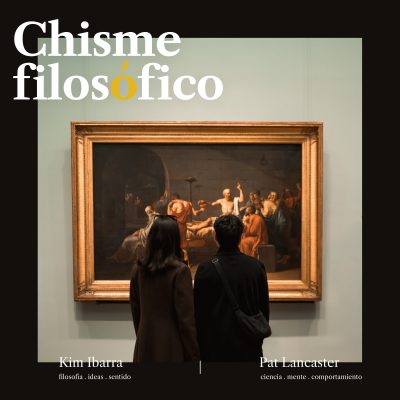
004 La neurociencia del arte: por qué una obra nos gusta y otra no
Show notes
¿Por qué nos gusta el arte? En este episodio cruzamos neurociencia, filosofía y psicoanálisis para entender qué pasa adentro de ti cuando creas una obra y cuando una te emociona.Pat lo cuenta desde la ciencia: qué le hace el arte al cerebro, por qué una pintura activa el mismo circuito de recompensa que la comida o el deseo (la neuroestética de Semir Zeki), qué dice Freud sobre la sublimación y el inconsciente, y por qué las pinturas rupestres más antiguas del mundo no están donde crees.Kim lo piensa desde la filosofía: qué es lo bello, por qué nos importa y qué significa que el arte sea, en el fondo, sacar afuera lo que traemos adentro.Un episodio sobre el arte, el cerebro, el gusto y el deseo, para entendernos un poco mejor a nosotras mismas.⸻Síguenos en instagram: @lafilosofiaenrosa y @causa.primera⸻Referencias:Libros académicos y de divulgación- Bozal, V. (2000). Historia de las ideas estéticas y de las teorías artísticas contemporáneas (Vol. 1). La Balsa de la Medusa.- Frankl, V. E. (2004). El hombre en busca de sentido (J. A. Villarreal, Trad.). Herder. (Obra original publicada en 1946).- Freud, S. (2012). Un recuerdo infantil de Leonardo da Vinci. Amorrortu. (Obra original publicada en 1910).- Freud, S. (2012). El Moisés de Miguel Ángel. Amorrortu. (Obra original publicada en 1914).- Banquete. (2015). En Diálogos (C. García Gual, Trad.). Gredos.- Shiner, L. (2004). La invención del arte: Una historia cultural. Paidós.➡️ Artículos científicos- Brumm, A., Oktaviana, A. A., Burhan, B., Hakim, B., Lebe, R., Zhao, J.-X., … Aubert, M. (2021). Oldest cave art found in Sulawesi. Science Advances, 7(3), eabd4648.- Chamberlain, R., McManus, I. C., Riley, H., Rankin, Q., Brunswick, N., & Kanai, R. (2014). Drawing on the right side of the brain: A voxel-based morphometry analysis of observational drawing. NeuroImage, 96, 167–173.- Cho, J., Kim, J., & Chatterjee, A. (2020). Neuroaesthetics and the beauty of art: A meta-analysis of functional neuroimaging studies. Cognitive, Affective, & Behavioral Neuroscience, 20(6), 1200–1214.- Ishizu, T., & Zeki, S. (2011). Toward a brain-based theory of beauty. PLoS ONE, 6(7), e21852.- Vessel, E. A., Starr, G. G., & Rubin, N. (2012). The brain on art: Intense aesthetic experience activates the default mode network. Frontiers in Human Neuroscience, 6, 66.- Vessel, E. A., Starr, G. G., & Rubin, N. (2013). Art reaches within: Aesthetic experience, the self and the default mode network. Frontiers in Neuroscience, 7, 258.Otras referencias- Aubert, M., Huntley, J., Oktaviana, A. A., Burhan, B., Hakim, B., Lebe, R., … Brumm, A. (2024). (Artículo sobre la redatación del arte rupestre de Sulawesi que sitúa escenas narrativas con más de 50 000 años).Crédito de imagenImagen de portada: La última cena (1495–1498), Leonardo da Vinci. Dominio público. Fuente: Wikimedia Commons.