

¿Por qué no escucha cuando le pido algo?
Show notes
“Le hablo y no me escucha” es una de las frases más repetidas en crianza.
En la mayoría de los casos —y especialmente cuando hay alta sensibilidad— no estamos frente a un problema de obediencia, sino frente a un tema de neurodesarrollo y procesamiento sensorial.
A lo largo del episodio explico por qué escuchar no es lo mismo que oír, qué funciones cerebrales están implicadas en la escucha y por qué muchas de ellas todavía no están maduras en la infancia. También hablo del desarrollo asincrónico, de la sensibilidad de procesamiento sensorial y de cómo un sistema nervioso que procesa en profundidad puede quedar absorbido, incluso frente a pedidos simples.
Si este episodio te ayudó a entender mejor lo que le pasa a tu hijo, podés profundizar este enfoque en mi libro Sensibles & Fuertes, donde desarrollo la crianza en clave de alta sensibilidad con ejemplos concretos y marco teórico claro.
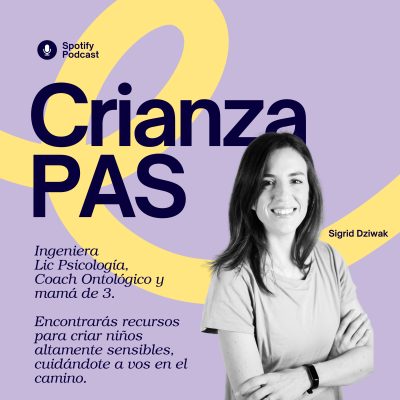
También acompaño a familias a través del Método Crianza PAS, un entrenamiento para aprender a liderar la crianza con estructura, conexión y conciencia, sin premios ni castigos.
Y si estás atravesando un momento puntual y necesitás sostén, el Ciclo Crianza PAS es un espacio de acompañamiento donde trabajamos estos temas paso a paso, de manera personalizada.
⭐⭐⭐⭐⭐ Si este episodio te sirvió, dejá tu rating y review: ayuda a que más familias conozcan la crianza en clave de alta sensibilidad.
Abrazo,
Sigi.
Marco teórico y fuentes mencionadas:
Aron, E. (2010). The Highly Sensitive Child.
Aron, E. & Aron, A. (1997). Sensory Processing Sensitivity.
Acevedo et al. (2014). Brain systems in highly sensitive persons – Social Cognitive and Affective Neuroscience.
Siegel, D. (2020). The Developing Mind.
Siegel, D. & Bryson, T. (2012). The Whole-Brain Child.
Porges, S. (2011). The Polyvagal Theory.
Cozolino, L. (2014). The Neuroscience of Human Relationships.
Greenspan, S. (1997). The Growth of the Mind.
Harvard Center on the Developing Child