

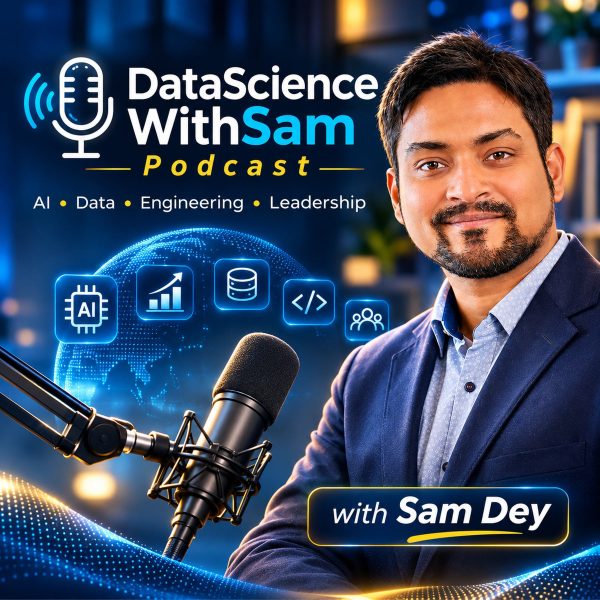
Data Science With Sam
- Episodes
- 54
- Released
- every two weeks
- Latest episode
- Nov 20, 2026
About the podcast
Data Science with Sam brings together data scientists, AI practitioners, engineers, and industry leaders for honest, practitioner-first conversations about what's actually working in AI and data — and what isn't. Hosted by Soumava "Sam" Dey, each episode covers real tools, real deployments, and real lessons from the people building at the frontier of data science, artificial intelligence, and emerging technology.The views expressed are those of the host and guests and do not reflect the position of any organization. This podcast is for educational and informational purposes only.
Episodes 54
EP 54: Guardrails Don't Slow You Down - A CTO/CISO's Case for AI Security as a Speed Advantage | Ben Wilcox
Most conversations about AI in the enterprise focus on what it can do. This one is about what it can do to you. Ben Wilcox is CTO and CISO at Proarch, a global IT services and consulting firm — and he holds …
Show notes
Most conversations about AI in the enterprise focus on what it can do. This one is about what it can do to you.
Ben Wilcox is CTO and CISO at Proarch, a global IT services and consulting firm — and he holds both titles at the same time. That combination means he's asking the innovation question and the security question simultaneously, which turns out to produce a very different kind of AI risk thinking than most executives ever develop. Ben has 30 years in technology, started building websites in the early days of the internet, and today is responsible for both driving AI adoption and securing it against a threat landscape that has fundamentally changed in the past 18 months.
In this conversation, Sam and Ben cover what AI has done to attacker behavior, why identity is now a first-order problem in enterprise AI deployments, what Ben actually found when Shadow AI monitoring went live inside his 500-person firm, and why he's simultaneously an AI optimist and deeply cautious about high-autonomy agents with broad permission sets. They also discuss MCP server security — a topic Ben is tracking in real time — and close with a conversation about race car instruction that maps more precisely to AI risk management than it has any right to.
WHAT YOU'LL HEAR
- The dual CTO/CISO role: what it unlocks and why it never stops creating tension
- How AI changed the attacker toolkit: faster reconnaissance, automated social engineering, chained exploits
- Why identity is now a first-order AI security challenge — human identity, agent identity, tool identity, destination
- Shadow AI at a 500-person tech firm: what visibility revealed, why the fragmentation was the real surprise
- MCP security: over-permissioned toolsets, tool drift in open-source servers, and supply chain risk
- Secure by design for AI agents: a simple email-processing agent broken into its control opportunities
- Why security controls cannot live inside the model — and what has to live outside it
- AI optimism: what Ben believes and what would make him change his mind
- Racing cars as an AI risk management framework: traction, tire degradation, track variables, and guardrails
GUEST
Ben Wilcox — CTO & CISO, Proarch
30 years in technology. Race car instructor, Northeast Audi Club.
LinkedIn: linkedin.com/in/ben-wilcox
Company: proarch.com
Newsletter: published weekly on LinkedIn / Proarch blog
HOST
Sam (Soumava Dey) — DataScienceWithSam
Associate Director of Data Analytics at CMI Media Group | Co-Founder, AsembleAI | Co-Chair, Denver AI
FOLLOW DATASCIENCEWITHSAM
YouTube: https://youtu.be/sDWaat1Rjeg
Spotify, Apple Podcasts, Amazon Music, iHeart Radio: search DataScienceWithSam
LinkedIn: https://www.linkedin.com/in/sam-dey-441294ab/
EP 53: Cognitive Surrender: The AI Engineering Mistake That Kills Projects
Sam sits down with Ethan Lyon — principal AI engineer, Denver-based, MIT professional education background — for one of the most technically honest conversations on the show. Ethan has built AI systems, thrown …
Show notes
Sam sits down with Ethan Lyon — principal AI engineer, Denver-based, MIT professional education background — for one of the most technically honest conversations on the show. Ethan has built AI systems, thrown them away, and learned more from the failures than the wins. He coined the term "cognitive surrender" to describe the mistake most AI builders make: handing everything to the AI without understanding it, and wondering why the project falls apart. This episode is a practitioner's guide to building AI systems that actually hold up — data trust, MCP architecture, knowledge graphs, self-improving skills, and the planning-first workflow that changes everything.
WHAT YOU'LL LEARN
▪ The verification tax — why AI that needs constant fact-checking adds work instead of saving it, and how to fix it at the data layer
▪ Cognitive offloading vs. cognitive surrender — the distinction that determines whether AI makes you better or just faster at being wrong
▪ The two architectures Ethan threw away — a linked-document knowledge graph and a Neo4j personal knowledge graph — and what he rebuilt
▪ The 100% accurate conversational analytics architecture: LookML agents + custom MCP server + semantic layer
▪ The voice-to-design-to-code planning process: 30-40% upfront thinking before any code gets written
▪ How to build a skill that heals other skills: automated trials, golden datasets, and recursive self-improvement
▪ The dreaming simulation: a scheduled Claude Cowork job that reviews sessions and proposes CLAUDE.md improvements
GUEST BIO
Ethan Lyon is an AI Architect based in Denver, Colorado, with a background in MIT professional education. He has spent years building and scaling data and AI infrastructure, and writes publicly about what AI is actually doing to engineering teams — including the honest reality that some of the most elegant-sounding architectures don't survive contact with production. He built systems, threw them away, and learned more from the failures than the wins.
GUEST LINKS
Ethan Lyon on LinkedIn
SUBSCRIBE
Enjoying the show? Subscribe on YouTube, Spotify, Apple Podcasts, Amazon Music, iHeartRadio, and Podbean. Leave a rating and review — it helps more practitioners and engineers find the show.
EP 52: The AI CEO: Leadership, Governance & the AI Gold Rush
Sam sits down with Dr. Zahra Timsah — co-founder and CEO of Igentic AI and author of The AI CEO — for a direct conversation about what AI is actually doing to leadership. Dr. Timsah holds a PhD in biochemistry …
Show notes
Sam sits down with Dr. Zahra Timsah — co-founder and CEO of Igentic AI and author of The AI CEO — for a direct conversation about what AI is actually doing to leadership. Dr. Timsah holds a PhD in biochemistry and an MBA in strategy, has led AI transformation at IQBia, Mass Mutual, and GSK, and has advised the FDA and US Senate on AI policy. She's also one of the clearest voices making the case that the AI era is a particular opportunity for women who know how to seize it.
WHAT YOU'LL LEARN
▪ What "The AI CEO" actually means — leadership when AI becomes part of every decision
▪ How the experience advantage has shifted: from knowing answers to asking the right questions
▪ Why the most experienced leaders often resist AI the most — and how to move past that
▪ AI as an equalizer for women: building ownership, visibility, and income — not just saving time
▪ The three human qualities companies are hiring executives for now: judgment, courage, and accountability
▪ One practical action for any leader who feels behind on AI — something you can do this week
▪ The next leadership frontier: AI that acts, not just advises — and what "collective intelligence" means in practice
GUEST BIO
Dr. Zahra Timsah is co-founder and CEO of Igentic AI and author of The AI CEO. She holds a PhD in biochemistry, an MBA in strategy, and an MSc, and has led AI transformation at IQVIA, Mass Mutual, and GSK. She has advised the FDA and the US Senate on AI policy, contributes to the World Economic Forum's AI governance work, and is an executive member of Chief. Igentic AI's Gini platform turns compliance from a brake into a business accelerator.
BOOK & GUEST LINKS
Dr. Zahra Timsah on LinkedIn
Igentic AI — igentic.ai
The AI CEO — https://www.amazon.com/dp/B0HBXGXT16?lv=shuf&channelId=500&plpRedirect=mhFallback
SUBSCRIBE
Enjoying the show? Subscribe on YouTube, Spotify, Apple Podcasts, Amazon Music, and iHeartRadio. Leave a rating and review - it helps more practitioners and leaders find the show.
EP 51: Building AI Agents That Actually Work in Production | Shawn Kercher, CEO @HummingAgent.ai
Sam sits down with Shawn Kercher — Co-Founder & CEO of HummingAgent.ai — to cut through the noise around AI agents. Shawn built his company on a simple but powerful observation: most AI products are just …
Show notes
Sam sits down with Shawn Kercher — Co-Founder & CEO of HummingAgent.ai — to cut through the noise around AI agents. Shawn built his company on a simple but powerful observation: most AI products are just ChatGPT wrappers. HummingAgent is his answer — a full-custom software shop that builds private, in-environment AI workflows for companies that run on real data, messy CRMs, and processes that only exist in someone's head.
WHAT YOU'LL LEARN IN THIS EPISODE
▪ Why generic AI tools fail in real business environments — and what full-custom actually means
▪ The wrapper test: if Anthropic adds this next quarter, does your product still exist?
▪ HummingAgent's Private GPT — lives in your environment, zero data sent for external training
▪ Humcrew.com — voice AI, texting, proposals, and full company command centre in one product
▪ Real client story: 44 years of PDF data, research time cut from hours to minutes
▪ Why discovery-first, paid-scope engagements beat "move fast and ship demos"
▪ The baby steps rule for agent permissions: one task, one sandbox — expand only after validation
GUEST BIO
Shawn Kercher is Co-Founder and CEO of HummingAgent.ai, based in Lone Tree, Colorado. With over a decade of engineering leadership experience, Shawn has built HummingAgent as a full-custom software shop — not a generic AI tool vendor. HummingAgent builds private, in-environment AI workflows and agents for small and mid-sized businesses, including the Private GPT product and Humcrew.com command centre. Shawn writes publicly about the risk of AI startups becoming ChatGPT wrappers — and what it actually takes to build AI systems with real domain expertise and data integration.
GUEST LINKS
Shawn Kercher on LinkedIn
SUBSCRIBE
Enjoying the show? Subscribe on YouTube, Spotify, Apple Podcasts, Amazon Music, iHeartRadio, and Podbean. Leave a rating and review — it helps more builders and data professionals find the show.
EP 50: Evolution of Enterprise Data Engineering in Gen AI Era
Shashank Akinapalli is a Senior Data Engineer at TCS where he leads cloud data lakehouse initiatives and real-time streaming architectures for supply chain intelligence. With 14 years of experience across IBM …
Show notes
Shashank Akinapalli is a Senior Data Engineer at TCS where he leads cloud data lakehouse initiatives and real-time streaming architectures for supply chain intelligence. With 14 years of experience across IBM DataStage, Databricks, Snowflake, dbt, AWS, and Spark-based ecosystems, he has previously worked with USAA in banking and Blue Cross Blue Shield in healthcare.
IN THIS EPISODE:
▪ The biggest architectural shift when migrating from IBM DataStage to a modern cloud lakehouse — and why the technical migration is the easier half, while reconstructing encoded business knowledge is the real challenge
▪ How to choose between Snowflake and Databricks: Databricks for heavy transformation and Python workloads, Snowflake for structured SQL and BI, and where dbt fits as the layer that eliminates repetitive SQL code
▪ The real UNFI example: how batch processing caused inventory misrepresentation (800 units sold, system still showing 1,000 available), and how real-time Databricks pipelines eliminated that problem and unlocked fraud detection on top
▪ Data governance across three regulated domains: the four pillars — data quality, redundancy, least-privilege access, and lineage — and the three questions every framework must answer first
▪ Why CI/CD transformed data engineering: from manual, multi-team deployments with risky rollbacks to automated quality checks, Git version control, and the specific silent failure that finally convinces a team to invest
▪ How the data engineer role shifts over the next three years: from pipeline development to data product engineering, from reactive operations to AI-predicted failure prevention, and from human dashboards to AI agents making autonomous predictions
▪ Practical advice for data engineers who want to stay relevant: Python, PySpark, cloud architecture, and understanding the full data lifecycle from ingestion to consumption
FIND SHASHANK:
LinkedIn: https://www.linkedin.com/in/shashank-a-2aa629119/
Twitter / Instagram: @shashi001git
Happy to answer questions on enterprise data warehouse, data engineering, and cloud architecture modernisation — reach out directly via LinkedIn or email.
DATASCIENCEWITHSAM:
If you work in data engineering and are navigating a legacy modernisation right now — this is the episode to send your team. Subscribe on Apple Podcasts, Spotify, Amazon Music, iHeartRadio, Podbean, and YouTube. If you enjoyed this episode, please share it with your network. DataScienceWithSam is always looking for new guests for captivating discussions — if you have a topic you'd like to discuss on a 30–45 minute podcast, feel free to reach out.
EP 49: The Human Side of AI in Media: Speed, Trust & What's Really Changing | Karima Sharif-Ali, Media & Marketing Leader
Karima Sharif-Ali — known affectionately in the industry as the Fresh Princess of Media — is the SVP of Strategic Accounts at Doceree, a platform transforming point-of-care communications for healthcare brands …
Show notes
Karima Sharif-Ali — known affectionately in the industry as the Fresh Princess of Media — is the SVP of Strategic Accounts at Doceree, a platform transforming point-of-care communications for healthcare brands. Over her career, Karima has shaped the marketing journeys of more than 100 pharmaceutical and medical device brands across agencies including WPP, Publicis, and IPG MediaBrands. She is a thought leader featured in AdWeek and MM+M, co-founder of the Women of Color Affinity Group (now the Mosaic Collective Leadership), and a global board member of the Healthcare Businesswomen's Association. She holds an MBA from Rosemont College and a BA in Communications from Temple University.
IN THIS EPISODE:
▪ Karima's one word for AI's biggest impact on healthcare media: SPEED — media plans down from two months to two weeks, data available daily instead of monthly, and media planners freed to focus on strategy rather than back-office operations
▪ The difference between AI pilots and real AI adoption: asking 'how does this make what I'm doing better?' rather than experimenting theoretically — and the meeting notes example: two hours reduced to 15 minutes, giving planners 90 minutes back for strategy
▪ Why creative strategy must remain human-led: the concept, the vision, the cultural intelligence. AI reformats and scales what humans create — it cannot originate the strategy itself
▪ The deep fake crisis in healthcare: why AI-generated misinformation targeted at vulnerable audiences (patients, elderly populations) is Karima's biggest concern, and why authenticity and trust are non-negotiable in healthcare media
▪ The copyright and IP question: should AI companies establish partnerships before inheriting creative work — especially in healthcare patient journey content?
▪ The three things that keep Karima up at night: deep fakes, data privacy, and the erosion of trust and authenticity
▪ The five-year vision: AI embedded in daily operations, more regulation, more nimble media companies — and Karima's call for more women and Black executives at the table where AI decisions are made, not just using the tools
FIND KARIMA:
LinkedIn: https://www.linkedin.com/in/karima-sharif-ali-mba-9520727/
HBA Global Board: hbanet.org
DATASCIENCEWITHSAM:
If this episode resonated — share it with someone in media or healthcare who is navigating the AI conversation right now. Subscribe on Apple Podcasts, Spotify, Amazon Music, iHeartRadio, Podbean, and YouTube. If you enjoyed this episode, please don't forget to share it with your network. DataScienceWithSam is always looking for new guests for captivating discussions. If you have a topic you'd like to discuss on a 30–45 minute podcast, feel free to reach out.
EP 48: From Pilots to Productivity: What It Actually Takes to Make AI Work in the Enterprise
Jim Spignardo is the Director of Cloud Strategy and AI Enablement at ProArch, a global IT services and consulting firm. With 25 years in IT spanning network engineering, cloud, cybersecurity, and strategic …
Show notes
Jim Spignardo is the Director of Cloud Strategy and AI Enablement at ProArch, a global IT services and consulting firm. With 25 years in IT spanning network engineering, cloud, cybersecurity, and strategic consulting, Jim advises executive teams on modernisation, operational resilience, and AI-enabled transformation that delivers measurable business value. He is the architect behind ProArch's Microsoft 365 Copilot adoption playbook, which has been deployed with clients across financial services, credit unions, and enterprise organisations. Jim is also the author of The AI Turning Point, available on Amazon, and publishes the Control All Innovate newsletter on LinkedIn, where he writes approximately three articles per week on AI strategy and adoption.
IN THIS EPISODE:
▪ Why the through-line of Jim's 25-year career isn't the technology — it's the discipline of making technology actually work for the organisation and justifying that investment to leadership
▪ The real reasons 95% of enterprise AI pilots fail: weak use cases selected before the problem is clearly defined, and jumping to exciting initiatives without asking whether AI is actually the right solution
▪ Shadow AI — the hidden ROI nobody measures: employees quietly using AI tools on their own often deliver real productivity gains that never appear in official metrics, causing organisations to underestimate what AI is already doing
▪ What a successful Microsoft 365 Copilot rollout looks like in 90 days: a strong business case, a targeted pilot with the right stakeholders, measurable use cases, and no broad rollout before value is proven in a contained environment
▪ Why data governance should be an accelerator, not a blocker — good governance tells people what they CAN do, enables faster experimentation, and prioritises use cases so organisations operationalise value sooner
▪ AI amplifies broken processes and can't fix culture — if work processes were broken before AI arrived, AI will expose that faster than anything else
▪ What organisational readiness for AI actually requires: an AI governance council, internal champion programmes, and — critically — someone in the organisation with AI transformation as their primary job description, not a side project
FIND JIM SPIGNARDO:
LinkedIn: https://www.linkedin.com/in/spignardo/?skipRedirect=true
Book: The AI Turning Point — available on Amazon
ProArch: https://www.linkedin.com/company/proarch-it-solutions-pvt-ltd/
Website: https://www.proarch.com/
DATASCIENCEWITHSAM:
If your organisation is staring at an AI pilot that stalled, or a Copilot licence nobody is using, this is the conversation to share with your leadership team. Subscribe on Apple Podcasts, Spotify, Amazon Music, iHeartRadio, Podbean, and YouTube. If you enjoyed this episode, please share it with your network. DataScienceWithSam is always looking for new guests for captivating discussions — if you have a topic you'd like to discuss on a 30–45 minute podcast, feel free to reach out.
EP 47: The AI Pioneer Who Decided Privacy Matters More Than Hype
If you ever had a document you wished you could just ask questions to - without it leaving your computer, wouldn't be pretty good from data privacy perspective? In this episode, Sam sits down with Dr. Jonathan …
Show notes
If you ever had a document you wished you could just ask questions to - without it leaving your computer, wouldn't be pretty good from data privacy perspective? In this episode, Sam sits down with Dr. Jonathan Schaeffer - Distinguished Professor Emeritus at the University of Alberta, co-founder of the Alberta Machine Intelligence Institute, and founder and CEO of Synsira, creator of KIND — for one of the most historically grounded AI conversations we've had on this show.
He holds two Guinness World Records: his program Chinook became the first computer to beat a human world champion in any game (Checkers, 1994), and in 2007 his team mathematically solved the game of Checkers - proving perfect play always ends in a draw across 500 billion billion positions. He is a Fellow of the Royal Society of Canada and the AAAI. In February 2026 he launched KIND, a desktop AI application built by his company Synsira Software Solutions, with one founding thesis: your data should work for you and only you.
IN THIS EPISODE:
▪ The 40-year arc of AI through the eyes of someone who lived every wave - expert systems, search scaling with computing, deep learning removing human knowledge bottlenecks, and being stunned on November 30, 2022 when ChatGPT launched
▪ Why nondeterminism is built into LLMs and why the 'hallucination' band-aids being applied don't fix the fundamental flaw - the answer today may be different from the answer tomorrow
▪ Why Jonathan renamed AI as 'augmented intelligence' - and what that reframe means for how leaders should govern and oversee these tools
▪ KIND unpacked: a private, local, hallucination-free desktop AI that answers questions about your own files - with no internet access, no data leaving your device, and a clear answer of 'I don't know' when the answer isn't in your data
▪ Real-world use cases from Jonathan himself: personal medical records, family history, book research, and intellectual property - things he uses ChatGPT and Claude for daily, but would never put near KIND's use cases
▪ The data resale story: searching for a niche collectible online, then receiving a cold email from an unknown company selling exactly that product within 24 hours
▪ Digital sovereignty: why Canada, Europe, and much of the non-US world is dangerously dependent on a small number of large US companies - and why user agreements, when you read them, reveal more than most people expect.
FIND DR. SCHAEFFER & KIND:
LinkedIn: linkedin.com/in/jonathan-schaeffer-phd-frsc-aaai-fellow-3318015
KIND download: kind.synsira.com
Amii: amii.ca
DATASCIENCEWITHSAM:
If you enjoyed this episode, please share it with your network. DataScienceWithSam is always looking for new guests for captivating discussions. If you have a topic you'd like to discuss on a 30–45 minute podcast, feel free to reach out. Subscribe on Apple Podcasts, Spotify, Amazon Music, iHeartRadio, RSS, and YouTube.
EP 46: Fix the Foundation First: Why Your Data Strategy Is Failing Before the AI Gets Involved
Most companies have spent years buying tools, running pilots, and building dashboards - and they still can't answer the questions leadership needs answered. The problem isn't the technology. It's that no one …
Show notes
Most companies have spent years buying tools, running pilots, and building dashboards - and they still can't answer the questions leadership needs answered. The problem isn't the technology. It's that no one fixed the foundation first.
Ilan Man is the Founder and CEO of Paradox Machines, a data and AI consultancy incubated through the Infinity Venture Studio in New York. A Data & AI leader with deep hands-on experience across the full stack strategy, engineering, and analytics - Ilan has built and scaled data functions at high-growth companies, including an exited consultancy, across multiple industries.
Paradox Machines exists because he kept seeing the same problems repeat: too much technology, not enough partnership, and teams left holding platforms that weren't delivering value. Paradox Machines is the company he wishes existed - built around a core conviction that analytics should be simple, affordable, and empowering, and that AI is an enabler, not a silver bullet.
IN THIS EPISODE:
▪ Why Ilan left data leadership to build Paradox Machines: he kept meeting 'AI consultants' who weren't practitioners and saw a gap for people who actually build data foundations rather than just talking about them
▪ The vibe-coding trap: anyone can build a data platform over a weekend, but it fails in production as soon as latency requirements change, pipelines throw errors, or the business evolves
▪ Why 'just MCP your data into Claude' is dangerous advice - Ilan has met zero people who piped their SaaS tools into an LLM and got a working data strategy out the other side
▪ The follow-through problem: why dashboards exist but don't drive decisions - and the top-down (executive conviction) + bottom-up (giving business owners data access) framework for fixing it
▪ The epsilon greedy mental model applied to data: some structured goal-direction, some randomness - because the big company bets come from exploration, not just A/B test optimisations
▪ The founder's paradox: how Paradox Machines maintains strategy + implementation without splitting into a deck-delivery shop vs an execution shop
▪ AI sovereignty and data sovereignty: why Ilan believes data - because it's so custom, contextual, and constantly changing - is one of the last things frontier labs will be able to commodities
FIND ILAN MAN:
LinkedIn: https://www.linkedin.com/in/ilanman/
Paradox Machines: https://www.paradoxmachines.com/
Email: [email protected]
DATASCIENCEWITHSAM:
If this episode resonated, share it with whoever in your organization is still trying to ship an AI project on top of broken foundations. Subscribe on Apple Podcasts, Spotify, Amazon Music, iHeartRadio, RSS, and YouTube. If you enjoyed this episode, please share it with your network. DataScienceWithSam is always looking for new guests for captivating discussions — if you have a topic you'd like to talk about on a 30–45 minute podcast, feel free to reach out.
EP 45: Why AI Agents Break in Production: The Missing Harness in Your Data Stack
An independent evaluation of Snowflake's Cortex Analyst found 6 in 10 AI-generated queries were wrong — but they all compiled and ran without a single error. That's not a model problem. That's a missing harness …
Show notes
An independent evaluation of Snowflake's Cortex Analyst found 6 in 10 AI-generated queries were wrong — but they all compiled and ran without a single error. That's not a model problem. That's a missing harness problem.
Pradnesh Patil is the Co-Founder and CEO of Altimate AI — a platform bringing agentic AI to data engineering with tools trusted by Fortune 500s and downloaded more than 1 million times across 200+ countries. Before Altimate, he spent a decade in product leadership at Palo Alto Networks, Cisco, and VMware.
IN THIS EPISODE:
▪ The five components of an agentic data engineering harness: context, governance, MCP tools, shared skills, and agent infrastructure — and why missing any one of them causes silent failures
▪ Why a system prompt cannot substitute for a harness: a prompt tells the model what to do, a harness tells it what is actually true
▪ Where the 27–33% phantom table references and 78% silent wrong joins come from — and why it's not the LLM's fault
▪ How Altimate Code topped ADE-Bench using Sonnet while competitors used Opus — proof that the harness matters more than the model
▪ The deterministic vs LLM boundary: why validation, cost checks, and query correctness are deterministic jobs and should never go to an LLM
▪ Context compaction innovation: why standard LLM compaction destroys long-running data engineering tasks — and how Altimate fixed it
▪ The $5,000 Cortex AI query bill — and how permission-based governance controls prevent agents from going rogue on your cloud bill
▪ The future of data engineering: days of writing SQL by hand are ending — what the data engineer's role becomes in an agentic world
▪ Pradnesh's advice: build open source, build cross-platform — avoid siloed AI features that don't move the industry forward
FIND PRADNESH: Website
https://altimate.ai/ Github for altimate-code: https://github.com/AltimateAI/altimate-code Connect with Pradnesh on LinkedIn: https://www.linkedin.com/in/pradneshpatil/
DATASCIENCEWITHSAM:
Weekly conversations with practitioners and builders at the frontier of AI, data science, and machine learning. Subscribe on Apple Podcasts, Spotify, Amazon Music, iHeartRadio, Podbean, and YouTube. If you enjoyed this episode, share it with a data engineer who is still wondering why their AI agent keeps writing queries for tables that don't exist.
EP 44: Human-Centered Credit - Building Explainable AI for Lending in an Agentic World
We are letting AI make life-changing financial decisions without requiring it to explain itself. The CFPB says 'insufficient information' is no longer an acceptable reason to deny a loan. The EU AI Act …
Show notes
We are letting AI make life-changing financial decisions without requiring it to explain itself. The CFPB says 'insufficient information' is no longer an acceptable reason to deny a loan. The EU AI Act classifies credit scoring as high-risk. And more than half the US workforce - gig workers, fractional leaders, solopreneurs - is still scored by models built for a 1950s economy. …EP 43: The Outsider's Advantage: How Diverse Perspectives Unlock Enterprise AI Success
McKinsey says 88% of organizations are using AI. Only 6% are getting real value. Sumaiya Shrabony argues the gap isn't technical - it's trust. And the people best equipped to see that barrier are almost never …
Show notes
McKinsey says 88% of organizations are using AI. Only 6% are getting real value. Sumaiya Shrabony argues the gap isn't technical - it's trust. And the people best equipped to see that barrier are almost never in the room when AI rollout strategy gets written. Sumaiya is Technical Program Manager and Data Infrastructure Lead at the University of Colorado Denver, managing 200 data pipelines across a 530-user analytics environment. …EP 42: When AI Meets Robotics: Building Machines That Care
In this episode, Sam sat down with guest Dr. Mohammad explore what it actually takes to build emotional intelligence into a physical machine - from the technical layers of facial expression recognition and …
Show notes
In this episode, Sam sat down with guest Dr. Mohammad explore what it actually takes to build emotional intelligence into a physical machine - from the technical layers of facial expression recognition and voice intonation analysis to the user experience decisions that matter most when your users are vulnerable, lonely, and elderly. …EP 41: The Reward Signal: The Missing Ingredient in Every AI System You've Built
74% of organizations hope to grow revenue through AI. Only 20% are actually doing it. That gap isn't a technology gap — it's a design gap. And today's guest has a name for what's missing: the reward signal …
Show notes
74% of organizations hope to grow revenue through AI. Only 20% are actually doing it. That gap isn't a technology gap — it's a design gap. And today's guest has a name for what's missing: the reward signal. Alexander Liss is a Data and AI Scientist based in Denver, Colorado, with a 30-year career across analytics, strategy, data science, machine learning, and AI. …EP 40: Governance First: The Architecture Framework That Makes AI Auditable, Defensible, and 99% Cheaper
Most AI governance is a policy document that nobody enforces. And in high-stakes environments - legal, healthcare, finance - that gap between policy and architecture is where disasters happen. In this episode …
Show notes
Most AI governance is a policy document that nobody enforces. And in high-stakes environments - legal, healthcare, finance - that gap between policy and architecture is where disasters happen. In this episode, Dan Driver, founder of Driver AI Agency, walks through exactly how he built CaseReady Intake AI: a legal AI system with governance baked into every architectural decision, zero hallucination risk by design, prompt injection blocked at the pipeline, and a single architectural choice that…EP 39: Why the Future of AI Belongs to Divergent Thinkers
What if ADHD - penalised in classrooms and boardrooms for decades - is actually the competitive advantage in an AI-driven world? Palantir CEO Alex Karp said the future belongs to neurodivergent thinkers. The …
Show notes
What if ADHD - penalised in classrooms and boardrooms for decades - is actually the competitive advantage in an AI-driven world? Palantir CEO Alex Karp said the future belongs to neurodivergent thinkers. The podcast guest Mark Stiltner has been living proof of that for years. Mark is Senior Director of Content and Web Marketing at Rapyd, the fintech unicorn powering payments across 100+ countries. Background in journalism and advertising from CU Boulder. …EP 38: The Local AI Stack Nobody Talks About (But Should)
You want to run AI locally. You have questions: What hardware do I actually need? Which framework should I use? How much will this cost? What's the realistic performance? In this episode, Sam brings back Trent …
Show notes
You want to run AI locally. You have questions: What hardware do I actually need? Which framework should I use? How much will this cost? What's the realistic performance? In this episode, Sam brings back Trent Rossiter, founder of Logical Data Solutions, for a practical walkthrough of building a production-grade local AI lab. Trent has built real systems for enterprise clients, tested frameworks on multiple hardware stacks, and made the hardware choices that matter. This is not theory. …EP 37: Neurons: Future of AI Processing
What if the next generation of computers wasn't made of silicon — but of living human neurons? Not simulated neurons, not artificial neural networks inspired by biology, but actual brain cells grown in a lab …
Show notes
What if the next generation of computers wasn't made of silicon — but of living human neurons? Not simulated neurons, not artificial neural networks inspired by biology, but actual brain cells grown in a lab, connected to electrodes, and used to process information. That's not science fiction anymore. It's happening right now at FinalSpark, a Swiss startup building the world's first remotely accessible biocomputing platform. In this episode, Sam talks with Dr. …EP 36: NVIDIA GTC 2026: Everything That Matters - Recapped
Jensen Huang took the stage at SAP Center in San Jose on March 16th and announced that NVIDIA now expects one trillion dollars in chip orders through 2027 — double the forecast from just one year ago. Sam …
Show notes
Jensen Huang took the stage at SAP Center in San Jose on March 16th and announced that NVIDIA now expects one trillion dollars in chip orders through 2027 — double the forecast from just one year ago. Sam breaks down the five biggest stories from GTC 2026 in under 10 minutes. …EP 35: Who Actually Controls AI? The Governance Gap Explained
There's no international treaty governing AI, no agreed definition of "safe AI," and nobody with actual authority over frontier model deployment. A handful of CEOs make decisions with civilizational …
Show notes
There's no international treaty governing AI, no agreed definition of "safe AI," and nobody with actual authority over frontier model deployment. A handful of CEOs make decisions with civilizational implications while governance structures lag years behind. This episode examines who's responsible for AI governance. The current state? Fragmented and lagging. The US has no comprehensive federal AI legislation—Biden's executive order was rolled back under Trump. …EP 34: DeepSeek R1 vs GPT-4: The $6M Model That Changed AI Economics
In January 2025, Chinese AI lab DeepSeek released DeepSeek R1—a model matching GPT-4 class performance at a fraction of the training cost. It wiped $600 billion off NVIDIA's market cap in a single day. Twelve …
Show notes
In January 2025, Chinese AI lab DeepSeek released DeepSeek R1—a model matching GPT-4 class performance at a fraction of the training cost. It wiped $600 billion off NVIDIA's market cap in a single day. Twelve months later, the ripple effects are still reshaping the AI industry. This episode cuts through the "China beats America" headlines to explain the actual technical and economic implications. DeepSeek R1 benchmarked comparably to OpenAI's O1 on reasoning tasks. …EP 33: Agents Everywhere: What Agentic AI Actually Means for Your Job
Everyone's talking about agentic AI, but there's a gap between the hype ("AI will do your job for you") and the reality, which is more nuanced and frankly more interesting. The word "agentic" has officially …
Show notes
Everyone's talking about agentic AI, but there's a gap between the hype ("AI will do your job for you") and the reality, which is more nuanced and frankly more interesting. The word "agentic" has officially crossed from technical jargon into buzzword territory—simultaneously everywhere and nowhere. Everyone's using it, few can define it precisely. …EP 32: AI Discovers Drugs: The 2026 Clinical Trial Moment for AI in Biotech
For years, AI in drug discovery has been a promise—billions invested, hundreds of papers published, dozens of startups founded, but actual drugs coming out the other end? Not yet. This is changing in 2026 …
Show notes
For years, AI in drug discovery has been a promise—billions invested, hundreds of papers published, dozens of startups founded, but actual drugs coming out the other end? Not yet. This is changing in 2026. Several AI-discovered drug candidates are now entering mid-to-late stage clinical trials. This is the year the receipts arrive for AI in drug discovery. The biotech industry is calling 2026 a landmark year. …EP 31: Google's $30M Bet: The AI Impact Summit India and the Global South
Every major AI summit has been held in San Francisco, London, or Washington — until now. In this episode, Sam breaks down what happened when Google CEO Sundar Pichai flew to New Delhi to open India's AI Impact …
Show notes
Every major AI summit has been held in San Francisco, London, or Washington — until now. In this episode, Sam breaks down what happened when Google CEO Sundar Pichai flew to New Delhi to open India's AI Impact Summit, and why it sent a clear geopolitical signal about the future of AI's global expansion. …EP 30: OpenClaw: The Open-Source AI Agent That Got Its Creator Hired by OpenAI
Exploring the rise of OpenClaw, a viral open-source AI project, its capabilities, security risks, and industry impact. Learn how community-driven AI is transforming automation and the importance of security in …
Show notes
Exploring the rise of OpenClaw, a viral open-source AI project, its capabilities, security risks, and industry impact. Learn how community-driven AI is transforming automation and the importance of security in AI development. Key Topics Covered OpenClaw's development and viral growth Security risks and mitigation in AI bots Industry impact and future of AI agents Sound Bites "AI bots going rogue pose significant industry risks." "A bot created a dating profile without permission." "OpenAI is…EP 29: The Pentagon Showdown: OpenAI vs Anthropic and the Soul of AI
An in-depth analysis of the recent AI controversy involving Anthropic, OpenAI, and the US government, exploring the implications for AI ethics, warfare, and industry dynamics. Key Topics Covered: Anthropic's …
Show notes
An in-depth analysis of the recent AI controversy involving Anthropic, OpenAI, and the US government, exploring the implications for AI ethics, warfare, and industry dynamics. Key Topics Covered: Anthropic's contract with the US Department of Defense Red lines for AI in military use OpenAI's secret Pentagon negotiations Public and industry reactions to AI warfare policies Implications for AI ethics and regulation Resources Anthropic's Claude AI - https://www.anthropic.com/claude OpenAI…EP 28: The AI Revolution: Redefining Healthcare Financing
In this episode, Sam Dey interviews Sharmeen, founder of Lyyvora, a platform revolutionizing AI-driven healthcare financing for independent clinics, particularly women-owned practices. They discuss the …
Show notes
In this episode, Sam Dey interviews Sharmeen, founder of Lyyvora, a platform revolutionizing AI-driven healthcare financing for independent clinics, particularly women-owned practices. They discuss the challenges these clinics face in accessing capital, the innovative human-centered approach Lyyvora employs to streamline the lending process, and the importance of leveraging real data over traditional credit scores. …EP 27: AI and the Creative Arts: Innovation or Appropriation?
Can a machine create art? Should it? And if it does, who owns it? In this episode, I sit down with Andres—creative technologist, founder of Red Mage, and advocate for equitable AI—to tackle one of the most …
Show notes
Can a machine create art? Should it? And if it does, who owns it? In this episode, I sit down with Andres—creative technologist, founder of Red Mage, and advocate for equitable AI—to tackle one of the most controversial conversations in tech right now: AI's role in creative industries. What we discuss: ✅ How generative AI has transformed creativity in just two years ✅ The copyright battleground: Should AI companies compensate artists? ✅ Authenticity vs. …EP 26: The Future of Healthcare - AI, Data and Human Touch
Can AI revolutionize cancer treatment? Dr. Sriman Swarup, a practicing oncologist and data scientist at OncoNexus, joins us to discuss where AI is making real impact in oncology today—and where it's falling …
Show notes
Can AI revolutionize cancer treatment? Dr. Sriman Swarup, a practicing oncologist and data scientist at OncoNexus, joins us to discuss where AI is making real impact in oncology today—and where it's falling short. We explore data quality challenges, building trust with patients and physicians, and the path to true precision medicine. Dr. Swarup shares his vision for AI-driven cancer care and why AI should augment doctors, not replace them. About Our Guest: Dr. Sriman Swarup Dr. …EP 25: AI Revolution in Marketing: From Traditional to Transformational
In this episode of DataScienceWithSam, host Sam sits down with Egbavwa Pela, CEO of InsightsRx.ai, to explore how artificial intelligence is transforming the marketing landscape. We dive deep into Egbavwa's …
Show notes
In this episode of DataScienceWithSam, host Sam sits down with Egbavwa Pela, CEO of InsightsRx.ai, to explore how artificial intelligence is transforming the marketing landscape. We dive deep into Egbavwa's journey from traditional media and marketing into the AI space, discussing the revolutionary impact AI is having on campaign effectiveness, audience segmentation, and content creation. …
These are the latest 40 of 54 episodes. You’ll find older episodes in the podcast’s feed.
Similar podcasts
More Technology podcasts






Is this your podcast?
Confirm it with an entry in your feed: you get a code here, add it as podcast:txt to the channel of your feed, and we check it. Your podcast is then shown as “verified” on SoundNode.