

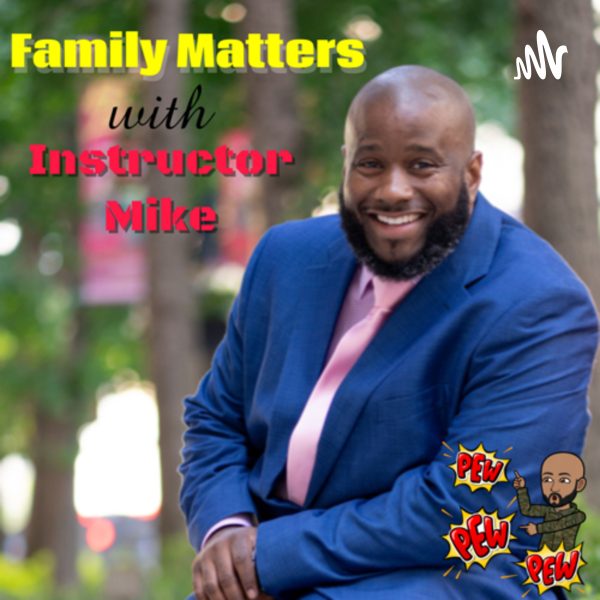
Family Matters with Instructor Mike
- Episodes
- 105
- Released
- daily
- Latest episode
- Oct 16, 2026
About the podcast
Family is the base of everything in your life. Just stop for a minute. Say the word, family. It feels warm doesn’t it? Do you have family or do you have relatives? How is your relationship with your children? Parents? It is very important to do the work of family. Family matters more than you know. To that end, let’s talk. Then, we are going to provide tools for you to use and invite special guests to discuss your issues. My issues. Our issues. As the African proverb says, “A child not embraced by the village will burn it to feel its warmth.” You matter. Your voice matters. Let’s get to work!
Episodes 105
THE CO-PARENTING TRAP: WHEN TO WALK AWAY FROM THE GAME
What happens when your desire to be a good parent becomes the very thing someone uses to control you?Not every co-parenting conflict is loud, aggressive, or obvious. Sometimes, the most exhausting battles …
Show notes
What happens when your desire to be a good parent becomes the very thing someone uses to control you?
Not every co-parenting conflict is loud, aggressive, or obvious. Sometimes, the most exhausting battles happen through polite text messages, constantly changing expectations, canceled arrangements, and subtle forms of gatekeeping that leave one parent endlessly trying to prove their worth.
In this thought-provoking episode of Family Matters, Instructor Mike examines Passive-Aggressive Boundary Control—a pattern in which access, cooperation, and parenting expectations become sources of ongoing conflict and emotional exhaustion.
Drawing from developmental psychology, Maria Montessori’s concept of the Prepared Environment, and the principles of emotional self-governance, Instructor Mike introduces Operational Concession: the deliberate decision to disengage from destructive conflict without abandoning parental responsibility.
In this episode, we explore:
- How subtle gatekeeping and shifting expectations can undermine healthy co-parenting.
- Why some parents become trapped in an endless cycle of proving themselves.
- How hostile, unpredictable environments affect adult functioning and children’s development.
- What Montessori’s Prepared Environment teaches us about healthy family systems.
- The difference between disengaging from conflict and disengaging from your child.
- Why protecting your emotional stability may be more productive than winning another argument.
The central message: You cannot build a healthy parenting relationship through conflict alone. Sometimes, the most responsible decision is to change how you participate, establish boundaries, and preserve your ability to remain a stable, available parent.
Walking away from the game doesn’t have to mean walking away from your child.
Family Matters with Instructor Mike challenges conventional thinking about parenting, relationships, and personal development through education, developmental science, and practical wisdom.
Because family matters—but so does the environment in which family relationships develop.
🎙️ Listen. Reflect. Learn.
This is Instructor Mike, and you’ve been trained.
#FamilyMatters #InstructorMike #CoParenting #HighConflictParenting #ParentingEducation #HealthyBoundaries #MontessoriEducation #ChildDevelopment #EmotionalIntelligence #ResponsibleFatherhood #FamilyDynamics #PersonalDevelopment
Back Office Trauma: The Part of Motherhood We Don’t Put on Facebook
Motherhood is celebrated publicly—but what happens in the back office?Behind the pregnancy announcements, baby showers, family photos, likes, hearts, and “you got this, Mama” comments can exist a very different …
Show notes
Motherhood is celebrated publicly—but what happens in the back office?
Behind the pregnancy announcements, baby showers, family photos, likes, hearts, and “you got this, Mama” comments can exist a very different reality: exhaustion, isolation, financial pressure, crying babies, sleepless nights, emotional overload, and the realization that the village you thought you had may not actually be available when you need it.
In this episode of Family Matters with Instructor Mike, Instructor Mike examines what he calls Back Office Trauma—the difficult and often unspoken experiences of parenting that exist behind the socially acceptable presentation of motherhood.
Inspired by candid responses from mothers who were asked, “When you really needed support, how many people were actually there?”, this episode explores three important distinctions:
The Social Village — the people who love you, celebrate you, and say they will be there.
The Functional Village — the people who actually show up when the baby is sick, childcare falls through, money gets tight, or you desperately need relief.
The Qualified Village — the people who not only show up, but possess the knowledge, emotional regulation, reliability, and developmental understanding necessary to safely help care for a child.
Grounded in developmental science, parental stress and burnout research, Bronfenbrenner’s ecological perspective, Montessori’s concept of the prepared adult, and insights from Promises I Can Keep, this conversation isn’t about criticizing motherhood or discouraging women from having children.
It’s about informed parenthood.
Because celebration is not infrastructure.
Love is not automatically competence.
Presence is not necessarily preparedness.
And 500 people celebrating your pregnancy online may become only one person answering the phone at 2:00 in the morning.
Before you need your village, find out who is actually in it.
Family Matters with Instructor Mike
This is Instructor Mike—and you’ve been trained.
Run When You Smell Gas: Why Some Conversations Aren’t Yours to Finish
Some conversations don’t explode because of you —they explode because of the vapor other people were carrying long before you arrived.In this groundbreaking episode, Instructor Mike breaks down the …
Show notes
Some conversations don’t explode because of you —
they explode because of the vapor other people were carrying long before you arrived.
In this groundbreaking episode, Instructor Mike breaks down the Knowledge–Flame / Vapor–Blame Pattern, a powerful way to understand why certain people become defensive, reactive, or combative the moment clarity enters the room. Using a simple but unforgettable metaphor — a torch entering a room filled with gasoline fumes — you’ll learn how to recognize when a conversation is safe to have… and when it’s time to get out for the protection of both people involved.
You’ll discover:
🔥 Why some people “blow up” when faced with truth, guidance, or education
🔥 The hidden childhood conditioning that trains adults to defend instead of reflect
🔥 APEIA — the five labels people use when they’re full of emotional vapor
🔥 How to stop taking reactions personally and start taking them as information
🔥 Why distance is sometimes the most compassionate response
🔥 How to tell the difference between a candle ready to receive the flame… and a gas can waiting to ignite
This episode is about wisdom, boundaries, and emotional safety — for educators, parents, mentors, leaders, and anyone who has ever tried to help someone who wasn’t ready to receive it.
If you’ve ever felt drained after trying to explain yourself…
If you’ve ever walked away from a conversation wondering, “What did I do wrong?”…
If you want to protect your peace without abandoning your purpose…
This episode will change how you see people — and how you see yourself.
Family Matters with Instructor Mike
Teach the fix before the feel. Illuminate without burning yourself out.
Flow: How Children Actually Learn — And Why Your Tone Matters More Than You Think
What if the problem isn’t your child’s attitude… but the environment they’re learning in?In this episode of Family Matters with Instructor Mike, we explore the state of flow — a powerful concept from …
Show notes
What if the problem isn’t your child’s attitude… but the environment they’re learning in?
In this episode of Family Matters with Instructor Mike, we explore the state of flow — a powerful concept from developmental psychology that explains why children learn best when they feel safe, understood, and appropriately challenged.
You’ll learn why:
• Compliance is not the same as learning
• Fear shuts down the brain’s ability to grow
• Tone, timing, and clarity matter more than volume
• Too many “no’s” create resistance instead of responsibility
• Children need agency to develop self-regulation
• Punishment teaches what not to do, but rarely teaches what to do
• Flow happens when challenge and skill are in balance
Drawing from Erik Erikson, Vygotsky, Csikszentmihalyi, Adlerian psychology, and real-life parenting examples, Instructor Mike breaks down how everyday moments — homework, cleanup, screen time, tone of voice — either support or block a child’s ability to learn.
This episode also introduces practical tools like:
• Conditional yes (teaching responsibility without power struggles)
• How to replace constant correction with clear guidance
• Why children need time to process before responding
• How parents can “re-parent” themselves to create calmer homes
• Why structure and warmth must exist together
This isn’t about being permissive.
It’s not about being perfect.
And it’s definitely not about blaming parents.
It’s about understanding how learning actually works — and how to create the conditions where children can thrive.
🎧 If you’ve ever wondered why your child shuts down, resists, or seems anxious… this episode will change how you see parenting forever.
This is Instructor Mike — and you’ve been trained.
Proximity Is Power: Teaching Kids How Temptation Works Before It Works Them
Why do kids—and even adults—struggle to resist temptation, even when they “know better”? Because knowledge isn’t enough. In this episode, Instructor Mike breaks down the physics of temptation using real-life …
Show notes
Why do kids—and even adults—struggle to resist temptation, even when they “know better”? Because knowledge isn’t enough. In this episode, Instructor Mike breaks down the physics of temptation using real-life metaphors like magnets, rubber bands, and even nuclear bombs. You’ll learn why proximity builds pressure, how impulse control is shaped by setup, and why walking away early is a sign of strength, not weakness.
From toddlers eyeing candy to preteens navigating peer pressure, you’ll get developmentally appropriate tools to teach self-discipline, emotional regulation, and real-world problem-solving.
Key Takeaways:
• How proximity turns potential energy into action
• Why verbal rules aren’t enough without environment training
• Rubber band and role-play strategies for young learners
• Conversation tools for older kids to build internal boundaries
• The truth about temptation: you don’t win it in the moment—you win it in the setup
Tune in and train your kids—before temptation does.
Foundations First: The ECE Mini-Course | Episode 11 - Montessori—Independence by Design
In this episode, Instructor Mike explores the Montessori method—one of the most respected, yet misunderstood approaches in early childhood education. Learn the science behind self-correcting materials …
Show notes
In this episode, Instructor Mike explores the Montessori method—one of the most respected, yet misunderstood approaches in early childhood education. Learn the science behind self-correcting materials, uninterrupted work cycles, and the power of freedom within structure. Discover how Montessori builds lifelong focus, independence, and confidence—without relying on gold stars or constant adult correction. Whether you’re a parent, teacher, or program director, this episode shows why Montessori isn’t a trend—it’s a system of training children to think and lead.
The Hidden Curriculum of Marriage: What They Don’t Teach Before “I Do”
You were taught how to fall in love. You were taught how to plan a wedding.But no one taught you the hidden curriculum of marriage—until now.In this powerful episode, Instructor Mike exposes the unspoken rules …
Show notes
You were taught how to fall in love. You were taught how to plan a wedding.
But no one taught you the hidden curriculum of marriage—until now.
In this powerful episode, Instructor Mike exposes the unspoken rules, legal traps, and emotional liabilities that come with marriage contracts in America. From family court’s bias toward emotion over evidence, to how pillow talk becomes courtroom testimony, this episode breaks down the difference between romantic hope and legal reality.
Whether you’re preparing for marriage, parenting future adults, or recovering from divorce, this is the lesson you wish you had before saying “I do.”
🔍 Topics Covered:
• What it means that family court is a court of equity, not law
• How spousal communication can be used against you
• Case law like In re Charous, Ohio v. Reiner, and Stephens v. Stephens
• Developmentally appropriate ways to teach children about discretion, emotional safety, and trust
• Why journaling, AI tools, and inner processing are safer than oversharing
• Strategic silence vs. emotional transparency
💡 Remember: Love is emotional, but divorce is procedural.
Let’s teach what the culture won’t.
Foundations First: The ECE Mini-Course | Episode 10 — Types of Childcare Centers: Reggio Emilia
What if the classroom was the teacher? In this episode, Instructor Mike dives into the Reggio Emilia philosophy—a powerful, child-centered approach born in postwar Italy. Learn how Reggio uses project-based …
Show notes
What if the classroom was the teacher? In this episode, Instructor Mike dives into the Reggio Emilia philosophy—a powerful, child-centered approach born in postwar Italy. Learn how Reggio uses project-based learning, beautiful environments, and the “hundred languages of children” to foster thinking, creativity, and real developmental growth. Whether you’re an educator, director, or a parent choosing the right fit, this episode reveals why Reggio is more than a buzzword—it’s a blueprint for lifelong learning.
The Rise of the Diagnostic Industry Around Black Children
What if the “help” your child is getting is actually fueling a billion-dollar industry?In this eye-opening episode, Instructor Mike breaks down the historical pipeline that turned Black children—especially …
Show notes
What if the “help” your child is getting is actually fueling a billion-dollar industry?
In this eye-opening episode, Instructor Mike breaks down the historical pipeline that turned Black children—especially boys—into currency for a sprawling diagnostic system. From the original intent of special education to today’s explosion of behavioral labels, pharmaceuticals, education tech, and consulting firms, we trace the shift from disability support to behavioral profit.
Learn how federal legislation like IDEA unintentionally incentivized misdiagnosis, how school budgets now depend on special ed classifications, and why Black parents must learn the system before the system learns their child.
🔎 Topics include:
• The 1975 legal spark that opened the floodgates
• How ADHD became the gateway diagnosis
• Why school “support” often equals surveillance
• The billion-dollar business of behavior
• What happens when Black children are no longer misread?
This episode isn’t just informative—it’s a warning. Because once your child is on the diagnostic train… it’s hard to get them off.
Foundations First: The ECE Mini-Course | Episode 9 — Types of Childcare Centers: What’s the Difference and Why It Matters
Not all childcare is created equal. In this episode, Instructor Mike breaks down the different types of childcare centers—from daycares and ECE centers to Montessori, Reggio-inspired programs, and family child …
Show notes
Not all childcare is created equal. In this episode, Instructor Mike breaks down the different types of childcare centers—from daycares and ECE centers to Montessori, Reggio-inspired programs, and family child care homes. You’ll learn how to evaluate what’s best for your child’s development, not just your schedule. Whether you’re a parent, educator, or future center director, this episode offers the clarity you need to make informed, professional decisions about early care and education.
The Forgotten Domains: Why Your Child’s Development Was Rewritten Without Your Consent
In this powerful episode of Family Matters with Instructor Mike, we dig deep into the forgotten history of child development and expose how today’s educational system quietly rewrote your child’s learning …
Show notes
In this powerful episode of Family Matters with Instructor Mike, we dig deep into the forgotten history of child development and expose how today’s educational system quietly rewrote your child’s learning path—without your input, your consent, or your understanding.
Instructor Mike breaks down the original three domains of development—physical, cognitive, and language—and explains how the quiet addition of social-emotional and adaptive/self-help domains created a gateway to an overgrown diagnostic industry. You’ll learn how funding laws, educational policy, and well-meaning professionals helped turn observation into surveillance, and how children—especially Black children—became the currency of a billion-dollar system built on labeling instead of liberating.
This episode answers:
• What were the original domains of child development—and why were they enough?
• Why did new domains get added, and what laws made that happen?
• How did early childhood education shift from teaching to tracking?
• Why does today’s emotional curriculum hurt more than it helps?
• What can you do as a parent, teacher, or leader to shift the system from inside or outside?
If you’ve ever felt like today’s early childhood approach is more about documentation than development—this episode will confirm your instincts and give you a blueprint to resist with purpose.
Foundations First: The ECE Mini-Course | Episode 8 — The Qualified Adult: What Kids Deserve
In this critical episode of Foundations First, Instructor Mike delivers a bold and necessary message: love is not enough. Children deserve qualified adults—not just well-meaning ones. From emotional …
Show notes
In this critical episode of Foundations First, Instructor Mike delivers a bold and necessary message: love is not enough. Children deserve qualified adults—not just well-meaning ones. From emotional intelligence to developmental science, this episode outlines the training, mindset, and self-awareness that every adult needs to responsibly lead, guide, and grow with young children.
You’ll learn:
• Why good intentions can still produce developmental harm
• What real ECE certification should include (beyond checkbox training)
• How to hold yourself—and others—to a standard that reflects what children actually need
• Where to find training that strengthens your skills, not just your résumé
Drawing on adult learning theory and emotional intelligence frameworks, this episode challenges the idea that being a parent or caregiver automatically qualifies someone to lead children well. It’s not about perfection—it’s about preparation.
Because the most dangerous lie we tell ourselves is
“I’m doing fine because I care.”
But in early childhood, care without competence is still a risk.
I’m Not Sorry for What I Wasn’t Taught—But I Am Learning: Breaking the Guilt, Performance, and Inclusion Chains
In this episode of Family Matters with Instructor Mike, we confront the pressure to apologize for things we were never taught—and unpack the cultural chains that keep us stuck in guilt, performance, and fake …
Show notes
In this episode of Family Matters with Instructor Mike, we confront the pressure to apologize for things we were never taught—and unpack the cultural chains that keep us stuck in guilt, performance, and fake inclusion. From performative healing to emotionally manipulative group dynamics, Instructor Mike dives into the developmental science behind why people say “sorry” without skills, and how to stop apologizing unless you have a real plan going forward.
Learn how to:
• Identify when guilt is misplaced and accountability is misdirected
• Replace hollow apologies with real, learned strategies
• Handle moments where you know better but don’t yet have the tools to do better
• Respond to culture, family, or community trying to guilt you back into stagnation
Featuring real-life apology scripts and grounded in psychology, education, and lived experience, this episode is a call to action for those who are learning out loud—and refusing to perform healing they haven’t been trained to execute.
Because family matters. Growth matters. And being under-trained isn’t your fault—but staying that way is your choice.
What I Feel vs. How I Feel: Why Teaching Emotion Before Sensation Sets Kids Up to Be Misunderstood
In this episode, Instructor Mike unpacks one of the most overlooked—and misunderstood—lessons in child development: the critical difference between what a child feels and how they feel about it.With only 1% of …
Show notes
In this episode, Instructor Mike unpacks one of the most overlooked—and misunderstood—lessons in child development: the critical difference between what a child feels and how they feel about it.
With only 1% of the English language dedicated to emotion words, why do we front-load that 1% into young children’s vocabulary while ignoring the 99% that teaches function, sensation, and reason?
This episode explores how emotional labeling without sensory training leads to misdiagnosis, performative distress, and a generation of children unable to describe what’s actually happening in their bodies or minds.
Learn how to teach kids to describe before they define, to observe before they interpret, and why phrases like “I feel disrespected” might actually be learned miscommunication—not truth.
Whether you’re a parent, educator, or someone healing your own emotional miseducation, this episode will give you practical tools to shift from emotional reaction to developmental precision.
🔧 Featuring sensory strategies, Vygotsky insights, and a cultural critique of emotional programming in early education.
Service Switching: Part 5 – When the Customer Is You: Advocacy Without Entitlement
What happens when your child isn’t just a student, a patient, or a passerby—but the customer?In Part 5 of the Service Switching series, Instructor Mike dives into the often-overlooked skill of self-advocacy—the …
Show notes
What happens when your child isn’t just a student, a patient, or a passerby—but the customer?
In Part 5 of the Service Switching series, Instructor Mike dives into the often-overlooked skill of self-advocacy—the power to speak up, clarify needs, and challenge unfair treatment without collapsing into entitlement or rage.
This episode teaches you:
• The developmental science behind self-advocacy vs. entitlement
• How to coach your child to name problems without emotional outbursts
• The role of tone, timing, and calm in getting what you need from adults in power
• How to practice scripts that work in schools, clinics, and even police encounters
Whether your child is ordering food, questioning a grade, or needing help in a crisis—this episode equips families to raise communicators, not complainers. Because in a system-driven world, knowing how to ask matters just as much as what you ask for.
“You’re not raising a customer. You’re raising a self-advocate.”
The Diagnostic Train: How Parents—Without Knowing—Put Their Children on the Tracks of a Profit System
What if your child’s diagnosis isn’t just about behavior—but about business?In this powerful episode, Instructor Mike unpacks the billion-dollar pipeline that thrives on pathologizing Black and low-income …
Show notes
What if your child’s diagnosis isn’t just about behavior—but about business?
In this powerful episode, Instructor Mike unpacks the billion-dollar pipeline that thrives on pathologizing Black and low-income children through labels like ADHD, ODD, and IEPs. From pediatricians to school psychologists, from behavioral techs to pharmaceutical contracts—this system depends on your misunderstanding of child development.
We break down:
• Why certain children get labeled faster—and what those labels lead to
• How schools become profit centers through diagnostic coding
• The role of well-meaning but under-trained parents and educators
• Chicago Public Schools’ layoffs as proof the profit model is cracking
• And how YOU, the parent, are often unknowingly flipping the switch
This episode isn’t just an exposé. It’s a roadmap. Because once you understand the system, you don’t have to comply with it.
🎧 Tune in and take your child off the diagnostic train—before it reaches the last stop.
Foundations First: The ECE Mini-Course | Episode 7 — Family as First Teachers
In Episode 7 of Foundations First, Instructor Mike reminds us of a simple truth with deep implications: Families are not guests in a child’s learning journey—they’re the foundation of it.Before …
Show notes
In Episode 7 of Foundations First, Instructor Mike reminds us of a simple truth with deep implications: Families are not guests in a child’s learning journey—they’re the foundation of it.
Before curriculum.
Before standards.
There was home.
There was rhythm.
There was family.
This episode explores how to honor that foundation by:
• Empowering parents and caregivers without shame
• Building healthy, respectful educator-parent partnerships
• Using shared language that makes learning portable across environments
• Applying Epstein’s Family Involvement Framework to practical, everyday communication
You’ll learn how to stop blaming, start bridging, and support children by aligning—not competing—with the values they bring from home.
Because the first classroom was a living room.
And the first teacher was someone who loved them.
Before You Demand Accountability: Why Skill Comes First (Not Shame)
In this episode of Family Matters with Instructor Mike, we challenge one of the most widespread yet misunderstood parenting habits: demanding accountability from children who were never taught the skills to …
Show notes
In this episode of Family Matters with Instructor Mike, we challenge one of the most widespread yet misunderstood parenting habits: demanding accountability from children who were never taught the skills to succeed in the first place.
Using developmental science, real-life classroom strategies, and powerful legal insights—including the U.S. Supreme Court case Ohio v. Reiner (2001)—Instructor Mike breaks down why forced confessions are not signs of maturity, but symptoms of under-training and psychological compliance.
You’ll learn:
• Why admissions like “I broke the egg” don’t mean what you think they do
• How to teach accountability through skill—not shame
• How premature guilt trains kids to become unintentional witnesses against themselves
• Why observation, problem-solving, and reflection should always come before blame
• How to raise children who know how to fix the problem—without fearing the truth
This episode is for every parent, educator, and community leader who wants to build kids who think, not just confess.
Foundations First: The ECE Mini-Course | Episode 6 — Cultural Responsiveness in ECE: Identity Is Instruction
In this powerful episode of Foundations First, Instructor Mike explores how culture isn’t just a backdrop—it’s a developmental force. From language to family rhythm, emotional expression to social cues, every …
Show notes
In this powerful episode of Foundations First, Instructor Mike explores how culture isn’t just a backdrop—it’s a developmental force. From language to family rhythm, emotional expression to social cues, every child brings a cultural framework into the classroom. And when we ignore that framework, we don’t just miss the lesson—we miseducate the child.
You’ll learn:
• Why cultural responsiveness goes beyond bulletin boards and holiday themes
• How identity shapes how children perceive safety, structure, and possibility
• What Bronfenbrenner’s Ecological Systems Theory teaches us about belonging
• Practical strategies to teach without projecting, correct without erasing, and lead without labeling emotions
This episode emphasizes presence over performance, validation over assumption, and the power of reflecting children back to themselves without judgment or distortion.
Because when we make room for who they are,
we protect who they’re becoming.
You Missed the Point: What IEPs and IFSPs Don’t Tell You About Development
In this episode of Family Matters with Instructor Mike, we go beneath the surface of IEPs and IFSPs—not to explain how to get one, but to question why and when we’re reaching for them in the first place. Too …
Show notes
In this episode of Family Matters with Instructor Mike, we go beneath the surface of IEPs and IFSPs—not to explain how to get one, but to question why and when we’re reaching for them in the first place. Too often, early childhood educators are trained to observe and refer, but not to discern whether a child’s behavior is developmentally appropriate.
Instructor Mike breaks down what the popular articles get right—and what they dangerously leave out. Backed by insights from Allen Frances (DSM-IV), NAEYC, and other experts, this episode calls out the systemic problem of pathologizing normal development and bypassing family education. We also confront the uncomfortable truth: some families lack the developmental literacy needed to advocate effectively for their children—and the system doesn’t always equip them.
Whether you’re an educator, a parent, or a policymaker, this episode is a wake-up call to stop outsourcing understanding to labels and start restoring developmental discernment to the center of early childhood inclusion.
🎧 Because sometimes inclusion doesn’t start with a plan—it starts with the courage to question the plan.
Empathy Without Agency Is Performance: Reclaiming Childhood from Emotional Programming
In this episode of Family Matters with Instructor Mike, we challenge the popular but developmentally flawed approach to teaching empathy in early childhood. Too often, children are taught to mimic emotional …
Show notes
In this episode of Family Matters with Instructor Mike, we challenge the popular but developmentally flawed approach to teaching empathy in early childhood. Too often, children are taught to mimic emotional responses before they’ve developed the agency, problem-solving skills, or self-awareness required for authentic empathy.
Instructor Mike breaks down the proper developmental sequence—from autonomy to initiative to emotional regulation—and explains why empathy must grow from within, not from adult-imposed scripts. Drawing on Erikson’s psychosocial stages and Vygotsky’s learning theory, we explore how real empathy emerges when children first learn to trust themselves, solve problems, and act independently.
Featuring practical examples, historical insight (including Harriet Tubman’s legacy), and direct parenting strategies, this episode helps caregivers reclaim childhood from emotional programming and replace it with meaningful, skill-based growth.
Whether you’re a parent, educator, or youth advocate, this episode equips you to raise helpers, not performers.
Foundations First: The ECE Mini-Course | Episode 5 — Play Is the Plan: Why Learning Looks Like Fun
In Episode 5 of Foundations First, Instructor Mike breaks down one of the most misunderstood and underestimated tools in early childhood education: play.Far from being a break from learning, play is the …
Show notes
In Episode 5 of Foundations First, Instructor Mike breaks down one of the most misunderstood and underestimated tools in early childhood education: play.
Far from being a break from learning, play is the learning. Rooted in constructivist theory and supported by research from Vygotsky and Piaget, this episode explains how play develops:
• Executive function
• Problem-solving
• Self-regulation
• Social reasoning
• And the language of independent thinking
You’ll learn how to:
• Describe what you see without naming emotion
• Narrate actions and choices as a teaching strategy
• Let play lead, while still guiding development with intention
• Use repetition, role-play, and open-ended materials to scaffold real growth
This episode also features a bonus breakdown of Mildred Parten’s Six Stages of Social Play—from unoccupied to cooperative. You’ll understand:
• What stage your child is in (and why it’s okay if they move backward sometimes)
• How to support social development without forcing it
• Why shared space doesn’t always mean shared play
Throughout the episode, you’ll hear one consistent message:
Play is not filler. Play is formation.
And when we stop interrupting the process with adult expectations,
children get to build something even better—themselves.
Don’t Wait to Talk: How to Frontload Your Baby’s Brain With Words That Work
In this powerful episode of Family Matters with Instructor Mike, we flip the script on traditional early language development. Forget emotional vocabulary—this episode is all about building brains, not just …
Show notes
In this powerful episode of Family Matters with Instructor Mike, we flip the script on traditional early language development. Forget emotional vocabulary—this episode is all about building brains, not just feelings.
From the womb to the toddler years, Instructor Mike walks you through a step-by-step method to expose your baby to functional, descriptive, and action-based words that improve cognitive outcomes, enhance problem-solving, and lay the groundwork for lifelong learning.
Learn:
• What to say and read while your baby is still in the womb
• How to use daily routines like diapering, cooking, and cleaning as vocabulary labs
• The difference between emotional labeling and functional description
• Why action words and system words build deeper brain connections than “happy” or “sad” ever could
• How to make the dictionary and thesaurus fun and effective tools for even the youngest learners
If you’re serious about giving your child a language advantage grounded in science, structure, and strategy—this episode is your blueprint.
🧠 They don’t have to talk yet to start learning.
🎯 And you don’t have to be a teacher to start training.
Listen now and learn how to frontload your baby’s brain with words that work.
Foundations First: The ECE Mini-Course | Episode 4 — Behavior Basics: Discipline vs. Punishment
In this no-nonsense episode of Foundations First, Instructor Mike breaks down the crucial difference between discipline and punishment in early childhood. Drawing from the teachings of Adler, Dreikurs, and …
Show notes
In this no-nonsense episode of Foundations First, Instructor Mike breaks down the crucial difference between discipline and punishment in early childhood. Drawing from the teachings of Adler, Dreikurs, and Conscious Discipline, this episode reframes common toddler behaviors—like hitting, biting, and screaming “no!”—as developmentally expected signals, not personal attacks.
You’ll learn:
• Why toddler behavior isn’t betrayal—it’s communication
• How to describe what you see, narrate your plan, and guide without shame
• Why punishment often reflects adult emotions, while discipline builds child skills
• Real-life language swaps that teach boundaries without labeling or emotional guessing
This episode equips parents, caregivers, and educators with developmentally respectful tools that promote leadership, not retaliation—because coaching behavior is more powerful than controlling it.
Behavior is not a test of power.
It’s a chance to train the brain—with calm, clarity, and consistency.
Respect Isn’t Automatic—It’s Modeled: Why Parents Have to Earn It Too
In this bold and necessary episode, Instructor Mike challenges one of the most deeply held beliefs in parenting culture: that respect is automatically owed to adults—especially parents. Drawing from early …
Show notes
In this bold and necessary episode, Instructor Mike challenges one of the most deeply held beliefs in parenting culture: that respect is automatically owed to adults—especially parents. Drawing from early childhood education, developmental science, and real-world experience, Mike explores why respect isn’t a guaranteed right but a relational result.
You’ll hear:
• Why early childhood educators earn a child’s trust before teaching anything
• How fear-based parenting often masquerades as respect
• What attachment theory and emotional development say about parent-child relationships
• Why parenting is a service role—not just a position of power
• How to scaffold trust and emotional safety at home
Whether you’re a parent, educator, or someone rethinking how you were raised, this episode invites you to reimagine what real respect looks like—and how to model it for the next generation.
💬 Let’s Talk About It:
👉 Do you believe parents should have to earn their child’s respect? Why or why not?
Tag @InstructorMike and share your thoughts.
🎧 Listen, reflect, and grow. Because family doesn’t just matter—it shapes everything.
Foundations First: The ECE Mini-Course | Episode 3 — The Language of Learning: Talk, Play, Repeat
In this episode of Foundations First, Instructor Mike explores how everyday language—not emotion labeling—is the most powerful teaching tool we have in early childhood. Grounded in constructivist theory and …
Show notes
In this episode of Foundations First, Instructor Mike explores how everyday language—not emotion labeling—is the most powerful teaching tool we have in early childhood. Grounded in constructivist theory and Vygotsky’s Zone of Proximal Development, this episode teaches caregivers, parents, and educators how to use real-time language to build brains, model sequencing, and foster independence.
You’ll learn:
• Why “serve and return” interactions matter more than lectures
• How to turn routines like diapering, mealtime, and play into language-rich learning labs
• How to describe the moment, narrate your actions, and avoid unnecessary emotion labeling
• Practical talk strategies that build cognition, vocabulary, and emotional safety
Because when we stop naming feelings and start solving the signals,
we turn every moment into a lesson—and every adult into a guide.
Are You Qualified? Common School-Age Child Problems & the Parenting Skills Required to Address Them
School-age children (ages 6–12) are forming identities, building peer relationships, and beginning to internalize values—and the problems they face are predictable. But are you trained to help them navigate …
Show notes
School-age children (ages 6–12) are forming identities, building peer relationships, and beginning to internalize values—and the problems they face are predictable. But are you trained to help them navigate them?
In this episode of Family Matters with Instructor Mike, we unpack the most common school-age struggles—lying, sibling rivalry, backtalk, low motivation, tech obsession, and anxiety—and break down the exact parenting skills needed to address each one.
You’ll get:
• The developmental science behind school-age behavior
• The real consequences of parenting without skill
• Practical tools and places to learn what you weren’t taught growing up
This isn’t about punishment. It’s about purposeful parenting for the years when your child needs leadership—not just love.
Because presence without preparation isn’t protection.
What You Didn’t Know Was Never Yours to Know: Reframing Relationship Ignorance Without Emotion, Shame, or Delay
In this episode of Family Matters with Instructor Mike, we dismantle the myth of self-blame in failed relationships and challenge the emotional conditioning that keeps generations locked in cycles of relational …
Show notes
In this episode of Family Matters with Instructor Mike, we dismantle the myth of self-blame in failed relationships and challenge the emotional conditioning that keeps generations locked in cycles of relational ignorance. Instructor Mike unpacks why most people were never actually taught how relationships function—and why trying to fix emotional damage with emotional tools only reinforces the problem.
You’ll learn:
• Why children are primed to think emotionally—and why that becomes a problem in adulthood
• The shocking truth about how little of the English language is emotional (less than 2%!)
• Why your past wasn’t a failure—it was a result of missing instructions
• Practical, emotion-free tools for rebuilding your relational framework using function, structure, and clarity
• How to stop passing down reaction-based models of “love” to your children and start teaching systems instead
This episode replaces shame with structure, guilt with guidance, and confusion with clarity.
And it sets the stage for our next episode: “Relationship Types: Familiar Doesn’t Mean Functional.”
Because what you didn’t know was never yours to know.
But now that you do… it’s time to build something different.
Foundations First: The ECE Mini-Course | Episode 2.5 — Episode 2.5: “Solving the Signal: Why Children Don’t Need Us to Name the Emotion”
In this pivotal in-between episode, Instructor Mike challenges the common parenting and early education practice of emotion-labeling. Drawing from Lisa Feldman Barrett’s Theory of Constructed Emotion, this …
Show notes
In this pivotal in-between episode, Instructor Mike challenges the common parenting and early education practice of emotion-labeling. Drawing from Lisa Feldman Barrett’s Theory of Constructed Emotion, this episode flips the script:
Instead of naming how children feel, we should focus on solving what they’re showing.
You’ll learn:
• Why emotions aren’t universal—they’re built by culture, context, and language
• How labeling emotions too early can misrepresent a child’s actual needs
• Why narrating the problem and the solution is more developmentally respectful than assuming their internal state
• How to become a guide, not an interpreter, in emotionally charged moments
This episode gives you real language swaps, science-backed insights, and a fresh lens on emotional literacy—one that centers safety, leadership, and clarity over labels.
Because kids don’t always need a name for their storm.
They need you to be the calm in it.
The Right to Be Wrong: Why Certainty Isn’t the Goal of Growth
In this episode of Family Matters with Instructor Mike, we challenge the cultural obsession with being right—and reclaim the developmental power of being wrong. From parenting and teaching to relationships and …
Show notes
In this episode of Family Matters with Instructor Mike, we challenge the cultural obsession with being right—and reclaim the developmental power of being wrong. From parenting and teaching to relationships and personal growth, Instructor Mike explores how mistakes, misunderstandings, and even bad takes are part of the natural learning process. Drawing on developmental science, cultural critique, and real-life reflections, this episode invites listeners to unlearn the shame of error and rediscover the humility of growth.
Whether you’re raising children, leading others, or simply evolving yourself, this conversation reminds us all:
✅ Growth isn’t about perfection.
✅ Correction without connection is control.
✅ And sometimes the most powerful move is to let people be wrong—and love them anyway.
These are the latest 40 of 105 episodes. You’ll find older episodes in the podcast’s feed.
Similar podcasts
More Kids & Family podcasts
Is this your podcast?
Confirm it with an entry in your feed: you get a code here, add it as podcast:txt to the channel of your feed, and we check it. Your podcast is then shown as “verified” on SoundNode.