

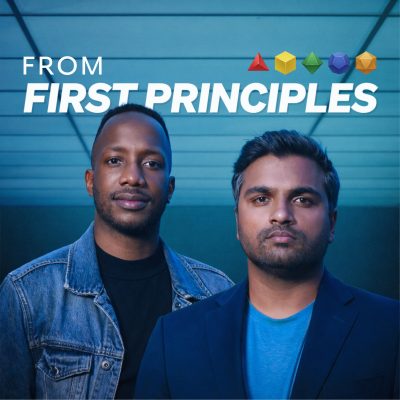
Destroying Tumors With Sound: Histotripsy with Dr. Zhen Xu
Show notes
Can sound destroy a tumor without an incision? Dr. Zhen Xu joins Krishna Choudhary to explain histotripsy: focused ultrasound that creates tiny bubbles to mechanically break apart tissue, without relying on heat.
From a noise complaint in a University of Michigan lab to the Edison system, Xu traces the unexpected discovery, the physics of cavitation, and the decades of research behind noninvasive liver-tumor treatment. We explore surprising immune effects in animal studies, the #HOPE4LIVER clinical trials, and what remains to be tested for other organs.
Recorded in Washington, D.C., on September 28, 2026, before the Golden Goose Awards ceremony. Xu is a histotripsy co-inventor, HistoSonics co-founder, and U-M's Li Ka Shing Professor of Biomedical Engineering. This is the first interview in our Golden Goose series.
CHAPTERS
00:00 The discovery that became histotripsy
00:50 A PhD student and a heart problem
03:42 Heat vs. sound: how histotripsy works
07:06 Gas pockets, and why not the lungs
09:06 The first paper (2004)
09:38 "Don't read any papers": Yellow Pages and pig hearts
12:29 Too loud: rethinking the ultrasound pulse
14:56 "Almost like smoke": the 2002 discovery
18:14 Building the equipment, and the Edison system
22:19 Through the skull, and controlling the bubbles
23:50 The physics: pressure waves, bubbles and cells
28:47 Ten years to understand it
32:42 Surgery keeps getting smaller: from ether to Star Trek
35:58 The surprise: an immune response
38:16 Why liver cancer, and 9 of 11 rats
47:19 #HOPE4LIVER: the clinical trial
49:59 How a treatment works
52:27 Recovery and the 20-mile-run anecdote
56:24 The future: worldwide, kidney, pancreas and brain
1:01:33 The Golden Goose Award and federal funding
1:04:31 Sign-off
1:04:41 Outro
RESEARCH & FURTHER READING
First tissue-erosion paper (2004):
https://doi.org/10.1109/tuffc.2004.1308731
High-speed imaging of bubble clouds (2007):
https://doi.org/10.1109/tuffc.2007.504
Microtripsy and precise cavitation (2014):
https://doi.org/10.1109/tuffc.2014.6722611
Bubble-cloud and cancer-cell interactions (2016):
https://doi.org/10.1016/j.ultrasmedbio.2016.05.018
Histotripsy through the skull (2016):
https://doi.org/10.1109/tuffc.2016.2531504
Abscopal immune responses: animal research (2020):
https://doi.org/10.1136/jitc-2019-000200
Partial treatment of rat liver tumors (2022):
https://doi.org/10.3390/cancers14071612
#HOPE4LIVER pivotal trial (2024):
https://doi.org/10.1148/radiol.233051
#HOPE4LIVER one-year follow-up (2025):
https://doi.org/10.1097/sla.0000000000006720
FDA Edison De Novo review:
https://www.accessdata.fda.gov/cdrh_docs/reviews/DEN220087.pdf
EDITORIAL NOTES
08:40 / 48:12: Edison received FDA De Novo authorization in 2023 for noninvasive liver-tumor destruction. This is not a general cancer-cure approval.
35:58-47:19: The cited immune-response and 9-of-11 results are animal studies, not human cure rates.
49:17: The one-year trial reported 63.4% local control on primary review and 90% on post hoc review. Technical success and durable tumor control are different measures.
53:46: The 20-mile run is an individual anecdote, not recovery advice; Dr. Xu explicitly advises against it.
55:39: The one-year #HOPE4LIVER update was published in 2025.
Clinical and company updates reflect the September 2026 recording. Dr. Xu co-founded HistoSonics.
WATCH & LISTEN
Episode notes and research: https://ffppod.com/episodes/ep66
Golden Goose science rundown (EP59): https://ffppod.com/episodes/ep59
Watch and listen: https://ffppod.com
Subscribe: https://www.youtube.com/@FromFirstPrinciplesPod?sub_confirmation=1
Support the show: https://ffppod.com/donate
Follow @FFPPod on Instagram, TikTok, X and Facebook.
Breaking down science news so it makes sense to curious people everywhere.
#Histotripsy #GoldenGooseAward #SciencePodcast