

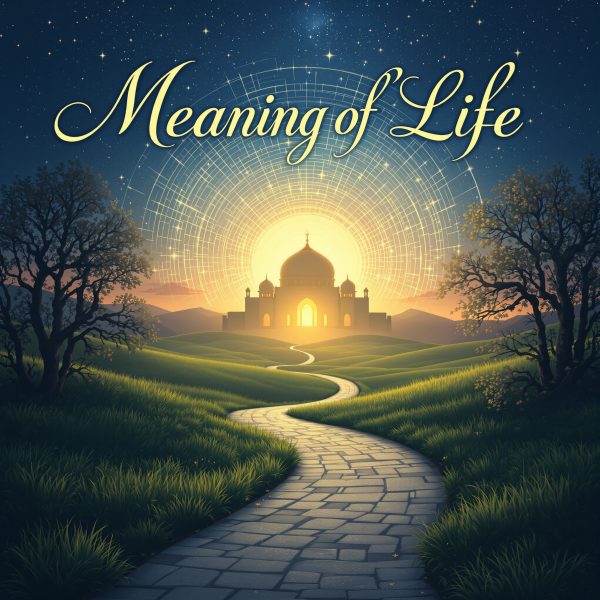
Meaning Of Life Coach – Religion, Science and Philosophy
- Episodes
- 29
- Released
- weekly
- Latest episode
- Nov 19, 2026
About the podcast
Searching for the meaning of life? Science explains the how – but not the why. Meaning Of Life Coach refuses flat answers and dogmatic phrases. Each episode triangulates the big questions for honest skeptics and seekers: 🧠 Science: Neuroscience & Psychology 🏛️ Philosophy: Existentialism & Logic 📖 Spirituality: Ancient Wisdom from Bible, Quran & Torah Not a religion podcast. Not superficial self-help. The honest conversation most podcasts avoid. Your compass for a complex world. 🎧 Subscribe now and visit MeaningOfLife.Coach/en
Episodes 29
Beyond Work-Life Balance: Why Your Sunday Scaries Point to Existential Emptiness, Not Just Burnout
Do you know that knot in your stomach late on Sunday afternoon, long before the Monday alarm goes off? Only 21 percent of employees worldwide feel engaged at work – and in one 2025 survey, 78 percent rated …
Show notes
Do you know that knot in your stomach late on Sunday afternoon, long before the Monday alarm goes off? Only 21 percent of employees worldwide feel engaged at work – and in one 2025 survey, 78 percent rated their work-life balance as healthy while 85 percent of the same group reported burnout or chronic exhaustion. What if the problem isn't the balance, but the split itself?
We explore this from three perspectives:
🧠 Science: Why burnout, according to Christina Maslach's research, stems less from long hours than from loss of control, missing reward, unfairness and value conflicts; how Viktor Frankl's "existential vacuum" and "Sunday neurosis" differ from clinical burnout; and why chronic moral injury at work can make us ill.
🏛️ Philosophy: Marx's four dimensions of alienation, Max Weber's "iron cage" and David Graeber's "bullshit jobs" – why measuring life only in Chronos instead of Kairos (fulfilled time) keeps work and life at war, and what AI automation reveals about who we really are.
✡️/✝️/🕌 Spirituality: How the Islamic paradigm of Tawhid dissolves the split between sacred and profane; how Amanah (trusteeship), Niyyah (intention) and Ibadah turn honest work into service – echoed in the Benedictine "Ora et Labora" and the Jewish "Tikkun Olam"; and how Tawakkul teaches us to "tie the camel" and then let go of the outcome.
In this episode, you'll discover:
- How to tell clinical burnout apart from a loss of meaning – and why each needs a different answer.
- Why spirituality must never become a sedative for exploitation, and when integrity means drawing a hard line or walking away.
- A simple daily structure: a morning intention and three evening questions – Does it serve the world? Was I ethical? Did I let go?
📓 A question to carry with you: To whom will you dedicate your work tomorrow morning?
📖 Read the full article behind this episode at MeaningOfLife.Coach
"I Do Not Love Those That Set": Abraham (Ibrahim) in Judaism, Christianity and Islam
Beneath the night sky of ancient Mesopotamia, a young man watches a star, the moon and the sun rise – and set, one after another. His conclusion changed the history of religion: "I do not love those that set." …
Show notes
Beneath the night sky of ancient Mesopotamia, a young man watches a star, the moon and the sun rise – and set, one after another. His conclusion changed the history of religion: "I do not love those that set." Who was Abraham, the forefather whom Jews, Christians and Muslims alike honor as the "Friend of God"?
We explore this from three perspectives:
🧠 Science: What Sir Leonard Woolley's excavations at Ur reveal about the idol-filled world Abraham grew up in, what modern analyses report about the Zamzam spring, and how psychology would describe his calm in the face of Nimrod's fire as extreme resilience.
🏛️ Philosophy: How Abraham's reasoning under the stars anticipates the cosmological argument for a "first cause" developed by Al-Ghazali and Ibn Rushd, and why Søren Kierkegaard, in "Fear and Trembling", called him the "Knight of Faith".
✡️/✝️/🕌 Spirituality: Abraham as Khalilullah, the Friend of God, in Isaiah, the Epistle of James and the Quran; the strikingly similar story of the smashed idols in the Midrash and the Quran; his hospitality to the three mysterious visitors; Hagar's desperate search for water; and the sacrifice of the son – Isaac or Ishmael – as a bridge between traditions rather than a wall.
In this episode, you'll discover:
- What it means to be a Hanif – someone naturally oriented toward God, before any later scripture, law or nation.
- How Judaism, Christianity and Islam each understand God's covenant with Abraham, from circumcision to the promised land.
- Why Abraham's trust (Tawakkul) and hospitality remain a living model for resilience and humanity today.
📓 A question to carry with you: Which "setting star" – success, recognition, security – are you still holding on to as if it could never fade?
📖 Read the full article behind this episode at MeaningOfLife.Coach
The Blind Spot of Ecology: Why the Climate Crisis Is at Heart a Spiritual Crisis
We have measured the climate crisis down to the last decimal place: record CO2 levels, the largest coral bleaching event on record, an Earth Overshoot Day that keeps moving earlier. We know almost everything …
Show notes
We have measured the climate crisis down to the last decimal place: record CO2 levels, the largest coral bleaching event on record, an Earth Overshoot Day that keeps moving earlier. We know almost everything – and still we don't act. What if the environmental crisis is, at its core, not a technological problem but a crisis of meaning?
We explore this from three perspectives:
🧠 Science: Why seven of nine planetary boundaries have already been crossed, what Suzanne Simard's "Wood Wide Web", E.O. Wilson's biophilia and research on forest bathing reveal about our bond with nature, and why climate anxiety and "solastalgia" are rational responses rather than hysteria.
🏛️ Philosophy: How Francis Bacon, Descartes' "animal machine" and what Max Weber called the "disenchantment of the world" turned living nature into dead material – and why CO2 tunnel vision, the rebound effect and offset "phantom credits" resemble what Dietrich Bonhoeffer called "cheap grace".
✡️/✝️/🕌 Spirituality: Why the Hebrew words behind "subdue" and "rule" in Genesis speak of cultivation and shepherding, not exploitation; how Shmita, the biblical sabbatical year, anticipated the idea of planetary boundaries; and how the Islamic concepts of Amanah and Khalifa, Hildegard of Bingen's Viriditas and Taoist Wu Wei call us to be guardians rather than conquerors.
In this episode, you'll discover:
- How the Islamic three-stage model of the soul (Nafs) maps our path from consumer greed through eco-grief to inner peace.
- Why sufficiency – the measure of "enough" – is liberation rather than loss, and why inner change must never become an excuse to avoid political action ("spiritual bypassing").
- How Joanna Macy's "Active Hope" and the hadith of planting a sapling even as the world ends turn powerlessness into dignified action.
📓 A question to carry with you: What are you buying to fill an inner emptiness – and what would "enough" feel like instead?
📖 Read the full article behind this episode at MeaningOfLife.Coach
The Last Brick in the House: Prophet Muhammad, the Seal of the Prophets, and Ahmad in the Bible
History is full of visionaries, thinkers and spiritual teachers. So why does Islam say that with one orphan from 7th-century Mecca, the chain of prophets that ran through Noah, Abraham, Moses and Jesus was …
Show notes
History is full of visionaries, thinkers and spiritual teachers. So why does Islam say that with one orphan from 7th-century Mecca, the chain of prophets that ran through Noah, Abraham, Moses and Jesus was completed? And what if the most influential person in history is also one of the most misunderstood?
We explore this from three perspectives:
🧠 Science: How the Qur'an has been carried through the centuries by millions of people who know it by heart, how the civilization that grew from his teaching produced figures like Al-Khwarizmi, Ibn Sina and Al-Biruni, and what research on "born believers" and current Pew data on global religion add to the picture.
🏛️ Philosophy: Why Michael H. Hart placed Muhammad first in "The 100", what Lamartine and Thomas Carlyle saw in him, and the idea of revelation as a gradual education of humanity that ends in one final, universal message.
✡️✝️🕌 Spirituality: The meaning of Khatam an-Nabiyyin, the Prophet's own parable of the house that was missing a single brick, and the biblical passages Muslim readers connect with him: the "prophet like Moses" in Deuteronomy, the Paraclete in John, Kedar in Isaiah, and Jesus' announcement of "Ahmad" in the Qur'an.
In this episode, you'll discover:
- Why, in Islam, the "last prophet" does not cancel Moses and Jesus but completes the house they helped build
- Moments from his life that reveal his character: the orphan, the stones of Ta'if, the forgiveness at the conquest of Mecca, and his last words "my community, my community"
- What the Farewell Sermon said about race, dignity and justice, and why it still speaks to us today
- What we can learn from his humility and mercy in everyday life, from mending his own shoes to never scolding the boy who served him
📓 A question to carry with you: When someone treats you harshly, what would it look like to answer with the kind of mercy that disarms rather than wins?
📖 Read the full article behind this episode at MeaningOfLife.Coach
Your Longing Is Not a Malfunction: Adam and Eve in Islam, Original Sin and the Way Home
Have you ever felt a sudden ache in the middle of a beautiful moment, as if something in you remembers a home you have never seen? What if that "Weltschmerz" is not a flaw, but the oldest memory your soul …
Show notes
Have you ever felt a sudden ache in the middle of a beautiful moment, as if something in you remembers a home you have never seen? What if that "Weltschmerz" is not a flaw, but the oldest memory your soul carries?
We explore this from three perspectives:
🧠 Science: Why 99 percent of your body mass is made of six elements also found in the Earth's crust, what current genomics says about the shared African origin of all living humans, and what cognitive research on "born believers" (and its critics) suggests about children's intuitive sense of a Creator.
🏛️ Philosophy: Why love and devotion only mean something if they could be refused, why the angels asked "Why create a being that sheds blood?", and how Viktor Frankl's "will to meaning" and "existential vacuum" echo the Qur'anic idea of the Fitrah.
✡️✝️🕌 Spirituality: The story of Adam and Hawwa in three acts: the human being as khalifa, the naming of things, Iblis and the arrogance of "I am better than him", the primordial covenant "Am I not your Lord?", the Fall told in the dual ("they both ate"), and repentance. Plus a respectful comparison of how Judaism, Christianity and Islam understand the Fall, and why Islam knows no inherited original sin.
In this episode, you'll discover:
- Why, in the Qur'an, Eve is not the temptress who led Adam astray, but an equally responsible partner
- The four directions from which Iblis whispers, read as a map of anxiety, regret, spiritual pride and craving
- What Adam's prayer "We have wronged ourselves" teaches about taking full responsibility without being crushed by guilt
- What Cain and Abel, the raven and Adam's forgotten gift to David say about envy, nonviolence and our very human forgetfulness
📓 A question to carry with you: What would change if you started each day not as someone born in debt, but as someone born with a clean slate?
📖 Read the full article behind this episode at MeaningOfLife.Coach
Does Injustice Ever Get Settled? The 14 Phases of the Day of Judgment in Islam and Christianity
A tyrant dies peacefully in his bed. The victims of a forgotten massacre appear in no history book. Is that really the last word of history, or is there a moment when every mask falls and not even the weight of …
Show notes
A tyrant dies peacefully in his bed. The victims of a forgotten massacre appear in no history book. Is that really the last word of history, or is there a moment when every mask falls and not even the weight of an atom is overlooked?
We explore this from three perspectives:
🧠 Science: What today's data on inequality, the global mental health crisis, booming skyscrapers in the Arabian desert and earthquake statistics have to do with the "minor signs" of the end times, how modern cosmology pictures the end of the universe, and why "The Body Keeps the Score" resonates with the Qur'anic image of the body as a witness.
🏛️ Philosophy: Immanuel Kant's argument that the moral demand for justice requires an immortal soul and a judging God, and why, without a final balancing, human existence would look like a cruel joke.
✡️✝️🕌 Spirituality: The complete sequence of Yawm al-Qiyama from the Qur'an and authentic hadith, step by step: the signs, the trumpet blasts, the physical resurrection, the 50,000-year gathering, the Basin, the Great Intercession, the scale, the Sirat bridge and the eternal abodes. Plus a respectful comparison with how Judaism and Christianity picture the final judgment.
In this episode, you'll discover:
- Why the Day of Judgment is less an instrument of fear than a promise of justice for the forgotten and the oppressed
- Who the "Seven under the Shade" are, and who the Prophet called the truly bankrupt person
- Why the "Hadith of the Card" and the bridge of reconciliation (Al-Qantara) put so much weight on sincere faith and a heart free of grudges
- How the idea of taking yourself to account today can change your small, everyday decisions
📓 A question to carry with you: If the books are still open today, what would you want written in yours before the ink dries?
📖 Read the full article behind this episode at MeaningOfLife.Coach
Why Your Soul Is Homesick for Jannah: The Garden of Eden in the Torah, Bible and Qur'an
Why do so many of us feel like strangers even in the most comfortable lives this world can offer? What if that quiet homesickness is not a flaw in us, but a memory of where we come from?We explore this from …
Show notes
Why do so many of us feel like strangers even in the most comfortable lives this world can offer? What if that quiet homesickness is not a flaw in us, but a memory of where we come from?
We explore this from three perspectives:
🧠 Science: Loneliness, which the WHO now treats as a global health crisis, our deep aversion to entropy and decay, what survivors of cardiac arrest report about a profound sense of peace, and why recent brain research places a turning point in the early thirties, the age the Prophet named for the people of Paradise.
🏛️ Philosophy: The argument from desire: we do not feel thirst in a world without water, so what does our longing for permanence point to? Plus Ockham's razor and cosmic fine-tuning as a case for one Creator, and how the promise of Paradise reframes the old question of suffering (theodicy).
✡️✝️🕌 Spirituality: The Garden of Eden as our origin and destination, the Fitrah as the soul's built-in compass, the Shahada as the key to Jannah, the eight names, eight gates and hundred levels of Paradise up to Al-Firdaus, and a respectful comparison with the New Jerusalem of Revelation, the Jewish "World to Come" and Paul's "what no eye has seen".
In this episode, you'll discover:
- Why your longing for a perfect, pain-free home may be a signpost rather than a weakness
- What the Qur'an and hadith describe: rivers and springs, the healing reunion of families, what awaits believing women, and why the "72 virgins" cliché is not supported by the Qur'an
- How a single moment in Paradise is said to erase a lifetime of suffering, and why the highest reward is seeing God Himself
- How everyday remembrance, charity and good character become the building material of your "palace" in the Hereafter
📓 A question to carry with you: Which of the eight gates is your everyday life already walking toward?
📖 Read the full article behind this episode at MeaningOfLife.Coach
AI and Religion: Can a Machine Recognize the Truth of the Quran?
A text that calls rejecting it not error, but death — and now a machine that believes nothing and feels nothing is asked to examine it. Can an AI recognize what is true, without ever believing it?We approach …
Show notes
A text that calls rejecting it not error, but death — and now a machine that believes nothing and feels nothing is asked to examine it. Can an AI recognize what is true, without ever believing it?
We approach this question from three angles that sharpen one another — never smoothing them over:
🧠 Science — Searle's "Chinese Room" and Shannon's information theory mark the wall every machine hits: it computes, but it never touches meaning. What it can do: test patterns in a text that no human could measure in a lifetime.
🏛️ Philosophy — From Averroes (Ibn Rushd) and the power of strict proof to al-Ghazali, who found final certainty not in deduction: the ancient line between recognizing (ʿaql) and believing (īmān).
🕌 Spirituality — The Quran stakes its authority on a testable claim (Surah 4:82): not an appeal to blind trust, but an invitation to the intellect — for believers and skeptics alike.
In this episode you'll discover:
- why the two obvious answers — "AI will prove it" and "a machine can never touch the sacred" — share the same hidden error;
- why a stronger AI makes the "yes" harder, not softer — and why it can still never be a coercive proof (resonance, not proof);
- why the real danger isn't the machine, but the question of who controls the frame in which it judges.
📖 Read the full article behind this episode at MeaningOfLife.Coach.
📓 And a question to carry with you: what if the most incorruptible voice on the sacred is one that does not itself believe?Drowning in Information, Starving for Wisdom: Knowledge vs. Wisdom in the Age of AI
Ever wonder how we can map the human genome and split the atom — yet over a billion of us are battling mental health crises and chronic loneliness? That's the paradox at the heart of this episode: we are …
Show notes
Ever wonder how we can map the human genome and split the atom — yet over a billion of us are battling mental health crises and chronic loneliness? That's the paradox at the heart of this episode: we are drowning in information, but starving for wisdom.
We triangulate the difference between knowledge and wisdom from three perspectives:
🧠 Science: What the WHO's latest data on the loneliness epidemic reveals — and why chronic disconnection harms the body like smoking 15 cigarettes a day.
🏛️ Philosophy: Why Socrates and Confucius agreed on one thing across continents: knowledge without ethical action is an illusion — and how "double ignorance" fuels today's echo chambers.
🕌 Spirituality: A haunting prophetic prayer against "knowledge that does not benefit," the Golden Age scholars who invented algebra and optics as acts of devotion, and Luqman's timeless four-step curriculum for wisdom.
In this episode, you'll discover:
- Why AI can pass the bar exam but can never be wise — the difference between calculation and character.
- The four modern idols (money, status, metrics, intellect) that block wisdom from entering your life.
- A simple 5-minute screen-free practice (tafakkur) to test whether your daily information diet is making you softer — or just more anxious.
📖 Read the full article behind this deep dive at MeaningOfLife.Coach
The Ultimate Purpose: Why True Character Building Beats Self-Optimization
Are we confusing "self-optimization" with true character building? In an age obsessed with productivity hacks, life-logging, and chasing external success, we have largely forgotten the ultimate, most important …
Show notes
Are we confusing "self-optimization" with true character building? In an age obsessed with productivity hacks, life-logging, and chasing external success, we have largely forgotten the ultimate, most important task of human life: refining our inner selves.
In this episode, we explore why saving the world starts with purifying your own heart. We triangulate the art of character building from three distinct perspectives:
🧠 Science & Psychology: How the science of neuroplasticity proves that our character isn't a fixed fate, but a physical reality that we rewire and rebuild every single day through our habits.
🏛️ Philosophical Logic: Aristotle’s timeless virtue ethics, which teach us that being a "good" person isn't about what you think or know, but about what you repeatedly do.
✝️/✡️/🕌 Spiritual Depth: The universal Abrahamic call to inner holiness. We dive deep into the profound Islamic concept of Tazkiyat al-Nafs (purification of the soul) and the timeless Prophetic tradition that true faith is ultimately measured by the perfection of one's character.
In this episode, you will learn:
Why the modern self-help industry often leaves us feeling empty by focusing on what we can achieve, rather than who we are becoming.
How to use the mechanics of neuroplasticity and ancient philosophy to actively train your virtues like a muscle.
The profound spiritual reality that you cannot transform the world around you until you have conquered the ego within you.
📖 Read the full article accompanying this episode on our website. Subscribe to this meaning of life podcast for deeper insights that bridge spirituality and science, and visit us at MeaningOfLife.Coach
Why Good Character Heals Your Brain: The Neuroscience of Virtue and Mental Health
Why are we facing a global mental health crisis despite living in an era of unprecedented material wealth? The answer to our anxiety might lie in a forgotten truth: your brain is biologically hardwired for …
Show notes
Why are we facing a global mental health crisis despite living in an era of unprecedented material wealth? The answer to our anxiety might lie in a forgotten truth: your brain is biologically hardwired for virtue. In this episode, we explore the profound connection between moral character and mental well-being by triangulating three perspectives: 🧠 Science: How modern neuroscience and epigenetics prove that holding grudges destroys your nervous system, while generosity (the "warm glow"…Why Responsibility is the Ultimate Freedom: Overcoming the Victim Mindset
We live in an era that endlessly celebrates freedom, yet we often run away from the heavy weight of responsibility. Are you feeling stuck in the passenger seat of your own life, waiting for circumstances to …
Show notes
We live in an era that endlessly celebrates freedom, yet we often run away from the heavy weight of responsibility. Are you feeling stuck in the passenger seat of your own life, waiting for circumstances to change? In this episode, we explore why true liberation only begins when we stop blaming the world and start owning our choices. …How Dialogue Rewires the Brain: Curing Extremism with Science, Philosophy & Faith
We live in a deeply polarized world where arguing on the internet rarely changes minds, but instead hardens hearts. But what happens inside our minds when we stop debating to win, and start listening to …
Show notes
We live in a deeply polarized world where arguing on the internet rarely changes minds, but instead hardens hearts. But what happens inside our minds when we stop debating to win, and start listening to understand? In this episode, we explore the transformative power of human connection and triangulate how true dialogue cures radicalization from three perspectives: 🧠 Science & Psychology: How active, empathetic listening physically deactivates the brain's threat response (the amygdala) and…Why Do Educated People Join Extremist Groups? The Engineering Mindset & Existential Questions
We tend to think of violent extremists as isolated or completely uneducated. But what happens when the data tells a terrifyingly different story? In this episode, we tackle a profound contradiction: Why do …
Show notes
We tend to think of violent extremists as isolated or completely uneducated. But what happens when the data tells a terrifyingly different story? In this episode, we tackle a profound contradiction: Why do highly educated professionals—specifically doctors, IT specialists, and engineers—often fall prey to radical ideologies? We explore the danger of treating ancient, multi-dimensional texts like flat, black-and-white instruction manuals. …Why Am I Here? Overcoming Existential Dread with Science, Philosophy & Faith
Picture this: It’s 2 a.m., the house is completely quiet, and out of nowhere, it hits you—why am I actually here? In this episode, we tackle the ultimate midnight question and explore why our existential dread …
Show notes
Picture this: It’s 2 a.m., the house is completely quiet, and out of nowhere, it hits you—why am I actually here? In this episode, we tackle the ultimate midnight question and explore why our existential dread isn't a biological flaw, but a powerful call to action. We triangulate the search for purpose from three distinct perspectives: 🧠 Science & Neurobiology: How our brain's Default Mode Network (DMN) acts as a relentless "me-center" that generates anxiety, and how shifting into states of…Tawhid vs. Trinity: An Islam and Christianity Comparison on God, Jesus & Human Nature
Have you ever wondered why two of the world's largest spiritual traditions—both revering Jesus and the prophets—arrived at such radically different conclusions about how to reach God? In this episode, we …
Show notes
Have you ever wondered why two of the world's largest spiritual traditions—both revering Jesus and the prophets—arrived at such radically different conclusions about how to reach God? In this episode, we explore the deep theological tensions and profound parallels between the Christian and Islamic worldviews without taking sides. …Jesus in Islam: The Untold Story of Isa ibn Maryam
Did you know that Jesus is one of the most revered prophets in the Quran, mentioned by name more times than the Prophet Muhammad? To truly understand the historical and spiritual ties between the world's two …
Show notes
Did you know that Jesus is one of the most revered prophets in the Quran, mentioned by name more times than the Prophet Muhammad? To truly understand the historical and spiritual ties between the world's two largest religions, we must explore the fascinating role of Jesus in Islam. …Quran and Modern Science: Miracles, Facts, and the Big Bang
How could an ancient text contain what many call Quran and science miracles—describing the expansion of the universe or the origins of life in water centuries before the invention of the telescope or the …
Show notes
How could an ancient text contain what many call Quran and science miracles—describing the expansion of the universe or the origins of life in water centuries before the invention of the telescope or the microscope? Or are these just convenient interpretations and Quran scientific mistakes waiting to be debunked? In this episode, we tackle one of the most fascinating paradoxes in history: the relationship between Quran and modern science. …The Spiritual Meaning of Water: Bridging Water Science and Religion
What is the spiritual meaning of water, and why does modern water science continue to find life-sustaining anomalies in this simple molecule? From the stars to our own cells, water is not just a resource—it is …
Show notes
What is the spiritual meaning of water, and why does modern water science continue to find life-sustaining anomalies in this simple molecule? From the stars to our own cells, water is not just a resource—it is a cosmic messenger. In this episode, we explore the mystery of spiritual water and the deep connections between water and religion. …The Code 19: Mathematics in the Quran and the Search for Proof
Does the Quran contain a hidden cryptographic signature that proves its origin? In 1969, a biochemist using early mainframe computers discovered a pattern based on the number 19 that seems to permeate the …
Show notes
Does the Quran contain a hidden cryptographic signature that proves its origin? In 1969, a biochemist using early mainframe computers discovered a pattern based on the number 19 that seems to permeate the entire text. Is this the ultimate intersection of mathematics and faith, or a case of human pattern-seeking? In this episode, we decode the "Code 19" phenomenon. …The Science of Good Deeds: Understanding Spiritual Reward and the Metaphysical Economy
What if your most valuable currency isn't in your bank account, but in your actions? In a world obsessed with accumulation, we explore the "Metaphysical Economy"—a system where the only way to truly gain is by …
Show notes
What if your most valuable currency isn't in your bank account, but in your actions? In a world obsessed with accumulation, we explore the "Metaphysical Economy"—a system where the only way to truly gain is by giving. In this episode, we decode the power of good deeds and the search for spiritual reward. We triangulate this "beautiful loan" from three perspectives: 🧠 Science: We look at Game Theory and Social Capital. Why is altruism a winning biological strategy? …Wealth, Poverty, and Divine Justice: A Logical Deconstruction
Does financial success define your worth, or is there a hidden divine justice at play that we often transform into a transaction? In this episode, we move beyond the superficial wealth meaning and explore why …
Show notes
Does financial success define your worth, or is there a hidden divine justice at play that we often transform into a transaction? In this episode, we move beyond the superficial wealth meaning and explore why the distribution of resources is one of the most profound tests of the human experience. …Finding Work-Life Balance: The Golden Mean and the Science of Burnout
Are you a master of your life, or are you simply running on biological software designed for a world that no longer exists? In this episode, we explore why modern burnout is often a symptom of losing our …
Show notes
Are you a master of your life, or are you simply running on biological software designed for a world that no longer exists? In this episode, we explore why modern burnout is often a symptom of losing our connection to the golden mean. We triangulate the art of balance from three perspectives: 🧠 Science: Evolutionary biology and dopamine loops. …What Happens When You Die? Science, NDEs, and Consciousness After Death
Have you ever wondered what happens after you die? Is the light at the end of the tunnel a biological trick of a dying brain, or a gateway to a different reality? In this episode, we tackle the ultimate …
Show notes
Have you ever wondered what happens after you die? Is the light at the end of the tunnel a biological trick of a dying brain, or a gateway to a different reality? In this episode, we tackle the ultimate question: What happens when you die? We move beyond fear and dogma to triangulate consciousness after death from three perspectives: 🧠 Science: We look at the latest medical research on Near-Death Experiences (NDEs). …Islam vs Christianity: Trinity, Tawhid, and the Logic of One God
When we look at Islam vs Christianity, we often focus on the friction—but what happens if we apply pure logic to the core of their beliefs? Is a single, indivisible Creator more rational than a complex one? In …
Show notes
When we look at Islam vs Christianity, we often focus on the friction—but what happens if we apply pure logic to the core of their beliefs? Is a single, indivisible Creator more rational than a complex one? In this episode, we deconstruct the theological architecture of the Abrahamic faiths. We triangulate the debate of Trinity vs Tawhid from three perspectives: 🧠 Science: We apply Occam's Razor—the principle that the simplest explanation is usually the correct one. …Islam and Science: Neuroscience, Faith, and the Heart
Is there one true religion that aligns perfectly with the biological reality of our minds? In this episode, we move beyond dogmatic debates to explore the powerful intersection of Islam and science. We …
Show notes
Is there one true religion that aligns perfectly with the biological reality of our minds? In this episode, we move beyond dogmatic debates to explore the powerful intersection of Islam and science. We triangulate the mystery of human transformation from three perspectives: 🧠 Science: We dive into neuroplasticity—the brain’s incredible ability to physically rewire itself. We examine how consistent spiritual practices impact the prefrontal cortex and lower the body's stress responses. …Finding Your Purpose in Life: Existential Homesickness and the Middle Path
Have you ever felt a profound longing for a "home" you cannot find on a map? This feeling is not a malfunction—it is a compass pointing toward your true purpose in life. In this episode, we explore why we feel …
Show notes
Have you ever felt a profound longing for a "home" you cannot find on a map? This feeling is not a malfunction—it is a compass pointing toward your true purpose in life. In this episode, we explore why we feel out of place in the world and how to find balance. We triangulate the concept of belonging from three perspectives: 🧠 Science: The psychology of Sehnsucht (longing). …Why Were We Created? Meaning of Life Psychology and Spiritual Purpose
"Why were we created?" It is the most fundamental question of human existence, yet we often get lost in the noise of daily life. In this premiere episode, we begin our journey to find a compass that works for …
Show notes
"Why were we created?" It is the most fundamental question of human existence, yet we often get lost in the noise of daily life. In this premiere episode, we begin our journey to find a compass that works for both the mind and the soul. We triangulate the search for meaning from three distinct perspectives: 🧠 Science: We explore the meaning of life psychology, specifically the research of Tatjana Schnell. …What Is the Meaning of Your Life? — The Trailer
What happens when a neurobiologist, an ancient philosopher, and a mystic sit down at the same table? Meaning Of Life Coach bridges what is usually kept apart: the precision of science, the depth of philosophy …
Show notes
What happens when a neurobiologist, an ancient philosopher, and a mystic sit down at the same table? Meaning Of Life Coach bridges what is usually kept apart: the precision of science, the depth of philosophy, and the wisdom of spirituality — all converging on one question: What is the meaning of your life? …
Similar podcasts
More Religion & Spirituality podcasts

Is this your podcast?
Confirm it with an entry in your feed: you get a code here, add it as podcast:txt to the channel of your feed, and we check it. Your podcast is then shown as “verified” on SoundNode.