

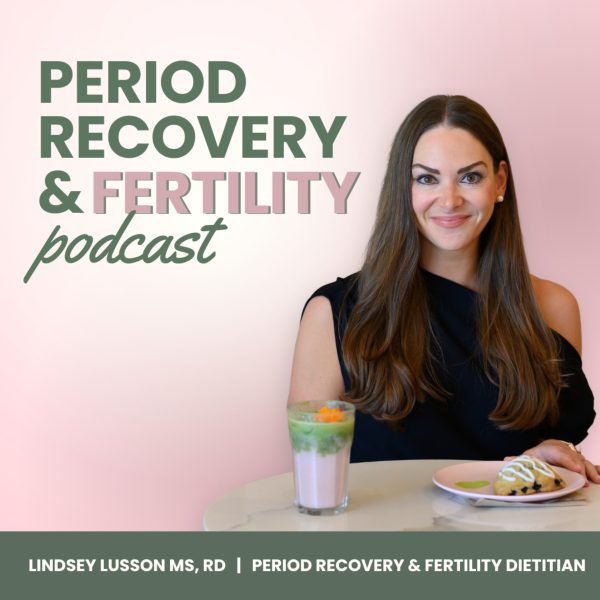
Period Recovery and Fertility Podcast
- Episodes
- 120
- Released
- every two weeks
- Latest episode
- Nov 9, 2026
About the podcast
Welcome to the Period Recovery and Fertility Podcast! Here we discuss the challenging, rewarding, and life changing process of recovering your period and finding freedom with food and exercise. Whether you’re hoping to regain your cycle and get your health on track or you're ready to become a momma- this podcast is for you. While the recovery process isn't always rainbows and butterflies, it’s my hope to bring you both information and inspiration during your own recovery journey. I’m your host, Registered Dietitian and fellow HA woman Lindsey Lusson.
Episodes 120
Episode 120: Exercise and Fertility Part 1 The Episode to Send Your Husband
Why kick off an exercise and fertility series by talking about men? Because male factor infertility is involved in roughly half of all infertility cases, and in 20 to 30% of couples it's the only cause. Yet in …
Show notes
Why kick off an exercise and fertility series by talking about men? Because male factor infertility is involved in roughly half of all infertility cases, and in 20 to 30% of couples it's the only cause. Yet in most fertility journeys, she gets the labs, the ultrasounds, the supplements and the medications, while he gets maybe one semen analysis and very little conversation about what his numbers mean or how to improve them.
In this episode, Lindsey walks through what the research actually says about exercise and male fertility: where it helps, where it starts to hurt, and why the benefit lives in moderate, consistent movement rather than more and harder training. Then she goes beyond the gym to the food, habits, environmental exposures and supplements that almost never come up in a fertility appointment but make a real difference. And fair warning: as you listen to the warning signs of under-fueling in men, you might hear something that sounds a little too familiar about you.
In this episode, we cover:
Why your partner's lifestyle is half the equation, and why only about half of men in couples seeking fertility help ever get tested
The 2017 randomized trial where every exercise group improved sperm quality, and why the moderate group, not the HIIT group, improved the most
Why the benefit of exercise lives at the bottom of the curve (going from nothing to something), and what that means if he's already very active
Why consistency beats intensity, and how quickly improvements faded once the men stopped exercising
The 3-month clock: why what he does today shows up in a semen analysis 3 months from now
When exercise flips for him, including cycling, heat exposure, and high-mileage running
The "exercise-hypogonadal male condition," and why it's essentially the male version of what we see with HA
RED-S in men: the warning signs to watch for, from low libido and cold hands to a rigid relationship with food and training
The habits that matter most: smoking, cannabis, and why a 3-month break makes sense
Simple, non-obsessive nutrition for sperm health, five easy swaps to cut down on BPA and phthalates, and a short list of supplements worth considering
The biggest takeaway: exercise is genuinely good for male fertility, and the research links it to better sperm quality and higher pregnancy and live birth rates. But the benefit comes from moderate, consistent movement, not from pushing harder. Add in enough food, fewer toxin exposures, the right supplements, and at least 3 months of consistency, and he can make a meaningful difference that's completely in his hands.
Before the end of today, send this episode to your partner. No long explanation, no lecture, just "I'd love for you to listen to this one." And if you checked off more of those RED-S warning signs for yourself than for him, don't miss Part 2 later this month, where Lindsey turns the microscope around to exercise and female fertility and where the tipping point actually is.
Links & Resources
Episode 119: Who Told You Period Recovery Could Take Years?
You finally work up the courage to ask your OB about getting your period back naturally, and the answer is “Keep doing what you’re doing, but this could take years. You might as well start fertility treatment.” …
Show notes
You finally work up the courage to ask your OB about getting your period back naturally, and the answer is “Keep doing what you’re doing, but this could take years. You might as well start fertility treatment.” If you’ve heard some version of that, this episode is for you. Across 400+ women, Lindsey has never once looked at a client’s labs and thought, “This is going to take you years.” On average, her clients get their period back in about 8 weeks, and 85% get it back within 90 days. Weeks and months, not years.
In this episode, Lindsey walks through how she reads a hormone panel, why she can usually estimate someone’s recovery timeline from her labs, and why the numbers alone will never tell you what to actually change. Then she shares two real client stories, with their real lab values: Haley, who hadn’t had a natural period in 15 years, and Caroline, who’d gone more than 10.
In this episode, we cover:
The hormones Lindsey looks at first (estradiol, LH, FSH, androgens, and vitamin D) and what each one tells her about where you are
The HA spectrum: what it looks like when your brain has gone almost quiet compared to when your body is right on the edge of ovulating
How starting labs can predict your timeline, and why one client took 15 weeks while another took just 5
Why your labs show where you are but not why you’re there, and how you can sit at “almost ovulating” for months or even years if nothing changes
Haley’s story: “clean” eating for her skin, food rules she didn’t recognize as rules, and why not having a period at 90 days didn’t mean her plan had failed
How one testosterone result could have sent Haley down the PCOS path, and the clue that showed it was actually her hormones surging right before ovulation
Caroline’s story: a 10/10 stress level, a quiet fear of weight gain, and why knowing what your body needs isn’t the same as being able to do it
Why “close to ovulating” isn’t the same as “ready for pregnancy”
The biggest takeaway: your labs are a snapshot, not a sentence. They can tell you how suppressed your hormones are and give you a sense of your timeline, but they can’t tell you what needs to change. That comes from connecting your numbers to your food, your training, your stress, and the rules you don’t even realize you’re following. When someone connects those dots, recovery happens in weeks and months, not years.
If you’ve been sitting in your labs wondering what they mean, or you’ve been doing everything “right” and still don’t have your period back, the Missing Period Assessment is open now. You’ll get your hormone labs reviewed, your food log analyzed, a personalized video breakdown from Lindsey, a custom plan, and a 1:1 strategy call with the lead dietitian. Enrollment closes Thursday, October 22 at midnight Central, and this is the last time it’s opening this year.
Links & Resources
Episode 118: Food Rules and Your Fertility (Part 4: Finding Food Freedom)
When you hear “food freedom,” you probably picture one of two things. Either the donuts-for-breakfast, cake-for-dinner free-for-all that's all over social media, or the quieter version your favorite wellness …
Show notes
When you hear “food freedom,” you probably picture one of two things. Either the donuts-for-breakfast, cake-for-dinner free-for-all that's all over social media, or the quieter version your favorite wellness accounts are selling: eat whatever you want… as long as it's 90% whole foods, portion controlled, and “in moderation.” One sounds like chaos. The other sounds balanced, but look closely and it's just more food rules wearing a cuter outfit.
In the final part of the Food Rules and Your Fertility series, Lindsey redefines what food freedom actually is (hint: it was never about what's on your plate) and speaks directly to the three women most likely listening right now: the one who just had the lightbulb moment, the one who's already tried everything and doesn't believe she can change, and the one who wants to know if all this work will actually get her pregnant.
This episode wraps up the series, so if you haven't listened yet, start with Episode 115, Episode 116, and Episode 117 first.
In this episode, we cover:
Why real food freedom happens in your head, not on your plate and what it looks like when food takes up almost zero space in your brain
The two biggest myths about food freedom, and why “food freedom with strings attached” is just more food rules in disguise
Why realizing you have food rules is the fastest part of the process, and how to keep that clarity from cooling off into “that was a good episode”
Why past attempts with a dietitian, a therapist, or going “all in” on your own may not have worked — and why that isn't a character flaw
How food rules, resistance to body changes, and constant food noise tell your body it isn't a safe time to make a baby
Why your period was never proof of a healthy cycle, and what your options really look like when ovulation is missing
A real-life picture of food freedom: a spontaneous weekend getaway with no workout plan, no menu research, and no fight in your own head
This episode is the final part of the Food Rules and Your Fertility series. Up next, Lindsey has one more mini series to share and she's saved the best for last.
The biggest takeaway: food freedom isn't a rulebook or an all-or-nothing free-for-all. It's quiet. It's food taking up so little space in your head that you can say yes to the spontaneous trip, order what actually sounds good, and come home remembering the trip instead of managing it. That's what's on the other side of this work — not just a period or a positive pregnancy test, but your actual life, back in your own hands.
Wherever you're standing after this series, there's a next step for you. If you just had your mind blown, book a discovery call. If you're not sure you're ready yet, get on the email list and keep listening. And if you need proof before you can believe any of this, join the waitlist for the Missing Period Assessment, opening October 15th.
Mentioned in this episode:
Episode 115 – Food Rules and Your Fertility (Part 1: What Food Rules Actually Are)
Episode 116 – Food Rules and Your Fertility (Part 2: Naming Your Food Rules)
Episode 117 – Food Rules and Your Fertility (Part 3: Common Pitfalls)
Episode 112 – All About Ovulation: Why Your Period Is Not Proof You Ovulated
Links & Resources
Episode 117: Food Rules and Your Fertility (Part 3: Common Pitfalls)
You did the homework. You named a food rule, maybe two, and you started challenging it you added the snack back, skipped tracking for a day, even had the bagel you hadn't touched in a decade. And at first it …
Show notes
You did the homework. You named a food rule, maybe two, and you started challenging it you added the snack back, skipped tracking for a day, even had the bagel you hadn't touched in a decade. And at first it felt fine. But a few weeks in, something feels off: your period still isn't back, you haven't ovulated, or you got one cycle and then stalled right back out.
In part 3 of the Food Rules and Your Fertility series, Lindsey names the most common pitfalls that quietly stall period recovery, even when you're doing “everything right.” None of these mean you're doing it wrong or not trying hard enough most of them are subtle by design, which is exactly why they're worth naming out loud instead of circling for months hoping you catch them on your own.
This episode builds on parts 1 and 2, so if you haven't listened yet, start with Episode 115 and Episode 116 first.
In this episode, we cover:
Why a food rule doesn't have to be about food to still be running the show and how to spot when it's relocated to weighing, comparison, or avoiding help
The eight most common pitfalls keeping women stuck, including eating only “whole foods,” never actually naming your food rules, avoiding fear foods, the “unicorn” mindset, calling it “intuitive eating” while still under-eating, controlling your weight, ignoring sleep and stress, and comparison
How to tell the difference between a genuine food preference and a fear-driven rule
Why quasi-recovery (getting your cycle back without ever naming the underlying rules) isn't the same as full recovery
This episode is part three of the Food Rules and Your Fertility series. In Episode 118, Lindsey wraps up the series with Part 4: Finding Food Freedom, walking through how to actually start letting go of these rules.
The biggest takeaway: awareness without a decision is just a more informed version of staying stuck. Before you do anything else today, go back through the list of pitfalls and name the one that's actually yours not the easiest one, the one you felt your stomach drop on. Say it out loud, write it down, or tell one person. That's the assignment.
If you recognized yourself in more than one of these, that's not a sign something is wrong with you it's a sign it's time to get honest about what's really driving your food decisions. Grab your list from the Part 2 homework, get some accountability, and meet Lindsey back for Part 4.
Mentioned in this episode:
Episode 115 – Food Rules and Your Fertility (Part 1: What Food Rules Actually Are)
Episode 116 – Food Rules and Your Fertility (Part 2: Naming Your Food Rules)
Episode 109 – Orthorexia Deep Dive: Why “Clean Eating” Can Tank Your Hormones
Food Freedom and Fertility – Alliance for Eating Disorders support
Links & Resources
Episode 116: Food Rules and Your Fertility (Part 2: Naming Your Food Rules)
Picture this: it's your birthday, and underneath the excitement there's a twinge of dread because you know dessert, family dinners, and “what will people think” are all coming with it. It's not just birthdays …
Show notes
Picture this: it's your birthday, and underneath the excitement there's a twinge of dread because you know dessert, family dinners, and “what will people think” are all coming with it. It's not just birthdays. Every holiday brings the same tug-of-war between excitement and anxiety, and if celebrations feel more like a threat than a gift, that's not “just being health conscious.” Those are your food rules running the show.
This episode is part two of the Food Rules and Your Fertility series. Last episode named what food rules actually are today Lindsey gets specific, walking through the ten most common food rules she sees in her practice, why “just eat intuitively” isn't the fix yet, and a simple homework activity to help you start untangling your own.
In this episode, we cover:
How to tell the difference between a food rule and genuinely liking to eat healthy and why it comes down to your level of distress, not the food itself
A homework activity to help you identify your own food rules and what would change in your life if you let go of them
This episode is part two of the Food Rules and Your Fertility series. In Episode 117, Lindsey wraps up the series by walking through how to actually start letting go of these rules and moving toward a more peaceful relationship with food.
The biggest takeaway: figuring out whether you have a food rule or just a preference isn't about the food itself, it's about the distress you feel when you can't follow it. Once you start noticing one rule, the floodgates open, and you'll likely be shocked at how many you actually have. Awareness is step one, and just listening to this episode already puts you ahead of most women.
If you heard yourself in even one or two of these rules, that's not a sign something is wrong with you, it's a sign it's time to start naming them. Grab a notebook, do the homework in this episode, and meet Lindsey back for Part 3.
Mentioned in this episode:
Episode 86 – What Every Woman Needs to Know About Carbs and Fertility
Episode 109 – Why Clean Eating Can Tank Your Hormones (orthorexia deep dive)
Food Freedom and Fertility – Alliance for Eating Disorders support
Links & Resources
Episode 115: Food Rules and Your Fertility Part 1: What are Food Rules?
If you've ever felt a flicker of panic before a dinner out, or noticed quiet rules running in the background of what you “allow” yourself to eat, this episode is for you.This episode kicks off a new three-part …
Show notes
If you've ever felt a flicker of panic before a dinner out, or noticed quiet rules running in the background of what you “allow” yourself to eat, this episode is for you.
This episode kicks off a new three-part series, Food Rules and Your Fertility, unpacking how these quiet, often invisible rules run in the background of your biggest trips and your most ordinary Tuesdays and how they can quietly suppress your hormones too.
In this episode, we cover:
What a food rule actually is, and why almost every one starts out as something genuinely healthy before it turns rigid and restrictive
Why your body can't tell the difference between a real threat and a made-up one, and what that means for your hormones when you restrict, skip meals, or panic over food
How survival mode shuts down the exact signals your hypothalamus sends to your ovaries, and why “survival mode does not equal fertility mode”
The under-the-radar signs you might still be under-fueling even after correcting an obvious energy deficit, like a low resting heart rate, waking between 2–4am, and estrogen that won't climb above 30 pg/mL
How under-fueling impacts your digestion (including SIBO, bloating, and slowed transit time), your mental and emotional health, your muscles and bones, and your nervous system
What the Minnesota Starvation Experiment revealed about food obsession, mood, and mental health—even in men with no prior history of disordered eating
Why you don't need to be in a measurable energy deficit for food restriction to impair your working memory and focus
The hidden, ritual-like behaviors around food that can be red flags for disordered eating, even when they feel like “just being healthy”
This episode is part one of the Food Rules and Your Fertility series. In Episode 116, Lindsey gets specific—walking through the ten most common food rules she sees in her practice, a simple homework activity to help you identify your own, and the pitfalls of jumping straight into intuitive eating for period recovery.
The biggest takeaway: almost every food rule started as something genuinely healthy, but the moment flexibility disappears and guilt shows up, your body reads it as a threat, not health. And your body will always choose keeping you alive over helping you conceive every single time.
If you've caught yourself in the clean eater, the macro tracker, or the calorie queen, that's not a sign something is wrong with you. It's a sign your body has been running on a rulebook it never should have needed.
Links & Resources
Episode 114: Do You Need Medication to Ovulate?
If you're standing at the crossroads between fertility treatment and working on restoring your fertility naturally, this episode is for you.The episode closes out the series with three sets of questions: ones …
Show notes
If you're standing at the crossroads between fertility treatment and working on restoring your fertility naturally, this episode is for you.
The episode closes out the series with three sets of questions: ones to ask yourself, ones to bring to your reproductive endocrinologist, and ones to bring to your dietitian or root-cause practitioner, so you can move forward from a place of real information rather than defaulting to “what medication do we add next.”
In this episode, we cover:
Why ovulatory dysfunction isn't always just about under-fueling, and how autoimmune thyroid disease or PCOS can be a separate issue, or one made worse by under-fueling
The real first question to ask when someone isn't ovulating: not “what medication fixes this,” but “why isn't this happening”
How Clomid and Letrozole actually work, and why Letrozole has become the preferred first-line option for most women
Why women who are under-fueled often already have a thinner uterine lining, and what that means when you add a medication that suppresses estrogen further
Why a short luteal phase can still show up even when ovulation is confirmed, and the questions worth asking if you're bleeding within a week of ovulating on medication
What the fertility intervention ladder can look like in practice: Letrozole, dose increases, Menopur, Estrace, trigger shots, and timed intercourse or IUI
Why there's no established medical standard for when to escalate from oral medication to injectables, and how a PCOS vs. HA misdiagnosis can send treatment in the wrong direction
Three sets of questions to ask yourself, your reproductive endocrinologist, and your dietitian or root-cause practitioner
This episode is the final part of the All About Ovulation series. If you haven't listened to Episode 112, where Lindsey covers why bleeding isn't the same thing as ovulating, or Episode 113, where she introduces the HA Spectrum, start there first, since today's episode builds directly on both.
The biggest takeaway: medication has a real place in fertility care, but it's a tool, not a starting point. The question is never just “how do we make ovulation happen.” It's “why isn't it happening, and what does my body actually need?”
If you've been on the fertility treatment merry-go-round without anyone asking why ovulation stopped in the first place, that's not a sign you're doing something wrong. It's a sign you're missing a plan built around your actual body, not just the next prescription.
Links & Resources:
Episode 113: Ovulatory Dysfunction & The HA Spectrum
If your period shows up every month like clockwork, it's easy to assume your hormones are fine.But a regular cycle is not the same thing as healthy ovulation.In this episode, Lindsey continues the All About …
Show notes
If your period shows up every month like clockwork, it's easy to assume your hormones are fine.
But a regular cycle is not the same thing as healthy ovulation.
In this episode, Lindsey continues the All About Ovulation series and introduces what she calls the HA Spectrum, a framework for understanding that ovulatory dysfunction is not a light switch. It's not simply "ovulating" or "not ovulating." There is a whole range in between, from a completely healthy cycle all the way to full hypothalamic amenorrhea (HA), and most women have no idea where they actually fall on it.
Many women rule themselves out of this conversation entirely. They picture HA as something that only happens to underweight women, athletes, or people with an eating disorder, and since that's not them, they assume it doesn't apply. But you can be much closer to the HA end of the spectrum than you think, even with a period that looks completely regular on paper. If you're curious whether you fall closer to HA or PCOS, Lindsey has covered that distinction in several past episodes: 48, 74, 102, and 108.
In this episode, we cover:
What ovulatory dysfunction actually is, and why it exists on a spectrum rather than a yes-or-no state
The four points on that spectrum: ovulatory eumenorrhea, subclinical ovulatory disturbances, oligomenorrhea, and hypothalamic amenorrhea
Why a "totally normal" 29-day cycle can hide the same root issue as a missing period
Why subclinical ovulatory disturbances matter, including their link to bone loss, mood, sleep, and cardiovascular health
Why normal labs don't rule out an ovulation problem
The real root cause of functional ovulatory dysfunction: your brain deciding now isn't a safe time to reproduce
The main drivers: low energy availability, overtraining or under-fueling around exercise, psychological stress, and dieting history
Why you do not have to be underweight, have an eating disorder, or be a competitive athlete for this to apply to you
Self-check questions to help you figure out where you might fall on the spectrum
What recovery actually requires beyond "eat more" — training load, digestion, stress, blood sugar, sleep, and your relationship with food
Why recovery isn't linear, and why guessing at one change at a time often drags the timeline out longer
This episode is part two of the All About Ovulation series. If you haven't listened to Episode 112 yet, where Lindsey covers progesterone and why bleeding isn't the same thing as ovulating, start there first, since today's episode builds directly on it.
The biggest takeaway: ovulatory dysfunction isn't a light switch, it's a spectrum, and you can be a lot closer to the HA end of it than you think, even with a cycle that looks completely regular. A period is a good sign, but it isn't proof your body is fully hormonally healthy or fertile.
If today had you nodding along, or you've been piecing this together on your own for months without much to show for it, that's not a sign you're doing something wrong. It's a sign you're missing a plan built around your actual body, not just general advice.
Links & Resources:
Episode 112: All About Ovulation: Why Your Period Is Not Proof You Ovulated
Most women are taught that getting a period is the main event of the menstrual cycle.But the truth is, ovulation is the main event.In this episode, Lindsey kicks off the All About Ovulation mini series and …
Show notes
Most women are taught that getting a period is the main event of the menstrual cycle.
But the truth is, ovulation is the main event.
In this episode, Lindsey kicks off the All About Ovulation mini series and breaks down why ovulation matters for fertility, hormones, and long-term health.
She explains why bleeding does not always mean you ovulated, why progesterone matters far beyond pregnancy, and how hormonal birth control can suppress ovulation while masking underlying hormonal issues.
In this episode, we cover:
● Why ovulation is the main event of the menstrual cycle
● Why getting a period does not always mean you ovulated
● How ovulation leads to progesterone production
● Why progesterone matters for mood, sleep, bones, heart health, and fertility
● Why hormonal birth control suppresses ovulation
● Why a pill bleed is not the same as a true period
● How birth control can mask missing, irregular, or painful periods
● What to know about birth control, nutrient depletion, AMH, SHBG, gut health, and thyroid markers
● Why missing cycles after coming off the pill are a sign to look deeper
● Why labs are helpful, but do not always show the full pictureOvulation is not just about getting pregnant.
It is a monthly sign that your body has enough safety, energy, and hormonal communication to support reproductive health.
And if you are not ovulating, you are not making meaningful amounts of progesterone — a hormone your brain, bones, heart, mood, sleep, and fertility all depend on.
Hormonal birth control can be helpful and necessary for many women, but women deserve informed consent around what it does in the body.
The goal is not just to bleed.
The goal is a healthy, ovulatory cycle that supports your fertility, hormones, and long-term health.
If you are missing your period, coming off birth control, or trying to understand your labs, Lindsey is hosting a $27 live training on July 16th called Read Between The Labs
Episode 111: How Do You Know You’re Actually Recovered?
If you’ve gotten your period back after hypothalamic amenorrhea, it can feel like the finish line.And honestly, it is a huge milestone. Getting a bleed again can be such a powerful sign that your body is …
Show notes
If you’ve gotten your period back after hypothalamic amenorrhea, it can feel like the finish line.
And honestly, it is a huge milestone. Getting a bleed again can be such a powerful sign that your body is responding to more nourishment, more rest, and a safer internal environment.
But getting your period back and being fully recovered are not always the same thing.
You may have gained weight, started eating more, stopped tracking calories, gotten a few cycles, or reintroduced some fear foods and still feel like food, exercise, and body image are taking up way too much mental space.
Or maybe you feel more mentally free, but your cycle is still missing, irregular, inconsistent, or showing signs that ovulation and progesterone are not fully restored yet.
In this episode, we cover:
● Why getting your period back does not always mean you are fully recovered● The difference between physical recovery and mental recovery● Why some women get one bleed but struggle to get consistent cycles after● What regular, predictable cycles should look like after HA recovery● Why ovulation matters more than simply bleeding● How BBT can help confirm whether ovulation is actually happening● What a healthy luteal phase looks like and why it matters for fertility● Why very short or light periods may signal that hormones are still rebuilding● The role of fertile cervical mucus as a sign of hormonal health● Why minimal PMS can be a marker of improved cycle health● Why mental recovery is just as important as physical recovery● How disordered eating, food rules, and perfectionism often show up in HA recovery● Why food should take up less brain space over time● What it looks like to feel flexible around restaurants, travel, social plans, and fun foods● Why being able to rest, skip workouts, and let life interrupt exercise is a major recovery milestone● How exercise can shift from body control to enjoyment, energy, and support● Why bad body image days do not have to become diet plans● How full recovery helps your identity expand beyond food, exercise, and your body
Physical recovery matters.
A regular cycle, consistent ovulation, a healthy luteal phase, enough cervical mucus, and a period that lasts more than a couple of days are all important signs that your body is becoming hormonally safer and more supported.
If you are ready for that level of recovery, we would love to support you inside the Food Freedom Fertility Society. The program application is linked in the show notes.
Episode 110: Client Story: From Missing Period to Natural Pregnancy After Years of “Doing Everything Right”
When you’ve been told that you’re “so healthy,” but your period is still missing, it can feel confusing, frustrating, and incredibly lonely. You may be eating well, exercising, seeing doctors, running labs …
Show notes
When you’ve been told that you’re “so healthy,” but your period is still missing, it can feel confusing, frustrating, and incredibly lonely. You may be eating well, exercising, seeing doctors, running labs, trying to “do the right thing,” and still not getting answers. And when every provider tells you nothing is wrong but your body still isn’t ovulating it can leave you wondering if IVF, medications, or fertility treatments are your only option. …Episode 109: Orthorexia Deep Dive: Why “Clean Eating” Can Tank Your Hormones
If you’re eating all organic, high-protein, “clean” foods but your period is still missing, it can feel confusing to know what your body actually needs. You may be tracking ingredients, avoiding processed …
Show notes
If you’re eating all organic, high-protein, “clean” foods but your period is still missing, it can feel confusing to know what your body actually needs. You may be tracking ingredients, avoiding processed foods, following wellness influencers, and doing everything you’ve been told is “healthy.” But what happens when those healthy habits start creating more stress, rigidity, food fear, and under-fueling? And what if clean eating isn’t the full story? …Episode 108: PCOS or Under-Fueling? How to Know What’s Really Keeping Your Period Missing
If you’ve been diagnosed with PCOS but your period is still missing, it can feel confusing to know what your body actually needs. You may be told to eat fewer carbs, exercise more, take Metformin, start …
Show notes
If you’ve been diagnosed with PCOS but your period is still missing, it can feel confusing to know what your body actually needs. You may be told to eat fewer carbs, exercise more, take Metformin, start Letrozole, or move straight to fertility treatments. But what happens when those recommendations don’t work? And what if PCOS isn’t the full story? …Episode 107: Low AMH and No Period: Why IVF Wasn’t Her Only Option
If you’ve been told your AMH is low, it can feel like the clock is suddenly ticking faster. You may hear things like: “You should freeze your eggs,” “You may need IVF,” or “You’re running out of time.” But AMH …
Show notes
If you’ve been told your AMH is low, it can feel like the clock is suddenly ticking faster. You may hear things like: “You should freeze your eggs,” “You may need IVF,” or “You’re running out of time.” But AMH is one of the most misunderstood fertility markers especially if you’re not ovulating regularly. …Episode 106: 5 “Healthy” Food Habits That Stall Ovulation
If your period is missing… and you feel like you’re doing everything “right” with food… this episode might shift everything. Because many habits that look healthy can actually signal stress or underfueling to …
Show notes
If your period is missing… and you feel like you’re doing everything “right” with food… this episode might shift everything. Because many habits that look healthy can actually signal stress or underfueling to your body keeping ovulation turned off. In this episode, Lindsey breaks down the 5 most common food habits that disrupt hormone signaling and delay ovulation and what your body actually needs instead. …Episode 105: Elevated FSH Isn’t Always the Problem (Client Case Study)
Fertility challenges don’t always show up clearly in lab work. In this episode, Lindsey breaks down a clinical case study of a client who was told her elevated FSH could be a major concern for fertility. But as …
Show notes
Fertility challenges don’t always show up clearly in lab work. In this episode, Lindsey breaks down a clinical case study of a client who was told her elevated FSH could be a major concern for fertility. But as you’ll hear, the real issue wasn’t ovarian failure, it was the environment her body was operating in. …Episode 104: Navigating Pregnancy After Loss: A Clinical Case Study
Episode 104: Navigating Pregnancy After Loss: A Clinical Case Study Pregnancy after miscarriage isn’t just about “trying again.” It’s about rebuilding ovulation, stabilizing the nervous system, and protecting …
Show notes
Episode 104: Navigating Pregnancy After Loss: A Clinical Case Study Pregnancy after miscarriage isn’t just about “trying again.” It’s about rebuilding ovulation, stabilizing the nervous system, and protecting against relapse especially for women with a history of restriction, over-exercise, or hormonal suppression. In this episode, Lindsey shares a clinical case study of a client who navigated period recovery, pregnancy loss, and pregnancy again. …Episode 103: If Your Period Still Isn’t Back, You’re Probably Solving the Wrong Problem
If You’re Still Stuck in Period Recovery, You’re Probably Solving the Wrong Problem Most women don’t stay stuck in period recovery because they’re not trying hard enough. They stay stuck because they’re focused …
Show notes
If You’re Still Stuck in Period Recovery, You’re Probably Solving the Wrong Problem Most women don’t stay stuck in period recovery because they’re not trying hard enough. They stay stuck because they’re focused on the wrong problem. In this episode, Lindsey reframes one of the biggest reasons women stay stuck in recovery not lack of effort, but misdirected effort. …Episode 102: Your Body Isn’t Broken: The Missing Piece in HA & PCOS Recovery
In this episode of the Period Recovery & Fertility Podcast, Lindsey breaks down a complex client case where hypothalamic amenorrhea and PCOS overlapped and why mislabeling the problem kept ovulation from …
Show notes
In this episode of the Period Recovery & Fertility Podcast, Lindsey breaks down a complex client case where hypothalamic amenorrhea and PCOS overlapped and why mislabeling the problem kept ovulation from happening for years. This client came in after nine months with no period, a failed Provera challenge, failed ovulation meds, and multiple PCOS diagnoses — even though her labs, symptoms, and history told a very different story. …Episode 101: When “Eating Enough” Isn’t Enough to Get Your Period Back
In this clinical case episode of the Period Recovery & Fertility Podcast, Lindsey breaks down one of the most confusing period recovery scenarios she’s seen: a client who was eating 2,500–3,000+ calories per …
Show notes
In this clinical case episode of the Period Recovery & Fertility Podcast, Lindsey breaks down one of the most confusing period recovery scenarios she’s seen: a client who was eating 2,500–3,000+ calories per day, had gained weight, stopped intense exercise, and still didn’t ovulate for over five years. …Episode 100: What I’d Do If I Lost My Period Again Today (With Everything I Know Now)
In this milestone 100th episode of the Period Recovery & Fertility Podcast, Lindsey shares a deeply practical, no-fluff conversation about what she would actually do if she woke up tomorrow without a period …
Show notes
In this milestone 100th episode of the Period Recovery & Fertility Podcast, Lindsey shares a deeply practical, no-fluff conversation about what she would actually do if she woke up tomorrow without a period armed with everything she knows now after helping 400+ women restore their cycles. …Episode 99: Getting Honest About Your Relationship With Exercise — You Can’t Heal What You Don’t Acknowledge
In this episode of the Period Recovery & Fertility Podcast, Lindsey has an honest, grounding conversation about exercise, identity, and why so many women stay stuck in recovery without realizing their training …
Show notes
In this episode of the Period Recovery & Fertility Podcast, Lindsey has an honest, grounding conversation about exercise, identity, and why so many women stay stuck in recovery without realizing their training habits are part of the problem. If you’re trying to get your period back or hoping to get pregnant in 2026, this episode is a must-listen. …Episode 98: 5 Things That Helped Me Overcome My Fear of Weight Gain
Episode 98: 5 Things That Helped Me Overcome My Fear of Weight Gain In this episode of the Period Recovery & Fertility Podcast, Lindsey opens up about one of the biggest fears women face in hypothalamic …
Show notes
Episode 98: 5 Things That Helped Me Overcome My Fear of Weight Gain In this episode of the Period Recovery & Fertility Podcast, Lindsey opens up about one of the biggest fears women face in hypothalamic amenorrhea recovery: the fear of weight gain. After years of disordered eating, compulsive exercise, and living in a body that was far below her natural set point, Lindsey shares the mindset shifts, science, faith, and lived experiences that helped her finally let go of control — and…Episode 97: From HA to Healthy Pregnancy: How a Touring Musician Got Her Period Back Naturally
In this episode of the Period Recovery & Fertility Podcast, Lindsey sits down with former client Taylor, a full-time touring musician and songwriter who went from years of restrictive eating, industry pressure …
Show notes
In this episode of the Period Recovery & Fertility Podcast, Lindsey sits down with former client Taylor, a full-time touring musician and songwriter who went from years of restrictive eating, industry pressure, and a completely missing period… to restoring her cycle naturally and getting pregnant on the very first month she and her husband tried. …Episode 96: She Got Pregnant on Her 1st Ovulation… After Thinking Recovery “Would Never Work”
In this episode of the Period Recovery & Fertility Podcast, Lindsey sits down with former client Tori, who went from years of missing periods, two rounds of amenorrhea, and “DIY recovery”… to restoring …
Show notes
In this episode of the Period Recovery & Fertility Podcast, Lindsey sits down with former client Tori, who went from years of missing periods, two rounds of amenorrhea, and “DIY recovery”… to restoring ovulation and getting pregnant on her very first ovulation inside the Food Freedom Fertility Society. She’s now 27 weeks along and thriving. …Ep 95: Stress, Missing Periods & Your Long-Term Health: Understanding HA with Dr. Chrisandra Shufelt of Mayo Clinic
If you’ve ever been told to “just go back on the pill” when you lost your period, or you’ve been dismissed with a misdiagnosis like “PCOS type D,” this episode is a must-listen. Today, Lindsey sits down with …
Show notes
If you’ve ever been told to “just go back on the pill” when you lost your period, or you’ve been dismissed with a misdiagnosis like “PCOS type D,” this episode is a must-listen. Today, Lindsey sits down with Dr. Chrisandra Shufelt, Chair of General Internal Medicine at Mayo Clinic Jacksonville and a leading researcher in Functional Hypothalamic Amenorrhea (FHA). Dr. …Ep 94: From Olympic Trials to Missing Periods: Taylor’s Fertility Wake-Up Call
Lindsey sits down with Taylor, a former elite marathoner who qualified for the Olympic Trials twice—but spent 15 years without a period. After years of overtraining, under-fueling, and convincing herself she …
Show notes
Lindsey sits down with Taylor, a former elite marathoner who qualified for the Olympic Trials twice—but spent 15 years without a period. After years of overtraining, under-fueling, and convincing herself she could “fix it” on her own, Taylor finally surrendered control, restored her cycle, and went from no period to pregnancy within months. …Ep 93: The Top Functional Tests for your Fertility Part 3: the DUTCH Test
We’re back with the final episode of our 3-part series on functional testing for fertility! 🎉 Lindsey is joined again by our functional fertility dietitian, Anabelle, to unpack one of the most popular (and …
Show notes
We’re back with the final episode of our 3-part series on functional testing for fertility! 🎉 Lindsey is joined again by our functional fertility dietitian, Anabelle, to unpack one of the most popular (and misunderstood) advanced hormone tests: the DUTCH test. If you’ve ever wondered whether the DUTCH test could be the missing piece in your fertility journey, this episode is for you. …Ep 92: 🎙️ The Top Functional Tests for your Fertility Part 2: GI MAP
Welcome to part two of our mini-series on the top functional tests for your fertility. Today we’ll discuss GI-MAP stool testing—a powerful way to uncover what’s really going on in your gut and how it’s …
Show notes
Welcome to part two of our mini-series on the top functional tests for your fertility. Today we’ll discuss GI-MAP stool testing—a powerful way to uncover what’s really going on in your gut and how it’s impacting your gut symptoms, your hormones, periods, and fertility. I’m joined again by our functional fertility dietitian, Annabelle, to break down everything you need to know. …Ep 91: The Top Functional Tests for your Fertility Part 1: HTMA
This is part one of a three-part series on functional lab testing with our Functional Fertility Dietitian, Anabelle. Over the next few episodes, we’ll dive into the three main labs we use to help clients get to …
Show notes
This is part one of a three-part series on functional lab testing with our Functional Fertility Dietitian, Anabelle. Over the next few episodes, we’ll dive into the three main labs we use to help clients get to the root of: Hormone imbalances Fatigue and burnout Missing or irregular cycles Fertility struggles and unexplained infertility In today’s episode, we’re starting with one of our favorite tests: the Hair Tissue Mineral Analysis (HTMA). …
These are the latest 40 of 120 episodes. You’ll find older episodes in the podcast’s feed.
Similar podcasts
More Health & Fitness podcasts




Is this your podcast?
Confirm it with an entry in your feed: you get a code here, add it as podcast:txt to the channel of your feed, and we check it. Your podcast is then shown as “verified” on SoundNode.