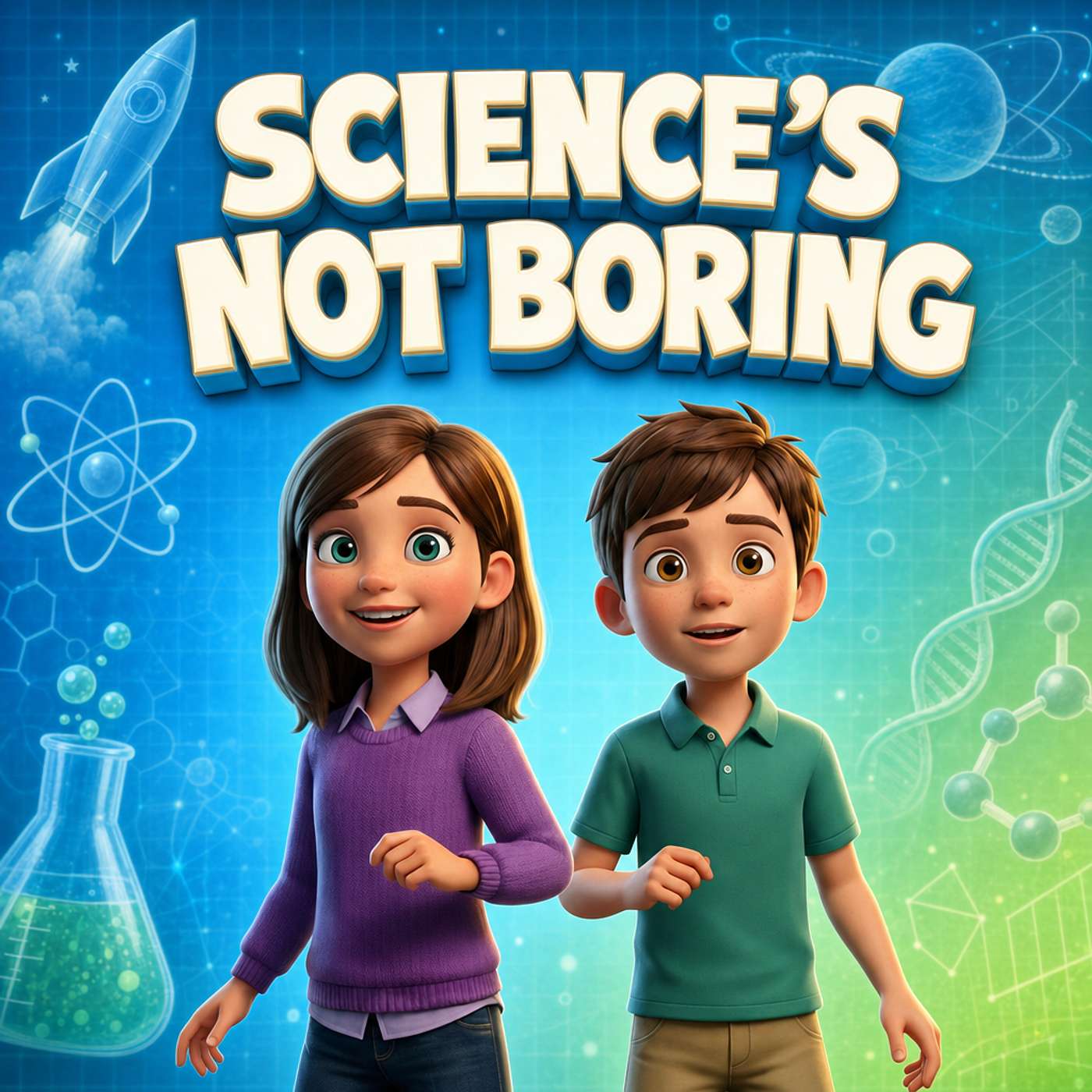
Science for Kids / Science’s Not Boring: The Kids Science Podcast
- Episodes
- 129
- Released
- daily
- Latest episode
- Oct 23, 2026
About the podcast
A groundbreaking podcast for curious kids aged 4-12 that proves science is anything but dull.
Join our fictional AI hosts Mira, a brilliant 9-year-old, and her younger brother Finn, age 7, as they explore the incredible world of science. From exploding volcanoes and black holes to deadly venom and the tiny machines inside your own body, each episode uncovers the most astonishing, surprising, and sometimes mind-bending wonders of science - explained in a way that actually makes sense to kids.
Whether you're discovering how rockets blast into space, why dinosaurs ruled the Earth, what really happens inside a thunderstorm, how your brain pulls off impossible tricks, or why the ocean's deepest creatures glow in the dark - Science Is Not Boring transforms big scientific ideas into unforgettable stories that ignite curiosity and wonder.
Because science isn't a pile of facts to memorize. It's the story of how everything works - and how we figure it out.
A note on why we use AI. For us, AI allows us to deliver learning at a scale and quality that previously would have been too expensive. If we make the odd technical error, or the sound goes a bit funny, bear with us, we're trying our best. We hope you enjoy the show!
Episodes 129
What is a marsupial?
Have you ever wondered what makes animals in Australia so weird and wonderful? Get ready to explore the incredible world of marsupials! Over 50 million years ago, the continent of Australia broke off like a …
Show notes
Have you ever wondered what makes animals in Australia so weird and wonderful? Get ready to explore the incredible world of marsupials! Over 50 million years ago, the continent of Australia broke off like a giant puzzle piece and drifted away into the ocean. Because these animals were trapped on a massive lifeboat, they evolved into over 250 amazing species! Join Mira and Finn as they uncover the wild secrets of the pouch. Did you know a newborn kangaroo joey is completely blind, hairless, and exactly the size of a tiny pink jellybean?! You will be amazed to learn how this tiny baby climbs a giant mountain of fur all by itself to find its mother's pouch. We also dig into why wombats have backward-facing pockets (hint: it keeps the dirt out while they burrow!) and meet the fierce Tasmanian devil. This 8-kilogram creature packs a bone-crushing bite force of 553 Newtons, acting like nature's very own vacuum cleaner! Tune in for mind-blowing facts, a fun trivia quiz, and find out why marsupials totally rule the land down under!What was the first photograph?
Have you ever tried sitting completely still without blinking, itching, or sneezing for eight whole hours? That’s exactly what you had to do to be in the very first photograph! Join Mira and Finn on a …
Show notes
Have you ever tried sitting completely still without blinking, itching, or sneezing for eight whole hours? That’s exactly what you had to do to be in the very first photograph! Join Mira and Finn on a time-traveling adventure to discover how cameras actually work! First, we’ll travel back a thousand years to ancient Egypt with a brilliant scientist named Ibn al-Haytham. He discovered the magical "camera obscura"—a completely dark room that projected moving pictures of the outside world completely upside down on the wall! Then, we'll visit French inventors Nicéphore Niépce and Louis Daguerre, who finally figured out how to trap light on sticky metal plates to create permanent pictures. You won't believe how a man getting his shoes shined accidentally became the first human ever photographed! Finally, we'll zoom into the modern world to learn how heavy, bowling-ball-sized digital cameras turned into the super-fast phone cameras we use today. Discover the amazing science of bouncing light, millions of microscopic digital pixels, and the incredible history of photography. Get ready to smile and say cheese!What is the colossal squid?
Are you ready to dive into the darkest, most freezing parts of the ocean? Join Mira and Finn on Science's Not Boring as they search for a real-life deep-sea monster: the colossal squid! Imagine a giant …
Show notes
Are you ready to dive into the darkest, most freezing parts of the ocean? Join Mira and Finn on Science's Not Boring as they search for a real-life deep-sea monster: the colossal squid! Imagine a giant creature as long as a school bus and as heavy as a grizzly bear, swimming thousands of feet below the icy waves of Antarctica. This massive sea creature is the heaviest invertebrate on Earth! Did you know it has eyes the size of soccer balls? These gigantic, glowing eyes help it spot its biggest predator, the mighty sperm whale, in the pitch-black water. But this squid isn't defenseless! It has tentacles covered in razor-sharp, swiveling hooks that act like little tiger claws to trap its prey. Learn the incredible, and totally gross, true story of how scientists first discovered this alien-like animal inside a whale's stomach way back in 1925! Plus, find out how fishermen in New Zealand finally caught a complete, bright red colossal squid eighty years later! Get ready for an epic underwater adventure packed with fascinating facts and a super fun trivia quiz at the end!What is the rock cycle?
Did you know that the ground beneath your feet is actually a giant, endless recycling machine? Join Mira and Finn on an epic geological adventure to discover the secrets of the rock cycle! You might think rocks …
Show notes
Did you know that the ground beneath your feet is actually a giant, endless recycling machine? Join Mira and Finn on an epic geological adventure to discover the secrets of the rock cycle! You might think rocks just sit there being boring and gray for millions of years, but our planet is constantly melting, squashing, and baking them into completely new shapes! Learn about igneous rocks born from glowing red-hot lava that can reach over 2,200 degrees Fahrenheit, and discover how nature perfectly cracked 40,000 hexagonal pillars at the Giant's Causeway in Ireland. We will explore sedimentary rocks made from mud, sand, and trillions of ancient, squashed sea shells stacked together like a giant colorful layer cake! Plus, find out what happens when you bake limestone deep underground until it magically turns into beautiful, sparkling marble. Did you know the Earth even gets special rock deliveries from outer space every single day? Grab your hard hat and magnifying glass, because this episode proves that geology is definitely not boring! Tune in to find out how any rock can transform into another!How was Earth formed?
Have you ever wondered where our home planet came from? Buckle up, space explorers, because we are traveling back four and a half billion years to witness the fiery, explosive birth of planet Earth! Before …
Show notes
Have you ever wondered where our home planet came from? Buckle up, space explorers, because we are traveling back four and a half billion years to witness the fiery, explosive birth of planet Earth! Before there were oceans, mountains, or even dinosaurs, Earth started as a giant, freezing cold cloud of space dust. But when an exploding star sent a shockwave through space, things got crazy! Tiny specks of dust crashed together like the ultimate bumper-car ride to form massive space rocks in a mind-blowing process called accretion. Soon, early Earth became a glowing, red, liquid lava planet floating in space! But the craziest part hasn't even happened yet. Imagine a Mars-sized planet named Theia slamming straight into Earth at twenty-two thousand miles per hour! This unbelievable cosmic collision blasted fiery debris into space, which quickly clumped together to create our very own Moon! Discover how a bubbling magma ocean finally cooled down, how steam created our first oceans, and where scientists found the oldest crystals on Earth. Join Mira and Finn on this spectacular adventure into the history of our solar system!How did the first plant grow?
Have you ever imagined what Earth looked like 500 million years ago? Picture this: absolutely zero green! No trees, no grass, no flowers—just endless, bare, jagged rock. If you wanted to find a plant, you had …
Show notes
Have you ever imagined what Earth looked like 500 million years ago? Picture this: absolutely zero green! No trees, no grass, no flowers—just endless, bare, jagged rock. If you wanted to find a plant, you had to dive underwater to find floating green algae! But how did those plants finally crawl onto the dry, scary land? Join Mira and Finn on a prehistoric adventure to discover the greatest survival story in Earth's history! You'll learn how brave little green blobs survived scorching sunburns to become the very first land plants. Find out why they had no roots, leaves, or seeds, and how they stuck to rocks using tiny velcro-like hairs! Plus, meet Cooksonia, the two-inch-tall skyscraper plant that grew microscopic plumbing tubes to stand up straight. You won't believe how these tiny heroes literally created the first dirt, paved the way for all land animals, and even caused a global ice age! Get ready to explore the wild and wonderful world of pioneer plants. It’s an episode packed with giant surprises from the tiniest ancient heroes!What is a seashell?
Have you ever picked up a beautiful, swirly seashell on the beach and wondered where it came from? It wasn't just a rock shaped by the ocean waves—it was built by a squishy sea creature! Join Mira and Finn …
Show notes
Have you ever picked up a beautiful, swirly seashell on the beach and wondered where it came from? It wasn't just a rock shaped by the ocean waves—it was built by a squishy sea creature! Join Mira and Finn as they dive underwater to discover the amazing world of molluscs. Learn how snails, clams, and oysters use a magical organ called a mantle to literally 3D-print their very own rock-hard armor out of ocean water! Did you know a baby snail is born already wearing its tiny shell and never sheds it? Or that the giant clam can weigh up to 550 pounds, making it as heavy as a full-grown grizzly bear?! Plus, we will uncover the hilarious secret of hermit crabs, the rule-breakers of the beach who can't grow their own shells. Find out what a "vacancy chain" is and how these tiny crabs line up to trade houses in the ultimate underwater swap meet! Get ready for mind-blowing facts, cool science, and an awesome quiz. You'll never look at a seashell the same way again!What is a tear?
Did you know your body makes enough tears every year to fill half a bathtub? It’s true! In this episode, Mira and Finn dive into the wild, slightly slimy, and totally amazing science of tears! You might think …
Show notes
Did you know your body makes enough tears every year to fill half a bathtub? It’s true! In this episode, Mira and Finn dive into the wild, slightly slimy, and totally amazing science of tears! You might think crying is just salty water leaking from your eyeballs, but tears are actually a super-advanced biological shield. Discover the microscopic bacteria-chopping ninja enzymes hiding in your everyday basal tears, and find out why chopping onions unleashes a massive flood of reflex tears to wash away stingy gases. Plus, did you know humans are the only animals on Earth that cry emotional tears? We’ll explore how crying is actually a biological superpower that flushes out stress hormones like cortisol and helps your brain calm down after a big, messy cry. From tiny hidden drain holes in your eyelids to the real truth behind crocodile tears, you will never look at crying the same way again. Join us to find out exactly what happens when the waterworks start!What is an octopus?
Have you ever wondered what it would be like to have three beating hearts, bright blue blood, and a brain that spreads into your arms? Meet the octopus, one of the wildest and smartest creatures in the entire …
Show notes
Have you ever wondered what it would be like to have three beating hearts, bright blue blood, and a brain that spreads into your arms? Meet the octopus, one of the wildest and smartest creatures in the entire ocean! In this episode of Science's Not Boring, Mira and Finn dive deep underwater to uncover the incredible secrets of these squishy, ancient animals. Did you know octopuses have been swimming in our oceans since the time of the Jurassic dinosaurs? It is absolutely true! Discover how they use copper-rich blue blood to survive in freezing deep waters, and how their eight arms have minds of their own—literally! Each arm can taste, touch, and think independently using millions of brain cells. We will also reveal how these deep-sea geniuses can change color in milliseconds like a real-life invisibility cloak, unscrew glass jars from the inside, and even use coconut shells as underwater armor! Join the adventure, learn some mind-blowing marine biology facts, and take our fun trivia quiz at the end to see if your brain is as sharp as a giant Pacific octopus!What is crude oil?
Did you know that the cars we drive, the plastic toys we play with, and even your daily toothbrush are all connected to ancient, dead sea creatures?! Join Mira and Finn as they dig deep underground to uncover …
Show notes
Did you know that the cars we drive, the plastic toys we play with, and even your daily toothbrush are all connected to ancient, dead sea creatures?! Join Mira and Finn as they dig deep underground to uncover the mind-blowing science of crude oil! Millions of years ago, microscopic sea plankton sank to the ocean floor. Trapped under heavy layers of mud and intense heat, they were slowly cooked into a thick, gooey black liquid! Discover how giant metal rigs use diamond-studded drills to chew through solid rock just to pump this ancient goo to the surface. You will also learn how massive 50-meter-tall towers boil the oil at 400 degrees Celsius to create petrol for cars, jet fuel for airplanes, and the sticky asphalt on our roads! With the world gulping down 100 million barrels of oil every single day, we will also explore why scientists are racing to build clean, renewable energy to protect our planet. It is a wild, high-pressure adventure you won't want to miss!What is an eye saccade?
Have you ever noticed what your eyes do when you read a book? You might think they slide smoothly across the page like an ice skater, but prepare to have your mind blown! Your eyes are actually bouncing …
Show notes
Have you ever noticed what your eyes do when you read a book? You might think they slide smoothly across the page like an ice skater, but prepare to have your mind blown! Your eyes are actually bouncing, hopping, and leaping at incredible speeds! In this episode of Science is Not Boring, Mira and Finn uncover the amazing, high-speed team sport happening right inside your head. Join the adventure as we discover "saccades"—the tiny, lightning-fast jumps your eyes make while reading. Did you know your eyes move up to 900 degrees per second? That makes it the fastest movement in the entire human body! We will also explore the tiny "fovea" spot that takes crystal-clear snapshots of words, and learn how twelve tiny eye muscles work together to create perfect pictures in your brain. Plus, find out about the wild science experiments used to study eye jumps, from a doctor putting a microphone against an eyelid to a scientist sticking a tiny mirror directly onto an eyeball! Get ready to see reading in a whole new way!What is the Amazon Rainforest?
Are you ready for a wild adventure? Pack your bags because we are traveling deep into the Amazon Rainforest in South America! Did you know this massive jungle is so big it stretches across nine different …
Show notes
Are you ready for a wild adventure? Pack your bags because we are traveling deep into the Amazon Rainforest in South America! Did you know this massive jungle is so big it stretches across nine different countries and covers the space of one billion football fields? In this episode of Science's Not Boring, Mira and Finn uncover the mind-blowing secrets hiding in the rainforest canopy and river! You'll learn about a fearsome bird called the Harpy Eagle that has talons the exact same size as a grizzly bear's claws! Then, float down the river on a giant water lily pad so huge and strong it can hold over 180 pounds without sinking! You will also discover how one crazy science experiment with a giant "bug bomb" helped scientists realize there might be 30 million insect species living on Earth! Plus, find out about magical pink river dolphins, flying rivers in the sky, and slow-moving sloths that grow actual gardens in their fur! Hit play to explore the greatest, greenest wilderness on our planet!What is a supernova?
Have you ever wondered what happens when a giant star reaches the end of its life? Boom! It explodes in one of the most powerful and spectacular events in the entire universe—a supernova! Join Mira and Finn on …
Show notes
Have you ever wondered what happens when a giant star reaches the end of its life? Boom! It explodes in one of the most powerful and spectacular events in the entire universe—a supernova! Join Mira and Finn on Science's Not Boring as we blast off to discover the amazing secrets of exploding stars! Did you know that a single supernova can shine brighter than a hundred billion stars combined? We’ll travel back in time to the year 1054 when Chinese astronomers saw a massive explosion so bright it could be seen in the daytime sky for 23 days straight! You’ll learn how stars are like giant games of tug-of-war between gravity and nuclear energy, and what happens when their core turns into iron. Plus, discover mind-blowing facts about what’s left behind! Imagine a neutron star so squished and heavy that just one single teaspoon of it weighs a billion tons! Get ready to find out how these epic space explosions actually created the ingredients that make up the Earth, and even you. We are literally made of stardust! Tune in for an out-of-this-world adventure!Who was Dmitri Mendeleev?
Have you ever wondered what the entire universe is made of? Believe it or not, everything from the farthest exploding stars to the bugs in your backyard is made of just 118 invisible building blocks called …
Show notes
Have you ever wondered what the entire universe is made of? Believe it or not, everything from the farthest exploding stars to the bugs in your backyard is made of just 118 invisible building blocks called elements! But how did scientists figure out how they all fit together? Join Mira and Finn on Science's Not Boring as they travel back to a freezing winter in 1869 to meet a brilliant Russian chemist named Dmitri Mendeleev. Dmitri was trying to organize 63 chaotic elements—some of which would violently explode the second they touched water! Discover how he used his favorite card game, Solitaire, to build the ultimate scientific trading cards. You won't believe how a frustrating three-day marathon of no sleep led to a magical nap where the answer to the universe appeared in a dream! Learn how Dmitri boldly predicted invisible missing elements, including a bizarre metal called Gallium that literally melts into a shiny puddle right in the palm of your warm hand! We’ll even explore how modern scientists smash atoms at the speed of light to create dangerously awesome, super-rare elements like Francium! Get ready to unlock the ultimate recipe book of the universe!What is a Portuguese man o' war?
Did you know the longest animal in the world is not the blue whale? Get ready to explore the deep sea as we uncover a real-life sea monster that totally breaks the rules of biology! Have you ever seen a blue …
Show notes
Did you know the longest animal in the world is not the blue whale? Get ready to explore the deep sea as we uncover a real-life sea monster that totally breaks the rules of biology! Have you ever seen a blue balloon floating on the beach with long stinging tentacles? Most people think the Portuguese man o' war is a jellyfish, but it's actually thousands of tiny cloned animals working together as a team! These tiny creatures are called zooids, and they join together to form a super-colony with a floating sail and venomous harpoon tentacles that can grow up to 165 feet long! Join Mira and Finn as they dive into the freezing, pitch-black ocean to learn all about these strange creatures called siphonophores. You will be amazed to discover a massive glowing 150-foot siphonophore shaped like a UFO spiral—the longest animal ever recorded on Earth! Plus, learn about strange deep-sea species that flash glowing red neon lights when they hunt. Tune in to uncover the wild secrets of the deep ocean and see why nature is sometimes stranger than science fiction!What is a Blood Moon?
Have you ever looked up at the night sky and seen a glowing, dark red moon? It looks like a giant floating campfire ember, but what exactly is a Blood Moon? Join Mira and Finn as they blast off 238,855 miles …
Show notes
Have you ever looked up at the night sky and seen a glowing, dark red moon? It looks like a giant floating campfire ember, but what exactly is a Blood Moon? Join Mira and Finn as they blast off 238,855 miles into space to solve this spectacular lunar mystery! You will discover what happens when the Sun, Earth, and Moon line up perfectly to create an enormous shadow called the umbra. But the Moon does not just go black! Instead, our planet's atmosphere acts like a massive magnifying glass, bending the red light from every single sunrise and sunset happening on Earth and shining it right onto the Moon's dusty surface! Learn all about Rayleigh scattering, the Danjon scale, and how a massive volcanic eruption like Mount Pinatubo can completely change the Moon's color. Plus, find out why NASA has to turn off its space robots during an eclipse to stop them from freezing in the sudden 540-degree temperature drop! It is a breathtaking cosmic light show that you definitely do not want to miss!What is a jellyfish?
Have you ever wondered what exactly a jellyfish is made of? Get ready for a mind-blowing deep dive into the ocean! In this episode of Science is Not Boring, Mira and Finn uncover the amazing secrets of the …
Show notes
Have you ever wondered what exactly a jellyfish is made of? Get ready for a mind-blowing deep dive into the ocean! In this episode of Science is Not Boring, Mira and Finn uncover the amazing secrets of the brainless blobs that have been swimming on Earth for over 500 million years. That means they are older than the dinosaurs and even older than sharks! Did you know a jellyfish is 95 percent water? They survive with absolutely no heart, no bones, and no brain! Instead, they use a super cool "nerve net" to sense the world around them. Discover the terrifying Lion's Mane Jellyfish, with tentacles longer than three school buses, and learn about the incredibly fast microscopic stinging harpoons they use to catch their food! Plus, we will meet the amazing Immortal Jellyfish that can turn itself back into a baby, and learn how glowing jellyfish actually helped human doctors win a Nobel Prize! You will even find out what happened when NASA sent thousands of jellyfish into outer space. Spoiler alert: they got very dizzy! Tap play to discover why these squishy sea ghosts are true ocean superheroes!What is a brain?
Have you ever wondered what is going on inside your head? Imagine a massive, buzzing city with over a hundred trillion roads, where cars zip by at 268 miles per hour! That is exactly what your amazing brain is …
Show notes
Have you ever wondered what is going on inside your head? Imagine a massive, buzzing city with over a hundred trillion roads, where cars zip by at 268 miles per hour! That is exactly what your amazing brain is like! It is packed with 86 billion tiny cells called neurons that pass messages to each other at lightning speed. Join Mira and Finn as they uncover the incredible secrets of how our minds are wired! You will learn all about the tiny immune cells called microglia that act like little gardeners in your head, snipping away unused pathways so your brain can think super fast. But what happens when those gardeners work a little differently? Discover why absolutely no two brains are alike! We explore how autistic, dyslexic, and ADHD brains are wired with unique connections that give people incredible strengths—like superpower hyperfocus, rapid problem-solving, and spotting brilliant details everyone else misses. Find out why a world full of differently wired brains is exactly what humans need to invent, explore, and do amazing things!What is hair made of?
Did you know your hair is so incredibly strong that it could hold the weight of two fully-grown African elephants?! That is over twelve tons of elephant! In this mind-blowing episode of Science's Not …
Show notes
Did you know your hair is so incredibly strong that it could hold the weight of two fully-grown African elephants?! That is over twelve tons of elephant! In this mind-blowing episode of Science's Not Boring, Mira and Finn dive deep into the wild world of hair to discover what is really growing out of our heads. Get ready to find out how your hair is actually made of keratin—the exact same tough stuff that makes up rhinoceros horns and horse hooves! If you zoom in closely, a strand of hair even looks like tiny overlapping dragon scales! We will travel down into the microscopic underground "factories" inside your skin called follicles to see how hair grows, and answer a massive question: if our hair is so tough, why doesn't it hurt when we cut it? (Hint: you have a whole mop of dead cells on your head!). Discover the secrets of a single hair strand, learn about people with eighteen-foot-long hair, and find out why our heads have built-in sunhats. Grab your hairbrush and get ready for some truly hair-raising science facts!What is the fastest animal on Earth?
Are you ready for the ultimate speed race in the animal kingdom? Buckle up and keep your hands inside the vehicle, because things are about to get really, really fast! When you think of the fastest animal on …
Show notes
Are you ready for the ultimate speed race in the animal kingdom? Buckle up and keep your hands inside the vehicle, because things are about to get really, really fast! When you think of the fastest animal on Earth, you probably picture the famous cheetah. While cheetahs are the undisputed speed kings of the savanna, sprinting up to 120 kilometers per hour, they are only the fastest on land! To find the absolute fastest creature on the entire planet, we have to look way up into the sky. Meet the Peregrine Falcon! When this incredible bird spots its prey from miles away, it tucks its wings in like a feathered torpedo and dives straight down in a move called a 'stoop.' Gravity takes over, and the falcon plummets at a mind-bending 389 kilometers per hour! It’s so insanely fast that human engineers actually copied a tiny bone inside the falcon's nose to build supersonic jet engines! But wait, what about flying in a straight line without gravity? The champion might surprise you—it’s not a bird at all, but a tiny bat! Tune in with Mira and Finn to uncover the amazing science behind Earth's ultimate speed champions!What are wasps?
Have you ever wondered why wasps crash your summer picnics? It turns out, these buzzy bugs are actually secret superheroes of the insect world! In this episode, Mira and Finn uncover the mind-blowing truth …
Show notes
Have you ever wondered why wasps crash your summer picnics? It turns out, these buzzy bugs are actually secret superheroes of the insect world! In this episode, Mira and Finn uncover the mind-blowing truth about wasps and why we desperately need them on Earth. Did you know that wasps were making waterproof paper millions of years before humans even existed? A single queen uses her own spit and chewed-up wood to build giant, skyscraper-like paper cities that can hold up to ten thousand bugs! We also solve the ultimate playground mystery: why can a wasp sting more than once when a honeybee cannot? You will learn all about their super-smooth stingers and their incredible hunting skills. Wasps are the ultimate garden protectors, eating an unbelievable fourteen million kilograms of squishy caterpillars and garden pests every single summer! Plus, discover the secret, microscopic wasp that loses its wings just to sneak inside a fig, saving the fruit from going totally extinct. Get ready to turn the least popular guest at your picnic into your new favorite bug!What is a black hole?
Have you ever wondered what a black hole actually is? Is it really a giant cosmic vacuum cleaner sucking up planets? Join Mira and Finn as they blast off into the deepest mysteries of space to find out! …
Show notes
Have you ever wondered what a black hole actually is? Is it really a giant cosmic vacuum cleaner sucking up planets? Join Mira and Finn as they blast off into the deepest mysteries of space to find out! Discover how massive stars can crush down into something so heavy and powerful that its gravity traps absolutely everything—even light itself! Learn about the "Event Horizon," the spooky point of no return, and find out what would actually happen if you fell inside. (Spoiler alert: it involves a hilarious real science word called "spaghettification," where you get stretched into a giant cosmic noodle!) Plus, you will hear the amazing true story of how a scientist used math to predict these invisible space monsters while calculating missile paths during World War One! Best of all, find out how astronomers finally took a real photograph of a black hole in 2019 by linking eight different telescopes to create one giant Earth-sized eyeball! It even took airplanes full of heavy hard drives just to move all the computer data! Buckle up and get ready for a mind-blowing space adventure!What is DNA?
Have you ever wondered why your hair is curly, or why your eyes are a certain color? The secret is hidden inside you right now! Join Mira and Finn on Science is Not Boring as they shrink down to explore the …
Show notes
Have you ever wondered why your hair is curly, or why your eyes are a certain color? The secret is hidden inside you right now! Join Mira and Finn on Science is Not Boring as they shrink down to explore the incredible, invisible world of DNA! DNA is like a massive instruction manual for building YOU. If you took all the tiny twisting "ladders" of DNA inside your body and lined them up, they would stretch all the way from Earth to the Sun and back... over two hundred times! Discover the four amazing chemical "letters" (A, T, C, and G) that spell out your entire body's unique code. Learn about the brilliant scientist Rosalind Franklin, who took a 62-hour photograph of DNA to reveal its famous twisted shape, known as a double helix. Plus, get ready for some truly wild science facts! Did you know you are 99.9% identical to every other human on Earth? Or that you actually share 60% of your basic genetic instructions with... a banana?! Tune in for mind-blowing science, a fun trivia quiz, and the amazing secrets of the code of life!What is a bagpipe?
Have you ever wondered how blowing into a simple tube can make loud, beautiful music? Join Mira and Finn as they uncover the wild science behind wind instruments! You'll discover how blowing air across an …
Show notes
Have you ever wondered how blowing into a simple tube can make loud, beautiful music? Join Mira and Finn as they uncover the wild science behind wind instruments! You'll discover how blowing air across an empty bottle sets an invisible column of air shaking to create sound waves. Did you know a tiny jet of air from a flute player's mouth can travel at 135 miles per hour—the speed of a Category 4 hurricane?! Or that if you completely unrolled a tuba, it would be as tall as a fully grown adult giraffe?! But there is one giant problem every wind instrument player faces: you can't breathe in and blow out at the same time! That is, unless you have a bagpipe! Discover the genius ancient invention that acts like a magical extra lung for musicians. We'll travel back in time to the Middle East where bagpipes were first created, learn about the frantically buzzing reeds that make them one of the loudest acoustic instruments in the world, and find out how a bagpiper can play a song that never, ever stops for a single breath!How does the voice work?
Have you ever wondered what happens inside your body when you sing, shout, or whisper? Your voice is actually a built-in, highly complex musical instrument, and there is some amazing science behind it! Join …
Show notes
Have you ever wondered what happens inside your body when you sing, shout, or whisper? Your voice is actually a built-in, highly complex musical instrument, and there is some amazing science behind it! Join Mira and Finn as they explore the fascinating world of human sound! Did you know that when a newborn baby cries, their tiny vocal cords are only the size of a grain of rice? Or that when a professional singer hits a super high note, the flaps in her throat slap together an incredible one thousand times every single second?! That is faster than a hummingbird's wings! Discover how a curious singing teacher named Manuel Garcia used a tiny dentist's mirror to invent the first laryngoscope just so he could see his own throat vibrating! Plus, learn mind-blowing world records, like how the loudest human shout is over 121 decibels—that is nearly as loud as a roaring jet engine! We will even talk about the world's fastest talker who can speak over 650 words in a single minute! Grab your microphone and get ready to learn how your mouth, throat, and lungs turn simple air into the amazing sound of your unique voice!What are stars?
Look up at the twinkling night sky! Did you know you actually have dead stars inside your body right now? Eww... but also totally awesome! Join Mira and Finn on an explosive space adventure to discover the wild …
Show notes
Look up at the twinkling night sky! Did you know you actually have dead stars inside your body right now? Eww... but also totally awesome! Join Mira and Finn on an explosive space adventure to discover the wild life story of every star in the universe. We are travelling to giant space clouds called nebulas, where freezing dust is squished together by gravity until—BOOM—a brand new baby star switches on! Discover how super-hot nuclear fusion keeps stars shining for billions of years, and what happens when they finally run out of gas. You will learn mind-blowing facts about our very own Sun, discover glowing white dwarf stars made entirely of crystallized diamond, and witness massive supernovas—the brightest and biggest explosions in the entire cosmos! Most unbelievable of all? Find out why the red iron in your blood and the white calcium in your teeth were forged straight out of these dying giant stars. You are literally made of star-stuff! Get ready for a cosmic, out-of-this-world episode of Science is Not Boring!What is a scab?
Have you ever fallen off your bike and scraped your knee? Ouch! It might look messy on the outside, but underneath, your body is launching a highly advanced microscopic rescue mission! Join Mira and Finn on an …
Show notes
Have you ever fallen off your bike and scraped your knee? Ouch! It might look messy on the outside, but underneath, your body is launching a highly advanced microscopic rescue mission! Join Mira and Finn on an amazing journey inside the human body to uncover the astonishing repair kit you carry everywhere you go. Did you know a single drop of blood contains ten million tiny cells called platelets? When you get a cut, these platelets grow sticky tentacles and team up to plug the leak! We’ll explore how your blood weaves a biological spiderweb out of fibrin to build a dam, which eventually dries into a natural bandage—a scab! But the action doesn't stop there! Discover the microscopic garbage truck cells that eat pesky germs, and the special builder cells that stitch your skin back together with super-strong collagen. Plus, find out what happens when you break a bone! You won't believe how squishy scaffolding turns into rock-hard armor that is actually stronger than solid steel. A piece of bone the size of a matchbox can hold up two adult elephants! Tune in to find out how our skeletons are basically invincible!What is fire?
Have you ever stared at a campfire and wondered what those glowing, dancing flames actually are? Join Mira and Finn as they uncover the blazing secrets of fire! You'll learn the secret "Fire Triangle" …
Show notes
Have you ever stared at a campfire and wondered what those glowing, dancing flames actually are? Join Mira and Finn as they uncover the blazing secrets of fire! You'll learn the secret "Fire Triangle" recipe that makes things burn and discover that flames are actually super-heated, glowing gases floating in the air. We’ll travel back in time over a million years to a place called Wonderwerk Cave in South Africa, where our early human ancestors first learned to tame wild flames. Did you know that cooking food over a fire gave them the extra energy they needed to grow bigger brains? Plus, we'll find out why a blue flame is the hottest color of all—reaching temperatures that can literally melt solid steel! And wait until you hear about the amazing Firehawk raptors in Australia! These wild, clever birds actually pick up burning sticks in their claws and drop them to start wildfires just so they can hunt for their dinner! Grab your marshmallows and get ready for a red-hot scientific adventure on this exciting episode!What is extinction?
Have you ever wondered where all the woolly mammoths and dodo birds went? Once upon a time, our planet thundered with incredible creatures that are now completely gone. But what does it actually mean when an …
Show notes
Have you ever wondered where all the woolly mammoths and dodo birds went? Once upon a time, our planet thundered with incredible creatures that are now completely gone. But what does it actually mean when an animal goes extinct? Join Mira and Finn as they uncover the wild, fascinating secrets behind why animals disappear forever! You will travel back in time to the tropical island of Mauritius to meet the funny, ground-nesting dodo bird, and journey to the freezing Arctic where the very last woolly mammoths lived at the exact same time the ancient Egyptians were building the Great Pyramids! But that is not all! Discover the thrilling true rescue mission of the California condor—a giant bird saved by brave scientists using hilarious hand-puppets! Plus, get ready for the most mind-blowing science of all: de-extinction. Could scientists really use futuristic DNA editing to bring extinct animals back to life? Could a chicken actually hatch a baby dodo? Tune in to find out how science is fighting to save our animal friends, and maybe even reverse the clock!What is an opposable thumb?
Did you know you are basically a biological puppet master?! It’s true! Wiggle your fingers right now. You might be shocked to learn that there are absolutely zero muscles in your fingers! Instead, they are …
Show notes
Did you know you are basically a biological puppet master?! It’s true! Wiggle your fingers right now. You might be shocked to learn that there are absolutely zero muscles in your fingers! Instead, they are controlled by long tendons connected to muscles all the way down in your forearm, just like puppet strings! Join Mira and Finn on Science is Not Boring as they explore the ultimate superpower: the amazing teamwork between your busy brain and your hands. You'll discover that a massive 25% of your entire skeleton's bones are stuffed right into your hands and feet (that’s 27 bones in just one hand!). We will learn how your clever opposable thumbs let you switch from crushing power grips to delicate precision grips in a split second. Plus, find out how your fingertips are packed with 3,000 touch receptors that zoom electrical signals to your brain at 250 miles per hour! Without this epic partnership between brain and hand, early humans could never have invented the very first stone tools 3.3 million years ago, and we wouldn't have built the incredible world we live in today. Get ready for some mind-blowing human biology!
These are the latest 100 of 129 episodes. You’ll find older episodes in the podcast’s feed.
Similar podcasts
More Education podcasts