

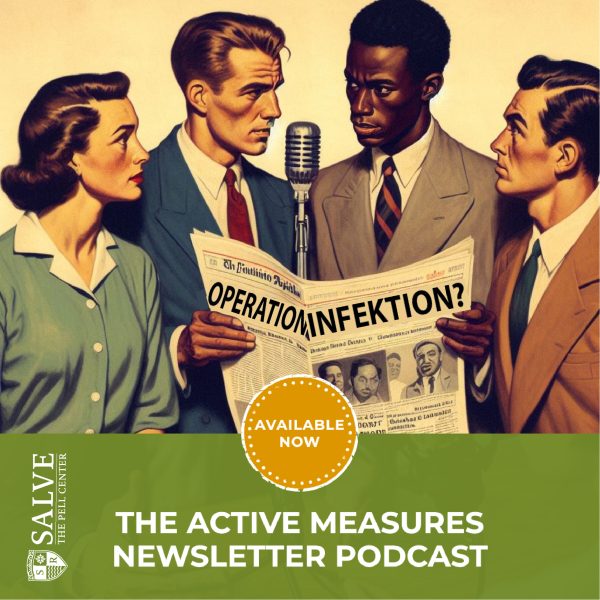
The Active Measures Newsletter Podcast
- Episodes
- 100
- Released
- weekly
- Latest episode
- Nov 21, 2026
About the podcast
From the Pell Center at Salve Regina University and the creators of the Active Measures Newsletter, a weekly dive into the latest trends in political warfare, influence, and information campaigns.
Episodes 100
Chinese Influence in Latin America with Natalia Cote-Muñoz
China is expanding its influence in Latin America, not with multi-billion dollar infrastructure projects, but with small, local partnerships with state- and municipal governments. Natalia Cote-Muñoz, a senior …
Show notes
China is expanding its influence in Latin America, not with multi-billion dollar infrastructure projects, but with small, local partnerships with state- and municipal governments. Natalia Cote-Muñoz, a senior fellow at Inter-American Dialogue and a former U.S. State Department official, explains how commercial agreements and sub-national relationships can build a lasting presence across the region. She tracks Chinese projects involving lithium, energy, policing and surveillance, and describes how Chinese engagement with local officials fosters connections that endure as those leaders move into national government. In the end, China is banking on smaller initiatives that add up to broader influence in the Americas. Hosts Jim Ludes and Mark Jacobson also note new reporting on Russian hybrid warfare in Poland and Norway.
See omnystudio.com/listener for privacy information.
Information Competition with Jessica Brandt
Artificial intelligence is giving foreign influence operations new ways to create, target, and promote deceptive content. Jessica Brandt, a senior fellow for technology and national security at the Council on …
Show notes
Artificial intelligence is giving foreign influence operations new ways to create, target, and promote deceptive content. Jessica Brandt, a senior fellow for technology and national security at the Council on Foreign Relations and former director of the Foreign Malign Influence Center, discusses how AI can support content generation, translation, fake personas, artificial engagement, audience research, and forged documents. She describes a Russia-linked operation that used ChatGPT to build a think-tank-style website, falsely listed real experts as affiliates, and promoted content praising Russia and denigrating the West. Brandt argues that such tools can make influence operations cheaper and help establish infrastructure for ongoing efforts, while making it harder to distinguish authentic domestic voices from foreign influence. Hosts Jim Ludes and Mark Jacobson also discuss the Trump administration’s reorganization of the Pentagon office responsible for Special Operations and Low Intensity Conflict as well as a report describing efforts by Russia and Iran to exploit and amplify recent French protests.
See omnystudio.com/listener for privacy information.
An AI Chatbot Built to Fight Disinformation with Matt Skibinski
Large language models can be corrupted by disinformation seeded online, causing them to repeat false claims as fact. But NewsGuard COO Matt Skibinski offers a solution: NewsGuard AI, a news-focused chatbot …
Show notes
Large language models can be corrupted by disinformation seeded online, causing them to repeat false claims as fact. But NewsGuard COO Matt Skibinski offers a solution: NewsGuard AI, a news-focused chatbot designed from the ground-up to draw language from sources rated for reliability cross-referenced against a continuously updated database of false claims. It’s a powerful tool that puts AI to good use, particularly in the context of a mid-term election awash with disinformation from both domestic and international sources. Hosts Jim Ludes and Mark Jacobson also discuss the spate of bomb-threats targeting European airlines and initial assessments of foreign malign influence in the mid-term elections.
See omnystudio.com/listener for privacy information.
Russia, China, and the 2026 U.S. Elections with Darren Linvill
Russia's influence campaigns aimed at the 2026 U.S. midterms seek, ultimately, to undermine confidence in the vote, not to change votes themselves. In this episode, Darren Linvill, professor of communication …
Show notes
Russia's influence campaigns aimed at the 2026 U.S. midterms seek, ultimately, to undermine confidence in the vote, not to change votes themselves. In this episode, Darren Linvill, professor of communication and co-director of the Media Forensics Hub at Clemson University walks through two Russian campaigns: Matryoshka—which makes AI-altered fake news videos for a limited audience—and Storm 1516, a more effective campaign that pays real influencers to spread invented stories of corruption and scandal, mostly about Democratic candidates. Hosts Jim Ludes and Mark Jacobson also discuss new evidence about Russia’s role in Brexit and the current reporting about Moscow’s efforts in the 2026 U.S. midterms.
See omnystudio.com/listener for privacy information.
Don't be Fooled by the Domestic Politics of Foreign Assistance with Rachel A. George
Washington keeps misreading the politics of foreign aid, and that misunderstanding is reshaping U.S. power. Rachel A. George of Stanford University breaks down why Americans are far less hostile to aid than …
Show notes
Washington keeps misreading the politics of foreign aid, and that misunderstanding is reshaping U.S. power. Rachel A. George of Stanford University breaks down why Americans are far less hostile to aid than politicians claim, what the Trump-era USAID shutdown actually changed, and why the real fight is over accountability, transparency, and strategy - not whether aid should exist at all.George explains how the collapse of USAID sent shockwaves through the global aid system, why the damage extended well beyond Washington, and how European donors responded by pulling back too. Co-hosts Jim Ludes and Mark Jacobson also discuss Russian efforts to intervene in the mid-terms as well as Russian efforts to weaponize history itself.
See omnystudio.com/listener for privacy information.
Russia vs. 'Pam' with Jessica Huseman
The gap between imagined and actual threats to elections is vast. Where the public is focused on hacking electronic voting machines, the actual threat, says Votebeat Editorial Director Jessica Huseman, is …
Show notes
The gap between imagined and actual threats to elections is vast. Where the public is focused on hacking electronic voting machines, the actual threat, says Votebeat Editorial Director Jessica Huseman, is unlikely to change actual votes. Still, there are real threats, from the 100 suspicious letters sent to election offices this week to the everyday cybersecurity challenges facing local officials. To complicate things further, the second Trump administration has unwound the tremendous work done in the first Trump administration to create a federal capacity to protect elections. What remains are patriotic, local election workers committed to serving their communities and ensuring democracy works. Hosts Jim Ludes and Mark Jacobson also discuss the viral claims about Ukrainian strikes on Russian data centers and the British Prime Minister’s recent remarks about Brexit.
See omnystudio.com/listener for privacy information.
Special Edition: Mark Jacobson on Effective Election Disinformation
Election interference doesn’t have to change votes to be effective. The long history of Russian efforts to target specific communities in the United States mirrors domestic efforts to suppress votes. These …
Show notes
Election interference doesn’t have to change votes to be effective. The long history of Russian efforts to target specific communities in the United States mirrors domestic efforts to suppress votes. These measures don’t require AI, social media, or bot-farms—they simply require a decent understanding of one candidate’s voters. With that, anyone can generate an effective campaign to confuse voters or suppress turn-out with the ultimate goal of undermining confidence in democratic processes and institutions. Russia has a long history of this tactic, and Mark Jacobson reviews the last decade of Russian campaigns targeting voters in successive American elections.
See omnystudio.com/listener for privacy information.
“We were here and we can come back again,” with Jim Ludes and Mark Jacobson
Hostile information activity is no longer just about false claims, but about intimidation, disruption, and shaping the conditions in which politics and policy unfold. In this week’s episode, Jim Ludes and Mark …
Show notes
Hostile information activity is no longer just about false claims, but about intimidation, disruption, and shaping the conditions in which politics and policy unfold. In this week’s episode, Jim Ludes and Mark Jacobson provide a wide-ranging update on current foreign malign influence efforts, from suspected break-ins at Finnish lawmakers’ homes to Russia’s growing use of cloned media outlets and AI-assisted deception. They also examine how Australia, Britain, and the United States are wrestling with the harder question of how democracies should respond without sliding into censorship.
See omnystudio.com/listener for privacy information.
Everything Old is New Again: Russian Election Interference with Dustin Volz
Foreign election interference aims to weaken trust in democracy more than to change vote counts. New York Times reporter Dustin Volz takes us inside his recent reporting on U.S. intelligence tracking current …
Show notes
Foreign election interference aims to weaken trust in democracy more than to change vote counts. New York Times reporter Dustin Volz takes us inside his recent reporting on U.S. intelligence tracking current foreign efforts to influence America’s election. The Russians are still sewing chaos; the Chinese are attacking down-ballot races, and the Iranians—locked in an intense fight with the United States—emerge as the wild card as we head into the mid-term elections. Hosts Jim Ludes and Mark Jacobson also look at the remarkable speech by UK Prime Minister Andy Burnham announcing the formation of a new, information defense agency.
See omnystudio.com/listener for privacy information.
Deepfakes and Disinformation with Katelyn Chedraoui
AI deepfakes don’t have to be flawless. They have to look believable enough to make you react. We spoke with CNET reporter Katelyn Chedraoui about where deepfakes are now—and what gives them so much potential …
Show notes
AI deepfakes don’t have to be flawless. They have to look believable enough to make you react. We spoke with CNET reporter Katelyn Chedraoui about where deepfakes are now—and what gives them so much potential as vehicles for disinformation. Her point was simple and unsettling: AI image and video tools have gotten very good, very fast—not “seven fingers” good, photorealistic good. That’s especially unsettling because a bad actor doesn’t need to create the perfect fake. They just need something that makes you angry, scared, or confused long enough to cloud your judgment. That can be a video; a robocall; a text about a polling place changing. Sometimes the most effective deception is also the most mundane. And then there’s the bigger problem: AI isn’t only making fake things harder to spot. It’s also making real things easier to doubt. Co-hosts Jim Ludes and Mark Jacobson also discuss the recent U.S. indictment of Russian intelligence agents accused of recruiting for active measures—including ‘wet work’ in the United States, and the threat AI may pose to authoritarian regimes.
See omnystudio.com/listener for privacy information.
AI and Radicalization in Closed Loops with Simeon Dukić and Natalie Vela
AI chatbots may be quietly reinforcing conspiracy thinking, extremist narratives, and harmful beliefs through private, personalized conversations designed to keep users engaged. Simeon Dukic and Natalie Vela of …
Show notes
AI chatbots may be quietly reinforcing conspiracy thinking, extremist narratives, and harmful beliefs through private, personalized conversations designed to keep users engaged. Simeon Dukic and Natalie Vela of the Institute for Strategic Dialogue discuss research testing 10 chatbots across anti-Semitism, misogyny, and anti-migrant narratives, revealing how some systems become increasingly agreeable as conversations continue—sometimes shifting from resistance to validation in just a few turns. …What Really Scares Authoritarians with Scott Fisher and Graig Klein
Authoritarian regimes from Moscow to Beijing fear losing control of their own information eco-systems—more than military exercises, more than economic sanctions, and more than diplomatic isolation. That’s the …
Show notes
Authoritarian regimes from Moscow to Beijing fear losing control of their own information eco-systems—more than military exercises, more than economic sanctions, and more than diplomatic isolation. That’s the conclusion from new research by Scott Fisher and Graig Klein who see in the data evidence of a tremendous opportunity for Western democracies to hold their authoritarian rivals at risk—either by threatening to break the regime’s monopoly on information, demonstrating the capability to do…The Propaganda Manual of the Ukraine War with Thomas Kent
Russia and Ukraine are fighting more than battles on Ukrainian soil, they are fighting a war for minds, and other governments are still playing catch-up. Thomas Kent of the American Foreign Policy Council …
Show notes
Russia and Ukraine are fighting more than battles on Ukrainian soil, they are fighting a war for minds, and other governments are still playing catch-up. Thomas Kent of the American Foreign Policy Council explains how Ukraine turned a chaotic communications system into a wartime information powerhouse, appealed to Speaker Mike Johnson’s Baptist roots to unlock U.S. …The AI Disinformation Incident Repository with Sam Stockwell and Broderick McDonald
AI disinformation is no longer just about deepfakes. It is now about poisoned search results, chatbot hallucinations, meme-driven propaganda, and a fast-growing economy built to exploit chaos. Sam Stockwell and …
Show notes
AI disinformation is no longer just about deepfakes. It is now about poisoned search results, chatbot hallucinations, meme-driven propaganda, and a fast-growing economy built to exploit chaos. Sam Stockwell and Broderick McDonald from the Alan Turing Institute unpack the new playbook - and why the next information war may be won before the truth even has a chance to catch up. …TikTok is a Potent Weapon of CCP Political Warfare with Michael Sobolik
TikTok is a potent tool for the Chinese Communist Party’s psychological warfare against the United States. In this conversation, the Hudson Institute’s Michael Sobolik highlights how TikTok's algorithm can …
Show notes
TikTok is a potent tool for the Chinese Communist Party’s psychological warfare against the United States. In this conversation, the Hudson Institute’s Michael Sobolik highlights how TikTok's algorithm can shape public opinion in the U.S., particularly among younger audiences, and raises concerns about national security. The discussion also covers the potential for crisis scenarios where the CCP could manipulate information during conflicts, such as a hypothetical situation involving Taiwan. …AI Powered Community Notes on X with Alexios Mantzarlis
AI is already writing more than half of X’s helpful Community Notes, and that changes everything about who gets fact-checked, what gets fact-checked, and what happens when “the community” starts looking a lot …
Show notes
AI is already writing more than half of X’s helpful Community Notes, and that changes everything about who gets fact-checked, what gets fact-checked, and what happens when “the community” starts looking a lot more synthetic. Alexios Mantzarlis, co-founder of Indicator and a self-described “recovering fact checker,” breaks down the surprising rise of AI-written notes, why bots sometimes outperform humans, and the bigger danger hiding underneath the numbers: a moderation system that can look…'Working the Political Engine': Revolutionary War-Era Propaganda with Robert Parkinson
Propaganda was foundational to America's independence, from the direct appeal of Thomas Paine’s Common Sense to the black-propaganda of Benjamin Franklin’s scalp hoax. Binghamton University Professor of History …
Show notes
Propaganda was foundational to America's independence, from the direct appeal of Thomas Paine’s Common Sense to the black-propaganda of Benjamin Franklin’s scalp hoax. Binghamton University Professor of History Robert Parkinson reveals the hidden power of newspapers, pamphlets, and even fake news in shaping independence. …'Assume that everything you're seeing is paid for' with Jason Beeferman
That post you saw about Polymarket odds? It very well may have been sponsored—paid for by the company that stands to gain the most from your wager. Only the influencer making the post didn’t have to disclose …
Show notes
That post you saw about Polymarket odds? It very well may have been sponsored—paid for by the company that stands to gain the most from your wager. Only the influencer making the post didn’t have to disclose their financial interest. Political Reporter Jason Beeferman, with his colleagues at Politico, have blown the doors off the story, identifying influencers and nearly 500 social media posts they created in exchange for payment—without disclosing that arrangement to their followers. …Special Edition: Operation Cornflakes
In the realm of disinformation and political warfare, few operations stand out as prominently as Operation Cornflakes. This unique campaign, launched during World War II, aimed to exploit the German postal …
Show notes
In the realm of disinformation and political warfare, few operations stand out as prominently as Operation Cornflakes. This unique campaign, launched during World War II, aimed to exploit the German postal system to disseminate black propaganda. In this special edition of the podcast, Mark Jacobson unravels the intricacies of Operation Cornflakes, examining how it worked, its historical context, and the lessons it offers for understanding modern information warfare. …Special Edition: Propaganda and the American Revolution
The Declaration of Independence, adopted on July 4, 1776, was more than a formal announcement of separation from Britain, it was a masterful piece of propaganda. By articulating grievances and affirming …
Show notes
The Declaration of Independence, adopted on July 4, 1776, was more than a formal announcement of separation from Britain, it was a masterful piece of propaganda. By articulating grievances and affirming universal rights, it sought to unify the colonies and garner international support. The document framed the revolution not just as a political struggle, but as a moral imperative--and the legacy of that framing resonates to this day.
See omnystudio.com/listener for privacy information.
The Bulgarian Elections with Sopo Gelava
We started noticing it in 2024: an inside-outside game in which American political actors seed divisive issues that are then exploited from abroad. But there are also internationally fueled narratives that …
Show notes
We started noticing it in 2024: an inside-outside game in which American political actors seed divisive issues that are then exploited from abroad. But there are also internationally fueled narratives that often spur domestic voices. We've described it as a “dialogue” between actors foreign and domestic. …Active Measures with Sean M. Wiswesser
Some look at the U.S. elections in 2016 and 2020 and see issues of partisan contention. Sean M. Wiswesser--a national security professional with 30 years of experience in intelligence, foreign service, and …
Show notes
Some look at the U.S. elections in 2016 and 2020 and see issues of partisan contention. Sean M. Wiswesser--a national security professional with 30 years of experience in intelligence, foreign service, and defense--sees an outright attack on American democracy by Russia, using an old playbook called 'active measures.' On this week's podcast, Wiswesser recounts Russia's tactics and the continuing danger to Western democracies. …Fighting Disinformation and Protecting the Constitution with Katie Kedian
During the Cold War, President Eisenhower used to caution people that in confronting the Soviets, the United States needed to be careful that we didn’t destroy the very thing we sought to preserve. GW Law …
Show notes
During the Cold War, President Eisenhower used to caution people that in confronting the Soviets, the United States needed to be careful that we didn’t destroy the very thing we sought to preserve. GW Law Visiting Associate Professor Katie Kedian makes a similar point about countering disinformation in American public life today. …CISA Dismantled with Former U.S. Representatives Tim Roemer and Reid Ribble
In 2018, President Donald Trump signed into law legislation creating the Cybersecurity Infrastructure Security Agency (CISA). Yet former Congressmen Tim Roemer (D-IN) and Reid Ribble (R-WI) warn that President …
Show notes
In 2018, President Donald Trump signed into law legislation creating the Cybersecurity Infrastructure Security Agency (CISA). Yet former Congressmen Tim Roemer (D-IN) and Reid Ribble (R-WI) warn that President Trump has since gutted the very same agency despite rising threats from Russia, China, and Iran. …Honoring the Fallen: A Memorial Day Tribute
As long as humanity has etched images into stone and told stories to others, we have honored and remembered heroes so that their names would live forever. In this Memorial Day edition of the Active Measures …
Show notes
As long as humanity has etched images into stone and told stories to others, we have honored and remembered heroes so that their names would live forever. In this Memorial Day edition of the Active Measures Newsletter Podcast, hosts Jim Ludes and Mark Jacobson read the names of U.S. psychological operations personnel who have given the final full measure since the Korean War and honor all who have made the ultimate sacrifice for our country. See omnystudio.com/listener for privacy information.Tracking Foreign Language Disinformation with Martina Guzmán
Anyone who has ever tried to study disinformation is well-familiar with the firehose of falsehoods—there’s just so much content on so many platforms and in so much media that it’s virtually impossible to track …
Show notes
Anyone who has ever tried to study disinformation is well-familiar with the firehose of falsehoods—there’s just so much content on so many platforms and in so much media that it’s virtually impossible to track it all. But Martina Guzmán figured out a way to use AI to help sift through all of the audio content being generated on radio stations across the country. …Disinformation, Accountability and Democracy with Alan Jagolinzer
Over the last 18 months, the Trump administration has characterized efforts to counter disinformation as attacks on free speech, going so far as refuse visas to European fact-checkers. But the founder and chair …
Show notes
Over the last 18 months, the Trump administration has characterized efforts to counter disinformation as attacks on free speech, going so far as refuse visas to European fact-checkers. But the founder and chair of the Cambridge Disinformation Summit, Alan Jagolinzer, sees disinformation not simply as speech, but rather a preparatory act preceding harm—a reframing of the challenge that opens the door to a wide-range of interventions. Hosts Jim Ludes and Mark Jacobson also talk about U.S. …Storm-1516 and the Hungarian Election with Darren Linvill
Peter Magyar and the Tisza Party won the Hungarian parliamentary elections in April, but Russia’s coordinated influence campaign to discredit him and his party exposes current Russian influence campaigns in the …
Show notes
Peter Magyar and the Tisza Party won the Hungarian parliamentary elections in April, but Russia’s coordinated influence campaign to discredit him and his party exposes current Russian influence campaigns in the West. Darren Linville of the Clemson University Media Forensics Hub walks us through the way Russia’s Storm-1516 ecosystem launders fabricated narratives—ranging from corruption and money laundering to military conscription and anti‑Ukraine claims—through fake news sites and outsourced…Iranian Influence Campaigns with "Jane" from Graphika
Iran’s digital influence campaigns didn’t start with the current war, and they won’t stop when it ends, says “Jane,” an analyst from the intelligence firm Graphika who asked us not to use her real name. In …
Show notes
Iran’s digital influence campaigns didn’t start with the current war, and they won’t stop when it ends, says “Jane,” an analyst from the intelligence firm Graphika who asked us not to use her real name. In fact, last year’s 12-Day War and the current conflict show all the hallmarks of Iran’s international information campaigns, running the gamut from traditional propaganda to hacktivism and AI-generated content, sometimes with international amplification from America’s adversaries. …Iran's Lego War with David Gilbert
Iran is winning the meme war. It may seem like a silly metric, but it cuts to the quick of the nature of conflict. Iranian use of AI generated Lego-movies has shown the power and potential for new technology to …
Show notes
Iran is winning the meme war. It may seem like a silly metric, but it cuts to the quick of the nature of conflict. Iranian use of AI generated Lego-movies has shown the power and potential for new technology to reshape the modern battlefield—especially where it matters, in the minds of audiences around the world. …
These are the latest 40 of 100 episodes. You’ll find older episodes in the podcast’s feed.
Similar podcasts
More History podcasts






Is this your podcast?
Confirm it with an entry in your feed: you get a code here, add it as podcast:txt to the channel of your feed, and we check it. Your podcast is then shown as “verified” on SoundNode.