

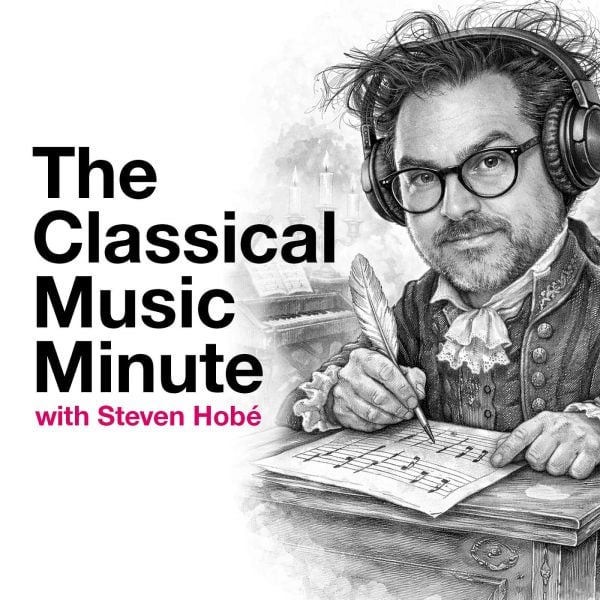
The Classical Music Minute
- Episodes
- 304
- Released
- weekly
- Latest episode
- Nov 25, 2026
About the podcast
The Classical Music Minute is a short, engaging classical music podcast that explores the stories, composers, and curious traditions behind the world’s greatest music.
Ever wondered who the Florentine Camerata were? Where the conductor’s baton came from? Or what the difference is between opera buffa and opera seria?
Hosted by Canadian composer and storyteller Steven Hobé, each episode offers a quick and entertaining journey through classical music history, uncovering fascinating facts about composers, famous works, opera, orchestras, and musical traditions.
Whether you’re a lifelong music lover or simply curious about classical music, hop around music history with Steven—one musical minute at a time.
Episodes 304
Mozart's Search for Independence | In Their Own Words, Part Two: The Paris Years
In March 1778, twenty-two-year-old Wolfgang Amadeus Mozart arrived in Paris with his mother, Anna Maria, hoping to build a career beyond Salzburg. But the city that promised opportunity soon tested his …
Show notes
In March 1778, twenty-two-year-old Wolfgang Amadeus Mozart arrived in Paris with his mother, Anna Maria, hoping to build a career beyond Salzburg. But the city that promised opportunity soon tested his patience, his pride, and ultimately his resilience.
In Part Two of Mozart’s Search for Independence, we follow Mozart through three of his letters, brought to life through dramatised readings. Writing to his father, Leopold, Mozart recalls the friendships and affection he left behind in Mannheim, then offers a sharply comic account of his encounters with Parisian high society—where extravagant compliments did not necessarily lead to paid work. The episode closes with a deeply personal letter to his trusted friend Abbé Bullinger, written in the immediate aftermath of his mother’s death.
From youthful hope to biting frustration and profound grief, these letters offer an intimate glimpse of Mozart at a pivotal moment in his life.
In Their Own Words is a special series from The Classical Music Minute, exploring the lives of composers through their correspondence.
Source and disclaimer: The letters featured in this episode are drawn from The Letters of Wolfgang Amadeus Mozart, 1769–1791, translated into English by Lady Wallace and made available in the public domain through Project Gutenberg. Selected passages have been omitted for length. The readings are dramatised performances of the historical English translation, not recordings of Mozart himself. Historical narration and commentary have been added for context.
Source: https://www.gutenberg.org/ebooks/5307
Your support helps bring more musical stories to life!
👉 Support The Classical Music Minute ☕ Why not buy me a coffee? 🤓
Love classical music? There's more to discover.
Join me on Substack at The Classical Music Minute. Or download the Classical Minute app for iPhone.
What Does the K Mean in Mozart’s Music? | The Classical Music Minute
What does the K in Mozart’s K. 525 mean? Meet Ludwig von Köchel and discover how his catalogue helps us find Mozart’s music, even when a piece goes by different titles.Your support helps bring more musical …
Show notes
What does the K in Mozart’s K. 525 mean? Meet Ludwig von Köchel and discover how his catalogue helps us find Mozart’s music, even when a piece goes by different titles.
Your support helps bring more musical stories to life!
👉 Support The Classical Music Minute ☕ Why not buy me a coffee? 🤓
Love classical music? There's more to discover.
Join me on Substack at The Classical Music Minute. Or download the Classical Minute app for iPhone.
Hearing the Impossible: How Beethoven Composed While Deaf | The Classical Music Minute
How did Beethoven compose music while deaf? Discover how his musical imagination and years of experience helped him create extraordinary works, including his Ninth Symphony, as his hearing deteriorated.Your …
Show notes
How did Beethoven compose music while deaf? Discover how his musical imagination and years of experience helped him create extraordinary works, including his Ninth Symphony, as his hearing deteriorated.
Your support helps bring more musical stories to life!
👉 Support The Classical Music Minute ☕ Why not buy me a coffee? 🤓
Love classical music? There's more to discover.
Join me on Substack at The Classical Music Minute. Or download the Classical Minute app for iPhone.
Celebrating Our 300th Episode | Charles Burney at 300 | The Classical Music Minute
We’re celebrating 300 episodes of The Classical Music Minute with Charles Burney, born 300 years ago in 1726. Discover the musician, traveller and historian whose encounters with Mozart and journeys across …
Show notes
We’re celebrating 300 episodes of The Classical Music Minute with Charles Burney, born 300 years ago in 1726. Discover the musician, traveller and historian whose encounters with Mozart and journeys across Europe helped preserve the stories behind the music.
Your support helps bring more musical stories to life!
👉 Support The Classical Music Minute ☕ Why not buy me a coffee? 🤓
Love classical music? There's more to discover.
Join me on Substack at The Classical Music Minute. Or download the Classical Minute app for iPhone.
When the Rules Were Broken: Music in the 20th Century | The Classical Music Minute
Tonality was challenged, rhythm reinvented, and technology introduced entirely new sounds. During the 20th century, classical music expanded in more directions than ever before.Your support helps bring more …
Show notes
Tonality was challenged, rhythm reinvented, and technology introduced entirely new sounds. During the 20th century, classical music expanded in more directions than ever before.
Your support helps bring more musical stories to life!
👉 Support The Classical Music Minute ☕ Why not buy me a coffee? 🤓
Love classical music? There's more to discover.
Join me on Substack at The Classical Music Minute. Or download the Classical Minute app for iPhone.
When Music Became Personal: The Romantic Era | The Classical Music Minute
Bigger orchestras, richer harmonies, virtuoso performers, and a new emphasis on personal expression transformed music during the Romantic era.Your support helps bring more musical stories to life!👉 Support The …
Show notes
Bigger orchestras, richer harmonies, virtuoso performers, and a new emphasis on personal expression transformed music during the Romantic era.
Your support helps bring more musical stories to life!
👉 Support The Classical Music Minute ☕ Why not buy me a coffee? 🤓
Love classical music? There's more to discover.
Join me on Substack at The Classical Music Minute. Or download the Classical Minute app for iPhone.
The Age of Elegance and Order: The Classical Era | The Classical Music Minute
Clear melodies, balanced forms, and the rise of the symphony helped define the Classical era. It was the age of Haydn and Mozart—and of a young Beethoven beginning to push music in a new direction.Your support …
Show notes
Clear melodies, balanced forms, and the rise of the symphony helped define the Classical era. It was the age of Haydn and Mozart—and of a young Beethoven beginning to push music in a new direction.
Your support helps bring more musical stories to life!
👉 Support The Classical Music Minute ☕ Why not buy me a coffee? 🤓
Love classical music? There's more to discover.
Join me on Substack at The Classical Music Minute. Or download the Classical Minute app for iPhone.
When Music Became Dramatic: The Baroque Era | The Classical Music Minute
Opera was born, instrumental music flourished, and major and minor keys became central to Western music. The Baroque era gave us some of classical music’s most enduring forms—and some of its greatest …
Show notes
Opera was born, instrumental music flourished, and major and minor keys became central to Western music. The Baroque era gave us some of classical music’s most enduring forms—and some of its greatest composers.
Your support helps bring more musical stories to life!
👉 Support The Classical Music Minute ☕ Why not buy me a coffee? 🤓
Love classical music? There's more to discover.
Join me on Substack at The Classical Music Minute. Or download the Classical Minute app for iPhone.
Mozart's Search for Independence | In Their Own Words, Part One: Mannheim
What was Mozart really like when the concert halls fell silent and he sat down to write to his family?In Their Own Words is a special series from The Classical Music Minute that explores the lives of history’s …
Show notes
What was Mozart really like when the concert halls fell silent and he sat down to write to his family?
In Their Own Words is a special series from The Classical Music Minute that explores the lives of history’s great composers through their personal correspondence. Combining historical context with dramatized readings of their letters, the series takes us beyond the familiar portraits of musical genius to encounter the people behind the music—their ambitions, frustrations, relationships, disappointments and triumphs.
In Part One, we meet Wolfgang Amadeus Mozart in Mannheim in 1777.
At twenty-one, Mozart is no longer the celebrated child prodigy touring the courts of Europe. He is a young professional composer searching for something much harder to find: a secure position that will give him recognition, financial stability and greater control over his own future.
Through two letters written to his father, Leopold, we hear Mozart in his own words—enthusiastic about Mannheim’s extraordinary musical world, wonderfully candid in his opinions, increasingly frustrated by his father’s concerns, and determined to establish a career on his own terms.
Behind it all lies a larger question that would follow Mozart throughout his life: how could a composer achieve artistic independence in a world still dominated by aristocratic patronage?
This is Mozart before Vienna, before The Marriage of Figaro, Don Giovanni and The Magic Flute—a twenty-one-year-old musician who has no idea what the future holds.
About the letters: The correspondence featured in this episode is drawn from the nineteenth-century English translation by Lady Grace Wallace, published in 1866 and available through Project Gutenberg. Selected passages have been omitted for length and narrative flow, while the wording of the passages presented has been preserved. The letters are presented as dramatized readings.
Your support helps bring more musical stories to life!
👉 Support The Classical Music Minute ☕ Why not buy me a coffee? 🤓
Love classical music? There's more to discover.
Join me on Substack at The Classical Music Minute. Or download the Classical Minute app for iPhone.
Music Reborn: The Renaissance Era | The Classical Music Minute
Polyphony flourished, madrigals filled courts and homes, and printing helped music travel across Europe. In just two centuries, the Renaissance transformed how Western music was composed, performed, and …
Show notes
Polyphony flourished, madrigals filled courts and homes, and printing helped music travel across Europe. In just two centuries, the Renaissance transformed how Western music was composed, performed, and shared.
Your support helps bring more musical stories to life!
👉 Support The Classical Music Minute ☕ Why not buy me a coffee? 🤓
Love classical music? There's more to discover.
Join me on Substack at The Classical Music Minute. Or download the Classical Minute app for iPhone.
How Did Medieval Music Shape the Western Tradition? | The Classical Music Minute
From Gregorian chant to polyphony, the Medieval era saw some of Western music’s most important developments—including the growth of musical notation and increasingly complex composition. Your support helps …
Show notes
From Gregorian chant to polyphony, the Medieval era saw some of Western music’s most important developments—including the growth of musical notation and increasingly complex composition. Your support helps bring more musical stories to life! 👉 Support The Classical Music Minute ☕ Why not buy me a coffee? 🤓 Love classical music? There's more to discover. Join me on Substack at The Classical Music Minute. Or download the Classical Minute app for iPhone.Why Did Baroque Arias Repeat Themselves? The Da Capo Aria | The Classical Music Minute
Why would an opera aria finish—and then send the singer straight back to the beginning? Discover the da capo aria, a Baroque form that turned repetition into an opportunity for singers to improvise, ornament …
Show notes
Why would an opera aria finish—and then send the singer straight back to the beginning? Discover the da capo aria, a Baroque form that turned repetition into an opportunity for singers to improvise, ornament, and show off their artistry—all in just sixty seconds. Your support helps bring more musical stories to life! 👉 Support The Classical Music Minute ☕ Why not buy me a coffee? 🤓 Love classical music? There's more to discover. Join me on Substack at The Classical Music Minute. …Before the Blues, There Was John Dowland | The Classical Music Minute
Sad songs were popular long before modern playlists. Meet John Dowland, the Elizabethan composer and virtuoso lutenist who transformed melancholy into some of the most hauntingly beautiful music of his age—all …
Show notes
Sad songs were popular long before modern playlists. Meet John Dowland, the Elizabethan composer and virtuoso lutenist who transformed melancholy into some of the most hauntingly beautiful music of his age—all in just sixty seconds. Your support helps bring more musical stories to life! 👉 Support The Classical Music Minute ☕ Why not buy me a coffee? 🤓 Love classical music? There's more to discover. Join me on Substack at The Classical Music Minute. …What Were the Apollonian Principles in Stravinsky’s Music? | The Classical Music Minute
Stravinsky wasn't always the revolutionary behind The Rite of Spring. Discover how the ancient Greek ideal of Apollo—order, clarity, balance, and restraint—helped shape his Neoclassical music and a very …
Show notes
Stravinsky wasn't always the revolutionary behind The Rite of Spring. Discover how the ancient Greek ideal of Apollo—order, clarity, balance, and restraint—helped shape his Neoclassical music and a very different side of his creativity, all in just sixty seconds. Your support helps bring more musical stories to life! 👉 Support The Classical Music Minute ☕ Why not buy me a coffee? 🤓 Love classical music? There's more to discover. Join me on Substack at The Classical Music Minute. …What Were Rescue Operas? | The Classical Music Minute
Prisoners, secret identities, political oppression—and a daring rescue just in time. Discover how the revolutionary spirit of Europe inspired the rescue opera, a dramatic genre that gave us works such as …
Show notes
Prisoners, secret identities, political oppression—and a daring rescue just in time. Discover how the revolutionary spirit of Europe inspired the rescue opera, a dramatic genre that gave us works such as Beethoven’s Fidelio—all in just sixty seconds. Your support helps bring more musical stories to life! 👉 Support The Classical Music Minute ☕ Why not buy me a coffee? 🤓 Love classical music? There's more to discover. Join me on Substack at The Classical Music Minute. …What Is the Circle of Fifths? | The Classical Music Minute
It looks like a musical clock, but the Circle of Fifths is actually a map of how musical keys relate to one another. Discover how this ingenious diagram helps explain key signatures, harmony, and even how …
Show notes
It looks like a musical clock, but the Circle of Fifths is actually a map of how musical keys relate to one another. Discover how this ingenious diagram helps explain key signatures, harmony, and even how composers move from one key to another—all in just sixty seconds. Your support helps bring more musical stories to life! 👉 Support The Classical Music Minute ☕ Why not buy me a coffee? 🤓 Love classical music? There's more to discover. Join me on Substack at The Classical Music Minute. …Why Can a Piano Play in Every Key? The Secret of Equal Temperament | The Classical Music Minute
What if making music sound in tune actually requires making it slightly out of tune? Discover the ingenious compromise of equal temperament and how dividing the octave into twelve equal parts allows musicians …
Show notes
What if making music sound in tune actually requires making it slightly out of tune? Discover the ingenious compromise of equal temperament and how dividing the octave into twelve equal parts allows musicians to play freely in every key—all in just sixty seconds. Your support helps bring more musical stories to life! 👉 Support The Classical Music Minute ☕ Why not buy me a coffee? 🤓 Love classical music? There's more to discover. Join me on Substack at The Classical Music Minute. …What Were Goethe's Rules for Actors? | The Classical Music Minute
Long before modern acting schools, Johann Wolfgang von Goethe wrote a remarkable guide for performers. Discover why his advice on clarity, discipline, and natural expression still resonates with actors …
Show notes
Long before modern acting schools, Johann Wolfgang von Goethe wrote a remarkable guide for performers. Discover why his advice on clarity, discipline, and natural expression still resonates with actors today—all in just sixty seconds. Your support helps bring more musical stories to life! 👉 Support The Classical Music Minute ☕ Why not buy me a coffee? 🤓 Love classical music? There's more to discover. Join me on Substack at The Classical Music Minute. …How Did We Start Writing Music? | The Classical Music Minute
Music wasn't always written down. Discover how a medieval monk named Guido of Arezzo helped revolutionize music with a system of notation that still shapes the way musicians read and perform music today—all in …
Show notes
Music wasn't always written down. Discover how a medieval monk named Guido of Arezzo helped revolutionize music with a system of notation that still shapes the way musicians read and perform music today—all in just sixty seconds. Your support helps bring more musical stories to life! 👉 Support The Classical Music Minute ☕ Why not buy me a coffee? 🤓 Love classical music? There's more to discover. Join me on Substack at The Classical Music Minute. Or download the Classical Minute app for iPhone.What Happened to Classical Music in the Early 20th Century? | The Classical Music Minute
The early twentieth century was a time of enormous musical change. Discover how composers responded to a changing world by breaking traditions, experimenting with new sounds, and redefining what classical music …
Show notes
The early twentieth century was a time of enormous musical change. Discover how composers responded to a changing world by breaking traditions, experimenting with new sounds, and redefining what classical music could become—all in just sixty seconds. Your support helps bring more musical stories to life! 👉 Support The Classical Music Minute ☕ Why not buy me a coffee? 🤓 Love classical music? There's more to discover. Join me on Substack at The Classical Music Minute. …Drama Meets Music with Monteverdi | The Classical Music Minute
Opera didn't appear overnight. Meet Claudio Monteverdi, the composer who transformed music into powerful drama and helped create one of the world's greatest art forms. In just sixty seconds, discover why he's …
Show notes
Opera didn't appear overnight. Meet Claudio Monteverdi, the composer who transformed music into powerful drama and helped create one of the world's greatest art forms. In just sixty seconds, discover why he's often called the father of opera. Your support helps bring more musical stories to life! 👉 Support The Classical Music Minute ☕ Why not buy me a coffee? 🤓 Love classical music? There's more to discover. Join me on Substack at The Classical Music Minute. …Who Was the First Female Composer? (That We Know Of…) | The Classical Music Minute
Let's travel back more than 1,100 years to meet Kassia of Constantinople, the earliest known female composer whose music still survives today. In just sixty seconds, I'll introduce you to this extraordinary …
Show notes
Let's travel back more than 1,100 years to meet Kassia of Constantinople, the earliest known female composer whose music still survives today. In just sixty seconds, I'll introduce you to this extraordinary Byzantine abbess, poet, and composer whose works are still sung today. Your support helps bring more musical stories to life! 👉 Support The Classical Music Minute ☕ Why not buy me a coffee? 🤓 Love classical music? There's more to discover. Join me on Substack at The Classical Music Minute. …Who Was the First Great Composer? | The Classical Music Minute
Join me as I introduce you to Pérotin, one of the earliest known composers whose music still survives today. In just sixty seconds, you'll discover how this remarkable medieval composer helped shape the future …
Show notes
Join me as I introduce you to Pérotin, one of the earliest known composers whose music still survives today. In just sixty seconds, you'll discover how this remarkable medieval composer helped shape the future of Western classical music Your support helps bring more musical stories to life! 👉 Support The Classical Music Minute ☕ Why not buy me a coffee? 🤓 Love classical music? There's more to discover. Join me on Substack at The Classical Music Minute. …Why Is Wagner So Controversial? | The Classical Music Minute
Why does Richard Wagner remain one of the most debated figures in classical music? In this episode of The Classical Music Minute, we explore the complex legacy of the German composer whose operas revolutionized …
Show notes
Why does Richard Wagner remain one of the most debated figures in classical music? In this episode of The Classical Music Minute, we explore the complex legacy of the German composer whose operas revolutionized music drama while also generating lasting controversy. Wagner's artistic influence was profound. His innovations in harmony, orchestration, and storytelling shaped the future of opera and inspired countless composers. …Why Do Symphony Orchestras Have So Many Violins? | The Classical Music Minute
Why are there so many violins in a symphony orchestra? In this episode of The Classical Music Minute, we explore the role of the violin section and why it often contains more players than any other group in the …
Show notes
Why are there so many violins in a symphony orchestra? In this episode of The Classical Music Minute, we explore the role of the violin section and why it often contains more players than any other group in the orchestra. Because a single violin produces a relatively delicate sound, many players are needed to create the rich, powerful sonority associated with orchestral strings. …How Do Opera Singers Sing So Loud Without Microphones? | The Classical Music Minute
How can opera singers be heard over an entire orchestra without any electronic amplification? In this episode of The Classical Music Minute, we explore the fascinating science behind operatic singing. Contrary …
Show notes
How can opera singers be heard over an entire orchestra without any electronic amplification? In this episode of The Classical Music Minute, we explore the fascinating science behind operatic singing. Contrary to popular belief, opera singers do not simply sing louder than everyone else. Instead, they train for years to develop breath control, resonance, and efficient vocal production. …Why Is Beethoven’s Ninth Symphony So Important? | The Classical Music Minute
Why is Beethoven’s Ninth Symphony considered one of the most important works in classical music? In this episode of The Classical Music Minute, we explore the revolutionary ideas behind Beethoven’s final …
Show notes
Why is Beethoven’s Ninth Symphony considered one of the most important works in classical music? In this episode of The Classical Music Minute, we explore the revolutionary ideas behind Beethoven’s final completed symphony. Premiered in 1824, the work broke new ground by introducing a choir and vocal soloists into the final movement—something virtually unheard of in a symphony at the time. …What Is the Difference Between Opera and Operetta? | The Classical Music Minute
What is the difference between opera and operetta? In this episode of The Classical Music Minute, we explore two closely related forms of musical theatre. Opera is usually larger in scale and often more serious …
Show notes
What is the difference between opera and operetta? In this episode of The Classical Music Minute, we explore two closely related forms of musical theatre. Opera is usually larger in scale and often more serious in tone, with music driving the drama from beginning to end. Many operas deal with intense themes such as love, tragedy, power, fate, and betrayal. Operetta, whose name means “little opera,” is generally lighter and more comic. …Why Did Beethoven Go Deaf? | The Classical Music Minute
Why did Beethoven lose his hearing? In this episode of The Classical Music Minute, we explore one of the most famous mysteries in music history. Ludwig van Beethoven began experiencing hearing problems in his …
Show notes
Why did Beethoven lose his hearing? In this episode of The Classical Music Minute, we explore one of the most famous mysteries in music history. Ludwig van Beethoven began experiencing hearing problems in his late twenties, including ringing in the ears and difficulty hearing high sounds and distant voices. By 1802, he knew the condition was serious and progressive. …Why Is Pachelbel’s Canon Played at So Many Weddings? | The Classical Music Minute
Why has Pachelbel’s Canon in D become one of the most popular wedding pieces of all time? In this episode of The Classical Music Minute, we explore how a Baroque composition written centuries ago became closely …
Show notes
Why has Pachelbel’s Canon in D become one of the most popular wedding pieces of all time? In this episode of The Classical Music Minute, we explore how a Baroque composition written centuries ago became closely associated with modern wedding ceremonies. Known for its flowing melodies and repeating harmonic progression, Canon in D creates a calm and elegant atmosphere that naturally suits processions and ceremonial moments. …
These are the latest 40 of 304 episodes. You’ll find older episodes in the podcast’s feed.
Similar podcasts
More Education podcasts




Is this your podcast?
Confirm it with an entry in your feed: you get a code here, add it as podcast:txt to the channel of your feed, and we check it. Your podcast is then shown as “verified” on SoundNode.