

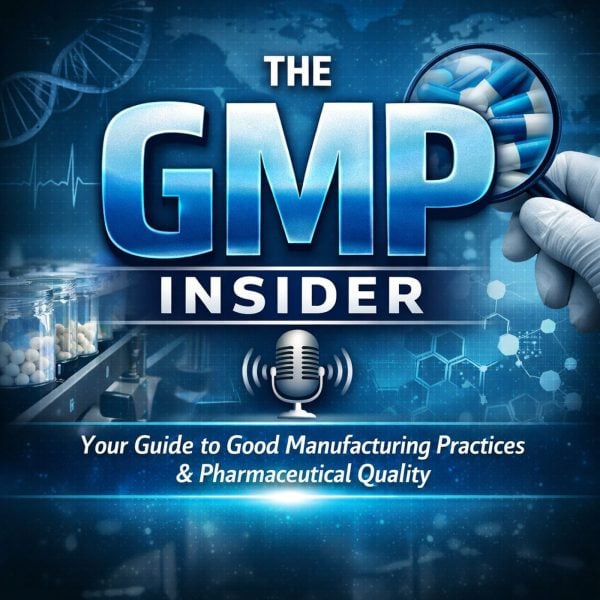
The GMP Insider
- Episodes
- 84
- Released
- weekly
- Latest episode
- Nov 25, 2026
About the podcast
GMP Insider is your go-to podcast for practical insights into pharmaceutical quality, Good Manufacturing Practices (GMP), and regulatory compliance.
Designed for quality professionals, manufacturing teams, and pharma leaders, this show breaks down complex regulations into clear, real-world guidance. Each episode explores topics like audits, CAPA, data integrity, quality systems, validation, and global regulatory expectations — all with a focus on protecting patients and building strong quality cultures.
Whether you work in Quality Assurance, Quality Control, Manufacturing, or Regulatory Affairs, GMP Insider helps you stay compliant, confident, and ahead in an ever-evolving pharmaceutical industry.
New episodes deliver:
• GMP best practices
• Audit readiness strategies
• Real compliance case studies
• Industry trends and updates
• Expert tips from quality professionals
From batch to patient — quality is everything.
Episodes 84
Can Pharma Trust AI in GMP? What FDA and EMA Actually Say
Every pharma conference now promises AI everywhere — auto-released batches, self-writing investigations, inspections predicted before they happen. Marcus and Priya separate what regulators have actually said …
Show notes
Every pharma conference now promises AI everywhere — auto-released batches, self-writing investigations, inspections predicted before they happen. Marcus and Priya separate what regulators have actually said from what's being sold: FDA's risk-based credibility framework, EMA's reflection paper, the use cases earning trust today, and the evidence a model owes you before it touches a GMP decision.
• What FDA has actually said: the January 2025 draft guidance on AI in drug manufacturing and its risk-based credibility assessment framework• What EMA has actually said: the reflection paper, AI across the medicine lifecycle, and human oversight that can actually intervene• Where AI works today: vision inspection, document drafting, predictive maintenance, deviation pattern detection — deployed and defensible• The evidence a model owes you: accuracy on your data against your criteria, managed drift, and version changes treated as process changes• Generative AI, the special case: trained on the internet, fluent in nonsense — why chatbots start in the sandbox, not the batch record• The trust question answered: use cases get trusted one at a time, and every model decision remains somebody's signature
New episodes every Monday and Wednesday — follow The GMP Insider so you never miss one.Connect with Tushar Arora on LinkedIn: https://www.linkedin.com/in/tushar-a-926382161Watch on YouTube: https://www.youtube.com/@TheGMPInsider
Produced with AI assistance.21 CFR Part 11 and Computerized Systems (CSV) in the Annex 22 Era
An electronic signature is the easy part of Part 11 — it's everything behind it that gets companies in trouble. Marcus and Priya cover what Part 11 and Annex 11 actually demand: validation for intended use …
Show notes
An electronic signature is the easy part of Part 11 — it's everything behind it that gets companies in trouble. Marcus and Priya cover what Part 11 and Annex 11 actually demand: validation for intended use, audit trails as a living control, shared responsibility in the cloud and SaaS era, and the EU's draft Annex 22, which puts AI decision-making systems on exactly that same discipline.
• What Part 11 actually demands: predicate rules, intended use, and why "the vendor validated it" was never a compliance position• Where CSV went wrong: document theatre that scales with neither risk nor change, and the CSA correction — assurance that scales with patient risk• Audit trails, the living control: generated, secure, computer time-stamped, retained as long as the record — and reviewed by the people who own the process• Cloud, SaaS, and shared responsibility: which controls live where, and how vendor patching quietly breaks validated states• Records in transit: migration, archiving, retirement, and the retiree's question — can a future inspector still read this?• Annex 22: the draft that treats AI systems as GMP decision systems — classified, data-governed, monitored, with a human accountable for the outcome
New episodes every Monday and Wednesday — follow The GMP Insider so you never miss one.Connect with Tushar Arora on LinkedIn: https://www.linkedin.com/in/tushar-a-926382161Watch on YouTube: https://www.youtube.com/@TheGMPInsider
Produced with AI assistance.Cleaning Validation: Worst-Case Approach, PDE and MACO Limits
Cleaning validation fails in places nobody looked: the product nobody chose, the limit nobody calculated, the swab nobody recovered. Marcus and Priya work through the modern approach — worst-case product …
Show notes
Cleaning validation fails in places nobody looked: the product nobody chose, the limit nobody calculated, the swab nobody recovered. Marcus and Priya work through the modern approach — worst-case product selection argued on paper, health-based PDE limits replacing inherited rules of thumb, the MACO carryover calculation step by step, and the sampling, recovery, and hold-time science that makes the numbers defensible.
• What cleaning validation must prove: the API is not the whole residue story — degradants, detergents, and bioburden included• The worst-case product: a scientific argument, not a vote — solubility, potency, cleanability, and the bracketing logic behind it• From dose rules to PDE: why the old one-thousandth-of-dose and ten-parts-per-million rules over-clean the easy and under-clean the potent• MACO walked through: previous product PDE, next batch size, maximum daily intake — and running it per product pair, not with one number for the building• Surface limits, the swab caveat, and recovery studies: why recovery below fifty percent suggests the method cannot find the residue• Dirty and clean hold times, campaign sizing, and verification versus validation in multipurpose facilities
New episodes every Monday and Wednesday — follow The GMP Insider so you never miss one.Connect with Tushar Arora on LinkedIn: https://www.linkedin.com/in/tushar-a-926382161Watch on YouTube: https://www.youtube.com/@TheGMPInsider
Produced with AI assistance.Environmental Monitoring: Alert vs Action Limits & Trending
An environmental monitoring programme can collect data for a year and still know nothing — thousands of results, beautifully filed, never trended, never questioned. Marcus and Priya lay out EM done properly …
Show notes
An environmental monitoring programme can collect data for a year and still know nothing — thousands of results, beautifully filed, never trended, never questioned. Marcus and Priya lay out EM done properly: alert limits built from your own baseline, trending by location, organism and operator, excursion investigations that separate the batch decision from the root-cause hunt, and the findings inspectors write when the data existed but the thinking didn't.
• What EM is actually for: the evidence system for state of control inside the contamination control strategy• Alert vs action limits: statistical tripwires from your own baseline vs the boundary of the qualified state — and why copied limits are decoration• Trending where the truth lives: drift before spikes, control charts, review cadence, and named ownership• Organism identification: the species is the source investigation's first clue — skin flora, spore formers, water organisms• On the filling line: monitor the act, the actor, and the moment — interventions, personnel, and continuous grade A particle data• Excursions: batch impact decided on the totality, patterns of alerts treated as excursions, and repeat signatures escalated to CAPA
New episodes every Monday and Wednesday — follow The GMP Insider so you never miss one.Connect with Tushar Arora on LinkedIn: https://www.linkedin.com/in/tushar-a-926382161Watch on YouTube: https://www.youtube.com/@TheGMPInsider
Produced with AI assistance.ICH Q9(R1) Quality Risk Management: What's Actually New
Most quality risk assessments fail in the first ten minutes, when someone picks a score out of the air and the room nods. Marcus and Priya break down what the ICH Q9(R1) revision actually changed: formality …
Show notes
Most quality risk assessments fail in the first ten minutes, when someone picks a score out of the air and the room nods. Marcus and Priya break down what the ICH Q9(R1) revision actually changed: formality that follows risk, subjectivity named and managed as a bias problem, product availability as a new risk lens, and risk review that turns assessments into living records instead of souvenirs.
• What Q9(R1) changed — and what it deliberately left alone: the core model, the tools annex, and the two founding principles• Formality: effort as a deliberate, documented decision, proportionate to risk — and why one template for everything is always wrong• Subjectivity: threshold-hugging scores, false consensus, and the structural fixes — anchored scales, independent scoring, recorded dissent• Scoring discipline: severity is not negotiable, acceptance criteria are set before scoring, and risk acceptance belongs to quality leadership• Product availability: a planning input for dual sourcing and escalation — never permission to release failing product• Risk review: owners, review triggers, and letting deviations and changes reopen assessments automatically
New episodes every Monday and Wednesday — follow The GMP Insider so you never miss one.Connect with Tushar Arora on LinkedIn: https://www.linkedin.com/in/tushar-a-926382161Watch on YouTube: https://www.youtube.com/@TheGMPInsider
Produced with AI assistance.Change Control Management: What Gets Companies in Trouble
The most dangerous change in a GMP plant is not the big capital project everyone debates for a year — it is the small one nobody logged, because someone called it like for like. Marcus and Priya walk through …
Show notes
The most dangerous change in a GMP plant is not the big capital project everyone debates for a year — it is the small one nobody logged, because someone called it like for like. Marcus and Priya walk through change control management: what the system is actually for, the invisible changes that escape it, where impact and risk assessment do the real work, the timing failures inspectors cite, honest rules for emergency and temporary changes, and how to keep control without freezing the plant.
• What change control actually is: 21 CFR 211.100, EU GMP, and ICH Q10 — and why the validated, registered state is the thing being protected• The invisible changes: like-for-like claims, temporary changes that never leave, software and spreadsheet changes, supplier notifications, and "editorial" edits• Assessment, where the real work is: cross-functional impact, the regulatory filing question, and risk assessment under ICH Q9• Timing failures: implementation before approval, training after the effective date, and the open tail of never-closed changes• Emergency and temporary changes: a faster door into the same system, expiry dates, owners, and end states• ICH Q12: established conditions and post-approval change management protocols — less theatre, more precision• What good looks like: a change log leaders test against floor reality, post-implementation effectiveness review, and change metrics in front of leadership
New episodes every Monday and Wednesday — follow The GMP Insider so you never miss one.Connect with Tushar Arora on LinkedIn: https://www.linkedin.com/in/tushar-a-926382161Watch on YouTube: https://www.youtube.com/@TheGMPInsider
Produced with AI assistance.Contamination Control Strategy (CCS) Under EU GMP Annex 1
Most contamination control strategies fail on page one — not because anything in them is wrong, but because everything in them is copied from somewhere else. Marcus and Priya break down the CCS under EU GMP …
Show notes
Most contamination control strategies fail on page one — not because anything in them is wrong, but because everything in them is copied from somewhere else. Marcus and Priya break down the CCS under EU GMP Annex 1: what it actually has to contain, how facility design, people, sterilisation, media fills, monitoring, and disinfection connect into one risk-based argument, the five failure patterns inspectors find again and again, and how to keep the strategy alive instead of letting it become a static binder.
• What a CCS is under Annex 1 — planned controls for microorganisms, particles, and pyrogens, built on ICH Q9 risk management• Start with sources, not solutions: people, materials, air, utilities, and the process itself — prevention, detection, and response for each• First air: what it is, how interventions break it, and why design and training must protect it• People, gowning, and behaviour: qualification, monitoring, and what a bad trend must trigger• Process controls: sterilisation, PUPSIT, validated material transfer, and the media fill as the strategy's exam• Monitoring and disinfection as the feedback loop: trending, alert vs action limits, and disinfectant efficacy against site flora• The five failures inspectors actually find: template strategies, static documents, missing interactions, monitoring divorced from action, and rationale gaps• Keeping the strategy alive: event-based review triggers, a named owner, and sterility metrics in front of leadership
New episodes every Monday and Wednesday — follow The GMP Insider so you never miss one.Connect with Tushar Arora on LinkedIn: https://www.linkedin.com/in/tushar-a-926382161Watch on YouTube: https://www.youtube.com/@TheGMPInsider
Produced with AI assistance.Deviation Investigation & Root Cause Analysis: 5 Whys Done Right
Most deviation investigations fail not because teams pick the wrong tool, but because they stop asking why the moment the answer becomes uncomfortable — usually at "human error" and a retraining record. Marcus …
Show notes
Most deviation investigations fail not because teams pick the wrong tool, but because they stop asking why the moment the answer becomes uncomfortable — usually at "human error" and a retraining record. Marcus and Priya walk through a real investigation: containment and timeline reconstruction in the first hours, the 5 Whys worked step by step on evidence, where the tool breaks, the fishbone breadth check, and how root cause should dictate a CAPA with an effectiveness check that can actually fail.
• What a deviation is under 21 CFR 211.192 — and why investigation depth must match risk• The first hours: containment first, then timeline reconstruction from records, not memory• The 5 Whys done right: a precise problem statement, verified answers, and the system-level stopping rule• Where the 5 Whys breaks: single-lane tunnels, opinion chains, leading questions, and stopping at human error• Why human error is a starting point for questions, never a root cause• Checking the chain: fishbone categories, evidence tests, and documenting causes ruled out• From root cause to CAPA that works: extent of condition and a countable effectiveness criterion• What good investigators do differently — and why investigation quality is a leadership metric
New episodes every Monday and Wednesday — follow The GMP Insider so you never miss one.Connect with Tushar Arora on LinkedIn: https://www.linkedin.com/in/tushar-a-926382161Watch on YouTube: https://www.youtube.com/@TheGMPInsider
Produced with AI assistance.How to Respond to an FDA 483 (and Warning Letter) in 15 Working Days
The inspection is over — and the second half of it has just started. Your written response to a Form FDA 483 is due within 15 working days, and FDA weighs it before deciding whether the matter ends there or …
Show notes
The inspection is over — and the second half of it has just started. Your written response to a Form FDA 483 is due within 15 working days, and FDA weighs it before deciding whether the matter ends there or escalates to a Warning Letter. Marcus and Priya lay out the full 15-day playbook: what a 483 is and is not, day-one triage and ownership, extent-of-condition review, root cause and CAPA discipline, evidence and timelines, the cold-read challenge review, and the five failures that sink responses again and again.
• What a Form FDA 483 is — and is not: inspectional observations, not a final agency determination• The 15-working-day clock: when it starts, and why a late response can arrive after the decision• Days 1–2: one response owner, every observation logged verbatim, containment and extent-of-condition• Days 3–7: real root cause, and separating correction, corrective action, preventive action, and effectiveness checks• Days 8–15: how to structure and write the response, tone, disagreement with evidence, and the cold-read review• Warning Letters: same discipline, higher stakes — responding to the pattern, not just the paragraphs• The five failures that sink responses: narrow fixes, human-error shortcuts, promise piles, defensive tone, missed commitments
New episodes every Monday and Wednesday — follow The GMP Insider so you never miss one.Connect with Tushar Arora on LinkedIn: https://www.linkedin.com/in/tushar-a-926382161Watch on YouTube: https://www.youtube.com/@TheGMPInsider
Produced with AI assistance.FDA Inspection Readiness 2026: The New Cross-System Inspection Model
FDA doesn't inspect your quality systems in silos anymore. The new inspection model is hypothesis-driven: the investigator pulls one thread — a complaint, a repeat deviation — through CAPA, risk management, and …
Show notes
FDA doesn't inspect your quality systems in silos anymore. The new inspection model is hypothesis-driven: the investigator pulls one thread — a complaint, a repeat deviation — through CAPA, risk management, and design as a single connected system, and watches whether your story holds. Marcus and Priya break down what changed in 2026, why training records and binders no longer equal readiness, the inspection playbook from war room to escorts, and the daily habits that make a site genuinely ready.
• The 2026 shift: from subsystem inspections to hypothesis-driven, cross-system inspections• How the new inspection actually works — following one thread across the whole quality system• Why readiness is a daily habit, not a pre-inspection scramble• The inspection playbook: war room, back room, document retrieval, SME selection, escort discipline• Making complaints, CAPA, deviations, and risk tell one consistent story• What the investigator asks for first — and what it reveals• The QMSR-era shift: from procedures to effectiveness• The Monday-morning playbook: pull the thread before the investigator does
New episodes every Monday and Wednesday — follow The GMP Insider so you never miss one.Connect with Tushar Arora on LinkedIn: https://www.linkedin.com/in/tushar-a-926382161Watch on YouTube: https://www.youtube.com/@TheGMPInsider
Produced with AI assistance.Why FDA Rejects Your CAPA: 5 CAPA Effectiveness Failures Explained
Nearly nine out of ten human-drug warning letters include at least one inadequate CAPA response. Your corrective action plan is the single most rejected document in FDA enforcement — and it's not for lack of …
Show notes
Nearly nine out of ten human-drug warning letters include at least one inadequate CAPA response. Your corrective action plan is the single most rejected document in FDA enforcement — and it's not for lack of effort. Marcus and Priya count down the five CAPA effectiveness failures that keep quality teams in warning-letter territory: fixing the event instead of the system, root causes that stop at human error, CAPAs closed with no proof they worked, CAPAs written to answer the 483 instead of…Why FDA Rejects Your CAPA: 5 CAPA Effectiveness Failures Explained
Nearly nine out of ten human-drug warning letters include at least one inadequate CAPA response. Your corrective action plan is the single most rejected document in FDA enforcement — and it's not for lack of …
Show notes
Nearly nine out of ten human-drug warning letters include at least one inadequate CAPA response. Your corrective action plan is the single most rejected document in FDA enforcement — and it's not for lack of effort. Marcus and Priya count down the five CAPA effectiveness failures that keep quality teams in warning-letter territory: fixing the event instead of the system, root causes that stop at human error, CAPAs closed with no proof they worked, CAPAs written to answer the 483 instead of…OOS Investigation Explained: Phase 1 vs Phase 2 (21 CFR 211.192)
An out-of-specification result lands on your desk — and one wrong decision in the next hour can manufacture the evidence for your own warning letter. Marcus and Priya break down the two-phase OOS investigation …
Show notes
An out-of-specification result lands on your desk — and one wrong decision in the next hour can manufacture the evidence for your own warning letter. Marcus and Priya break down the two-phase OOS investigation step by step: Phase 1, the laboratory investigation, and Phase 2, the full-scale investigation, under 21 CFR 211.192 — from the Barr Labs decision to the retest rules to what to do on Monday morning. …ALCOA+ Explained: The 9 Data Integrity Principles FDA Actually Cites
When an FDA investigator stops trusting your data, the inspection is over — because if the records can't be trusted, nothing built on them can be. Marcus and Priya break down all nine ALCOA+ principles — …
Show notes
When an FDA investigator stops trusting your data, the inspection is over — because if the records can't be trusted, nothing built on them can be. Marcus and Priya break down all nine ALCOA+ principles — Attributable, Legible, Contemporaneous, Original, Accurate, Complete, Consistent, Enduring, Available — what investigators actually find when each one is missing, and the Monday-morning fixes that close most findings before they happen. …Top 10 FDA 483 Observations in 2026 (and How to Avoid Each One)
Every year, FDA investigators write thousands of 483 observations — and almost every one was avoidable. Marcus and Priya count down the ten most-cited observations in drug manufacturing for 2026, what …
Show notes
Every year, FDA investigators write thousands of 483 observations — and almost every one was avoidable. Marcus and Priya count down the ten most-cited observations in drug manufacturing for 2026, what investigators are actually finding, and exactly how to keep your site off the list. …Quality Debt: The Hidden Liability Inside Pharmaceutical Quality Systems
Every shortcut, deferred CAPA, and "we'll fix it later" is a loan — and quality debt charges interest. Repeat deviations, findings, and warning letters are just the payments coming due. • What quality debt is …
Show notes
Every shortcut, deferred CAPA, and "we'll fix it later" is a loan — and quality debt charges interest. Repeat deviations, findings, and warning letters are just the payments coming due. • What quality debt is and how it silently accumulates • The interest payments: repeat deviations and FDA findings • Paying it down without stopping the line • Preventing new debt while clearing the old New episodes every Monday and Wednesday — follow The GMP Insider so you never miss one. …The Hidden Cost of Poor Quality: The Business Impact Beyond Recalls
Recalls make the headlines. But the real cost of poor quality never makes the press release — it hides in rework, investigations, remediation, and the launches that never happen. • The costs nobody puts on the …
Show notes
Recalls make the headlines. But the real cost of poor quality never makes the press release — it hides in rework, investigations, remediation, and the launches that never happen. • The costs nobody puts on the recall announcement • Rework, investigations, and remediation: the real math • How poor quality taxes every future product launch • Making the business case for quality investment New episodes every Monday and Wednesday — follow The GMP Insider so you never miss one. …Why CAPA Doesn't Fix Culture: Symptoms vs Systems
Your CAPA system can be perfect on paper and still change nothing — because CAPAs fix symptoms, and culture is the system underneath. • Why brilliant CAPAs die in broken cultures • Symptoms vs systems: knowing …
Show notes
Your CAPA system can be perfect on paper and still change nothing — because CAPAs fix symptoms, and culture is the system underneath. • Why brilliant CAPAs die in broken cultures • Symptoms vs systems: knowing which one you're treating • What culture change actually requires from QA leaders • Building a system where CAPAs stick New episodes every Monday and Wednesday — follow The GMP Insider so you never miss one. …Compliance vs Effectiveness: Is Your Quality System Healthy?
Compliant doesn't mean effective. Effective doesn't mean sustainable. Most quality systems are only one of the three — and leadership can't tell which. • The three lenses every quality system needs • Why …
Show notes
Compliant doesn't mean effective. Effective doesn't mean sustainable. Most quality systems are only one of the three — and leadership can't tell which. • The three lenses every quality system needs • Why compliance alone is a fragile victory • Measuring effectiveness, not just activity • Building a system that lasts beyond the next inspection New episodes every Monday and Wednesday — follow The GMP Insider so you never miss one. …When a Green Dashboard Lies: Signals Your Metrics Miss
Every metric green, every trend flat — and the system is rotting underneath. Dashboards don't lie on purpose. They lie by design. • Why green metrics create dangerous comfort • The quality signals dashboards …
Show notes
Every metric green, every trend flat — and the system is rotting underneath. Dashboards don't lie on purpose. They lie by design. • Why green metrics create dangerous comfort • The quality signals dashboards systematically miss • What to measure when the numbers look fine • Leading beyond the dashboard New episodes every Monday and Wednesday — follow The GMP Insider so you never miss one. …When Quality Has to Say NO: Tough QA Decisions in Pharma
Saying no in QA is easy on paper and brutal in practice. This episode is about the decision nobody wants to make — and why making it is the job. • Why "no" is a quality decision, not a career risk • How great …
Show notes
Saying no in QA is easy on paper and brutal in practice. This episode is about the decision nobody wants to make — and why making it is the job. • Why "no" is a quality decision, not a career risk • How great QA leaders frame rejection so it actually lands • The difference between blocking progress and protecting patients • Sleeping well after the hardest call of your career New episodes every Monday and Wednesday — follow The GMP Insider so you never miss one. …AI Governance in Pharma: Ethics by Design for Quality Leaders
AI governance in the pharmaceutical industry cannot begin after deployment. By that point, critical decisions about data, accountability, human oversight, transparency, risk, and system behavior have already …
Show notes
AI governance in the pharmaceutical industry cannot begin after deployment. By that point, critical decisions about data, accountability, human oversight, transparency, risk, and system behavior have already been embedded into the technology. So the better question is: What if ethics were designed into AI from the beginning? …Big Pharma vs Small Pharma: Where Quality Culture Thrives
What is it really like to work in Quality Assurance at a large pharmaceutical company compared with a smaller organization? The answer goes far beyond company size. In this episode of The GMP Insider, we …
Show notes
What is it really like to work in Quality Assurance at a large pharmaceutical company compared with a smaller organization? The answer goes far beyond company size. In this episode of The GMP Insider, we explore how Big Pharma and Small Pharma can develop very different professional skills, experiences, and perspectives—and why Quality Culture often matters more than organizational scale. …The Human Side of Pharma Quality: Quality Is Love in Action
What if the deepest meaning of Pharmaceutical Quality isn't compliance? What if it's caring? Every SOP written, every deviation investigated, every batch reviewed, and every quality decision made represents …
Show notes
What if the deepest meaning of Pharmaceutical Quality isn't compliance? What if it's caring? Every SOP written, every deviation investigated, every batch reviewed, and every quality decision made represents something bigger than a regulatory requirement. It represents a person who cared enough to do the work right. …QA Leadership: Making Difficult Quality Decisions with Confidence
Some of the hardest decisions in Pharmaceutical Quality are not difficult because the answer is unclear. They're difficult because the right answer isn't necessarily the popular one. A Quality Leader may have …
Show notes
Some of the hardest decisions in Pharmaceutical Quality are not difficult because the answer is unclear. They're difficult because the right answer isn't necessarily the popular one. A Quality Leader may have to say no. They may have to escalate an uncomfortable issue. They may have to challenge production pressure. They may have to make a decision that creates short-term frustration but protects long-term patient safety. …The Most Dangerous Day in Quality: When Questions Stop
The most dangerous day in Pharmaceutical Quality isn't necessarily the day an inspector arrives. It may be the day people stop asking questions. A Quality System can appear completely compliant while a much …
Show notes
The most dangerous day in Pharmaceutical Quality isn't necessarily the day an inspector arrives. It may be the day people stop asking questions. A Quality System can appear completely compliant while a much deeper problem develops beneath the surface. SOPs are followed. CAPAs are closed. Metrics are green. Dashboards look perfect. …Beyond CAPA Closure: The QA Judgment That Gets You Promoted
In Quality Assurance, we often measure success through activity. How many CAPAs were closed? How many deviations were completed? How many investigations were approved? Those metrics are important. But they …
Show notes
In Quality Assurance, we often measure success through activity. How many CAPAs were closed? How many deviations were completed? How many investigations were approved? Those metrics are important. But they don't tell the complete story of leadership. In this episode of The GMP Insider, we explore a critical transition in every Quality Assurance career: the shift from being valued for execution to being trusted for judgment. As QA professionals grow, the questions around them begin to change. …The One Lesson Nobody Teaches You in QA
Technical knowledge is essential in Pharmaceutical Quality Assurance—but it isn't what separates good professionals from exceptional ones. Curiosity does. In this episode of The GMP Insider, we explore why …
Show notes
Technical knowledge is essential in Pharmaceutical Quality Assurance—but it isn't what separates good professionals from exceptional ones. Curiosity does. In this episode of The GMP Insider, we explore why curiosity is one of the most valuable skills a QA professional can develop and how asking better questions leads to stronger investigations, more effective CAPAs, better risk management, and continuous improvement. …Quality by Character: Confidence Through Leadership
The most effective Quality Leaders are not remembered for the number of audits they passed or the investigations they closed. They are remembered for the culture they created. In this episode of The GMP …
Show notes
The most effective Quality Leaders are not remembered for the number of audits they passed or the investigations they closed. They are remembered for the culture they created. In this episode of The GMP Insider, we explore the principle of Quality by Character and why leadership rooted in integrity, humility, trust, and respect builds organizations where quality thrives. …Quality by Service: Patients, Not Auditors
In the pharmaceutical industry, inspections, audits, and regulatory compliance are essential. But they are not the ultimate purpose of quality. The true purpose of every Quality Management System is to protect …
Show notes
In the pharmaceutical industry, inspections, audits, and regulatory compliance are essential. But they are not the ultimate purpose of quality. The true purpose of every Quality Management System is to protect patients by ensuring that every medicine is safe, effective, reliable, and consistently manufactured. …
These are the latest 40 of 84 episodes. You’ll find older episodes in the podcast’s feed.
Similar podcasts
More Science podcasts




Is this your podcast?
Confirm it with an entry in your feed: you get a code here, add it as podcast:txt to the channel of your feed, and we check it. Your podcast is then shown as “verified” on SoundNode.