

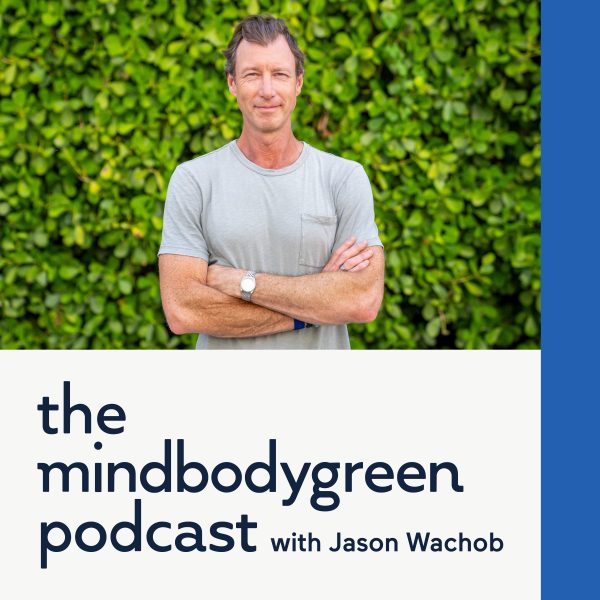
The mindbodygreen Podcast
- Episodes
- 617
- Released
- weekly
- Latest episode
- Nov 17, 2026
About the podcast
The mindbodygreen podcast explores the infinite possibilities of health & well-being. Hosted by founder and co-CEO Jason Wachob, each episode features a thought-provoking interview with a leader in the health space. Whether you’re thinking about changing what’s on your plate, how you move, or how you think, these conversations are sure to offer solutions in whole-body health.
Episodes 617
673: How to make your workout better for your brain | Beth Lewis, MS
“You can actually get more from your workout if you just stop and pay attention to what your body's doing,” says Beth Lewis, MS. Lewis is a movement specialist whose approach combines artistic training with …
Show notes
“You can actually get more from your workout if you just stop and pay attention to what your body's doing,” says Beth Lewis, MS.
Lewis is a movement specialist whose approach combines artistic training with exercise science. After earning her BFA in Dance Performance, she toured internationally with the dance company Pilobolus. She holds an MS in Kinesiology with a focus on Aging and Exercise and is currently pursuing a master's in social work with a focus in gerontology. Lewis works in longevity medicine and preventive neurology, bringing research-based exercise methods into everyday practice. She is the founder of Beth Lewis Moves, an age integrated fitness community that combines aging research with accessible, effective training. Her work also extends to film and live performance. She was Brendan Fraser's movement coach for his Oscar-winning performance in The Whale, prepared Hugh Jackman for his return as Wolverine at age 55, and choreographed Jackman's jump rope performance at Radio City Music Hall.
00:00 - From pro dancer to movement coach
05:20 - Why curiosity matters in your workouts
07:23 - Making exercise better for your brain
09:38 - Movement sequences to train memory
11:31 - Rowing's hidden brain-body benefits
18:04 - Minimum effective dose for rowing
20:19 - Hugh Jackman's rowing routine
21:27 - Episode break
23:19 - Jump rope & brain gains
27:10 - How to start jumping rope safely
29:08 - The importance of learning new skills
33:21 - Her ideal weekly training formula
37:25 - Aesthetics, function, & physical reserve
39:38 - The psychosocial side of aging
41:41 - Inside the Beth Lewis Moves community
Referenced in the episode:
Listen to our episode with Dr. Kellyann Niotis: https://podcasts.apple.com/us/podcast/the-latest-on-how-to-prevent-alzheimers-kellyann-niotis-m-d/id1246494475?i=1000795232654
Listen to our episode with Courtney Conley: https://podcasts.apple.com/us/podcast/how-to-walk-to-optimize-your-health-courtney-conley-d-c/id1246494475?i=1000765873094
Follow Lewis on Instagram: https://www.instagram.com/bethlewisfit/
Lewis’s rowing community: https://www.instagram.com/rowingkweens/
Lewis’s jump rope community: https://www.instagram.com/jumprope_baddies/
Lewis’s website & classes: https://www.improveyourmoves.online/
We hope you enjoy this episode, and feel free to watch the full video on YouTube! Whether it's an article or podcast, we want to know what we can do to help here at mindbodygreen. Let us know at: [email protected].
Learn more about your ad choices. Visit megaphone.fm/adchoices
672: A neuropsychologist’s focus rule for a sharper brain | Aldrich Chan, PsyD
“We are no longer living in conditions that we naturally evolved for,” says Aldrich Chan, PsyD. Chan is a neuropsychologist, psychotherapist, and author of two award winning books: Reassembling Models of …
Show notes
“We are no longer living in conditions that we naturally evolved for,” says Aldrich Chan, PsyD.
Chan is a neuropsychologist, psychotherapist, and author of two award winning books: Reassembling Models of Reality and 7 Principles of Nature: How We Strayed & How We Return. He is the president of the Society for Neuroexistential Psychology and founder of the Center for Neuropsychology and Consciousness (CNC), a practice in Miami, Florida that provides neuropsychological and psychological services. In addition to his practice, he serves on the faculty at Pepperdine University, teaching at their masters and doctoral programs.
00:00 - What a neuropsychologist does
06:25 - How much of the brain can change
08:21 - Working in focus cycles
11:41 - The SAD theory of mental distress
16:51 - Evolutionary mismatch and modern life
18:35 - Choice overload
21:05 - The problem with divided attention
23:22 - Episode break
25:20 - Vital signals & finding your values
30:01 - The neuroscience of intuition
34:27 - Intuition vs overanalyzing
37:41 - 7 principles for living in alignment
41:10 - Reframing uncertainty as opportunity
44:45 - A Taoist parable about fortune
Referenced in the episode:
For more about Chan, visit: https://www.drchancnc.com/
Ward 2017: https://www.journals.uchicago.edu/doi/full/10.1086/691462
Ang 2025: https://psycnet.apa.org/record/2027-05616-001
We hope you enjoy this episode, and feel free to watch the full video on YouTube! Whether it's an article or podcast, we want to know what we can do to help here at mindbodygreen. Let us know at: [email protected].
Learn more about your ad choices. Visit megaphone.fm/adchoices
The housekeepers who got leaner just by changing what they believed
In this week’s solo episode of the mindbodygreen podcast, Jason breaks down a fascinating study of hotel room attendants that showed how a small shift in mindset can completely change how our bodies respond to …
Show notes
In this week’s solo episode of the mindbodygreen podcast, Jason breaks down a fascinating study of hotel room attendants that showed how a small shift in mindset can completely change how our bodies respond to movement. It’s easy to get caught up in the data, but this study is a reminder that the meaning you assign to what you're doing is another critical input.
00:00 - The chambermaid study
04:06 - What changed after four weeks
06:24 - The milkshake study
07:37 - The honest caveats
09:03 - 3 ways to use this today
Referenced in the episode:
Read the Harvard study: https://pubmed.ncbi.nlm.nih.gov/17425538/
Read the milkshake study: https://pubmed.ncbi.nlm.nih.gov/21574706/
For more about Alia Crum, visit: https://www.instagram.com/draliacrum/?hl=en
Listen to the episode with Dr. Ellen Langer: https://podcasts.apple.com/us/podcast/how-to-think-yourself-younger-mother-of-mindfulness/id1246494475?
We hope you enjoy this episode, and feel free to watch the full video on YouTube! Whether it's an article or podcast, we want to know what we can do to help here at mindbodygreen. Let us know at: [email protected].
Learn more about your ad choices. Visit megaphone.fm/adchoices
671: Is being “good enough” the secret to longevity? | Matt Bloom, Ph.D.
“Small steps add up over time to the big changes that we seek,” says Matt Bloom, Ph.D. Bloom is a professor emeritus of business at the University of Notre Dame. He has a PhD in psychology from Cornell …
Show notes
“Small steps add up over time to the big changes that we seek,” says Matt Bloom, Ph.D.
Bloom is a professor emeritus of business at the University of Notre Dame. He has a PhD in psychology from Cornell University. For nearly thirty years, he and his research team studied the well-being of people who work in the helping and healing professions including physicians, humanitarian workers, clergy and public school teachers. Matt is cofounder of Ritual, a mobile app that offers a living library of evidence-based well-being practices created in partnership with wise guides including Barbara Brown Taylor, Kate Bowler, Steve Kerr, Nedra Glover Tawaab, and Anne Lamott.
00:00 - Why small habits beat big overhauls
05:05 - The 5-minute worry window
07:24 - Lessons from high-stress professions
13:32 - Radical acceptance & psychological flexibility
15:32 - An exercise for hard experiences
17:33 - When resilience through becomes self-destructive
20:22 - Why you need an accountability partner
24:57 - Practice over perfectionism
28:16 - Balancing great & good enough
31:48 - Burnout & finding your core values
34:34 - His Wall Street wake-up call
35:37 - Achieving personal & professional alignment
40:15 - Science that stands out
42:11 - Children & grandchildren
Referenced in the episode:
Visit Bloom’s website: https://mattbloom.org/
Buy Bloom’s new book: https://www.amazon.com/Lasting-Wellbeing-Science-Based-Tranquility-Authenticity/dp/1637748787/ref=sr_1_1
For more about the worry window, visit Elissa Epel’s website: https://www.elissaepel.com/
For more about radical acceptance, visit Steven Hayes’ website: https://stevenchayes.com/the-bittersweet-art-of-acceptance-2/
We hope you enjoy this episode, and feel free to watch the full video on YouTube! Whether it's an article or podcast, we want to know what we can do to help here at mindbodygreen. Let us know at: [email protected].
Learn more about your ad choices. Visit megaphone.fm/adchoices
670: Why food quality matters more than calories | Dariush Mozaffarian, M.D.
“The food industry is experimenting on us without data and knowledge,” says Dariush Mozaffarian, M.D., DrPH. Mozaffarian is a cardiologist, Director of the Food is Medicine Institute at Tufts University, and …
Show notes
“The food industry is experimenting on us without data and knowledge,” says Dariush Mozaffarian, M.D., DrPH.
Mozaffarian is a cardiologist, Director of the Food is Medicine Institute at Tufts University, and author of the book, Food is Medicine (Holt/Macmillan). He serves as Distinguished Professor, Dean Emeritus, and Jean Mayer Professor; and is clinically active in cardiology at Tufts Medical Center. His work aims to create the evidence and translation for a food system that is nutritious, equitable, and sustainable. He has authored nearly 700 scientific publications, and has served in numerous advisory roles. His work has been featured in leading media outlets, and Thomson Reuters has named him as one of the World’s Most Influential Scientific Minds. Dr. Mozaffarian received his B.S. in biological sciences from Stanford, M.D. from Columbia, Doctorate in Public Health from Harvard, and clinical training in internal medicine at Stanford and in cardiology at the University of Washington. He is married, has three children, and actively trains as a Fourth Degree Black Belt in Taekwondo.
00:00 - The last century of nutrition science
07:03 - The single-nutrient mistake
10:50 - Pellagra & the birth of enriched flour
13:45 - Macros vs. food quality
17:05 - The 3 buckets of food
21:56 - What’s the deal with red meat
24:46 - Episode break
27:14 - Cholesterol absorbers & plant sterols
31:05 - How low-fat & Big Tobacco fueled ultra-processing
33:24 - The truth about seed oils
38:06 - Sweeteners & additives
41:41 - Flipping the script on the food system
47:28 - The problem with calorie counting
52:16 - Inside a cardiologist's shopping cart
Referenced in the episode:
Buy Mozaffarian’s book here: https://www.amazon.com/dp/1250394287
Visit the Food Is Medicine Institute website: https://tuftsfoodismedicine.org/
We hope you enjoy this episode, and feel free to watch the full video on YouTube! Whether it's an article or podcast, we want to know what we can do to help here at mindbodygreen. Let us know at: [email protected].
Learn more about your ad choices. Visit megaphone.fm/adchoices
669: The latest on how to prevent Alzheimer’s | Kellyann Niotis, M.D.
"What we know for sure is that Alzheimer's is a preventable disease. It's not destiny,” says Kellyann Niotis, M.D. Niotis is the world’s first fellowship-trained preventive neurologist. She is a Clinical …
Show notes
"What we know for sure is that Alzheimer's is a preventable disease. It's not destiny,” says Kellyann Niotis, M.D.
Niotis is the world’s first fellowship-trained preventive neurologist. She is a Clinical Assistant Professor of Neurology at Weill Cornell Medicine, the Director of Parkinson’s and Lewy Body Dementia Prevention Research at the Institute for Neurodegenerative Diseases (IND) and runs a private preventive neurology practice in New York City focused on early detection and personalized risk reduction strategies for diseases like Alzheimer’s, Parkinson’s and Dementia with Lewy Bodies. Her research has been published in notable medical journals and presented at national and international conferences. Her expertise has been featured in media outlets such as CNN and NBC, and she has received numerous honors and awards recognizing her work. She is passionate about advancing the field of preventive neurology—not only through clinical care and research but also through advocacy for policy change and expanding access to education and treatment.
00:00 - Your genes are not your destiny
05:06 - Why prevention starts in your 30s
06:44 - Cholesterol management for brain health
11:06 - Explaining amyloid & p-tau 217
17:17 - How viruses & your cycle affect tau
19:37 - Dr. Niotis’s research
23:41 - What movement reveals about your brain
30:37 - Why motor reserve matters
34:47 - Why variety is key when exercising for brain health
37:38 - Elen’s story with two APOE4 copies
44:37 - ApoA1: the brain's cholesterol exception
47:42 - The future of Alzheimer's treatment
50:43 - The statin study she'd love to run
Referenced in the episode:
Visit Niotis’s website: http://www.drkellyannniotis.com/
Visit Niotis’s practice: http://www.preventive-neuro.com/
For more about Beth Lewis: https://www.instagram.com/bethlewisfit/
Listen to our episode with Richard Isaacson: https://open.spotify.com/episode/4uW7V9qfeD2vj2m56MZlYB
We hope you enjoy this episode, and feel free to watch the full video on YouTube! Whether it's an article or podcast, we want to know what we can do to help here at mindbodygreen. Let us know at: [email protected].
Learn more about your ad choices. Visit megaphone.fm/adchoices
Why 70% of American kids quit sports by age 13
Youth sports has become a multi-billion-dollar industry built on one unspoken promise: specialize early, and your kid has a shot. In this solo episode, we dig into what the research really says about early …
Show notes
Youth sports has become a multi-billion-dollar industry built on one unspoken promise: specialize early, and your kid has a shot. In this solo episode, we dig into what the research really says about early specialization. We also looks at how Norway built a youth sports system around play instead of competition, and why it's keeping kids in the game at nearly triple the US rate.
00:00 - The myth of sports specialization
04:29 - How youth sports became a billion-dollar industry
05:10 - My own path to Division I basketball
06:52 - Higher risk of overuse injuries
09:42 - The weaker case for burnout
10:41 - Junior stars & adult pro athletes are different people
12:28 - Deliberate play & the sampling years
15:00 - 3 honest caveats
16:10 - How Norway keeps kids playing
20:29 - What every parent should actually do
Referenced in the episode:
2022 meta-analysis from Jean Côté’, Ph.D.: https://doi.org/10.1177/19417381211056301
2015 study from Neeru Jayanthi, M.D.: .https://pubmed.ncbi.nlm.nih.gov/25646361/
Research from David Bell, Ph.D.: https://pubmed.ncbi.nlm.nih.gov/31633411/
Research from Tim McGuine, Ph.D: https://pubmed.ncbi.nlm.nih.gov/28735552/
We hope you enjoy this episode, and feel free to watch the full video on YouTube! Whether it's an article or podcast, we want to know what we can do to help here at mindbodygreen. Let us know at: [email protected].
Learn more about your ad choices. Visit megaphone.fm/adchoices
668: What 200K full-body scans reveal about how we age | Andrew Lacy, Founder & CEO at Prenuvo
"I hope in 20 or 30 years time, a clinical diagnosis is something that's rarely given because most everything has been caught before it rises to that stage,” says Andrew Lacy. Lacy is the CEO and founder of …
Show notes
"I hope in 20 or 30 years time, a clinical diagnosis is something that's rarely given because most everything has been caught before it rises to that stage,” says Andrew Lacy.
Lacy is the CEO and founder of Prenuvo, the company pioneering proactive whole-body imaging for the early detection of cancer and other diseases. Under Lacy’s leadership, the company has expanded across North America, establishing Prenuvo as a recognized and trusted proactive healthcare service to both patients and referring clinicians. A seasoned entrepreneur, he scaled transformative products (including Tapulous, acquired by Disney) and grew Prenuvo into a global leader. He actively serves as an advisor and investor across a diverse portfolio of startups. He received an MBA from Stanford University and a JD from the University of Melbourne. He is currently based in Los Angeles.
This podcast was created in partnership with Prenuvo. Their whole-body MRI scans 33 organs for hundreds of conditions in as little as an hour, finding a potentially life-saving diagnosis in 1 in 20 people.* Prenuvo can help give you a broader understanding of what’s happening in your body–before symptoms appear. Get a $300 discount on comprehensive and executive memberships, along with a standalone whole-body scan at prenuvo.com/MINDBODYGREEN.
00:00 - What's changed in the last two years of scanning
03:58 - The importance of establishing a baseline
06:15 - The average scan turns up nine findings
07:55 - Ageotypes: why everyone ages differently
09:19 - Inside the new body composition report
11:47 - 4 ways AI is changing medical imaging
15:44 - NeuroQuant & catching dementia decades early
18:07 - Building a comprehensive, preventative healthcare system
24:10 - Busy Philipps’s story & what people actually fear
25:17 - The case for peace of mind over avoidance
30:46 - Skin health as the next imaging frontier
37:27 - Why people worry most about the brain
39:21 - Changing the approach to healthcare
Referenced in the episode:
Read about Jason’s experience first Prenuvo scan here: https://www.mindbodygreen.com/articles/full-body-mri-scan-review
We hope you enjoy this episode, and feel free to watch the full video on YouTube! Whether it's an article or podcast, we want to know what we can do to help here at mindbodygreen. Let us know at: [email protected].
*Based on our internal data analysis, 5% of Prenuvo scans have helped detect a potentially life-saving condition. This reflects in particular the combined prevalence of radiologically-suspected pre-cancerous/cancerous-findings or brain-aneurysms in our whole body MRI screening practice.
Learn more about your ad choices. Visit megaphone.fm/adchoices
667: Why this doctor stopped fearing sugar, ice cream, & alcohol | Keshav Grover, D.O, M.S.
"What is the lowest dose of intervention that can have the maximum effect to help the body heal itself?” asked Keshav Grover, D.O., M.S., IFMCP. Grover is the founder of Grover Health and Wellness, PLLC. He is …
Show notes
"What is the lowest dose of intervention that can have the maximum effect to help the body heal itself?” asked Keshav Grover, D.O., M.S., IFMCP.
Grover is the founder of Grover Health and Wellness, PLLC. He is a physician, keynote speaker, and champion of functional/integrative medicine and of eating a whole foods, plant-based diet. He holds a Doctorate in osteopathic medicine from Michigan State University College and a Master of Science from Wayne State University School of Medicine. He completed the prestigious Andrew Weil Center of Integrative Medicine fellowship at the University of Arizona and is a certified functional medicine practitioner by the Institute for Functional Medicine. He has spoken to leading organizations about holistic health and has been featured on CBS and Fox News as a wellness expert. His first book, Wellness Bridge, was published this August.
00:00 - The "Wellness Bridge"
05:37 - Why medicine doesn't have to be either/or
08:55 - A simple at-home gut health check
11:21 - There’s no universal cure
13:37 - Peptides 101
19:30 - Who should avoid peptides entirely
22:21 - Smallest dose, maximum effect
24:27 - Grover’s approach to testing
30:29 - Where health testing is headed next
33:38 - The connection between glyphosate & cancer
40:38 - His brother's warts & a homeopathy win
44:37 - Why he stopped being the ingredient police
47:31 - Gut health & food sensitivity
49:55 - Why genetics isn't your destiny
Referenced in the episode:
For more about Grover, visit: https://www.drkeshavgrover.com/
Buy Grover’s book: https://www.amazon.com/dp/B0GZMP5BQX/ref=as_li_qf_sp_asin_il_tl?tag=mind0a3-20
We hope you enjoy this episode, and feel free to watch the full video on YouTube! Whether it's an article or podcast, we want to know what we can do to help here at mindbodygreen. Let us know at: [email protected].
Learn more about your ad choices. Visit megaphone.fm/adchoices
666: Is wellness culture making us less healthy? | Ezekiel J. Emanuel, MD, PhD, MsC
“I don't need to track it. I just listen to my body,” says Ezekiel J. Emanuel, M.D., Ph.D., Ms.C. Dr. Emanuel is an oncologist and world leader in health policy and bioethics. He is the Vice Provost for Global …
Show notes
“I don't need to track it. I just listen to my body,” says Ezekiel J. Emanuel, M.D., Ph.D., Ms.C.
Dr. Emanuel is an oncologist and world leader in health policy and bioethics. He is the Vice Provost for Global Initiatives at the University of Pennsylvania, and holds appointments in the Department of Medical Ethics and Health Policy in the Perelman School of Medicine and the Department of Health Care Management in the Wharton School. He is Special Advisor to the Director General of the WHO, Senior Fellow at the Center for American Progress, and a member of the Council on Foreign Relations. He was founding chair of the Department of Bioethics at the NIH. He served as a Special Advisor on Health Policy to the Director of the Office of Management and Budget and National Economic Council. In this role, he was instrumental in drafting the Affordable Care Act. He served on the Biden-Harris Transition Covid Advisory Board. Dr. Emanuel is the most widely cited bioethicist in history with over 350 publications. He has authored or edited 16 books. His newest book, Eat Your Ice Cream, is out now.
00:00 - When tracking our health goes overboard
06:19 - The health markers worth testing
08:03 - Daily nutrition habits
09:34 - What it means to “eat your ice cream”
14:15 - The importance of social connection
19:12 - Why willpower fails & habits win
24:47 - Everest, introverts, & grip strength
27:52 - How purpose is linked to health
31:06 - Why & how the Emanuel brothers succeeded
35:21 - Rethinking retirement for brain health
36:42 - Age-old health wins (& that’s a relief)
40:10 - Favorite ice cream shops
Referenced in the episode:
For more about Emanuel, visit his website: https://www.ezekielemanuel.com/
Buy Eat Your Ice Cream here: https://www.amazon.com/Eat-Your-Ice-Cream-Healthy/dp/1324117532/ref=as_li_qf_sp_asin_il_tl?tag=mind0a3-20
Find our episode on the rabbit cholesterol here: https://youtu.be/er3k40nlCh8?si=MxeG7IxEVnirxIoX
We hope you enjoy this episode, and feel free to watch the full video on YouTube! Whether it's an article or podcast, we want to know what we can do to help here at mindbodygreen. Let us know at: [email protected].
Learn more about your ad choices. Visit megaphone.fm/adchoices
660: Why adding more to your diet beats eliminating | Wendy Bazilian, DrPH, MA, RDN
"The diet you'll stay on is a diet that's enjoyable and not too hard,” says Wendy Bazilian, DrPH, MA, RDN. Bazilian is a Registered Dietitian Nutritionist, American College of Sports Medicine Certified Exercise …
Show notes
"The diet you'll stay on is a diet that's enjoyable and not too hard,” says Wendy Bazilian, DrPH, MA, RDN. Bazilian is a Registered Dietitian Nutritionist, American College of Sports Medicine Certified Exercise Physiologist, and Doctor of Public Health. She's authored multiple bestselling books, as well as contributed to a New York Times bestseller and a James Beard-nominated cookbook. …Status, Sex, & Sports Cars: What Science Says
What does driving a sports car actually do to your hormones? In this episode, we break down a surprisingly revealing 2009 study in which researchers had men drive a bright red sports car and a beige sedan and …
Show notes
What does driving a sports car actually do to your hormones? In this episode, we break down a surprisingly revealing 2009 study in which researchers had men drive a bright red sports car and a beige sedan and measured changes in their testosterone before and after. The results weren't what anyone expected. And the real finding had nothing to do with speed, horsepower, or even the car itself. …665: Is Zone 2 training a waste of your workout time? | Kristi Storoschuk, exercise scientist
“As your time commitment goes down, the importance of intensity goes up,” says Kristi Storoshuk. Storoschuk is a PhD candidate in Muscle Physiology at Queen’s University in Kingston, Ontario. Her research …
Show notes
“As your time commitment goes down, the importance of intensity goes up,” says Kristi Storoshuk. Storoschuk is a PhD candidate in Muscle Physiology at Queen’s University in Kingston, Ontario. Her research focuses on the relationship between skeletal muscle metabolism and whole-body metabolism, with an emphasis on how nutrient–exercise timing influences physiological adaptations to exercise. …664: High-achiever? Here’s how to prevent burnout | science writer Elizabeth Svoboda
"It's way better to pull yourself back from the brink of burnout before it hits than to let yourself fall all the way in,” says Elizabeth Svoboda. Svoboda is an award-winning science writer and contributor to …
Show notes
"It's way better to pull yourself back from the brink of burnout before it hits than to let yourself fall all the way in,” says Elizabeth Svoboda. Svoboda is an award-winning science writer and contributor to Scientific American, Discover, The Boston Globe, The New York Times, and other publications. Elizabeth is a winner of the Evert Clark/Seth Payne Award for Young Science Writers, and her work has been anthologized in the Best American Science and Nature Writing series. …663: Daily choices that shape brain health in your 30s, 40s & beyond | David Perlmutter, MD
“We can choose our brain’s destiny,” says David Perlmutter, MD. Perlmutter is a Board-Certified Neurologist and six-time New York Times bestselling author whose work focuses on the intersection of neurology …
Show notes
“We can choose our brain’s destiny,” says David Perlmutter, MD. Perlmutter is a Board-Certified Neurologist and six-time New York Times bestselling author whose work focuses on the intersection of neurology, nutrition, and brain health. He is on the Board of Directors of the American College of Nutrition and the Editorial Board of the Journal of Alzheimer’s Disease. His books, including the #1 bestseller Grain Brain, has been published in 32 languages and sold over a million copies. …662: The truth about peptides, NAD, & other longevity treatments | Rachele Pojednic, Ph.D.
"If you don't get those foundational behaviors down, there ain't nothing a peptide's gonna do for you,” says Rachele Pojednic, Ph.D. Pojednic is a professor of Sports Nutrition and Exercise Physiology at …
Show notes
"If you don't get those foundational behaviors down, there ain't nothing a peptide's gonna do for you,” says Rachele Pojednic, Ph.D. Pojednic is a professor of Sports Nutrition and Exercise Physiology at Stanford University and is the Chief Science Officer at Restore. Her work examines nutrition, supplementation and physical activity interventions on muscle physiology, performance and recovery, as well as muscle related chronic disease, with a particular focus on women. …661: Why structure is good for your brain | journalist David Epstein
"I think structure is more liberating than it is stifling, and it often takes people losing it to sort of realize that,” says David Epstein. Epstein is the author of the number one New York Times bestseller …
Show notes
"I think structure is more liberating than it is stifling, and it often takes people losing it to sort of realize that,” says David Epstein. Epstein is the author of the number one New York Times bestseller Range and the New York Times bestseller The Sports Gene. He has master’s degrees in environmental science and journalism and has worked as a senior writer for Sports Illustrated and as an investigative reporter for ProPublica. He lives in Washington, DC. …659: How to build a flourishing mind in 5 minutes | Richard Davidson, Ph. D.
“Every human being comes equipped with the capacity to flourish,” says Richard Davidson, Ph.D. Davidson is the William James and Vilas Professor of Psychology and Psychiatry at the University of …
Show notes
“Every human being comes equipped with the capacity to flourish,” says Richard Davidson, Ph.D. Davidson is the William James and Vilas Professor of Psychology and Psychiatry at the University of Wisconsin–Madison and the Founder and Director of the Center for Healthy Minds. He is best known for his groundbreaking work studying emotion and the brain. …658: The most efficient path to better cardio | sports scientist Fraser Thurlow, Ph.D.
"When it comes to high-intensity interval training work, quality is much more important than quantity,” says Fraser Thurlow, Ph.D. Thurlow is a high-performance coach, researcher, and lecturer with over a …
Show notes
"When it comes to high-intensity interval training work, quality is much more important than quantity,” says Fraser Thurlow, Ph.D. Thurlow is a high-performance coach, researcher, and lecturer with over a decade of experience helping people improve their fitness and performance. He holds a PhD in Human Performance, has published extensively on training, and has lectured at leading Australian universities in sport and exercise science. …657: The science of art as medicine | behavioral scientist Daisy Fancourt
“When we engage in the arts, it exposes us to a lot of emotions, which can have a tangible impact on the neurotransmitters released in our brains, the stress hormones in our bodies, and even the levels of …
Show notes
“When we engage in the arts, it exposes us to a lot of emotions, which can have a tangible impact on the neurotransmitters released in our brains, the stress hormones in our bodies, and even the levels of inflammation in our immune system,” says Daisy Fancourt. Fancourt is a Professor of Psychobiology and Epidemiology at University College London where she heads the Social Biobehavioural Research Group, and serves as the Director of the World Health Organization Collaborating Centre on Arts…656: The connection between pain & the brain | Rachel Zoffness, Ph.D.
“Anatomy and physiology always matter when it comes to pain. They're just not the whole story,” says Rachel Zoffness, Ph.D. Zoffness is a pain scientist, pain psychologist, and thought-leader revolutionizing …
Show notes
“Anatomy and physiology always matter when it comes to pain. They're just not the whole story,” says Rachel Zoffness, Ph.D. Zoffness is a pain scientist, pain psychologist, and thought-leader revolutionizing the way we understand and treat pain. She's an assistant clinical professor at UCSF, lectures at Stanford, and consults on the development of pain management programs around the world. Dr. …655: A cardiac surgeon had a heart attack—here’s what he missed | Jeremy London, M.D.
"Making the effort earlier totally changes the trajectory for the rest of your life,” says Jeremy London, MD. London is a board-certified cardiovascular surgeon with more than 25 years of clinical experience …
Show notes
"Making the effort earlier totally changes the trajectory for the rest of your life,” says Jeremy London, MD. London is a board-certified cardiovascular surgeon with more than 25 years of clinical experience caring for patients across the full spectrum of heart disease — from prevention to advanced intervention. Dr. London received his medical degree from the Medical College of Georgia and completed his general surgery residency at Joseph’s Hospital in Denver, Colorado. …654: Why your 40s & 50s are your most powerful years yet | psychologist Margie Lachman, Ph.D.
"Midlife is a perfect time for you to think about where you've been & where you want to go,” says Margie Lachman, PhD. Lachman is professor of psychology at Brandeis University and director of the Lifespan Lab …
Show notes
"Midlife is a perfect time for you to think about where you've been & where you want to go,” says Margie Lachman, PhD. Lachman is professor of psychology at Brandeis University and director of the Lifespan Lab. A leading expert on adult development and aging, Lachman is one of a small group of scholars who study midlife from a lifespan developmental perspective. Her honors include research awards from the American Psychological Association (APA) and the Gerontological Society of America. …653: A neurologist's honest take on Alzheimer's blood tests | Richard Isaacson, MD
"There is no one magic test for brain health,” says Richard Isaacson, MD. Isaacson is a Harvard-trained neurologist who directs the Precision Prevention Program at Atria Health and Research Institute and …
Show notes
"There is no one magic test for brain health,” says Richard Isaacson, MD. Isaacson is a Harvard-trained neurologist who directs the Precision Prevention Program at Atria Health and Research Institute and founded the world's first Alzheimer's Prevention Clinic at Weill Cornell Medicine/NewYork-Presbyterian. A leader in precision-medicine approaches to Alzheimer's risk reduction, he has served as principal investigator for multiple research initiatives focused on individualized care. …652: A guide to healthy pooping | Trisha Pasricha, MD, MPH
"You shouldn't be spending more than five minutes in there at a time,” says Trisha Pasricha, MD, MPH. A graduate of Harvard College, Pasricha earned her medical degree from Vanderbilt University School of …
Show notes
"You shouldn't be spending more than five minutes in there at a time,” says Trisha Pasricha, MD, MPH. A graduate of Harvard College, Pasricha earned her medical degree from Vanderbilt University School of Medicine and a Master of Public Health from the Harvard T.H. Chan School of Public Health. Her training includes an internal medicine residency at The Johns Hopkins Hospital and gastroenterology and motility fellowships at Massachusetts General Hospital. …651: 36 years of happiness research points to this | Sonja Lyubomirsky, Ph.D.
"Almost all of the interventions that make us happier work because they make us feel more connected and more loved,’ says Sonja Lyubomirsky, Ph.D. Lyubomirsky is a Distinguished Professor of Psychology at the …
Show notes
"Almost all of the interventions that make us happier work because they make us feel more connected and more loved,’ says Sonja Lyubomirsky, Ph.D. Lyubomirsky is a Distinguished Professor of Psychology at the University of California, Riverside, a Fellow of the American Association for the Advancement of Science, and the bestselling author of The How of Happiness and The Myths of Happiness—and her latest, How to Feel Loved (Harper Collins, 2026), paired with a mainstage TED talk. …650: Is spirituality medicine? | Joshua W. Brown, Ph.D.
“Placebo effects are real and mind-body effects are real, and there's a fairly large scientific literature on these things,” says Joshua W. Brown, Ph.D. Brown is a professor of Psychological and Brain Science …
Show notes
“Placebo effects are real and mind-body effects are real, and there's a fairly large scientific literature on these things,” says Joshua W. Brown, Ph.D. Brown is a professor of Psychological and Brain Science at Indiana University, where he directs the Cognitive Control Lab. …649: Why “in range” lab results aren’t the solution to longevity | Florence Comite, M.D.
"What we don't know CAN really hurt us, " says Florence Comite, M.D. Comite is a Yale University School of Medicine and National Institutes of Medicine trained physician-scientist, endocrinologist, and the …
Show notes
"What we don't know CAN really hurt us, " says Florence Comite, M.D. Comite is a Yale University School of Medicine and National Institutes of Medicine trained physician-scientist, endocrinologist, and the leading voice in the field of precision medicine and healthy longevity. …648: How to walk to optimize your health | Courtney Conley, D.C.
"I want people to start thinking of walking as a physiological necessity, not simply as a form of exercise,” explains Courtney Conley, D.C. Conley is a renowned foot and gait specialist, chiropractic physician …
Show notes
"I want people to start thinking of walking as a physiological necessity, not simply as a form of exercise,” explains Courtney Conley, D.C. Conley is a renowned foot and gait specialist, chiropractic physician, and founder of Gait Happens and Total Health Solutions clinic and Total Health Performance gym in Lakewood, She is a founding member of the Healthy Foot Alliance and coauthor of Walk, a new book about the power of walking. …647: The new rules of heart health | Giovanni Campanile, MD & Sandra Cammarata, MD
“The awareness of how lifestyle, diet, and exercise affect us is mind-blowing.” Dr. Giovanni Campanile and Dr. Sandra Cammarata are the founders of CorAeon, the only functional medicine practice founded and led …
Show notes
“The awareness of how lifestyle, diet, and exercise affect us is mind-blowing.” Dr. Giovanni Campanile and Dr. Sandra Cammarata are the founders of CorAeon, the only functional medicine practice founded and led by a husband-and-wife team. Campanile is a Harvard-trained functional cardiologist, Associate Professor of Medicine at Rutgers, New Jersey Medical School, and former cardiologist for the President of the United States, George H.W. Bush. …
These are the latest 40 of 617 episodes. You’ll find older episodes in the podcast’s feed.
Similar podcasts
More Health & Fitness podcasts


Is this your podcast?
Confirm it with an entry in your feed: you get a code here, add it as podcast:txt to the channel of your feed, and we check it. Your podcast is then shown as “verified” on SoundNode.