

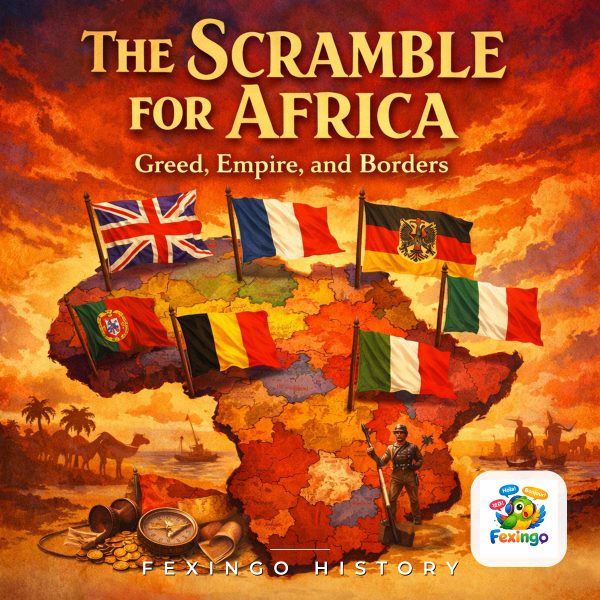
The Scramble for Africa: Greed, Empire, and Borders — Fexingo History
- Episodes
- 293
- Released
- daily
- Latest episode
- Nov 18, 2026
About the podcast
Between 1881 and 1914, Europe carved up Africa with the stroke of a pen. The Scramble for Africa saw the Berlin Conference of 1884–85 formalize a land grab that redrew the continent's map, imposing borders that still fuel conflict today. Lucas and Luna guide listeners through this brutal chapter, from King Leopold II's Congo Free State—where millions died for rubber—to the Anglo-Zulu War, the Mahdist Revolt in Sudan, and the Boer Wars in South Africa. They explore the roles of figures like Cecil Rhodes, whose dream of a Cape-to-Cairo railway drove colonial expansion, and Menelik II, the Ethiopian emperor who defeated Italy at Adowa in 1896, the only African victory that preserved independence. The show examines the technologies that made conquest possible: the Maxim gun, quinine against malaria, and steamboats on the Niger and Congo rivers. It also delves into the cultural justifications—the 'civilizing mission,' Social Darwinism, and missionary narratives—and the resistance movements they sparked, from the Maji Maji Rebellion in German East Africa to the Herero and Nama genocide in Namibia. The consequences are still with us: arbitrary borders, ethnic strife, resource curses, and the trauma of extraction. Why did Europe carve up a continent it barely understood? And what does that legacy mean for modern Africa? This is the story of how greed, fear, and ambition redrew a world. #ScrambleForAfrica #BerlinConference #KingLeopoldII #CongoFreeState #CecilRhodes #MenelikII #Adowa1896 #AngloZuluWar #BoerWars #MahdistRevolt #MajiMajiRebellion #HereroGenocide #MaximGun #Colonialism #ImperialPower #AfricanHistory #History #FexingoHistory Keep every episode free: buymeacoffee.com/fexingo
Contributors
- LucasHost
- LunaCo-host
Episodes 293
The Scramble's Silent Architects: Private Companies
Episode 293 explores the often-overlooked role of chartered companies in the European partition of Africa. While diplomats like Otto von Bismarck and King Leopold II get the credit at the Berlin Conference …
Show notes
Episode 293 explores the often-overlooked role of chartered companies in the European partition of Africa. While diplomats like Otto von Bismarck and King Leopold II get the credit at the Berlin Conference, figures like George Taubman Goldie used entities such as the Royal Niger Company to seize territory before official colonial administrations arrived. This episode examines how private corporations acted as de facto governments, enforcing 'effective occupation' through military force and economic monopolies. We trace the rise of the Royal Niger Company under Goldie’s leadership, its conflict with rival French interests, and the eventual nationalization that brought these corporate empires under state control. Listeners will discover how the logic of profit drove imperial expansion long before it was codified in international law, and why the transition from company rule to direct colonial administration marked a significant shift in the brutality and scale of extraction across West Africa.
#RoyalNigerCompany #GeorgeTaubmanGoldie #BerlinConference #ScrambleForAfrica #CharteredCompanies #EffectiveOccupation #WestAfricaHistory #ColonialEmpire #HenryMortonStanley #CongoFreeState #BritishImperialism #AfricanHistory #Imperialism #FexingoHistory #HistoryPodcast #Geopolitics #19thCenturyHistory #NigerRiver #History
The Forgotten Kingdoms: Africa's Pre-Colonial States
Long before the Berlin Conference redrew maps in European drawing rooms, powerful African states were navigating global trade, diplomacy, and military innovation. This episode moves away from the colonial …
Show notes
Long before the Berlin Conference redrew maps in European drawing rooms, powerful African states were navigating global trade, diplomacy, and military innovation. This episode moves away from the colonial narrative to explore the Kingdom of Kongo, the Asante Empire, and the Sokoto Caliphate as independent political entities with complex internal structures. We examine how rulers like Nzinga a Mbande and Samori Touré engaged with Portuguese and French powers not just as victims, but as strategic actors managing sovereignty. By looking at the economic foundations of the transatlantic slave trade and the subsequent shift to legitimate commerce, we uncover how these societies adapted to external pressures while maintaining their own laws, religions, and succession traditions. The conversation highlights specific treaties, diplomatic missions, and military reforms that challenged the simplistic view of a passive continent, offering a deeper understanding of African agency in the face of imperial expansion.
#KingdomOfKongo #AsanteEmpire #SokotoCaliphate #NzingaAMbande #SamoriTouré #PreColonialAfrica #AfricanHistory #BerlinConference #TransatlanticSlaveTrade #DiplomacyInAfrica #MilitaryReform #TreatyOf1491 #AshantiUnion #IslamicScholarship #EuropeanImperialism #FexingoHistory #HistoryPodcast #WorldHistory
The Berlin Conference Mapmakers: Drawing Lines on Africa
Episode 291 revisits the Berlin Conference of 1884-1885, but this time we zoom in on the specific cartographic techniques and diplomatic friction that turned a continent into a puzzle. We explore how European …
Show notes
Episode 291 revisits the Berlin Conference of 1884-1885, but this time we zoom in on the specific cartographic techniques and diplomatic friction that turned a continent into a puzzle. We explore how European mapmakers like Henry Morton Stanley and George Taubman Goldie used rivers and latitude lines to claim vast territories without ever setting foot on the ground. Lucas details the intense negotiations between Otto von Bismarck’s Germany, King Leopold II’s Belgium, and Britain’s Royal Niger Company, focusing on the concept of 'effective occupation' which required powers to prove administrative control. Luna probes the human cost of these arbitrary borders, specifically asking about the immediate impact on the Sokoto Caliphate and the Wassoulou Empire as their sovereignty was erased by ink on paper. The episode contrasts the sterile language of the General Act of Berlin with the violent realities faced by African leaders like Samori Touré and Yaa Asantewaa, who watched their empires fractured by distant diplomats. We examine how the Treaty of Wuchale and subsequent conflicts were direct consequences of these early mapping decisions, offering a fresh look at the structural origins of modern African border disputes through the lens of imperial cartography.
#BerlinConference #ScrambleForAfrica #OttoVonBismarck #KingLeopoldII #HenryMortonStanley #GeorgeTaubmanGoldie #RoyalNigerCompany #CongoFreeState #GeneralActOfBerlin #EffectiveOccupation #SokotoCaliphate #WassoulouEmpire #SamoriTouré #YaaAsantewaa #TreatyOfWuchale #AfricanBorders #History #FexingoHistory
The Berlin Conference's Forgotten African Voices
While history remembers the European powers dividing Africa at the 1884–1885 Berlin Conference, it often omits the complex diplomatic reality on the ground. This episode explores how African leaders like Samori …
Show notes
While history remembers the European powers dividing Africa at the 1884–1885 Berlin Conference, it often omits the complex diplomatic reality on the ground. This episode explores how African leaders like Samori Touré of the Wassoulou Empire and Menelik II of Ethiopia navigated the scramble not as passive victims, but as active geopolitical players. We examine the Treaty of Wuchale’s linguistic trap that led to the Battle of Adwa, the sophisticated statecraft of the Sokoto Caliphate under George Taubman Goldie’s encroachment, and the strategic alliances formed by figures like Yaa Asantewaa. By focusing on these non-European actors, we uncover a layer of resistance and negotiation that challenges the traditional narrative of unilateral European conquest.
#BerlinConference #ScrambleForAfrica #SamoriTouré #MenelikII #WassoulouEmpire #TreatyOfWuchale #BattleOfAdwa #SokotoCaliphate #YaaAsantewaa #AshantiUnion #EthiopianHistory #AfricanDiplomacy #ColonialResistance #GeorgeTaubmanGoldie #OttoVonBismarck #KingLeopoldII #FexingoHistory #HistoryPodcast
The Treaty of Wuchale and the Road to Adwa
Episode 289 examines the diplomatic fault line that triggered the First Italo-Ethiopian War. We trace how Emperor Menelik II navigated the treacherous waters of European imperialism by signing the Treaty of …
Show notes
Episode 289 examines the diplomatic fault line that triggered the First Italo-Ethiopian War. We trace how Emperor Menelik II navigated the treacherous waters of European imperialism by signing the Treaty of Wuchale in 1889. The episode dissects the critical discrepancy between the Amharic and Italian texts, specifically Article 17, which determined whether Ethiopia was an independent sovereign state or an Italian protectorate. Lucas and Luna explore Menelik’s strategic use of diplomacy, his secret acquisition of modern weapons from Russia and France, and the mobilization of a diverse Ethiopian army. We follow the timeline from the initial treaty signing through Menelik’s bold rejection of the protectorate status in 1890, culminating in the decisive Battle of Adwa in March 1896. This conversation highlights the agency of African leaders in the Scramble for Africa, moving beyond the narrative of passive victimhood to show how local political maneuvering reshaped the colonial map.
#BattleOfAdwa #MenelikII #TreatyOfWuchale #EthiopiaHistory #ItalianColonialEmpire #Article17 #Abyssinia #Shewa #NegusNegast #FirstItaloEthiopianWar #DukeOfAosta #OresteBaratieri #TaytuBetul #RasMakonnen #ScrambleForAfrica #AfricanResistance #FexingoHistory #History
The Scramble's Forgotten Architects: Private Companies
We often picture the Scramble for Africa as a contest between European statesmen like Otto von Bismarck and King Leopold II, but the real engines of conquest were often private trading companies operating in …
Show notes
We often picture the Scramble for Africa as a contest between European statesmen like Otto von Bismarck and King Leopold II, but the real engines of conquest were often private trading companies operating in legal gray zones. In this episode, we examine how the Royal Niger Company, led by George Taubman Goldie, and the British East Africa Company used armed expeditions to carve out territories long before official colonial governments took over. We look at the specific tactics these corporations employed to bypass the Berlin Conference's rules on effective occupation, using mercenaries and local alliances to secure vast resources. From the rubber taxes of the Congo Free State to the brutal suppression of resistance in West Africa, we explore how profit-driven entities reshaped the continent's political landscape with minimal oversight from their home governments.
#ScrambleForAfrica #RoyalNigerCompany #GeorgeTaumanGoldie #PrivateCompanies #ColonialHistory #AfricanHistory #BerlinConference #EffectiveOccupation #Imperialism #KingLeopoldII #CongoFreeState #ForcePublique #HenryMortonStanley #BritishEastAfricaCompany #ResourceExtraction #ColonialBorders #WestAfricaHistory #FexingoHistory #History
The Scramble for Africa: The Diplomats Who Divided the Continent
While we often remember the Maxim gun and the rubber tax, the true engine of the Scramble for Africa was the diplomat’s pen. This episode explores how European powers negotiated borders in drawing rooms across …
Show notes
While we often remember the Maxim gun and the rubber tax, the true engine of the Scramble for Africa was the diplomat’s pen. This episode explores how European powers negotiated borders in drawing rooms across Europe, often with zero knowledge of African geography or politics. We examine the role of Sir Harry Johnston, who mapped vast swathes of East and Central Africa while ostensibly serving British interests, and the complex treaty negotiations that stripped sovereignty from African leaders through linguistic tricks and mistranslations. From the Treaty of Wuchale’s Article 17 to the secret agreements between Britain, France, and Germany, we look at the bureaucratic machinery that turned independent kingdoms into colonial possessions without a single shot fired on the negotiating table. Join Lucas and Luna as they trace the ink-stained fingers behind the map lines.
#ScrambleForAfrica #BerlinConference #SirHarryJohnston #TreatyOfWuchale #MenelikII #BritishEmpire #FrenchColonialism #GermanEastAfrica #AfricanHistory #ColonialBorders #Diplomacy #Imperialism #Ethiopia #Somaliland #CongoFreeState #RoyalNigerCompany #FexingoHistory #History
The Scramble's Hidden Tax: How Silver Bought Africa
Episode 286 moves beyond the famous map-drawing of the Berlin Conference to examine the economic machinery that made European colonization possible in Central and West Africa. While previous episodes covered …
Show notes
Episode 286 moves beyond the famous map-drawing of the Berlin Conference to examine the economic machinery that made European colonization possible in Central and West Africa. While previous episodes covered the political maneuvers of Otto von Bismarck and the brutal extraction of King Leopold II’s Congo Free State, this conversation focuses on the specific financial instruments used to fund imperial expansion. We explore how the British Empire utilized silver-backed currencies like the West African Pound to displace indigenous trade networks and enforce colonial authority. Lucas details the role of the Royal Niger Company and its chief agent, George Taubman Goldie, who leveraged credit and debt to dismantle the Sokoto Caliphate’s economy before military conquest was even necessary. Luna guides the narrative by asking about the human impact of these monetary shifts, particularly how local merchants and farmers were forced into new labor systems to pay taxes denominated in foreign currency. The episode also touches on the Somali Shilling as a tool of Italian and later British control in the Horn of Africa, illustrating how money was just as violent as the Maxim gun. By focusing on the ledger rather than the battlefield, we reveal how the Scramble for Africa was fundamentally a project of financial engineering that redrew wealth flows from African hands to European banks.
#ScrambleForAfrica #BerlinConference #WestAfricanPound #RoyalNigerCompany #GeorgeTaubmanGoldie #SokotoCaliphate #CongoFreeState #KingLeopoldII #ColonialEconomy #ImperialTaxation #AfricanHistory #CurrencyColonialism #SomaliShilling #TradeRoutes #EconomicImperialism #FexingoHistory #HistoryPodcast #Decolonization
The Scramble for Africa's African Architects
While European powers met in Berlin to carve up the continent, African leaders were already weaving a complex web of diplomacy, trade, and resistance that shaped the outcome of the Scramble. This episode moves …
Show notes
While European powers met in Berlin to carve up the continent, African leaders were already weaving a complex web of diplomacy, trade, and resistance that shaped the outcome of the Scramble. This episode moves beyond the narrative of passive victimhood to explore how figures like Menelik II, Yaa Asantewaa, and Samori Touré actively negotiated with imperial powers, leveraging their own military innovations and political structures to delay or deflect colonization. We examine the role of intermediaries, the strategic use of European rivalries, and the internal reforms undertaken by African states to modernize their armies. From the diplomatic finesse of the Zulu kingdom under Cetshwayo to the industrial-scale resistance of the Wassoulou Empire, we uncover how African agency complicated the European project. By focusing on specific treaties, arms deals, and battlefield tactics driven by African initiative, we reveal a history where Africans were not just lines on a map, but active players in a high-stakes geopolitical game.
#ScrambleForAfrica #AfricanHistory #MenelikII #YaaAsantewaa #SamoriTouré #BerlinConference #EthiopianEmpire #AshantiUnion #WassoulouEmpire #DiplomacyInAfrica #ColonialResistance #Cetshwayo #ZuluKingdom #Majunga #TreatyOfWuchale #Imperialism #FexingoHistory #History
The Scramble's Secret Currency: How Silver Bought Africa
While the Berlin Conference drew borders on paper, a quiet financial war raged across the continent. This episode explores how European banks, private companies, and colonial governments used silver, copper …
Show notes
While the Berlin Conference drew borders on paper, a quiet financial war raged across the continent. This episode explores how European banks, private companies, and colonial governments used silver, copper, and credit to dismantle African economies before firing a single shot. We look at the Congo Free State’s rubber taxes, the Royal Niger Company’s monopoly on trade, and the deliberate devaluation of local currencies like the Somali shilling and the West African pound. Through the eyes of traders in Lagos, merchants in Zanzibar, and administrators in Leopoldville, we see how debt and currency manipulation were just as effective as the Maxim gun. From the gold standards of Britain to the forced labor systems that paid in worthless tokens, this story reveals the economic machinery behind the imperial scramble.
#ScrambleForAfrica #ColonialEconomics #BerlinConference #CongoFreeState #RoyalNigerCompany #SilverTrade #CurrencyManipulation #KingLeopoldII #GeorgeTaubmanGoldie #RubberTaxes #WestAfricanPound #SomaliShilling #AfricanResistance #ImperialFinance #EconomicHistory #FexingoHistory #HistoryPodcast #Colonialism
The Anglo-Zanzibar War: A 38-Minute Empire
On August 27, 1896, the British Empire launched a naval bombardment against the Sultanate of Zanzibar that lasted exactly thirty-eight minutes. This episode explores the immediate aftermath of the Berlin …
Show notes
On August 27, 1896, the British Empire launched a naval bombardment against the Sultanate of Zanzibar that lasted exactly thirty-eight minutes. This episode explores the immediate aftermath of the Berlin Conference’s scramble for East Africa, focusing on the succession crisis between Khalid bin Barghash and Hamoud bin Mohammed. We examine how Sir Harry Johnston manipulated British policy to install a puppet ruler, using the HMS St George and HMS Thrush to enforce a treaty clause that no African leader had signed. The conversation details the tactical deployment of British marines, the rapid collapse of the palace defenses, and the geopolitical maneuvering that turned Zanzibar into a protectorate without a prolonged campaign.
#AngloZanzibarWar #KhalidbinBarghash #HamoudbinMohammed #HMSStGeorge #HMSThrush #SirHarryJohnston #ZanzibarSultanate #BritishEastAfrica #ColonialHistory #BerlinConference #NavalBombardment #Imperialism #AfricanHistory #VictorianEra #TreatyOfUcciali #PuppetRuler #FexingoHistory #History
The Berlin Conference's Secret Architects
We often picture Otto von Bismarck at the head of a table in Berlin, dictating the fate of an entire continent to European diplomats while African leaders were excluded. But this episode pulls back the curtain …
Show notes
We often picture Otto von Bismarck at the head of a table in Berlin, dictating the fate of an entire continent to European diplomats while African leaders were excluded. But this episode pulls back the curtain on the men who did the heavy lifting before the ink was dry on the General Act of Berlin. We explore how agents like George Taubman Goldie and explorers like Henry Morton Stanley turned abstract treaties into tangible claims on the ground. Through the lens of the Royal Niger Company and the Congo Free State, we see that the Scramble wasn't just about drawing lines on maps; it was a race by private corporations and individual opportunists to secure resources before their rivals even knew where they were heading. You will meet the merchants and mercenaries who acted as Europe’s vanguard, creating facts on the ground that forced governments to follow. This is a story of corporate greed, diplomatic panic, and the terrifying efficiency of those who raced to claim land no one had fully mapped.
#BerlinConference #GeorgeTaubmanGoldie #RoyalNigerCompany #HenryMortonStanley #CongoFreeState #LeopoldII #ScrambleForAfrica #EffectiveOccupation #GeneralActOfBerlin #Kongokonferenz #WestAfricaHistory #CentralAfricaHistory #ColonialEmpire #AfricanHistory #Imperialism #VictorianEra #PrivateCompanies #FexingoHistory
How European Rivals Divided Africa Without Africans
While the Berlin Conference of 1884–1885 is famous for drawing arbitrary borders, this episode explores the complex diplomatic maneuvering behind those lines. We examine how Otto von Bismarck orchestrated the …
Show notes
While the Berlin Conference of 1884–1885 is famous for drawing arbitrary borders, this episode explores the complex diplomatic maneuvering behind those lines. We examine how Otto von Bismarck orchestrated the Kongokonferenz to prevent war among European powers while simultaneously legitimizing colonial expansion. The conversation details the General Act of Berlin’s provisions on free trade in the Congo and Niger basins, and effective occupation requirements that ignored existing African empires like the Sokoto Caliphate and the Wassoulou Empire. Lucas and Luna discuss the role of explorers like Henry Morton Stanley and merchants like George Taubman Goldie in paving the way for these decisions. They also touch upon the resistance from leaders such as Menelik II of Ethiopia and Yaa Asantewaa of the Ashanti, who defied the encroaching imperial forces. This narrative moves beyond the map-drawing to reveal the human cost and political gamesmanship that reshaped the continent’s future.
#BerlinConference #ScrambleForAfrica #OttoVonBismarck #Kongokonferenz #GeneralActOfBerlin #EffectiveOccupation #HenryMortonStanley #GeorgeTaubmanGoldie #RoyalNigerCompany #SokotoCaliphate #WassoulouEmpire #MenelikII #YaaAsantewaa #AshantiEmpire #CongoFreeState #ColonialHistory #AfricanResistance #FexingoHistory
The Scramble's Forgotten Architects: Private Companies
While history books focus on the Berlin Conference and the diplomats who drew lines on maps, the real engines of colonization were often private trading companies. This episode explores how entities like the …
Show notes
While history books focus on the Berlin Conference and the diplomats who drew lines on maps, the real engines of colonization were often private trading companies. This episode explores how entities like the Royal Niger Company, the Congo Free State under King Leopold II, and the British East Africa Company operated with royal charters that granted them quasi-governmental powers. We examine the role of George Taubman Goldie in consolidating control over the Niger Delta and the brutal efficiency of the Force Publique in the Congo. Through the stories of men like Henry Morton Stanley and the resistance they faced from local leaders, we uncover how profit-driven ventures laid the groundwork for modern African borders, leaving a legacy of economic extraction and political instability that persists today.
#ScrambleForAfrica #BerlinConference #RoyalNigerCompany #GeorgeTaubmanGoldie #CongoFreeState #KingLeopoldII #HenryMortonStanley #ForcePublique #BritishEastAfricaCompany #ColonialHistory #AfricanHistory #Imperialism #TradeCompanies #ColonialBorders #NigerDelta #BulaMatador #PrivateEnterprise #FexingoHistory
The Scramble's Silent Victims: African Laborers
Episode 279 shifts focus from the diplomatic maps drawn at Berlin to the brutal human machinery that enforced them. While previous episodes covered Menelik II’s victory at Adwa and the political maneuvering of …
Show notes
Episode 279 shifts focus from the diplomatic maps drawn at Berlin to the brutal human machinery that enforced them. While previous episodes covered Menelik II’s victory at Adwa and the political maneuvering of Bismarck, this episode examines the everyday reality for ordinary Africans under colonial rule. We explore the Congo Free State’s rubber terror, where King Leopold II’s private army extracted wealth through mutilation and hostage-taking. Lucas and Luna discuss Roger Casement’s damning reports, the role of the Force Publique, and the quiet resistance of laborers in West Africa who navigated forced labor on the Uganda Railway and in the Sokoto Caliphate. This is a story of economic exploitation, systemic violence, and the resilience of communities like the Luba and Lunda empires who faced unprecedented pressure. It reveals how the 'effective occupation' doctrine translated into physical suffering for millions.
#CongoFreeState #KingLeopoldII #RogerCasement #ForcePublique #RubberTerror #AfricanLaborHistory #ColonialViolence #LubaEmpire #LundaEmpire #UgandaRailway #SokotoCaliphate #WassoulouEmpire #HenryMortonStanley #BerlinConference #EffectiveOccupation #FexingoHistory #HistoryPodcast #AfricanHistory
The Anglo-Zanzibar War: Empire's Shortest Conflict
In this episode, we look at the Anglo-Zanzibar War of August 1896, a conflict that lasted just thirty-eight minutes yet encapsulated the brutal mechanics of imperial control. We trace the power struggle between …
Show notes
In this episode, we look at the Anglo-Zanzibar War of August 1896, a conflict that lasted just thirty-eight minutes yet encapsulated the brutal mechanics of imperial control. We trace the power struggle between Sultan Khalid bin Barghash and the British Resident Sir Henry John Mackinnon Campbell, who demanded a compliant ruler in his place. The narrative follows the buildup to the bombardment of the Royal Palace, the role of HMS St George and HMS Thrush in enforcing British will, and the immediate aftermath that reshaped Zanzibar’s political landscape. We also examine how this brief engagement served as a psychological weapon for European powers, demonstrating that modern naval artillery could topple local dynasties with terrifying speed. Through the lens of this singular afternoon, we explore the broader context of the Scramble for Africa, where sovereignty was increasingly defined by the capacity to project force rather than traditional legitimacy.
#AngloZanzibarWar #KhalidbinBarghash #HenryCampbell #ZanzibarSultanate #HMSStGeorge #HMSThrush #BritishImperialism #ScrambleForAfrica #ColonialHistory #NavalBombardment #SultanHamoud #SirHarryJohnston #EastAfricanCoast #19thCenturyEmpire #MilitaryHistory #FexingoHistory #HistoryPodcast #AfricanHistory
The Berlin Conference Mapmakers: Drawing Lines on Africa
In this episode of Fexingo History, Lucas and Luna explore the human mechanics behind the infamous Berlin Conference of 1884-1885. While previous episodes have touched on the political maneuvering of Otto von …
Show notes
In this episode of Fexingo History, Lucas and Luna explore the human mechanics behind the infamous Berlin Conference of 1884-1885. While previous episodes have touched on the political maneuvering of Otto von Bismarck and the devastating impact on African sovereignty, we focus specifically on the cartographers and explorers who turned diplomatic treaties into physical reality. We examine how figures like Henry Morton Stanley and George Taubman Goldie used rivers, latitude, and longitude to slice up a continent that had no such grid. The conversation delves into the specific borders drawn for the Royal Niger Company’s territory, the contested status of the Witu Sultanate, and the concept of effective occupation that forced European powers to plant flags rather than just sign papers. Listeners will discover how abstract lines in Paris became brutal realities on the ground, reshaping the Sokoto Caliphate and the Wassoulou Empire overnight. This is a deep dive into the geometry of empire and the men who held the pens.
#BerlinConference #ScrambleForAfrica #ColonialHistory #HenryMortonStanley #GeorgeTaubmanGoldie #RoyalNigerCompany #WassoulouEmpire #SokotoCaliphate #EffectiveOccupation #GeneralActOfBerlin #AfricanBorders #Cartography #Imperialism #Kongokonferenz #GermanEastAfrica #Nyasa #WituSultanate #HistoryPodcast #FexingoHistory
The Scramble for Africa: Women Who Defied Empire
While the Berlin Conference of 1884-1885 is remembered for men drawing lines on maps, African women were actively dismantling those boundaries through diplomacy, military command, and economic resistance. This …
Show notes
While the Berlin Conference of 1884-1885 is remembered for men drawing lines on maps, African women were actively dismantling those boundaries through diplomacy, military command, and economic resistance. This episode moves beyond the familiar narratives of Menelik II and Yaa Asantewaa to explore the strategic brilliance of Empress Taytu Betul in Ethiopia, Queen Nzinga’s legacy in Ndongo, and the collective power of the Igbo Women’s War in Nigeria. We examine how these leaders used traditional networks, foreign alliances, and non-violent protest to challenge European encroachment long before and after formal colonial administrations were established. By looking at the specific tactics of figures like Ghanzi Mubada and Nwanyeruwa, we uncover a history of female sovereignty that was not merely reactive but deeply structural. The conversation highlights how gender roles in pre-colonial Africa often provided unique avenues for political influence that European colonizers misunderstood or sought to suppress. From the courts of Shewa to the markets of Oloko, this episode reveals the hidden architecture of African resistance.
#TaytuBetul #EmpressOfEthiopia #BattleOfAdwa #NzingaMbande #NdongoKingdom #IgboWomenWar #Nwanyeruwa #OlokoMarket #AfricanResistance #BerlinConference #ColonialHistory #FexingoHistory #HistoryPodcast #WomenInHistory #EthiopianHistory #AngolanHistory #NigerianHistory #PreColonialAfrica #History
The Berlin Conference and the Igbo Women War
While the Berlin Conference of 1884–1885 is famous for European diplomats drawing borders on maps, the true impact was felt on the ground decades later. This episode explores the 1929 Igbo Women's War, a …
Show notes
While the Berlin Conference of 1884–1885 is famous for European diplomats drawing borders on maps, the true impact was felt on the ground decades later. This episode explores the 1929 Igbo Women's War, a massive uprising in southeastern Nigeria against British colonial taxation policies. We look at how the arbitrary lines drawn in Berlin created administrative chaos, leading to the imposition of indirect rule through male chiefs who had no authority over women. Led by figures like Nwanyeruwa and the 'Sitting on Men' movement, thousands of Igbo women used traditional protest methods to shut down trade and government offices. The conflict reveals how colonial structures disrupted local gender dynamics and sparked one of the largest anti-colonial protests in African history.
#IgboWomenWar #Nwanyeruwa #BritishColonialism #BerlinConference #IndirectRule #NigeriaHistory #AntiColonialResistance #AfricanWomenLeaders #TaxationProtests #1929Uprising #ColonialBorders #SoutheasternNigeria #PatriarchyAndPower #HistoricalJustice #FexingoHistory #HistoryPodcast #AfricanHistory #WorldHistory
How Railways Redrew Africa's Economy
In Episode 274, we move beyond the map-drawing at the Berlin Conference to examine how colonial infrastructure actually functioned on the ground. While previous episodes covered the political treaties and the …
Show notes
In Episode 274, we move beyond the map-drawing at the Berlin Conference to examine how colonial infrastructure actually functioned on the ground. While previous episodes covered the political treaties and the human cost of labor in the Congo, this conversation focuses on the physical arteries of empire: the railways and river systems imposed by European powers. We explore why lines were drawn from mines directly to ports rather than connecting African regions to each other, effectively isolating local economies. We look at specific examples like the Congo-Océan Railway, a notorious project driven by brutal forced labor, and the Uganda Railway, which facilitated British control over East Africa despite its high financial cost. Lucas and Luna discuss how these engineering projects served extractive interests rather than development, creating lasting economic distortions that persist today. You will hear about the strategic logic behind the 'port-to-mine' model, the role of companies like the Royal Niger Company in managing transport, and how geography dictated the flow of wealth away from the continent. This is a deep dive into the machinery of imperial extraction.
#CongoOceantRailway #UgandaRailway #ColonialInfrastructure #ExtractiveEconomies #BerlinConference #RoyalNigerCompany #GeorgeTaubmanGoldie #HenryMortonStanley #AfricanHistory #Imperialism #TransportHistory #EconomicExtraction #FexingoHistory #HistoryPodcast #PostColonialAfrica #EngineeringHistory #ForcedLabor #ColonialBorders
The Berlin Conference Mapmakers: Drawing Lines on Africa
In this episode, we peel back the layers of the 1884–1885 Kongokonferenz to reveal how a room full of European diplomats redrawn the continent without a single African representative present. Lucas walks us …
Show notes
In this episode, we peel back the layers of the 1884–1885 Kongokonferenz to reveal how a room full of European diplomats redrawn the continent without a single African representative present. Lucas walks us through the mechanics of 'effective occupation,' a clause that sounded bureaucratic but became a weapon of conquest. Luna probes the human cost behind these straight lines, asking about the immediate aftermath for communities like those in the Sokoto Caliphate and the Wassoulou Empire. We examine the role of George Taubman Goldie and the Royal Niger Company, exploring how private chartered companies acted as the sharp tips of imperial spears. The conversation also touches on the diplomatic maneuvering of Otto von Bismarck, who sought to prevent war between European powers by formalizing the partition. Through specific examples of border disputes and the erasure of indigenous political structures, we uncover how the legacy of these mapmakers continues to shape modern African geopolitics.
#BerlinConference #Kongokonferenz #ScrambleForAfrica #EffectiveOccupation #OttoVonBismarck #GeorgeTaubmanGoldie #RoyalNigerCompany #SokotoCaliphate #WassoulouEmpire #HenryMortonStanley #AfricanBorders #ColonialHistory #EuropeanImperialism #MapmakingHistory #AfricanResistance #MenelikII #TreatyOfWuchale #FexingoHistory #History
The Scramble's Human Cost: Labor in the Congo
While Berlin Conference mapmakers drew lines across a continent, the reality on the ground was defined by extraction and coercion. This episode examines the mechanics of imperial labor in the Belgian Congo Free …
Show notes
While Berlin Conference mapmakers drew lines across a continent, the reality on the ground was defined by extraction and coercion. This episode examines the mechanics of imperial labor in the Belgian Congo Free State, focusing on the rubber quotas that drove the violence of the late 1890s. We explore the role of the Force Publique as an instrument of terror, the economic pressures from King Leopold II, and the resistance efforts of figures like Roger Casement who documented the atrocities. By looking at the daily lives of Congolese laborers and the specific policies that led to the mutilation campaigns, we uncover the human toll behind the diplomatic treaties.
#CongoFreeState #KingLeopoldII #ForcePublique #RogerCasement #RubberTerror #BerlinConference #ScrambleForAfrica #ColonialViolence #MutilationCampaigns #E.D.Morel #StanleyPool #Boma #LubaEmpire #LundaEmpire #MulenaKabongo #HenryMortonStanley #History #FexingoHistory #AfricanHistory
The Scramble for Africa: The Battle of Adwa
Episode 271 explores the pivotal Battle of Adwa in 1896, where Emperor Menelik II and Empress Taytu Betul defeated Italian forces, preserving Ethiopian sovereignty. While the Berlin Conference carved up most of …
Show notes
Episode 271 explores the pivotal Battle of Adwa in 1896, where Emperor Menelik II and Empress Taytu Betul defeated Italian forces, preserving Ethiopian sovereignty. While the Berlin Conference carved up most of the continent, this episode details how Menelik navigated European diplomacy, leveraged modern weaponry, and utilized strategic terrain to secure a decisive victory. We examine the Treaty of Wuchale’s disputed Article 17, the mobilization of diverse Ethiopian regional armies, and the aftermath that reshaped colonial ambitions in the Horn of Africa. Listeners will learn about Ras Makonnen’s military leadership, the logistical challenges faced by Duke of Aosta, and why Adwa remains a symbol of African resistance against imperial domination.
#Adwa #MenelikII #TaytuBetul #Ethiopia #Abyssinia #BattleOfAdwa #ItalianColonialism #TreatyOfWuchale #Article17 #RasMakonnen #DukeOfAosta #OresteBaratieri #Shewa #HornOfAfrica #AfricanResistance #ColonialHistory #FexingoHistory #History
The Scramble's Forgotten Laborers in the Congo
In this episode of Fexingo History, Lucas and Luna move beyond the diplomatic maps of the Berlin Conference to examine the brutal reality on the ground. They explore the creation of the Congo Free State under …
Show notes
In this episode of Fexingo History, Lucas and Luna move beyond the diplomatic maps of the Berlin Conference to examine the brutal reality on the ground. They explore the creation of the Congo Free State under King Leopold II of Belgium and the establishment of the Force Publique, a private army tasked with extracting rubber and ivory at any cost. The conversation details how 'effective occupation' was enforced through terror, focusing on the systematic mutilation of civilians and the exploitation of indigenous labor. Lucas narrates the rise of key figures like Henry Morton Stanley, who helped pave the way for Belgian control, while Luna asks about the human toll and the specific mechanisms of coercion used by colonial administrators. Together, they uncover the stories of resistance and survival, including the role of local leaders like Mulena Kabongo and the complex dynamics within the Luba and Lunda Empires as they navigated the encroaching crisis. This deep dive reveals that the borders drawn in Europe were not just lines on paper but instruments of profound violence, reshaping Central Africa’s social fabric for generations.
#CongoFreeState #KingLeopoldII #ForcePublique #HenryMortonStanley #RogerCasement #E.D.Morel #StanleyPool #Boma #LubaEmpire #LundaEmpire #MulenaKabongo #RubberTerror #ColonialCruelty #CentralAfricaHistory #BerlinConferenceAftermath #EffectiveOccupation #AfricanResistance #FexingoHistory
The Berlin Conference Mapmakers: Drawing Lines on Africa
In 1884, German Chancellor Otto von Bismarck convened thirty-two diplomats in Berlin to carve up the African continent without inviting a single African representative. This episode explores the mechanics of …
Show notes
In 1884, German Chancellor Otto von Bismarck convened thirty-two diplomats in Berlin to carve up the African continent without inviting a single African representative. This episode explores the mechanics of that division, focusing on how European powers used the concept of 'effective occupation' to justify their claims. We examine the specific roles played by figures like King Leopold II of Belgium and George Taubman Goldie of the Royal Niger Company, and how arbitrary borders split ethnic groups and united rivals. From the Congo Basin to the Sahel, we trace how these diplomatic decisions created modern political boundaries that still influence conflicts today, revealing the human cost behind the maps drawn in a quiet German villa.
#BerlinConference #ScrambleForAfrica #OttoVonBismarck #KingLeopoldII #CongoFreeState #RoyalNigerCompany #GeorgeTaubmanGoldie #EffectiveOccupation #ColonialBorders #AfricanHistory #EuropeanImperialism #Kongokonferenz #GeneralActOfBerlin #HenryMortonStanley #EthiopianResistance #MenelikII #YaaAsantewaa #History #FexingoHistory
How the Scramble Redrew Africa’s Rivers and Railways
Episode 268 moves beyond the diplomatic maps drawn at the Berlin Conference to examine the physical infrastructure that cemented European control across the continent. We explore how colonial powers prioritized …
Show notes
Episode 268 moves beyond the diplomatic maps drawn at the Berlin Conference to examine the physical infrastructure that cemented European control across the continent. We explore how colonial powers prioritized extracting resources over connecting African societies, building railways like the Cape-to-Cairo dream and river steamers on the Congo and Niger that served imperial interests alone. The episode details the brutal construction of these networks, the forced labor of millions, and the lasting economic distortions that left landlocked nations isolated while coastal ports thrived under foreign management. Through the stories of engineers, porters, and resistance fighters, we uncover how geography was manipulated to serve greed rather than human need.
#CongoFreeState #BerlinConference #ColonialRailways #CapeToCairo #KingLeopoldII #HenryMortonStanley #ScrambleForAfrica #ForcePublique #TransvaalRailway #UgandaRailway #CongoRiverSteamers #PortugueseColonialism #BritishWestAfrica #GermanEastAfrica #ExtractiveEconomies #InfrastructureHistory #AfricanResistance #FexingoHistory
The Scramble's Human Cost: African Resistance
While the Berlin Conference of 1884–1885 is often remembered for diplomats drawing lines on maps in Europe, this episode shifts the lens to the ground where those lines were enforced. We explore how African …
Show notes
While the Berlin Conference of 1884–1885 is often remembered for diplomats drawing lines on maps in Europe, this episode shifts the lens to the ground where those lines were enforced. We explore how African societies actively resisted European encroachment long before the final colonial borders were locked in. From the diplomatic maneuvering of Menelik II in Ethiopia to the guerrilla warfare of Samori Ture and the spiritual mobilization of the Maji Maji rebellion, we examine the strategies used to defend sovereignty. Lucas and Luna discuss the military technology gaps, the role of local alliances, and the devastating human toll of conflicts like the Battle of Omdurman and the Anglo-Zanzibar War. This narrative moves beyond the 'scramble' as a European political event to reveal it as a violent contest for land and autonomy, highlighting figures like Yaa Asantewaa and Taytu Betul who led nations into battle. Listeners will gain a concrete understanding of why some colonies fell quickly while others held out for decades, and how these early resistances shaped the modern geopolitical landscape of Africa.
#ScrambleForAfrica #BerlinConference #AfricanResistance #MenelikII #SamoriTure #MajiMajiRebellion #YaaAsantewaa #EthiopianHistory #WassoulouEmpire #AshantiEmpire #Omdurman #AngloZanzibarWar #Colonialism #Imperialism #AfricanHistory #FexingoHistory #HistoryPodcast #PostColonial
The Treaty of Ucciali and Ethiopia's Defiance
In this episode, we explore the diplomatic trap set by Italy in 1889 through the Treaty of Ucciali. We follow Emperor Menelik II as he navigates the subtle but devastating difference between the Italian and …
Show notes
In this episode, we explore the diplomatic trap set by Italy in 1889 through the Treaty of Ucciali. We follow Emperor Menelik II as he navigates the subtle but devastating difference between the Italian and Amharic texts, specifically Article 17, which claimed Ethiopian foreign policy should be conducted under Italian protection. Lucas details how Menelik’s discovery of this discrepancy led to a firm refusal to recognize the clause, setting the stage for the Battle of Adwa. Luna asks about the specific mechanics of the translation error and how it revealed Italy’s miscalculation of Ethiopian sovereignty. The conversation highlights the role of Ras Makonnen and Empress Taytu Betul in securing international support and preparing for war, showing that Adwa was not just a military victory but the result of years of careful diplomatic maneuvering.
#MenelikII #TreatyOfUcciali #BattleOfAdwa #EthiopianHistory #TaytuBetul #RasMakonnen #Shewa #Abyssinia #ItalianColonialism #Amharic #Diplomacy #Sovereignty #1889 #FexingoHistory #AfricanEmpires #ColonialBorders #MilitaryStrategy #History
The Battle of Adwa: How Ethiopia Defeated Italy
While European powers carved up the African continent at the Berlin Conference in 1884, one nation stood firm against imperial encroachment. Episode 265 explores the pivotal Battle of Adwa in March 1896, where …
Show notes
While European powers carved up the African continent at the Berlin Conference in 1884, one nation stood firm against imperial encroachment. Episode 265 explores the pivotal Battle of Adwa in March 1896, where Emperor Menelik II and Empress Taytu Betul led Ethiopian forces to a decisive victory over the Italian army. This episode moves beyond the broad strokes of the Scramble for Africa to examine the military logistics, diplomatic maneuvers, and internal unity that allowed Ethiopia to remain sovereign. We look at the Treaty of Wuchale’s disputed Article 17, the role of Ras Makonnen, and the tactical brilliance displayed on the highlands of Shewa. Discover how this single engagement not only preserved Ethiopian independence but also sent shockwaves through the colonial world, proving that African resistance could triumph against modern European weaponry.
#Adwa #MenelikII #TaytuBetul #EthiopianHistory #BattleOfAdwa #ItalianColonialism #Abyssinia #Shewa #RasMakonnen #TreatyOfWuchale #Article17 #OresteBaratieri #DukeOfAosta #EastAfrica #AntiColonialResistance #19thCenturyAfrica #FexingoHistory #History
The Scramble for Africa: The Forgotten Women Leaders
While history often focuses on the male diplomats at the Berlin Conference and the generals in the field, this episode uncovers the critical role of African women who resisted European colonization through …
Show notes
While history often focuses on the male diplomats at the Berlin Conference and the generals in the field, this episode uncovers the critical role of African women who resisted European colonization through diplomacy, military command, and economic power. We explore figures like Yaa Asantewaa, who led the Ashanti War against the British in 1900, and Taytu Betul, the Empress of Ethiopia who played a decisive strategic role in defeating Italy at Adwa. By examining these leaders, we reveal how colonial powers frequently underestimated or deliberately obscured the agency of African women, reshaping our understanding of sovereignty and resistance during the late nineteenth century.
#YaaAsantewaa #TaytuBetul #AshantiWar #EthiopianResistance #BerlinConference #AfricanHistory #WomenInHistory #Colonialism #Empire #Adwa #Kumasi #MenelikII #FexingoHistory #ScrambleForAfrica #IndigenousLeadership #MilitaryStrategy #Diplomacy #History
These are the latest 40 of 293 episodes. You’ll find older episodes in the podcast’s feed.
Similar podcasts
More Education podcasts







Is this your podcast?
Confirm it with an entry in your feed: you get a code here, add it as podcast:txt to the channel of your feed, and we check it. Your podcast is then shown as “verified” on SoundNode.