

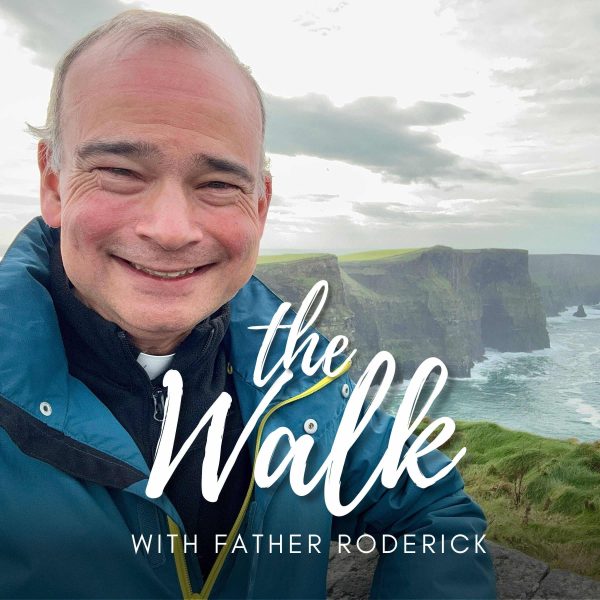
The Walk
- Episodes
- 406
- Released
- weekly
- Latest episode
- Nov 6, 2026
About the podcast
A weekly walk with Fr. Roderick during which he shares his thoughts as a priest on the struggles and challenges as well as the joys and surprises of day-to-day life.
Episodes 406
The Pasta Machine, a Lego City and All My Other Plans
I have a pasta machine somewhere in the house.At least, I think I still do.There was a period when I watched MasterChef almost religiously and imagined myself becoming this adventurous home cook who would make …
Show notes
I have a pasta machine somewhere in the house.
At least, I think I still do.
There was a period when I watched MasterChef almost religiously and imagined myself becoming this adventurous home cook who would make everything from scratch. So obviously I needed a pasta machine. And a bread machine. And various other things that would allow me to cook the way people on television cooked.
I did use some of them for a while. I learned a lot. I still love cooking.
But these days I’m much more likely to find a simple recipe on TikTok, grab a good knife and make something that tastes great without turning dinner into a three-hour project.
And yet some of those machines are still sitting there.
I’ve been thinking about that this week because I’m beginning to notice how often I do the same thing with other parts of my life.
The things that once mattered
For years I had this feeling that once I had started something, I somehow had to keep it going.
A podcast. A website. A social media channel. A project. Sometimes even a hobby.
If I stopped, it felt suspiciously like failure.
I would tell myself that if only I were more disciplined, or had a better system, or managed my time more efficiently, I could keep all of it alive.
Which is obviously nonsense.
At one point I also decided I was going to build a huge Lego city. I bought quite a lot of Lego for it, and I still like the idea. Little buildings, lights inside the houses, streets, the whole thing.
The problem is that it takes me several months to finish one Lego set.
So unless I suddenly get an extra lifetime, that city may have to remain imaginary.
The funny thing is that some part of me still says: but you already bought all this. Maybe someday.
That “maybe someday” can take up an enormous amount of space.
Not just physical space either.
I already ran the marathons
I noticed the same thing on today’s walk when I passed the place where I once injured myself while training for a marathon.
For almost twenty years I ran a marathon nearly every year. For the past few years I haven’t.
And occasionally this thought pops up that perhaps I should run another one, if only to prove to myself that I still can.
But then I think about what marathon training actually means. Running four or five times a week, and eventually some of those runs take two or three hours.
Do I really want to spend that time on proving something I’ve already proven many times?
I still enjoy running. I still want to be healthy. I just don’t know if I need another marathon.
Maybe that period of my life already did what it was supposed to do.
That’s surprisingly difficult for me to accept.
There are things we buy, habits we build and projects we start because they fit the person we are at that moment. They can be genuinely good. They can teach us something, give us joy, introduce us to people or help us become healthier or more creative.
But that doesn’t necessarily mean they have to come with us forever.
It served its purpose
Sometimes you just have to accept that something has reached the end of its usefulness, at least for now.
That can be an object. It can be a hobby. It can be a project, or even an image of yourself that you have been carrying around for years.
I scanned a lot of my childhood drawings a few years ago. Some of them are terrible, of course. There is probably a green blob somewhere that six-year-old me considered the most magnificent frog ever committed to paper.
I don’t look at that drawing and think I should still be drawing frogs exactly like that.
It was practice.
It got me somewhere.
I’m trying to become a little more comfortable thinking that way about other things too.
Not everything I once loved has to remain part of my life forever. Not every project needs another season. And not every version of myself needs to be maintained simply because I invested a lot of time becoming that person.
I’m still not throwing out all the Lego tomorrow.
But I may finally be ready to admit that the city can wait.
Father Roderick Vonhögen
P.S.: these thoughts were part of this week’s podcast episode of The Walk; you can listen via the player at the top of this page.
Get full access to Father Roderick at fatherroderick.substack.com/subscribeThe Month I Made My World Smaller
The woods are absolutely beautiful at the moment. On my walk today I passed an old tree trunk covered in tiny yellow mushrooms, almost like little houses built against the side of a cliff, with a sea of brown …
Show notes
The woods are absolutely beautiful at the moment. On my walk today I passed an old tree trunk covered in tiny yellow mushrooms, almost like little houses built against the side of a cliff, with a sea of brown and golden leaves underneath. And immediately my imagination went somewhere else entirely. I could see little creatures living underneath those mushrooms, sitting inside at the end of the day drinking hot chocolate.
I have no idea how that would work in a mushroom house, but apparently my imagination does not care about practical details.
This really is peak fairy-tale season for me. Last year, around this time, I wrote 30 or 31 short stories in a month. This October has been very different because I deliberately tried to focus more. I wanted to work on my fantasy novel, on Pangur’s story, and on some of the other writing projects that have been waiting for me.
What I hadn’t expected was that October would also teach me something about the circumstances in which I seem to work best.
This Substack is reader-supported. To receive new posts and support my work, consider becoming a free or paid subscriber.
The retreat I didn’t go on
Originally, I had this idea that I needed to go away somewhere. Maybe Ireland. Maybe some sort of writing retreat. I had already cleared most of my calendar, so the plan was to travel, walk, write, and create that sense of separation from normal life.
In the end I stayed home.
And after a slightly restless beginning, the rhythm just settled by itself. I went to bed around the same time, woke up around the same time, wrote in the mornings and went for long walks in the afternoons. There were very few appointments, hardly any travel, and not much external pressure.
At some point I noticed that I wasn’t missing the retreat anymore.
Apparently, what I needed wasn’t another place. I needed predictability.
That has been interesting to discover because I’m actually very good at improvising. I’ve been doing that for most of my working life. Podcasting certainly trains you to solve problems quickly, and I have a very associative brain, so if something changes I can usually think of three other ways to make it work.
But it costs energy.
I noticed that again this week when some plans for the saints podcast suddenly changed. It wasn’t even necessarily the amount of extra work that bothered me. It was having to rearrange everything. I woke up much too early the next morning and my brain immediately started trying to solve the entire month of November.
I can do that. I’ve always done that. But I’m beginning to see more clearly what it does to the other work I want to do.
What happened when things got quiet
Once October became predictable, I had much more room to think.
I spent a lot of time rebuilding the plot of my fantasy novel, and I’m very glad I didn’t give myself a deadline of 3,000 words a day or decide that the book had to be finished by Christmas. I’ve done those kinds of writing sprints before, and they can be wonderful, but this book needed something else. I had forgotten how many pieces of the world were still vague in my own head. Going back to the foundations forced me to think again about the history, the magic, the characters and, most importantly, why I want to tell this particular story.
That takes time. There isn’t really a word-count target for thinking.
Of course, social media doesn’t help. You see another writer announce that they finished a novel in six weeks, or that they wrote 5,000 words before breakfast, and immediately part of your brain goes: I should be doing that too.
But you don’t see the ten years before those six weeks. You don’t see the days when they were tired or sick or simply didn’t write anything. You see the part that makes a good post.
I would love to have several finished books by now. I’m very impatient about that. But since I don’t, rushing the first one in order to feel as though I’m catching up with somebody else is probably not going to help me very much.
And strangely enough, the month in which I stopped pushing for that kind of visible progress has been one of my most creative months in a long time.
Keeping some of this
All of this is on my mind because my work is going to change quite dramatically at the end of the year. The daily saints podcast will stop in its current form, which also means that a large part of my income disappears. So I have plenty of practical questions to answer.
But I don’t want to answer those questions only by asking what kind of work I can find.
I’m also asking what kind of life allows me to do the work I’m actually good at.
I love telling stories. I love travelling and interviewing people. I love history, saints, books, fantasy, walking and writing. There are probably ways to combine much more of that than I have done in the past, and I’m exploring quite a few of them at the moment.
What I don’t want is to fill every empty space in the calendar again simply because it is empty.
October has been a useful experiment in that sense. My world became physically quite small. I spent most mornings in the same little room and most afternoons walking through the same woods. Yet my imagination went everywhere.
Tolkien once wrote that “the realm of fairy-story is wide and deep and high and filled with many things.”
He was so right!
Father Roderick Vonhögen
P.S.: these thoughts were part of this week’s podcast episode of The Walk; you can listen via the player at the top of this page.
Get full access to Father Roderick at fatherroderick.substack.com/subscribeMy Hobbit Hole Needs an Upgrade
Of all the rooms in my house, I spend most of my working day in what is basically a closet.It was never meant to be an office. When I moved into the former rectory where I live, this tiny room beside the front …
Show notes
Of all the rooms in my house, I spend most of my working day in what is basically a closet.
It was never meant to be an office. When I moved into the former rectory where I live, this tiny room beside the front door was simply where people hung their coats. It measures 2.5 meters (about 8.2 feet) in length and 2 meters (about 6.6 feet) in width. Last year, I turned it into my Hobbit hole.There was just enough space for a small IKEA desk, a chair, and a few bookshelves. One wall holds a cupboard with all the house’s electronics, and there’s a single square window.
I’ve always loved the image of Bilbo Baggins sitting safely inside Bag End, surrounded by books and familiar things, writing down his adventures while the outside world disappears. That’s more or less what I wanted for myself: a small, warm place where I could shut out distractions and step into a story.
There was also a very practical reason for choosing the smallest room in the house: it was the only room I could afford to keep warm.
Writing with gloves on
The rectory was built in the 1950s, when apparently nobody expected heating a house to become a luxury.
The roof has never been properly insulated. The insulation inside the walls has largely deteriorated. Downstairs there are enormous old windows through which both heat and money disappear at alarming speed.
Last January, I spent around €1,200 on heating alone.
So during the winter I mostly retreat to my Hobbit hole. I keep the rest of the house at a fairly low temperature and heat only the room where I work. Last year there were days when even that wasn’t enough and I sat behind my computer wearing thin gloves.
It turns out that typing fantasy novels with cold fingers is considerably less romantic than it sounds.
This week I finally decided that something has to change.
I had two people from a local energy service inspect the house and explain where the biggest problems are. A company is coming to look at the walls and give me a quote for new insulation. I’m also investigating how to insulate the attic without spending a fortune.
And for the Hobbit hole itself, I’m considering an infrared panel.
Bilbo had a fireplace.
I’ll take what I can get.
The unromantic side of a creative life
I’ve been thinking about this because October has been such an intensely creative month for me.
Every morning I sit in that little room and work on stories. My big fantasy novel is slowly being rebuilt. The children’s book about Pangur the magical monastery cat is evolving almost every day. Then, after several hours behind the desk, I put on my coat and walk into the woods to solve whatever story problem is currently occupying my brain.
It is pretty close to the life I imagined when I decided I wanted to become a writer.
Except that imaginary writers never seem to spend much time comparing insulation quotes. They don’t worry about natural gas prices or whether their hands will be warm enough to type in January.
Real life insists on being considerably more practical. But perhaps those practical things matter more than I used to think.
The stories may happen in my imagination, but I still need somewhere to sit while I write them. I need enough peace to concentrate. I need food, electricity and a room that is not thirteen degrees Celsius.
Creativity doesn’t exist separately from all of that.
A small room can hold a very large world
The funny thing is that I don’t wish my office were bigger.
There are much larger rooms in this house, but I rarely want to work in them. I like being surrounded by bookshelves. I like being able to reach almost everything without getting out of my chair. I like that when I close the door, the room feels separate from the rest of the house.
The physical world gets smaller, and somehow that makes the imaginary world bigger.
Over the past two years, that tiny room has contained medieval Ireland, dragons, saints, magical storytellers, short stories, podcasts and now a white monastery cat who is causing considerably more trouble than I originally expected.
So I don’t want a different writing room.
I just want this one to be warm.
Hopefully, by the time winter really arrives, my Hobbit hole will have received its first major renovation.
No round window or a fireplace. After all, this is not Bag End.
But if I can write without gloves on, I’ll consider it a success.
Fr. Roderick Vonhögen.
P.S. This article grew out of this week’s episode of The Walk. In the full episode I also talk about Pangur’s latest adventures, my plans for a Story Magic magazine, and why this writing retreat has generated far more ideas than I expected. You can listen via the player at the top of the page.
Get full access to Father Roderick at fatherroderick.substack.com/subscribeMy Fantasy Novel Sent Me Back to Seminary
Today, I ran into some parishioners while walking in the woods. “I thought you were going to be in Ireland,” they said. So did I.For months, October had been blocked out in my calendar as my writing month. The …
Show notes
Today, I ran into some parishioners while walking in the woods. “I thought you were going to be in Ireland,” they said. So did I.
For months, October had been blocked out in my calendar as my writing month. The original plan was to travel to Ireland, move from hostel to hostel, walk for hours every day and spend the rest of my time working on my fantasy novel.
Then I looked at the prices.
Travel alone had become expensive, accommodation would add another considerable amount, and suddenly my supposedly simple writing retreat was turning into a trip of several thousand euros.
So I stayed home.
At first that felt a little disappointing. Now, halfway through October, I’m beginning to think it may have been exactly what I needed.
This Substack is reader-supported. To receive new posts and support my work, consider becoming a free or paid subscriber.
Walking without going anywhere
One thing I knew I would miss about Ireland was the walking.
When I’m there, I can easily spend most of the day on foot. Walking helps me think. Problems that seem impossible behind a desk often begin to loosen after an hour or two outside.
So I’ve simply kept doing that here.
This week I spent three hours wandering through the woods and the park around a nearby castle. Autumn has arrived properly now. The leaves are changing, the light is getting warmer, and at one point the late-afternoon sun hit the moss on the trees in such a way that I had to stop recording and take a picture.
The strange thing is that I don’t feel as if I’m missing Ireland very much.
I’m spending so much time inside the world of my stories that Ireland seems to be following me around anyway.
A different kind of retreat
What I didn’t expect was how personal the writing would become.
I’m rebuilding the fantasy novel I started last year, and the main characters are young people trying to work out who they are, how much they should conform to what others expect from them, and whether they can trust their own gifts.
The more I develop them, the more memories return from my own twenties.
I spent the first five years of seminary in Louvain-la-Neuve, in the French-speaking part of Belgium. I was incredibly happy there. It was international, exciting, and for a long time it felt as if I had found exactly where I belonged.
Returning to the Netherlands was much harder. Suddenly I felt like the outsider. The culture was different, the expectations were different, and during those early years of priesthood I often struggled with a question that I now recognize much more clearly: can I be myself, or do I have to become the person other people expect a priest to be?
At the time, I didn’t have the language for some of what was happening. Looking back now, I can recognize things like masking and the strain of constantly trying to fit myself into roles that didn’t quite fit me.
Writing fictional characters who wrestle with similar questions has brought all of that back.
Sometimes I go to bed after working on the novel and dream about seminary again.
Seeing the same road differently
Something similar happened earlier this year when I walked the Camino again.
I returned to places I had first visited almost ten years before. The landscape hadn’t changed very much, but I had.
That made it possible to look at old experiences differently. Things that once seemed like failures or difficult detours now belonged to a much larger story.
October is beginning to feel like that too.
I thought I had cleared the month so I could travel somewhere and finish a book. Instead, staying home has given me the space to look backwards, write, walk, sleep properly and take care of things I’ve been postponing for far too long.
Some of those things are extremely ordinary. I’m finally looking into fixing the insulation in my house before another cold winter. I need new glasses; apparently twelve years between eye tests may be pushing it slightly. I’m also taking the first steps towards getting proper professional help with some of the ADHD-related issues I’ve been learning to recognize and manage.
None of this was on my romantic picture of a month-long writing retreat in Ireland.
But perhaps a retreat doesn’t always require going somewhere.
The ideas are coming back
The easiest way for me to tell whether this slower rhythm is working is that ideas have started appearing again.
I’m working on the novel. A little side project about a magical monastery cat has unexpectedly turned into an entire book. Other stories are beginning to connect. I’m walking more, sleeping more and feeling increasingly like myself.
There are still plenty of practical questions waiting for me. My daily saints podcast ends at the end of December, so I have to work out how to replace a substantial part of my income next year without creating another job that consumes all the time I want to spend writing.
But I don’t have to solve all of that this week.
For now, I’m walking through autumn woods, working on stories and slowly sorting out the things that have been waiting for my attention.
Ireland would have been wonderful.
This is pretty good too.
P.S. This article grew out of this week’s episode of The Walk. You can hear the full update via the player at the top of this page.
Get full access to Father Roderick at fatherroderick.substack.com/subscribeI Think I’m Suffering From Time Travel Whiplash
I think I might be suffering from time travel whiplash. A couple of days ago, I spent most of an afternoon editing a podcast I had recorded at the Elfia fantasy festival in Arcen two weeks earlier. The …
Show notes
I think I might be suffering from time travel whiplash. A couple of days ago, I spent most of an afternoon editing a podcast I had recorded at the Elfia fantasy festival in Arcen two weeks earlier. The recording had gone badly wrong. My ancient audio recorder had apparently decided that fifteen years of loyal service was enough, and large chunks of conversations had simply disappeared. So I spent six or eight hours reconstructing what was left, cutting around the gaps and trying to make the finished episode sound as if nothing unusual had happened.
By the end of the day, something strange had happened to me as well. I felt as if I had just returned from the festival. I could remember the sunshine, the people I had talked to, the atmosphere, the conversations. Audio does that to me. The moment I start editing an old recording, I am back there again.
Then I opened Instagram and started promoting episodes of my saints podcast based on recordings I had made six weeks earlier. At the same time, I was scheduling other episodes that won’t be published until November. Past, present and future were all occupying the same afternoon. No wonder my brain occasionally wonders what month it is.
The month I was supposed to write
October was supposed to be simple. I had deliberately cleared the month so I could concentrate on rewriting my fantasy novel. Originally, I imagined myself spending much of October in Ireland, moving between hostels, walking during the day and writing the book in the evenings.
Instead, the first week mostly involved recovering from everything I had done to clear the month in the first place. I slept. I tried to slow down. I looked at travel prices, discovered that Ireland would cost considerably more than I’d expected, and started wondering whether I should change the plan.
Then I started another story. Then I researched medieval monasteries. Then medieval storytellers. Then architecture. Then ninth-century Irish monks living in Germany.
All fascinating. None of which involved actually rewriting the novel.
I know this pattern rather well. When something important feels difficult, I become extremely good at improving everything around it. I reorganize the system, fix my email, rethink my routines, do more research and make a better plan. All of those things can be useful, but they can also become an extraordinarily sophisticated form of procrastination.
The problem isn’t motivation
This morning I finally sat down and asked myself what was actually going on. I’m not lacking motivation. I love this book, I love the world, and I know much more about the story than I did when I wrote the first draft.
That’s part of the problem.
The better I understand it, the more pressure I feel to get everything right. If I’m creating an entire fantasy world, shouldn’t I know exactly how the monasteries work? Shouldn’t I understand the history? Shouldn’t the magic system make sense? Shouldn’t I know how all of this affects books I haven’t even written yet?
Before I know it, I’m standing at the bottom of another research rabbit hole.
Meanwhile, writing my little story about an old monk and his magical cat feels effortless. I think that’s because I’ve told myself it’s a small story. I’m allowed to play with it. I’m allowed to make jokes. I’m not worrying about whether I’ll regret chapter seven five years from now.
The bar is lower, and apparently that makes it much easier to jump.
Standing on the platform
It reminded me of something I did years ago during youth camps. We had one of those climbing courses high up in the trees. At one point you had to step off a small platform and trust the cable attached to you to carry you across to the next tree.
I hate heights.
I remember standing there calculating everything that could possibly go wrong. Then a girl of about eleven went before me. She didn’t hesitate. She jumped and had a wonderful time.
And there I was, still standing on the platform, considerably older and supposedly wiser, imagining every possible disaster.
That feels uncomfortably familiar now. I see other writers publishing books. Their first novels aren’t perfect. Their fifth probably won’t be perfect either. But they’re writing them.
Meanwhile, I keep thinking that perhaps I should first do a little more research. Or build a better system. Or go to Ireland. Or not go to Ireland. Or solve some other problem before I begin.
At some point, you have to step off the platform.
Here and now
Maybe that’s where my strange time-travel week has been pointing me. My head spends an enormous amount of time somewhere else. Sometimes I’m reliving something from six weeks ago. Sometimes I’m imagining what readers might think of a book that doesn’t exist yet. Sometimes I’m worrying that future me will look back and wonder why I made a particular choice.
It reminded me of Luke Skywalker. In The Empire Strikes Back, his mind is always racing ahead. Later in life, he gets trapped in the opposite direction and can’t stop looking backwards. Neither helps him very much with what is actually in front of him.
And right now, what is in front of me is remarkably simple. It’s October 8. I have about three weeks left. My novel has roughly twenty-five chapters. I could spend those weeks designing the perfect writing system, or I could write one chapter a day.
The trip to Ireland may happen. It may not. The research will continue. The book won’t be perfect.
But none of those questions need answering before I write today’s chapter.
So that’s my assignment to myself: stop time travelling, write the story that’s in front of me, and jump.
Fr. Roderick Vonhögen
P.S. This article grew out of this week’s episode of my podcast The Walk. You can hear the full episode via the audio player at the top of this page.
Get full access to Father Roderick at fatherroderick.substack.com/subscribeI’m Excited to Be Writing Again
October has finally arrived, and I’ve been looking forward to it for quite some time.I deliberately cleared as much as possible from my calendar. No big recording trips. No looming podcast deadlines. No …
Show notes
October has finally arrived, and I’ve been looking forward to it for quite some time.
I deliberately cleared as much as possible from my calendar. No big recording trips. No looming podcast deadlines. No administrative projects. For once, I want most of my days to revolve around one thing: writing.
Getting here was not particularly relaxing. Over the past two weeks, I produced around thirty episodes of my Dutch saints podcast, finished the paperwork for the audit of our foundation, and spent more than four hours on trains to record another ten episodes in a basilica in the south of the Netherlands.
By the time October arrived, I was exhausted. But the blinking lights in my head had finally gone out.
When everything keeps blinking
I’ve noticed this about myself before. I can have plenty of time to write, but if there are five other things demanding my attention, I find it almost impossible to really disappear into a story.
An email I still need to answer. A recording that has to be scheduled. A problem someone else is waiting for me to solve. None of those things may take much time on their own, but together they create a kind of white noise in my head.
Producing a daily podcast has created a lot of that noise this year. I’ve loved making it, but it also asks for a constant stream of creative energy. Spending your working day telling stories doesn’t necessarily make it easier to sit down afterwards and tell another one.
Last year, I was constantly dreaming up new stories. This year, much of that came to a halt.
I missed it more than I realised.
Three days into October
On October 1, I started writing again.
I’m back to rewriting my fantasy novel, and the year away from it may actually have helped. The world is much clearer to me now. I understand the characters better, and I have a stronger sense of why I want to tell this story in the first place.
At the same time, another idea came back to life.
A couple of months ago, while walking through Utrecht, I had a very simple thought: what if an old monk had a magical cat?
The cat soon acquired nine lives, each lasting a century. The monk became a former story mage who had lost confidence in his abilities. Something hidden beneath the monastery should probably have remained there.
This week I wondered whether I could combine that idea with Inktober, the annual drawing challenge with a different prompt for every day in October. Three days later, I had the outline for a 31-chapter story.
I’m still tired, and I’m already behind on the drawings. But my brain is making things again.
That is the difference.
Keeping it playful
I’m deliberately keeping this second project small.
The novel gets the serious writing hours. The story about the monk and his cat gets my lunch breaks. One short chapter, one small illustration, then back to the novel.
I’ve learned that tiny side projects have a habit of turning into enormous undertakings if I’m not careful. This time, I want the lunch breaks to remain playful. I want to make something because the idea makes me smile, not because it has to become part of some larger strategy.
Ireland can wait
I still haven’t booked my trip to Ireland.
A few years ago, that probably would have made me panic. Instead, I looked at the possibilities and realised that travelling immediately would be unnecessarily expensive.
So I’m not going yet.
My first job this month isn’t to maximise every available day. It’s to recover from the sprint that got me here, to walk, sleep, settle into a rhythm, and write every day.
Ireland can wait another week or two.
For once, I’m not particularly worried about how much I’ll accomplish by the end of the month. Three days in, something more important has already happened.
I’m excited about writing again.
And I’ve missed that feeling.
P.S. This article grew out of this week’s episode of The Walk. You can hear more about my plans for October, the stories I’m working on, and why I may end up in Ireland, Scotland, or both by hitting play on the audio player at the top of this page.
Get full access to Father Roderick at fatherroderick.substack.com/subscribeYou Don't Have to Finish Everything You Start
At the beginning of this year, I decided I was going to read 100 books.It seemed perfectly reasonable at the time. I’d read even more than that in previous years, and although I knew 2026 would be busy, surely …
Show notes
At the beginning of this year, I decided I was going to read 100 books.
It seemed perfectly reasonable at the time. I’d read even more than that in previous years, and although I knew 2026 would be busy, surely I could manage 100?
We are now approaching October.
I recently looked at my Goodreads account and discovered that, to reach my goal, I’d pretty much have to read a book every single day until the end of the year.
Part of my brain immediately went: Challenge accepted!
Fortunately, another part asked a much more sensible question.
Why?
When goals become obligations
There’s nothing wrong with setting goals. I love goals.
The problem starts when circumstances change but the goal doesn’t.
When I decided to read 100 books, I didn’t know quite how demanding producing a daily podcast would become. I didn’t know how much time I’d spend recording, editing, traveling and doing everything else around it.
And yet there was still a little voice telling me that I’d failed because I wasn’t keeping a promise I’d made to myself nine months ago.
I recognize exactly the same voice when I look at my writing.
At one point, I wanted to publish eight books this year. Then I meet another author who published their first novel last year and already has their second book out, and immediately I think:
I’m so far behind.
Behind whom?
Nobody is waiting outside my house with a stopwatch.
The deadline mostly exists in my own imagination.
The Halloween project
I ran into the same problem again this week.
I had come up with an idea for a special series of seven episodes of my Dutch saints podcast leading up to Halloween. There are some surprisingly eerie stories about saints, demons and supernatural encounters, and I thought it would be fun to tell them almost like horror stories, complete with music and sound effects.
I loved the idea.
Then I tried writing them.
It was hard.
I’ve never written horror before. I’m actually rather impressionable myself, so I tend to avoid it. The first attempts felt cheesy. I couldn’t find the right voice. After struggling with it for a couple of days, I realized that doing this properly might consume another two weeks.
A few years ago, that wouldn’t have stopped me.
I’d had the idea. I’d committed to it in my head. Therefore I had to finish it.
This time I asked myself another question.
Why?
Nobody had asked for these seven episodes. We already have interviews recorded that can fill those slots perfectly well. The Halloween series was something I’d invented because it sounded fun.
So I parked it.
Maybe I’ll return to it someday. Maybe I’ll have learned enough about writing horror by then to make it work.
For now, letting it go gave me something much more valuable: room to breathe.
Goals can change. Priorities don’t have to.
I’m slowly learning to distinguish between my goals and the reasons I set those goals in the first place.
Reading 100 books was a goal. Loving books and wanting to read more is the priority.
Publishing eight books was a goal. Becoming a better writer and bringing my stories into the world is the priority.
Creating a Halloween series was a goal. Telling good stories is the priority.
Once I look at it that way, changing a goal doesn’t feel nearly as much like failure.
Sometimes the circumstances simply changed.
And sometimes I changed.
That doesn’t mean giving up on the things that matter. Quite the opposite. It means protecting them from all the arbitrary targets, deadlines and expectations that can gradually make them feel like obligations.
My desire to write hasn’t disappeared because I haven’t published eight books this year.
If anything, it’s stronger.
And now that I’ve cleared a few things from my October calendar, I’m getting ready to return to Ireland.
This time, I don’t have a target for how many chapters I need to finish while I’m there.
I just want to write.
That seems like a pretty good goal to me.
P.S. This article grew out of this week’s episode of my podcast The Walk. You can listen to the full episode by hitting play on the audio player at the top of this page.
Get full access to Father Roderick at fatherroderick.substack.com/subscribeHow to deal with a disturbance in the Force
I knew exactly what I wanted to work on this week. I was going to continue rewriting my fantasy novel. I had made some good progress on the worldbuilding and the magic system, and I was finally getting back …
Show notes
I knew exactly what I wanted to work on this week. I was going to continue rewriting my fantasy novel. I had made some good progress on the worldbuilding and the magic system, and I was finally getting back into a rhythm.
Then a letter arrived from the Dutch tax authorities.
Our non-profit foundation, Trideo, had been selected for a routine check. Nothing alarming, as far as I can tell. But they need documents. Annual reports. Plans. Financial information. Details about what we’ve been doing and what we’re planning to do.
And they need it before the end of the month.
There went my carefully planned September.
A disturbance in the Force
As I walked through the woods this week, I called it a disturbance in the Force.
You can have your priorities perfectly organized and diligently work through them every day. Then something appears that you didn’t plan for but can’t ignore.
I initially tried to keep everything else going alongside it. The novel. My podcast work. Preparations for a possible research trip in October. Fantasyfans. All the other projects already occupying little corners of my brain.
That didn’t work particularly well.
I stopped taking my daily walks. I didn’t sleep as well. I became agitated. There was a knot in my stomach.
The funny thing is that the paperwork itself isn’t particularly frightening. The problem is uncertainty. When something suddenly lands on my desk with lots of different parts and no obvious first step, my brain wants to solve all of it at once.
So I eventually did the opposite.
For the next two weeks, the paperwork gets priority. The contractual work still gets done. Everything else can wait.
Getting lost
There was a certain irony to explaining all this while recording the podcast.
I decided to take a path through the woods that I hadn’t walked before.
Except it wasn’t really a path.
Soon I was climbing over fallen trees, crawling underneath branches and trying to work out whether I had accidentally wandered into someone’s backyard. At one point I found an enormous cobweb and decided that awakening Shelob would not improve my week.
Eventually I found a real path again.
Then the thunder started.
Within minutes, the blue skies disappeared, rain was pouring through my flimsy running jacket and cold water was trickling down my spine.
So much for planning.
But perhaps that’s why I need these walks especially when life gets busy.
For about a week I had skipped them because I thought I didn’t have time. In reality, walking is one of the things that makes everything else sustainable. The same goes for keeping my evenings free, going to bed on time and occasionally doing something creative that doesn’t have to become another project.
Even drawing medieval miniatures can become work if I’m not careful. Before long I’m imagining a book, a video series and twelve social media posts about them.
Sometimes a drawing should just be a drawing.
There will always be more work
By the time I found my familiar walking route again, the storm had passed. The sun even came back.
My plans for the next couple of weeks haven’t magically become less complicated. There is still a pile of paperwork waiting for me. There are podcast episodes to produce. I’m going to Elfia this weekend. And somewhere beyond all that, my unfinished novel is patiently waiting for me.
But I’ve also made one decision that I’m rather happy about.
In October, I want to return to Ireland.
I had been considering Scotland, but Ireland makes more sense right now. It gives me a chance to write, revisit some of the places that inspired my stories and gather more material for the books I’m already working on.
More importantly, putting the trip on the calendar protects it from all the work that will inevitably try to take its place.
Because there will always be more work.
There won’t always be another autumn in which I can go to Ireland.
P.S. These reflections began during this week’s episode of The Walk. If you’d like to hear the original (and hear me get lost, caught in a thunderstorm and eventually find my way home) you’ll find the audio player at the top of this page.
Get full access to Father Roderick at fatherroderick.substack.com/subscribeWhat Season of Life Are You In?
One of the unexpected gifts of this past week didn’t happen while writing my novel or recording a podcast. It happened while walking through the woods.As autumn slowly announces itself here in the Netherlands …
Show notes
One of the unexpected gifts of this past week didn’t happen while writing my novel or recording a podcast. It happened while walking through the woods.
As autumn slowly announces itself here in the Netherlands, the first mushrooms are appearing among the fallen branches. They’re easy to miss, but every year they remind me that life has its own seasons. Some things disappear. New things quietly emerge in their place.
I’ve noticed something similar happening in my own life.
For years I’ve tried to hold on to every version of Father Roderick that ever existed. The Star Wars enthusiast. The television presenter. The priest. The podcaster. The documentary maker. The YouTuber. The writer. I kept wondering whether I should still be all of those things at once.
Lately I’ve begun to suspect that the question itself is wrong.
Finding my place
Last weekend I spent a day at a small fantasy festival, recording interviews for my new Dutch podcast, Fantasyfans.nl. It was a much smaller event than Castlefest, which made it possible to have real conversations with artists, writers and visitors.
What struck me most wasn’t the costumes or the music.
It was the kindness.
Again and again I met people eager to encourage each other, share their creativity and celebrate each other’s stories. I came home with hours of interviews, but also with a growing conviction that this community is exactly where I need to be right now.
Not because everyone thinks the same way, quite the opposite.
It’s because I can simply show up as myself: a priest who loves stories. A storyteller who happens to be a priest.
Letting go of old roles
That has also made me think about the things I’m slowly letting go of.
This week I started clearing out one of the cupboards in my office. It was filled with microphones, cameras, old phones and equipment I bought for projects I once imagined I would make.
I realised I wasn’t really sorting electronics.
I was sorting through old versions of myself.
Some of those dreams were worth pursuing because they brought me exactly where I am today. Others have simply run their course. Keeping hold of them doesn’t honour the past. It only clutters the present.
The same is true for the roles we assign ourselves.
There comes a moment when you have to stop asking, “Who am I supposed to be?” and start asking, “Who has God actually made me to be?”
Trusting the journey
That question has made returning to my fantasy novel much easier. I’m no longer trying to become “an author” as quickly as possible. I’m simply writing the story that has been growing inside me for years.
The same goes for podcasting, for building this new fantasy community, and for everything else that currently fills my days.
I don’t need to keep proving that I can still do everything I used to do. I only need to be faithful to the work I’ve been given today.
Perhaps that’s what vocation looks like: not becoming someone else.
But gradually becoming more fully yourself.
Fr. Roderick VonhögenP.S. This week's newsletter is based on the latest episode of The Walk. You can listen to it by pressing play on the audio player at the top of the page.
Fantasyfans.nl update
A warm welcome if you recently discovered this newsletter through Fantasyfans.nl!
Last weekend I recorded the latest episode of the podcast live at the Evermore Fantasy Festival. It turned into a wonderful collection of conversations with artists, writers, cosplayers and fantasy fans about creativity, community and why these festivals feel like coming home for so many people.
🎙️ You can listen to the live festival episode (in Dutch) here:
Get full access to Father Roderick at fatherroderick.substack.com/subscribeBack in Medieval Ireland
Home againEvery weekday morning this week, I’ve found myself back in early medieval Ireland.The morning mist still hangs over the valley as monks make their way across the monastery grounds. The bell has just …
Show notes
Home again
Every weekday morning this week, I’ve found myself back in early medieval Ireland.
The morning mist still hangs over the valley as monks make their way across the monastery grounds. The bell has just called the community to prayer. In the scriptorium, novices bend over their desks, learning to shape letters and illuminate manuscripts. Outside the walls, old legends are stirring, and somewhere in the distance a young novice is about to stumble into a story much bigger than he could ever imagine.
Then I look up from my laptop.
For the first time in months, I’m genuinely looking forward to sitting down every morning to rewrite my first fantasy novel.
Not because I’m making spectacular progress. Quite the opposite. Some mornings I rewrite a single page. Others I don’t write anything at all. Instead, I listen back to old voice notes, rethink the history of a monastery or spend an hour trying to understand one of my characters a little better.
And I’m having the time of my life.
Exploring instead of producing
Only a few weeks ago, this felt completely different.
Rewriting the novel had become a mountain I kept avoiding to climb. Every new story idea seemed more exciting than returning to the manuscript I’d already written. I felt guilty about that, convinced I simply needed more discipline.
Now I think something else was going on…
Last week I wrote about letting go of the imaginary version of myself who always had enough time to do everything. Once I stopped measuring myself against that impossible person, something unexpected happened. The pressure disappeared.
I no longer felt I had to prove I could write a novel, I could simply take the time to learn how to write one. And that tiny shift changed everything.
Instead of trying to produce pages as quickly as possible, I’ve started treating these mornings as an opportunity to explore. Sometimes I end up reading about medieval pigments. Or I draw a map of the monastery grounds. Sometimes I realise an entire chapter needs to happen somewhere else.
None of that feels like wasted time anymore. It’s part of building a world I’d actually want to visit myself.
Becoming a storyteller
As I mentioned last week, Tolkien once described writers as sub-creators. I’ve always loved that expression. We don’t create out of nothing. We receive the world as a gift, then patiently shape it into stories of our own.
Perhaps that’s what I’ve been rediscovering this week: writing isn’t simply producing words… It’s learning to see. Learning to listen. Learning to inhabit a world until it begins to feel real enough for someone else to step inside.
Will it take longer to finish this novel than I’d hoped a year ago?
Almost certainly.
But that no longer bothers me.
Because every morning I return to medieval Ireland, I leave my desk with something much more valuable than another completed chapter.
I close my laptop with the feeling that, little by little, I’m becoming the writer this story has needed all along.
Fr. Roderick Vonhögen
P.S.: This article is based on the latest episode of my podcast The Walk. If you’d rather hear the story in my own voice, you’ll find the podcast player at the top of this page.
Fantasyfans.nl update
It’s been exciting to watch my new Dutch fantasy podcast and community slowly find its audience. Just over a month after launching, Fantasyfans.nl has grown to around 350 Instagram followers, while the Facebook and YouTube communities are steadily growing as well. What I enjoy most, though, is the interaction. Every week I record a community podcast, and it’s wonderful to see the discussions continue long after the microphones have been switched off.
Last week I published an interview with fantasy author G.J.G. Klaassen, whom I quite literally bumped into while walking the Four Day Marches of Nijmegen. We talked about his debut novel, writing fantasy and finding inspiration in unexpected places. You can read or listen to the interview here.
This weekend I also spent a day at the Evermore Fantasy Festival in Ede, where I recorded a new community podcast and spoke with visitors, authors and creators. I’m editing those conversations now, along with plenty of photos from the festival, and I’ll start sharing them later this week. If you’re curious about the Dutch fantasy community, keep an eye on Fantasyfans.nl!
Get full access to Father Roderick at fatherroderick.substack.com/subscribeThe Version of Me That Doesn't Exist
A decluttering expert said something this week that I haven't been able to get out of my head.We often buy things not for the person we are today, but for the person we hope to become. Running shoes for the …
Show notes
A decluttering expert said something this week that I haven't been able to get out of my head.We often buy things not for the person we are today, but for the person we hope to become. Running shoes for the future athlete. A bread machine for the baker who’s definitely going to make fresh sourdough every weekend. An expensive sketchbook for the artist who’s just waiting for the right moment to begin.
As I looked around my own house, I realised I’d been doing exactly the same thing.
Not just with possessions.
With my life.
For years I’d been making plans for someone who always seemed just around the corner. He somehow had enough time to keep half a dozen YouTube channels alive, maintain every hobby he’d ever enjoyed, answer every email the day it arrived, write books at remarkable speed and still have time left over for everything else.
The strange thing is that I’d started measuring myself against him.
No wonder I always felt behind.
Learning the craft
That realisation changed the way I looked at almost everything. I no longer felt guilty about projects that no longer fit the life I’m actually living. I stopped worrying that I wasn’t moving fast enough. Even my fantasy novel began to look different. Instead of asking why it still wasn’t finished, I found myself enjoying the slow process of becoming the writer who can tell this story well.
That reminded me of one of Tolkien’s favourite ideas. He described artists and storytellers as sub-creators. God alone creates from nothing. We receive creation as a gift and shape it through imagination, craftsmanship and patience. I’ve always loved that image because it shifts the focus away from producing something as quickly as possible. Craft isn’t measured by speed. It’s measured by the care you bring to it.
Perhaps that’s why I find so much joy these days in things that don’t seem particularly efficient. Painting medieval-style creatures in watercolor. Recording conversations with fantasy authors. Walking through the woods until a new idea appears. None of those activities produces a finished novel by the end of the day. Yet all of them are teaching me something about storytelling.
The real Father Roderick
That person I kept trying to become doesn’t exist.
Oddly enough, admitting that felt liberating rather than disappointing.
It made me ask a much simpler question.
Who is the real Father Roderick today?
The answer is becoming clearer. I’m a priest. A storyteller. A podcaster. And, increasingly, a writer. That doesn’t mean the earlier chapters of my life were mistakes. They brought me here. But some ambitions no longer fit the person I’ve become, and letting them go creates room for the ones that do.
Perhaps that’s why I’m ending this month with far more excitement than I expected. I haven’t finished my novel. I haven’t crossed a major milestone. What I have done is something that may turn out to be far more valuable.
I’ve stopped chasing the person I imagined I could become.
I’m beginning to pay attention to the person God is inviting me to be.
And that feels like the best possible place to begin the next chapter.
Fr. Roderick Vonhögen
P.S.: This article is based on the latest episode of my podcast The Walk. If you’d rather hear the story in my own voice, you’ll find the podcast player at the top of this page.
Get full access to Father Roderick at fatherroderick.substack.com/subscribeThe Story Underneath the Story
This week I finally began preparing the rewrite of my novel. Over the past year I’ve recorded hundreds of voice notes whenever an idea appeared, while walking through the woods, riding my bike or making dinner …
Show notes
This week I finally began preparing the rewrite of my novel. Over the past year I’ve recorded hundreds of voice notes whenever an idea appeared, while walking through the woods, riding my bike or making dinner. Most of them last less than a minute. A better ending to a scene. A new character. A monastery that suddenly belongs on a cliff instead of in a valley. My plan was simply to transcribe them, organise them into a story bible and finally start writing. Instead, I spent an afternoon listening to my own thoughts, and as the notes piled up on my screen, I realised they weren’t really about medieval Ireland or even the mechanics of the magic system. Almost every idea circled back to the same question: what does creativity actually do?
This Substack is reader-supported. To receive new posts and support my work, consider becoming a free or paid subscriber.
That question led me to the medieval monks who inspired much of my story. They weren’t merely copying manuscripts. Through words, images and craftsmanship they shaped the imagination of the people around them. It reminded me of Tolkien’s description of artists as sub-creators. God alone creates from nothing. We receive creation as a gift and, through imagination and skill, participate in it. Suddenly I understood that this had become the foundation of my novel. The magic isn’t really about extraordinary powers. It’s about the mysterious way stories, beauty and imagination can change people and, through them, the world.
Perhaps that’s also why rewriting this book has become so important to me. For months I’d measured my progress in chapters, deadlines and word counts. Sitting there with those voice notes, I realised I’d been measuring the wrong thing. The novel isn’t only teaching me how to tell a better story. It’s teaching me how to become a better storyteller. Every rewrite, every conversation with another author, every sketch in my notebook and every documentary I make is part of that same apprenticeship. I still hope that one day I’ll hold this novel in my hands. But when that day comes, I suspect the greatest gift won’t be the finished book. It will be the journey of becoming the person who was able to write it.
Fr. Roderick Vonhögen
P.S.: This article is based on the latest episode of my podcast The Walk. If you’d rather hear the story in my own voice, you’ll find the podcast player at the top of this page.
News updates:
I’ve started painting again for the first time in more than thirty years. Inspired by medieval manuscripts, I’m creating a small bestiary of strange and mythical creatures in watercolor. It’s still very much an experiment, but several of the illustrations have already sparked ideas for new stories.
My new Dutch fantasy podcast, Fantasyfans, is also beginning to find its audience. This weekend I recorded a series of interviews at a small outdoor fantasy and board game fair. One of my favorite parts of these events is discovering how generous creative people are when they start talking about their work. Every conversation leaves me with fresh ideas and renewed enthusiasm for my own writing.
That theme continued in another way this week, when I joined fantasy author Sandy Butchers on her podcast for a conversation about creativity, geek culture and why we tell stories in the first place. It was a joy to switch from interviewer to guest for a change. If you’d like to listen, you can find the episode here:
Get full access to Father Roderick at fatherroderick.substack.com/subscribeThe Eclipse That Measured My Life
When a partial solar eclipse became visible across Europe this week, I grabbed the most sophisticated piece of scientific equipment I own.A kitchen colander.I’d read that the tiny holes work like a pinhole …
Show notes
When a partial solar eclipse became visible across Europe this week, I grabbed the most sophisticated piece of scientific equipment I own.
A kitchen colander.
I’d read that the tiny holes work like a pinhole camera, projecting dozens of miniature eclipses onto a sheet of white paper. It sounded just improbable enough to be worth trying. So I packed the colander in my backpack, walked to the open fields outside my village, and joined hundreds of other people who had gathered to watch the sky.
Some had brought telescopes. Others carried homemade viewing boxes or expensive camera gear. A few generous souls let curious strangers peer through their eclipse glasses. Children pointed excitedly at the strange crescent-shaped shadows beneath the trees, while amateur photographers compared lenses and filters.
For a brief moment, complete strangers became companions, united by the simple fact that something remarkable was happening overhead.
My humble colander turned out to work perfectly.
More Than an Eclipse
The last time I witnessed a solar eclipse was more than twenty-five years ago.
As I stood there watching the Moon slowly uncover the Sun again, I realised how much life had happened between those two afternoons.
Back then I had only recently been ordained. Podcasting barely existed. Smartphones belonged to science fiction. I hadn’t studied in Rome yet. I hadn’t experienced burnout. I hadn’t spent years making television documentaries, walked the Camino de Santiago or started writing novels.
Standing in that same sunlight, I wasn’t just watching an eclipse. I was looking across almost three decades of my own life.
It’s strange how time works.
Twenty-five years ago feels almost like yesterday. Yet when I imagine another twenty-five years stretching ahead, it suddenly seems like an impossibly long road. Our memories compress time. The future, meanwhile, always feels endless, until one day you realise it isn’t.
What Actually Lasts
That thought lingered with me as I walked home.
People often worry about the legacy they’ll leave behind. Buildings. Careers. Collections. Recognition.
History suggests those things don’t last very long.
One of the advantages of having studied in Rome is that you spend your days surrounded by the remains of people who once believed their empires would last forever. Today, even the mightiest monuments are incomplete. Stones have been reused. Statues have crumbled. Names have faded.
Perhaps that’s why I don’t find much comfort in the idea of leaving something behind.
What matters far more to me are the moments that quietly shape a life. An afternoon spent filming a documentary. A conversation with a stranger. A walk through the woods. Or standing in a field with hundreds of people, all looking up at the same sky.
Those are the moments that stay with us long after the photographs have disappeared into forgotten hard drives.
As the sunlight slowly returned to normal, everyone packed away their cameras, folded up their picnic chairs and cycled home.
I put the colander back in my backpack.
I won’t need it to watch solar eclipses anymore. The next deep partial eclipse in my country will be in 2081.
But I’ll keep it anyway.
Maybe not for the next eclipse.
Just for draining my pasta.
This article is based on the latest episode of my podcast The Walk. If you’d rather hear the story in my own voice, you’ll find the podcast player at the top of this page.
Get full access to Father Roderick at fatherroderick.substack.com/subscribeI Didn't Expect to Fall in Love Again
On Sunday afternoon at the Castlefest fantasy festival, I made a last-minute decision.I’d already spent the previous day interviewing authors for my new Dutch podcast, Fantasyfans.nl. Instead of recording more …
Show notes
On Sunday afternoon at the Castlefest fantasy festival, I made a last-minute decision.
I’d already spent the previous day interviewing authors for my new Dutch podcast, Fantasyfans.nl. Instead of recording more conversations, I decided to spend the rest of the festival making a short documentary.
There was no camera crew, no script and no elaborate equipment. Just my iPhone and a rough idea of the story I wanted to tell. I wandered through the castle grounds, talking to visitors about the stories behind their costumes, interviewing artists and following whatever caught my attention.
By the time I boarded the train home, I couldn’t stop smiling.
This Substack is reader-supported. To receive new posts and support my work, consider becoming a free or paid subscriber.
An Old Craft
It took me a while to understand why.
Long before writing became such a big part of my life, I spent seventeen years making television documentaries. I eventually learned to do almost everything myself, from finding stories and conducting interviews to filming and editing.
The first documentary I ever made was awful.
I made every mistake a beginner could make. After spending the better part of a week trying to rescue the edit, I finally asked one of our experienced editors to have a look. He watched the footage for a few minutes, suggested a different structure and suddenly everything fell into place. It wasn’t that I had filmed the wrong material. I simply didn’t yet know how to shape it into a story.
That afternoon at Castlefest brought all of that back.
As soon as I started filming, it felt familiar. I instinctively knew who to approach, which questions to ask and how to collect the pieces I’d need later in the editing room. It reminded me that seventeen years of practice don’t simply disappear because you spend a few years doing other things.
The Next Chapter
On the train home, another thought crossed my mind.
Writing my first fantasy novel feels remarkably similar to making that first documentary all those years ago.
The story is there. So is the enthusiasm. What I’m still developing is the craft. Over the past year I’ve interviewed dozens of fantasy authors for the new podcast, and every conversation has taught me something. We talk about worldbuilding, rewriting, publishing and all the invisible work that goes into finishing a book. I often leave those interviews with pages of notes, not because I plan to imitate anyone else’s way of writing, but because it’s reassuring to hear how every author has learned their craft one book at a time.
That’s exactly what Castlefest reminded me of.
For one afternoon I stepped back into a profession that once felt impossibly difficult. It no longer does. Years of practice have taken care of that.
Perhaps writing works the same way.
Right now, I’m wrestling with the first rewrite of my novel, trying to solve problems that seem enormous. Maybe, years from now, I’ll look back at this manuscript the way I now look back at that first documentary.
Not with embarrassment because I was still learning, but with gratitude that I had the courage to begin.
And perhaps that’s what I really fell in love with all over again.
Not documentary making or writing.
But the joy of discovering that every hour you invest in a craft makes the next story a little better.
Fr. Roderick Vonhögen
From My Desk
* This article is based on the latest episode of The Walk. If you’d like to hear the story as I originally told it, simply press play on the podcast player at the top of this page.
* Curious about the documentary I mention in the article? I’ve started sharing a few behind-the-scenes photos and video clips on Instagram and Facebook. I’ll post updates there as the project comes together.
* Work on my Camino book continues, although at a slightly slower pace than I’d originally planned. August is also dedicated to rewriting my first fantasy novel, and I’d rather make steady progress on both projects than rush either of them.
* If you speak Dutch, you might enjoy my new podcast Fantasyfans, featuring conversations with fantasy authors, artists and cosplayers. Recent guests include Sandy Butchers, Pepijn Hamer, Cocky van Dijk, Charlotte de Winter and Arlieke van Remmerden. You can find all the episodes and articles at fantasyfans.nl.
* Meanwhile, my daily Camino series continues in my Dutch podcast Heilige van de Dag, following my pilgrimage to Santiago one saint at a time until the end of August. Earlier this week I also joined a Dutch radio program to talk about the series, and you can listen to that interview here.
* One final thing: I’m hoping to resume my live Q&A sessions on YouTube and Substack later this month. I miss talking with you in real time, so keep an eye on my social media channels for dates and announcements.
Get full access to Father Roderick at fatherroderick.substack.com/subscribeToo Many Good Ideas
Every creative life has one problem that success doesn’t solve. Sometimes it actually makes it worse.Earlier this week, I found myself looking at my calendar with a growing sense of unease. It should have been …
Show notes
Every creative life has one problem that success doesn’t solve. Sometimes it actually makes it worse.
Earlier this week, I found myself looking at my calendar with a growing sense of unease. It should have been a quiet week. After walking two hundred kilometres during the Nijmegen Four Days Marches, I’d planned to recover before beginning the next phase of my fantasy novel. Instead, my schedule filled itself almost overnight. Interviews in three cathedrals. Editing another series of podcasts. Publishing a few articles. Parish work. A radio interview about my Dutch podcast. And then, almost at the last minute, an invitation to Castlefest as a member of the press, my favorite fantasy festival of the year. The sensible thing would have been to stay home. Instead, I immediately started looking for my recording gear.
That’s the problem with work you genuinely enjoy. It rarely feels like work. I love interviewing authors and exploring old churches. I love telling stories about saints and meeting people who care about fantasy as much as I do. Every invitation sounds like an opportunity I shouldn’t miss. Yet somewhere along the way I realised that I was measuring success by everything I managed to fit into a week, while the project that matters most, writing my own books, kept waiting patiently for “when things calm down.” They never do.
Earlier this year, I made a public promise that I wanted to publish eight books this year (most of them already exist as drafts). It’s an absurdly ambitious goal, and I probably wouldn’t recommend it to anyone else. But I know myself well enough to understand why I set it. The number isn’t really the point. It’s a reminder of the person I’m trying to become. You don’t become a writer by thinking about books. You become a writer by protecting the time to write them. That means saying no, not only to bad ideas, but sometimes to wonderful ones as well.
So this August I’m trying something different. One chapter a day. That’s all. Not the perfect chapter, just the next one. Everything else will go on hold. Cathedrals will still be there. Festivals will return next summer. New opportunities always appear. Stories, on the other hand, only exist if someone sits down and writes them. For the next month, I want that someone to be me.
This article is based on the latest episode of my podcast The Walk. If you'd rather hear the story in my own voice, you'll find the podcast player at the top of this page.
This Substack is reader-supported. To receive new posts and support my work, consider becoming a free or paid subscriber.
Get full access to Father Roderick at fatherroderick.substack.com/subscribeFor Four Days, the World Felt Different
For four days, I walked fifty kilometres a day. I came home with sore feet, very little sleep, and a renewed faith in people.This Substack is reader-supported. To receive new posts and support my work, consider …
Show notes
For four days, I walked fifty kilometres a day. I came home with sore feet, very little sleep, and a renewed faith in people.
This Substack is reader-supported. To receive new posts and support my work, consider becoming a free or paid subscriber.
By Friday afternoon, every step hurt.
After four days of walking fifty kilometers a day during the Nijmegen Four Days Marches—the world’s largest multi-day walking event—I had reached the point where my feet objected to almost every surface. The next morning, the short walk to the supermarket felt harder than some of the longest stretches during the event itself.
Yet that isn't what I remember most.
What stays with me are the people.
Every village seemed determined to keep forty-five thousand walkers moving. Children stood along the road handing out cucumber slices, cookies and sweets. Churches served us free coffee. Complete strangers applauded as we passed, as if finishing the walk mattered just as much to them as it did to us. Along the route I kept running into familiar faces. Friends from the fantasy community. People I’d interviewed years ago. Listeners who recognized me from my podcasts or from my social media posts. Even the Klingon cosplayer I'd once posed with at Comic Con somehow appeared among the crowds. With tens of thousands of participants, none of those meetings should have happened. Yet they kept happening.
Walking fifty kilometres together has an interesting effect on people. Conversation becomes easier. Pretence disappears somewhere around the thirty-kilometer mark. You talk about books, life, work and dreams simply because there's nothing else to do except keep putting one foot in front of the other. I spent much of the week with friends who are organizing a new fantasy festival. We talked about storytelling, community and why so many people feel at home in worlds filled with elves, dwarves and dragons. By the end of the week I found myself sketching the mythology behind their festival in my notebook. Apparently, sore feet don't stop the imagination from wandering.
On the final day, someone said something I’ve heard after almost every fantasy convention I’ve ever attended: “I wish the real world were more like this.”
I understood exactly what she meant.
But perhaps we’ve got it the wrong way round.
Maybe this is the real world.
A place where strangers encourage one another, where generosity is the default, where differences matter less than the simple fact that we’re all traveling the same road.
The news rarely reports on that version of humanity.
But it's there.
Sometimes you just have to put on your walking shoes before you notice it.
This article is based on the latest episode of my podcast The Walk. If you'd rather hear the story in my own voice, you'll find the podcast player at the top of this page.
Get full access to Father Roderick at fatherroderick.substack.com/subscribeThe Camino Didn't End in Santiago
When I arrived in Santiago de Compostela two months ago, I assumed the journey was over. I’d recorded forty podcast episodes along the way, filled my phone with hundreds of photos, and written a short diary …
Show notes
When I arrived in Santiago de Compostela two months ago, I assumed the journey was over. I’d recorded forty podcast episodes along the way, filled my phone with hundreds of photos, and written a short diary entry every evening before going to bed. Surely that would be enough to remember what had happened.
This month I’ve started turning those memories into a book. Every morning I open my Camino diary, replay one of the podcast episodes I recorded on the trail, and begin writing. Almost immediately, something unexpected happens. A single photograph reminds me of a conversation I’d forgotten. A village on Google Street View brings back the smell of wet earth after an early morning rain. I find myself remembering details I never consciously stored away, as if they had simply been waiting for someone to ask the right question.
The biggest surprise is that I’m not just recovering memories. I’m discovering meaning. While I was walking, most days were wonderfully ordinary. Walk, eat, meet people, find a place to sleep, repeat. Only now, with a little distance, do I begin to notice how those encounters belong together. A conversation in the morning sheds light on a visit to a tiny church hours later. The story of a saint suddenly explains why a particular moment stayed with me. None of that was obvious at the time. Apparently, experiences need room to breathe before they reveal what they were trying to say.
Perhaps that’s true of more than pilgrimages. We often expect life’s important moments to announce themselves while they’re happening. In reality, they tend to whisper long after we’ve returned home. Looking back isn’t simply an exercise in nostalgia. Sometimes it’s the first time we truly understand where we’ve been. That’s why, in a strange way, I no longer feel that I’m writing about the Camino. I’m still walking it.
Listen to the podcast
This article grew out of this week’s episode of my podcast The Walk. You can listen by tapping the play button in the podcast player at the top of this post.
Help Me Write This Book
For the next few weeks, I’m publishing a new chapter of Saints on the Camino every weekday on my Substack.
You’re reading the book as I’m writing it.
Before I send the manuscript to a professional editor, I’d love your help. If you notice an awkward sentence, a typo, or simply have a suggestion that would make a chapter stronger, please leave a comment. Your feedback will help shape the final version.
You can start at the beginning or jump to any chapter using the table of contents.
Thanks in advance!Father Roderick Vonhögen
Get full access to Father Roderick at fatherroderick.substack.com/subscribeLearning to Stop
On Monday evening, I finally uploaded the first chapter of my Camino book. By the time I’d published the accompanying newsletter and shared it online, it was already half past ten. I stared at the clock with …
Show notes
On Monday evening, I finally uploaded the first chapter of my Camino book. By the time I’d published the accompanying newsletter and shared it online, it was already half past ten. I stared at the clock with mixed feelings. Not because the chapter had taken longer than expected, but because I’d broken a promise to myself. For months I’d been trying to stop working at five in the afternoon. That simple habit had transformed my days. I slept better, woke up with more energy, and actually looked forward to sitting down at my desk each morning.
This Substack is reader-supported. To receive new posts and support my work, consider becoming a free or paid subscriber.
The irony was that nothing had gone wrong. Quite the opposite. The book had finally found its voice. I had set out to write a guide to the saints along the Camino de Santiago, but somewhere in the first chapter it became something else. Instead of describing churches and biographies, I found myself back on the trail, meeting fellow pilgrims again, hearing the church bells of small Spanish villages, and rediscovering the conversations that had shaped my own pilgrimage. Every chapter opened the door to another memory, and before I knew it, I wanted to keep writing long after dinner.
Only a few weeks ago, I couldn’t persuade myself to work on my novel. Now I had the opposite problem. The words kept coming, and I didn’t want to interrupt them. It’s a much nicer problem to have, but it carries its own danger. I’ve learned often enough that enthusiasm can be just as exhausting as procrastination. Creative work isn’t only about finding momentum. It’s also about protecting it.
So this week I’m trying something that feels almost unnatural. When five o’clock arrives, I’ll turn off the computer, even if the next paragraph is already forming in my head. I’d rather leave something unwritten today than discover, a few weeks from now, that I’ve exhausted the very excitement that made me want to write in the first place. The Camino taught me that long journeys are completed one day at a time. Perhaps writing books works the same way.
🎧 I talk about this and more in this week’s episode of my podcast ‘The Walk’. You can listen via the player at the top of this page.
👉 Read the fist chapters of my book about the Camino here: Saints on the Camino.
Get full access to Father Roderick at fatherroderick.substack.com/subscribeTime Traveling Through Ireland and Scotland
This morning, I found myself back in Ireland on top of a cliff at the end of the Pilgrim’s Path in County Donegal.A little later I wandered through the Scottish Highlands near Ullapool. By the afternoon I was …
Show notes
This morning, I found myself back in Ireland on top of a cliff at the end of the Pilgrim’s Path in County Donegal.
A little later I wandered through the Scottish Highlands near Ullapool. By the afternoon I was standing inside a medieval chapel in Brittany, listening to the echoes of footsteps from years ago.
And yet, I never left my home.
In fact, only a day earlier I’d decided that I wasn’t going anywhere this summer.
For weeks I’d been trying to convince myself that I should return to Ireland. The Nijmegen Four Days Marches are coming up, and a week of hiking through the Irish countryside seemed like perfect training. I also wanted to record a new series of podcast episodes about Celtic saints. And, if I’m honest, I didn’t need much of an excuse to go back. Ireland has a habit of making me feel at home.
Then my left foot had other ideas.
This Substack is reader-supported. To receive new posts and support my work, consider becoming a free or paid subscriber.
While putting on my walking shoes one morning, I felt a sharp pain across the middle of my foot. Nothing dramatic (probably an irritated tendon due to the amount of walking I’ve been doing lately) but enough to make me wonder whether hiking eight hours a day was really such a brilliant plan. After a bit of reading, the advice seemed remarkably consistent.
Take it easy.
Not exactly the words an enthusiastic walker hopes to hear.
For a day or two I kept trying to negotiate with reality. Maybe it would disappear. Maybe I could simply walk through it. Walkers are remarkably good at bargaining with their own bodies.
Eventually I admitted that Ireland would have to wait.
Oddly enough, I didn’t feel disappointed for very long.
That afternoon I connected an old external hard drive to my computer.
Back in time
The drive was full of video footage I’d almost forgotten about.
Ireland.
Scotland.
Brittany.
Hours upon hours of walks through ruined monasteries, tiny churches and windswept landscapes. I started opening folders almost at random, curious to see what my younger self had been filming all those years ago.
I was surprised by what I found.
Long before I ever started my daily podcast about the saints, I was already stopping in front of ancient statues and forgotten chapels, trying to tell their stories. Apparently I’ve been preparing for this project for years without realising it.
I even found clips that I’d filmed twice, once in Dutch and once in English, because at the time I imagined turning them into a television series.
That television series never happened.
Life took a different direction.
But as I watched those old recordings, a new idea began to emerge.
Looking forward by looking back
I asked myself if I really needed to travel back to Ireland right now? Or had I already brought home everything I needed?
Instead of rushing to book flights and hostels, I could revisit those journeys from my desk. I could combine the old recordings with new narration and tell the stories I hadn’t yet found the time to tell.
In a way, it felt like walking those roads again.
Only this time I could slow down.
There’s something strangely comforting about discovering that not every creative project has to begin with something new. Sometimes you’ve already done half the work years earlier, without knowing where it would eventually lead.
I’m beginning to suspect that creativity isn’t only about collecting new experiences. It’s also about recognising the value of experiences you’ve been carrying with you all along.
The right journey
So Ireland is staying exactly where it is.
The hills will still be there in autumn. The monasteries aren’t going anywhere. And perhaps my foot will be a little happier by then as well.
In the meantime, I have plenty of stories waiting to be rediscovered.
Not only on that hard drive, but also in the growing stack of interviews with fantasy authors, in the pages of my unfinished novel, and in the recordings I made only this week inside a museum filled with centuries of Christian history.
It’s funny: I thought I was postponing a journey. Instead, I seem to have found another one.
Maybe Doc Brown was right.
Sometimes you really don’t need roads.
Listen to the Podcast
This article grew out of this week’s episode of my podcast The Walk. You can listen by tapping the play button in the podcast player at the top of this post.
Quick updates
* This week, my Dutch podcast about the saints follows the route of the Nijmegen Four Days Marches, which begins in just a few weeks. Along the way, we explore the remarkable stories of the saints who have shaped this region for centuries. If you understand Dutch, you can listen to the series here.
* Next week, the podcast heads to Spain. Throughout July and August, I’ll be taking listeners along the Camino de Santiago in a 40 part series, sharing the stories of the saints, churches and unexpected encounters I experienced along the pilgrimage.
* Behind the scenes, I’m migrating my website and podcasts to a new hosting provider. It’s mostly technical housekeeping and shouldn’t affect listeners, readers or supporters. My hope is simply to make everything a bit more sustainable for the future.
* I’m also working on two new podcast projects. One is a soft reboot of The Break, exploring the deeper layers of films, television series and other stories. The other is a Dutch podcast for fantasy readers, featuring conversations with some of my favourite authors. More on both very soon.
This Substack is reader-supported. To receive new posts and support my work, consider becoming a free or paid subscriber.
Get full access to Father Roderick at fatherroderick.substack.com/subscribeWhat the Camino Taught Me About Writing
In this episode I record during a historic Dutch heatwave, on a day officially marked as code red. I talk about waking up at five to cool the house, improvising sun‑blocking with bedsheets, and trying to adapt …
Show notes
In this episode I record during a historic Dutch heatwave, on a day officially marked as code red. I talk about waking up at five to cool the house, improvising sun‑blocking with bedsheets, and trying to adapt to temperatures that feel increasingly normal in a changing climate.
I explain why I cancelled a planned storytelling workshop for seminarians, even though the topic is close to my heart. Instead, I stay home and continue editing the Camino saints series, reflecting on how much I enjoy spontaneous, on‑location storytelling and how these recordings remind me of my early podcasting days.
As I walk, I think aloud about the tension between creative energy and ADHD. New ideas give me momentum, while editing drains it. A helpful insight emerges: instead of “editing” my first novel, I can retell it with everything I’ve learned over the past year. That shift in mindset makes the work feel possible again.
I also talk about the frustrations of working within a broadcast organization where I have no control over promotion, and why Substack feels like a better home for building a community around my work. A lunch‑walk story about “a man who wanted to take his horse to heaven” reminds me how essential walking and play are to my creativity, and sparks the idea of sharing daily short stories as a way to reach readers.
The episode ends with a reflection on focus, choices, and the need to protect creative space — especially on a day when simply surviving the heat already feels like a full‑time job.
Get full access to Father Roderick at fatherroderick.substack.com/subscribeThe Walk - The Joy of Missing Out
This week I take an evening walk through the woods during a heatwave and reflect on a surprising decision: skipping one of my favorite events of the year.Comic Con Holland was happening just down the road …
Show notes
This week I take an evening walk through the woods during a heatwave and reflect on a surprising decision: skipping one of my favorite events of the year.
Comic Con Holland was happening just down the road. Friends were there. Authors I admire were there. Under normal circumstances, I would have spent the entire weekend interviewing writers, meeting readers, and soaking up inspiration.
Instead, I stayed home.
In this episode I talk about why I made that choice, how the fear of missing out can quietly undermine focus, and what I'm learning about protecting my energy and attention so I can return to the work that matters most.
I also share updates on my summer plans, my struggle to catch up with podcast production after the Camino, and my ongoing efforts to create a more sustainable rhythm for writing and creative work.
Along the way, I reflect on two stories that unexpectedly inspired me this weekend: the emotional finale of Young Sheldon and the animated film Transformers One. Both reminded me why storytelling matters and challenged me to bring more emotional depth to my own novels.
Get full access to Father Roderick at fatherroderick.substack.com/subscribeThe Walk - The Question That Changed My Week
This week I'm reflecting on something that many creative people struggle with: what happens when motivation disappears.After several busy weeks filled with podcast production, events, travel, administration …
Show notes
This week I'm reflecting on something that many creative people struggle with: what happens when motivation disappears.
After several busy weeks filled with podcast production, events, travel, administration, and a growing backlog of unfinished tasks, I found myself dealing with fatigue, brain fog, and procrastination. Instead of trying to push harder, I decided to take a closer look at what was really going on.
In this episode I talk about the importance of rhythm, the hidden cost of open loops, why journaling helps me make sense of difficult periods, and how I've learned to replace self-criticism with curiosity.
I also share updates on several creative projects, including the upcoming Four Days Marches saints series, the Camino podcasts, plans for a book about the saints of the Camino, and my ongoing struggle between chasing exciting new ideas and finishing the stories I've already started.
Topics in this episode:
• Recovering from mental and physical fatigue• Brain fog, procrastination, and creative work• The value of journaling and self-reflection• Preparing a special saints series for the Four Days Marches• Writing plans for the Saints of the Camino book• Revisiting the Story Mages novel rewrite• Why Ireland keeps calling me back as a writer and pilgrim
As always, thank you for walking with me.
Get full access to Father Roderick at fatherroderick.substack.com/subscribeThe Walk - Momentum Before Motivation
For a long time, I thought that progress depended on inspiration.If only I felt more motivated. If only I had more energy. If only I could find a few uninterrupted days to focus on the things that matter …
Show notes
For a long time, I thought that progress depended on inspiration.
If only I felt more motivated. If only I had more energy. If only I could find a few uninterrupted days to focus on the things that matter most.
But the older I get, the more I discover that meaningful work is rarely built on inspiration alone. It's built on small routines, simple habits, and the willingness to take the next step even when you don't feel like it.
In this week's episode of my podcast 'The Walk', I reflect on that lesson while preparing a new batch of podcasts, working on a book about the saints of the Camino, and getting ready to finally rewrite the fantasy novel I've been developing since last year. Along the way, I share some of the practical tricks that help me deal with overwhelm, procrastination, clutter, and the endless stream of creative ideas that compete for attention. Not because I've mastered any of these things, but because I'm still learning them myself.
The surprising discovery is that the same principles seem to work everywhere. Writing a novel. Cleaning a kitchen. Reading more books. Building a healthier life. In every case, success rarely comes from giant leaps. It comes from creating a little space, taking one small action, and trusting that momentum will follow.
Often all you need to do is to take the next step.
Get full access to Father Roderick at fatherroderick.substack.com/subscribeThe Walk - What Happens When You Challenge Your Own Beliefs?
For most of us, it happens without us noticing.Our world slowly becomes smaller. The people we follow think like us. The news we read confirms what we already believe. The conversations we have rarely challenge …
Show notes
For most of us, it happens without us noticing.
Our world slowly becomes smaller. The people we follow think like us. The news we read confirms what we already believe. The conversations we have rarely challenge our assumptions. Social media is especially good at creating that kind of comfortable bubble.
In this week's episode of my podcast The Walk, I found myself reflecting on what happens when we deliberately step outside of it.
The thought started with the stories of the saints that I've been recording these past weeks. Again and again, I encounter people who leave the safety of their familiar world. Princes who choose poverty. Scholars who engage with people who disagree with them. Men and women who cross cultural boundaries because they care more about truth and compassion than comfort.
That same pattern has shaped my own life in unexpected ways. Whether it's attending fantasy festivals, talking to people with very different beliefs, or listening to those who are questioning and even leaving the faith traditions they grew up in, I've discovered that curiosity is often far more valuable than certainty.
In this episode, I reflect on faith, deconstruction, critical thinking, the algorithms that shape our online lives, and why I believe genuine growth often begins when we're willing to ask uncomfortable questions.
Not because questioning automatically destroys belief.
Sometimes it deepens it.
And sometimes it helps us let go of things that were never really faith in the first place.
It's a personal and wide-ranging conversation about saints, storytelling, empathy, doubt, and why keeping an open mind may be one of the most important spiritual disciplines of our time.
Get full access to Father Roderick at fatherroderick.substack.com/subscribeThe Walk - The Pressure That Finally Caught Up With Me
Last week I found myself doing something I haven’t done in a long time. Instead of working on the mountain of deadlines waiting for me, I disappeared into video games for three days straight.On paper, that made …
Show notes
Last week I found myself doing something I haven’t done in a long time. Instead of working on the mountain of deadlines waiting for me, I disappeared into video games for three days straight.
On paper, that made no sense at all. I had twenty-two podcast episodes still to produce, unanswered emails, financial administration, requests for future talks, parish work, and a head full of open loops. The more pressure I felt, the more impossible it became to sit down and actually start. So instead of writing scripts, I escaped into the deserts of Arrakis and the forests of Viking survival games. At first I felt guilty about it. But slowly I started to realize something important: maybe this wasn’t laziness at all. Maybe it was my system trying to recover.
In this episode, I reflect on something I’m only now beginning to understand about myself. The moment life becomes too externally driven, too full of expectations and obligations, I freeze. Not because I don’t care. Quite the opposite. The pressure becomes so loud that my brain starts looking for predictable worlds where nothing is demanded of me anymore. What surprised me most is that the solution did not come from forcing myself back to work. It came from sleep, walking, journaling, and creating enough mental space to calm the noise in my head.
I also talk about a difficult encounter after Mass last Sunday, a moment that stayed with me much longer than I expected, and about how easily we underestimate the emotional cost of always having to “perform” socially, creatively, or spiritually. The deeper theme running through this entire conversation is the tension between external expectations and inner freedom. What happens when your creative life slowly starts to feel like obligation? And how do you protect the part of yourself that needs wonder, recovery, and room to breathe in order to stay alive?
This episode became a kind of audio journal about overload, recovery, creativity, and the surprising realization that sometimes the healthiest response to stress is not more discipline, but more stability.
Get full access to Father Roderick at fatherroderick.substack.com/subscribeThe Walk - Imagination Is Not Escapism
Some weeks feel like spring sunlight breaking through the trees. Other weeks feel like standing in the hail with your hands in your pockets, wondering why everything suddenly turned cold again.This past week …
Show notes
Some weeks feel like spring sunlight breaking through the trees. Other weeks feel like standing in the hail with your hands in your pockets, wondering why everything suddenly turned cold again.
This past week felt like both at the same time.
After returning from the Camino, I found myself immediately pulled back into a whirlwind of obligations: parish life, fantasy festivals, interviews, talks, trains that weren’t running, late nights, and a stubborn cold that refused to leave. Somewhere between coughing fits, crowded convention halls and endless cups of tea, I also had to write something that unexpectedly terrified me: a sermon about fantasy.
Not a church sermon, at least not really. This was for a fantasy festival held inside a former church in Nijmegen. The organizers had invited me, partly as a priest and partly because I’ve somehow become known in Dutch fantasy circles as “that priest who likes fantasy stories.” And despite years of public speaking, despite television work and podcasts and interviews, I suddenly felt like an impostor. Like I didn’t belong there. Not enough of a writer. Not enough of a fantasy expert. Too religious for one world, too geeky for the other.
So naturally, I procrastinated completely.
What finally unlocked the entire talk was an unexpected memory of Charlie and the Chocolate Factory. As a child, that factory looked more like heaven to me than clouds and golden harps ever did. And from there the entire theme suddenly became clear: imagination matters because every meaningful future first exists as a story we dare to tell ourselves.
That is why fantasy matters.
Not because it helps us escape reality, but because it reminds us that reality is not finished yet. Every creative act begins with imagination. Every hopeful future starts with someone envisioning something better than what currently exists. Children understand this instinctively. Adults often lose it under layers of exhaustion, cynicism and endless bad news.
Maybe that is why stories still matter so much to me. Whether it’s Tolkien, Studio Ghibli, the Camino, saints, or the fantasy novels I’m slowly trying to finish. Stories keep alive the part of us that still believes transformation is possible.
And maybe that’s also why I needed a few days of rest, video games and long walks in the rain.
Not every pause is failure.
Sometimes recovery is part of the creative process too.
Get full access to Father Roderick at fatherroderick.substack.com/subscribeThe Walk - Returning to Work After the Camino
Coming home from the Camino felt stranger than I expected. Not because I missed the walking itself, but because I suddenly had to switch back into a life full of deadlines, obligations and screens. After weeks …
Show notes
Coming home from the Camino felt stranger than I expected. Not because I missed the walking itself, but because I suddenly had to switch back into a life full of deadlines, obligations and screens. After weeks of spending my days outdoors, telling stories while walking through forests and villages in Spain, I found myself sitting behind a desk again, staring at giant research documents and struggling to begin.
In this episode of The Walk, I talk about the friction between creativity and pressure. About why some work drains energy while other work gives it back. And about the realization that for me, balance is less about working harder and more about finding a rhythm that actually fits the way I function. I also share how the Camino unexpectedly reshaped my plans for writing, podcasting and building a fantasy storytelling community in both English and Dutch.
This walk through the woods became a conversation about overwhelm, delayed gratification, creative identity and the challenge of protecting long-term dreams while daily responsibilities keep demanding attention. And somewhere between the trees, dogs chasing my microphone, and thoughts about fantasy festivals and unfinished novels, I slowly started to see a clearer path forward again.
Get full access to Father Roderick at fatherroderick.substack.com/subscribeThe Walk - What the Camino Taught Me
I didn’t expect the hardest part of the Camino to come after I got home.A week after arriving in Santiago de Compostela, I found myself walking again, this time through familiar surroundings. Same blue sky …
Show notes
I didn’t expect the hardest part of the Camino to come after I got home.
A week after arriving in Santiago de Compostela, I found myself walking again, this time through familiar surroundings. Same blue sky. Same rhythm. But everything felt… different. During the Camino, life was simple. Walk, observe, create, connect. Back home, all the noise returns. Deadlines, expectations, unfinished work. And yet, something had shifted. The Camino didn’t change my life overnight, it showed me how much had already changed.
One of the biggest lessons hit me in a way I couldn’t ignore. When everything aligns, I go into full flow mode. I can walk 50 kilometers, record podcasts, generate ideas, and feel unstoppable. But that same flow hides the cost. I push too far. Ignore signals. Until something forces me to stop. A blister. A pulled muscle. Exhaustion. What surprised me most was this: every time I did stop, everything improved. Clearer thinking. Better creativity. More energy. Rest didn’t slow me down, it made everything better. That’s a lesson I’m still learning.
And then there’s something deeper. On the Camino, I let go of control. No strict plans. Just walking until it felt right. Talking to people without an agenda. Trusting that things would work out. And they did. Again and again. Strangers helped me. Problems solved themselves. It sounds simple, almost naive. But living it day after day changes something. It makes you wonder how much of your normal stress is… unnecessary.
Maybe the real challenge isn’t walking across Spain. Maybe it’s bringing that same trust, that same openness, back into ordinary life.
View my daily Camino Journal (with lots of photos) on Polarsteps: https://www.polarsteps.com/FatherRoderick/24866392-camino-frances
Get full access to Father Roderick at fatherroderick.substack.com/subscribeThe Walk - My Camino Week 4
The arrival at Santiago de Compostela. Get full access to Father Roderick at fatherroderick.substack.com/subscribe
The Walk - My Camino Week 3
My thoughts on the third week of my Camino. Get full access to Father Roderick at fatherroderick.substack.com/subscribe
These are the latest 40 of 406 episodes. You’ll find older episodes in the podcast’s feed.
Similar podcasts
More Society & Culture podcasts


Is this your podcast?
Confirm it with an entry in your feed: you get a code here, add it as podcast:txt to the channel of your feed, and we check it. Your podcast is then shown as “verified” on SoundNode.