

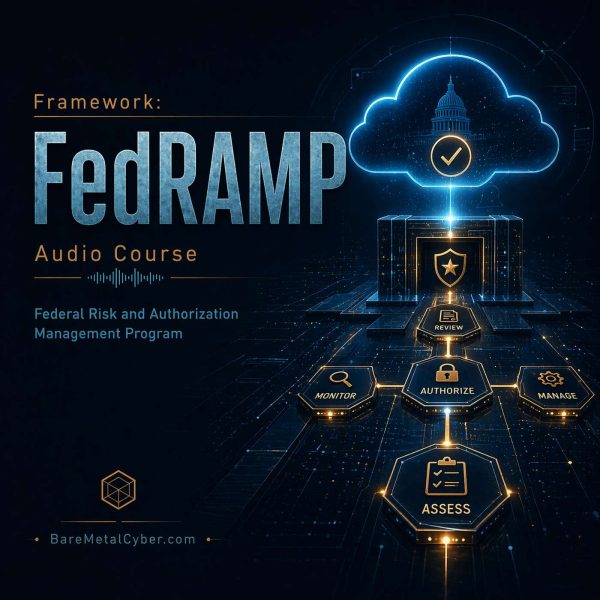
Framework: FedRAMP Audio Course
- Episodios
- 71
- Formato
- Serie: escúchala desde el principio
- Último episodio
- 10 Nov 2025
Sobre el podcast
Step inside the FedRAMP world with an audio course built for real people, not policy wonks. In clear, story-driven language, each short episode unpacks the steps, roles, and secrets behind earning and keeping a federal cloud authorization. You’ll hear how the pieces fit together—documents, assessments, evidence, and continuous monitoring—without ever touching a slide or staring at a diagram. It’s designed for anyone who wants to get it: cloud providers chasing their first ATO, assessors sharpening their review skills, or agency staff looking to understand how it all connects. You’ll move from zero to confident, guided by plain talk, real examples, and practical takeaways you can apply immediately. Press play, follow the journey, and discover how FedRAMP actually works—start to finish.
Episodios 71
Episode 70 — Final Review: From Package to ATO
This concluding episode brings the entire FedRAMP journey together—from early readiness through authorization and continuous monitoring—showing how each artifact contributes to a single chain of assurance. We …
Notas del episodio
This concluding episode brings the entire FedRAMP journey together—from early readiness through authorization and continuous monitoring—showing how each artifact contributes to a single chain of assurance. We revisit the key milestones: readiness confirmation through the RAR, boundary and baseline definition in the SSP, objective verification via the SAP and SAR, disciplined risk management in the POA&M, and sustained vigilance through monthly ConMon submissions. Each step reinforces traceability between control implementation, testing, remediation, and evidence, forming the narrative that leads to an Authorization to Operate. The FedRAMP process rewards clarity, consistency, and persistence far more than speed or volume.
We close with reflection and forward motion. Continuous improvement after the first ATO is how mature providers earn trust, achieve faster renewals, and support agency reuse at scale. Keep refining evidence pipelines, updating parameter values to align with evolving NIST guidance, and applying lessons from each cycle to strengthen design and documentation. For learners, this review underscores that mastering FedRAMP is about managing assurance—knowing what proof is needed, when, and why. The journey from package to ATO transforms compliance into confidence, showing that security can be both verifiable and repeatable. Produced by BareMetalCyber.com, where you’ll find more cyber audio courses, books, and information to strengthen your educational path. Also, if you want to stay up to date with the latest news, visit DailyCyber.News for a newsletter you can use, and a daily podcast you can commute with.
Episode 69 — Navigate Marketplace Listings and Reuse
The FedRAMP Marketplace serves as the central repository of authorized cloud products, enabling agencies to discover, evaluate, and reuse existing authorizations. This episode explains how listings work, what …
Notas del episodio
The FedRAMP Marketplace serves as the central repository of authorized cloud products, enabling agencies to discover, evaluate, and reuse existing authorizations. This episode explains how listings work, what information they display, and how service providers maintain them. We describe the listing types—In Process, Ready, and Authorized—along with the evidence and validation requirements for each. You will learn how accurate listings increase visibility to agencies seeking compliant solutions, how updates signal continued activity, and why timely posting of package changes supports reuse. Maintaining a transparent listing ensures agencies can trust the status and lineage of your authorization.
We discuss reuse mechanics and their strategic benefits. Agencies leverage Marketplace listings to onboard services faster by reviewing existing packages rather than starting new assessments. We outline how providers facilitate reuse by keeping packages synchronized, responding to agency inquiries, and sharing sanitized evidence where permitted. Examples show how inconsistency between Marketplace data and PMO submissions can slow onboarding or trigger extra validation requests. Regularly verify that descriptions, version numbers, and contact details remain current, and archive outdated materials responsibly. Marketplace visibility, paired with clean reuse processes, turns authorization into sustained adoption across government missions. Produced by BareMetalCyber.com, where you’ll find more cyber audio courses, books, and information to strengthen your educational path. Also, if you want to stay up to date with the latest news, visit DailyCyber.News for a newsletter you can use, and a daily podcast you can commute with.
Episode 68 — Evaluate Readiness With the RAR
The Readiness Assessment Report (RAR) is the earliest formal evaluation in the FedRAMP process, confirming that a cloud service provider is prepared for a full security assessment. This episode clarifies its …
Notas del episodio
The Readiness Assessment Report (RAR) is the earliest formal evaluation in the FedRAMP process, confirming that a cloud service provider is prepared for a full security assessment. This episode clarifies its purpose, structure, and common pitfalls. We explain the main sections—system overview, boundary and data flow description, implemented versus planned controls, vulnerability scan results, and organizational readiness factors like incident response and configuration management maturity. You will learn how to demonstrate that foundational security practices exist, even if not yet fully documented in an SSP. A complete, well-evidenced RAR shortens the later authorization timeline and helps determine whether the JAB or an agency path is more appropriate.
We expand with guidance for providers approaching readiness. Begin by performing self-assessments against FedRAMP baseline controls and fixing obvious gaps, such as missing inventories or untested incident response procedures. Conduct preliminary scans and address high-severity vulnerabilities before submitting data to your 3PAO. Document inheritance sources, boundary stability, and shared responsibility clarity so the assessor can validate them easily. Examples show how incomplete data flow diagrams or outdated inventories often trigger rework and delays. Treat the RAR as both a readiness test and a rehearsal for the main assessment, ensuring evidence is in the correct format, accessible, and traceable. Done properly, the RAR becomes the blueprint for a predictable, successful authorization journey. Produced by BareMetalCyber.com, where you’ll find more cyber audio courses, books, and information to strengthen your educational path. Also, if you want to stay up to date with the latest news, visit DailyCyber.News for a newsletter you can use, and a daily podcast you can commute with.
Episode 67 — Automate Evidence Collection Workflows
Automation is the key to sustaining continuous monitoring without drowning in manual reporting. This episode details how to design evidence collection workflows that produce consistent, auditable artifacts for …
Notas del episodio
Automation is the key to sustaining continuous monitoring without drowning in manual reporting. This episode details how to design evidence collection workflows that produce consistent, auditable artifacts for FedRAMP submissions. We discuss integrating compliance tools with operational systems—ticketing, CI/CD, logging, and configuration management—to capture outputs like patch approvals, baseline comparisons, scan summaries, and sign-offs automatically. You will learn to define evidence templates per control, identify authoritative data sources, and apply metadata tags for date, owner, and version. Automating evidence gathering not only saves time but ensures traceability and freshness, two attributes assessors prioritize.
We continue with design considerations and safeguards. Implement secure pipelines that collect and store artifacts in controlled repositories, encrypt in transit and at rest, and restrict access to evidence stewards. Examples include generating monthly scan manifests with hashes, extracting change-control tickets linked to deployment IDs, and creating dashboards that flag missing or stale evidence before submission deadlines. Monitor automation health to detect data drift or pipeline failures that could compromise accuracy. We also emphasize preserving human oversight: quality reviews must verify that automation output still aligns with control intent and parameter requirements. When built correctly, automated evidence workflows make compliance real-time, transparent, and sustainable. Produced by BareMetalCyber.com, where you’ll find more cyber audio courses, books, and information to strengthen your educational path. Also, if you want to stay up to date with the latest news, visit DailyCyber.News for a newsletter you can use, and a daily podcast you can commute with.
Episode 66 — Adopt OSCAL for Submissions
Open Security Controls Assessment Language (OSCAL) transforms static FedRAMP documentation into structured, machine-readable data that accelerates reviews and improves consistency. This episode explains what …
Notas del episodio
Open Security Controls Assessment Language (OSCAL) transforms static FedRAMP documentation into structured, machine-readable data that accelerates reviews and improves consistency. This episode explains what OSCAL is, why it matters, and how it fits into the broader ecosystem of compliance automation. We describe OSCAL’s layered architecture—metadata models for system security plans, assessment plans and results, and POA&M data—and how each replaces traditional Word or Excel templates with standardized XML or JSON schemas. You will learn how OSCAL enables automated validation of control statements, parameter values, and inheritance mappings before submission, reducing manual reviewer effort and error risk. FedRAMP’s PMO actively promotes OSCAL adoption to shorten package processing and support continuous monitoring data exchange.
We then outline practical steps for implementation. Begin by generating or converting your SSP and other artifacts using official FedRAMP OSCAL templates and toolkits, ensuring field alignment with existing narrative content. Integrate OSCAL production into your document lifecycle: automate population from configuration databases or policy repositories, maintain version control with Git, and validate files with schema checkers before submission. Examples show how OSCAL exports simplify crosswalks between SSP, SAP, and SAR by reusing shared identifiers. We also discuss how machine-readability facilitates dashboards that visualize control status, residual risk, and dependency relationships. Adopting OSCAL modernizes FedRAMP compliance, turning documentation into data that agencies can analyze, reuse, and trust. Produced by BareMetalCyber.com, where you’ll find more cyber audio courses, books, and information to strengthen your educational path. Also, if you want to stay up to date with the latest news, visit DailyCyber.News for a newsletter you can use, and a daily podcast you can commute with.
Episode 65 — Build a Strong 3PAO QMS
A Quality Management System (QMS) is how a 3PAO ensures assessments are consistent, competent, and continuously improving. This episode describes essential QMS components as they appear in FedRAMP work …
Notas del episodio
A Quality Management System (QMS) is how a 3PAO ensures assessments are consistent, competent, and continuously improving. This episode describes essential QMS components as they appear in FedRAMP work: documented procedures for planning and executing assessments, training and qualification paths for team members, peer review and technical oversight of work papers, nonconformance handling, corrective and preventive actions, and internal audits that test the system itself. We connect these elements to outcomes providers care about—stable scopes, timely clarifications, accurate severity ratings, and SARs that withstand PMO review without rework—because quality management makes assessment quality visible and repeatable.
We then explore how QMS practices surface in day-to-day collaboration. You should see versioned templates for SAPs and SARs, checklists that force parameter and inheritance cross-checks, and evidence packaging requirements that reduce ambiguity. When issues occur—missed samples, tool misconfiguration, or contradictory findings—the QMS provides a structured path to analyze root cause, implement fixes, and prevent recurrence on future engagements. Providers can support QMS effectiveness by delivering deterministic artifacts, answering RFI threads with precise references, and reviewing draft outputs against their own single source of truth. A strong 3PAO QMS is not overhead; it is the mechanism that keeps conclusions reliable across teams and time, enabling confident authorizations and efficient reuse. Produced by BareMetalCyber.com, where you’ll find more cyber audio courses, books, and information to strengthen your educational path. Also, if you want to stay up to date with the latest news, visit DailyCyber.News for a newsletter you can use, and a daily podcast you can commute with.
Episode 64 — Operate Under ISO 17020
ISO/IEC 17020 defines competence and impartiality requirements for bodies performing inspection, and accredited 3PAOs operate under this standard to deliver consistent, defensible FedRAMP assessments. This …
Notas del episodio
ISO/IEC 17020 defines competence and impartiality requirements for bodies performing inspection, and accredited 3PAOs operate under this standard to deliver consistent, defensible FedRAMP assessments. This episode translates 17020 principles into operational realities: documented methods that produce repeatable results, control over impartiality risks, competency management for assessors, and quality records that show every decision’s basis. We explain how method selection, sampling rationale, tool control, and evidence traceability align with 17020’s expectations, and why providers benefit from this rigor—fewer surprises, clearer scopes, and reports that different agencies interpret the same way. Accreditation is not a label; it is a management system that shapes daily work.
For providers, understanding 17020 helps coordinate effectively with assessors. Expect defined roles, formal acceptance of the assessment plan, and change control for any mid-engagement adjustments. Prepare to furnish calibration details for scanners or scripts, environment prerequisites for tests, and authoritative inventories that support representative sampling. Recognize why 17020 emphasizes records: assessors must maintain notes, checklists, and evidence references that justify ratings and conclusions, which you can facilitate by delivering submission-ready artifacts. When both parties align to 17020’s discipline, assessments proceed predictably, disagreements are resolved with facts, and the SAR reads like a transparent ledger of what was done, what was found, and why the risk posture is sound. Produced by BareMetalCyber.com, where you’ll find more cyber audio courses, books, and information to strengthen your educational path. Also, if you want to stay up to date with the latest news, visit DailyCyber.News for a newsletter you can use, and a daily podcast you can commute with.
Episode 63 — Validate 3PAO Independence and Ethics
A Third-Party Assessment Organization’s credibility rests on independence and professional ethics, and FedRAMP expects providers to understand and respect these boundaries. This episode explains what …
Notas del episodio
A Third-Party Assessment Organization’s credibility rests on independence and professional ethics, and FedRAMP expects providers to understand and respect these boundaries. This episode explains what independence means in practice: the assessment team cannot design, implement, or operate the very controls it evaluates; commercial relationships must be disclosed; and potential conflicts—such as advisory work that shapes evidence—must be avoided or mitigated. We outline what assessors document for transparency, including engagement letters, scopes, and statements about impartiality, and how providers should interact without overstepping: answer questions, supply evidence, and clarify facts while refraining from pressuring methods, ratings, or conclusions.
Ethics also govern how evidence is handled and how findings are debated. We discuss secure data handling obligations, least-privilege access to environments, and the need to preserve original records with timestamps and hashes when feasible. When disagreements arise, the record should show professional discourse: root-cause analysis, corroborating artifacts, and explicit rationale for severity changes that both sides can defend to the PMO. Providers can validate independence by ensuring separated roles internally—no one who wrote a control response should approve the assessor’s test plan—and by capturing all interactions on ticketed channels with auditable outcomes. Respecting independence and ethics produces assessments that withstand scrutiny and support reuse across agencies without reputational risk to either party. Produced by BareMetalCyber.com, where you’ll find more cyber audio courses, books, and information to strengthen your educational path. Also, if you want to stay up to date with the latest news, visit DailyCyber.News for a newsletter you can use, and a daily podcast you can commute with.
Episode 62 — Quick Recap: Continuous Monitoring
Continuous monitoring ties assessment results to everyday operations so authorization stays credible between audits. This recap pulls together its essentials: authenticated monthly scans aligned to complete …
Notas del episodio
Continuous monitoring ties assessment results to everyday operations so authorization stays credible between audits. This recap pulls together its essentials: authenticated monthly scans aligned to complete inventories, incident reporting within required timelines, disciplined POA&M management with clear milestones, targeted retests that verify closure, and annual reassessments that sample where risk actually changed. We emphasize traceability across artifacts—the same asset identifiers in inventories, scans, and tickets; the same parameter values in SSP text and tooling; the same boundary components in diagrams and test targets—because reviewers judge consistency as much as control intent. When the pieces agree, agencies can trust your posture without requesting extra clarifications.
We translate that consistency into habits that prevent churn. Maintain a single source of truth for owners, due dates, and evidence locations; generate submission-ready exports from pipelines rather than manual steps; and record context around anomalies, like plugin updates that spike counts or platform patches that alter cipher suites. Use trend metrics beyond raw counts—median remediation age, percentage of assets fully remediated, and recurrence rates—to show improvement trajectory. Finally, rehearse the “what if” paths: how a significant change triggers targeted testing, how a deviation request is justified, and how incident lessons learned drive parameter updates. Continuous monitoring works when it feels routine, not heroic, and when each month’s package tells a coherent, improving story. Produced by BareMetalCyber.com, where you’ll find more cyber audio courses, books, and information to strengthen your educational path. Also, if you want to stay up to date with the latest news, visit DailyCyber.News for a newsletter you can use, and a daily podcast you can commute with.
Episode 61 — Maintain Authorization Over Time
Maintaining an Authorization to Operate is an operational discipline that proves your controls continue to function, your risks are actively managed, and your documentation reflects reality. This episode frames …
Notas del episodio
Maintaining an Authorization to Operate is an operational discipline that proves your controls continue to function, your risks are actively managed, and your documentation reflects reality. This episode frames “maintenance” as a living cycle tied to defined cadences: monthly vulnerability scans with authenticated coverage, quarterly or event-driven updates to inventories and boundary artifacts, annual assessments aligned to recent change history, and ongoing POA&M governance with measurable progress. We connect these activities to decision points that authorizing officials and the FedRAMP PMO rely on, such as whether aging critical findings trend down, whether deviations are truly time-boxed, and whether significant changes were reported and tested before production impact. Treat authorization status as a dashboard of verifiable signals—parameters, evidence freshness, trend metrics—rather than a static letter.
Sustaining that dashboard requires repeatable processes and clear ownership. Establish a compliance calendar with automated reminders, define evidence stewards for each control family, and standardize submission packaging with manifests, hashes, and stable file naming so reviewers navigate without guesswork. Integrate monitoring into everyday operations: link scanners to asset governance to catch inventory drift, feed SIEM alerts and incident tickets into monthly summaries, and map change approvals to parameter checks that detect misconfiguration early. Use retrospectives after each cycle to remove friction—tighten credential management for scanning, refine sampling for configuration tests, and compress turnaround from finding to verified fix. The payoff is resilience: an authorization posture that remains accurate through product evolution and agency reuse. Produced by BareMetalCyber.com, where you’ll find more cyber audio courses, books, and information to strengthen your educational path. Also, if you want to stay up to date with the latest news, visit DailyCyber.News for a newsletter you can use, and a daily podcast you can commute with.
Episode 60 — Report Incidents Promptly and Properly
Incident reporting ties real-world response performance to FedRAMP compliance. This episode explains mandatory reporting timelines and formats, including immediate notification within one hour of confirmed …
Notas del episodio
Incident reporting ties real-world response performance to FedRAMP compliance. This episode explains mandatory reporting timelines and formats, including immediate notification within one hour of confirmed incidents involving federal data. We describe the minimum information that must be conveyed—incident type, detection method, systems affected, data exposure scope, and containment actions—and how to transmit updates securely through approved channels. You will learn how to align internal incident management procedures with FedRAMP and agency requirements, ensuring that every escalation path and message template supports timely communication. Prompt, accurate reporting is both a regulatory requirement and a measure of organizational maturity.
We extend to integration with operational and assessment processes. Examples demonstrate linking incident tickets to log evidence, forensic images, and communication records, as well as documenting lessons learned in POA&M updates. We also discuss classifying incident severity, distinguishing between operational outages and true security breaches, and coordinating with the 3PAO when post-incident retesting is required. Continuous monitoring submissions should include incident summaries with status updates and corrective actions taken. Following these structured steps not only ensures compliance but also builds credibility with authorizing officials who rely on transparency to maintain trust. Produced by BareMetalCyber.com, where you’ll find more cyber audio courses, books, and information to strengthen your educational path. Also, if you want to stay up to date with the latest news, visit DailyCyber.News for a newsletter you can use, and a daily podcast you can commute with.
Episode 59 — Harden Logging and SIEM Practices
Logging and Security Information and Event Management (SIEM) form the detection layer that validates continuous monitoring effectiveness. This episode describes how FedRAMP evaluates logging coverage, content …
Notas del episodio
Logging and Security Information and Event Management (SIEM) form the detection layer that validates continuous monitoring effectiveness. This episode describes how FedRAMP evaluates logging coverage, content, and retention to ensure sufficient visibility into security events. We explain key expectations: collection of system, application, and network logs; time synchronization to a trusted source; protection of log integrity; and correlation through a SIEM or equivalent platform. You will learn to document log types, retention durations, and alerting thresholds in the SSP, linking them to incident response workflows. Strong logging enables evidence-rich forensics and timely detection of abnormal behavior—cornerstones of ongoing authorization confidence.
We then outline implementation and validation techniques. Examples include using centralized log collectors, verifying that privileged actions generate alerts, and documenting filtering or suppression logic to prevent missed detections. Ensure logs are encrypted in transit and at rest, access is restricted, and changes are monitored. Review dashboards for event trends, failed logins, configuration changes, and privilege escalations. During assessments, provide sampled logs showing timestamps, correlation identifiers, and incident ticket links. Continuous review and tuning of SIEM rules transform static logging into proactive defense. Effective logging practices not only meet FedRAMP criteria but also enhance operational resilience and investigative readiness. Produced by BareMetalCyber.com, where you’ll find more cyber audio courses, books, and information to strengthen your educational path. Also, if you want to stay up to date with the latest news, visit DailyCyber.News for a newsletter you can use, and a daily podcast you can commute with.
Episode 58 — Execute Annual Assessment Requirements
Annual assessments revalidate system controls to ensure they still meet FedRAMP baseline requirements under live operational conditions. This episode outlines how to plan and execute these recurring assessments …
Notas del episodio
Annual assessments revalidate system controls to ensure they still meet FedRAMP baseline requirements under live operational conditions. This episode outlines how to plan and execute these recurring assessments efficiently. We describe how to select representative controls across families, integrate recent vulnerability trends and configuration changes, and coordinate testing schedules with ongoing operations. Annual assessments should leverage lessons from continuous monitoring, focusing on areas where deviations or exceptions have occurred. You will learn to document assessment scope, ensure evidence freshness, and use prior-year SARs as benchmarks for improvement. The annual process proves long-term compliance maturity rather than one-time success.
Execution requires coordination among multiple stakeholders—system owners, security engineers, compliance leads, and the 3PAO. We discuss creating a testing plan that minimizes disruption, updating test scripts for version changes, and capturing evidence with timestamps to differentiate from monthly scans. Summaries should highlight closed POA&M items, lingering risks, and improvements in metrics such as mean time to remediate. Examples show how to manage overlapping activities with patch cycles or feature releases without missing reporting deadlines. Annual assessments provide the audit trail that bridges continuous monitoring and reauthorization, verifying that the system remains resilient and well-managed. Produced by BareMetalCyber.com, where you’ll find more cyber audio courses, books, and information to strengthen your educational path. Also, if you want to stay up to date with the latest news, visit DailyCyber.News for a newsletter you can use, and a daily podcast you can commute with.
Episode 57 — Process Significant Changes Safely
Significant changes—major system modifications, infrastructure migrations, or service integrations—must be managed and reported under FedRAMP continuous monitoring. This episode defines what constitutes a …
Notas del episodio
Significant changes—major system modifications, infrastructure migrations, or service integrations—must be managed and reported under FedRAMP continuous monitoring. This episode defines what constitutes a “significant change” and why timely communication to the authorizing official and FedRAMP PMO preserves authorization integrity. We explain how to categorize changes by impact: boundary-affecting (adding regions or components), security posture-altering (new identity systems, cryptographic methods), and dependency-related (service replacements or integrations). Each requires documentation of risk analysis, control impacts, test plans, and evidence updates. Understanding these classifications prevents accidental noncompliance and ensures agencies remain confident in your ongoing security posture.
We detail the operational process for safe change handling. Examples show how to initiate a change request, perform pre-implementation assessments, and gather approvals before deployment. Post-change, run targeted scans and regression tests to verify that controls remain effective. Update the SSP, diagrams, and interconnection documents to reflect new architecture, and, when necessary, coordinate with the 3PAO for partial assessments. Maintain communication logs and approval letters as artifacts for the next monthly submission. Treat every significant change as a mini-assessment—traceable, approved, tested, and documented. Doing so demonstrates continuous vigilance and regulatory discipline in complex, evolving environments. Produced by BareMetalCyber.com, where you’ll find more cyber audio courses, books, and information to strengthen your educational path. Also, if you want to stay up to date with the latest news, visit DailyCyber.News for a newsletter you can use, and a daily podcast you can commute with.
Episode 56 — Deliver Penetration Test Reports
Penetration test reports are the tangible outcome of controlled attack simulations, and FedRAMP requires them to be comprehensive, reproducible, and linked to subsequent remediation. This episode explains how …
Notas del episodio
Penetration test reports are the tangible outcome of controlled attack simulations, and FedRAMP requires them to be comprehensive, reproducible, and linked to subsequent remediation. This episode explains how to structure a professional report that balances technical depth with readability for agency reviewers. We describe key sections: objectives and scope, methodology and tools, environment details, findings with evidence, risk ratings, exploit validation results, and a summary of residual vulnerabilities. You will learn how to articulate attack paths clearly—showing initial vector, escalation steps, and containment results—and how to separate proof-of-concept data from sensitive artifacts to protect system confidentiality. The goal is to demonstrate control effectiveness and prompt remediation, not to sensationalize results.
We expand with practical documentation and quality tips. Include tool versions, payload signatures, and timestamps to allow independent verification. Align each finding with affected assets, control identifiers, and mitigation recommendations. For multi-tenant systems, mark which findings are tenant-specific versus systemic. Highlight false positives and environmental constraints that shaped testing outcomes, ensuring conclusions remain objective. Finally, show closure evidence for retests, either embedded or appended. Reviewers value concise, evidence-rich reporting that links directly to the POA&M and confirms fixes are verified. A well-written penetration test report transforms technical testing into a clear risk narrative that sustains trust throughout the authorization lifecycle. Produced by BareMetalCyber.com, where you’ll find more cyber audio courses, books, and information to strengthen your educational path. Also, if you want to stay up to date with the latest news, visit DailyCyber.News for a newsletter you can use, and a daily podcast you can commute with.
Episode 55 — Run Required Penetration Vectors
FedRAMP mandates annual penetration testing across specific vectors to validate defensive effectiveness and identify exploitable weaknesses before adversaries can. This episode defines those vectors—external …
Notas del episodio
FedRAMP mandates annual penetration testing across specific vectors to validate defensive effectiveness and identify exploitable weaknesses before adversaries can. This episode defines those vectors—external network, internal network, web application, API, and privilege escalation—and explains how to scope each relative to system architecture and data sensitivity. You will learn how to pre-stage test data, select representative accounts and roles, and coordinate test windows under Rules of Engagement. Each vector should exercise realistic threat paths while protecting production availability, with logs captured for correlation and validation. Detailed planning ensures that results are both safe and sufficient for assessment.
We then describe execution and documentation practices that pass FedRAMP scrutiny. Capture proof of exploitation attempts, screenshots or command output demonstrating achieved access, and confirmation of rollback to a secure state. Summarize vulnerabilities discovered, correlate them with prior scan data, and document whether mitigations exist. Include findings in the Security Assessment Report and POA&M with remediation milestones. Examples show how to handle multi-tenant environments where lateral movement testing must respect tenant isolation. Conduct retests after fixes and retain all data for reproducibility. A well-structured penetration test provides assurance that implemented controls perform as intended against real attack techniques, reinforcing both the SSP narrative and agency confidence. Produced by BareMetalCyber.com, where you’ll find more cyber audio courses, books, and information to strengthen your educational path. Also, if you want to stay up to date with the latest news, visit DailyCyber.News for a newsletter you can use, and a daily podcast you can commute with.
Episode 54 — Configure Authenticated Scanning Safely
Authenticated scanning provides deeper assurance by testing systems from an insider perspective, confirming patch levels, configuration states, and control operations. This episode explains how to configure and …
Notas del episodio
Authenticated scanning provides deeper assurance by testing systems from an insider perspective, confirming patch levels, configuration states, and control operations. This episode explains how to configure and secure credentialed scanning without compromising production systems. We cover credential storage methods, access restrictions, network throttling, scan account privileges, and segmentation to limit potential impact. You will learn how to establish temporary credentials, record proof of privilege restrictions, and rotate or revoke accounts immediately after use. Documentation should capture scanner configurations, credentials used, and audit logs showing proper account lifecycle handling. Authenticated scans validate controls more thoroughly and reveal misconfigurations invisible to external probes.
We focus next on operational safeguards and troubleshooting. Examples illustrate scanning with limited administrative privileges that still permit registry or configuration file checks, handling agent-based scans for dynamic hosts, and validating coverage against inventory baselines. We discuss recovery steps if a scan inadvertently disrupts performance and how to coordinate with operations to prevent recurrence. Assessors check that credentials are handled securely, scans complete successfully across all targets, and findings correspond to real configurations. A disciplined authenticated scanning program enhances credibility, strengthens remediation accuracy, and assures agencies that your monitoring extends below surface-level discovery. Produced by BareMetalCyber.com, where you’ll find more cyber audio courses, books, and information to strengthen your educational path. Also, if you want to stay up to date with the latest news, visit DailyCyber.News for a newsletter you can use, and a daily podcast you can commute with.
Episode 53 — Analyze and Report Scan Results
Scanning only provides raw data; analysis transforms it into actionable insight. This episode outlines how to interpret vulnerability results, identify trends, and communicate remediation progress to both …
Notas del episodio
Scanning only provides raw data; analysis transforms it into actionable insight. This episode outlines how to interpret vulnerability results, identify trends, and communicate remediation progress to both internal stakeholders and agencies. We explain the metrics FedRAMP reviewers expect: counts of open findings by severity, aging of unresolved vulnerabilities, percentage of hosts fully remediated, and average closure time compared to required deadlines. You will learn how to visualize data for clarity—highlighting recurring misconfigurations, patching cadence, or dependency lag—and how to correlate findings with change events or specific code releases. Transparent reporting proves that risk is being managed systematically rather than reactively.
We extend into communication and evidence alignment. For each monthly submission, provide executive summaries with trend commentary, attach raw scanner exports, and map findings directly to POA&M entries. Examples demonstrate how to explain spikes caused by new plugin sets or platform versioning rather than regressions in posture. Use normalized identifiers and stable asset tags so the same resource can be tracked across cycles. Conduct internal “findings review” meetings to prioritize work and verify that remediation tickets close with verifiable proof. Effective analysis transforms static numbers into a narrative of continuous improvement that both 3PAOs and agencies can easily validate. Produced by BareMetalCyber.com, where you’ll find more cyber audio courses, books, and information to strengthen your educational path. Also, if you want to stay up to date with the latest news, visit DailyCyber.News for a newsletter you can use, and a daily podcast you can commute with.
Episode 52 — Manage Monthly Vulnerability Scans
Monthly vulnerability scanning provides the quantitative heartbeat of continuous monitoring, revealing whether systems remain patched, configured securely, and within acceptable risk tolerance. This episode …
Notas del episodio
Monthly vulnerability scanning provides the quantitative heartbeat of continuous monitoring, revealing whether systems remain patched, configured securely, and within acceptable risk tolerance. This episode defines the requirements for scope, credentialing, frequency, and evidence format. We clarify that scans must cover all in-scope assets—including hosts, containers, and applications—using authenticated methods wherever feasible. You will learn how to maintain allowlists, control throttling to prevent outages, and align scan windows with change freezes. Accurate, repeatable scanning depends on matching inventory lists, stable network routes, and up-to-date credentials. Assessors look for traceability between inventory counts, scan outputs, and remediation records to confirm true coverage and completeness.
We discuss best practices for execution and submission. Confirm that scanner policies include both vulnerability and configuration checks, record tool versions and plugin updates, and provide output in machine-readable formats. Handle credential failures promptly and reschedule scans to close data gaps within the same cycle. Use dashboards or scripts to trend exposure metrics—such as count of critical findings or mean time to remediate—and include them in monthly summaries. Examples show how to triage false positives through fingerprint verification or replication testing, ensuring POA&M entries reflect real weaknesses. Robust scanning demonstrates that monitoring is active, data-driven, and improving, not just procedural. Produced by BareMetalCyber.com, where you’ll find more cyber audio courses, books, and information to strengthen your educational path. Also, if you want to stay up to date with the latest news, visit DailyCyber.News for a newsletter you can use, and a daily podcast you can commute with.
Episode 51 — Stand Up Continuous Monitoring
Continuous Monitoring (ConMon) is the operational backbone that sustains a FedRAMP authorization after the initial ATO is granted. This episode explains its purpose: maintaining visibility into system security …
Notas del episodio
Continuous Monitoring (ConMon) is the operational backbone that sustains a FedRAMP authorization after the initial ATO is granted. This episode explains its purpose: maintaining visibility into system security, tracking control effectiveness, and ensuring timely detection of new vulnerabilities or deviations. We describe the foundational requirements—monthly vulnerability scans, annual penetration testing, configuration drift detection, incident reporting, and ongoing POA&M management—and how each ties back to the baseline controls established in the SSP. ConMon is not an optional maintenance task but a recurring evidence cycle demonstrating that the system remains at or above its authorized security posture. Assessors and agencies rely on these submissions to decide whether the authorization remains valid or needs review.
In practice, standing up ConMon requires repeatable automation and disciplined communication. We outline how to schedule scanning and report generation, establish version-controlled repositories for monthly deliverables, and integrate configuration management, ticketing, and monitoring tools to feed consistent data. Examples show how to coordinate among operations, compliance, and 3PAO contacts so findings are triaged, logged, and remediated without delays. We also address change triggers, such as significant architecture updates or new features, which must be reported within required timeframes. The hallmark of successful ConMon is predictability: every month, complete data sets arrive on time, in the right format, and with clear evidence of analysis and follow-up. Produced by BareMetalCyber.com, where you’ll find more cyber audio courses, books, and information to strengthen your educational path. Also, if you want to stay up to date with the latest news, visit DailyCyber.News for a newsletter you can use, and a daily podcast you can commute with.
Episode 50 — Quick Recap: Assessment to Authorization
This recap ties together the path from planning to authorization, highlighting the artifacts and decisions that carry the most weight. We revisit building a testable Security Assessment Plan, choosing effective …
Notas del episodio
This recap ties together the path from planning to authorization, highlighting the artifacts and decisions that carry the most weight. We revisit building a testable Security Assessment Plan, choosing effective methods, executing fieldwork under clear Rules of Engagement, and producing a Security Assessment Report that is precise, neutral, and defensible. We underscore how findings flow into a disciplined POA&M, how deviations are justified and time-boxed, and how parseable scan artifacts and consistent inventories turn monthly monitoring into credible evidence. The through-line is traceability: every claim in the SSP should lead to verifiable artifacts, every test should map to a control statement, and every risk decision should be recorded with rationale that authorizing officials can trust across reuse.
We close with practical habits that keep momentum toward authorization and sustain it afterward. Maintain a single source of truth for parameters, inheritance, and interconnections; rehearse submissions with internal red teams who look for contradictions; and pre-stage response playbooks for PMO RFIs so clarifications arrive quickly and consistently. Treat the ATO letter as a living set of conditions that drive daily operations, service communications, and release planning, and confirm that change management keeps the authorized boundary accurate over time. By viewing assessment and authorization as an integrated lifecycle rather than a sequence of hurdles, teams reduce surprises, shorten review timelines, and strengthen the posture they must demonstrate every month. Produced by BareMetalCyber.com, where you’ll find more cyber audio courses, books, and information to strengthen your educational path. Also, if you want to stay up to date with the latest news, visit DailyCyber.News for a newsletter you can use, and a daily podcast you can commute with.
Episode 49 — Submit for PMO Review
A successful FedRAMP PMO submission depends on completeness, internal consistency, and reviewer-friendly organization of the entire package. This episode details how to assemble the SSP, SAP/SAR, POA&M …
Notas del episodio
A successful FedRAMP PMO submission depends on completeness, internal consistency, and reviewer-friendly organization of the entire package. This episode details how to assemble the SSP, SAP/SAR, POA&M, attachments, scan artifacts, interconnection documents, privacy materials, letters, and cover forms into a coherent set with stable filenames, versioning, and checksums. We explain how to prepare a submission index that mirrors the PMO checklist, how to reference each artifact from the SSP so reviewers can navigate quickly, and how to secure the transfer channel with encryption and access controls appropriate to the data. We also describe pre-submission readiness checks that surface contradictions—parameter mismatches, inheritance claims without attestations, boundary diagrams that omit components in inventories—before the PMO finds them.
After submission, responsiveness and traceability determine how fast the review closes. Establish a triage team to manage Requests for Information (RFIs), assign owners, provide precise page and line references, and resubmit updated artifacts with clear redlines and a change summary. Preserve immutable copies of each submitted version and maintain an issue log that tracks questions, decisions, and follow-up evidence. Coordinate with your 3PAO when clarifications touch assessment methods or findings so that the SAR remains authoritative. Anticipate reviewers’ needs by supplying additional context—without adding noise—when a condition or exception is central to the risk story. A deliberate, organized PMO interaction shortens cycles and sets the tone for a smooth transition into authorization and continuous monitoring. Produced by BareMetalCyber.com, where you’ll find more cyber audio courses, books, and information to strengthen your educational path. Also, if you want to stay up to date with the latest news, visit DailyCyber.News for a newsletter you can use, and a daily podcast you can commute with.
Episode 48 — Understand ATO Letters and Conditions
Authorization to Operate (ATO) letters are formal risk decisions issued by an agency or, in the JAB context, paired with a Provisional ATO (P-ATO); they acknowledge residual risk and impose conditions the …
Notas del episodio
Authorization to Operate (ATO) letters are formal risk decisions issued by an agency or, in the JAB context, paired with a Provisional ATO (P-ATO); they acknowledge residual risk and impose conditions the provider must meet to keep operating for federal missions. This episode explains the structure and implications of these letters: scope statements that define what system and boundary are authorized, effective and expiration dates, enumerated conditions such as reporting cadences, required control improvements, incident notification timelines, and significant change triggers. We clarify the difference between conditions that are immediate prerequisites for go-live, ongoing obligations verified in continuous monitoring, and time-limited corrective actions tied to POA&M items. Understanding the letter’s language prevents accidental non-compliance and sets expectations for agency reuse.
We then show how to operationalize the letter so that obligations are never abstract. Map each condition to owners, artifacts, and dashboards; encode reporting due dates into your compliance calendar; and build checks that detect drift in parameters explicitly cited by the authorizing official. Tie incident thresholds and significant change definitions to playbooks that generate timely notifications and evidence packages. Keep a change log of how the system evolves against the authorized boundary and re-confirm conditions after each major release, dependency change, or onboarding of new tenants. Finally, educate account teams and support personnel so that commitments made in the ATO letter are reflected in customer communications and contract language. Treat the ATO not as a trophy but as a living agreement that guides daily operations and renewal success. Produced by BareMetalCyber.com, where you’ll find more cyber audio courses, books, and information to strengthen your educational path. Also, if you want to stay up to date with the latest news, visit DailyCyber.News for a newsletter you can use, and a daily podcast you can commute with.
Episode 47 — Package Parseable Scan Artifacts
Scan artifacts are only useful if reviewers can trace what was scanned, when, with which policies, and how the results map to inventory. This episode explains how to produce machine-readable, submission-ready …
Notas del episodio
Scan artifacts are only useful if reviewers can trace what was scanned, when, with which policies, and how the results map to inventory. This episode explains how to produce machine-readable, submission-ready exports for vulnerability scanning, configuration compliance, web application testing, and container or image analysis. We cover the essentials: include tool names and versions, policy IDs, credential use, plugin or ruleset timestamps, target lists with unique asset identifiers, and the full raw results in parseable formats (such as CSV, XML, or native export) alongside human-readable summaries. We emphasize alignment with inventories and boundary diagrams so every hostname, instance ID, IP, container digest, or image tag can be reconciled, and we explain how to separate authenticated failures from unreachable assets to prevent false coverage claims.
We also address workflow and quality checks that reduce back-and-forth during assessment and continuous monitoring. Produce a manifest file per submission that lists each artifact, hash, size, and creation time; maintain stable directory structures and naming conventions; and include deltas that show progress since the previous month. For web application and API scans, attach the authenticated context, scope lists, and out-of-scope exclusions, plus any manual verification notes. For configuration benchmarks, export per-control pass/fail with host mapping so assessors can sample quickly. Common pitfalls include mixing scan windows across change events, submitting screenshots instead of raw data, and omitting proof that scans were credentialed. With deterministic packaging, assessors can parse, sample, and trend without guessing, which shortens review cycles and increases confidence in your monitoring posture. Produced by BareMetalCyber.com, where you’ll find more cyber audio courses, books, and information to strengthen your educational path. Also, if you want to stay up to date with the latest news, visit DailyCyber.News for a newsletter you can use, and a daily podcast you can commute with.
Episode 46 — Manage Deviation Requests and Exceptions
Deviation Requests and exceptions are the formal mechanisms FedRAMP uses to handle situations where a weakness cannot be remediated on the normal timeline, where an alternate control achieves equivalent …
Notas del episodio
Deviation Requests and exceptions are the formal mechanisms FedRAMP uses to handle situations where a weakness cannot be remediated on the normal timeline, where an alternate control achieves equivalent protection, or where a scanner-reported issue is a verified false positive. This episode explains the difference between common categories—due-date extensions tied to POA&M items, risk adjustments based on compensating safeguards, vendor dependencies that constrain patch windows, and false positives with corroborating evidence—and shows how each maps to required fields and approvals. We describe the core argument structure: state the weakness precisely, quantify exposure and blast radius, present compensating controls with operating evidence, estimate residual risk, and propose a milestone plan with review dates. The objective is not to “paper over” risk but to make a transparent, auditable case that keeps authorization integrity while acknowledging real-world constraints and engineering timelines.
Execution quality turns a request from delay paperwork into a disciplined risk decision. We outline evidence packages that support each type: authenticated rescans showing non-exploitation and segmentation, configuration exports proving control layering, monitoring dashboards that flag attempted abuse, vendor bulletins and ticket histories, and sign-offs from the system owner and authorizing official. We cover pitfalls that trigger rejections—reusing boilerplate rationales, omitting asset identifiers, failing to quantify detection/response strength, or asking for open-ended extensions—and offer review practices that keep requests concise, consistent, and traceable. Finally, we explain how to track approvals in the POA&M, publish follow-through metrics, and close deviations promptly when conditions change. Managed well, deviations become rare, time-boxed exceptions inside a program that still demonstrates steady risk reduction. Produced by BareMetalCyber.com, where you’ll find more cyber audio courses, books, and information to strengthen your educational path. Also, if you want to stay up to date with the latest news, visit DailyCyber.News for a newsletter you can use, and a daily podcast you can commute with.
Episode 45 — Close POA&M Items Effectively
Closing POA&M items confirms that risks have been mitigated or accepted through proper review. This episode outlines how to validate corrective actions, collect closure evidence, and document concurrence from …
Notas del episodio
Closing POA&M items confirms that risks have been mitigated or accepted through proper review. This episode outlines how to validate corrective actions, collect closure evidence, and document concurrence from the 3PAO or authorizing official as required. We detail evidence expectations: rescanned results showing vulnerability resolution, configuration screenshots with timestamps, approval tickets referencing implemented changes, or updated policies proving procedural fixes. You will learn how to distinguish between “remediated,” “risk accepted,” and “false positive” closures, ensuring each includes rationale and sign-off that will withstand FedRAMP PMO audit. Closure accuracy is essential for maintaining trust in continuous monitoring data and renewal assessments.
We illustrate how to manage closure workflow and verification cadence. Implement peer reviews before submitting items as closed, track closure metrics to monitor efficiency, and retain prior versions for traceability. For recurring vulnerabilities, document systemic changes that prevent recurrence—patch automation, configuration hardening, or additional monitoring. For risk acceptance, capture authorizing official letters or change-control board minutes referencing the decision. Periodically audit closed items to confirm evidence retention and verify that resolved issues do not reappear in subsequent scans. Timely, verifiable closures show continuous control maturity and reinforce agency confidence that authorization remains well-managed. Produced by BareMetalCyber.com, where you’ll find more cyber audio courses, books, and information to strengthen your educational path. Also, if you want to stay up to date with the latest news, visit DailyCyber.News for a newsletter you can use, and a daily podcast you can commute with.
Episode 44 — Populate the POA&M Accurately
The Plan of Actions and Milestones (POA&M) is the authoritative tracking document for all unresolved risks and corrective actions. This episode explains its structure—unique identifier, control reference …
Notas del episodio
The Plan of Actions and Milestones (POA&M) is the authoritative tracking document for all unresolved risks and corrective actions. This episode explains its structure—unique identifier, control reference, weakness description, discovery source, risk rating, scheduled completion date, interim milestones, responsible party, and closure evidence field—and how FedRAMP requires standardized formatting and formulas to ensure uniform reporting. You will learn how to populate POA&M entries directly from validated SAR findings, ensuring severity ratings and due dates align with FedRAMP-defined timelines. Accurate POA&M management demonstrates disciplined risk governance and gives agencies clear visibility into progress.
We cover best practices for ongoing maintenance. Keep one master POA&M per authorization package, implement change tracking for every update, and link closed items to specific evidence artifacts such as screenshots, approvals, or test reruns. Examples show how to justify risk downgrades, manage deviation requests when timelines slip, and reflect residual risk accepted by the authorizing official. Avoid pitfalls like inconsistent identifiers, missing discovery dates, or vague milestone descriptions. Use the POA&M as both a tactical remediation tracker and a strategic tool for continuous improvement trend analysis. A complete, current, and well-documented POA&M demonstrates that security is managed as a process, not a project. Produced by BareMetalCyber.com, where you’ll find more cyber audio courses, books, and information to strengthen your educational path. Also, if you want to stay up to date with the latest news, visit DailyCyber.News for a newsletter you can use, and a daily podcast you can commute with.
Episode 43 — Triage and Rate Assessment Findings
After the assessment, findings must be analyzed, categorized, and prioritized for remediation. This episode outlines FedRAMP’s required severity levels—High, Moderate, Low, and Very Low—and the factors that …
Notas del episodio
After the assessment, findings must be analyzed, categorized, and prioritized for remediation. This episode outlines FedRAMP’s required severity levels—High, Moderate, Low, and Very Low—and the factors that influence each rating: exploitability, impact, exposure duration, and available mitigations. We explain how to separate false positives from valid issues, aggregate duplicates across scans, and distinguish configuration drift from systemic design flaws. You will learn how to document root cause, affected assets, and associated controls so that each finding can be tracked through the POA&M lifecycle. Proper triage converts raw test data into actionable risk intelligence that authorizing officials can trust.
We then illustrate how to perform triage sessions and rating reviews. Use multidisciplinary teams—security engineers, system owners, compliance analysts, and 3PAO liaisons—to ensure consistent interpretation. Record risk rationale and any compensating evidence discussed, such as redundant controls or segmentation boundaries. Verify that each confirmed finding receives a remediation milestone with realistic timing and that dependencies are captured. Review severity adjustments with 3PAO concurrence before finalizing the SAR. Finally, reflect results into control improvement backlogs so lessons are institutionalized. Effective triage turns findings from one-time corrections into enduring control maturity. Produced by BareMetalCyber.com, where you’ll find more cyber audio courses, books, and information to strengthen your educational path. Also, if you want to stay up to date with the latest news, visit DailyCyber.News for a newsletter you can use, and a daily podcast you can commute with.
Episode 42 — Produce a Clear SAR
The Security Assessment Report (SAR) is the definitive record of assessment results, mapping tested controls to findings and risk decisions. This episode details how to structure the SAR so reviewers can follow …
Notas del episodio
The Security Assessment Report (SAR) is the definitive record of assessment results, mapping tested controls to findings and risk decisions. This episode details how to structure the SAR so reviewers can follow the story from methodology to conclusion. We describe required sections: executive summary, assessment scope, methodology, results overview, individual control findings with severity ratings, and a consolidated risk posture statement. You will learn how to articulate assessment evidence, test methods used, and residual risk rationale with precision and neutrality. A well-written SAR allows the FedRAMP PMO and authorizing officials to judge whether residual risk is acceptable without confusion or restatement.
We emphasize clarity and traceability across artifacts. Each SAR finding should point to evidence attachments, screenshots, logs, or scan IDs with timestamps and host identifiers, and should map directly to a POA&M item. Examples demonstrate how to explain false positives, document compensating controls, and justify risk downgrades based on validated mitigations. Avoid narrative gaps—if a control was not tested, explain why and how assurance was otherwise obtained. Consistency in tone and formatting supports easier review by multiple agencies and future reuse. A clear SAR functions as both the technical conclusion of assessment and the foundation for authorization decisions that must stand over time. Produced by BareMetalCyber.com, where you’ll find more cyber audio courses, books, and information to strengthen your educational path. Also, if you want to stay up to date with the latest news, visit DailyCyber.News for a newsletter you can use, and a daily podcast you can commute with.
Episode 41 — Coordinate Seamlessly With the 3PAO
Working efficiently with a Third-Party Assessment Organization (3PAO) is essential to a smooth FedRAMP authorization. This episode explains the relationship between the cloud service provider and the 3PAO …
Notas del episodio
Working efficiently with a Third-Party Assessment Organization (3PAO) is essential to a smooth FedRAMP authorization. This episode explains the relationship between the cloud service provider and the 3PAO, clarifying independence requirements under ISO 17020 and the role separation between the assessed and the assessor. We outline pre-assessment coordination steps—readiness reviews, evidence mapping, tool access setup, and security of data exchange—that reduce friction once testing begins. You will learn how to create an evidence delivery calendar tied to control families, manage version control for submissions, and maintain a single source of truth for clarifications. Effective coordination accelerates assessment cycles and ensures transparency between provider, assessor, and FedRAMP PMO reviewers.
We expand into communication and issue management. Establish standing channels for daily status updates, ticketed requests for missing or unclear evidence, and prompt root-cause analysis when tests fail or scope questions arise. Document every agreement or deviation in writing so adjustments remain auditable. Examples show how to handle overlap between internal security testing and 3PAO work to avoid duplication, and how to redact proprietary data while preserving traceability. After testing, synchronize on finding summaries and verify risk ratings before formal report submission. The result is a professional, repeatable partnership where both parties operate from shared expectations, and the final Security Assessment Report emerges accurate, timely, and defensible. Produced by BareMetalCyber.com, where you’ll find more cyber audio courses, books, and information to strengthen your educational path. Also, if you want to stay up to date with the latest news, visit DailyCyber.News for a newsletter you can use, and a daily podcast you can commute with.
Aquí están los 60 episodios más recientes de 71. Los anteriores están en el feed del podcast.
Recomendado por Framework: FedRAMP Audio Course




Podcasts similares
Más podcasts de Educación







¿Es tu podcast?
Confírmalo con una entrada en tu feed: aquí recibes un código, lo añades como podcast:txt en el canal de tu feed y nosotros lo comprobamos. Después tu podcast aparecerá como «verificado» en SoundNode.