

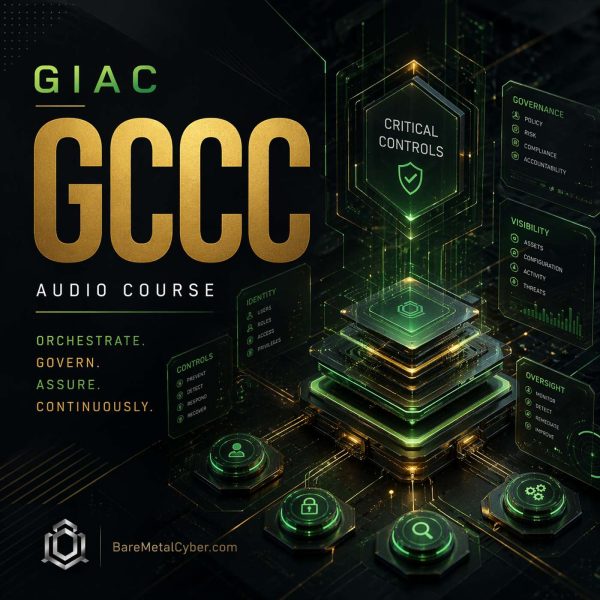
Certified: The GIAC GCCC Audio Course
- Épisodes
- 60
- Format
- Série – à écouter depuis le début
- Dernier épisode
- 9 Fév 2026
À propos du podcast
GCCC is a control-first security course built for busy professionals who want practical mastery of the CIS Controls v8 and the real-world workflows that make them stick. You’ll learn how to inventory assets and software with confidence, harden configurations without breaking operations, manage vulnerabilities with proof-based closure, and turn logging into outcomes through centralized collection, correlation, and sustainable alerting. The course also covers malware defense as layered prevention plus rapid containment, data protection through classification, access boundaries, and safe retention, and recovery readiness with RPO/RTO planning, backup isolation, and restore testing. You’ll strengthen governance across identity and access management, change control, third-party risk, awareness programs that drive behavior change, incident response readiness and execution, and how to use testing results to improve controls over time. Every lesson stays exam-focused while keeping the emphasis on operational evidence, measurable effectiveness, and decision-making under pressure—so you’re not just memorizing terms, you’re learning how to run the controls in production with confidence.
Épisodes 60
Welcome to the GIAC GCCC Audio Course
If you build, run, or defend systems for a living, you already know the truth: security isn’t one thing you do. It’s a chain of decisions—design, build, deploy, operate, recover—under real constraints.This …
Notes de l’épisode
If you build, run, or defend systems for a living, you already know the truth: security isn’t one thing you do. It’s a chain of decisions—design, build, deploy, operate, recover—under real constraints.
This 90-second trailer is for an audio course that treats cybersecurity like an operational discipline, not a buzzword. You’ll learn how to set recovery objectives that match business reality, protect backups like high-value targets, and prove recoverability with restore tests and closure evidence. You’ll hear how to harden the software lifecycle end-to-end, manage dependencies and patch weak components fast, and turn pen test findings into measurable control improvements instead of one-time cleanup. You’ll also get practical guidance for third-party risk, from due diligence through contract enforcement and continuous monitoring, and you’ll build incident response readiness that holds up under pressure—clear roles, reliable playbooks, and communications discipline.
Every episode is designed for busy professionals: plain language, real-world decision points, and repeatable habits you can apply immediately.
If you want security that actually survives production and incident reality, start here.
Developed by BareMetalCyber.com.
Episode 59 — Validate resilience after fixes with retesting and durable closure evidence
This final episode focuses on validating resilience after fixes, emphasizing retesting and durable closure evidence so improvements persist beyond a single remediation sprint. You’ll define retesting as …
Notes de l’épisode
This final episode focuses on validating resilience after fixes, emphasizing retesting and durable closure evidence so improvements persist beyond a single remediation sprint. You’ll define retesting as confirming that exploited paths are no longer feasible and that compensating controls work as intended, then connect it to exam expectations about verification, continuous control validation, and defensible evidence. We’ll cover retesting methods such as targeted re-exploitation attempts, configuration verification, vulnerability rescans, and detection validation to ensure monitoring now catches the behaviors that previously slipped through. Real-world scenarios include confirming ransomware containment controls hold after segmentation changes, validating that privileged access controls prevent repeat abuse, and ensuring patch and hardening changes did not introduce new operational fragility. Troubleshooting includes partial fixes that leave alternate attack paths open, environment changes that invalidate earlier assumptions, and weak evidence practices that cannot demonstrate closure; you’ll learn how to document outcomes with timestamps, scope, artifacts, and follow-up checks so closure is credible and long-lasting. Produced by BareMetalCyber.com, where you’ll find more cyber audio courses, books, and information to strengthen your educational path. Also, if you want to stay up to date with the latest news, visit DailyCyber.News for a newsletter you can use, and a daily podcast you can commute with.
Episode 58 — Translate pen test findings into remediation priorities and measurable control improvements
This episode focuses on turning penetration test findings into remediation priorities and measurable improvements, because the real value of testing is how it strengthens controls and reduces future risk …
Notes de l’épisode
This episode focuses on turning penetration test findings into remediation priorities and measurable improvements, because the real value of testing is how it strengthens controls and reduces future risk. You’ll define the difference between findings that show a specific vulnerability and findings that reveal systemic control gaps, then connect this to exam logic about prioritization, ownership, and verification. We’ll cover how to triage findings using exploitability, exposure, business impact, and control relevance, and how to convert results into work items with clear owners, deadlines, and success criteria. Real-world examples include addressing credential abuse paths by tightening privileged access and monitoring, fixing segmentation weaknesses that enabled lateral movement, and improving secure configuration baselines when default settings made exploitation easy. Troubleshooting includes remediation that treats symptoms without root cause, teams that dispute findings due to environment drift, and programs that close tickets without validating results; you’ll learn how to tie fixes to control statements, create evidence artifacts, and show measurable improvement over time. Produced by BareMetalCyber.com, where you’ll find more cyber audio courses, books, and information to strengthen your educational path. Also, if you want to stay up to date with the latest news, visit DailyCyber.News for a newsletter you can use, and a daily podcast you can commute with.
Episode 57 — Plan penetration tests safely: scope control, rules of engagement, and reporting clarity
This episode teaches how to plan penetration tests safely and effectively, focusing on scope control, rules of engagement, and reporting clarity that protect operations while producing useful results. You’ll …
Notes de l’épisode
This episode teaches how to plan penetration tests safely and effectively, focusing on scope control, rules of engagement, and reporting clarity that protect operations while producing useful results. You’ll define a penetration test as an authorized simulation of adversary techniques to evaluate controls, not a chaotic “hack everything” exercise, and connect this to exam questions that test governance and safety. We’ll cover scope definition, allowed targets, prohibited actions, test windows, communication paths, and approval requirements, plus how rules of engagement establish guardrails for social engineering, exploitation, data access, and denial-of-service risk. Real-world examples include coordinating with IT operations to prevent false incident escalations, defining how credentials and sensitive findings are handled, and ensuring testing does not accidentally disrupt critical services. Troubleshooting includes ambiguous scope that leads to conflict, missing contacts during the test window, poor documentation of assumptions, and report outputs that lack reproducibility or actionable detail for remediation teams. Produced by BareMetalCyber.com, where you’ll find more cyber audio courses, books, and information to strengthen your educational path. Also, if you want to stay up to date with the latest news, visit DailyCyber.News for a newsletter you can use, and a daily podcast you can commute with.
Episode 56 — Improve response capability with lessons learned and continuous program refinement
This episode explains how to improve incident response capability using lessons learned, because the exam often expects you to treat response as a program that matures through evidence-based refinement. You’ll …
Notes de l’épisode
This episode explains how to improve incident response capability using lessons learned, because the exam often expects you to treat response as a program that matures through evidence-based refinement. You’ll define lessons learned as a structured review that identifies what happened, what worked, what failed, and what must change in people, process, and technology, without turning into blame. We’ll cover how to produce actionable outputs such as updated playbooks, improved logging and detection coverage, clarified escalation rules, and better containment tooling, then show how to assign owners and deadlines so improvements actually land. Real-world scenarios include discovering that missing identity logs delayed triage, or that unclear authority for isolating systems caused response hesitation, and how those insights translate into concrete fixes. Troubleshooting includes reviews that become vague narratives, action items that never close, and improvements that are not validated; you’ll learn how to retest response changes through tabletop exercises, controlled simulations, and metrics like time-to-detect and time-to-contain. Produced by BareMetalCyber.com, where you’ll find more cyber audio courses, books, and information to strengthen your educational path. Also, if you want to stay up to date with the latest news, visit DailyCyber.News for a newsletter you can use, and a daily podcast you can commute with.
Episode 55 — Execute incident response under pressure: detection, containment, and evidence handling
This episode focuses on executing incident response under pressure, emphasizing detection confirmation, rapid containment, and careful evidence handling so actions are defensible and effective. You’ll define …
Notes de l’épisode
This episode focuses on executing incident response under pressure, emphasizing detection confirmation, rapid containment, and careful evidence handling so actions are defensible and effective. You’ll define the early response objectives: stop the bleeding, understand scope, preserve proof, and maintain business operations where possible, which maps directly to exam scenarios that ask for the best “next step.” We’ll cover practical containment actions like isolating hosts, disabling compromised accounts, blocking malicious indicators, and securing affected segments, along with decision-making guidance on when containment should happen immediately versus after collecting volatile evidence. Real-world examples include responding to suspected ransomware spread, credential theft with active session abuse, and suspicious admin changes that suggest persistence. Troubleshooting includes avoiding destructive “cleanup” that destroys evidence, handling conflicting priorities between uptime and containment, documenting actions in a clear timeline, and maintaining communications discipline so stakeholders receive accurate updates without speculation. Produced by BareMetalCyber.com, where you’ll find more cyber audio courses, books, and information to strengthen your educational path. Also, if you want to stay up to date with the latest news, visit DailyCyber.News for a newsletter you can use, and a daily podcast you can commute with.
Episode 54 — Build incident response readiness with roles, playbooks, and communications discipline
This episode builds incident response readiness as a structured capability that can be executed under stress, which aligns with exam questions that test process clarity and role accountability. You’ll define …
Notes de l’épisode
This episode builds incident response readiness as a structured capability that can be executed under stress, which aligns with exam questions that test process clarity and role accountability. You’ll define readiness as having named roles, clear decision rights, and documented playbooks that cover common incident types, while ensuring evidence handling and containment steps are not improvised. We’ll cover role assignments such as incident commander, technical leads, communications lead, legal liaison, and operations coordinators, and explain how to establish escalation triggers and authority boundaries before a crisis. Real-world examples include creating playbooks for ransomware, credential compromise, and data exposure, with emphasis on what to do in the first hour and how to coordinate across security, IT, and leadership. Troubleshooting includes missing contact paths, unclear approval chains that slow containment, poorly maintained playbooks that no longer match the environment, and building communications discipline so internal updates and external statements stay accurate and consistent. Produced by BareMetalCyber.com, where you’ll find more cyber audio courses, books, and information to strengthen your educational path. Also, if you want to stay up to date with the latest news, visit DailyCyber.News for a newsletter you can use, and a daily podcast you can commute with.
Episode 53 — Reinforce skills over time with role-based focus, coaching, and timely feedback
This episode focuses on reinforcement, because durable security improvement requires repeated practice, coaching, and timely feedback rather than one-time annual training. You’ll define reinforcement as the …
Notes de l’épisode
This episode focuses on reinforcement, because durable security improvement requires repeated practice, coaching, and timely feedback rather than one-time annual training. You’ll define reinforcement as the cycle of reminding, practicing, observing, and correcting, and connect it to exam logic where ongoing validation and continuous improvement matter more than policies alone. We’ll cover role-based reinforcement methods, such as admin runbooks and tabletop drills for responders, secure coding reviews and patterns for developers, and simple verification workflows for business teams facing fraud attempts. Real-world scenarios include providing immediate feedback after a user reports a suspicious message, coaching managers during access reviews to reduce rubber-stamping, and reinforcing secure change procedures after a near-miss outage. Troubleshooting includes preventing reinforcement from becoming noise, choosing the right cadence for different roles, avoiding “gotcha” culture, and creating feedback loops where lessons learned from incidents and audits directly update the next reinforcement cycle. Produced by BareMetalCyber.com, where you’ll find more cyber audio courses, books, and information to strengthen your educational path. Also, if you want to stay up to date with the latest news, visit DailyCyber.News for a newsletter you can use, and a daily podcast you can commute with.
Episode 52 — Measure training effectiveness with metrics tied to real risk reduction outcomes
This episode teaches how to measure security training effectiveness in ways that connect to real risk reduction, which is what exam scenarios often want when they ask how to prove a control is working. You’ll …
Notes de l’épisode
This episode teaches how to measure security training effectiveness in ways that connect to real risk reduction, which is what exam scenarios often want when they ask how to prove a control is working. You’ll define meaningful metrics that go beyond attendance, such as phishing report rates, reduction in repeated policy violations, faster incident reporting, fewer risky credential behaviors, and improved secure configuration compliance for technical teams. We’ll explain how to design measurement so it respects privacy and avoids punishing individuals, while still producing actionable program insights. Real-world examples include measuring time-to-report suspicious email, tracking reduction in malware infections tied to risky browsing patterns, and correlating improved access review hygiene after targeted training for managers. Troubleshooting covers misleading metrics, small sample sizes, changing attacker tactics that distort trends, and the common failure where organizations collect numbers but do not change the program based on what the data shows. Produced by BareMetalCyber.com, where you’ll find more cyber audio courses, books, and information to strengthen your educational path. Also, if you want to stay up to date with the latest news, visit DailyCyber.News for a newsletter you can use, and a daily podcast you can commute with.
Episode 51 — Build awareness programs that change behavior, not just complete training requirements
This episode focuses on designing security awareness programs that produce measurable behavior change, which is often the underlying goal behind exam questions that reference “training” as a control. You’ll …
Notes de l’épisode
This episode focuses on designing security awareness programs that produce measurable behavior change, which is often the underlying goal behind exam questions that reference “training” as a control. You’ll define awareness as building recognition and safer decision-making, and training as developing specific skills, then explain why check-the-box completion rates rarely reduce phishing success, data mishandling, or policy violations. We’ll cover program design elements such as audience segmentation, role-specific messaging, realistic scenarios, and reinforcement patterns that match how people actually work. Real-world examples include tailoring content for finance, IT admins, developers, and frontline staff, and using policy moments like new tool rollouts or incidents to make messaging timely and relevant. Troubleshooting includes handling resistance, avoiding fear-based messaging, preventing “security theater” campaigns, and building governance so content stays current and aligned to top threat patterns and control priorities. Produced by BareMetalCyber.com, where you’ll find more cyber audio courses, books, and information to strengthen your educational path. Also, if you want to stay up to date with the latest news, visit DailyCyber.News for a newsletter you can use, and a daily podcast you can commute with.
Episode 50 — Monitor third-party risk continuously with signals, assessments, and escalation triggers
This episode focuses on continuous third-party risk monitoring, because provider posture can change quickly due to acquisitions, new products, outages, or security incidents. You’ll define continuous monitoring …
Notes de l’épisode
This episode focuses on continuous third-party risk monitoring, because provider posture can change quickly due to acquisitions, new products, outages, or security incidents. You’ll define continuous monitoring as maintaining ongoing visibility into provider risk signals and control performance rather than relying on annual questionnaires. We’ll cover monitoring inputs such as periodic reassessments, security attestations, vulnerability and incident disclosures, service reliability trends, access log reviews where feasible, and business-side signals like expanding data scope or increasing integration depth. Exam scenarios often test whether you can detect scope creep, respond to new risks, and escalate when a provider no longer meets requirements, so we’ll build practical escalation triggers tied to severity, customer impact, and control failure patterns. Real-world examples include responding to a provider breach notification, reassessing a vendor after a major platform change, and tightening access when integration expands to new sensitive datasets. Troubleshooting includes avoiding monitoring theater, preventing alert overload, and ensuring escalations lead to real decisions such as mitigation plans, contractual remediation, or provider exit strategies. Produced by BareMetalCyber.com, where you’ll find more cyber audio courses, books, and information to strengthen your educational path. Also, if you want to stay up to date with the latest news, visit DailyCyber.News for a newsletter you can use, and a daily podcast you can commute with.
Episode 49 — Enforce provider accountability through contracts, controls, and ongoing assurance reviews
This episode explains how to enforce service provider accountability after selection, because third-party risk management fails when controls exist only during onboarding. You’ll define accountability …
Notes de l’épisode
This episode explains how to enforce service provider accountability after selection, because third-party risk management fails when controls exist only during onboarding. You’ll define accountability mechanisms such as contractual requirements, security addenda, right-to-audit clauses, breach notification timelines, subcontractor disclosures, and clear responsibility boundaries for shared controls. Exam relevance includes recognizing that “trust” must be operationalized through measurable obligations and ongoing assurance, especially when providers process sensitive data or maintain privileged access. We’ll cover control expectations like access logging, encryption requirements, incident response coordination, vulnerability management, and change notification for impactful platform updates. Real-world scenarios include negotiating acceptable SLA language, ensuring providers support timely user access reviews, and establishing procedures for emergency access and evidence requests during incidents. Troubleshooting includes ambiguous shared-responsibility assumptions, contracts that lack enforcement teeth, assurance reviews that become checkbox exercises, and building a repeatable cadence of reviews, metrics, and escalation paths when providers fail to meet requirements. Produced by BareMetalCyber.com, where you’ll find more cyber audio courses, books, and information to strengthen your educational path. Also, if you want to stay up to date with the latest news, visit DailyCyber.News for a newsletter you can use, and a daily podcast you can commute with.
Episode 48 — Evaluate service providers with due diligence that matches risk and criticality
This episode teaches third-party due diligence as a risk-matching exercise, because the exam often tests whether you can scale scrutiny based on the provider’s access, data sensitivity, and operational …
Notes de l’épisode
This episode teaches third-party due diligence as a risk-matching exercise, because the exam often tests whether you can scale scrutiny based on the provider’s access, data sensitivity, and operational criticality. You’ll define service provider evaluation as assessing security posture, reliability, and governance before onboarding, then connect it to practical questions like what evidence is reasonable to request and what red flags should block adoption. We’ll cover due diligence inputs such as security questionnaires, independent assessments, incident history, data handling practices, access models, and continuity capabilities, with emphasis on verifying claims instead of relying on marketing statements. Real-world scenarios include selecting a SaaS platform that stores customer data, a managed service provider with admin access, and a niche vendor supporting a mission-critical workflow. Troubleshooting includes vendors that resist transparency, mismatched control language, incomplete scope definitions, and how to document risk decisions, compensating controls, and approval outcomes so onboarding is defensible and aligned to the organization’s risk tolerance. Produced by BareMetalCyber.com, where you’ll find more cyber audio courses, books, and information to strengthen your educational path. Also, if you want to stay up to date with the latest news, visit DailyCyber.News for a newsletter you can use, and a daily podcast you can commute with.
Episode 47 — Detect and remediate weaknesses with testing evidence, prioritization, and closure proof
This episode explains application and system weakness management as a lifecycle that depends on testing evidence, risk-based prioritization, and verified closure rather than optimistic ticket updates. You’ll …
Notes de l’épisode
This episode explains application and system weakness management as a lifecycle that depends on testing evidence, risk-based prioritization, and verified closure rather than optimistic ticket updates. You’ll define weakness detection methods such as static analysis, dynamic testing, dependency scanning, configuration testing, and manual review, and you’ll connect these to exam questions that test what evidence is strongest and what actions are most appropriate for different findings. We’ll cover how to prioritize weaknesses using exploitability, exposure, business impact, and compensating controls, then translate priorities into remediation plans with owners, timelines, and acceptance criteria. Real-world scenarios include a critical injection flaw in a public API, weak authentication logic in an internal admin tool, and insecure defaults in cloud configuration that create app-level data exposure. Troubleshooting focuses on false positives, tool overlap that creates duplicate findings, and remediation that breaks functionality because fixes were not validated. You’ll learn closure proof techniques like retesting, verifying deployed versions, and recording artifacts so findings can be defended as resolved. Produced by BareMetalCyber.com, where you’ll find more cyber audio courses, books, and information to strengthen your educational path. Also, if you want to stay up to date with the latest news, visit DailyCyber.News for a newsletter you can use, and a daily podcast you can commute with.
Episode 46 — Reduce application risk by managing dependencies and patching weak components quickly
This episode focuses on dependency risk because modern applications rely on third-party libraries, frameworks, containers, and services that can introduce critical vulnerabilities outside your own code. You’ll …
Notes de l’épisode
This episode focuses on dependency risk because modern applications rely on third-party libraries, frameworks, containers, and services that can introduce critical vulnerabilities outside your own code. You’ll define dependencies broadly, including open-source packages, internal shared libraries, base images, and hosted service components, then connect that definition to exam scenarios where the right answer involves inventory, version control, and timely patch action. We’ll cover practical dependency management, such as maintaining a software bill of materials mindset, pinning versions, validating sources, and monitoring for vulnerable components. Patching strategy is discussed as both speed and safety, including how to prioritize exploitable weaknesses, stage updates, and prevent breaking changes with testing gates and rollback plans. Real-world scenarios include high-profile library vulnerabilities, compromised package repositories, and container image drift where “latest” quietly changes. Troubleshooting includes incomplete dependency visibility, slow ownership response, conflicting versions across microservices, and how to prove closure with evidence that updated components were deployed and vulnerable versions are no longer reachable. Produced by BareMetalCyber.com, where you’ll find more cyber audio courses, books, and information to strengthen your educational path. Also, if you want to stay up to date with the latest news, visit DailyCyber.News for a newsletter you can use, and a daily podcast you can commute with.
Episode 45 — Secure the software lifecycle end-to-end: design, build, deploy, and operate safely
This episode explains securing the software lifecycle as a continuous set of controls that start at design and extend through build, deployment, and ongoing operation, which aligns closely with control-based …
Notes de l’épisode
This episode explains securing the software lifecycle as a continuous set of controls that start at design and extend through build, deployment, and ongoing operation, which aligns closely with control-based exam thinking. You’ll define lifecycle security goals such as reducing defect introduction, preventing tampering, and ensuring changes are traceable, then map those goals to practical practices like threat modeling, secure coding standards, code review discipline, and build pipeline hardening. We’ll cover how to protect source repositories, control who can merge changes, secure CI/CD secrets, and ensure artifacts are signed and traceable so you can answer exam questions about supply chain integrity and change accountability. Real-world examples include separating duties between developers and release approvers, limiting production access, and monitoring deployments for unexpected changes. Troubleshooting includes dealing with legacy apps, balancing speed with risk, preventing “bypass paths” around pipelines, and generating evidence such as commit histories, review records, pipeline logs, and deployment approvals that demonstrate the controls are operating in reality. Produced by BareMetalCyber.com, where you’ll find more cyber audio courses, books, and information to strengthen your educational path. Also, if you want to stay up to date with the latest news, visit DailyCyber.News for a newsletter you can use, and a daily podcast you can commute with.
Episode 44 — Prove recoverability with restore tests, integrity checks, and documented results
This episode focuses on proving recoverability, because the exam frequently distinguishes “we have backups” from “we can restore correctly under pressure.” You’ll define recoverability as the ability to restore …
Notes de l’épisode
This episode focuses on proving recoverability, because the exam frequently distinguishes “we have backups” from “we can restore correctly under pressure.” You’ll define recoverability as the ability to restore required systems and data within stated objectives, with verified integrity and usable outcomes, not merely completed backup jobs. We’ll cover restore testing types, from file-level restores to full system recovery and application-consistent restores, and how to choose tests that match criticality and change frequency. Integrity checks are emphasized, including checksum validation, verification that restored data is current enough for business use, and ensuring configuration and secrets needed to run the service are recoverable too. Real-world scenarios include restoring after ransomware, validating that backups were not silently corrupted, and recovering cloud workloads where infrastructure definitions and permissions are as important as data. Troubleshooting includes tests that never exercise production-like complexity, missing documentation, unclear success criteria, and how to capture results as audit evidence with dates, scope, steps, outcomes, and remediation actions for failures. Produced by BareMetalCyber.com, where you’ll find more cyber audio courses, books, and information to strengthen your educational path. Also, if you want to stay up to date with the latest news, visit DailyCyber.News for a newsletter you can use, and a daily podcast you can commute with.
Episode 43 — Protect backups as high-value targets: access controls, encryption, and isolation strategy
This episode explains why backups are prime targets for attackers and how protecting them requires stronger controls than ordinary storage because backups can recreate the entire environment. You’ll define …
Notes de l’épisode
This episode explains why backups are prime targets for attackers and how protecting them requires stronger controls than ordinary storage because backups can recreate the entire environment. You’ll define backup security objectives such as confidentiality, integrity, availability, and recoverability, then connect these to exam scenarios involving ransomware, insider threats, and compromised admin credentials. We’ll cover access controls like separate backup admin roles, MFA, least privilege to modify retention or delete sets, and monitoring for unusual delete or encryption events. You’ll also learn encryption decisions, including key ownership and separation so attackers who compromise production cannot automatically decrypt backup data. Isolation strategy is a core focus, including immutable storage, offline or air-gapped options, and separate accounts or tenants to prevent blast radius. Troubleshooting includes avoiding single points of failure, preventing backup agents from becoming attack paths, ensuring backup metadata is protected, and validating protections with periodic reviews of permissions, change logs, and alerting on destructive operations. Produced by BareMetalCyber.com, where you’ll find more cyber audio courses, books, and information to strengthen your educational path. Also, if you want to stay up to date with the latest news, visit DailyCyber.News for a newsletter you can use, and a daily podcast you can commute with.
Episode 42 — Define recovery objectives that fit business reality: RPO, RTO, and scope decisions
This episode teaches recovery objectives as decision tools that shape how resilient your environment truly is, and how exam questions often test whether you can match objectives to business needs instead of …
Notes de l’épisode
This episode teaches recovery objectives as decision tools that shape how resilient your environment truly is, and how exam questions often test whether you can match objectives to business needs instead of picking the most aggressive option. You’ll define RPO as the maximum tolerable data loss window and RTO as the maximum tolerable downtime window, then explain how scope decisions determine what systems, data sets, and dependencies are included in recovery planning. We’ll connect objectives to concrete design choices such as replication frequency, backup strategy, failover design, staffing readiness, and the difference between recovering a service versus restoring full business function. Real-world scenarios include choosing different RPO and RTO targets for payroll, customer-facing apps, and internal collaboration tools, and negotiating realistic targets when budgets and operational constraints exist. Troubleshooting covers vague objectives that cannot be tested, missing dependency mapping that breaks recoveries, and documentation gaps that create false confidence until a real outage forces uncomfortable truths. Produced by BareMetalCyber.com, where you’ll find more cyber audio courses, books, and information to strengthen your educational path. Also, if you want to stay up to date with the latest news, visit DailyCyber.News for a newsletter you can use, and a daily podcast you can commute with.
Episode 41 — Retain and dispose of data safely with automation, approvals, and audit evidence
This episode explains data retention and disposal as lifecycle controls that reduce legal exposure, breach impact, and storage sprawl while preserving what the business truly needs. You’ll define retention as …
Notes de l’épisode
This episode explains data retention and disposal as lifecycle controls that reduce legal exposure, breach impact, and storage sprawl while preserving what the business truly needs. You’ll define retention as keeping data for a justified period and disposal as verified removal or destruction, then connect both to exam scenarios that test whether controls are enforceable and evidenced, not merely documented. We’ll cover automation patterns like retention policies by data class, storage tier rules, and scheduled deletion workflows that reduce human error, plus approval gates for legal holds, investigations, and exception cases where disposal must pause. Real-world examples include cleaning up old user data in SaaS platforms, retiring legacy file shares, and disposing of backups and logs without breaking compliance obligations. Troubleshooting focuses on proving disposal happened, preventing orphaned copies in sync tools, handling conflicting requirements across jurisdictions, and producing audit evidence such as policy versions, approval records, job logs, exception registers, and periodic verification reports. Produced by BareMetalCyber.com, where you’ll find more cyber audio courses, books, and information to strengthen your educational path. Also, if you want to stay up to date with the latest news, visit DailyCyber.News for a newsletter you can use, and a daily podcast you can commute with.
Episode 40 — Protect data with access boundaries, encryption decisions, and controlled sharing patterns
This episode explains how to protect data by combining access boundaries, encryption decisions, and controlled sharing patterns that reduce accidental exposure and intentional misuse. You’ll define access …
Notes de l’épisode
This episode explains how to protect data by combining access boundaries, encryption decisions, and controlled sharing patterns that reduce accidental exposure and intentional misuse. You’ll define access boundaries as the segmentation of data by sensitivity, ownership, and purpose, then connect that to exam scenarios where the right answer depends on limiting who can access what, from where, and under what conditions. We’ll discuss encryption decisions in practical terms, including encryption at rest versus in transit, key management responsibilities, and how to avoid false confidence when encryption is enabled but keys are overly accessible. Real-world scenarios include sharing sensitive files with external partners, controlling access to cloud storage, and preventing uncontrolled data replication through email, chat, or personal cloud accounts. Troubleshooting includes identifying overbroad sharing links, fixing permissions drift, handling legitimate business needs for collaboration without weakening controls, and producing evidence that protections are operating through access reviews, audit logs, and repeatable verification checks. Produced by BareMetalCyber.com, where you’ll find more cyber audio courses, books, and information to strengthen your educational path. Also, if you want to stay up to date with the latest news, visit DailyCyber.News for a newsletter you can use, and a daily podcast you can commute with.
Episode 39 — Classify data in practice: sensitivity tiers, handling rules, and real-world exceptions
This episode teaches data classification as an operational system that drives real handling behaviors, not a theoretical labeling exercise. You’ll define classification as assigning sensitivity tiers based on …
Notes de l’épisode
This episode teaches data classification as an operational system that drives real handling behaviors, not a theoretical labeling exercise. You’ll define classification as assigning sensitivity tiers based on confidentiality, integrity, and availability needs, then explain how those tiers translate into handling rules like storage locations, access restrictions, encryption requirements, retention, and approved sharing methods. Exam relevance includes recognizing which classification level should apply in a scenario and what controls must follow from that decision, especially when questions test “appropriate” rather than “maximum” security. Real-world examples include classifying customer data, internal financial information, source code, and operational telemetry, along with the practical reality that teams will request exceptions for business workflows. Troubleshooting focuses on preventing classification from becoming inconsistent across departments, handling mixed-data repositories, and creating an exception process that documents why an exception exists, what compensating safeguards apply, and when the exception must be reviewed or removed. Produced by BareMetalCyber.com, where you’ll find more cyber audio courses, books, and information to strengthen your educational path. Also, if you want to stay up to date with the latest news, visit DailyCyber.News for a newsletter you can use, and a daily podcast you can commute with.
Episode 38 — Confirm email and browser protections work with testing and measurable outcomes
This episode focuses on confirming that phishing and browsing controls actually reduce risk by using testing and measurable outcomes rather than assuming tools are effective. You’ll define testing as controlled …
Notes de l’épisode
This episode focuses on confirming that phishing and browsing controls actually reduce risk by using testing and measurable outcomes rather than assuming tools are effective. You’ll define testing as controlled validation of control behavior, such as safe phishing simulations, benign attachment tests, and controlled link detonation, and you’ll connect the results to exam expectations around continuous control verification. We’ll cover metrics that matter, including delivery rates of simulated campaigns, click and credential submission rates, time to report suspicious messages, and the percentage of endpoints enforcing required browser policies. Real-world scenarios include validating that risky file types are blocked, confirming that spoofed domains trigger warnings, and ensuring that web filtering policies apply consistently across remote and on-network users. Troubleshooting includes avoiding misleading metrics, preventing tests from becoming punitive, handling changes in attacker tactics, and using test failures to drive concrete fixes like policy updates, training adjustments, and improved reporting workflows that shorten the time between detection and containment. Produced by BareMetalCyber.com, where you’ll find more cyber audio courses, books, and information to strengthen your educational path. Also, if you want to stay up to date with the latest news, visit DailyCyber.News for a newsletter you can use, and a daily podcast you can commute with.
Episode 37 — Harden web browsing with technical safeguards and safer execution pathways
This episode explains how to harden web browsing so routine internet use does not become an easy malware delivery channel or credential theft pathway. You’ll define browsing risk in terms of drive-by downloads …
Notes de l’épisode
This episode explains how to harden web browsing so routine internet use does not become an easy malware delivery channel or credential theft pathway. You’ll define browsing risk in terms of drive-by downloads, malicious scripts, exploit chains, and credential harvesting, then connect those risks to exam questions that emphasize preventative controls and safe defaults. We’ll cover technical safeguards such as secure browser configurations, extension governance, blocking risky content types, DNS and web filtering, and isolating or sandboxing browsing sessions to reduce the blast radius of a compromise. Real-world examples include restricting local admin privileges so browser compromise cannot immediately install persistence, using separate browsers or profiles for privileged workflows, and applying policies that reduce exposure to unknown or newly registered domains. Troubleshooting covers balancing usability with security, handling business sites that break under stricter controls, and ensuring “secure browsing” is not just a policy statement but a verifiable configuration with measurable coverage across endpoints. Produced by BareMetalCyber.com, where you’ll find more cyber audio courses, books, and information to strengthen your educational path. Also, if you want to stay up to date with the latest news, visit DailyCyber.News for a newsletter you can use, and a daily podcast you can commute with.
Episode 36 — Reduce phishing success with email controls that block, warn, and verify safely
This episode focuses on reducing phishing success by combining blocking, warning, and verification controls that protect users even when messages look legitimate. You’ll define phishing as deception designed to …
Notes de l’épisode
This episode focuses on reducing phishing success by combining blocking, warning, and verification controls that protect users even when messages look legitimate. You’ll define phishing as deception designed to steal credentials, deliver malware, or trigger fraudulent actions, then connect that to exam-style prompts that test layered defenses rather than a single tool. We’ll cover email controls such as sender authentication, attachment and link inspection, sandboxing, and policies that flag risky patterns like unusual sender domains, lookalike addresses, and spoofed internal communications. You’ll also learn user-facing warning patterns and verification workflows, including how to confirm sensitive requests through trusted channels so the “reply to the email” trap is avoided. Real-world scenarios include invoice fraud, password reset lures, and executive impersonation attempts, highlighting what controls stop delivery versus what controls reduce impact after delivery. Troubleshooting includes managing false positives that block business email, handling new vendors and legitimate external senders, and building evidence that controls are working through metrics like click rates, reported messages, and blocked campaign patterns. Produced by BareMetalCyber.com, where you’ll find more cyber audio courses, books, and information to strengthen your educational path. Also, if you want to stay up to date with the latest news, visit DailyCyber.News for a newsletter you can use, and a daily podcast you can commute with.
Episode 35 — Improve monitoring outcomes with tuning, validation, and gap-driven coverage fixes
This episode teaches how to improve monitoring outcomes by treating detection as an engineered system that needs tuning, validation, and continuous coverage improvement. You’ll define tuning as adjusting …
Notes de l’épisode
This episode teaches how to improve monitoring outcomes by treating detection as an engineered system that needs tuning, validation, and continuous coverage improvement. You’ll define tuning as adjusting detections to reduce false positives while preserving sensitivity to real threats, and validation as proving detections fire when expected through controlled tests and incident replay. We’ll connect these concepts to exam questions that distinguish “we collect logs” from “we can detect and respond,” emphasizing measurable outcomes like time to detect and time to triage. Real-world scenarios include tuning brute-force alerts, reducing duplicate notifications from correlated sensors, and adding enrichment so analysts can make decisions faster. Troubleshooting covers gaps discovered during incidents, such as missing endpoint telemetry on high-risk hosts or absent identity logs that block investigation, and how to drive fixes through ownership, deadlines, and verification. The goal is to build a feedback loop where monitoring improves based on evidence, not hope, and where coverage gaps become tracked work items rather than recurring surprises. Produced by BareMetalCyber.com, where you’ll find more cyber audio courses, books, and information to strengthen your educational path. Also, if you want to stay up to date with the latest news, visit DailyCyber.News for a newsletter you can use, and a daily podcast you can commute with.
Episode 34 — Detect threats faster with triage workflows, escalation rules, and response coordination
This episode focuses on detection as a process, not a product, showing how triage workflows and escalation rules turn alerts into timely action. You’ll define triage as rapidly determining credibility, scope …
Notes de l’épisode
This episode focuses on detection as a process, not a product, showing how triage workflows and escalation rules turn alerts into timely action. You’ll define triage as rapidly determining credibility, scope, and urgency, then connect that to exam scenarios where the correct response is to prioritize containment and evidence preservation based on risk. We’ll cover escalation rules that clarify when to involve incident response, IT operations, legal, or leadership, and how to prevent delays caused by unclear decision rights. Real-world examples include handling suspected credential compromise, ransomware indicators, and suspicious administrative changes, each requiring different first steps and coordination patterns. Troubleshooting emphasizes common failure modes like alert overload, missing context, unclear ownership, and slow approvals that let incidents expand. You’ll learn how to build a repeatable runbook approach that includes minimum required data, standard communication channels, and fast containment options so detection becomes a reliable capability under pressure. Produced by BareMetalCyber.com, where you’ll find more cyber audio courses, books, and information to strengthen your educational path. Also, if you want to stay up to date with the latest news, visit DailyCyber.News for a newsletter you can use, and a daily podcast you can commute with.
Episode 33 — Design network visibility that matters: telemetry selection and baseline behavior modeling
This episode teaches how to design network visibility that produces actionable security outcomes instead of overwhelming teams with noise. You’ll define telemetry as the signals collected from networks and …
Notes de l’épisode
This episode teaches how to design network visibility that produces actionable security outcomes instead of overwhelming teams with noise. You’ll define telemetry as the signals collected from networks and devices, then explain which sources are most useful for detecting threats, investigating incidents, and validating controls. We’ll cover selecting telemetry such as flow records, firewall logs, DNS data, proxy events, authentication-related network signals, and intrusion detection outputs, with an emphasis on choosing signals that support realistic threat scenarios. You’ll also learn baseline behavior modeling, meaning you understand what “normal” traffic looks like so anomalies stand out as meaningful, not random variation. Real-world scenarios include spotting unusual outbound connections from a server, detecting lateral movement patterns, and identifying unexpected DNS behavior that hints at command-and-control. Troubleshooting includes handling incomplete coverage, inconsistent time settings, noisy environments with frequent change, and ensuring the visibility design is tied to response workflows so telemetry leads to decisions, not dashboards. Produced by BareMetalCyber.com, where you’ll find more cyber audio courses, books, and information to strengthen your educational path. Also, if you want to stay up to date with the latest news, visit DailyCyber.News for a newsletter you can use, and a daily podcast you can commute with.
Episode 32 — Control network changes safely with baselines, approvals, and rollback discipline
This episode focuses on network change control as a security control, not just an IT process, because uncontrolled changes can create exposures faster than scanners can find them. You’ll define a network …
Notes de l’épisode
This episode focuses on network change control as a security control, not just an IT process, because uncontrolled changes can create exposures faster than scanners can find them. You’ll define a network baseline as an approved “known good” configuration state and explain how baselines support both stability and defensible security posture. We’ll discuss approval workflows that match risk, such as peer review for routine changes and stricter gates for firewall rules, VPN access changes, or routing updates that affect segmentation. Exam relevance shows up when questions test whether you can prevent accidental exposure and detect unauthorized modifications through change records and configuration monitoring. Real-world scenarios include emergency changes during outages and how rollback plans keep pressure from turning into permanent insecure shortcuts. Troubleshooting covers incomplete documentation, drift between intended and running configurations, and building evidence that every meaningful change had an owner, a reason, a tested plan, and a verified outcome. Produced by BareMetalCyber.com, where you’ll find more cyber audio courses, books, and information to strengthen your educational path. Also, if you want to stay up to date with the latest news, visit DailyCyber.News for a newsletter you can use, and a daily podcast you can commute with.
Episode 31 — Harden network device management planes to reduce takeover and tampering risk
This episode explains how to secure network device management planes so attackers cannot quietly take control of routing, switching, or security enforcement. You’ll define the management plane as the interfaces …
Notes de l’épisode
This episode explains how to secure network device management planes so attackers cannot quietly take control of routing, switching, or security enforcement. You’ll define the management plane as the interfaces and services used to administer devices, then connect that concept to exam-style scenarios where compromise happens through exposed admin ports, weak authentication, or mis-scoped management access. We’ll cover best practices like restricting management to dedicated networks, enforcing strong authentication and MFA where supported, disabling insecure protocols, and limiting who can make configuration changes. Real-world examples include hardening SNMP usage, protecting remote administration paths, securing device credentials, and ensuring logging exists for configuration and privilege changes. Troubleshooting includes handling legacy devices that lack modern controls, reducing operational pushback by using staged changes and break-glass procedures, and validating hardening with checks that confirm management access is limited to expected sources and identities. Produced by BareMetalCyber.com, where you’ll find more cyber audio courses, books, and information to strengthen your educational path. Also, if you want to stay up to date with the latest news, visit DailyCyber.News for a newsletter you can use, and a daily podcast you can commute with.
Recommandé par Certified: The GIAC GCCC Audio Course




Podcasts similaires
Plus de podcasts : Éducation







C’est votre podcast ?
Confirmez-le avec une entrée dans votre flux : vous recevez ici un code, vous l’ajoutez comme podcast:txt dans le canal de votre flux, et nous le vérifions. Votre podcast apparaît ensuite comme « vérifié » sur SoundNode.