

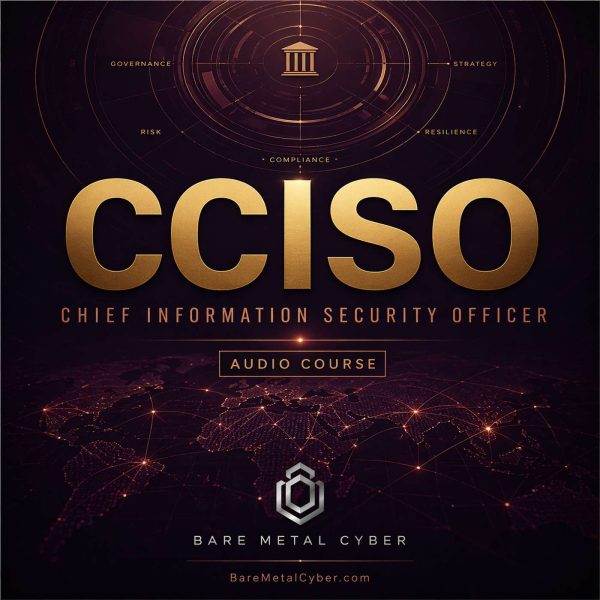
Certified: The CCISO Audio Course
- Folgen
- 71
- Format
- Serie – von Anfang an hören
- Letzte Folge
- 14. Okt. 2025
Über den Podcast
The Bare Metal Cyber CCISO Audio Course is your complete, executive-level training companion for mastering the Certified Chief Information Security Officer (CCISO) certification. Built for experienced cybersecurity professionals and strategic leaders, this Audio Course delivers over seventy focused episodes covering every domain, concept, and competency area tested on the official EC-Council exam. From governance, risk, and compliance to strategic planning, vendor oversight, and technical control management, each episode provides structured, exam-aligned instruction that bridges theory with real-world leadership practice. Designed for busy executives, this series helps you build fluency across global standards and frameworks, including ISO 27005, NIST Risk Management Framework (RMF), Factor Analysis of Information Risk (FAIR), and TOGAF enterprise architecture. The CCISO certification is a globally recognized credential that validates both technical expertise and executive acumen in managing enterprise-wide security programs. It focuses on the leadership-level skills required to align cybersecurity strategy with organizational goals—covering domains such as governance and policy, risk management, program development, incident response, and financial oversight. Earning the CCISO demonstrates your ability to lead mature security operations, communicate effectively with boards and stakeholders, and balance strategic, operational, and compliance priorities in high-stakes environments. Developed by BareMetalCyber.com, the CCISO Audio Course offers practical insights, structured learning, and exam-focused clarity to help you prepare efficiently and think like a security executive. Whether you’re advancing toward a C-suite position or refining your enterprise security leadership skills, this series gives you the knowledge, confidence, and strategic perspective to succeed at the highest level.
Folgen 71
Welcome to the CCISO Certification
Dive into a fast, no-fluff overview of what this podcast delivers, who it’s for, and how each episode helps you level up with practical, real-world takeaways. In this trailer, you’ll hear the show’s promise …
Shownotes
Dive into a fast, no-fluff overview of what this podcast delivers, who it’s for, and how each episode helps you level up with practical, real-world takeaways. In this trailer, you’ll hear the show’s promise, the format you can expect, and a sneak peek at the kinds of stories, tips, and expert insights coming your way. Hit follow to get new episodes as they drop and start listening smarter from day one.
Episode 70: Final Exam Review and Strategy
In this final episode of the prepcast, we shift focus from content to performance. You’ve learned the material—now it's time to master the test. We walk through proven strategies for final review, including how …
Shownotes
In this final episode of the prepcast, we shift focus from content to performance. You’ve learned the material—now it's time to master the test. We walk through proven strategies for final review, including how to prioritize domains, balance study time, and simulate test conditions. You’ll get tips on memory recall, cognitive pacing, and avoiding exam fatigue. We also address last-minute prep tools, time management during the exam, and how to approach difficult or multi-part questions with clarity.
Just as important, we provide mindset guidance for test day—how to manage nerves, trust your preparation, and stay confident under pressure. The CCISO exam is challenging, but it rewards those who think like leaders, connect the dots across domains, and stay focused on business value. This episode is your final briefing before stepping into the exam room. You've built the knowledge—now lead with it.
Ready to start your journey with confidence? Learn more at BareMetalCyber.com.Episode 69: Vendor Risk Oversight and Auditing
Vendor relationships introduce risk far beyond basic performance metrics—and in this episode, we dive into the executive oversight practices required to manage those risks. You’ll learn how to assess …
Shownotes
Vendor relationships introduce risk far beyond basic performance metrics—and in this episode, we dive into the executive oversight practices required to manage those risks. You’ll learn how to assess third-party risk using tiered models, risk questionnaires, and onsite audits. We also discuss how to require evidence of compliance, conduct assessments aligned to frameworks like ISO 27001 or SOC 2, and monitor ongoing vendor health through threat intelligence and financial viability reviews.
We explore how to embed vendor risk into your broader governance strategy and how to integrate third-party risk data into enterprise risk dashboards. For the CCISO exam, expect questions that test your ability to detect, communicate, and act on vendor-related risks. This episode prepares you to lead third-party risk management as an ongoing, programmatic discipline—not just a checkbox during onboarding.
Ready to start your journey with confidence? Learn more at BareMetalCyber.com.Episode 68: Vendor Contracts, SLAs, and Performance Metrics
Securing a vendor is only the beginning—the real work lies in managing performance, risk, and accountability. This episode focuses on the contractual elements that govern third-party relationships, including …
Shownotes
Securing a vendor is only the beginning—the real work lies in managing performance, risk, and accountability. This episode focuses on the contractual elements that govern third-party relationships, including service level agreements (SLAs), key performance indicators (KPIs), penalties for non-compliance, and confidentiality clauses. You’ll learn how to review and negotiate contracts with a security lens, ensuring that your organization's expectations are explicitly documented and enforceable.
We also cover how to monitor vendor performance over time, including periodic reviews, SLA scorecards, and escalation procedures. CISOs must balance operational needs with legal and reputational exposure, especially in heavily outsourced or regulated environments. The CCISO exam frequently includes contract governance scenarios—this episode prepares you to manage vendor relationships proactively and protect the enterprise from hidden dependencies and underperformance.
Ready to start your journey with confidence? Learn more at BareMetalCyber.com.Episode 67: Security Procurement: RFPs, RFIs, and Vendor Selection
Procurement is more than just purchasing tools—it’s a strategic process that shapes your organization's security ecosystem. In this episode, we walk you through the essentials of security procurement, including …
Shownotes
Procurement is more than just purchasing tools—it’s a strategic process that shapes your organization's security ecosystem. In this episode, we walk you through the essentials of security procurement, including how to develop Requests for Proposals (RFPs) and Requests for Information (RFIs), establish evaluation criteria, and conduct vendor due diligence. You’ll learn how to write procurement documents that reflect technical requirements, business needs, and compliance expectations.
We also explore the CISO’s role in managing cross-functional procurement teams, negotiating terms, and aligning procurement with long-term architecture and budget planning. The CCISO exam may include questions related to vendor selection, bid evaluation, or managing third-party engagements—this episode gives you the procedural fluency and strategic lens to oversee the full procurement lifecycle with integrity, rigor, and transparency.
Ready to start your journey with confidence? Learn more at BareMetalCyber.com.Episode 66: ROI and Cost-Benefit Analysis for Security Investments
As cybersecurity budgets grow, so does the need to justify investments with clear, measurable value. In this episode, we explore how CISOs evaluate the return on investment (ROI) of security initiatives …
Shownotes
As cybersecurity budgets grow, so does the need to justify investments with clear, measurable value. In this episode, we explore how CISOs evaluate the return on investment (ROI) of security initiatives, technologies, and services. You’ll learn how to calculate ROI using both quantitative and qualitative factors, including risk reduction, productivity gains, regulatory compliance, and reputational protection. We also walk through real-world examples of how to make the business case for security without relying solely on fear-based messaging.
Cost-benefit analysis goes beyond spreadsheet math—it requires executive judgment, stakeholder communication, and alignment with strategic objectives. We explain how to compare competing investments, use scoring models to rank projects, and frame decisions for the board. The CCISO exam includes scenarios that test your ability to prioritize initiatives, defend spending, and explain the business impact of security efforts. This episode gives you the analytical and communication tools needed to lead with fiscal credibility and strategic focus.
Ready to start your journey with confidence? Learn more at BareMetalCyber.com.Episode 65: Security Budgeting Essentials: Managing and Adjusting Budgets
Security budgeting doesn’t end once funding is approved—CISOs must continuously manage, adjust, and defend their budgets in the face of shifting priorities and evolving threats. In this episode, we explore the …
Shownotes
Security budgeting doesn’t end once funding is approved—CISOs must continuously manage, adjust, and defend their budgets in the face of shifting priorities and evolving threats. In this episode, we explore the fundamentals of dynamic budget management, including tracking expenditures, reallocating resources, and responding to unexpected events such as incidents, audits, or compliance changes. You’ll learn how to build budget flexibility into your planning process and how to engage in mid-year or quarterly budget reviews with clarity and purpose.
We also examine the leadership strategies needed to secure additional funding, justify budget increases, or defend cuts without compromising critical operations. From cost-benefit analysis to scenario planning, this episode prepares you to manage your security financials as a strategic asset. The CCISO exam may test your ability to analyze budget variances, prioritize investments, and present alternatives to executive stakeholders—this episode gives you the language, mindset, and methods to succeed.
Ready to start your journey with confidence? Learn more at BareMetalCyber.com.Episode 64: Financial Management Principles for Security Leaders
Financial fluency is essential for every CISO—and in this episode, we break down the core principles of financial management in the context of enterprise cybersecurity. You’ll learn how to interpret balance …
Shownotes
Financial fluency is essential for every CISO—and in this episode, we break down the core principles of financial management in the context of enterprise cybersecurity. You’ll learn how to interpret balance sheets, manage operational and capital expenditures, and build forecasts that align with multi-year strategic plans. We explain how to calculate total cost of ownership (TCO), return on investment (ROI), and how to present these figures in ways that resonate with CFOs and boards.
Just as importantly, we discuss how financial management intersects with vendor negotiations, contract reviews, and program scalability. As a CCISO, your ability to speak the language of finance builds trust, supports budgeting success, and enables smarter prioritization across competing initiatives. The exam will challenge you to make budget and investment decisions based on business context—this episode equips you with the leadership and financial acumen to do so with confidence.
Ready to start your journey with confidence? Learn more at BareMetalCyber.com.Episode 63: Strategic Security Planning Frameworks (TOGAF, SABSA)
Effective security leaders think in frameworks—and in this episode, we explore two of the most influential planning models for enterprise architecture: TOGAF (The Open Group Architecture Framework) and SABSA …
Shownotes
Effective security leaders think in frameworks—and in this episode, we explore two of the most influential planning models for enterprise architecture: TOGAF (The Open Group Architecture Framework) and SABSA (Sherwood Applied Business Security Architecture). You’ll learn how these frameworks guide long-term security strategy by aligning governance, policy, technology, and risk with enterprise business models. We compare their methodologies, planning layers, and lifecycle phases so you can understand their strengths and applications.
We also examine how to tailor these frameworks to your organization's unique needs, regulatory environment, and maturity level. On the CCISO exam, you may encounter scenarios that test your ability to apply framework-based thinking to problems involving architecture, governance, or cross-functional planning. This episode gives you the vocabulary and insight to lead strategic planning with structure, vision, and executive alignment.
Ready to start your journey with confidence? Learn more at BareMetalCyber.com.Episode 62: Aligning Security with Organizational Objectives
Security is no longer a siloed function—it must be embedded in business strategy. In this episode, we examine how CISOs align cybersecurity initiatives with overarching organizational goals. You’ll learn how to …
Shownotes
Security is no longer a siloed function—it must be embedded in business strategy. In this episode, we examine how CISOs align cybersecurity initiatives with overarching organizational goals. You’ll learn how to interpret business drivers, engage with other executive leaders, and shape security programs that enable growth, agility, and competitive advantage. This includes aligning with priorities like digital transformation, market expansion, regulatory readiness, and stakeholder trust.
We also explore how security teams can shift from being perceived as cost centers to becoming strategic partners that reduce risk while enabling innovation. For the CCISO exam, you’ll need to demonstrate your ability to articulate how specific controls, investments, or policies support broader business outcomes. This episode prepares you to lead with a strategic mindset—one that reflects your dual role as a security guardian and business enabler.
Ready to start your journey with confidence? Learn more at BareMetalCyber.com.Episode 61: Autonomous Security Operations Centers and Future Trends
As security operations evolve, the idea of the autonomous SOC is moving from concept to implementation. In this episode, we explore what defines an autonomous Security Operations Center and how automation, AI …
Shownotes
As security operations evolve, the idea of the autonomous SOC is moving from concept to implementation. In this episode, we explore what defines an autonomous Security Operations Center and how automation, AI, machine learning, and orchestration platforms are converging to reduce human intervention. You’ll learn about the architectural components of next-generation SOCs, including automated threat detection, self-healing systems, and intelligent playbooks for response actions.
From a CCISO perspective, adopting autonomous operations means rethinking staffing models, technology investments, and risk tolerances. We also discuss the future trends reshaping the SOC—like predictive analytics, decentralized security operations, and AI-driven decision-making. The CCISO exam may present forward-looking scenarios that challenge you to assess new technologies strategically. This episode ensures you’re equipped to evaluate innovation through a leadership lens and position your organization at the cutting edge without sacrificing security governance.
Ready to start your journey with confidence? Learn more at BareMetalCyber.com.Episode 60: Emerging Tech in Security: AI and Machine Learning
Artificial intelligence and machine learning are rapidly reshaping the cybersecurity landscape—and CISOs must understand both their potential and their limitations. In this episode, we explore how AI and ML are …
Shownotes
Artificial intelligence and machine learning are rapidly reshaping the cybersecurity landscape—and CISOs must understand both their potential and their limitations. In this episode, we explore how AI and ML are used in security solutions, from behavioral analytics and anomaly detection to automated threat hunting and decision support. You’ll learn how these technologies function, what data they require, and how they improve detection accuracy and response times.
We also tackle the risks of AI misuse, model drift, algorithmic bias, and overreliance on automation. As a CCISO, you must be able to evaluate the trustworthiness of AI-based tools, challenge vendor claims, and ensure alignment with your organization’s risk posture and regulatory obligations. On the exam, expect scenarios that test your ability to strategically adopt and govern emerging technologies. This episode helps you approach AI not just as innovation, but as a risk-aware executive decision.
Ready to start your journey with confidence? Learn more at BareMetalCyber.com.Episode 59: Virtualization Security Overview
Virtualized environments introduce a unique set of security concerns that CISOs must understand and manage. In this episode, we break down how hypervisors, virtual machines, and containers work—and how these …
Shownotes
Virtualized environments introduce a unique set of security concerns that CISOs must understand and manage. In this episode, we break down how hypervisors, virtual machines, and containers work—and how these technologies change the security landscape. You’ll learn about hypervisor attacks, inter-VM threats, virtual network segmentation, and the implications of snapshot management and VM sprawl. We explore how virtualization platforms like VMware, Hyper-V, and KVM must be hardened and monitored.
From an executive perspective, securing virtual environments requires proper configuration management, role-based access, and rigorous patching policies across both host and guest systems. We also discuss virtualization’s role in disaster recovery, cloud migration, and lab environments, emphasizing how these operational benefits must be weighed against potential risks. The CCISO exam expects you to demonstrate fluency in securing virtualized infrastructure as part of a broader enterprise strategy—this episode gets you there.
Ready to start your journey with confidence? Learn more at BareMetalCyber.com.Episode 58: Mobile Device Security Essentials
With mobile devices becoming core tools for business productivity, they also represent a growing attack surface that CISOs must manage. In this episode, we examine the risks posed by smartphones, tablets, and …
Shownotes
With mobile devices becoming core tools for business productivity, they also represent a growing attack surface that CISOs must manage. In this episode, we examine the risks posed by smartphones, tablets, and other portable devices, and the controls needed to secure them. You’ll learn how to implement mobile device management (MDM), containerization, encryption, and remote wipe capabilities. We also explore policies for Bring Your Own Device (BYOD) environments and the use of corporate-owned devices.
Beyond the technical controls, we dive into user behavior, policy enforcement, and endpoint hygiene—all key concerns in mobile security governance. The episode emphasizes the importance of visibility, patching, and telemetry when managing mobile endpoints in highly distributed workforces. Expect the CCISO exam to challenge you with scenarios involving mobile compromise, access violations, and policy gaps—this episode gives you the leadership tools to address each effectively.
Ready to start your journey with confidence? Learn more at BareMetalCyber.com.Episode 57: Physical Security Management
While cybersecurity often dominates the conversation, physical security remains an essential component of any comprehensive security program. In this episode, we explore how physical controls—like access …
Shownotes
While cybersecurity often dominates the conversation, physical security remains an essential component of any comprehensive security program. In this episode, we explore how physical controls—like access badges, surveillance systems, security guards, and biometrics—support the protection of data centers, executive offices, and other sensitive facilities. You'll learn how these controls are selected, monitored, and integrated into enterprise-wide risk assessments.
We also highlight the often-overlooked intersections between physical and logical security—such as preventing unauthorized access to critical hardware, intercepting maintenance activities, and managing third-party contractor access. CISOs must ensure that physical controls are not only in place, but tested, maintained, and audited regularly. This episode prepares you for exam questions that frame physical security as a governance and risk management issue, ensuring you treat it with the strategic weight it deserves.
Ready to start your journey with confidence? Learn more at BareMetalCyber.com.Episode 56: Encryption Principles and Practices
Encryption is a cornerstone of data protection, and in this episode, we break down its role in securing data both at rest and in transit. You’ll learn about the key encryption types—symmetric, asymmetric, and …
Shownotes
Encryption is a cornerstone of data protection, and in this episode, we break down its role in securing data both at rest and in transit. You’ll learn about the key encryption types—symmetric, asymmetric, and hashing—and how each serves a distinct purpose in confidentiality, integrity, and authentication strategies. We explore how encryption is applied across systems, from full-disk encryption and encrypted databases to TLS protocols, encrypted backups, and secure communications.
From a CCISO perspective, implementing encryption isn’t just about deploying the right algorithm—it’s about key management, policy alignment, regulatory compliance, and ensuring usability doesn’t suffer in the process. We also discuss hardware security modules (HSMs), cloud key management systems, and emerging topics like homomorphic encryption and post-quantum cryptography. On the exam, you’ll need to demonstrate both conceptual understanding and executive oversight of encryption strategies across your enterprise.
Ready to start your journey with confidence? Learn more at BareMetalCyber.com.Episode 55: Data Security and Privacy Basics
Data is the crown jewel of most organizations—and protecting it is a central responsibility of the CISO. In this episode, we explore the foundational practices for securing sensitive and regulated data …
Shownotes
Data is the crown jewel of most organizations—and protecting it is a central responsibility of the CISO. In this episode, we explore the foundational practices for securing sensitive and regulated data, including classification, labeling, access controls, encryption, and secure disposal. You’ll learn how to define data handling requirements by type, user role, business function, and compliance regime, whether you’re protecting customer PII, intellectual property, or financial records.
We also examine how data privacy laws—such as GDPR, CCPA, and HIPAA—drive technical and policy decisions around data governance. A CCISO must balance usability and innovation with strict legal requirements, ensuring that privacy is embedded into every aspect of data handling. On the exam, expect questions that challenge your ability to define, enforce, and monitor data security across complex and distributed environments. This episode gives you both the policy and technical fluency to lead data protection with confidence.
Ready to start your journey with confidence? Learn more at BareMetalCyber.com.Episode 54: Cloud Security Fundamentals
As organizations migrate more infrastructure and services to the cloud, CISOs must adapt their strategies to manage risk in cloud environments. This episode introduces the core principles of cloud security …
Shownotes
As organizations migrate more infrastructure and services to the cloud, CISOs must adapt their strategies to manage risk in cloud environments. This episode introduces the core principles of cloud security, including shared responsibility models, identity federation, encryption of data at rest and in transit, and secure API design. You'll learn about common misconfigurations that lead to breaches, and how to implement guardrails using native tools from providers like AWS, Azure, and Google Cloud.
We also explore how to evaluate cloud service providers, define contract security clauses, and align cloud deployments with compliance requirements. Multi-cloud and hybrid cloud architectures introduce added complexity, so the episode also addresses governance strategies that scale across environments. The CCISO exam will require you to demonstrate fluency in cloud risk management and architecture—this episode gives you a solid foundation to support both strategic decisions and day-to-day oversight.
Ready to start your journey with confidence? Learn more at BareMetalCyber.com.Episode 53: Network Security for Executives
Network security remains a foundational element of cybersecurity architecture, even as perimeter boundaries blur in cloud-first and remote-enabled environments. In this episode, we provide a comprehensive …
Shownotes
Network security remains a foundational element of cybersecurity architecture, even as perimeter boundaries blur in cloud-first and remote-enabled environments. In this episode, we provide a comprehensive overview of modern network security strategies, including segmentation, firewall deployment, IDS/IPS, secure tunneling, and zero trust network access (ZTNA). You’ll learn how to assess and design secure architectures that account for both internal and external threats.
We also focus on the executive responsibilities in overseeing network security, such as budget allocation for next-generation firewalls, ensuring alignment with compliance mandates, and integrating network logs into centralized monitoring solutions. The CCISO exam often challenges candidates to prioritize network security investments or respond to architectural weaknesses—this episode ensures you can lead those conversations with a clear view of risk, resilience, and long-term scalability.
Ready to start your journey with confidence? Learn more at BareMetalCyber.com.Episode 52: Endpoint Security Essentials
Endpoints represent one of the largest attack surfaces in modern organizations, making endpoint protection a critical priority. In this episode, we cover the foundational components of endpoint …
Shownotes
Endpoints represent one of the largest attack surfaces in modern organizations, making endpoint protection a critical priority. In this episode, we cover the foundational components of endpoint security—including antivirus, EDR (Endpoint Detection and Response), application whitelisting, configuration hardening, and data loss prevention (DLP). You’ll learn how to approach endpoint protection for traditional workstations, mobile devices, and remote users in a hybrid work environment.
From a CCISO perspective, securing endpoints requires more than just deploying tools—it means creating and enforcing endpoint security baselines, defining acceptable use policies, and coordinating with IT operations for lifecycle management. We also explore the intersection of endpoint security with BYOD (Bring Your Own Device) policies, mobile device management (MDM), and asset inventory practices. The exam may present scenarios involving endpoint compromise, remediation, or policy conflict—this episode prepares you to respond strategically and align controls with enterprise risk tolerance.
Ready to start your journey with confidence? Learn more at BareMetalCyber.com.Episode 51: Best Practices for Access Control
Once you've selected the right access control model, the challenge shifts to enforcing it consistently across systems, users, and environments. In this episode, we walk through best practices for implementing …
Shownotes
Once you've selected the right access control model, the challenge shifts to enforcing it consistently across systems, users, and environments. In this episode, we walk through best practices for implementing, maintaining, and auditing access control systems in complex enterprises. You'll learn how to enforce least privilege, manage role creep, and reduce the risk of unauthorized access through structured provisioning and deprovisioning processes. We also cover the importance of regular access reviews, segregation of duties, and integrating identity data across platforms.
For CCISOs, effective access control is about more than prevention—it’s a foundation for audit readiness, regulatory compliance, and operational stability. We explore how access control practices tie into larger frameworks like Zero Trust, Identity Governance and Administration (IGA), and privileged access management (PAM). The CCISO exam will test your ability to enforce access governance in varied scenarios, so this episode equips you with executive-level insight into how to scale and manage access controls in a secure, sustainable way.
Ready to start your journey with confidence? Learn more at BareMetalCyber.com.Episode 50: Access Control Models Overview
Access control is foundational to every security program, and this episode introduces the core models used to govern who can access what, when, and under what conditions. We examine the primary access control …
Shownotes
Access control is foundational to every security program, and this episode introduces the core models used to govern who can access what, when, and under what conditions. We examine the primary access control models—Discretionary Access Control (DAC), Mandatory Access Control (MAC), Role-Based Access Control (RBAC), Attribute-Based Access Control (ABAC), and Rule-Based Access Control—and explain where each is most effectively applied in the enterprise. You’ll learn how these models impact system design, auditability, and compliance outcomes.
For CISOs, selecting and implementing the right access model is about more than just security—it’s about usability, scalability, and policy alignment. This episode also discusses how access control ties into identity governance, privilege management, and zero trust principles. The CCISO exam may test your ability to evaluate model selection scenarios or address complex access requirements in a dynamic organization. With this episode, you’ll gain the executive-level understanding needed to make strategic decisions about identity and access governance.
Ready to start your journey with confidence? Learn more at BareMetalCyber.com.Episode 49: Advanced Threat Hunting Concepts
Building on the previous episode, we now explore more advanced threat hunting concepts that CISOs must understand to support elite detection capabilities. You'll learn how mature organizations move beyond …
Shownotes
Building on the previous episode, we now explore more advanced threat hunting concepts that CISOs must understand to support elite detection capabilities. You'll learn how mature organizations move beyond one-off hunts to establish sustained, repeatable hunting programs with custom detection logic, automation pipelines, and continuous telemetry tuning. We explore how machine learning, behavior analytics, and advanced data correlation help threat hunters discover stealthy, long-dwell threats that evade traditional defenses.
From an executive standpoint, we examine how to measure the effectiveness of threat hunting teams, align hunts with threat modeling outcomes, and justify the investment to boards or budget committees. Advanced hunting programs often uncover systemic weaknesses in infrastructure or policy—making CISO-level oversight essential. This episode prepares you to lead advanced detection initiatives, ensure ROI on hunting investments, and respond strategically to the findings that emerge.
Ready to start your journey with confidence? Learn more at BareMetalCyber.com.Episode 48: Threat Hunting Basics for Executives
Threat hunting goes beyond traditional alert-driven detection by proactively searching for indicators of compromise within the environment. In this episode, we explore what threat hunting is, why it's becoming …
Shownotes
Threat hunting goes beyond traditional alert-driven detection by proactively searching for indicators of compromise within the environment. In this episode, we explore what threat hunting is, why it's becoming a critical capability, and how CISOs support and guide hunting programs. You’ll learn about the use of hypotheses, the importance of telemetry visibility, and how analysts use hunting frameworks like MITRE ATT&CK to identify suspicious behaviors before they trigger alarms.
We also discuss the executive considerations of launching and maintaining a threat hunting function, including resourcing, tooling, and cross-team collaboration. A CISO doesn’t need to perform the hunts—but they do need to understand their value, how results are measured, and how they feed into larger security initiatives. On the exam, you may encounter scenario-based questions that test your grasp of threat hunting maturity and investment decisions—this episode ensures you're ready to lead from the top.
Ready to start your journey with confidence? Learn more at BareMetalCyber.com.Episode 46: Vulnerability Management Essentials
Vulnerability management is the process of identifying, evaluating, and remediating weaknesses in systems, applications, and configurations before they can be exploited. In this episode, we break down the key …
Shownotes
Vulnerability management is the process of identifying, evaluating, and remediating weaknesses in systems, applications, and configurations before they can be exploited. In this episode, we break down the key stages of an effective vulnerability management program, from scanning and prioritization to patching and verification. You’ll learn how to classify vulnerabilities using CVSS scores and how to factor in business context, asset value, and exposure when determining which issues to address first.
From a leadership perspective, we explore how CISOs integrate vulnerability management into broader risk frameworks, governance models, and reporting cycles. You’ll hear strategies for managing patch cycles, avoiding disruption to business-critical systems, and communicating vulnerability trends to executive stakeholders. The CCISO exam expects you to understand not just how vulnerabilities are discovered, but how their remediation is prioritized and tracked at the enterprise level. This episode ensures you can lead a mature, defensible vulnerability program from end to end.
Ready to start your journey with confidence? Learn more at BareMetalCyber.com.Episode 45: Leveraging SIEM Solutions Strategically
Security Information and Event Management (SIEM) platforms are powerful tools for correlation, alerting, and visibility—but they can also become operational burdens if poorly managed. In this episode, we …
Shownotes
Security Information and Event Management (SIEM) platforms are powerful tools for correlation, alerting, and visibility—but they can also become operational burdens if poorly managed. In this episode, we explore how CISOs select, configure, and govern SIEM solutions to drive meaningful insights without overwhelming analysts. You'll learn what data sources matter most, how to define useful correlation rules, and how to balance retention policies with performance and cost concerns.
We also dive into the strategic role of SIEMs in compliance reporting, incident detection, and executive dashboards. SIEMs are more than just technical platforms—they’re decision support systems. This episode teaches you how to ensure your SIEM implementation is aligned with business goals, regulatory expectations, and the needs of both technical staff and executive leadership. For the CCISO exam, expect scenario-based questions that probe your ability to prioritize use cases, evaluate outputs, and oversee SIEM strategy holistically.
Ready to start your journey with confidence? Learn more at BareMetalCyber.com.Episode 44: Security Operations Center (SOC) Basics
The Security Operations Center, or SOC, is the front line of defense against cyber threats. In this episode, we explain how SOCs operate, what core functions they perform, and how they fit into an enterprise …
Shownotes
The Security Operations Center, or SOC, is the front line of defense against cyber threats. In this episode, we explain how SOCs operate, what core functions they perform, and how they fit into an enterprise security architecture. You’ll learn about SOC tiers, key analyst roles, common tools such as SIEMs, SOAR platforms, and EDR systems, and how SOCs manage threat detection, alert triage, and incident escalation. Whether the SOC is internal, outsourced, or hybrid, CISOs must understand how it operates and how to measure its performance.
We also explore how to build or optimize a SOC from the executive level—including staffing strategies, shift models, threat intelligence integration, and metrics such as mean time to detect (MTTD) and mean time to respond (MTTR). For the CCISO exam, you’ll need to understand SOC operations not as a technician, but as a leader accountable for its success. This episode helps you bridge that gap, preparing you to oversee SOCs that align with both operational realities and enterprise risk goals.
Ready to start your journey with confidence? Learn more at BareMetalCyber.com.Episode 43: Disaster Recovery Strategy Essentials
Disaster recovery (DR) is the technical counterpart to business continuity—and this episode explores how CISOs ensure the restoration of systems, services, and data after catastrophic disruptions. You’ll learn …
Shownotes
Disaster recovery (DR) is the technical counterpart to business continuity—and this episode explores how CISOs ensure the restoration of systems, services, and data after catastrophic disruptions. You’ll learn about the core elements of DR planning, including backup strategies, failover procedures, DR site selection, data replication models, and system recovery sequencing. We explain how DR plans are tested, validated, and maintained over time to ensure readiness in real-world conditions.
Just as important is the leadership role a CISO plays in defining DR policy, securing budget for recovery infrastructure, and aligning recovery goals with business risk appetite. The CCISO exam includes scenarios that blend DR, continuity, and crisis communication into a single narrative. This episode prepares you to make informed executive decisions about recovery priorities, tradeoffs, and resource allocation—ensuring you can guide your organization from chaos to stability with a structured and strategic approach.
Ready to start your journey with confidence? Learn more at BareMetalCyber.com.Episode 42: Business Continuity Planning Fundamentals
Business continuity planning (BCP) ensures that critical operations can continue even in the face of major disruptions—and CISOs play a central role in shaping those plans. In this episode, we break down the …
Shownotes
Business continuity planning (BCP) ensures that critical operations can continue even in the face of major disruptions—and CISOs play a central role in shaping those plans. In this episode, we break down the key components of a business continuity strategy, including business impact analysis (BIA), recovery objectives (RTOs and RPOs), critical systems identification, and continuity playbooks. You’ll learn how to define recovery priorities that are both risk-informed and business-aligned.
We also explore how CISOs coordinate with other departments—such as operations, finance, and facilities—to build cross-functional continuity frameworks that go beyond IT disaster recovery. The CCISO exam will assess your ability to lead or support continuity planning that reflects executive concerns like revenue preservation, customer trust, and regulatory compliance. This episode gives you the tools to design, implement, and maintain a continuity program that keeps the organization operational during its most vulnerable moments.
Ready to start your journey with confidence? Learn more at BareMetalCyber.com.
Hier stehen die neuesten 60 von 71 Folgen. Ältere Folgen findest du im Feed des Podcasts.
Empfohlen von Certified: The CCISO Audio Course


Ähnliche Podcasts
Mehr Bildung-Podcasts







Ist das dein Podcast?
Bestätige es mit einem Eintrag in deinem Feed: Du bekommst hier einen Code, trägst ihn als podcast:txt in den Kanal deines Feeds ein, und wir prüfen ihn. Danach steht dein Podcast als „verifiziert“ bei SoundNode.