

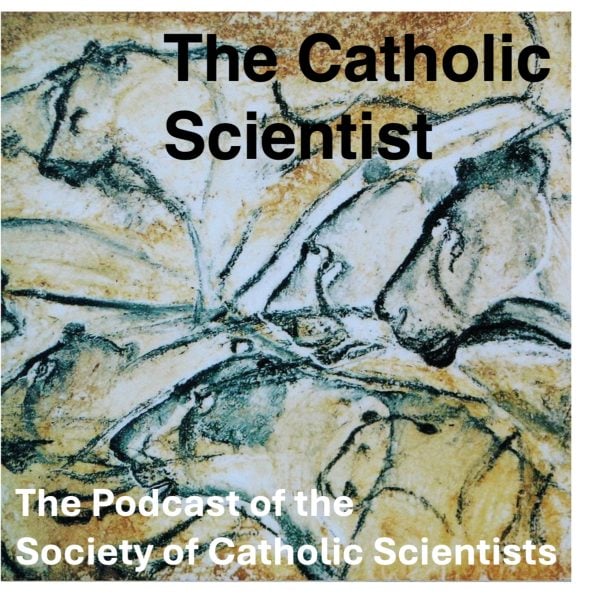
The Catholic Scientist
- Folgen
- 26
- Erscheint
- monatlich
- Letzte Folge
- 24. Nov. 2026
Über den Podcast
The show explores important questions concerning the relationship between science and the Catholic faith. These include such topics as evolution, cosmology, neuroscience, quantum physics, and free will. The show also highlights the work of leading Catholic scientists as well as their reflections on how they integrate the worlds of science and religion in their life's work.
Folgen 26
Episode 26: Stephen Barr, Quantum Physics and Free Will, Part 1
In the first episode of a two-part podcast, Dr. Stephen Barr, the President of the Society of Catholic Scientists and author of Modern Physics and Ancient Faith, discusses the science of quantum physics and how …
Shownotes
In the first episode of a two-part podcast, Dr. Stephen Barr, the President of the Society of Catholic Scientists and author of Modern Physics and Ancient Faith, discusses the science of quantum physics and how it revolutionized our understanding of the material world. He discusses the key difference between Newtonian physics and quantum physics and delves into the many weird and unexpected aspects of quantum physics. This overview sets up the second episode in which he discusses the philosophical implications of quantum physics for our understanding of free will and whether or not matter is all that exists.
Episode 25: Anthony Ichiro Sanda, Integrating Science and Faith in Japan
Anthony Ichiro Sanda, a theoretical particle physicist who received the American Physical Society’s Sakurai prize in 2004,joins the podcast to discuss his work in physics and his journey to becoming a leading …
Shownotes
Anthony Ichiro Sanda, a theoretical particle physicist who received the American Physical Society’s Sakurai prize in 2004,joins the podcast to discuss his work in physics and his journey to becoming a leading voice for the integration of faith and science in Japan. Dr. Sanda has not only won numerous scientific awards in the U.S. and Japan for his contributions to fundamental physics, he has also written and spoken extensively in Japan on the relation of science and the Catholic faith, including writing a book in Japanese entitled “As a Scientist, Why Do I Believe in God?” He was ordained as a permanent deacon in the Diocese of Nagoya in May 2006, and was transferred to the Archdiocese of Tokyo in April 2011.
Episode 24: Po-Shen Loh, Teaching Math and Creativity in the Age of AI
Po-Shen Loh, Professor of Mathematics at Carnegie Mellon University and social entrepreneur, joins the podcast to discuss how humans can thrive in the age of AI. He examines what hecalls Thought-Full education …
Shownotes
Po-Shen Loh, Professor of Mathematics at Carnegie Mellon University and social entrepreneur, joins the podcast to discuss how humans can thrive in the age of AI. He examines what hecalls Thought-Full education, which focuses on developing the unique feature of human intelligence: love for humanity. He gives examples of how best to use AI to assist human directed work and he discusses his efforts to foster collaborative problem-solving math education with young students across the country. More on his work and his upcoming speaking engagements can be found at https://poshenloh.com/.
Episode 23: Taylor Black, The AI Revolution and the Reshaping of Human Society
Taylor Black, director of AI & Venture Ecosystems in the Office of the Chief Technology Officer at Microsoft and founding director of Catholic University of America’s Leonum Institute joins the podcast to …
Shownotes
Taylor Black, director of AI & Venture Ecosystems in the Office of the Chief Technology Officer at Microsoft and founding director of Catholic University of America’s Leonum Institute joins the podcast to discuss the on-going AI revolution. Taylor discusses his journey from a philosophy and classics major as an undergraduate to law school to becoming a leader in the high-tech arena. Taylor explains the goals of CUA’s Leonum Institute, a research and venture creation hub focused on advancing human‑centered AI and emerging technologies through the lens of Catholic humanism. The podcast also delves into the promises, pitfalls, and limitations of AI. In addition, Taylor shares his views on how AI will change the future of work and how this could lead to more opportunities for human flourishing.
Episode 22: Sr. Cevallos and Fr. Davenport, Science and Faith and Dominican Vocations
In this episode of the podcast Sr. Albertine Cevallos and Fr. Thomas Davenport join the show to discuss their journey from science majors at Caltech to vocations in the Dominican order. Sister Albertine is a …
Shownotes
In this episode of the podcast Sr. Albertine Cevallos and Fr. Thomas Davenport join the show to discuss their journey from science majors at Caltech to vocations in the Dominican order. Sister Albertine is a Dominican sister of St. Cecilia who currently teaches high school science in Maryland. She discusses her time at Caltech, where she met Christians who witnessed to their faith by their joy and goodness. This ultimately led to her reversion to the Catholic faith and a calling to the Dominican sisters of St. Cecilia. Fr. Davenport, O.P., an American Dominican, physicist, and philosopher, discusses his time as an undergraduate at Caltech and his time at Stanford where he earned a Ph.D. in theoretical particle physics and was simultaneously drawn to a vocation with the Dominicans. Both Sr. Albertine and Fr. Davenport discuss the many ways they now combine science and faith in their vocations.
Episode 21: Nuno Castel-Branco, Nicolas Steno-The Traveling Anatomist
Dr. Nuno Castel-Branco is a historian of science, culture, and religion with a focus on early modern Europe. Currently he is a research fellow of All Souls College at the University of Oxford. In this episode …
Shownotes
Dr. Nuno Castel-Branco is a historian of science, culture, and religion with a focus on early modern Europe. Currently he is a research fellow of All Souls College at the University of Oxford. In this episode, Dr. Castel-Branco discusses his new book on the life and work of Blessed Nicolas Steno, The Traveling Anatomist Nicolaus Steno and the Intersection of Disciplines in Early Modern Science (Univ of Chicago Press). Steno is considered the founder of modern geology and Dr. Castel-Branco discusses his training in medicine and his early work in anatomy as well as his travels throughout Europe. Dr. Castel-Branco talks about the nature of Steno’s conversion to the Catholic faith and his continued interest in science following that conversion. Steno’s importance in helping foster the development of scientific networks in Christian Europe during the 17th century is also examined in this discussion. In addition to his academic work, Dr. Castel-Branco also maintains a substack called Stories of Science that examines the history of science for a popular audience.
Episode 20: Bob Scherrer, How Will the Universe End?
Robert Scherrer, a Professor of Physics and Astronomy at Vanderbilt University and an SCS Board member, discusses what the standard cosmological model suggests regarding the future of our universe. Will it end …
Shownotes
Robert Scherrer, a Professor of Physics and Astronomy at Vanderbilt University and an SCS Board member, discusses what the standard cosmological model suggests regarding the future of our universe. Will it end with a bang or a whimper? He discusses the on-going search to detect dark matter and dark energy and the role they both play in the evolution of theuniverse. His research work focuses on cosmology, encompassing dark energy, dark matter, big bang nucleosynthesis, and the large-scale structure of the universe. He is also the author of a quantum mechanics textbook and haspublished several popular science articles and science fiction short stories. He also maintains a blog on science and science fiction.
Episode 19: Andrew Sodergren, A Catholic Approach to Gender Dysphoria
Dr. Sodergren, a practicing psychologist at Ruah Woods Psychological Services in Cincinnati, delivers a talk entitled “Integrating Body and Soul: Principles for a Catholic Approach to Gender Dysphoria.” Dr …
Shownotes
Dr. Sodergren, a practicing psychologist at Ruah Woods Psychological Services in Cincinnati, delivers a talk entitled “Integrating Body and Soul: Principles for a Catholic Approach to Gender Dysphoria.” Dr. Sodergren is an active member of the Catholic Psychotherapy Association and is a frequent speaker for professional and lay audiences on topics involving the integration of psychology and the Catholic faith. In 2022, Dr.Sodergren contributed a chapter on the “Psychology of the Sexual Difference” to the book Sexual Identity: The Harmony of Philosophy, Science,and Revelation published by the St. Paul Center. In this talk, he discusses the data behind the recent increase in gender dysphoria cases and how Catholic psychologists can best help individuals with gender dysphoria.
Episode 18: Matthew Ramage, The Theology of Pope Benedict on Creation
Dr. Matthew Ramage, a Professor of Theology at Benedictine College and a Scholar Associate of SCS, is the guest on this episode of The Catholic Scientist. Dr. Ramage discusses his research and writing on the …
Shownotes
Dr. Matthew Ramage, a Professor of Theology at Benedictine College and a Scholar Associate of SCS, is the guest on this episode of The Catholic Scientist. Dr. Ramage discusses his research and writing on the theology of Joseph Ratzinger/Pope Benedict XVI, with a particular focus on the dialogue between faith and science. He discusses his latest book, The Essential Guide to Ratzinger: The Man and His Message (OSV Press), as well as how he got interested in the intersection between science and Catholic theology. He also describes his latest project, The Two Books Network, which he hopes to be a resource hub for those interested in engaging creation from the heart of the Church.
Further information on the Society of Catholic Scientists and the work it does can be found here. https://catholicscientists.org/
Episode 17: Laura Upenieks, Factors that Shape Views on Science and Faith
Dr. Laura Upenieks, an Associate Professor of Sociology at Baylor University discusses her work investigating the intersection of religious belief, religious practice, and attitudes toward science. In …
Shownotes
Dr. Laura Upenieks, an Associate Professor of Sociology at Baylor University discusses her work investigating the intersection of religious belief, religious practice, and attitudes toward science. In particular, she delves into the factors that shape how young people view matters of faith and science. She discusses how the level of perceived conflict is related to the level of trust individuals have in both scientists and religious leaders. With trust in authority continuing to erode throughout society in general, she offers possible ways to approach young people to build the connections that are necessary to help them better integrate faith and science.
Further information on the Society of Catholic Scientists and the work it does can be found here. https://catholicscientists.org/
Episode 16: Stephen Barr, Creation and the Big Bang
Dr. Stephen Barr, the President of the Society of Catholic Scientists and author of Modern Physics and Ancient Faith, discusses the relationship between the Catholic understanding of Creation and the science …
Shownotes
Dr. Stephen Barr, the President of the Society of Catholic Scientists and author of Modern Physics and Ancient Faith, discusses the relationship between the Catholic understanding of Creation and the science regarding the Big Bang. Is the Big Bang “proof” of the Catholic dogma of Creation? Is the Big Bang the beginning of the material universe? What is the relationship between Creation and the origins of the universe? Did the universe actually have a beginning in time? Dr. …Episode 15: Peter Kilpatrick, Faith and Science in Catholic Higher Education
Dr. Peter Kilpatrick, President of the Catholic University of America (CUA), discusses the unique role that Catholic institutions have in the landscape of higher education as well as how CUA in looking to …
Shownotes
Dr. Peter Kilpatrick, President of the Catholic University of America (CUA), discusses the unique role that Catholic institutions have in the landscape of higher education as well as how CUA in looking to fulfill that role. Toward this end, he discusses recent initiatives launched at the Catholic University of America around science and faith including one on artificial intelligence. Dr. Kilpatrick also shares his professional and personal journey that led him to eventually being named the 16th president in CUA’s history.
Episode 14: Maureen Condic, Human Embryos-When Does Life Begin?
Dr. Maureen Condic discusses the question of when human life begins and the arguments regarding the moral status of the human embryo. She also examines the state of current research on human embryos as well as …
Shownotes
Dr. Maureen Condic discusses the question of when human life begins and the arguments regarding the moral status of the human embryo. She also examines the state of current research on human embryos as well as ethical alternatives to embryo destructive research. Dr. Condic is currently the Ombudsman and Mediator for the Catholic University of America. …Episode 13, Chris Baglow, Extraterrestrial Intelligent Life- A Catholic Response
What is the likelihood that intelligent life exists somewhere else in the Universe? What would the existence of intelligent extraterrestrial life mean for the Catholic understanding that Christ is the means of …
Shownotes
What is the likelihood that intelligent life exists somewhere else in the Universe? What would the existence of intelligent extraterrestrial life mean for the Catholic understanding that Christ is the means of Salvation? Would the existence of life elsewhere in the Universe undermine man’s special relationship to the Creator? Dr. …Episode 12: Stephen Barr, What Will Our Bodies Be Like In Heaven?
Dr. Stephen Barr, the President of the Society of Catholic Scientists and author of Modern Physics and Ancient Faith, speculates on what our bodies will be like in heaven. Wouldphysical bodies that resemble our …
Shownotes
Dr. Stephen Barr, the President of the Society of Catholic Scientists and author of Modern Physics and Ancient Faith, speculates on what our bodies will be like in heaven. Wouldphysical bodies that resemble our current bodies in structure and function even be possible in the eternal realm of heaven? Reflecting on numerous Scriptural passages, the writings of Pope Benedict XVI, as well as what we know about death and decay in the physical world, Dr. …Episode 11: Sofia Carozza, Integrating Neuroscience and Faith
Dr. Sofia Carozza discusses the promises and pitfalls of integrating neuroscience and faith during a talk she delivered at the Society of Catholic Scientists’ 2023 annual meeting. Dr. Carozza has a Ph.D. in …
Shownotes
Dr. Sofia Carozza discusses the promises and pitfalls of integrating neuroscience and faith during a talk she delivered at the Society of Catholic Scientists’ 2023 annual meeting. Dr. Carozza has a Ph.D. in Cognition and Brain Science from the University of Cambridge and is currently working on her M.D. at the University of Chicago Pritzker School of Medicine. In this talk, she discusses the neuroplasticity of the brain and how it can respond to changes in our behavior over time. …Episode 10: Daniel Kuebler, Darwin and Doctrine
Dr. Daniel Kuebler, a Professor of Biology at Franciscan University, talks about his recent book, Darwin and Doctrine: The Compatibility of Evolution and Catholicism, which was published by Word on Fire Press …
Shownotes
Dr. Daniel Kuebler, a Professor of Biology at Franciscan University, talks about his recent book, Darwin and Doctrine: The Compatibility of Evolution and Catholicism, which was published by Word on Fire Press. He and Dr. Stephen Barr discuss the order that undergirds the evolutionary process, the similarities between evolutionary history and Salvation history, and how best to understand the origin of man in light of both modern science and Catholic teaching. Dr. …Episode 9: David Chiang, What Large Language Models Can or Can't Do
Dr. David Chiang, an Associate Professor in the Department of Computer Science and Engineering at the University of Notre Dame, discusses what large language models (LLMs) can or can’t do in a presentation at …
Shownotes
Dr. David Chiang, an Associate Professor in the Department of Computer Science and Engineering at the University of Notre Dame, discusses what large language models (LLMs) can or can’t do in a presentation at the 2024 Society of Catholic Scientists annual meeting. Dr. Chiang’s research is in natural language processing, the subfield of computer science that aims to enable computers to understand and produce human language. …Episode 8: Martin Nowak, Does Evolution Lead to God?
Dr. Nowak, a Professor of Biology and Mathematics at Harvard University, discusses his thoughts on evolution and particularly the role of cooperation in the evolutionary process. He examines how evolution is …
Shownotes
Dr. Nowak, a Professor of Biology and Mathematics at Harvard University, discusses his thoughts on evolution and particularly the role of cooperation in the evolutionary process. He examines how evolution is both ordered and mathematical, which points toward the existence of a rational God who stands behind the evolutionary process. Dr. …Episode 7: Martin Nowak, Does Mathematics Lead to God?
Dr. Nowak, a Professor of Biology and Mathematics at Harvard University, discusses his thoughts on the nature of mathematics as the language of science. He examines how the truths of mathematics point to the …
Shownotes
Dr. Nowak, a Professor of Biology and Mathematics at Harvard University, discusses his thoughts on the nature of mathematics as the language of science. He examines how the truths of mathematics point to the existence of immaterial realities and how mathematics reflects the mind of God. Dr. Nowak's research focuses on the mathematical description of evolutionary processes, including the evolution of cooperation and human language, as well as the dynamics of virus infections and human cancer. …Episode 6: Steve Barr, A Brief History of the Catholic Church and Science
Dr. Stephen Barr, the President of the Society of Catholic Scientists and author of Modern Physics and Ancient Faith, discusses the history of the interaction between science and Christianity in the West. In …
Shownotes
Dr. Stephen Barr, the President of the Society of Catholic Scientists and author of Modern Physics and Ancient Faith, discusses the history of the interaction between science and Christianity in the West. In particular, he discusses how the Catholic Church fostered the growth of science from the Middle Ages onward as well as how the myth of conflict between the Catholic Church and science arose. \Further information on the Society and the work it does can be found here. …Episode 5: Kenneth Kemp, Human Origins and Humani generis
Dr. Kenneth Kemp, an emeritus professor of philosophy at the University of St. Thomas, discusses human evolution in light of the first Papal encyclical to discuss human evolution, Humani generis. He also gives …
Shownotes
Dr. Kenneth Kemp, an emeritus professor of philosophy at the University of St. Thomas, discusses human evolution in light of the first Papal encyclical to discuss human evolution, Humani generis. He also gives an overview of his most recent book, The Origins of Catholic Evolutionism, 1831–1950 (CUA Press), which details how the Church engaged with evolutionary thought in the 19th and early 20th century.
Episode 4: Jonathan Lunine Part 2, Life Beyond Earth
In the second of two episodes, Dr. Jonathan Lunine, Chief Scientist at NASA's Jet Propulsion Laboratory, discusses the possibility of life existing elsewhere in the solar system and how scientists are able to …
Shownotes
In the second of two episodes, Dr. Jonathan Lunine, Chief Scientist at NASA's Jet Propulsion Laboratory, discusses the possibility of life existing elsewhere in the solar system and how scientists are able to get data from various NASA missions to address this question. Dr. Lunine is a member of the NationalAcademy of Sciences and is one of the founding board members of the Society of Catholic Scientists.
Episode 3: Jonathan Lunine Part 1, Planetary Science
Dr. Jonathan Lunine, Chief Scientist at NASA's Jet Propulsion Laboratory, discusses his career in planetary science as well as his faith journey as a scientist. He is a member of the National Academy of …
Shownotes
Dr. Jonathan Lunine, Chief Scientist at NASA's Jet Propulsion Laboratory, discusses his career in planetary science as well as his faith journey as a scientist. He is a member of the National Academy of Sciences and is one of the founding board members of the Society of Catholic Scientists.
Episode 2: Ross Douthat- Believe, Why Everyone Should Be Religious
In this episode we bring you a talk Ross Douthat delivered at the Society of Catholic Scientists' 2025 Annual Conference. In the talk, Douthat discusses his latest book, Believe: Why Everyone Should Be …
Shownotes
In this episode we bring you a talk Ross Douthat delivered at the Society of Catholic Scientists' 2025 Annual Conference. In the talk, Douthat discusses his latest book, Believe: Why Everyone Should Be Religious (Zondervan), and the arguments for why our experience of reality is more parsimoniously explained from a theist perspective than from an atheistic or materialistic perspective. …Episode 1: The Origin and Purpose of SCS
Dr. Stephen Barr shares the story behind the foundation of the Society of Catholic Scientists. Dr. Barr, the President of the Society of Catholic Scientists, discusses how he became interested in the …
Shownotes
Dr. Stephen Barr shares the story behind the foundation of the Society of Catholic Scientists. Dr. Barr, the President of the Society of Catholic Scientists, discusses how he became interested in the relationship between science and the Catholic faith and why he felt compelled to work with other Catholic scientists to launch the Society in 2016. Further information on the Society and the work it does can be found here. https://catholicscientists.org/ If you are interested in Dr. …
Ähnliche Podcasts
Mehr Wissenschaft-Podcasts


Ist das dein Podcast?
Bestätige es mit einem Eintrag in deinem Feed: Du bekommst hier einen Code, trägst ihn als podcast:txt in den Kanal deines Feeds ein, und wir prüfen ihn. Danach steht dein Podcast als „verifiziert“ bei SoundNode.