

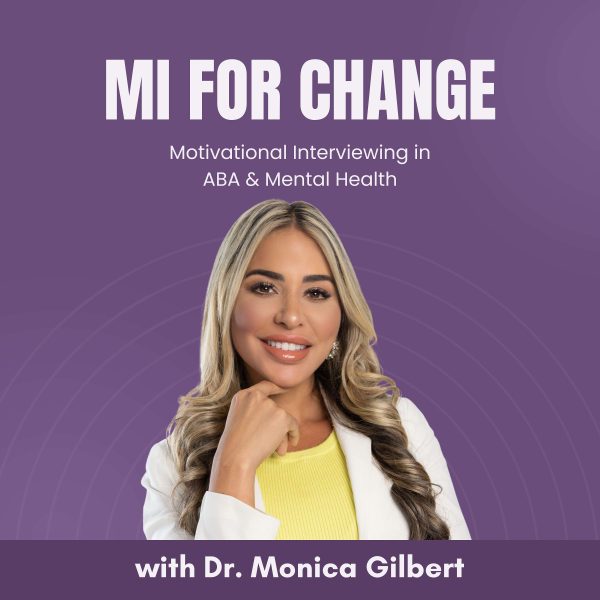
MI for Change: Motivational Interviewing in ABA & Mental Health
- Episódios
- 61
- Publicação
- semanal
- Último episódio
- 10 nov 2026
Sobre o podcast
MI for Change is the podcast dedicated to exploring Motivational Interviewing (MI) in behavior analysis and mental health. Hosted by Dr. Monica Gilbert, a Board Certified Behavior Analyst and Licensed Psychologist, this show helps professionals transform client conversations — one question at a time.
Each episode delivers:
✨ Practical MI strategies you can apply immediately in sessions
✨ Real case examples that bring concepts to life
✨ Inspiring interviews with experts across ABA and mental health
Whether you’re an ABA practitioner, therapist, counselor, or student, you’ll discover how simple shifts in communication can reduce resistance, strengthen rapport, and spark lasting change.
Because parent coaching and client conversations don’t have to feel like a struggle — they can be the spark that makes transformation possible.
Subscribe today and join the journey to becoming a more effective, confident, and client-centered communicator.
This is MI for Change.
Participantes
Episódios 61
How to Structure a One-on-One ABA Parent Training Session: A Practical Framework for BCBAs
Share Your Thoughts With UsYou ask: do you have any questions?Parent says: no, not really.You ask: is there anything you’d like to work on?Parent says: nothing I can think of.And now you have 40 minutes left …
Notas do episódio
You ask: do you have any questions?
Parent says: no, not really.
You ask: is there anything you’d like to work on?
Parent says: nothing I can think of.
And now you have 40 minutes left and you’re starting to explain reinforcement again.If you’ve been there — and most BCBAs have — this episode is for you.
Dr. Monica Gilbert names something the field doesn’t say out loud: parent training sessions are awkward. Not because BCBAs aren’t skilled. But because nobody ever gave them a structure for what that hour is actually supposed to look like.
In this episode she walks through exactly why one-on-one parent training sessions go flat — three specific reasons, not one of which is “you’re just not good at this” — and introduces a practical framework for a 60-minute session that creates meaningful collaboration instead of one-sided teaching.
She also challenges a habit almost every BCBA has: opening with “do you have any questions?” And explains why that question, however well-intentioned, puts all the responsibility on the parent to know what they need.
This one is practical. You can use it in your next session.
Learn more about Motivational Interviewing and explore on-demand courses at www.drmonicagilbert.com
Join the MI Academy for practical training and resources — and enjoy an exclusive 15% off with code MIFORCHANGE at checkout.
📲 Connect with me on Instagram: @drmonicagilbert
You’ve Heard About the Ruler Method — Here’s What It Actually Sounds Like
Share Your Thoughts With UsYou’ve Heard About the Ruler Method — Here’s What It Actually Sounds LikeThis episode is different from every other episode of MI For Change.Monica demonstrates MI live. No script. On …
Notas do episódio
You’ve Heard About the Ruler Method — Here’s What It Actually Sounds Like
This episode is different from every other episode of MI For Change.
Monica demonstrates MI live. No script. On a real person with a real behavior goal. Then she breaks down exactly what she did and why.
Guest: Daniela Galvez Moreno
BCBA since 2015. Co-founder of In Vivo CE — a platform creating virtual conferences for behavior analysts on niche, specific topics. Host of Self Said Go, a conference focused on behavior analysis, personal development, and the multi-passionate BCBA. Daniela left a clinical role in 2023 to travel the world solo for four months before getting married — and came back to build something completely different in the field.
What you’ll hear:
- How In Vivo CE was born — from Self Said Go to 11 virtual conferences in year one, with 14 planned for next year
- The “Day Four” concept: day one through three you’re doing great. Day four your son doesn’t sleep, a client cancels, and everything falls apart. Why systems that work for everything else don’t automatically protect your new behaviors
- Why BCBAs create systems for every clinical problem but almost never create a system for parent conversations — and what happens when you do
- The behavioral science behind avoidance: immediate vs. delayed reinforcement, why waiting to feel ready is its own kind of avoidance trap
- Ambivalence applied to the BCBA: wanting to do it and not wanting to at the same time — and how MI helps tilt that scale
- The live role play — Monica uses MI on Danny around the behavior of working out more consistently. Ruler Method, open questions, reflections, evoking the solution from the person rather than offering it
- The full clinical debrief: every technique named, every decision explained
- BCBA burnout as a pattern of serving others before self — and what gets in the way of asking for help
- Danny’s closing tips: ask the right questions for yourself, not just your clients; get rid of black-and-white thinking; 1% is better than 0%
Learn more about Motivational Interviewing and explore on-demand courses at www.drmonicagilbert.com
Join the MI Academy for practical training and resources — and enjoy an exclusive 15% off with code MIFORCHANGE at checkout.
📲 Connect with me on Instagram: @drmonicagilbert
When a Good MI Question Doesn’t Land — The Assumption You Didn’t Know You Were Making
Share Your Thoughts With UsYou asked a really good open-ended question. You know your OARS. You know the processes. You’ve practiced. And the parent looked at you like you were speaking a completely different …
Notas do episódio
You asked a really good open-ended question. You know your OARS. You know the processes. You’ve practiced. And the parent looked at you like you were speaking a completely different language.
In this episode Dr. Monica Gilbert gets personal about something she doesn’t often share: she was sent to Cuba at 13 years old, and even as a Cuban-born, bilingual clinician, it was a complete culture shock. Because having a cultural connection to a place doesn’t automatically mean you understand every experience within that culture. And the same is true in every parent session — whether the family’s background feels familiar or completely foreign.
The insight at the center of this episode: sometimes when an MI question doesn’t land, the problem isn’t your question. It’s the assumption underneath it. And cultural responsiveness isn’t about knowing everything about a family’s background. It’s about staying curious enough to recognize that your way of seeing the world isn’t the only way.
Monica also makes one of the most practical points in the series: if grandma is the one who actually implements the plan at home and you haven’t included her, the best clinical plan in the world isn’t a collaborative plan.
Learn more about Motivational Interviewing and explore on-demand courses at www.drmonicagilbert.com
Join the MI Academy for practical training and resources — and enjoy an exclusive 15% off with code MIFORCHANGE at checkout.
📲 Connect with me on Instagram: @drmonicagilbert
The Question That Makes the Future Visible — And Why BCBAs Are Afraid to Ask It
Share Your Thoughts With UsThere’s a question Monica asked a parent recently that she knew some BCBAs would hear and immediately think: you went there?She went there. And she’ll explain why.The parent became …
Notas do episódio
There’s a question Monica asked a parent recently that she knew some BCBAs would hear and immediately think: you went there?
She went there. And she’ll explain why.
The parent became teary-eyed. And what happened next changed the entire session.
In this episode Dr. Monica Gilbert walks through a consultation with a stuck parent — a parent a BCBA referred to her because nothing was landing — and the one question that shifted everything: Where do you see your child after high school?
She also teaches what most BCBAs don’t know how to do when a parent starts crying in session. Not how to stop it. Not how to fix it. How to stay in it — because sometimes the most important clinical conversation is the one you almost rescued the parent out of.
If you’ve ever avoided a big question because you were scared of what it would open up — this episode is for you.
Learn more about Motivational Interviewing and explore on-demand courses at www.drmonicagilbert.com
Join the MI Academy for practical training and resources — and enjoy an exclusive 15% off with code MIFORCHANGE at checkout.
📲 Connect with me on Instagram: @drmonicagilbert
Supporting Your BCBA Doesn’t Mean Taking Their Side — The Leadership Skill Nobody Teaches in ABA
Share Your Thoughts With UsYour BCBA comes to you frustrated. The parent is pushing back on the treatment plan. Maybe they’re questioning the BCBA’s judgment, demanding something clinically inappropriate, or …
Notas do episódio
Your BCBA comes to you frustrated. The parent is pushing back on the treatment plan. Maybe they’re questioning the BCBA’s judgment, demanding something clinically inappropriate, or just not communicating in a way that feels respectful. And your BCBA says: I can’t keep doing this.
You understand completely. You’ve been in those shoes. But you also know that if this relationship breaks down, a family loses services — and your organization loses a case.
So you’re stuck in the middle. And nobody taught you how to get out of it.
In this episode Dr. Monica Gilbert speaks directly to clinical directors, agency owners, and leaders who live in this exact tension — and introduces a framework she calls “protect the clinician, preserve the relationship.” The insight at the center: you can support your BCBA fully without automatically siding with them. And you can preserve the parent relationship without throwing your BCBA under the bus. Those aren’t opposites. They’re both part of the same leadership skill.
Monica also shares how MI applies not just in clinical sessions with parents — but in the conversations leaders have with their own clinical teams. Sometimes the person who needs MI isn’t the parent. It’s the BCBA sitting across from you.
And at the end — a direct invitation for clinical directors and agency owners who want to bring this work to their teams.
Learn more about Motivational Interviewing and explore on-demand courses at www.drmonicagilbert.com
Join the MI Academy for practical training and resources — and enjoy an exclusive 15% off with code MIFORCHANGE at checkout.
📲 Connect with me on Instagram: @drmonicagilbert
When MI Doesn't Seem to Work — Diagnose the Conversation, Not the Parent
Share Your Thoughts With UsI teach motivational interviewing. I speak at conferences about it. I train clinicians on it. And there was a session — early in my MI practice — where I walked out thinking: this …
Notas do episódio
I teach motivational interviewing. I speak at conferences about it. I train clinicians on it. And there was a session — early in my MI practice — where I walked out thinking: this stuff doesn't work.
The parent had nodded through the whole conversation. Agreed with everything. Said all the right things. And I knew, the moment it ended, that nothing was going to change.
In this episode Dr. Monica Gilbert gets honest about what that moment felt like — and more importantly, what she eventually figured out. It wasn't that MI didn't work. She didn't yet know how to recognize why a specific conversation wasn't working. And those are completely different problems.
The insight at the center of this episode is one of the most useful in the series: when a session falls flat, the instinct is to diagnose the parent. They're not motivated. They don't follow through. This family just isn't ready. But those statements don't tell you what actually happened in the conversation. What does tell you is learning to diagnose the conversation itself — where did we lose the thread? Were we still in Engage? Did we ever find Focus? Did we give ambivalence room to come out before we moved to the plan?
Evidence-based doesn't mean guaranteed. But it does mean you have a structure you can learn from when something doesn't work. And that's what this episode is about.
Learn more about Motivational Interviewing and explore on-demand courses at www.drmonicagilbert.com
Join the MI Academy for practical training and resources — and enjoy an exclusive 15% off with code MIFORCHANGE at checkout.
📲 Connect with me on Instagram: @drmonicagilbert
When a Family Just Got a Diagnosis — Your First Job Isn't What You Think
Share Your Thoughts With UsYou walk in with your clipboard. Your intake paperwork. Your assessment tools. Your predetermined questions and your full plan for the session.And you look at this parent …
Notas do episódio
You walk in with your clipboard. Your intake paperwork. Your assessment tools. Your predetermined questions and your full plan for the session.
And you look at this parent. They're answering you. They're being cooperative. They're signing the consent forms. Saying yes to everything.
But they're not really there.
In this episode Dr. Monica Gilbert — recording live from the FABA conference in Orlando — talks about what she's learned about the moment a family receives a diagnosis and what BCBAs and intake coordinators are often missing in that first session. Not because they don't care, but because they're trained to move forward with the clinical plan before the parent is anywhere near ready for it.
The insight at the center of this episode is one of the most important in the series: we mistake quiet for understanding. We mistake agreement for buy-in. We mistake compliance for readiness. And a parent who says yes to everything may not be bought in at all — she may just not trust herself yet.
Monica walks through what engagement actually looks like in that first session, the specific questions that change everything, and why slowing down in session one often makes the entire process faster. Including the question she now asks every newly diagnosed family before opening a single form.
Learn more about Motivational Interviewing and explore on-demand courses at www.drmonicagilbert.com
Join the MI Academy for practical training and resources — and enjoy an exclusive 15% off with code MIFORCHANGE at checkout.
📲 Connect with me on Instagram: @drmonicagilbert
BCBA Parent Session Anxiety: Why Confidence Isn't the Problem
Share Your Thoughts With UsHave you ever sat in your car before a parent session, rehearsing the whole conversation in your head? Deciding what to cover first, what questions to ask, how to respond if the …
Notas do episódio
Have you ever sat in your car before a parent session, rehearsing the whole conversation in your head? Deciding what to cover first, what questions to ask, how to respond if the parent brings up that one thing?
It's not because you don't know what you're doing. It's because parent sessions feel unpredictable. And unpredictable is a very specific kind of uncomfortable.
In this episode Dr. Monica Gilbert names the word she hears from BCBAs over and over — not hard, not exhausting — unpredictable. And she makes the case that the feeling most clinicians call "not being confident" in parent sessions isn't actually a confidence problem. It's a framework problem. And those are completely different.
She walks through the story of a BCBA she was consulting with — clinically sharp, strong cases, good relationship with her clients — who would lose her footing the moment a parent said something she didn't expect. What that BCBA needed wasn't more clinical knowledge, more charisma, or more self-belief. She needed a way to navigate a conversation she couldn't predict.
The line this clinician said after one particular session is what this whole episode is about: "I didn't know where the conversation was going to go. But I knew what to do when it got there."
That's not certainty. That's navigation. And navigation is something you can learn.
Learn more about Motivational Interviewing and explore on-demand courses at www.drmonicagilbert.com
Join the MI Academy for practical training and resources — and enjoy an exclusive 15% off with code MIFORCHANGE at checkout.
📲 Connect with me on Instagram: @drmonicagilbert
When "Okay" Doesn't Mean Agreement — What Collaboration Actually Looks Like in a Clinical Conversation
Share Your Thoughts With UsWhen a patient says "okay" — what does that actually mean?Sometimes it means I agree. Sometimes it means I understand. And sometimes it just means I don't know how to disagree …
Notas do episódio
When a patient says "okay" — what does that actually mean?
Sometimes it means I agree. Sometimes it means I understand. And sometimes it just means I don't know how to disagree with you.
Those are three completely different situations. And if we treat them all the same way — if we accept the okay and move forward — we're building a plan on a foundation that was never there.
In this episode Dr. Monica Gilbert uses a psychiatric treatment conversation she encountered in the news to explore something much broader: what genuine collaboration actually looks like when one person in the room has clinical expertise and the other has lived experience. And why those are two different kinds of expertise — both necessary, neither sufficient on its own.
This episode is not about any specific case, verdict, or individual. It's about a moment in a clinical conversation that illustrated something Monica has been teaching for years: MI is not about giving clients control over things outside their control. It's about giving them a voice in the conversation about their own lives. It's about the difference between compliance and collaboration. And it's about what happens when we treat resistance as information instead of as the enemy.
The MI challenge at the end of this episode is one of the most practically useful in the series. You'll want to write it down.
Learn more about Motivational Interviewing and explore on-demand courses at www.drmonicagilbert.com
Join the MI Academy for practical training and resources — and enjoy an exclusive 15% off with code MIFORCHANGE at checkout.
📲 Connect with me on Instagram: @drmonicagilbert
You Don't Have an OARS Problem — You Have a Timing Problem
Share Your Thoughts With UsYou've learned the OARS. You're asking open questions, you're reflecting, you're using affirmations. And you leave the session thinking — why didn't that …
Notas do episódio
You've learned the OARS. You're asking open questions, you're reflecting, you're using affirmations. And you leave the session thinking — why didn't that conversation move? Why does it still feel like I'm pushing?
Here's what Dr. Monica Gilbert realized about her own early MI work: it wasn't an OARS problem. It was a timing problem.
OARS are the ingredients. The four MI processes are the recipe. And if you don't understand the recipe, you can have the best ingredients in the world and still somehow make a quiche when you wanted a pizza.
In this episode Monica gets practical — all the way down to the specific questions, reflections, and affirmations that belong at each stage of a parent session. She walks through a morning routine case start to finish: what to ask in Engage when your brain is already three steps ahead, how to find Focus when a session is wandering across behaviors and school and grandma and bedtime, what to do when you hear change talk in Evoke and every instinct tells you to move, and the two very different endings a Plan session can have — one that looks good on paper and never gets implemented, and one where the parent solves her own implementation barrier before she leaves the room.
If you've been using MI techniques and still feeling like something is off — this is the episode that names what it is.
Learn more about Motivational Interviewing and explore on-demand courses at www.drmonicagilbert.com
Join the MI Academy for practical training and resources — and enjoy an exclusive 15% off with code MIFORCHANGE at checkout.
📲 Connect with me on Instagram: @drmonicagilbert
The Missing Ingredient in Your Parent Training Sessions
Share Your Thoughts With UsYou have the curriculum. You have the motivation. You've taken a course, learned the techniques, told yourself you're going to use open-ended questions and affirmations and …
Notas do episódio
You have the curriculum. You have the motivation. You've taken a course, learned the techniques, told yourself you're going to use open-ended questions and affirmations and reflections in your next parent session.
And it still feels like something is missing.
In this episode Dr. Monica Gilbert opens with a story about trying to bake a protein pizza — having almost every ingredient, skipping the one she didn't have, and ending up with a quiche. The metaphor is sharper than it sounds: in parent training sessions, knowing the tools isn't the same as knowing how to combine them. And it's the combination that makes the difference between a session with good rapport and a session where the parent actually moves.
This episode covers the most important reframe of the entire arc: are you doing parent training TO the parent — or WITH and FOR the parent? One word changes everything about how you show up in the room.
Monica also introduces the relationship between OARS and the four MI processes — how knowing where a parent is in the change process tells you exactly which tool to use, how much of it, and when. Not just what the tools are. When to use them.
Next episode: the full breakdown of how to apply OARS across each of the four processes.
Learn more about Motivational Interviewing and explore on-demand courses at www.drmonicagilbert.com
Join the MI Academy for practical training and resources — and enjoy an exclusive 15% off with code MIFORCHANGE at checkout.
📲 Connect with me on Instagram: @drmonicagilbert
Why Stalled Cases Aren't a Clinical Problem — They're a System Problem
Share Your Thoughts With UsYou're in a case review. The graphs are flattening. The child is making progress in session — treatment integrity is high, IOA is high, the programs look solid. But every goal …
Notas do episódio
You're in a case review. The graphs are flattening. The child is making progress in session — treatment integrity is high, IOA is high, the programs look solid. But every goal that depends on what happens outside of therapy hasn't moved in months.
Your first instinct is to modify the intervention. Change the prompting hierarchy. Adjust the reinforcement. Look at the function.
Sometimes that's right. But sometimes the data is pointing somewhere else entirely — and most agencies aren't structured to see it.
In this episode, Dr. Monica Gilbert speaks directly to agency owners and clinical directors about a pattern she has seen across clinics, across clinicians, and across diagnoses: excellent progress during sessions, minimal progress outside of them. The same outcome, over and over, in cases with completely different treatment plans. And the reason, when she finally looked at it honestly, wasn't clinical. It wasn't a family problem either.
It was a system problem.
This episode covers what most agencies audit for versus what actually predicts long-term outcomes, why parent coaching consistently becomes an afterthought at the end of supervision visits, and the one question Monica gave a BCBA last week that immediately changed how she was approaching a case she'd been stuck on for months.
Learn more about Motivational Interviewing and explore on-demand courses at www.drmonicagilbert.com
Join the MI Academy for practical training and resources — and enjoy an exclusive 15% off with code MIFORCHANGE at checkout.
📲 Connect with me on Instagram: @drmonicagilbert
Why Most CEUs Don't Change How You Practice — And What Actually Does
Share Your Thoughts With UsHave you ever finished a CEU training thinking it was genuinely good — took notes, highlighted the slides, told yourself you'd use it with your families — and then three months …
Notas do episódio
Have you ever finished a CEU training thinking it was genuinely good — took notes, highlighted the slides, told yourself you'd use it with your families — and then three months later couldn't remember what the presenter actually taught?
Most continuing education doesn't fail because the information is bad. It fails because information alone rarely changes behavior. And as behavior analysts, we already know this. We know our clients need practice, feedback, repetition, and reinforcement before new skills generalize. We just somehow expect ourselves to learn differently.
In this episode Dr. Monica Gilbert gets honest about the gap between attending a training and actually changing how you practice — including a two-day workshop she was genuinely excited about, bought the book for, and then quietly stopped using when life became life. She also shares why Motivational Interviewing has stayed with her in a way that most other trainings haven't — not because it's inspiring, but because it's structured. It gives you a roadmap, decision points, specific questions, and techniques you can use in your very next session.
One of those techniques — the AOA approach — is demonstrated live in this episode through a real session with a skeptical ABA parent who came in having heard everything negative about the field on social media.
Free AOA guide . Grab it and use it this week.
Learn more about Motivational Interviewing and explore on-demand courses at www.drmonicagilbert.com
Join the MI Academy for practical training and resources — and enjoy an exclusive 15% off with code MIFORCHANGE at checkout.
📲 Connect with me on Instagram: @drmonicagilbert
Don't Try to Impress, Try to Connect
Share Your Thoughts With UsWhy do parents keep agreeing with you in session — and doing nothing at home?If you've ever asked yourself that, this episode is for you. Dr. Monica Gilbert sits down with Jany …
Notas do episódio
Why do parents keep agreeing with you in session — and doing nothing at home?
If you've ever asked yourself that, this episode is for you. Dr. Monica Gilbert sits down with Jany Bello, M.Ed, BCBA, LBA — founder of Exceptional Minds ABA — to talk about the real reasons behind parent follow-through, why the fix-it reflex BCBAs are trained to use is often the thing killing rapport, and what motivational interviewing actually looks like in a parent coaching session versus what most of us were taught.
They also get into the BCBA-RBT relationship — the breakdown, the burnout, and the three questions every supervisor should be asking before giving any feedback at all.
Whether you're a BCBA struggling with parent buy-in, an RBT trying to find your voice, or a supervisor who wants a team that actually trusts you — this conversation is going to hit.
Don't try to impress. Try to connect. That's the episode in one line.
Find Jany at Exceptional Minds ABA for RBT and BCBA exam prep, ABA education content, and straight-talk advocacy for the field.
Learn more about Motivational Interviewing and explore on-demand courses at www.drmonicagilbert.com
Join the MI Academy for practical training and resources — and enjoy an exclusive 15% off with code MIFORCHANGE at checkout.
📲 Connect with me on Instagram: @drmonicagilbert
Your Hair Isn't Green
Share Your Thoughts With UsIf someone walked up to you and said your hair is green -- and it isn't -- you'd laugh it off. You wouldn't lose sleep. You wouldn't question your worth …
Notas do episódio
If someone walked up to you and said your hair is green -- and it isn't -- you'd laugh it off. You wouldn't lose sleep. You wouldn't question your worth. You'd just know it wasn't true. So why is it that certain things people say can stick for days?
In this episode, Dr. Monica Gilbert unpacks the difference between information and interpretation -- and why the comments that sting us most often say more about us than they do about the person who said them. She shares the story of a business owner who lost three nights of sleep over something that was actually half true, introduces the three questions that redirect your brain from defensiveness to curiosity, and explains why 1 in 10 people won't like you no matter what -- and why chasing that approval is the thing that actually costs you.
Learn more about Motivational Interviewing and explore on-demand courses at www.drmonicagilbert.com
Join the MI Academy for practical training and resources — and enjoy an exclusive 15% off with code MIFORCHANGE at checkout.
📲 Connect with me on Instagram: @drmonicagilbert
When You're a BCBA, You're All Alone
Share Your Thoughts With UsA parent said something to Dr. Monica Gilbert after a session that she's never forgotten. She wasn't criticizing. She wasn't feeling sorry. She simply looked at Monica …
Notas do episódio
A parent said something to Dr. Monica Gilbert after a session that she's never forgotten. She wasn't criticizing. She wasn't feeling sorry. She simply looked at Monica and said: "When you're a BCBA, you're all alone."
In this episode, Monica talks about the part of clinical work no graduate program prepares you for -- the emotional weight of being the person everyone runs to, the isolation that hides behind productivity, and the cost of carrying uncertainty without anyone to process it with. She shares what finally changed her thinking, the story of a BCBA-D colleague who burned out and left the field entirely, and four concrete things you can do to build the support structure the profession doesn't build for you. Plus: a free resource in the show notes that makes some of your hardest conversations with parents and staff feel lighter immediately.
Remember how lonely your first year felt. Sometimes the most valuable supervision isn't an answer -- it's helping someone realize they're asking completely normal questions.
"Great clinicians aren't the ones who never need support. They're the ones wise enough to build it."
That parent was only half right. The role can feel lonely. But it doesn't have to stay that way. The moment we start talking about it, the isolation loses some of its power.
Free resource: grab the AOA guide -- a small, practical communication tool that can immediately make some of your conversations with parents and staff feel lighter and more collaborative. Download it and use it this week.
Learn more about Motivational Interviewing and explore on-demand courses at www.drmonicagilbert.com
Join the MI Academy for practical training and resources — and enjoy an exclusive 15% off with code MIFORCHANGE at checkout.
📲 Connect with me on Instagram: @drmonicagilbert
Stop Explaining More
Share Your Thoughts With Us"I've explained it five different times. They keep agreeing with me but nothing changes. I don't know how to get them to buy in." If you've sent that message to a …
Notas do episódio
"I've explained it five different times. They keep agreeing with me but nothing changes. I don't know how to get them to buy in." If you've sent that message to a colleague, said it out loud in supervision, or thought it at 10pm on a Tuesday -- this episode is for you.
Dr. Monica Gilbert makes a case that might be uncomfortable: buy-in isn't the problem. The phrase itself is. In this episode, she walks through what actually keeps parents stuck (hint: it's rarely lack of understanding), shares the story of a mom of twins whose silence was fear, not resistance, and offers three concrete shifts that change the entire dynamic of a parent coaching session -- starting with stopping what most clinicians do instinctively: explaining more.
Learn more about Motivational Interviewing and explore on-demand courses at www.drmonicagilbert.com
Join the MI Academy for practical training and resources — and enjoy an exclusive 15% off with code MIFORCHANGE at checkout.
📲 Connect with me on Instagram: @drmonicagilbert
The Compliance Illusion: Why Agreement Isn’t Buy-In
Share Your Thoughts With UsDr. Monica Gilbert posted a 60-second reel meant to teach the difference between passive, aggressive, and assertive communication. The response told her something else entirely.In …
Notas do episódio
Dr. Monica Gilbert posted a 60-second reel meant to teach the difference between passive, aggressive, and assertive communication. The response told her something else entirely.
In this episode, she unpacks why so many RBTs immediately recognized themselves in an intentionally exaggerated, role-played scenario — and what that reaction reveals about psychological safety, the “compliance illusion,” and what it actually takes to get a team member to tell you the truth. Pulling from motivational interviewing, Monica breaks down why agreement isn’t buy-in, why trust functions like a thermometer, and why the strongest teams aren’t the ones where everyone agrees.
Learn more about Motivational Interviewing and explore on-demand courses at www.drmonicagilbert.com
Join the MI Academy for practical training and resources — and enjoy an exclusive 15% off with code MIFORCHANGE at checkout.
📲 Connect with me on Instagram: @drmonicagilbert
Does Getting Better at ABA Parent Training Hurt Your Caseload? The Truth About Fading Services
Share Your Thoughts With UsDr. Monica Gilbert almost didn't record this episode.Here's the question underneath it: what happens if you get so good at parent coaching that your clients need you less? …
Notas do episódio
Dr. Monica Gilbert almost didn't record this episode.
Here's the question underneath it: what happens if you get so good at parent coaching that your clients need you less? What happens if families become independent faster — and services fade sooner than they used to?
As clinicians, that's supposed to be the win. But if you're honest with yourself, another thought sneaks in right behind it: if families leave sooner, what happens to my caseload? My hours? My income? My business?
Nobody says this out loud. Monica says it out loud in this episode — not as a teacher, but as someone who has run a practice for 16 years and felt this exact tension herself.
Then she dismantles it. With 16 years of data behind her. The therapists who create the most independence don't end up with empty schedules — they end up with the busiest ones, because empowered families become the loudest referral sources in the room.
This is the final episode in the 6-part arc — and it closes with Monica's complete invitation into the work she's built around everything you've heard so far.
Learn more about Motivational Interviewing and explore on-demand courses at www.drmonicagilbert.com
Join the MI Academy for practical training and resources — and enjoy an exclusive 15% off with code MIFORCHANGE at checkout.
📲 Connect with me on Instagram: @drmonicagilbert
The Session Where I Said Almost Nothing — And the Parents Built the Whole Plan
Share Your Thoughts With UsMom wanted structure and safety. Dad wanted independence and flexibility. For months they couldn't agree on anything — and the BCBA caught in the middle was running out of ways …
Notas do episódio
Mom wanted structure and safety. Dad wanted independence and flexibility. For months they couldn't agree on anything — and the BCBA caught in the middle was running out of ways to explain, mediate, and convince.
So she asked Dr. Monica Gilbert to sit in.
What happened in that session wasn't a technique or a script. There was no agenda. No talking points. Monica came in with nothing — and by the end, the parents had built their own complete plan. Without being told what to do. Without being convinced of anything. Without Monica or the BCBA solving a single problem.
The only thing Monica did was ask two questions.
In this episode, Dr. Monica Gilbert walks through that session in real time — what she observed, why she stopped the conversation and went somewhere completely different, what she asked, and what happened when she stopped talking and let the parents find each other. It's the clearest example yet of why the goal in parent sessions isn't getting parents to agree with you. It's helping them reconnect with what already matters to them.
The lesson that changes everything:
"People follow through on plans they create far more than plans they're handed."One of the biggest mistakes in parent sessions is believing your value comes from having the answers. From solving, fixing, convincing. But in that session, the less Monica tried to solve, the more movement happened. The more space she gave, the more ownership the parents took.
What transformed Monica's practice wasn't learning more solutions. It was learning when not to provide them.
What this is — and what it isn't:
What happened in that session wasn't magic. It wasn't luck. It wasn't a personality trait.
It's a skill. It can be learned. It can be practiced. And it's exactly what Monica teaches inside her Motivational Interviewing for ABA Parent Training course.
MI for ABA Parent Training — CEU-Accredited Course
This course is:
- CEU accredited through Crystal Minds New Beginning, approved by the BACB
- Self-paced — work through it on your schedule
- Designed specifically for behavior analysts who want parent sessions to feel less like persuasion and more like partnership
👉 https://monica-gilbert.mykajabi.com/new-mi-beginners
Not ready for the course yet? Join the free live training.
Monica is hosting a free live webinar where you'll see these conversations unfold in real time — how to evoke change talk, reduce defensiveness, and run parent sessions that actually go somewhere.
If this resonated:
This is episode 5 of a 6-part series. Next week Monica closes the arc with something nobody in this field wants to talk about — the ethical tension that keeps BCBAs from fully committing to this work. If getting better at parent sessions means faster progress and fading services sooner, what does that mean for your hours and your income? She names it honestly and dismantles it completely.Subscribe so you don't miss it.
Learn more about Motivational Interviewing and explore on-demand courses at www.drmonicagilbert.com
Join the MI Academy for practical training and resources — and enjoy an exclusive 15% off with code MIFORCHANGE at checkout.
📲 Connect with me on Instagram: @drmonicagilbert
Why Parent Sessions Feel Awkward . How a Framework Changes Everything
Share Your Thoughts With UsHere's something almost nobody in this field says out loud.Parent sessions feel awkward.Not always. Not with every family. But often enough that you've probably rehearsed …
Notas do episódio
Here's something almost nobody in this field says out loud.
Parent sessions feel awkward.
Not always. Not with every family. But often enough that you've probably rehearsed what you were going to say in the car on the way there. Often enough that you've sat across from a parent thinking what do I do if they start crying? What do I say if they push back? Do I have enough to fill this hour? Often enough that you've left those sessions feeling drained, incompetent, or convinced you said everything wrong — while assuming everyone else is walking out of their parent sessions just fine.
They're not. They're coping with the same discomfort in different ways. They're just not talking about it either.
In this episode, Dr. Monica Gilbert says it out loud — and then explains exactly where that feeling comes from and what to do about it.
What you'll hear in this episode:
- Why parent sessions feel awkward — and why it's not a personality problem
- The two traps therapists fall into: too rigid or too friendly — and why both come from the same root cause
- What confidence in parent sessions actually looks like (it's not charisma, extroversion, or "fake it till you make it")
- The Transtheoretical Model of Change: a stage-based framework that tells you exactly where a parent is and what to do about it
- Why pushback from a parent is information, not failure
- How to guide instead of convince — and why that distinction changes everything about how sessions feel
- The questions that open ambivalence instead of shutting it down
Monica is hosting a free live webinar where she'll model real parent sessions, show you how to evoke change talk and reduce defensiveness, and walk through the emotional accountability piece that most parent training sessions miss entirely.
If this episode resonated, the webinar is the next step.
If this resonated: This is episode 4 of a 6-part series. Next week Monica shares the session that changed everything — the one where she said almost nothing, asked two questions, and watched two parents build their own plan from scratch. Subscribe so you don't miss it.
Learn more about Motivational Interviewing and explore on-demand courses at www.drmonicagilbert.com
Join the MI Academy for practical training and resources — and enjoy an exclusive 15% off with code MIFORCHANGE at checkout.
📲 Connect with me on Instagram: @drmonicagilbert
Why BCBA Programs Never Taught You How to Work With Adults — And What to Do About It
Share Your Thoughts With UsGo back to your BCBA coursework for a second.Data collection. Behavior analysis. Program design. Ethics. Verbal behavior. The hours were real. The training was rigorous. And it …
Notas do episódio
Go back to your BCBA coursework for a second.
Data collection. Behavior analysis. Program design. Ethics. Verbal behavior. The hours were real. The training was rigorous. And it prepared you to be an exceptional clinician for the children you work with.
Now answer this honestly: how many of those hours were dedicated to sitting across from a parent who's heard your advice a hundred times — who is ambivalent, resistant, overwhelmed, and has fears that have nothing to do with your program — and actually knowing what to do?
For most BCBAs, the answer is zero.
And yet that conversation is the hardest part of the job. It's the part that drives burnout. It's the part that determines whether the work you're doing in session ever generalizes. And nobody taught it.
What you'll hear in this episode:
- Why the BCBA curriculum was built entirely around child behavior — and what got left out
- The Toys R Us story: a real session, a real mom, ambivalence playing out in real time in the middle of a toy aisle — and what it revealed about everything we weren't taught
- What ambivalence actually is, why it's normal, and why pushing harder against it always makes it worse
- The difference between a non-compliant parent and an ambivalent one — and why that distinction changes everything about how you show up in sessions
- The first introduction to Motivational Interviewing: what it is, where it came from, and why it maps so cleanly onto the exact problems BCBAs face with parents
- Why MI isn't soft skills or intuition — it's an evidence-based method built specifically for working with ambivalent humans
- A direct message to every BCBA who has ever left a parent session feeling like they failed
🔗 Free Resource: The AOA Approach — One-Page Guide
The AOA approach is one of the most praised techniques from Monica's MI Bootcamp. It stands for:
- Ask what they already know
- Offer information with permission
- Ask what they understood
It's a structured way to give feedback and recommendations that protects your relationship with the parent, respects their autonomy, and actually lands.
Download the free one-pager in the link below. You can use it in your next parent session.
Learn more about Motivational Interviewing and explore on-demand courses at www.drmonicagilbert.com
Join the MI Academy for practical training and resources — and enjoy an exclusive 15% off with code MIFORCHANGE at checkout.
📲 Connect with me on Instagram: @drmonicagilbert
The Parent Is Your Real Intervention — Why Everything Else Is Secondary
Share Your Thoughts With UsQuick question: who is your client?If you said the child — you're right. And you're missing half the picture.Here's the math nobody talks about in BCBA programs: your …
Notas do episódio
Quick question: who is your client?
If you said the child — you're right. And you're missing half the picture.
Here's the math nobody talks about in BCBA programs: your child client spends maybe 10 to 20 hours a week in therapy. They spend 100 or more hours a week with their family. If the parent isn't carrying what you're building in session, you are fighting against 100 hours of counter-programming with 10 hours of intervention. That math doesn't work. It was never going to work.
In this episode, Dr. Monica Gilbert shares two real families — one that stopped services because the behavior never generalized outside of sessions, and one that came from Ecuador with a nearly identical child profile and saw a complete turnaround in six weeks. Same diagnosis. Same presentation. Completely different outcome. The only variable that changed was the parent.
Monica also names an uncomfortable truth that most people in this field already sense but nobody says out loud: most parent training sessions in ABA aren't actually parent training sessions. They're check-ins. And the difference between those two things is where child outcomes are actually determined.
No frameworks yet. Just the truth about who your real intervention is — and why that realization changes everything.
Learn more about Motivational Interviewing and explore on-demand courses at www.drmonicagilbert.com
Join the MI Academy for practical training and resources — and enjoy an exclusive 15% off with code MIFORCHANGE at checkout.
📲 Connect with me on Instagram: @drmonicagilbert
BCBA Burnout: Why the Parent Piece Is Draining You (And What to Do About It)
Share Your Thoughts With UsYou went into this field because of the kids. The sessions with them — even the hard ones — leave you feeling something. Fulfilled. Purposeful. Like you're doing exactly what you …
Notas do episódio
You went into this field because of the kids. The sessions with them — even the hard ones — leave you feeling something. Fulfilled. Purposeful. Like you're doing exactly what you were trained to do.
But the parent sessions? That's a different story.
If you've ever sat across from a parent — in person or on Zoom — and felt that slow crawl of frustration, that quiet defeat, that voice in your head saying why am I doing all of this if nothing is going to change — this episode is for you.
In this episode of MI For Change, Dr. Monica Gilbert gets honest about where BCBA burnout is actually coming from. And it's not the kids. It's not the caseload. It's not even the documentation.
It's the weight of carrying the entire parent piece on your back — the responsibility, the solutions, the follow-through — all of it. And nobody in your BCBA program ever told you that was happening.
Monica shares a real Zoom session she sat in on with a fellow BCBA — what she watched unfold, what she was texting behind the scenes, and the moment she realized: you don't have to work this hard.
Learn more about Motivational Interviewing and explore on-demand courses at www.drmonicagilbert.com
Join the MI Academy for practical training and resources — and enjoy an exclusive 15% off with code MIFORCHANGE at checkout.
📲 Connect with me on Instagram: @drmonicagilbert
How to Stop Shrinking in Conversations | Build Confidence with Motivational Interviewing
Share Your Thoughts With UsMost people think confidence is something you’re born with.It’s not.In this episode of MI For Change, Dr. Monica Gilbert breaks down the real reason you feel yourself shrinking in …
Notas do episódio
Most people think confidence is something you’re born with.
It’s not.
In this episode of MI For Change, Dr. Monica Gilbert breaks down the real reason you feel yourself shrinking in difficult conversations—and how to finally show up with confidence, clarity, and presence.
Whether you're speaking to a client, parent, boss, or team member…
that moment of overthinking, second-guessing, and wanting to “get it right” can take over fast.But here’s the shift:
Confidence doesn’t come from controlling the conversation.
It comes from knowing how to navigate it.In this episode, you’ll learn:
- Why anxiety shows up in high-stakes conversations
- How the “fixing reflex” actually makes you feel less confident
- The mindset shift from control → curiosity
- How to read the room using your “conversation thermometer”
- What to say instead of correcting, confronting, or over-explaining
- How to use simple MI tools like reflections and open-ended questions naturally
You’ll also hear a real consultation example where a clinician struggled to “confront” a client—and how reframing the approach completely changed the conversation.
This episode is for therapists, BCBAs, leaders, and professionals who want to:
✔ Speak with more confidence
✔ Reduce anxiety in conversations
✔ Build stronger relationships
✔ Stop overthinking what to sayBecause the goal isn’t to sound perfect…
It’s to connect.Learn more about Motivational Interviewing and explore on-demand courses at www.drmonicagilbert.com
Join the MI Academy for practical training and resources — and enjoy an exclusive 15% off with code MIFORCHANGE at checkout.
📲 Connect with me on Instagram: @drmonicagilbert
Stop Fighting Resistance: The Real Reason Clients Push Back (Motivational Interviewing)
Share Your Thoughts With Us“Clients aren’t fighting you… they’re fighting to feel understood.”In this episode of MI4Change, Dr. Monica Gilbert breaks down one of the most misunderstood concepts in therapy, ABA …
Notas do episódio
“Clients aren’t fighting you… they’re fighting to feel understood.”
In this episode of MI4Change, Dr. Monica Gilbert breaks down one of the most misunderstood concepts in therapy, ABA, and leadership: resistance.
Why do parents, clients, and even supervisees push back—even when they know the intervention works?
It’s not defiance.
It’s not lack of motivation.
And it’s not something you need to “win.”In this episode, you’ll learn:
- Why resistance is actually valuable information
- How ambivalence (not defiance) drives client behavior
- Why giving more advice often makes things worse
- How to shift from fixing → evoking
- The exact questions that help clients find their own solutions
- How to reduce burnout by working smarter, not harder
You’ll also hear a powerful strategy using future-based questions (the “miracle question”) to help parents connect present behavior to long-term goals—without confrontation.
This episode is essential for therapists, BCBAs, psychologists, coaches, and leaders who want to:
✔ Improve client engagement
✔ Increase buy-in
✔ Reduce resistance
✔ Feel less frustrated in sessionsBecause the goal isn’t to convince people to change…
It’s to help them want to change.Learn more about Motivational Interviewing and explore on-demand courses at www.drmonicagilbert.com
Join the MI Academy for practical training and resources — and enjoy an exclusive 15% off with code MIFORCHANGE at checkout.
📲 Connect with me on Instagram: @drmonicagilbert
Motivational Interviewing Role Play: What It Actually Sounds Like in Real Sessions
Share Your Thoughts With UsWhat does Motivational Interviewing actually sound like in a real conversation?In this episode of MI For Change, Dr. Monica Gilbert walks you through a live role play using …
Notas do episódio
What does Motivational Interviewing actually sound like in a real conversation?
In this episode of MI For Change, Dr. Monica Gilbert walks you through a live role play using motivational interviewing techniques—followed by a step-by-step breakdown of exactly what was done and why it works.
This is where theory meets practice.
In this episode, you’ll learn:
- How to create psychological safety at the start of a conversation
- The power of open-ended questions to reduce defensiveness
- How to use simple, complex, and double-sided reflections effectively
- How to navigate resistance without confrontation
- What change talk actually sounds like in real time
- How to shift from defensiveness → collaboration → openness
You’ll hear how a resistant therapist moves from:
“I don’t need to be here…”
➡️ to
“Maybe this is something I could look at.”This episode is a must-listen for therapists, BCBAs, psychologists, leaders, and anyone who wants to improve real-life conversations—not just understand theory.
Because knowing MI is one thing…
But hearing it in action changes everything.Learn more about Motivational Interviewing and explore on-demand courses at www.drmonicagilbert.com
Join the MI Academy for practical training and resources — and enjoy an exclusive 15% off with code MIFORCHANGE at checkout.
📲 Connect with me on Instagram: @drmonicagilbert
Motivational Interviewing Explained: The 3 Core Foundations Every Therapist Must Know
Share Your Thoughts With UsIf you’ve ever felt unsure about how to actually apply Motivational Interviewing in real sessions—this episode is your starting point.In this foundational episode of MI4Change, Dr …
Notas do episódio
If you’ve ever felt unsure about how to actually apply Motivational Interviewing in real sessions—this episode is your starting point.
In this foundational episode of MI4Change, Dr. Monica Gilbert breaks down the 3 essential pillars of Motivational Interviewing in a way that is practical, clear, and immediately applicable.
Whether you’re a therapist, BCBA, psychologist, coach, educator, or leader, this episode will give you the tools to transform your conversations and create meaningful change.
You’ll learn:
- The Spirit of Motivational Interviewing (PACE) and why it matters more than techniques
- How to use OARS communication skills (Open-ended questions, Affirmations, Reflections, Summaries) effectively
- The 4 Processes of MI: Engaging, Focusing, Evoking, and Planning
- Why many clinicians unintentionally create resistance—and how to avoid it
- How to shift from expert-driven conversations → to collaborative change
- Real examples you can apply immediately in therapy, leadership, and coaching
Motivational Interviewing is not just a technique—it’s a way of being with people.
And when done correctly, it helps clients find their own motivation… instead of relying on yours.
🎯 If you're new to MI, start here.
🎯 If you're experienced, this is your reset.Learn more about Motivational Interviewing and explore on-demand courses at www.drmonicagilbert.com
Join the MI Academy for practical training and resources — and enjoy an exclusive 15% off with code MIFORCHANGE at checkout.
📲 Connect with me on Instagram: @drmonicagilbert
Dale Carnegie vs Motivational Interviewing: The Difference Between Influence and True Change
Share Your Thoughts With UsIn this episode of MI For Change, Dr. Monica Gilbert explores a powerful and often misunderstood comparison: Dale Carnegie’s “How to Win Friends and Influence People” vs. Motivational …
Notas do episódio
In this episode of MI For Change, Dr. Monica Gilbert explores a powerful and often misunderstood comparison: Dale Carnegie’s “How to Win Friends and Influence People” vs. Motivational Interviewing (MI).
While both approaches emphasize communication, connection, and influence, they differ in one critical way—the intention behind the conversation.
You’ll learn:
- Why the concept of “influence” can feel manipulative in clinical and leadership settings
- The key similarities between Dale Carnegie’s principles and Motivational Interviewing
- The missing piece in Carnegie’s work: the Spirit of MI (partnership, autonomy, compassion, evocation)
- How the righting reflex can damage rapport and create resistance
- The difference between persuading someone vs helping them find their own motivation
- Real-life examples of how MI transforms conversations with parents, clients, and teams
This episode will challenge the way you think about communication and help you shift from trying to convince people… to helping them convince themselves.
If you’re a therapist, BCBA, psychologist, leader, or helping professional, this is a must-listen episode to elevate your conversations and create lasting change.
Learn more about Motivational Interviewing and explore on-demand courses at www.drmonicagilbert.com
Join the MI Academy for practical training and resources — and enjoy an exclusive 15% off with code MIFORCHANGE at checkout.
📲 Connect with me on Instagram: @drmonicagilbert
How to Build Systems and Culture That Scale in Your Practice
Share Your Thoughts With UsIn this episode of MI4Change, we explore how Motivational Interviewing can be applied beyond clinical work—into leadership, business growth, and organizational culture.If you’re a: • …
Notas do episódio
In this episode of MI4Change, we explore how Motivational Interviewing can be applied beyond clinical work—into leadership, business growth, and organizational culture.
If you’re a:
• BCBA
• Business owner
• Clinical supervisor
• Therapist building a practiceThis episode will help you understand how to scale your organization in a way that is sustainable and aligned with your values.
In this episode, Dr. Monica Gilbert shares:
• Why processes are critical for scaling a business
• How to define roles and responsibilities within your team
• How to handle staff resistance and pushback
• How to use Motivational Interviewing to build collaboration and autonomy
• Why doing too much as a leader creates bottlenecks
• How to create a culture of ownership and accountabilityYou’ll also hear real examples from a growing ABA and mental health organization and the lessons learned over 16+ years in the field.
Because scaling isn’t just about growth…
👉 It’s about building something that can thrive without you.
Learn more about Motivational Interviewing and explore on-demand courses at www.drmonicagilbert.com
Join the MI Academy for practical training and resources — and enjoy an exclusive 15% off with code MIFORCHANGE at checkout.
📲 Connect with me on Instagram: @drmonicagilbert
Aqui estão os 40 episódios mais recentes de 61. Os mais antigos estão no feed do podcast.
Podcasts parecidos
Mais podcasts de Educação






Este podcast é seu?
Confirme com uma entrada no seu feed: você recebe um código aqui, adiciona como podcast:txt no canal do seu feed e nós verificamos. Depois disso, seu podcast aparece como “verificado” no SoundNode.