

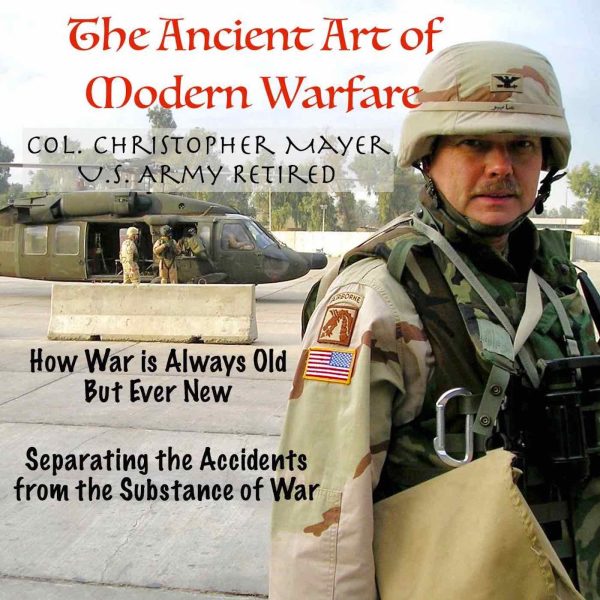
The Ancient Art of Modern Warfare
- Episódios
- 100
- Publicação
- quinzenal
- Último episódio
- 17 out 2026
Sobre o podcast
Exploring changes in the practice of war while the fundamental nature and principles of war are unchanging. Includes mercenaries, PMSC, Hybrid Warfare, revolution in military affairs. For in-depth information see my blog at blog.ctmayer.net
Episódios 100
Seven Deadly Sins of War (E144)
It seems to be popular to publish lists of five, seven, or more items that represent whatever the author thinks it is important for others to know. For this episode, I decided to go along with this trend. I …
Notas do episódio
It seems to be popular to publish lists of five, seven, or more items that represent whatever the author thinks it is important for others to know. For this episode, I decided to go along with this trend. I came up with seven deadly sins in fighting a war. These sins, things never to do, apply to the decision to go to war – this includes the decisions associated with defending one’s nation when attacked.
Music: Holst, G. The Planets: Mars Bringer of War, downloaded from Internet Archive
Is Just War Theory Obsolete? (E143)
Is Just War Theory still relevant to war and war fighting in the world today? Are the criteria of Just Cause, Right Intent, Legitimate Authority, and Proportionality, and Last Resort tools to restrain nations …
Notas do episódio
Is Just War Theory still relevant to war and war fighting in the world today? Are the criteria of Just Cause, Right Intent, Legitimate Authority, and Proportionality, and Last Resort tools to restrain nations from going to war, or have these principles been twisted into excuses for going to war. This is part of the argument Pope Leo XIV makes in his recent Encyclical, Magnifica Humanitas, in which he is reported to say that Just War Theory is outdated. Is this true? If so, what does it mean? That is the subject of this episode of The Ancient Art of Modern Warfare.
References:
- Leo XVI P.P., Magnifica Humanitas: On Safeguarding the Human Person in the Time of Artificial Intelligence, https://www.vatican.va/content/leo-xiv/en/encyclicals/documents/20260515-magnifica-humanitas.html
- U.S. Department of Defense, The Department of Defense Law of War Manual (June 2015, Updated July 2023), https://media.defense.gov/2023/Jul/31/2003271432/-1/-1/0/DOD-LAW-OF-WAR-MANUAL-JUNE-2015-UPDATED-JULY%202023.PDF
Music: Wagner, R. and the USMC Band, Siegfried’s Funeral (Public Domain)
Just War and Atom Bombs (E142)
Every August and September, the U.S. atomic bombing of Japan in 1945 seems to be a topic of discussion. This year, I decided to take that on and place it into the Just War framework, specifically jus in bello …
Notas do episódio
Every August and September, the U.S. atomic bombing of Japan in 1945 seems to be a topic of discussion. This year, I decided to take that on and place it into the Just War framework, specifically jus in bello, or justice in the conduct of war. Just War Theory is a recurring topic in this podcast series. I believe that this framework is critical as a restraint on war and to establishing a just and lasting peace after war. (I still intend on addressing Pope Leo’s statement that Just War Theory is outdated.) This episode builds on information my guests and I presented in previous episodes, and particularly Episodes 13-16, and Episode 17 which described Just War Theory in theory and practice. As a side note, the web service that hosts these podcasts informed me that the episodes of the Ancient Art of Modern Warfare now have 50,000 downloads. I know that many podcasters get this for a single episode. Since I don’t do this for the clicks, but just to share my thoughts on war, I was somewhat impressed that so many people bothered to download my thoughts. Thank you.
Music:
- Liszt, F., and the USMC Band, Les Preludes. Public Domain
- Copland, A. & United States Marine Band. (2000) Fanfare for the Common Man. unpublished, Washington, DC. [Audio] Retrieved from the Library of Congress, (Fair use for educational purposes.)
Is Hizballah a Mercenary Organization (E141)
The common definition of a mercenary is a soldier paid to fight in an armed conflict for a country that is not his or her own. The terrorist organization Hizballah operates in Lebanon, fighting against Israel …
Notas do episódio
The common definition of a mercenary is a soldier paid to fight in an armed conflict for a country that is not his or her own. The terrorist organization Hizballah operates in Lebanon, fighting against Israel, with financial, material and organizational support from Iran, and frequently under the direction of the Iranian Revolutionary Guard Corps. Under the common definition, could Hizballah be considered mercenaries fighting for Iran? Royce de Melo, Doug Brooks, and I discuss this question in this episode of the Ancient Art of Modern Warfare.
References:
- Hague 1907: Convention (IV) respecting the Laws and Customs of War on Land and its annex: Regulations concerning the Laws and Customs of War on Land. The Hague, 18 October 1907. (definition of lawful combatant) https://ihl-databases.icrc.org/en/ihl-treaties/hague-conv-iv-1907
- Article 47, Additional Protocol (I) to the Geneva Conventions, 1977 (definition of mercenary) (The United States is not a party to this Protocol) https://ihl-databases.icrc.org/en/ihl-treaties/api-1977?activeTab=1949GCs-APs-and-commentaries
- United Nations Mercenary Convention: International Convention against the Recruitment, Use, Financing and Training of Mercenaries https://www.google.com/url?sa=t&source=web&rct=j&opi=89978449&url=https://www.ohchr.org/en/instruments-mechanisms/instruments/international-convention-against-recruitment-use-financing-and&ved=2ahUKEwi47cCQ6M-VAxV4M1kFHX_OGsAQFnoECA0QAQ&usg=AOvVaw1fCthlNI1AV0DjEGZmeTVl (As of the date of this episode, only 38 governments had ratified this treaty. Only two NATO countries are parties to the convention.)
Music:
- Liszt, F., and the USMC Band, Les Preludes. Public Domain
- Kiilstofte, P. Mercenaries, Machinamasound (Licensed)
War Is Irrational (E140)
Is war rational? The great philosopher of war, Carl von Clausewitz, was a product of three schools of education: the classical tradition of Aristotle, the enlightenment philosophers such as Kant, and the …
Notas do episódio
Is war rational? The great philosopher of war, Carl von Clausewitz, was a product of three schools of education: the classical tradition of Aristotle, the enlightenment philosophers such as Kant, and the practical experience of Napoleon. Each of these three challenged and opposed the other two. His work, On War expresses this tension and opposition. In his effort to develop a comprehensive theory of war, he had to deal with the many instances where the reality of war seemed to defy any coherent framework, where the things which should happen in war are contradicted by what actually happens. (This fits with his assigning the element of probability and chance to the military leg of his famous triad.) “Consequently,” he wrote, “it would be an obvious fallacy to imagine war between civilized peoples as resulting merely from a rational act on the part of their governments…” If it did, he concluded, then in the end, war would never need to be fought. But wars are fought. Is war itself then, irrational?
Music:
- Traditional, The Army Strings, Garryowen (Public Domain)
- Copland, A. & United States Marine Band. (2000) Fanfare for the Common Man. unpublished, Washington, DC. [Audio] Retrieved from the Library of Congress, (Fair use for educational purposes.)
The Rational Actor Model (E139)
Since at least the 1940’s, policy and strategic thinking uses the so-called rational actor model in determining what competitors and partners may do, how to respond to them, and how they may react in return …
Notas do episódio
Since at least the 1940’s, policy and strategic thinking uses the so-called rational actor model in determining what competitors and partners may do, how to respond to them, and how they may react in return. Even considering variations to that model to explain less than optimal choices by these actors, there appears to be enough irrationality by state and non-state actors to call into question whether continued use of the rational actor model is itself rational.
Music:
- Traditional, The Army Strings, Garryowen (Public Domain)
- Copland, A. & United States Marine Band. (2000) Fanfare for the Common Man. unpublished, Washington, DC. [Audio] Retrieved from the Library of Congress, (Fair use for educational purposes.)
Wars of Choice? (E138)
I haven’t posted for a few weeks mostly because the current armed conflict with Iran poses a lot of questions that I don’t have answers for. One thing I might have an answer for is the question about wars of …
Notas do episódio
I haven’t posted for a few weeks mostly because the current armed conflict with Iran poses a lot of questions that I don’t have answers for. One thing I might have an answer for is the question about wars of choice. Recently, this term is used in a way that implies that this armed conflict is illegitimate or unethical. Like many terms used by any faction with intended political impact, the term is left undefined. Without defining terms there can be no logical argument. Rather, the intent is an appeal to emotion, rather than reason. In this episode of the Ancient Art of Modern Warfare, I take on the challenge of defining that term and applying it to modern conflicts.
Music:
- Traditional, The Army Strings, Garryowen (Public Domain)
- Holst, G. The Planets: Mars Bringer of War, downloaded from Internet Archive
Cyber-Mercenaries (E136)
Any quick net search for the term “cyber mercenary” will result in dozens, if not hundreds of entries. These concerns largely focus on the effect these persons or entities have on personal freedoms, economic …
Notas do episódio
Any quick net search for the term “cyber mercenary” will result in dozens, if not hundreds of entries. These concerns largely focus on the effect these persons or entities have on personal freedoms, economic activity, and the ability of hackers and States can work together to undermine human rights. What about cyber mercenaries and warfare? Can – or do – real mercenaries of the cyber domain of warfare actively participate in combat? If so, how can they disrupt armed conflict or undermine whatever humanitarian principles still exist in warfare? It took the international community years to catch up on the use of private military and security companies in armed conflict and we are still struggling with State-run quasi-mercenary organizations. We need to get ahead of cyberwarfare domain mercenaries now, while the genie is still peeking out from the bottle.
References:
- Convention (IV) respecting the Laws and Customs of War on Land and its annex: Regulations concerning the Laws and Customs of War on Land. The Hague, 18 October 1907
- International Committee of the Red Cross (2008) The Montreux Document On pertinent international legal obligations and good practices for States related to operations of private military and security companies during armed conflict. Geneve: International Committee of the Red Cross / Swiss Federal Department of Foreign Affairs
- Melzer, Nils, Interpretive Guidance on the Notion of Direct Participation in Hostilities under International Humanitarian Law, International Committee of the Red Cross, Geneva, 2009.
Music: Kiilstofte, P. Mercenaries, Machinamasound (Licensed)
Ceasefire? (E136)
As I post this, the cease-fires in Lebanon and Iran are still holding, and much longer than I expected. We usually think of cease fires as a good thing, enabling humanitarian activity and at least pause the …
Notas do episódio
As I post this, the cease-fires in Lebanon and Iran are still holding, and much longer than I expected. We usually think of cease fires as a good thing, enabling humanitarian activity and at least pause the death and destruction. That is not, however, the purpose behind any suspension in fighting a war. In this episode I examine the real reasons for most truces or cease fires, explore probable motivations for the current cease fires, and ask whether all cease fires are inherently good.
Disclaimer: These podcasts are not monetized or subsidized in any way, nor do they represent anyone’s opinion but my own.
Reference: Clausewitz, C. On War, Book One, Chapter One
Music: Copland, A. & United States Marine Band. (2000) Fanfare for the Common Man. unpublished, Washington, DC. [Audio] Retrieved from the Library of Congress, (Fair use for educational purposes.)
What is a War Crime? (E135)
Every time the United States or Israel use military force, there are immediate claims that those military forces are committing war crimes. I also note that such claims are never made about the opposing side …
Notas do episódio
Every time the United States or Israel use military force, there are immediate claims that those military forces are committing war crimes. I also note that such claims are never made about the opposing side, whether that is Hamas, Hizbollah, Houthis, Iran or any other state or non-state armed group opposing Western armed forces. It also seems that there are voices that insist than any military operation is unjust and constitutes a war crime, at last if the party involved is from the West. Aside from the bias, there is the deliberate use of the term “war crime,” intended to be inflammatory and de-legitimize the accused party, raising images of Nazi and Japanese atrocities of WW2. In this episode I describe what is a war crime under international and U.S. national law. You may be surprised at what is and what isn’t a war crime. I conclude with the claim of Pope Leo IV and the response from the White House.
As usual, the opinions in these podcasts are my own and do not necessarily represent the opinion of the Department of Defense, anyone else in the U.S. Government, or any other organization I am or ever have been associated with. I also want to reiterate that I am not a law of war expert, just a retired cavalry officer for whom the laws and customs of war provided the boundaries of what was allowed and what was unacceptable.
References:
- of Defense, DoD Law of War Manual, June 2015, Updated July 2023
- The Hague Convention (IV) of the Law of War on Land (1907) available at: https://digital-commons.usnwc.edu/cgi/viewcontent.cgi?article=1907&context=ils
Music: Copland, A. & United States Marine Band. (2000) Fanfare for the Common Man. unpublished, Washington, DC. [Audio] Retrieved from the Library of Congress, (Fair use for educational purposes.)
Winning and Losing (E134)
The United States is in yet another war. The usual pundits say that we cannot win while others say we have already won. The same people seem to say nearly the same things about Russia’s war in Ukraine. I doubt …
Notas do episódio
The United States is in yet another war. The usual pundits say that we cannot win while others say we have already won. The same people seem to say nearly the same things about Russia’s war in Ukraine. I doubt that pundits in either camp can coherently describe what winning or losing a war means or looks like. So, in this episode, I will once again lean heavily on Carl von Clausewitz to describe what has always been true about winning a war and how that applies to current wars. For the pro-Sun Tzu crowd, stay with me to the end as he makes a rare appearance in my podcasts.
Disclaimer: The information in these podcasts is my own opinion and does not represent that of the Department of Defense or any other organization I am or have been affiliated with.
Music: Wagner, R. and the USMC Band, Siegfried’s Funeral (Public Domain)
Beyond IHL: The Law of Neutrality
I am not sure, but I think that I mention the Laws and Customs of War in about half of my episodes. (Clausewitz, of course features in almost EVERY episode -- except this one.) There is one part of the Law of …
Notas do episódio
I am not sure, but I think that I mention the Laws and Customs of War in about half of my episodes. (Clausewitz, of course features in almost EVERY episode -- except this one.) There is one part of the Law of War that is infrequently discussed. So infrequent that the term International Humanitarian Law (IHL) doesn’t even include it. The International Committee of the Red Cross even says that it is of little importance! That nearly forgotten part of the Law of War is the Law of Neutrality. I do not agree with the comment in the ICRC’s IHL database tha, “the traditional law of neutrality has lost much of its former importance.” I believe that the armed conflicts between Russia and Ukraine and those in the middle east reveal problems which result when the law of neutrality is forgotten or abused. I believe these conflicts also represent an opportunity to reassert that branch of the Law of War, but only if States and nations have the courage to do so.
As usual, the content of this podcast is entirely my own opinion, and does not represent to position of the U.S. Department of Defense or any other orgaization I am or have previously been associated with
References:
- of Defense, DoD Law of War Manual, June 2015, Updated July 2023
- ICRC, How does Law Protect in War, p.3 https://www.icrc.org/sites/default/files/document/file_list/icrc-0739-part-i.pdf
- International Committee of the Red Cross IHL Databases: https://ihl-databases.icrc.org/en/ihl-treaties/hague-conv-v-1907
Music: Kiilstofte, P. Freedom Fighters, Machinamasound (Licensed)
When the Law of War Fails (E132)
I believe that the Law of War remains valid in modern warfare and is essential to establishing peace after war. Despite that belief we see States such as Russia and Iran and non-state groups such as Hamas …
Notas do episódio
I believe that the Law of War remains valid in modern warfare and is essential to establishing peace after war. Despite that belief we see States such as Russia and Iran and non-state groups such as Hamas operate in a manner that looks like violating the most fundamental aspects of the law of war, including deliberate targeting of civilians, to be an objective rather than a restriction. In this episode of the Ancient Art of Modern Warfare I propose some reasons for this and insist that, in the end, it will be counterproductive to achieving success.
The material in these podcasts are my own opinion and do not represent the official opinion of the Department of Defense or any other organization I have been or I am currently associated with
References:
- “The Law of War: Not Dead Yet,” Episode 56 of the Ancient Art of Modern Warfare
- Clausewitz, C. von, Howard, M. E., Paret, P., & Clausewitz, C. (1984). On war. Princeton University Press.
- of Defense, DoD Law of War Manual, June 2015, Updated July 2023
Music
- Kiilstofte, J., The Cavalry, Machinamasound (Licensed)
Operation Epic Fury vs. The Powell Doctrine (E131)
In podcast episode 128, posted just before Operation Epic Fury began, I outlined how I think that an attack on Iran could be just, necessary, and what I perceived as a path to achieve the goals expressed by the …
Notas do episódio
In podcast episode 128, posted just before Operation Epic Fury began, I outlined how I think that an attack on Iran could be just, necessary, and what I perceived as a path to achieve the goals expressed by the U.S. Government in the weeks leading to the start of the war. I did not expect this to be a blueprint for what would actually happen. What I really did not expect was for the conduct of the war to be completely different that that. So different that more than the usual naysayers are questioning whether this war is just at all, or winnable. In this episode I go beyond the Just War Theory I used in my previous analysis, using the Weinberger-Powell model for the use of military force. This model is credited with successful use of American military force in the last decade and a half of the 20th century. Although it is not, and was never intended as a recipe for success, abandoning its thought process seems to have been a formula for failure.
As usual, the opinions in these podcasts are my own and do not necessarily represent the opinion of the Department of Defense, anyone else in the U.S. Government, or any other organization I am or ever have been associated with. The United States should not commit forces to combat unless the vital national interests of the United States or its allies are involved.
Dedication to my sons, 1st Lt Miles Mayer USAF and PFC Charles Mayer USA. With the commitment to our future military engagements being jus ad bellum and jus in bello.
The Weinberger-Powell Doctrine (1984) Promulgated by Secretary of Defense Casper Weinberger. Believed to have been written by then Maj Gen Colin Powell, his senior military assistant.
- The United States should not commit forces to combat unless the vital national interests of the United States or its allies are involved.
- S. troops should only be committed wholeheartedly and with the clear intention of winning. Otherwise, troops should not be committed.
- U.S. combat troops should be committed only with clearly defined political and military objectives and with the capacity to accomplish those objectives.
- The relationship between the objectives and the size and composition of the forces committed should be continually reassessed and adjusted if necessary.
- U.S. troops should not be committed to battle without a "reasonable assurance" of the support of U.S. public opinion and Congress.
- The commitment of U.S. troops should be considered only as a last resort.
General Colin Powell’s re-statement of the Doctrine in 1992, as Chairman of the Joint Chiefs of Staff.
- Is a vital national security interest threatened?
- Do we have a clear attainable objective?
- Have the risks and costs been fully and frankly analyzed?
- Have all other nonviolent policy means been fully exhausted?
- Is there a plausible exit strategy to avoid endless entanglement?
- Have the consequences of our action been fully considered?
- Is the action supported by the American people?
- Do we have genuine broad international support?
If after careful consideration of these questions, the decision is made to commit U.S. military forces, then two imperatives shall apply:
- Clear and unambiguous objectives must be given to the armed forces. These objectives must be firmly linked with the political objectives.
- When we do use it, we should not be equivocal: we should win and win decisively.
Reference: Powell, C. “U.S. Forces: Challenges Ahead,” Foreign Affairs, Winter 1992/93
Music: Kiilstofte, J., The Cavalry, Machinamasound (Licensed)
Revisiting Just Cause (E130)
In the last episode, I said that I would compare we know about Operation Epic Fury against the Weinberger-Powell doctrine for the use of American military force. I need to push that off for a week. Current …
Notas do episódio
In the last episode, I said that I would compare we know about Operation Epic Fury against the Weinberger-Powell doctrine for the use of American military force. I need to push that off for a week. Current events – and some pushback from my previous episode – require me to revisit my assessment of Just Cause in our attacking Iran. I stand by my initial assessment in Episode 128, which I recorded before our attack. In that episode I expressed my opinion that Humanitarian Intervention was a valid argument for both Just Cause and Last Resort. Nonetheless, I included a caveat from that episode where I said that the reality of a military operation against Iran would probably look different than what I proposed. It has, and so a review is important.
The information in this podcast is my own opinion and does not represent the views of the U.S. Department of Defense or any other organization I am or have previously been associated with.
- Holst, G. The Planets: Mars Bringer of War, downloaded from Internet Archive
- Kiilstofte, J., The Cavalry, Machinamasound (Licensed)
The Persian Problem in Practice
I keep on trying to podcast about other things and current events keep distracting me. In my previous episode in this series, “The Persian Problem, I described some conditions under which U.S. military action …
Notas do episódio
I keep on trying to podcast about other things and current events keep distracting me. In my previous episode in this series, “The Persian Problem, I described some conditions under which U.S. military action against Iran would meet the Jus Ad Bellum criteria of Just War Theory. That description was, at the time I posted it, theoretical. Now we have the reality of having initiated combat operations. In this episode, I will review what I said in the previous episode and compare it to what we can see so far in this current conflict.
Music:
- Holst, G. The Planets: Mars Bringer of War, downloaded from Internet Archive
- Kiilstofte, J., The Cavalry, Machinamasound (Licensed)
The Persian Problem (E128)
By the time anyone reads or listens to this podcast, the situation with Iran may be completely different than when I write this. In keeping with the intent of this podcast series, however, I thought it might be …
Notas do episódio
By the time anyone reads or listens to this podcast, the situation with Iran may be completely different than when I write this. In keeping with the intent of this podcast series, however, I thought it might be worthwhile to explore the possibility of intervention in Iran in a way that is in line with the enduring principles of war. In doing this I am not advocating such an intervention. Neither do I express any opinion about whether or not it is even a good idea. My intent is to frame a possible military intervention within the framework of time proven successful strategy and Just War criteria. Given the record of U.S. military interventions following the first Gulf War, I am confident that whatever we do regarding Iran will completely ignore that framework.
Music:
- Copland, A. & United States Marine Band. (2000) Fanfare for the Common Man. unpublished, Washington, DC. [Audio] Retrieved from the Library of Congress, (Fair use for educational purposes.)
- Wagner, R. and the USMC Band, Siegfried’s Funeral (Public Domain)
The Morality of Strategic Bombing (E127)
Can strategic bombing of cities ever be justified? In the previous episode of this podcast series (E126), Col. Altieri said that the air force always considers itself revolutionary. Before I began recording, he …
Notas do episódio
Can strategic bombing of cities ever be justified? In the previous episode of this podcast series (E126), Col. Altieri said that the air force always considers itself revolutionary. Before I began recording, he cited strategic bombing in World War Two as both revolutionary and consistent with Clausewitz’s concept of making things so painful that the enemy will not continue to resist. I responded, saying that strategic bombing of the civilian population was a war crime and violates Just War criteria. Afterwards, I thought my response might have been hasty. In this episode, I re-look the idea of strategic bombardment, not as we might see it today, but as it was believed during WWII. In any examination of history, we need to see things as they were understood by those making decisions at that time, not from our current perspective.
Music: Holst, G. The Planets: Mars Bringer of War, downloaded from Internet Archive
A Revolution in Military Affairs? (E126)
The philosopher of war, Carl von Clausewitz, described three legs that support the architecture of war: Primordial violence, the play of chance, and reason. Clausewitz aligned the element of chance the …
Notas do episódio
The philosopher of war, Carl von Clausewitz, described three legs that support the architecture of war: Primordial violence, the play of chance, and reason. Clausewitz aligned the element of chance the military. Every revolution brings unintended consequences -- the free play of chance. A revolution in military affairs, therefore, means exponential chance to affect the other legs of that trinity. Did the predicted revolution in military affairs come about? Are we at the threshold of one? Is that a good thing or an unacceptable risk that must be avoided? Can we avoid it? Colonels Jayson Altieri and Robert Waring, US Army Retired and instructors in our War Colleges, join me to discuss some of these questions. This is longer than my recent podcasts, but I think it will be worth your time.
Music:
- Liszt, F., and the USMC Band, Les Preludes. Public Domain
- Beatles, Revolution (1968). (Unpublished take) Downloaded from Internet Archives, Identifier# 680904f-revolution-take-1 (Fair use for education)
Predicting the future...has a rather bad track record (E125)
The inevitable never happens. It is the unexpected always. -- J.M. Keynes 1938 Almost everyone plays with predicting the future. Persons who speak with presumed authority and say that some outlandish thing is …
Notas do episódio
The inevitable never happens. It is the unexpected always.
-- J.M. Keynes 1938
Almost everyone plays with predicting the future. Persons who speak with presumed authority and say that some outlandish thing is inevitable often get a lot of media attention. The more media attention, the more people come to think that the outlandish thing really is inevitable. In warfare, I have lived through the inevitability of guerilla warfare as the model for all future warfare; the inevitable demise armored warfare, the transformation of maneuver warfare; counter-insurgency warfare as the inevitable future war form; and more recently, that drones will so dominate the battlefield, that all previous forms of warfighting will be obsolete. In my opinion, inevitability has a rather bad track record. From time to time in these podcasts, I will revisit some of these predictions and see which of these were inevitable and which were overcome by reality.
The information in these podcasts is solely my own opinion and do not represent the position of the U.S. Department of Defense, or any other organization I am or have ever been associated with.
Certified 100% natural intelligence. No artificial intelligence was used in making this podcast.
References:
- Pournelle, J., The Mercenary, (1977, republished 1986, ISBN 9780671655945)
- Recompiled with other works of the series and published as:
- Pournelle, J. and Stirling, M., The Prince (2002) (ISBN 0-7434-3556-7)
- Heinlein, R., Starship Troopers, (1959) ISBN 978-0450044496
Music: Kiilstofte, P. Mercenaries, Machinamasound (Licensed)
- Pournelle, J., The Mercenary, (1977, republished 1986, ISBN 9780671655945)
Greenland (E124)
The idea that we would invade Greenland is about the stupidest idea I ever heard. I find it difficult to believe that anyone believed that implying the United States might use military force was anything other …
Notas do episódio
The idea that we would invade Greenland is about the stupidest idea I ever heard. I find it difficult to believe that anyone believed that implying the United States might use military force was anything other than a negotiating tactic. An ill-advised negotiating tactic, but still, nothing more than that. Putting aside the fear and anger generated from different sources there are concerns and questions to be addressed, particularly as Greenland continues to move on its path to independence from Denmark.
Outside References:
- The United States and Greenland, Part I: Episodes in Nuclear History 1947-1968 https://nsarchive.gwu.edu/briefing-book/nuclear-vault/2025-06-03/united-states-and-greenland-part-i-episodes-nuclear-history
- Trump is Right About Greenland – Wrong about How to Secure It: https://www.justsecurity.org/128707/trump-right-greenland-wrong-secure/
Music:
- Traditional, The Army Strings, Garryowen (Public Domain)
Disobedience to superior orders? (E123)
Recently, there has been controversy over public statements from some politicians about the responsibility of members of the armed forces to disobey unlawful orders. In theory, there should be nothing …
Notas do episódio
Recently, there has been controversy over public statements from some politicians about the responsibility of members of the armed forces to disobey unlawful orders. In theory, there should be nothing objectionable about that. Members of the armed forces, from the lowest enlisted to the highest general or admiral, receive regular instruction on the laws and customs of war and our responsibilities under the Constitution. In this episode, I describe what that means and where the responsibility to promptly and effectively execute orders ends.
Music Credits:
- Wagner, R. and the USMC Band, Siegfried’s Funeral (Public Domain)
- Hagman, R., Main Theme from “She Wore a Yellow Ribbon,” from The Wild West - The Essential Western Film Music Collection, (Fair use for educational purposes.)
- Kiilstofte, J., The Cavalry, Machinamasound (Licensed)
That Ancient Art of Modern Terrorism Part 6: State Sponsored Terrorism (E122)
This series on Terrorism is wrapping up with the problem of state sponsored terrorism. This form of international terrorism is most clearly a method of warfare, with the state using terrorist organizations as …
Notas do episódio
This series on Terrorism is wrapping up with the problem of state sponsored terrorism. This form of international terrorism is most clearly a method of warfare, with the state using terrorist organizations as deniable proxies in armed conflict. International law, however, does not recognize that form of terrorism as war, but as criminal acts subject only criminal jurisprudence. This situation does little to stop this war form or to protect those who should be protected under the laws and customs of war.
The information in these podcasts is solely my own opinion and do not represent the position of the U.S. Department of Defense, or any other organization I am or have ever been associated with.
Certified 100% natural intelligence. No artificial intelligence was used in making this podcast.
References:
- Articles 2 and 3 of the four Geneva Conventions of 1947
- Protocol II Additional to the Geneva Conventions of 1947
- Melzer, N. and the International Committee of the red Cross, Interpretive Guidance on the Notion of Direct Participation in Hostilities (2009)
- Carter, C. “Analyzing the Criminal Justice and Military Models of Counterterrorism: Evidence from the United States” (Ph.D. Dissertation) (2017)
Music credits:
- Holst, G. The Planets: Mars Bringer of War, downloaded from Internet Archive
- Mozart, W.A. and Berlin Philharmonic Orchestra, Requiem in D Minor, downloaded from the Internet Archive, https://archive.org
Counter-terrorism In Practice (E121)
In the last few episodes, I explained that international terrorism can be considered a war form and how it has been practiced through history. I described that, according to international law, terrorism is a …
Notas do episódio
In the last few episodes, I explained that international terrorism can be considered a war form and how it has been practiced through history. I described that, according to international law, terrorism is a crime and should be addressed as such. I also described how criminal laws are frequently inadequate to deal with terrorism used as a form of warfare. This leads to the question of how states deal with this in practice.
The information in these podcasts is solely my own opinion and do not represent the position of the U.S. Department of Defense, or any other organization I am or have ever been associated with.
Certified 100% natural intelligence. No artificial intelligence was used in making this podcast.
Music credits:
- Mozart, W.A. and Berlin Philharmonic Orchestra, Requiem in D Minor, downloaded from the Internet Archive, https://archive.org
Liszt, F., and the USMC Band. Les Preludes, Public Domain
Combatting International Terrorism (E120),
If terrorism, unlawfully attacking civilian targets to achieve a political outcome, is a modern war form, a different manner of armed conflict. When terrorist attacks are planned, organized, and operate from a …
Notas do episódio
If terrorism, unlawfully attacking civilian targets to achieve a political outcome, is a modern war form, a different manner of armed conflict. When terrorist attacks are planned, organized, and operate from a foreign country, or otherwise use that country as a safe haven, what are the options of the attacked State in using military force to fight this new form of armed conflict? This episode of the Ancient Art of Modern Warfare looks at the authority and limitations of the war making powers of a state to do that. In this episode, I do not look at the right or wrong of any particular State or any particular operation. This episode only sets the context for the potential use of military force against international terrorist organizations.
The information in these podcasts is solely my own opinion and do not represent the position of the U.S. Department of Defense, or any other organization I am or have ever been associated with.
Certified 100% natural intelligence. No artificial intelligence was used in making this podcast.
Principal Reference:
- Office of the General Counsel, Department of Defense, Department of Defense Law of War Manual (2023), https://media.defense.gov/2023/Jul/31/2003271432/-1/-1/0/DOD-LAW-OF-WAR-MANUAL-JUNE-2015-UPDATED-JULY%202023.PDF
Music:
- Kiilstofte, P. Mercenaries, Machinamasound (Licensed)
- Liszt, Les Preludes, perfomed by the USMC Band. Public Domain
Terrorism and War (E119)
I decided to change the trajectory of this series. Rather than continue with the history of terrorism, I am jumping ahead to how terrorism fits within the overarching philosophy of war. The manifestation of …
Notas do episódio
I decided to change the trajectory of this series. Rather than continue with the history of terrorism, I am jumping ahead to how terrorism fits within the overarching philosophy of war. The manifestation of terrorism as it has evolved in the past century is not inconsistent with our understanding of war. Understanding that will help us to understand the ways and means to defeat it.
The information in these podcasts is solely my own opinion and do not represent the position of the U.S. Government, the Department of Defense, or any other organization I am or have ever been associated with.
References:
- UN Office of Drugs and Crime, Introduction to International Terrorism, https://www.unodc.org/documents/e4j/18-04932_CT_Mod_01_ebook_FINALpdf.pdf
- Office of the General Counsel, Department of Defense, Department of Defense Law of War Manual (2023), https://media.defense.gov/2023/Jul/31/2003271432/-1/-1/0/DOD-LAW-OF-WAR-MANUAL-JUNE-2015-UPDATED-JULY%202023.PDF
Music:
- Kiilstofte, P. Mercenaries, Machinamasound (Licensed)
- Liszt, Les Preludes, perfomed by the USMC Band. Public Domain
Is Terrorism Ancient or a Modern Development? (E118)
This continues my description of terrorism and warfare. The previous episode defined terrorism. This episode traces terroristic attacks from the Bible to the First World War and how it differed from modern …
Notas do episódio
This continues my description of terrorism and warfare. The previous episode defined terrorism. This episode traces terroristic attacks from the Bible to the First World War and how it differed from modern terrorism. World War One had profound impacts on almost every aspects of human civilization and this included the use of terror to achieve political ends.
The information in these podcasts is solely my own opinion and do not represent the position of the U.S. Government, the Department of Defense, or any other organization I am or have ever been associated with.
References:
- UN Office of Drugs and Crime, Introduction to International Terrorism, https://www.unodc.org/documents/e4j/18-04932_CT_Mod_01_ebook_FINALpdf.pdf
- Office of the General Counsel, Department of Defense, Department of Defense Law of War Manual (2023), https://media.defense.gov/2023/Jul/31/2003271432/-1/-1/0/DOD-LAW-OF-WAR-MANUAL-JUNE-2015-UPDATED-JULY%202023.PDF
Music:
- Kiilstofte, P. Mercenaries, Machinamasound (Licensed)
- Liszt, Les Preludes, perfomed by the USMC Band. Public Domain
The Ancient Art of Modern Terrorism (E117)
What is terrorism? Is it something as old as warfare or something that has changed the nature of war? Is fighting terrorism the same as counterinsurgency? Despite more than two decades of the so-called War on …
Notas do episódio
What is terrorism? Is it something as old as warfare or something that has changed the nature of war? Is fighting terrorism the same as counterinsurgency? Despite more than two decades of the so-called War on Terror, we seem no closer to ending terrorism that we were when the Black September group attacked the Olympic Village in 1972. Before we can propose solutions to a problem, we must start by defining the problem. According to Socrates, the first step in defining a problem is defining terms. Defining terrorism is the subject of this episode of the Ancient Art of Modern Warfare.
References:
- UN Office of Drugs and Crime, Introduction to International Terrorism, https://www.unodc.org/documents/e4j/18-04932_CT_Mod_01_ebook_FINALpdf.pdf
- Office of the General Counsel, Department of Defense, Department of Defense Law of War Manual (2023), https://media.defense.gov/2023/Jul/31/2003271432/-1/-1/0/DOD-LAW-OF-WAR-MANUAL-JUNE-2015-UPDATED-JULY%202023.PDF
Music:
- Kiilstofte, P. Mercenaries, Machinamasound (Licensed)
- Liszt, Les Preludes, perfomed by the USMC Band. Public Domain
Can There be Peace in Gaza (E116)
I am reluctant to post much of anything about the current armed conflict in Gaza. As the saying goes, the first casualty in war is the truth, and the truth of this saying is manifest in Gaza. It is almost …
Notas do episódio
I am reluctant to post much of anything about the current armed conflict in Gaza. As the saying goes, the first casualty in war is the truth, and the truth of this saying is manifest in Gaza. It is almost impossible to separate information from information operations by either side. The International Committee of the Red Cross cites allegations of grave beaches of the law of war by both sides. In previous episodes I described how war crimes make reaching peace even more difficult than it usually is. Nonetheless, if achieving peace seems insurmountable, a cease fire leading to non-kinetic conflict resolution may be possible if we listen and put pressure on each sides stated war aims.
These podcasts do not necessarily represent the views of the Department of Defense, the Army War College, or any other organization I am associated with
Music
- Liszt, F. and Royal Philharmonic Orchestra, Totentanz, https://download.stream.publicradio.org/podcast/minnesota/classical/programs/free-downloads/2020/10/27/daily_download_20201027_128.mp3?listeningSessionID=0CD_382_200__6cca22efd3d270af449f392040641d0331631df3
- Copland, A. & United States Marine Band. (2000) Fanfare for the Common Man, unpublished, Washington, DC. [Audio] Retrieved from the Library of Congress, (Fair use for educational purposes.)
- Mozart, W.A. and Berlin Philharmonic Orchestra, Requiem in D Minor, downloaded from the Internet Archive, https://archive.org
Photo: Palestinian News & Information Agency. CC
A Modest Proposal for Peace in Ukraine (E115)
It seems that the time has come in Putin’s war on Ukraine that both sides indicate a willingness to negotiate. But negotiate what? This episode moves on from what is necessary for a sustainable peace, what …
Notas do episódio
It seems that the time has come in Putin’s war on Ukraine that both sides indicate a willingness to negotiate. But negotiate what? This episode moves on from what is necessary for a sustainable peace, what Putin’s real goals are in his war on Ukraine, and propose a possible path forward. I introduced this possible path in In Episode 104. This episode sets that idea in the context of the previous two episodes and the recent political and military developments.
Music:
- Copland, A. & United States Marine Band. (2000) Fanfare for the Common Man, unpublished, Washington, DC. [Audio] Retrieved from the Library of Congress, (Fair use for educational purposes.)
- Mozart, W.A. and Berlin Philharmonic Orchestra, Requiem in D Minor, downloaded from the Internet Archive, https://archive.org
Reference Book: Walsh, M. (2025). A rage to conquer: Twelve battles that changed the course of Western history (First edition). St. Martin’s Press.
Aqui estão os 40 episódios mais recentes de 100. Os mais antigos estão no feed do podcast.
Podcasts parecidos
Mais podcasts de Sociedade e cultura







Este podcast é seu?
Confirme com uma entrada no seu feed: você recebe um código aqui, adiciona como podcast:txt no canal do seu feed e nós verificamos. Depois disso, seu podcast aparece como “verificado” no SoundNode.