

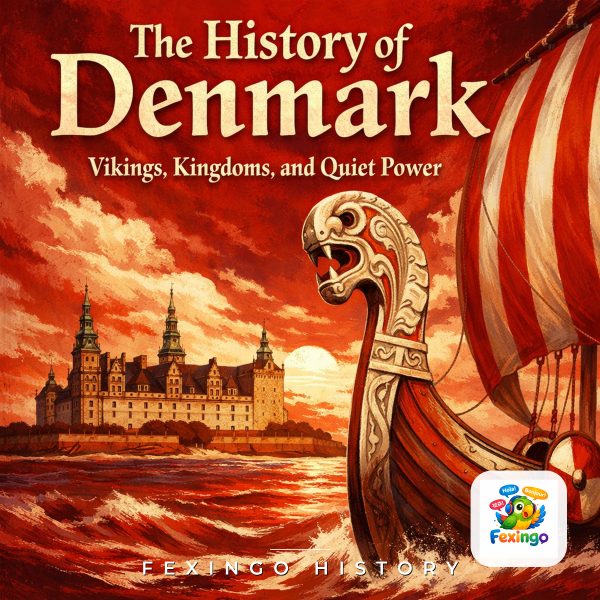
The History of Denmark: Vikings, Kingdoms, and Quiet Power — Fexingo History
- Episódios
- 297
- Publicação
- diária
- Último episódio
- 20 nov 2026
Sobre o podcast
From the first runic whispers of the Jelling stones to the sleek design of modern welfare state, Denmark’s history is a saga of resilience, adaptation, and quiet influence. This show traces the arc of a small northern nation that once terrorized Europe as Viking raiders—Ragnar Lothbrok, Harald Bluetooth, Cnut the Great—and later reinvented itself as a Baltic power under the Kalmar Union and the Oldenburg dynasty. We’ll explore the reign of Christian IV, builder of Kronborg and Rosenborg; the catastrophic Thirty Years’ War and the loss of Skåne; the absolutist constitution of 1665; the rise of the peasant-friendly Grundtvigian movement; the peaceful transition to democracy in 1849; the German-Danish wars over Schleswig-Holstein; the German occupation of World War II and the rescue of Danish Jews; and the postwar emergence of hygge, design, and green energy. Lucas and Luna guide listeners through these centuries, weighing the costs of empire, the power of small-state diplomacy, and the meaning of a kingdom that chose quiet strength over loud conquest. Denmark’s story is not just about the past—it asks what it means to wield influence without dominance. #VikingAge #HaraldBluetooth #CnutTheGreat #KalmarUnion #OldenburgDynasty #ChristianIV #ThirtyYearsWar #Absolutism #Grundtvig #SchleswigHolstein #WorldWarII #DanishRescue #Hygge #KronborgCastle #DanishHistory #ScandinavianHistory #History #FexingoHistory Keep every episode free: buymeacoffee.com/fexingo
Participantes
- LucasApresentação
- LunaCoapresentação
Episódios 297
Denmark's Medieval Silk Road and the Trade of Ambergris
While Viking raids and welfare states dominate the narrative, Denmark’s medieval economy relied on a quieter, more luxurious engine: the trade in exotic goods. This episode explores how Danish merchants …
Notas do episódio
While Viking raids and welfare states dominate the narrative, Denmark’s medieval economy relied on a quieter, more luxurious engine: the trade in exotic goods. This episode explores how Danish merchants, particularly those based in Hedeby and later Copenhagen, became vital nodes in the Hanseatic League’s network for transporting ambergris, walrus ivory, and Byzantine silks. We focus on the role of the merchant guilds, the specific legal frameworks that protected these high-value trades, and the surprising archaeological evidence of luxury consumption among the Danish elite. By examining the accounts of the Lübeck merchants and the customs records of the Øresund, we uncover how a small Nordic kingdom positioned itself as a gateway between East and West, long before it became a military power. The story reveals the intricate web of credit, risk, and cultural exchange that defined medieval Denmark’s prosperity.
#MedievalDenmark #HanseaticLeague #AmbergrisTrade #HedebyArchaeology #ØresundTolls #DanishMerchants #ByzantineSilk #WalrusIvory #LübeckTrade #MedievalEconomy #NorthernEuropeHistory #VikingAgeCommerce #KingsGabel #DanmarksKejsertid #HamburgMerchant #RibeTrade #BalticSeaRoutes #FexingoHistory #History
The Day Denmark Sold Its Crown to the World
In 1763, King Christian VII of Denmark faced a humiliating financial crisis that threatened to unravel the monarchy itself. With the treasury empty and creditors from across Europe demanding payment for past …
Notas do episódio
In 1763, King Christian VII of Denmark faced a humiliating financial crisis that threatened to unravel the monarchy itself. With the treasury empty and creditors from across Europe demanding payment for past wars and royal excesses, the king was forced into an unprecedented arrangement: he pawned his personal crown jewels and the regalia of the Danish state to a consortium of London merchants. This episode explores the intricate diplomatic maneuvering behind this secret transaction, involving key figures like Johann Friedrich Struensee, who would soon rise to power as the king’s physician and de facto ruler. We trace how the loss of these symbolic objects impacted national pride, the role of the Hanseatic League in mediating the debt, and how this quiet surrender of wealth inadvertently paved the way for economic reforms that would stabilize Denmark for decades. It is a story about the fragility of power, the weight of symbols, and the unexpected resilience of a small nation navigating the turbulent waters of 18th-century European politics.
#ChristianVII #DanishMonarchy #CrownJewels #Struensee #HanseaticLeague #EuropeanHistory #NordicHistory #Diplomacy #18thCentury #RoyalDebt #Copenhagen #LondonMerchants #Regalia #PoliticalReform #EconomicHistory #SmallNations #FexingoHistory #History
Denmark's Lost Empire: The Kalmar Union Explained
We trace the rise and collapse of the Kalmar Union, the ambitious political project that briefly united Denmark, Norway, and Sweden under a single monarch. Starting with Queen Margaret I’s strategic marriage …
Notas do episódio
We trace the rise and collapse of the Kalmar Union, the ambitious political project that briefly united Denmark, Norway, and Sweden under a single monarch. Starting with Queen Margaret I’s strategic marriage alliances in the late 13th and early 14th centuries, we explore how she engineered a personal union that expanded Danish power across the North Sea. We look at the coronation of Eric of Pomerania in 1397, the heavy toll of the Øresund Toll on trade, and the growing resentment from Swedish nobles who felt suffocated by Copenhagen’s control. The conversation moves through the brutal suppression of the Sture Parties, the assassination of Bishop Jens Beldt, and the eventual breakdown of the alliance after the Stockholm Bloodbath in 1520. Finally, we examine why this massive northern empire dissolved not through conquest, but through bureaucratic fatigue and the rising tide of national identity in the 16th century.
#KalmarUnion #QueenMargaretI #EricOfPomerania #StockholmBloodbath #ØresundToll #Dannebrog #NordicHistory #MedievalEurope #CopenhagenEmpire #SwedishRebellion #NorwegianDecline #HanseaticLeague #ChristianII #GustavVasa #UnionPolitics #BalticTrade #FexingoHistory #History
The Danish Welfare Model's Radical Roots
We trace the unexpected intellectual lineage of Denmark’s modern social safety net, moving far beyond the familiar post-war political settlements to uncover the radical ideas of N.F.S. Grundtvig and the folk …
Notas do episódio
We trace the unexpected intellectual lineage of Denmark’s modern social safety net, moving far beyond the familiar post-war political settlements to uncover the radical ideas of N.F.S. Grundtvig and the folk high school movement. This episode explores how teacher Johann Gottlieb Hagen and engineer J.C.H. Lindencrone translated Enlightenment ideals into a practical framework for rural communities, creating a system where education and economic cooperation were treated as inseparable civic duties. We examine the specific mechanisms of the andelsbevægelsen (cooperative movement) and how these humble agricultural experiments in Kalundborg and surrounding regions laid the groundwork for what we now call the Nordic model. By focusing on the quiet, persistent work of local organizers like Niels Esbensen, we reveal how a nation built its reputation not through military conquest or imperial expansion, but through a deliberate, structured commitment to social equity and collective self-reliance.
#DanishHistory #NordicModel #WelfareStateOrigins #Grundtvig #FolkHighSchool #Andelsbevægelsen #CooperativeMovement #Kalundborg #JCHLindencrone #NielsEsbensen #SocialHistory #Denmark #RuralDevelopment #EducationReform #19thCenturyEurope #FexingoHistory #HistoryPodcast #Scandinavia
How Denmark Built a Welfare State from Farmland
We trace the roots of Denmark’s global reputation for social welfare back to the late nineteenth century, long before the modern state existed. The story begins not with politicians, but with farmers who …
Notas do episódio
We trace the roots of Denmark’s global reputation for social welfare back to the late nineteenth century, long before the modern state existed. The story begins not with politicians, but with farmers who organized themselves into cooperative dairy societies to compete against German imports. We explore how N.F.S. Grundtvig’s idea of folk high schools created a culture of shared learning that made these cooperatives possible. You will hear about Niels Lauritsen Hansen, the visionary who first proposed the model, and the practical challenges of turning milk into butter for export. This episode reveals how a small nation turned agricultural necessity into a social contract that defined its national identity.
#DenmarkHistory #AgriculturalCooperatives #NielsEsbensen #Grundtvigianism #DanishWelfareState #FolkHighSchools #Kalundborg #ButterCooperatives #19thCenturyEurope #SocialEntrepreneurship #NordicModel #RuralDevelopment #DanishAgriculture #CollectiveOwnership #HistoricalEconomics #NorthernEurope #HistoryPodcast #FexingoHistory
The Day Denmark Sold Its Crown to the World
In this episode, Lucas and Luna explore the dramatic and often overlooked story of Queen Christina of Sweden’s abdication and her subsequent relocation to Rome. While Denmark is frequently remembered for its …
Notas do episódio
In this episode, Lucas and Luna explore the dramatic and often overlooked story of Queen Christina of Sweden’s abdication and her subsequent relocation to Rome. While Denmark is frequently remembered for its naval battles or welfare state, this narrative highlights a pivotal moment in 17th-century European diplomacy where Danish interests intersected with the fate of a deposed monarch. We examine how Denmark navigated the power vacuum left by Sweden’s decline, focusing on the role of the Danish court in offering asylum and the complex web of treaties that reshaped the Baltic balance of power. Listeners will discover the human side of political exile, the influence of Catholicism in Protestant Scandinavia, and the quiet maneuvering that allowed Denmark to maintain its status as a regional player despite losing its imperial ambitions. From the halls of the Royal Court in Copenhagen to the streets of Rome, we trace the personal and geopolitical stakes of one woman’s decision to trade a crown for a cross.
#QueenChristina #Abdication #DanishRoyalCourt #BalticPower #CopenhagenHistory #SwedishExile #17thCenturyEurope #Dannebrog #FrederickIII #RomePapacy #NordicHistory #PoliticalExile #ScandinavianMonarchs #ColdWarPrehistory #EuropeanDiplomacy #ChristianityVsLutheranism #FexingoHistory #HistoryPodcast #NorthernEurope
Denmark's Quiet Superpower: Normative Power Diplomacy
We trace how a small Nordic nation with no army to speak of became a global diplomatic heavyweight through the Hækkerup Doctrine and normative power. Starting in the tense years of the Cold War, we explore how …
Notas do episódio
We trace how a small Nordic nation with no army to speak of became a global diplomatic heavyweight through the Hækkerup Doctrine and normative power. Starting in the tense years of the Cold War, we explore how Foreign Minister Per Hækkerup navigated the razor's edge between Soviet pressure and Western alliances, establishing Denmark as a bridge-builder rather than a combatant. The conversation moves from the strategic genius of keeping NATO nuclear weapons on Danish soil while refusing their deployment during crises, to the modern era where Denmark leads in human rights advocacy and climate diplomacy. We examine specific figures like Hans Hedtoft and the intellectual foundations laid by N.F.S. Grundtvig that shaped this unique foreign policy approach. This episode unpacks the mechanics of soft power, showing how legislation, international law, and quiet negotiation can exert influence far greater than military might, offering a fresh perspective on how small states punch above their weight in world affairs.
#HækkerupDoctrine #NormativePower #PerHækkerup #DanishForeignPolicy #ColdWarHistory #SmallStateDiplomacy #NATOHistory #SoftPower #NordicModel #InternationalLaw #HansHedtoft #Khrushchev #JohnFitzgeraldKennedy #Folketinget #DanishPolitics #BalticSecurity #HumanRightsAdvocacy #History #FexingoHistory
Denmark's Quiet Superpower: How Small Nations Influence the World
While we’ve spent many episodes exploring Denmark’s turbulent past—from Viking conquests to the Danish-Swedish wars and the dramatic fall of Christian IV—this episode looks at a different kind of power. We …
Notas do episódio
While we’ve spent many episodes exploring Denmark’s turbulent past—from Viking conquests to the Danish-Swedish wars and the dramatic fall of Christian IV—this episode looks at a different kind of power. We examine how modern Denmark became a global model for welfare, design, and diplomacy without ever firing a shot in its own defense. Lucas and Luna discuss the Hækkerup Doctrine, the concept of Normative Power Europe applied northward, and the humble origins of the cooperative movement that fed a nation. You’ll meet figures like Niels Esbensen, who founded the first dairy cooperative in Kalundborg, and learn how folkehøjskole (folk high schools) shaped a citizenry educated not for exams, but for life. This is the story of how a small country with limited resources built an outsized reputation for stability, transparency, and social trust, turning vulnerability into a strategic advantage during the Cold War and beyond.
#DenmarkHistory #WelfareState #HækkerupDoctrine #NormativePower #Andelsbevægelsen #Folkehøjskole #NielsEsbensen #JCLindencrone #Kalundborg #DanishDesign #SocialTrust #ColdWarDenmark #NorthernEurope #CooperativeMovement #Grundtvig #NFSGrundtvig #FexingoHistory #History
The Danish-Jewish Refuge: How Denmark Saved Its Jews
In August 1943, as Nazi occupation tightened its grip on Copenhagen, a quiet, extraordinary act of collective conscience unfolded against all odds. While most of Europe watched helplessly or collaborated, the …
Notas do episódio
In August 1943, as Nazi occupation tightened its grip on Copenhagen, a quiet, extraordinary act of collective conscience unfolded against all odds. While most of Europe watched helplessly or collaborated, the Danish resistance, working with ordinary citizens and sympathetic German officials like Prince Bernhard of Saxony-Coburg and Gotha’s liaison Otto Meyn, organized the largest rescue of Jews in occupied Europe. This episode explores how fishermen, police officers, and teachers turned their boats toward neutral Sweden, carrying nearly seven thousand refugees across the Øresund under cover of darkness. We examine the political calculus that allowed this to happen, the role of King Christian X’s symbolic presence, and the fragile negotiations that delayed the deportation order just long enough for the fleet to sail. It is a story not of grand military strategy, but of moral clarity executed with remarkable efficiency.
#DenmarkWW2 #DanishResistance #August1943Rescue #JewishRefugees #CopenhagenHistory #OccupiedEurope #KingChristianX #OttoMeyn #PrinceBernhard #FishingBoatsSweden #NaziOccupation #HolocaustRescue #NordicHistory #NeutralSweden #ØresundCrossing #WorldWarII #HumanitarianAct #FexingoHistory
The Forgotten Danish Monks Who Shaped the Baltic
We explore the lesser-known story of the Cistercian monasteries in medieval Denmark, particularly Esrum Abbey and its vast network of landholdings. Long before Denmark became a naval power or a welfare state …
Notas do episódio
We explore the lesser-known story of the Cistercian monasteries in medieval Denmark, particularly Esrum Abbey and its vast network of landholdings. Long before Denmark became a naval power or a welfare state, these quiet religious communities were the backbone of the kingdom's economy and spiritual life. Lucas traces how King Valdemar the Great used the Church to consolidate power, while Luna asks about the daily reality for the monks who drained marshes and built barns that still stand today. We look at the specific relationship between the crown and the cloister, the architectural legacy of Romanesque stone churches, and how this 'quiet power' laid the groundwork for the Danish Golden Age centuries later. This episode moves away from battles and treaties to examine the soil, the silence, and the systematic organization that defined medieval Danish society.
#Cistercians #EsrumAbbey #ValdemarTheGreat #MedievalDenmark #NordicHistory #Christianization #BalticTrade #RomanesqueArchitecture #MonasticLife #KingdomOfDenmark #ChurchHistory #Scandinavia #Feudalism #AgriculturalReform #ReligiousOrders #NorthernEurope #History #FexingoHistory
The Danish Welfare State's Humble Origins
We trace the unexpected roots of Denmark’s world-renowned social safety net back to the mid-19th century, long before the modern welfare state existed. While we often associate Danish social democracy with …
Notas do episódio
We trace the unexpected roots of Denmark’s world-renowned social safety net back to the mid-19th century, long before the modern welfare state existed. While we often associate Danish social democracy with post-war politics, this episode explores how grassroots cooperatives and folk high schools planted the seeds for a society built on trust rather than charity. We look at key figures like N.F.S. Grundtvig, whose philosophy of 'folkeoplysning' (popular enlightenment) reshaped national identity, and the practical impact of the 'andelsbevægelsen' (cooperative movement). From dairy cooperatives in Jutland to the establishment of the first folk high schools in Roskilde, we examine how ordinary Danes organized themselves to survive economic hardship and democratic transition. This is a story about community resilience, agricultural innovation, and the quiet power of collective action that transformed a poor agrarian kingdom into a model of social cohesion.
#DanishHistory #WelfareStateOrigins #Andalsbevægelsen #Grundtvig #Folkehøjskole #DanishCooperatives #JutlandHistory #SocialDemocracyRoots #NordicModel #AgriculturalReform #NielsEsbern #Kalundborg #FolkHighSchool #DanishCulture #19thCenturyEurope #CommunityBuilding #FexingoHistory #History
Denmark's Secret Cold War Strategy: The Hækkerup Doctrine
While the world held its breath during the Cuban Missile Crisis, Denmark was playing a quiet, high-stakes game that would define its foreign policy for decades. This episode explores the origins of the Hækkerup …
Notas do episódio
While the world held its breath during the Cuban Missile Crisis, Denmark was playing a quiet, high-stakes game that would define its foreign policy for decades. This episode explores the origins of the Hækkerup Doctrine, named after Defence Minister Per Hækkerup, which established that any attack on Denmark or Greenland would be considered an attack on NATO itself. We dive into the tense diplomatic negotiations with Washington and Moscow in the early 1960s, the strategic importance of Thule Air Base, and how this policy allowed Denmark to maintain sovereignty while firmly anchoring itself in the Western alliance. Through declassified cables and historical analysis, we uncover how a small nation navigated the pressures of the Cold War without firing a single shot, shaping what scholars now call 'Normative Power' diplomacy. Join Lucas and Luna as they unpack the delicate balance of deterrence, loyalty, and independence that defined Denmark's silent victory in the Cold War.
#HækkerupDoctrine #PerHækkerup #ThuleAirBase #ColdWarDenmark #NATOHistory #GreenlandDefense #CubanMissileCrisis #Khrushchev #JohnFitzgeraldKennedy #DanishForeignPolicy #NordicSecurity #NormativePower #SovietUnion #UnitedStatesRelations #Folketinget #TreatyOfRome #AtomicBases #FexingoHistory #History
The Danish Golden Age: Struensee and the Fall of a King
In 1770, Johann Friedrich Struensee arrived in Copenhagen as a German doctor with radical ideas for reforming absolute monarchy. Partnered by Crown Prince Christian, he enacted sweeping changes including …
Notas do episódio
In 1770, Johann Friedrich Struensee arrived in Copenhagen as a German doctor with radical ideas for reforming absolute monarchy. Partnered by Crown Prince Christian, he enacted sweeping changes including freedom of the press and religious tolerance, challenging the entrenched power of the Rigsraad and Queen Juliane Marie. But his modernization alienated the conservative court, leading to a secret plot that would see him arrested, tried, and executed alongside his lover, Queen Louise. This episode explores the brief but intense period known as the Enlightenment reforms, the personalities involved, and why Denmark's attempt at rapid liberalization collapsed so violently.
#JohannFriedrichStruensee #ChristianVIIofDenmark #DanishGoldenAge #EnlightenmentReforms #QueenLouise #JulianeMarie #CopenhagenHistory #AbsoluteMonarchy #Rigsraad #DanishConstitution #NordicHistory #18thCenturyEurope #RoyalScandal #FreedomOfPress #ReligiousTolerance #DanishCourt #NorthernEurope #History #FexingoHistory
The Danish Welfare State's Humble Origins
We often think of the modern Nordic welfare model as a post-war invention, but its roots run much deeper into Denmark’s agricultural past. In this episode, we explore how J. C. H. Lindencrone and his colleagues …
Notas do episódio
We often think of the modern Nordic welfare model as a post-war invention, but its roots run much deeper into Denmark’s agricultural past. In this episode, we explore how J. C. H. Lindencrone and his colleagues in the late nineteenth century began experimenting with cooperative farming to save the Danish peasantry from economic collapse. We look at the specific mechanics of the folkehøjskole movement and how these rural schools became incubators for social trust rather than just educational centers. The conversation also examines the role of Andelsbevægelsen, the cooperative movement that allowed small farmers to pool resources for dairy processing and slaughterhouses, effectively democratizing capital. By tracing the lineage from the 1860s land reforms through the establishment of the first milk cooperatives in the 1880s, we see how a pragmatic response to market volatility evolved into a cultural ethos of collective security. This is not a story about political ideology imposed from above, but a grassroots evolution of mutual aid that reshaped the relationship between the citizen and the state.
#DanishHistory #NordicWelfare #Andelsbevægelsen #JCLindencrone #Folkehøjskole #DanishAgriculture #CooperativeMovement #RuralDenmark #19thCenturyEurope #SocialTrust #HjalmarBranting #DanishGoldenAge #PeasantLiberalism #MilkCooperatives #Kalundborg #NielsEsbensen #ScandinavianModel #HistoryPodcast #FexingoHistory
Denmark's Hidden Naval Empire in the Baltic
While we have covered the Viking roots and the later absolutist state, this episode uncovers the economic engine that made Denmark a great power for centuries: the Øresundstolden, or Sound Dues. Between the …
Notas do episódio
While we have covered the Viking roots and the later absolutist state, this episode uncovers the economic engine that made Denmark a great power for centuries: the Øresundstolden, or Sound Dues. Between the 15th and 18th centuries, the Danish crown taxed every ship passing through the narrow strait between Copenhagen and Helsingør. This revenue funded everything from royal palaces to naval wars, turning a small kingdom into a gatekeeper of global trade. We explore how this system worked, the fierce resistance it provoked from Dutch merchants, and the complex diplomacy that kept it alive until Napoleon reshaped Europe. Join us as we navigate the history of the Sundgæld and discover how Denmark profited from the movement of goods across the world.
#Øresundstolden #SoundDues #Sundgæld #DanishBalticEmpire #KronborgCastle #Helsingør #CopenhagenHistory #NordicTrade #16thCenturyEurope #DutchGoldenAge #FrederickII #ChristianIV #Flaggermusmiddagen #GuldetAfSundet #MaritimeHistory #EuropeanEconomy #FexingoHistory #History
Denmark's Secret War: The Danelaw and Viking England
While earlier episodes covered the Viking Kings of Denmark and their Baltic conquests, this episode shifts focus across the North Sea to the Danelaw—the vast region of eastern England under Norse rule during …
Notas do episódio
While earlier episodes covered the Viking Kings of Denmark and their Baltic conquests, this episode shifts focus across the North Sea to the Danelaw—the vast region of eastern England under Norse rule during the tenth century. We explore how Danish settlers didn't just raid but established a complex legal system known as the Danegeld and reshaped English society through intermarriage and trade. Lucas and Luna discuss key figures like King Cnut the Great, who ruled both England and Denmark, and examine the cultural fusion that defined the period from 865 to 1066. You will hear about the Treaty of Wedmore, the significance of York (Jorvik) as a Viking capital, and how the legacy of these Norse-Danish communities survived the Norman Conquest in place names, law, and language. This is a deep dive into the forgotten political reality where England was once part of a greater Scandinavian empire.
#Danelaw #VikingEngland #CnutTheGreat #Danegeld #YorkHistory #Jorvik #TreatyOfWedmore #NorthSeaEmpire #AngloSaxonHistory #NorseCulture #VikingLaw #King Alfred #EnglishPlaceNames #ScandinavianLegacy #MedievalEurope #NorthernEuropeHistory #FexingoHistory #History
Denmark's Forgotten Civil War: The Count's Feud
In 1534, Denmark plunged into a brutal three-year civil war known as the Count’s Feud, tearing the kingdom apart in a struggle for power between rival factions. While earlier episodes have explored the Viking …
Notas do episódio
In 1534, Denmark plunged into a brutal three-year civil war known as the Count’s Feud, tearing the kingdom apart in a struggle for power between rival factions. While earlier episodes have explored the Viking age and the rise of absolutism, this episode focuses on the chaotic transition period that nearly destroyed the Danish monarchy. We follow the rise of Christian II, the turbulent reign of Frederick I, and the dramatic intervention of German mercenaries led by Count Christopher of Oldenburg. Lucas and Luna trace how the conflict evolved from noble rivalry into a religious upheaval, pitting Lutheran reformers against Catholic loyalists in the streets of Copenhagen and the fields of Jutland. Key figures include Queen Dorothea, who rallied the nobility, and King Christian III, whose eventual victory at the Battle of Møgeltønder reshaped the nation’s political and religious landscape. Listeners will learn about the siege of Copenhagen, the role of the Hanseatic League, and how this internal bloodshed paved the way for the Lutheran state church. Through specific details of battles, betrayals, and diplomatic maneuvering, we uncover how Denmark survived its own fragmentation to emerge as a unified Protestant power.
#CountFeud #DenmarksCivilWar #ChristianIII #ChristopherOfOldenburg #DannebrogHistory #LutheranReformation #CopenhagenSiege #BattleOfMogeltonder #QueenDorothea #FrederickI #ChristianII #DanishNobility #HanseaticLeague #JutlandHistory #NordicHistory #ProtestantDenmark #FexingoHistory #History
Denmark's Hidden Naval Empire in the Baltic
While we have covered Denmark’s vast Baltic Empire under Valdemar II and its later naval conflicts with Nelson, this episode explores a quieter, more enduring aspect of Danish power: the strategic management of …
Notas do episódio
While we have covered Denmark’s vast Baltic Empire under Valdemar II and its later naval conflicts with Nelson, this episode explores a quieter, more enduring aspect of Danish power: the strategic management of the Øresund Strait. We dive into the Sound Dues (Øresundstolden), the tolls collected by Danish kings from all foreign ships passing between the North Sea and the Baltic. This revenue stream funded Copenhagen’s transformation into a major European capital and shaped international diplomacy for centuries. Lucas and Luna examine how Denmark leveraged its geographic monopoly to become a neutral trade arbiter, the diplomatic tensions with rising powers like Sweden and England, and the eventual abolition of these dues in the 19th century. Discover how a small kingdom used geography and tariffs to punch far above its weight, influencing global commerce long before modern international law defined free passage.
#SoundDues #OresundStrait #DanishNavy #CopenhagenHistory #BalticTrade #NordicHistory #MaritimeLaw #ChristianIV #FrederickIII #TreatyOfKiel #HanseaticLeague #SwedishExpansion #EnglishNavy #GlobalCommerce #NorthernEurope #FexingoHistory #HistoryPodcast #EuropeanHistory
How Denmark Won the Cold War Without a Shot Fired
While the world held its breath during the Cuban Missile Crisis, Denmark’s foreign minister Per Hækkerup navigated a delicate diplomatic tightrope between NATO allies and Soviet pressure. This episode explores …
Notas do episódio
While the world held its breath during the Cuban Missile Crisis, Denmark’s foreign minister Per Hækkerup navigated a delicate diplomatic tightrope between NATO allies and Soviet pressure. This episode explores the 'Hækkerup Doctrine' of 1962, a policy that declared Denmark would never host nuclear weapons on its soil in peacetime. We examine the secret negotiations with Washington, the internal cabinet debates, and how this quiet stance helped establish Denmark’s unique identity as a 'normative power.' Through the lens of declassified cables and personal diaries from the era, we uncover how small states can exert disproportionate influence through moral consistency rather than military might, shaping Denmark’s post-war international reputation.
#PerHækkerur #HækkerurDoctrine #CubanMissileCrisis #DenmarkNATO #NormativePower #ColdWarDenmark #Khrushchev #JohnFitzgeraldKennedy #DanishForeignPolicy #1962Denmark #NuclearNeutrality #ScandinaviaHistory #ColdWarDiplomacy #DanishParliament #Folketinget #NordicSecurity #ColdWarHistory #FexingoHistory
The Danish Gold Rush That Bankrolled Europe
While the world watched Viking longships and royal battles, Denmark quietly became the financial engine of Northern Europe through the Skåne salt trade. This episode explores how the monopoly on salt preserved …
Notas do episódio
While the world watched Viking longships and royal battles, Denmark quietly became the financial engine of Northern Europe through the Skåne salt trade. This episode explores how the monopoly on salt preserved meat for the Baltic fleets and fueled Copenhagen’s rise as a commercial hub. We follow the journey of Henrik Müller, the merchant who turned state privilege into private wealth, and examine the complex web of alliances with Hanseatic cities like Lübeck and Hamburg. The narrative reveals how this unglamorous commodity created Denmark’s first modern middle class, shifting power from the sword to the ledger. Discover the economic strategies that allowed a small kingdom to influence international trade routes, the tensions between royal absolutism and merchant freedom, and the legacy of these early capitalist structures in modern Danish society.
#SkaneSaltTrade #HenrikMuller #DanishEconomy #BalticSeaHistory #HanseaticLeague #CopenhagenCommerce #LubbeckTrade #NordicMercantilism #17thCenturyDenmark #ChristianIV #AbsoluteMonarchy #MerchantClass #FoodPreservation #NorthernEurope #HistoricalEconomics #FexingoHistory #HistoryPodcast #ScandinavianHistory
Christian IV's Grand Ambition and the Battle of Kircholm
While previous episodes have explored Denmark’s Viking roots, Baltic empire under Valdemar II, and naval conflicts like the bombardment by Nelson, this episode shifts focus to the Danish-Swedish wars of the …
Notas do episódio
While previous episodes have explored Denmark’s Viking roots, Baltic empire under Valdemar II, and naval conflicts like the bombardment by Nelson, this episode shifts focus to the Danish-Swedish wars of the early seventeenth century, specifically the reign of Christian IV. We examine his visionary but costly ambition to transform Denmark into a dominant European power through urban planning, trade monopolies, and military expansion. The narrative centers on the pivotal Battle of Kircholm in 1605, where Christian IV’s aggressive tactics against Sweden’s King Charles IX led to a disastrous defeat that halted Danish hegemony in the region. We also explore the architectural legacy he left behind in Copenhagen, including the founding of Frederiksstaden and the construction of Rosenborg Castle, contrasting these cultural achievements with the financial ruin caused by the Thirty Years' War. Through specific details about the Tresty of Knäred in 1613 and the strategic loss of Scania, we uncover how Christian IV’s personal charisma and relentless drive shaped Denmark’s identity as a regional power, even as it signaled the beginning of its long-term decline relative to its Swedish neighbor.
#ChristianIV #BattleOfKircholm #DenmarkHistory #SwedishEmpire #RosenborgCastle #Frederiksstaden #ThirtyYearsWar #TreatyOfKnared #Scania #Dannebrog #NorthernEurope #VikingLegacy #CopenhagenHistory #CharlesIX #AbsoluteMonarchy #FexingoHistory #BalticHegemony #History
The Day the Dannebrog Fell from the Sky
In this episode of Fexingo History, we turn back to June 15, 1219, in the Estonian town of Lyndanise—modern-day Tallinn—to witness one of the most enduring legends of Northern European history. While previous …
Notas do episódio
In this episode of Fexingo History, we turn back to June 15, 1219, in the Estonian town of Lyndanise—modern-day Tallinn—to witness one of the most enduring legends of Northern European history. While previous episodes have detailed the broader Baltic campaigns of King Valdemar II and his Archbishop Absalon, we focus specifically on the Battle of Lyndanise, where Danish forces were on the verge of total annihilation against a vastly outnumbered local coalition. The story centers on a moment of divine intervention: the sudden appearance of the Dannebrog, the red and white cross flag said to have fallen from heaven, which reversed the tide of battle. We explore how this event transformed a military disaster into a foundational myth for the Danish kingdom, cementing the symbol’s place in national identity. Through the eyes of chroniclers like Albert of Riga and the later Valdemar Vinlanders Book, we examine the tension between historical reality and sacred legend, asking why a falling flag mattered so much to a medieval army. Join us as we unravel the spiritual and political power of a single piece of cloth that helped define Denmark’s lost empire.
#ValdemarII #Dannebrog #BattleOfLyndanise #Tallinn #Estonia #NordicCrusades #MedievalDenmark #Absalon #AlbertOfRiga #ValdemarVinlandersBook #NorthernEurope #History #FexingoHistory #FlagLegend #DanishEmpire #BalticSea #ChristianMilitaryOrder #MedievalMyth
The Forgotten Danish Admiral Who Defied Nelson
In 1801, the British fleet under Lord Nelson arrived in Copenhagen with orders to break the League of Armed Neutrality by force. While earlier episodes covered the famous 1807 bombardment where Nelson famously …
Notas do episódio
In 1801, the British fleet under Lord Nelson arrived in Copenhagen with orders to break the League of Armed Neutrality by force. While earlier episodes covered the famous 1807 bombardment where Nelson famously put his telescope to his blind eye, this episode explores the first encounter: the Battle of Copenhagen. We focus on Admiral Ove Høegh-Guldberg, the young but steadfast Danish commander who held the line against a vastly superior enemy. Unlike the later capitulations or evacuations, the 1801 defense was a tactical stalemate that saved the Danish navy from destruction and preserved Denmark’s sovereignty during the Napoleonic Wars. Lucas and Luna trace the chaotic waters of the Inner Harbour, the confusion of signals, and the moment Horatio Nelson chose to ignore his own admiral’s recall order. It is a story of naval courage, political pressure, and the quiet power of holding ground when all odds suggest surrender.
#BattleOfCopenhagen #OveHøeghGuldberg #HoratioNelson #DanishNavy #NapoleonicWars #LeagueOfArmedNeutrality #CopenhagenHarbour #19thCenturyHistory #NordicHistory #NavalWarfare #BritishRoyalNavy #ScandinavianEmpire #FrederickVI #PrinceAdmiral #Danebrog #FexingoHistory #HistoryPodcast #MilitaryHistory
The Battle of Copenhagen: Nelson's Bombardment
In 1801, the Royal Navy under Admiral Horatio Nelson launched a daring assault on the Dano-Norwegian fleet anchored in Copenhagen harbor. This episode explores how Denmark, officially neutral but allied with …
Notas do episódio
In 1801, the Royal Navy under Admiral Horatio Nelson launched a daring assault on the Dano-Norwegian fleet anchored in Copenhagen harbor. This episode explores how Denmark, officially neutral but allied with Britain’s enemies in the League of Armed Neutrality, became the target of a brutal naval bombardment designed to break the coalition against Britain. We examine the tactical brilliance and moral ambiguity of Nelson’s decision to ignore his commander’s signal to withdraw, a moment that defined Danish military history and strained Anglo-Danish relations for decades. Through the eyes of both British officers and Copenhagen defenders, we uncover the chaos of the waterfront, the destruction of civilian neighborhoods, and the diplomatic fallout that followed the Treaty of Copenhagen.
#BattleOfCopenhagen #HoratioNelson #DanoNorwegianFleet #LeagueOfArmedNeutrality #DanishHistory #BritishRoyalNavy #NordicNavalWarfare #CopenhagenHarbor #19thCenturyEurope #MaritimeHistory #ScandinavianMilitary #AdmiralSirHydeParker #DenmarkNeutral #NelsonsSignal #RearAdmiralSuderman #TreatyOfCopenhagen #FexingoHistory #History
The Danish-Swedish Wars: How Denmark Lost Its Empire
We left off with Valdemar II’s vast Baltic Empire, but the road to collapse was paved with Swedish resistance and Danish overreach. This episode traces the devastating Thirty Years’ War intervention under …
Notas do episódio
We left off with Valdemar II’s vast Baltic Empire, but the road to collapse was paved with Swedish resistance and Danish overreach. This episode traces the devastating Thirty Years’ War intervention under Christian IV, a monarch who turned Denmark into a battlefield to protect Lutheran interests but ended up bankrupting the kingdom. We examine the Treaty of Lübeck, which saved Copenhagen from destruction but stripped Denmark of its continental ambitions, marking the end of an era. Then we pivot to the Second Northern War against Sweden, where Charles X Gustav famously marched across the frozen Belts to siege Copenhagen in 1658. The survival of the city through the Battle of Køge Bay and the subsequent Treaty of Roskilde shifted the balance of power in Scandinavia forever. Listen as Lucas and Luna unpack how these military failures forced Denmark to retreat from imperial expansion and focus inward, laying the groundwork for its future stability. We discuss key figures like Peder Griffenfeld and the strategic genius of Admiral Niels Juel, whose naval victories prevented total conquest. This is the story of how defeat became the catalyst for a quiet, pragmatic strength that defined modern Denmark.
#ChristianIV #ThirtyYearsWar #TreatyOfLubeck #CharlesXGustav #SecondNorthernWar #BattleOfKogeBay #TreatyOfRoskilde #PederGriffenfeld #NielsJuel #Dano-SwedishWars #DanishImperialDecline #ScandinavianHistory #VikingLegacy #NordicEmpire #MilitaryHistory #EuropeanPolitics #17thCenturyDenmark #FexingoHistory
The Danish Golden Age of Art and Enlightenment
While Denmark is often remembered for its Viking past or its modern welfare state, the late 18th century was a period of profound cultural flourishing known as the Guldalderen. This episode explores how …
Notas do episódio
While Denmark is often remembered for its Viking past or its modern welfare state, the late 18th century was a period of profound cultural flourishing known as the Guldalderen. This episode explores how Copenhagen became a beacon of Neoclassical art and intellectual freedom under King Christian VII and his physician Johann Friedrich Struensee. We examine the lives of key figures like Nicolai Abildgaard and Johan Georg Hagen, whose works defined a national aesthetic independent of foreign influence. The conversation also touches on the brief but radical Enlightenment reforms that attempted to reshape Danish society before the conservative backlash restored royal absolutism. By looking at the galleries, salons, and printing presses of this era, we see how quiet cultural power can sometimes be more enduring than military conquest.
#DanishGoldenAge #Guldalderen #ChristianVIIofDenmark #JohannFriedrichStruensee #NicolaiAbildgaard #JohanGeorgHagen #NeoclassicalArt #CopenhagenHistory #EnlightenmentDenmark #DanishRoyalGallery #NationalRomanticism #DanishLiterature #Holberg #LudvigHolberg #DanishArchitecture #Frederiksstaden #Amalienborg #History #FexingoHistory
Denmark's Lost Baltic Empire: Valdemar II
In 1219, King Valdemar II led a Danish army across the sea to Tallinn, Estonia, where a legendary red flag with a white cross, known as the Dannebrog, supposedly fell from the sky to secure victory. This …
Notas do episódio
In 1219, King Valdemar II led a Danish army across the sea to Tallinn, Estonia, where a legendary red flag with a white cross, known as the Dannebrog, supposedly fell from the sky to secure victory. This episode explores the brief but intense period when Denmark controlled much of the Baltic coast, stretching from Scania to Livonia. We examine the military campaigns of Bishop Absalon and the administrative challenges of ruling distant territories like Reval Castle. The narrative also covers the sudden collapse of this empire after Valdemar’s capture at the Battle of Lyndanise, leaving Denmark to retreat back to its Scandinavian roots. Listeners will encounter specific details about the Holy Roman Empire’s reaction, the role of Eric Ploughpenny, and how this fleeting imperial dream shaped Denmark’s national identity for centuries.
#ValdemarII #Dannebrog #BalticEmpire #Tallinn #Absalon #Lyndanise #EricPloughpenny #RevalCastle #LilleBält #AlbertOfRiga #ValdemarVinlandersBook #Scania #HolyRomanEmpire #DanishHistory #MedievalDenmark #NordicHistory #FexingoHistory #History
How Denmark Conquered the Baltic Empire
This episode explores the rise of Valdemar II, known as Valdemar the Victorious, and the zenith of Danish power in the early thirteenth century. We trace his campaigns in Estonia, the legendary capture of the …
Notas do episódio
This episode explores the rise of Valdemar II, known as Valdemar the Victorious, and the zenith of Danish power in the early thirteenth century. We trace his campaigns in Estonia, the legendary capture of the Dannebrog at the Battle of Lyndanise in 1219, and the subsequent establishment of a vast Baltic empire that stretched from Scania to Tallinn. Lucas and Luna discuss the administrative challenges of ruling such distant territories, the role of Archbishop Absalon in shaping this imperial vision, and the eventual collapse of these holdings after the disastrous Battle of Bornholm in 1227. The conversation highlights how this brief but intense period of expansion shaped Denmark's national identity and its relationship with Northern Europe for centuries to come.
#ValdemarII #Dannebrog #Lyndanise #EstoniaHistory #Tallinn #Absalon #BalticEmpire #MedievalDenmark #BattleOfBornholm #Scania #Lindanisse #NordicHistory #VikingLegacy #DanishKingdom #ArchbishopAbsalon #HanseaticLeague #FexingoHistory #History #NorthernEurope #MedievalWarfare
Denmark's Silent Coup: The 1849 Constitution
In this episode of The History of Denmark, Lucas and Luna explore the dramatic transition from absolute monarchy to constitutional democracy in 1849. While previous episodes covered the Viking age, the Baltic …
Notas do episódio
In this episode of The History of Denmark, Lucas and Luna explore the dramatic transition from absolute monarchy to constitutional democracy in 1849. While previous episodes covered the Viking age, the Baltic Empire, and the welfare state roots, we focus on the pivotal year when King Frederick VII signed the constitution, ending centuries of royal absolutism. We examine the role of Jens Christian Hauge, a blind poet who became the voice of the people through his newspaper Fædrelandet. The conversation details the peaceful revolution that swept away the Rigsraad’s power and established the Folketinget, creating one of Europe’s first democratic frameworks. Listeners will learn about the specific pressures from the 1848 revolutions across Europe that forced Copenhagen’s hand, the internal debates among Danish liberals, and how this quiet shift laid the groundwork for modern Danish society without a single battle being fought in the streets.
#DenmarkHistory #1849Constitution #FrederickVII #JensChristianHauge #Fædrelandet #DanishDemocracy #AbsoluteMonarchy #Folketinget #NordicHistory #EuropeanRevolution1848 #LiberalMovement #KingdomOfDenmark #CopenhagenHistory #PoliticalReform #ScandinavianCulture #PeacefulRevolution #RoyalAbsolutism #HistoryPodcast
Denmark's Forgotten Naval War Against Barbary Pirates
For decades, the Barbary corsairs held Danish and Norwegian ships hostage in Algiers, demanding ransom for every crew member. In 1769, King Frederick V commissioned a daring naval expedition to strike back at …
Notas do episódio
For decades, the Barbary corsairs held Danish and Norwegian ships hostage in Algiers, demanding ransom for every crew member. In 1769, King Frederick V commissioned a daring naval expedition to strike back at the heart of this piracy. Led by Captain Poul de Løvenørn, the fleet sailed into the Mediterranean with a secret mission: destroy the pirate harbor of Bougie and free Danish prisoners without starting a full-scale war. This episode explores the tense diplomacy, the brutal reality of captivity, and the surprising success of the raid that shifted the balance of power in the Mediterranean. We look at the letters written from prison cells, the political maneuvering in Copenhagen, and how this quiet victory paved the way for Denmark’s later treaties with North African states. It is a story of maritime strategy, human resilience, and the hidden costs of peace.
#BarbaryPirates #Algiers #FrederickV #PoulDeLoevenoern #BougieRaid #DanishNavy #MediterraneanHistory #Corsairs #MaritimeTrade #18thCenturyEurope #DanoNorwegianUnion #NorthAfricaHistory #NavalExpedition #PrisonerRansom #DiplomaticHistory #NordicHistory #FexingoHistory #History
Aqui estão os 40 episódios mais recentes de 297. Os mais antigos estão no feed do podcast.
Podcasts parecidos
Mais podcasts de Educação







Este podcast é seu?
Confirme com uma entrada no seu feed: você recebe um código aqui, adiciona como podcast:txt no canal do seu feed e nós verificamos. Depois disso, seu podcast aparece como “verificado” no SoundNode.