

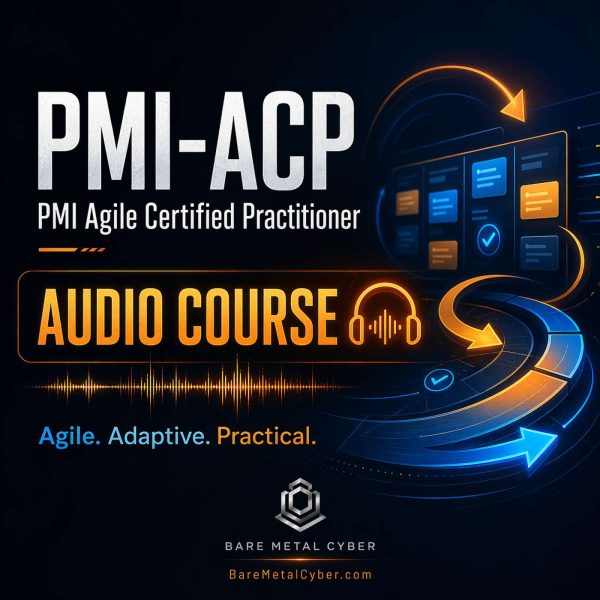
Certified – PMI-ACP Audio Course
- Episodes
- 100
- Format
- Series – listen from the start
- Latest episode
- Oct 14, 2025
About the podcast
The PMI-ACP Audio Course is your complete, audio-first companion for mastering the Project Management Institute’s Agile Certified Practitioner (PMI-ACP) certification. Designed for professionals who want structured, on-the-go learning, this Audio Course breaks down every domain of the PMI-ACP exam into 99 clear, practical, and scenario-based episodes. Each lesson explores agile mindset, leadership, stakeholder engagement, product delivery, team performance, metrics, and continuous improvement—helping you connect agile theory to real-world practice. Whether you’re studying during your commute, exercising, or reviewing between projects, this course builds your knowledge step by step and strengthens your fluency in agile principles, tools, and techniques. The PMI-ACP certification validates your ability to lead and collaborate in agile environments using frameworks like Scrum, Kanban, Lean, XP, and Crystal. It demonstrates that you understand adaptive planning, iterative delivery, and continuous improvement—skills increasingly sought across industries. The exam emphasizes practical application, testing how well you can blend servant leadership, agile values, and project management fundamentals to drive value and respond to change. Earning the PMI-ACP credential signals that you can guide teams toward high performance and help organizations achieve business agility in complex and fast-moving settings. Developed by BareMetalCyber.com, the PMI-ACP Audio Course delivers structured instruction, practical insights, and focused exam preparation. Each episode is designed to make agile learning flexible, engaging, and effective—helping you internalize agile thinking, refine your approach to leadership, and confidently prepare for certification success.
Episodes 100
Episode 99 — Flow Optimization: Using Metrics to Improve Throughput
This episode concludes the series by exploring flow optimization as the capstone of agile delivery. Learners discover how metrics such as cycle time, throughput, and flow efficiency reveal opportunities to …
Show notes
This episode concludes the series by exploring flow optimization as the capstone of agile delivery. Learners discover how metrics such as cycle time, throughput, and flow efficiency reveal opportunities to improve performance. The session emphasizes that optimization is about increasing finished value per unit of time without sacrificing quality.
Examples highlight PMI exam scenarios where teams face overloaded systems, bottlenecks, or variability. The correct solution often involves analyzing flow metrics, limiting WIP, and removing blockers systematically. By mastering flow optimization, agile teams achieve sustainable throughput and maximize value delivery. Produced by BareMetalCyber.com.
Episode 98 — Team Interfaces: Shielding the Team from Interruptions
This episode explores how teams manage interfaces with stakeholders and the broader organization to protect focus and flow. Learners examine practices such as designated product owners, communication protocols …
Show notes
This episode explores how teams manage interfaces with stakeholders and the broader organization to protect focus and flow. Learners examine practices such as designated product owners, communication protocols, and boundary-setting. The session emphasizes that shielding does not mean isolation but ensuring that input flows through the right channels.
Examples illustrate PMI exam scenarios where uncontrolled interruptions erode productivity. The correct solution often involves establishing clear interfaces that balance responsiveness with stability. By managing interfaces, teams sustain momentum while remaining aligned with stakeholder needs. Produced by BareMetalCyber.com.
Episode 97 — WIP Limits: Constraining Work at Every Level
This episode introduces the concept of work-in-progress (WIP) limits as a tool for improving flow and reducing multitasking. Learners discover how limiting concurrent work prevents bottlenecks, shortens cycle …
Show notes
This episode introduces the concept of work-in-progress (WIP) limits as a tool for improving flow and reducing multitasking. Learners discover how limiting concurrent work prevents bottlenecks, shortens cycle time, and improves predictability. The session explains that WIP limits apply at multiple levels, from individual contributors to teams and portfolios.
Examples highlight PMI exam scenarios where excessive parallel work slows delivery. The correct approach involves applying WIP limits to balance throughput and quality. Learners understand that constraints can be enablers, not obstacles, when designed intentionally. Produced by BareMetalCyber.com.
Episode 96 — Collaboration: Strengthening Customer–Team Interaction
This episode reviews how collaboration between customers and teams sustains alignment and value delivery. Learners explore practices such as joint backlog refinement, co-creation workshops, and regular demos …
Show notes
This episode reviews how collaboration between customers and teams sustains alignment and value delivery. Learners explore practices such as joint backlog refinement, co-creation workshops, and regular demos. The session highlights that collaboration reduces misunderstandings, builds trust, and accelerates learning.
Examples show how PMI exam scenarios may test whether candidates choose to involve customers continuously or defer engagement. The correct solution usually favors frequent, meaningful collaboration. By strengthening interaction, agile teams ensure products evolve in line with real needs. Produced by BareMetalCyber.com.
Episode 95 — Acceptance: Validating Deliverables Against Criteria
This episode highlights the role of acceptance in confirming that deliverables meet defined criteria. Learners explore how clear acceptance criteria guide development, testing, and validation. The discussion …
Show notes
This episode highlights the role of acceptance in confirming that deliverables meet defined criteria. Learners explore how clear acceptance criteria guide development, testing, and validation. The discussion emphasizes that acceptance ensures both quality and alignment with stakeholder expectations.
Examples illustrate PMI exam scenarios where incomplete or vague acceptance criteria create ambiguity. The correct approach often involves clarifying and validating deliverables explicitly against agreed standards. Acceptance is presented as a safeguard for value delivery and trust with stakeholders. Produced by BareMetalCyber.com.
Episode 94 — Customer Analysis: Identifying Users and Needs
This episode explores how agile teams perform customer analysis to ensure products address the right problems. Learners examine techniques such as interviews, personas, and journey mapping to identify user …
Show notes
This episode explores how agile teams perform customer analysis to ensure products address the right problems. Learners examine techniques such as interviews, personas, and journey mapping to identify user groups and their needs. The session emphasizes that customer analysis is not a one-time task but an ongoing process as markets and users evolve.
Examples highlight PMI exam scenarios where teams lack clarity about customer needs, leading to misaligned delivery. The correct solution involves investing in analysis to ground decisions in evidence. By mastering customer analysis, agile teams align increments with real value. Produced by BareMetalCyber.com.
Episode 93 — Effectiveness: Evaluating Process Changes
This episode reviews how agile teams evaluate the effectiveness of process changes after implementation. Learners are introduced to methods such as pilot testing, A/B comparisons, and retrospective reviews to …
Show notes
This episode reviews how agile teams evaluate the effectiveness of process changes after implementation. Learners are introduced to methods such as pilot testing, A/B comparisons, and retrospective reviews to determine whether improvements achieved their intended outcomes. The session emphasizes that evaluation is essential to refining practices and avoiding regression.
Examples show how PMI exam scenarios may test whether candidates recognize the importance of measuring impact rather than assuming success. The correct solution often involves collecting evidence and validating results before standardizing changes. By evaluating effectiveness, teams ensure continuous improvement remains purposeful and evidence-based. Produced by BareMetalCyber.com.
Episode 92 — Implementation: Executing Improvement Actions
This episode focuses on how agile teams translate improvement insights into concrete actions. Learners explore how to plan, prioritize, and execute changes within the flow of delivery. The discussion emphasizes …
Show notes
This episode focuses on how agile teams translate improvement insights into concrete actions. Learners explore how to plan, prioritize, and execute changes within the flow of delivery. The discussion emphasizes embedding improvements in the backlog, assigning ownership, and measuring impact.
Examples highlight PMI exam scenarios where improvements are identified but not acted upon. The correct approach involves disciplined execution and follow-through to ensure learning becomes practice. Implementation is presented as the bridge between insight and impact, turning continuous improvement from theory into reality. Produced by BareMetalCyber.com.
Episode 91 — Evidence-Driven Improvement: Metrics and Feedback
This episode emphasizes the role of evidence in guiding continuous improvement. Learners discover how teams use metrics such as throughput, cycle time, and defect rates alongside stakeholder feedback to inform …
Show notes
This episode emphasizes the role of evidence in guiding continuous improvement. Learners discover how teams use metrics such as throughput, cycle time, and defect rates alongside stakeholder feedback to inform changes. The session explains that improvement should be anchored in data, not opinions, ensuring credibility and accountability.
Examples illustrate how PMI exam scenarios may present teams making changes without clear evidence, leading to wasted effort. The correct solution often involves using data and feedback to validate whether improvements are effective. By adopting an evidence-driven approach, agile teams create sustainable progress and measurable outcomes. Produced by BareMetalCyber.com.
Episode 90 — Iteration: Repeating Identification and Reduction Cycles
This episode emphasizes how iteration sustains continuous improvement. Learners discover how repeating cycles of waste identification, reduction, and reassessment ensures that improvements compound over time …
Show notes
This episode emphasizes how iteration sustains continuous improvement. Learners discover how repeating cycles of waste identification, reduction, and reassessment ensures that improvements compound over time. The discussion explains that iteration is not limited to product development but also applies to processes and practices.
Examples illustrate PMI exam scenarios where teams attempt one-time fixes without iteration, leading to regression. The correct answer often involves embedding iterative cycles into team routines. By applying iteration consistently, agile teams maintain adaptability and evolve continuously. Produced by BareMetalCyber.com.
Episode 89 — Waste Reduction: Prioritizing and Executing Improvements
This episode builds on waste detection by focusing on reduction strategies. Learners explore how to prioritize which wastes to eliminate first, based on impact and feasibility. The discussion emphasizes …
Show notes
This episode builds on waste detection by focusing on reduction strategies. Learners explore how to prioritize which wastes to eliminate first, based on impact and feasibility. The discussion emphasizes incremental execution of improvements to avoid overwhelming the team.
Examples highlight PMI exam scenarios where waste persists because teams fail to prioritize improvements. The correct solution usually involves tackling the most consequential inefficiencies and demonstrating progress. Waste reduction is presented as an ongoing discipline that improves flow and satisfaction. Produced by BareMetalCyber.com.
Episode 88 — Waste Detection: Metrics, Tools, and Feedback Loops
This session examines how agile teams detect waste that slows value delivery. Learners explore categories of waste, such as handoffs, waiting, rework, and overproduction, and how tools like cumulative flow …
Show notes
This session examines how agile teams detect waste that slows value delivery. Learners explore categories of waste, such as handoffs, waiting, rework, and overproduction, and how tools like cumulative flow diagrams reveal inefficiencies. Feedback loops are emphasized as critical to identifying and reducing waste.
Examples show how PMI exam scenarios may involve unrecognized waste in processes. The correct answer often involves using metrics and feedback to expose inefficiencies. By mastering waste detection, agile teams improve predictability and deliver greater value. Produced by BareMetalCyber.com.
Episode 87 — Value Stream: Visualizing End-to-End Flow
This episode introduces the concept of value streams, which map the flow of value from customer request to delivery. Learners explore how visualizing value streams reveals bottlenecks, handoffs, and delays that …
Show notes
This episode introduces the concept of value streams, which map the flow of value from customer request to delivery. Learners explore how visualizing value streams reveals bottlenecks, handoffs, and delays that constrain throughput. The session emphasizes that understanding flow end-to-end enables teams to focus on systemic improvement.
Examples highlight PMI exam scenarios where teams optimize locally but fail to improve overall delivery. The correct approach involves viewing the entire value stream and aligning efforts to the bigger picture. Learners gain a systems-thinking perspective essential to agile maturity. Produced by BareMetalCyber.com.
Episode 86 — Learning Loops: Preventing Recurrence with Lessons Learned
This session highlights how agile teams use learning loops to prevent recurrence of issues and embed knowledge into practice. Learners are introduced to methods such as after-action reviews, root cause …
Show notes
This session highlights how agile teams use learning loops to prevent recurrence of issues and embed knowledge into practice. Learners are introduced to methods such as after-action reviews, root cause follow-ups, and retrospective-driven experiments. The emphasis is on turning lessons into sustainable improvements.
Examples show how PMI exam scenarios may involve repeating mistakes due to weak follow-through. The correct solution often requires applying learning loops to institutionalize changes. By making learning an intentional cycle, teams create lasting resilience and adaptability. Produced by BareMetalCyber.com.
Episode 85 — Monitoring and Control: Tracking Risks and Impediments
This episode focuses on how agile teams monitor and control risks and impediments once they are identified. Learners explore techniques such as risk boards, burndown charts, and regular reviews to track …
Show notes
This episode focuses on how agile teams monitor and control risks and impediments once they are identified. Learners explore techniques such as risk boards, burndown charts, and regular reviews to track exposure and progress. The emphasis is on visibility, ownership, and adaptation.
Examples show how PMI exam scenarios may present risks that disappear from view until they resurface. The correct approach involves maintaining continuous monitoring and adjusting strategies based on new information. By practicing disciplined monitoring, agile teams prevent surprises and sustain resilience. Produced by BareMetalCyber.com.
Episode 84 — Prioritization: Sequencing Mitigation and Removal Work
This session dives into prioritizing work related to risk mitigation and impediment removal. Learners explore how to balance delivery of features with the necessity of addressing items that threaten flow and …
Show notes
This session dives into prioritizing work related to risk mitigation and impediment removal. Learners explore how to balance delivery of features with the necessity of addressing items that threaten flow and quality. The discussion emphasizes that prioritization must account for both value creation and risk reduction.
Examples highlight PMI exam scenarios where teams defer mitigation, leading to compounding problems. The correct solution often involves sequencing risk-related work early to stabilize delivery. Learners are reminded that true prioritization weighs urgency, exposure, and impact, not just business value. Produced by BareMetalCyber.com.
Episode 83 — Team Engagement: Co-Creating the Best Course of Action
This episode explores how agile leaders engage teams by involving them directly in problem-solving and decision-making. Candidates learn how co-creation builds ownership, improves motivation, and strengthens …
Show notes
This episode explores how agile leaders engage teams by involving them directly in problem-solving and decision-making. Candidates learn how co-creation builds ownership, improves motivation, and strengthens outcomes. The discussion highlights practices such as collaborative workshops, consensus-building, and shared prioritization.
Examples show how PMI exam scenarios may test whether candidates recognize the importance of team involvement versus top-down direction. The correct answers often emphasize inclusiveness and leveraging team insight. By fostering engagement, agile leaders create stronger commitment and higher performance. Produced by BareMetalCyber.com.
Episode 82 — Risk and Impediment Identification: Proactive Discovery
This session highlights the importance of identifying risks and impediments early before they escalate into major issues. Learners explore proactive techniques such as risk workshops, backlog reviews, and daily …
Show notes
This session highlights the importance of identifying risks and impediments early before they escalate into major issues. Learners explore proactive techniques such as risk workshops, backlog reviews, and daily standups to surface concerns quickly. The episode explains how agile favors prevention and early discovery over reactive crisis management.
Examples illustrate how PMI exam scenarios may involve hidden risks that become blockers. The correct approach involves proactive discovery and transparent discussion to mitigate them. By embedding risk and impediment identification into team routines, agile teams protect flow and maintain momentum. Produced by BareMetalCyber.com.
Episode 81 — Data-Driven Decisions: Using Metrics to Guide Action
This episode explores how agile teams move from intuition to evidence by making data-driven decisions. Learners discover how metrics such as lead time, cycle time, and customer satisfaction can inform …
Show notes
This episode explores how agile teams move from intuition to evidence by making data-driven decisions. Learners discover how metrics such as lead time, cycle time, and customer satisfaction can inform prioritization, process changes, and risk management. The discussion emphasizes that data supports transparency, enabling teams to defend their choices with clarity and credibility.
Examples highlight PMI exam scenarios where teams ignore data in favor of opinions, leading to poor outcomes. The correct solution usually involves leveraging evidence to inform the next steps, even when it challenges assumptions. By practicing data-driven decision-making, agile teams strengthen accountability and align actions with results. Produced by BareMetalCyber.com.
Episode 80 — Metric Review: Analyzing Trends and Variance
This episode highlights the importance of reviewing metrics regularly to analyze trends and variance. Learners discover how examining data over time reveals patterns that guide improvement. The session …
Show notes
This episode highlights the importance of reviewing metrics regularly to analyze trends and variance. Learners discover how examining data over time reveals patterns that guide improvement. The session emphasizes that reviewing metrics is not about chasing numbers but about using evidence to drive better decisions.
Examples show how PMI exam scenarios may involve interpreting cycle time trends or variance in throughput. The correct answer typically involves analyzing the data to identify causes and opportunities for improvement. By practicing disciplined metric review, teams evolve continuously and remain aligned with outcomes. Produced by BareMetalCyber.com.
Episode 79 — Metric Radiation: Making Measures Visible and Useful
This episode reviews the concept of metric radiation, which ensures that measures are not hidden but made visible to everyone. Learners explore practices such as dashboards, information radiators, and physical …
Show notes
This episode reviews the concept of metric radiation, which ensures that measures are not hidden but made visible to everyone. Learners explore practices such as dashboards, information radiators, and physical or digital boards that display performance data openly. The goal is to make metrics accessible and actionable.
Examples illustrate how PMI exam scenarios may involve teams struggling with hidden or outdated data. The correct solution often involves radiating metrics to improve transparency and enable informed decision-making. Learners are reminded that openness fosters accountability and collaboration. Produced by BareMetalCyber.com.
Episode 78 — Metrics Selection: Choosing Measures for Each Audience
This session explores how teams select appropriate metrics to guide decisions and demonstrate progress. Learners discover that different audiences—teams, product owners, executives—require different metrics to …
Show notes
This session explores how teams select appropriate metrics to guide decisions and demonstrate progress. Learners discover that different audiences—teams, product owners, executives—require different metrics to meet their needs. The discussion emphasizes that one-size-fits-all measurement undermines alignment and clarity.
Examples highlight PMI exam scenarios where teams must decide which metric to present in a given context. The correct choice involves tailoring measures to the audience, ensuring that information is meaningful and actionable. This approach reflects agile’s principle of transparency adapted to stakeholder needs. Produced by BareMetalCyber.com.
Episode 77 — Stakeholder Feedback: Routine Collection and Incorporation
This episode explains how agile teams build stakeholder feedback into the rhythm of delivery. Learners are introduced to practices such as sprint reviews, demos, and ongoing conversations that ensure …
Show notes
This episode explains how agile teams build stakeholder feedback into the rhythm of delivery. Learners are introduced to practices such as sprint reviews, demos, and ongoing conversations that ensure stakeholders are part of the process. The emphasis is on making feedback routine rather than occasional.
Examples illustrate PMI exam scenarios where teams defer stakeholder involvement, resulting in misalignment. The correct approach involves seeking feedback consistently and incorporating it into backlog refinement and prioritization. By embedding feedback into delivery, teams reduce surprises and strengthen stakeholder trust. Produced by BareMetalCyber.com.
Episode 76 — Small Batches: Delivering in Thin, Testable Slices
This session reviews the agile practice of delivering work in small batches to reduce risk, increase feedback, and improve flow. Learners discover how small batches make problems visible earlier and create …
Show notes
This session reviews the agile practice of delivering work in small batches to reduce risk, increase feedback, and improve flow. Learners discover how small batches make problems visible earlier and create opportunities for rapid adjustment. The episode emphasizes that delivering in thin slices improves adaptability and stakeholder confidence.
Examples highlight how PMI exam scenarios may involve teams choosing between large upfront releases and incremental delivery. The correct answer typically favors smaller batches, which support learning and reduce waste. Learners understand that agility is rooted in the discipline of small, testable slices. Produced by BareMetalCyber.com.
Episode 75 — Customer Satisfaction: Evaluating Experience and Outcomes
This episode explores customer satisfaction as the ultimate measure of agile success. Learners discover how to evaluate satisfaction through direct feedback, usage patterns, and outcome-based measures. The …
Show notes
This episode explores customer satisfaction as the ultimate measure of agile success. Learners discover how to evaluate satisfaction through direct feedback, usage patterns, and outcome-based measures. The discussion emphasizes that delivering increments is not enough if customers do not find them valuable.
Examples show how PMI exam questions may involve scenarios where delivery is technically complete but customers remain dissatisfied. The correct answer involves seeking feedback, adjusting delivery, and focusing on experience rather than output. This session reinforces that agile teams prioritize customer delight as the benchmark of success. Produced by BareMetalCyber.com.
Episode 74 — Domain 4 Delivery: Overview
This episode introduces the fourth PMI-ACP domain, Delivery, which focuses on executing increments effectively and ensuring value flows through the system. Learners gain an overview of the domain’s scope …
Show notes
This episode introduces the fourth PMI-ACP domain, Delivery, which focuses on executing increments effectively and ensuring value flows through the system. Learners gain an overview of the domain’s scope, including practices such as batching, feedback, metrics, and impediment management. The session also clarifies how this domain is weighted on the exam.
Examples highlight how PMI exam scenarios often test whether candidates understand the principles of delivery efficiency and predictability. By grounding learners in the expectations of this domain, the episode sets the stage for detailed exploration of delivery-focused practices. Produced by BareMetalCyber.com.
Episode 73 — Results Validation: Customer Satisfaction and Business Impact
This session focuses on validating results to ensure that increments actually deliver value. Learners explore how customer satisfaction surveys, adoption rates, and business impact metrics provide evidence of …
Show notes
This session focuses on validating results to ensure that increments actually deliver value. Learners explore how customer satisfaction surveys, adoption rates, and business impact metrics provide evidence of effectiveness. The episode emphasizes that validation is essential to avoiding the trap of delivering outputs that fail to create meaningful outcomes.
Examples show how PMI exam scenarios may present teams that assume delivery equals success. The correct solution often involves testing whether the increment truly solves the customer’s problem or meets business goals. By practicing results validation, teams demonstrate accountability and align delivery with impact. Produced by BareMetalCyber.com.
Episode 72 — Optimizing Value: Right-Sizing Increments and Scope
This episode examines how agile teams optimize value delivery by tailoring increments and scope to fit the context. Learners discover how right-sizing work enables teams to deliver meaningful outcomes without …
Show notes
This episode examines how agile teams optimize value delivery by tailoring increments and scope to fit the context. Learners discover how right-sizing work enables teams to deliver meaningful outcomes without overloading or under-delivering. The discussion emphasizes that optimization is about maximizing value per unit of effort, not simply increasing throughput.
Examples illustrate PMI exam scenarios where teams face scope pressure, and the correct answer involves focusing on the highest-value items and adjusting increments accordingly. The episode reinforces that value optimization requires discipline, stakeholder alignment, and a willingness to defer or drop low-value work. Produced by BareMetalCyber.com.
Episode 71 — Defining Value: Success Criteria, Sustainability, and Compliance
This episode explores how agile teams define value in ways that extend beyond simple delivery of functionality. Learners are introduced to dimensions such as success criteria, sustainability, and compliance …
Show notes
This episode explores how agile teams define value in ways that extend beyond simple delivery of functionality. Learners are introduced to dimensions such as success criteria, sustainability, and compliance. Success criteria provide clear measures of what “good” looks like, while sustainability ensures that value is not achieved at the cost of long-term viability. Compliance is presented as a non-negotiable aspect of value, especially in regulated industries where adherence to standards is critical.
Examples highlight how PMI exam scenarios may require candidates to recognize that value includes customer satisfaction, risk reduction, and compliance obligations. The discussion emphasizes that agile does not treat value as one-dimensional but as multi-faceted, requiring a balanced approach. By defining value broadly, teams ensure that they deliver outcomes that matter to both customers and organizations. Produced by BareMetalCyber.com.
These are the latest 60 of 100 episodes. You’ll find older episodes in the podcast’s feed.
Recommended by Certified – PMI-ACP Audio Course


Similar podcasts
More Education podcasts





Is this your podcast?
Confirm it with an entry in your feed: you get a code here, add it as podcast:txt to the channel of your feed, and we check it. Your podcast is then shown as “verified” on SoundNode.