

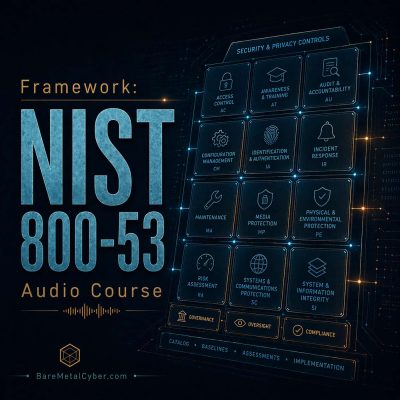
Episode 89 — Spotlight: Identification and Authentication (Organizational Users) (IA-2)
Show notes
Identification and Authentication (IA-2) establishes the foundation of trust by ensuring that only verified users gain access to organizational systems. For exam purposes, this control requires that every user be uniquely identified and authenticated before establishing a session or performing an action. Authentication mechanisms can include passwords, multi-factor authentication (MFA), smart cards, or biometrics depending on risk level. The goal is to confirm identity with sufficient assurance to prevent unauthorized access. IA-2 applies across all organizational systems, balancing usability, scalability, and security assurance.
Operationally, IA-2 implementations rely on centralized identity providers that manage credentials and enforce authentication policies consistently. MFA adoption significantly reduces credential theft risk by adding independent verification factors. Authentication events are logged and correlated with access reviews to detect anomalies such as excessive failed attempts or unusual login times. Password complexity, rotation policies, and account lockout thresholds are tailored to impact level and threat environment. Metrics include MFA coverage rate, failed login trends, and time to disable compromised accounts. Avoiding pitfalls requires ensuring that authentication mechanisms extend to all interfaces, including APIs and remote administration tools. IA-2 mastery demonstrates the ability to implement identity assurance as a measurable control, not an assumption.
Produced by BareMetalCyber.com, where you’ll find more cyber audio courses, books, and information to strengthen your educational path. Also, if you want to stay up to date with the latest news, visit DailyCyber.News for a newsletter you can use, and a daily podcast you can commute with.