

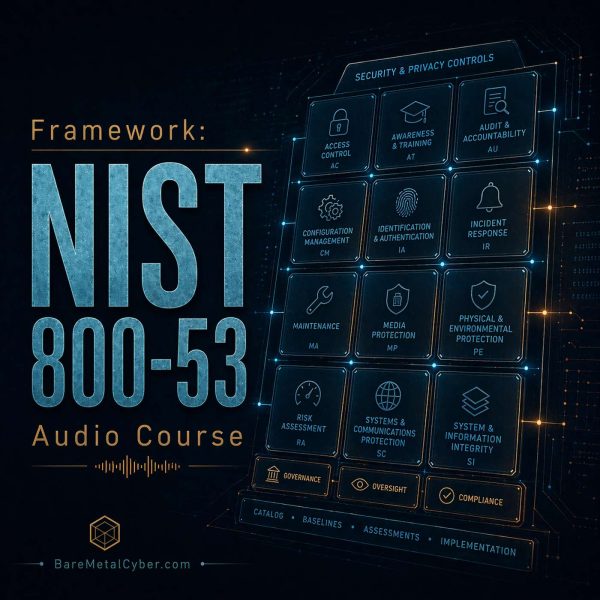
Framework: NIST 800-53 Audio Course
- Episodes
- 147
- Format
- Series – listen from the start
- Latest episode
- Oct 20, 2025
About the podcast
This **NIST Special Publication 800-53 Audio Course** is a complete, audio-first learning series designed to make one of the most comprehensive cybersecurity standards both clear and approachable. Through structured, plain-language narration, each episode walks you through the controls, objectives, and principles that form the foundation of modern federal and enterprise security programs. You’ll learn how NIST 800-53 defines safeguards across access control, incident response, risk assessment, system integrity, and continuous monitoring—building both exam readiness and real-world comprehension. The course translates complex regulatory and technical language into straightforward explanations you can absorb on the go. Each lesson defines essential terms, explores real-world implementation scenarios, and reinforces key ideas to ensure lasting understanding. Whether you’re preparing for a certification, managing compliance initiatives, or simply strengthening your cybersecurity foundation, the series helps you connect the “what” and “why” behind every control family. By the end, you’ll have a confident grasp of the **core domains and control structures** within NIST 800-53, a repeatable study rhythm that supports long-term retention, and the clarity to apply these standards effectively in both assessment and operational contexts. Developed by **BareMetalCyber.com**, this course delivers structured, professional insight for learners who want practical understanding of one of the most important cybersecurity frameworks in the world.
Episodes 147
Episode 147 — Spotlight: Physical Access Control (PE-3)
Physical Access Control (PE-3) translates least privilege into the built environment by governing who may enter facilities, rooms, and cages that host systems, media, and network infrastructure. For the exam …
Show notes
Physical Access Control (PE-3) translates least privilege into the built environment by governing who may enter facilities, rooms, and cages that host systems, media, and network infrastructure. For the exam, recognize that PE-3 requires identity-backed credentials, authorization rules tied to roles and need-to-know, and enforcement points—badge readers, biometric devices, mantraps, and locks—that prevent tailgating and unauthorized movement between zones. It mandates auditable processes for issuing, modifying, and revoking badges; time-based and area-based restrictions; and visitor management with verification, logging, and continuous escort in sensitive areas. PE-3’s objective is to limit the blast radius of physical compromise, ensure accountability for presence in protected spaces, and preserve the conditions required for logical controls to work. Effective implementations integrate with IAM so access changes propagate instantly, while alarms and sensors detect forced doors, propped entries, or off-hours anomalies that indicate risk.
In practice, PE-3 maturity shows up as layered defenses and disciplined review. Zones are mapped to impact levels with explicit rules for entry and surveillance coverage; delivery bays and maintenance routes follow controlled paths; and temporary access—contractors, emergency responders, break-glass events—is time-bound and supervised. Evidence includes badge issuance records, access review attestations, alarm response logs, camera retention summaries, and maintenance tickets proving that readers, controllers, and locks are tested and functional. Periodic reconciliations match access rights to current staffing and roles, while drills validate that response teams can isolate areas quickly. Metrics track off-hours entries, denied attempts, orphaned badges, alarm acknowledgment time, and exception age. Pitfalls include shared credentials, unmonitored back doors, stale visitor procedures, and retention gaps that erase needed footage. By mastering PE-3, organizations demonstrate that physical protections are intentional, measured, and synchronized with cyber controls, creating a cohesive defense where people, processes, and technology reinforce one another.
Produced by BareMetalCyber.com, where you’ll find more cyber audio courses, books, and information to strengthen your educational path. Also, if you want to stay up to date with the latest news, visit DailyCyber.News for a newsletter you can use, and a daily podcast you can commute with.Episode 146 — Spotlight: Risk Management Strategy (PM-9)
Risk Management Strategy (PM-9) defines how an organization articulates risk appetite, tolerance, priorities, and decision rules so that security and privacy controls are selected and operated with intent. For …
Show notes
Risk Management Strategy (PM-9) defines how an organization articulates risk appetite, tolerance, priorities, and decision rules so that security and privacy controls are selected and operated with intent. For exam readiness, understand that PM-9 sits above system-level decisions and provides the compass for categorization, tailoring, exception handling, and investment tradeoffs. A credible strategy describes what kinds of loss the organization is willing to accept, which scenarios are intolerable, and how competing objectives—cost, speed, reliability, compliance—are balanced. It specifies how risks are identified, analyzed, scored, and escalated; how residual risk is accepted and by whom; and how frequently assumptions are revisited. PM-9 links enterprise goals to control families by translating abstract posture into operational directives: patch fast for exploitable flaws, enforce strong identity at high-value boundaries, require encryption where data exposure would be material, and prove effectiveness through metrics. The result is consistency: programs stop arguing case-by-case and start executing within clear, documented guardrails that leadership owns.
Operationally, PM-9 becomes real through policies, heat maps, risk registers, thresholds, and governance rhythms that determine what happens when evidence changes. Triggers—new threats, architectural changes, supplier incidents, audit results—drive reassessment and reprioritization. Portfolio views compare systems by impact and exposure so resources go where they reduce the most risk per unit of effort. The strategy ties directly to monitoring and authorization: thresholds define when CA-7 telemetry forces deeper assessment, when CA-6 authorizations become conditional, and when CA-5 items must escalate. Evidence includes an approved strategy document, decision records, acceptance memos with revisit dates, and dashboards that show trend lines for loss events, near misses, control coverage, and remediation velocity. Metrics such as percentage of risk decisions made within policy windows, aging of high-risk items, variance between modeled and observed incident frequency, and budget allocation aligned to top risks reveal maturity. Common pitfalls include vague appetite statements, orphaned exceptions, and static strategies that ignore changing technology and business models. Mastery of PM-9 demonstrates leadership’s ability to steer security as a managed business function with transparent choices, measurable outcomes, and accountable ownership.
Produced by BareMetalCyber.com, where you’ll find more cyber audio courses, books, and information to strengthen your educational path. Also, if you want to stay up to date with the latest news, visit DailyCyber.News for a newsletter you can use, and a daily podcast you can commute with.Episode 145 — Spotlight: System Security and Privacy Plans (PL-2)
System Security and Privacy Plans (PL-2) define how security and privacy controls are implemented, documented, and maintained for each system. For exam purposes, understand that PL-2 serves as the cornerstone …
Show notes
System Security and Privacy Plans (PL-2) define how security and privacy controls are implemented, documented, and maintained for each system. For exam purposes, understand that PL-2 serves as the cornerstone of authorization and continuous monitoring, describing the control environment, inheritance, roles, and connections. The plan must explain how controls satisfy requirements, include system boundaries, and provide rationale for tailoring decisions. Privacy plans parallel security plans, detailing how personal information is protected under applicable authorities. Together, they form the narrative that connects governance policies with technical implementation.
Operationally, PL-2 plans are developed collaboratively by system owners, security officers, and privacy officers, using standardized templates for consistency. Updates occur whenever significant system or control changes take place. Evidence includes current, approved plan documents, version histories, and cross-references to supporting artifacts such as risk assessments and test results. Metrics include plan currency rate, number of unresolved review comments, and consistency across linked documents. Pitfalls include boilerplate text, misaligned inheritance claims, and failure to keep plans synchronized with implemented controls. Mastering PL-2 shows the ability to maintain authoritative, audit-ready documentation that reflects real system conditions and supports informed decision-making.
Produced by BareMetalCyber.com, where you’ll find more cyber audio courses, books, and information to strengthen your educational path. Also, if you want to stay up to date with the latest news, visit DailyCyber.News for a newsletter you can use, and a daily podcast you can commute with.Episode 144 — Spotlight: Authority to Process Personally Identifiable Information (PT-2)
Authority to Process Personally Identifiable Information (PT-2) requires organizations to establish and document legal, regulatory, and policy bases for collecting and using PII. For exam readiness, understand …
Show notes
Authority to Process Personally Identifiable Information (PT-2) requires organizations to establish and document legal, regulatory, and policy bases for collecting and using PII. For exam readiness, understand that PT-2 ensures that all PII processing is traceable to an approved authority—such as consent, statute, contract, or mission necessity—and that systems operate only within those defined bounds. The control mandates evidence of authorization, privacy impact assessments, and continuous review of legitimacy as laws or missions evolve. Its goal is to ensure accountability and compliance in every instance where personal data is handled.
Operationally, PT-2 integrates with system authorization and privacy documentation. System owners must identify applicable authorities, reference them in privacy notices, and maintain records that justify data processing. Legal and privacy officers review these authorities for completeness and relevance during authorization or reauthorization. Evidence includes legal citations, privacy assessments, consent forms, and data sharing agreements. Metrics like percentage of systems with documented processing authority, review frequency, and number of unapproved data uses detected measure maturity. Pitfalls include outdated authorities, undocumented data sharing with third parties, and inconsistent application across systems. Mastering PT-2 demonstrates the organization’s capacity to process personal data responsibly, transparently, and lawfully.
Produced by BareMetalCyber.com, where you’ll find more cyber audio courses, books, and information to strengthen your educational path. Also, if you want to stay up to date with the latest news, visit DailyCyber.News for a newsletter you can use, and a daily podcast you can commute with.Episode 143 — Spotlight: Personnel Screening (PS-3)
Personnel Screening (PS-3) ensures that individuals with system access undergo appropriate background investigations before being granted authorization. For exam purposes, understand that PS-3 verifies …
Show notes
Personnel Screening (PS-3) ensures that individuals with system access undergo appropriate background investigations before being granted authorization. For exam purposes, understand that PS-3 verifies identity, trustworthiness, and suitability in relation to assigned duties and system sensitivity. Screening level and frequency depend on position risk designation, regulatory requirements, and access to classified or sensitive data. The objective is to reduce insider threat potential and to establish accountability through documented vetting processes.
Operationally, PS-3 involves coordination between human resources, security offices, and system owners. Checks may include identity verification, criminal history, employment, education, and reference reviews, conducted under privacy and legal frameworks. Records of screening and adjudication decisions are retained securely and periodically updated for continuing access eligibility. Evidence includes completed screening forms, adjudication summaries, and access approval letters. Metrics such as percentage of staff with current screenings, average time to complete investigations, and exceptions under temporary approvals demonstrate control effectiveness. Pitfalls include incomplete documentation, inconsistent adjudication standards, or failure to revalidate screenings after role changes. Mastering PS-3 shows proficiency in managing personnel trust as a measurable control within the broader security ecosystem.
Produced by BareMetalCyber.com, where you’ll find more cyber audio courses, books, and information to strengthen your educational path. Also, if you want to stay up to date with the latest news, visit DailyCyber.News for a newsletter you can use, and a daily podcast you can commute with.Episode 142 — Spotlight: Media Sanitization (MP-6)
Media Sanitization (MP-6) ensures that storage media containing sensitive information are properly cleared, purged, or destroyed before reuse or disposal. For exam purposes, understand that MP-6 applies to any …
Show notes
Media Sanitization (MP-6) ensures that storage media containing sensitive information are properly cleared, purged, or destroyed before reuse or disposal. For exam purposes, understand that MP-6 applies to any medium capable of retaining data—hard drives, flash memory, tapes, optical disks, mobile devices, and even virtual volumes. The control requires methods aligned with data classification and media type, such as degaussing, cryptographic erase, or physical destruction. The objective is to prevent data recovery by unauthorized individuals after media leave organizational control.
Operationally, MP-6 integrates sanitization into asset management workflows. Each item scheduled for reuse or disposal is documented, processed by approved personnel, and verified for successful data removal. Cryptographic erasure techniques are validated through checksum or log reviews. Evidence includes sanitization logs, destruction certificates, chain-of-custody forms, and witness sign-offs. Metrics like number of sanitized assets per period, failure rate of verification checks, and timeliness of sanitization after decommissioning measure control performance. Pitfalls include skipping verification, outsourcing destruction without auditing the provider, or reusing storage devices before clearance. Mastering MP-6 proves the organization’s commitment to data confidentiality throughout the entire asset lifecycle.
Produced by BareMetalCyber.com, where you’ll find more cyber audio courses, books, and information to strengthen your educational path. Also, if you want to stay up to date with the latest news, visit DailyCyber.News for a newsletter you can use, and a daily podcast you can commute with.Episode 141 — Spotlight: Controlled Maintenance (MA-2)
Controlled Maintenance (MA-2) ensures that all maintenance activities—routine, preventive, or emergency—are performed under defined, authorized, and auditable conditions. For exam readiness, understand that …
Show notes
Controlled Maintenance (MA-2) ensures that all maintenance activities—routine, preventive, or emergency—are performed under defined, authorized, and auditable conditions. For exam readiness, understand that MA-2 governs both internal and external maintenance, including work performed by contractors or vendors. It requires documented procedures, approval processes, supervision, and recordkeeping to protect systems from accidental damage or malicious modification during servicing. The control’s purpose is to maintain system integrity, confidentiality, and availability while ensuring maintenance actions are predictable and traceable.
Operationally, MA-2 relies on maintenance logs that record who performed the work, what was done, when it occurred, and what tools were used. Remote maintenance sessions must be authorized, encrypted, monitored, and terminated when complete. Systems are validated afterward to ensure normal operation and baseline integrity. Evidence includes approved work orders, maintenance logs, session recordings, and validation results. Metrics such as completion rate of authorized maintenance, number of unsupervised maintenance events detected, and time to close validation checks indicate control health. Pitfalls include performing maintenance without documented approval, failing to track external technicians, or neglecting to verify integrity post-maintenance. Mastering MA-2 demonstrates disciplined operational control over a high-risk system function often exploited through poor oversight.
Produced by BareMetalCyber.com, where you’ll find more cyber audio courses, books, and information to strengthen your educational path. Also, if you want to stay up to date with the latest news, visit DailyCyber.News for a newsletter you can use, and a daily podcast you can commute with.Episode 140 — Spotlight: Awareness Training (AT-2)
Awareness Training (AT-2) ensures that personnel understand security and privacy responsibilities commensurate with their roles and the organization’s risk environment. For exam readiness, recognize that AT-2 …
Show notes
Awareness Training (AT-2) ensures that personnel understand security and privacy responsibilities commensurate with their roles and the organization’s risk environment. For exam readiness, recognize that AT-2 mandates periodic, measurable training that translates policy into behavior. The program must cover acceptable use, data handling, incident reporting, and emerging threats, emphasizing why compliance matters rather than just what rules exist. The objective is to make security awareness part of organizational culture and to reduce human error, the most common cause of breaches.
Operationally, AT-2 programs combine required annual training with targeted refreshers triggered by incidents, audits, or policy updates. Courses use multimedia delivery—e-learning modules, live sessions, and phishing simulations—to sustain engagement and retention. Completion records are maintained centrally, linked to HR systems, and reviewed for compliance. Evidence includes training materials, attendance logs, test results, and feedback surveys. Metrics such as completion rates, assessment scores, and click rates on simulated phishing exercises measure impact. Pitfalls include outdated content, lack of differentiation by role, and treating training as a checkbox requirement. Mastery of AT-2 demonstrates that awareness is operationalized, data-informed, and continuously refreshed to address evolving threats and technologies.
Produced by BareMetalCyber.com, where you’ll find more cyber audio courses, books, and information to strengthen your educational path. Also, if you want to stay up to date with the latest news, visit DailyCyber.News for a newsletter you can use, and a daily podcast you can commute with.Episode 139 — Spotlight: Supply Chain Risk Management Plan (SR-2)
Supply Chain Risk Management Plan (SR-2) establishes how organizations identify, assess, and mitigate risks arising from suppliers, service providers, and dependencies. For exam purposes, understand that SR-2 …
Show notes
Supply Chain Risk Management Plan (SR-2) establishes how organizations identify, assess, and mitigate risks arising from suppliers, service providers, and dependencies. For exam purposes, understand that SR-2 formalizes governance: roles, risk criteria, review cadence, escalation procedures, and reporting. The plan must define integration points with procurement, asset management, and incident response. It outlines processes for tiering suppliers by criticality, assigning control requirements, and maintaining current assurance documentation. SR-2 ensures that supply chain security is systematic and consistent, not reactive or vendor-specific.
Operationally, organizations maintain an SR-2 plan aligned with enterprise risk management frameworks. The plan includes supplier inventories, risk scoring methods, communication channels, and contractual security clauses. Annual reviews ensure relevance as supply relationships and threat environments evolve. Evidence includes approved plan documents, version histories, risk tiering tables, and governance meeting minutes. Metrics such as plan update frequency, supplier risk coverage percentage, and time to incorporate new suppliers measure program maturity. Pitfalls include siloed planning within procurement teams, unapproved deviations from policy, and lack of integration with monitoring or incident management. Mastery of SR-2 demonstrates that supply chain oversight operates with the same rigor as internal control programs—planned, measurable, and continually improved.
Produced by BareMetalCyber.com, where you’ll find more cyber audio courses, books, and information to strengthen your educational path. Also, if you want to stay up to date with the latest news, visit DailyCyber.News for a newsletter you can use, and a daily podcast you can commute with.Episode 138 — Spotlight: Component Authenticity (SR-11)
Component Authenticity (SR-11) focuses on verifying that hardware, software, and firmware components are genuine, unaltered, and obtained from trusted sources. For the exam, understand that SR-11 mitigates the …
Show notes
Component Authenticity (SR-11) focuses on verifying that hardware, software, and firmware components are genuine, unaltered, and obtained from trusted sources. For the exam, understand that SR-11 mitigates the risk of counterfeit or tampered components entering the system supply chain. This control requires traceability from manufacturer to deployment, authentication of components through digital signatures or serial number validation, and documented custody through delivery and installation. The goal is to ensure that every part of a system—whether a circuit board, driver, or code library—can be verified as authentic and safe to use.
Operationally, SR-11 is achieved through strict procurement policies, approved vendor lists, and authenticity verification at receipt. Tools that validate digital signatures or firmware checksums confirm that software has not been modified. Hardware authenticity checks include vendor-provided certificates or tamper-evident packaging inspections. Evidence consists of supplier attestations, verification logs, and chain-of-custody records maintained from acquisition through deployment. Metrics include the number of verified components, authenticity test success rates, and incidents involving counterfeit detection. Pitfalls include bypassing verification for “trusted” suppliers, incomplete tracking of subcomponents, or failing to revalidate during maintenance. Mastery of SR-11 proves the ability to maintain technical trustworthiness across increasingly complex supply chains.
Produced by BareMetalCyber.com, where you’ll find more cyber audio courses, books, and information to strengthen your educational path. Also, if you want to stay up to date with the latest news, visit DailyCyber.News for a newsletter you can use, and a daily podcast you can commute with.Episode 137 — Spotlight: Supplier Assessments (SR-6)
Supplier Assessments (SR-6) verify that external vendors and service providers meet security and privacy requirements before and during their engagement. For exam readiness, recognize that SR-6 mandates ongoing …
Show notes
Supplier Assessments (SR-6) verify that external vendors and service providers meet security and privacy requirements before and during their engagement. For exam readiness, recognize that SR-6 mandates ongoing evaluation of supplier practices through questionnaires, audits, testing, and performance reviews. It aligns with risk tolerance and contract obligations, ensuring suppliers deliver evidence of control implementation and maintain transparency about incidents or material changes. The purpose is to convert supplier management from a procurement task into an assurance activity with measurable outcomes.
Operationally, SR-6 assessments occur at onboarding, renewal, and trigger points such as reported vulnerabilities or control failures. Organizations use standardized assessment templates mapped to NIST 800-53 controls, scoring suppliers on maturity and residual risk. Supporting evidence includes certifications, penetration test reports, SOC 2 summaries, and remediation plans. Results feed into risk registers and influence contract decisions. Metrics track assessment completion rates, average remediation cycle time, and number of critical findings outstanding. Pitfalls include one-time assessments that expire, superficial document reviews without validation, and lack of corrective action follow-up. Mastering SR-6 ensures that supplier assurance remains dynamic, data-driven, and directly tied to enterprise risk posture.
Produced by BareMetalCyber.com, where you’ll find more cyber audio courses, books, and information to strengthen your educational path. Also, if you want to stay up to date with the latest news, visit DailyCyber.News for a newsletter you can use, and a daily podcast you can commute with.Episode 136 — Spotlight: Supply Chain Controls and Processes (SR-3)
Supply Chain Controls and Processes (SR-3) ensure that products and services acquired or integrated into an organization’s environment meet established security and privacy requirements throughout their …
Show notes
Supply Chain Controls and Processes (SR-3) ensure that products and services acquired or integrated into an organization’s environment meet established security and privacy requirements throughout their lifecycle. For exam purposes, understand that SR-3 requires identifying supply chain risks early—before acquisition—and embedding security criteria into procurement, contracting, and performance management. This includes defining control requirements for vendors, verifying the integrity of delivered components, and maintaining traceability from origin to deployment. SR-3 also mandates documented processes for supplier evaluation, ongoing assurance, and response to discovered vulnerabilities or counterfeit components. The objective is to prevent compromises that originate from unverified suppliers, tampered hardware, or insecure software updates.
Operationally, organizations apply SR-3 through formal supplier onboarding procedures, contract clauses mandating adherence to NIST 800-53 or equivalent frameworks, and secure delivery verification steps such as digital signatures and tamper-evident packaging. Supplier audits, third-party attestations, and continuous monitoring ensure obligations remain current. Evidence includes supplier assessments, delivery acceptance records, risk treatment plans, and component authenticity certificates. Metrics such as percentage of suppliers with completed risk assessments, number of nonconforming deliveries detected, and remediation turnaround time measure program maturity. Common pitfalls include relying solely on vendor assurances, failing to track subcontractors, and neglecting verification at the integration stage. Mastering SR-3 demonstrates the ability to operationalize trust, ensuring that supply chain controls are continuous, documented, and enforceable across all tiers.
Produced by BareMetalCyber.com, where you’ll find more cyber audio courses, books, and information to strengthen your educational path. Also, if you want to stay up to date with the latest news, visit DailyCyber.News for a newsletter you can use, and a daily podcast you can commute with.Episode 135 — Spotlight: Authorization (CA-6)
Authorization (CA-6) is the formal, risk-based decision that a system may operate within defined conditions, made by an authorizing official who accepts residual risk backed by evidence. For exam readiness …
Show notes
Authorization (CA-6) is the formal, risk-based decision that a system may operate within defined conditions, made by an authorizing official who accepts residual risk backed by evidence. For exam readiness, know that CA-6 is not a rubber stamp; it relies on credible inputs—assessment results, POA&M status, continuous monitoring strategy, system documentation, and risk analyses. The decision letter should state the authorization type (initial, ongoing, interim), duration, terms, and any conditions or constraints such as required mitigations, monitoring frequencies, or usage limits. CA-6 links governance and operations by converting technical assurance into an executive accountability act, establishing a clear boundary of responsibility and expectations for performance and reporting.
In operation, mature programs treat authorization as a managed state, reaffirmed by evidence freshness and metric thresholds rather than expiring unnoticed. Dashboards show control effectiveness, open high-risk findings, incident history, and compliance with monitoring cadence; breaches of thresholds trigger review or conditional changes. Evidence includes signed authorization letters, risk acceptance memos, and periodic reaffirmations tied to CA-7 outputs. Metrics such as percentage of systems with current authorizations, average time from assessment to decision, and number of conditional authorizations lifted after remediation provide visibility. Pitfalls include outdated packages, misalignment between stated conditions and actual monitoring, and reliance on inherited controls without current provider artifacts. Mastery of CA-6 demonstrates that authorization is a living commitment: informed, constrained, and actively maintained to keep system risk within tolerable limits as environments evolve.
Produced by BareMetalCyber.com, where you’ll find more cyber audio courses, books, and information to strengthen your educational path. Also, if you want to stay up to date with the latest news, visit DailyCyber.News for a newsletter you can use, and a daily podcast you can commute with.Episode 134 — Spotlight: Continuous Monitoring (CA-7)
Continuous Monitoring (CA-7) sustains assurance between assessments by collecting, analyzing, and acting on security-relevant data with defined cadence and triggers. For exam purposes, CA-7 requires a …
Show notes
Continuous Monitoring (CA-7) sustains assurance between assessments by collecting, analyzing, and acting on security-relevant data with defined cadence and triggers. For exam purposes, CA-7 requires a monitoring strategy that specifies what information to gather (vulnerabilities, configurations, incidents, asset changes), how often to refresh it, and how results influence risk posture and authorization status. The objective is a living understanding of control effectiveness rather than snapshots. Data sources span scanners, SIEM dashboards, ticket systems, supplier artifacts, and configuration inventories; the program correlates these inputs to detect drift, emerging weaknesses, and control failures before they materialize into incidents. CA-7 ties directly to the risk management strategy and defines thresholds that prompt deeper assessment, tailoring updates, or leadership escalation.
Operationally, organizations implement CA-7 through automation and governance. Pipelines ingest telemetry, normalize it, and publish role-specific views: engineers receive actionable defect queues; managers see trend lines and SLA adherence; authorizing officials receive summaries tied to impact levels and exceptions. Evidence includes the monitoring strategy, data dictionaries, job schedules, dashboards, and records of triggered actions. Metrics track evidence freshness, coverage percentage by asset class, mean time from signal to ticket, and percentage of inherited controls verified with current provider reports. Pitfalls include collecting data without decisions, ignoring blind spots like ephemeral assets, and failing to update parameters when business context shifts. Mastery of CA-7 proves that assurance is not episodic but operational—quantified, visualized, and wired into the same rhythms that run the systems themselves.
Produced by BareMetalCyber.com, where you’ll find more cyber audio courses, books, and information to strengthen your educational path. Also, if you want to stay up to date with the latest news, visit DailyCyber.News for a newsletter you can use, and a daily podcast you can commute with.Episode 133 — Spotlight: Plan of Action and Milestones (CA-5)
Plan of Action and Milestones (CA-5) is the enterprise ledger for weaknesses, corrective actions, and accountability. For the exam, understand that CA-5 transforms assessment and monitoring results into a …
Show notes
Plan of Action and Milestones (CA-5) is the enterprise ledger for weaknesses, corrective actions, and accountability. For the exam, understand that CA-5 transforms assessment and monitoring results into a managed backlog of remediation tasks with owners, budgets, milestones, and due dates. Entries must trace to specific controls, systems, and risks; they include interim compensating measures when full fixes require longer cycles. CA-5 also records risk acceptances with documented justification and defined revisit dates, ensuring that deviations from ideal control states remain visible to leadership. A credible POA&M prevents “audit whack-a-mole” by consolidating issues across sources—assessments, incidents, supplier findings—into one governed pipeline aligned to risk tolerance.
Operational effectiveness comes from treating the POA&M like a program board: items move through states, dependence mapping highlights blockers, and metrics drive prioritization. Integration with ticketing and change systems ensures that remediation is executed through normal engineering workflows and that evidence of completion flows back automatically. Reports show burn-down of high-risk items, average age by severity, schedule variance, and remediations verified by rescans or retests. Pitfalls include stale entries without owners, vague corrective actions that cannot be validated, and risk acceptances that never expire. Governance bodies should review the POA&M on a regular cadence, escalating resource conflicts and rebalancing priorities when new threats arise. Mastery of CA-5 demonstrates transparent, outcome-focused remediation management, converting findings into measurable reductions in exposure rather than static lists in spreadsheets.
Produced by BareMetalCyber.com, where you’ll find more cyber audio courses, books, and information to strengthen your educational path. Also, if you want to stay up to date with the latest news, visit DailyCyber.News for a newsletter you can use, and a daily podcast you can commute with.Episode 132 — Spotlight: Control Assessments (CA-2)
Control Assessments (CA-2) verify that implemented safeguards function as intended and achieve their stated objectives. For exam readiness, recognize that CA-2 requires assessment plans with defined methods …
Show notes
Control Assessments (CA-2) verify that implemented safeguards function as intended and achieve their stated objectives. For exam readiness, recognize that CA-2 requires assessment plans with defined methods, coverage, and success criteria, executed by qualified and sufficiently independent assessors. The control spans design evaluation, implementation testing, and operational effectiveness checks, producing findings with evidence and severity ratings. CA-2 closes the loop between documentation and reality by proving that control narratives, parameters, and inheritance claims map to actual behavior and measurable outcomes. Assessments must be repeatable, risk-based, and scoped to system criticality; they inform authorization decisions and continuous monitoring priorities rather than existing as compliance rituals. Results feed the POA&M and drive corrective action with clear ownership and due dates.
In practice, CA-2 is delivered through standardized procedures that specify what to examine (artifacts), what to interview (roles), and what to test (technical controls) across families such as AC, IA, AU, CM, SC, and SI. Tool-assisted checks validate configurations and encryption posture; walkthroughs confirm processes like incident escalation or access reviews; sampling demonstrates coverage across time and populations. Evidence integrity matters: screenshots with timestamps, command outputs, signed reports, and reconciled inventories prevent disputes. Metrics include assessment completion rate, finding density by control family, average time from finding to remediation plan creation, and recurrence of previously closed issues. Pitfalls include superficial testing, assessor conflicts of interest, and misaligned scopes that ignore high-risk integrations or inherited services. Mastery of CA-2 shows you can translate policy and plans into defensible, data-backed judgments about control effectiveness, setting the stage for credible authorization and targeted improvements.
Produced by BareMetalCyber.com, where you’ll find more cyber audio courses, books, and information to strengthen your educational path. Also, if you want to stay up to date with the latest news, visit DailyCyber.News for a newsletter you can use, and a daily podcast you can commute with.Episode 131 — Spotlight: System Recovery and Reconstitution (CP-10)
System Recovery and Reconstitution (CP-10) ensures that after a disruption—malware outbreak, data corruption, hardware failure, or site loss—systems are restored to a known good state and returned to normal …
Show notes
System Recovery and Reconstitution (CP-10) ensures that after a disruption—malware outbreak, data corruption, hardware failure, or site loss—systems are restored to a known good state and returned to normal operations in a controlled, auditable manner. For exam purposes, understand that CP-10 bridges contingency plans with technical execution: recovery procedures must be preapproved, version-controlled, and mapped to specific platforms, data sets, and dependencies. The control expects you to define trusted images and gold configurations, identify authoritative data sources, and document the sequence for rebuilding services while preserving evidence when incidents are security-related. Recovery is not a blind rebuild; it is a risk-managed process that validates integrity before reintroducing systems into production. Scope extends to application tiers, databases, identity services, and network configurations, with explicit criteria for when to fail forward to alternates or roll back. CP-10 also requires coordination with change control so that reconstituted systems align with current baselines rather than reintroducing obsolete settings or unpatched software.
Operationally, mature programs operationalize CP-10 through automation and rehearsed runbooks. Orchestrated workflows provision clean infrastructure, hydrate applications from signed artifacts, restore data from validated backups, and perform post-restore checks—hash comparisons, configuration compliance scans, and functional smoke tests—before lifting traffic. Where forensic preservation is required, parallel recovery paths rebuild capability while investigators maintain custody of compromised assets. Evidence includes recovery task logs, verification artifacts, approvals to place systems back in service, and reconciliation records showing that CM-2 baselines and CM-6 settings match production. Metrics such as recovery time actuals versus RTO, data loss compared to RPO, defect escape rate after reconstitution, and number of configuration drifts detected post-restore indicate effectiveness. Common pitfalls include restoring malware-laden snapshots, skipping identity or certificate rekeying, neglecting DNS/route updates, and failing to reenable monitoring. Mastery of CP-10 demonstrates the ability to restore securely, quickly, and verifiably, turning disruption into a controlled engineering exercise instead of an improvised scramble.
Produced by BareMetalCyber.com, where you’ll find more cyber audio courses, books, and information to strengthen your educational path. Also, if you want to stay up to date with the latest news, visit DailyCyber.News for a newsletter you can use, and a daily podcast you can commute with.Episode 130 — Spotlight: Contingency Plan Testing (CP-4)
Contingency Plan Testing (CP-4) ensures that the organization’s recovery strategies and procedures are validated through realistic, periodic exercises. For exam readiness, understand that CP-4 transforms …
Show notes
Contingency Plan Testing (CP-4) ensures that the organization’s recovery strategies and procedures are validated through realistic, periodic exercises. For exam readiness, understand that CP-4 transforms written plans into actionable assurance by testing people, processes, and technologies under controlled conditions. The control requires a range of tests—from simple walkthroughs to full operational failovers—conducted at defined intervals and after significant changes. The results must document lessons learned, corrective actions, and plan revisions. The objective is to ensure that contingency plans work as intended, personnel are trained, and dependencies are clearly understood before an actual disruption occurs.
Operationally, CP-4 tests involve coordinated participation from business units, IT teams, and leadership. Test objectives, scope, and success criteria are established beforehand, and results are evaluated against RTO and recovery point objective (RPO) targets. Evidence includes test plans, participant rosters, issue logs, and updated plan versions showing incorporated improvements. Metrics such as issue closure rate, test coverage, and time to validate corrective actions demonstrate program maturity. Pitfalls include rehearsing only partial steps, skipping documentation, or neglecting to involve external partners who play critical roles. Mastering CP-4 demonstrates that resilience has been proven in practice, not assumed on paper.
Produced by BareMetalCyber.com, where you’ll find more cyber audio courses, books, and information to strengthen your educational path. Also, if you want to stay up to date with the latest news, visit DailyCyber.News for a newsletter you can use, and a daily podcast you can commute with.Episode 129 — Spotlight: System Backup (CP-9)
System Backup (CP-9) ensures that critical information, configurations, and software are copied and stored securely to enable rapid recovery after data loss or corruption. For exam purposes, understand that …
Show notes
System Backup (CP-9) ensures that critical information, configurations, and software are copied and stored securely to enable rapid recovery after data loss or corruption. For exam purposes, understand that CP-9 defines what data must be backed up, how often, where it resides, and how it is protected. The control mandates that backup media be encrypted, labeled, tested for restorability, and retained according to policy. It also emphasizes segregation between production and backup storage, preventing a single event from destroying both. The objective is to maintain reliable, current recovery copies that align with mission recovery time and recovery point objectives.
Operationally, CP-9 involves scheduled automated backups, secure replication across geographic zones, and periodic restoration testing. Backup catalogs track version history and location for each dataset. Offline and immutable backups defend against ransomware and unauthorized deletion. Evidence includes backup job logs, encryption configurations, storage inventories, and restoration test reports. Metrics such as backup success rate, restoration success rate, and time to restore critical systems quantify program health. Pitfalls include incomplete backups, unverified encryption, and untested restore procedures. By implementing CP-9 as a continuous control rather than a one-time configuration, organizations achieve true resilience through verified recoverability.
Produced by BareMetalCyber.com, where you’ll find more cyber audio courses, books, and information to strengthen your educational path. Also, if you want to stay up to date with the latest news, visit DailyCyber.News for a newsletter you can use, and a daily podcast you can commute with.Episode 128 — Spotlight: Contingency Plan (CP-2)
Contingency Plan (CP-2) requires organizations to establish, maintain, and test documented procedures for restoring essential operations following disruption. For exam purposes, recognize that CP-2 goes beyond …
Show notes
Contingency Plan (CP-2) requires organizations to establish, maintain, and test documented procedures for restoring essential operations following disruption. For exam purposes, recognize that CP-2 goes beyond IT recovery—it ensures mission continuity by defining recovery priorities, roles, communication paths, and restoration timelines. The control mandates that contingency plans align with business continuity, disaster recovery, and incident response frameworks. The plan must identify critical systems, data dependencies, alternate facilities, and testing schedules. Its purpose is to guarantee that operations can resume quickly and predictably after an outage or compromise.
Operationally, CP-2 is realized through a formal, version-controlled document updated after system or organizational changes. Exercises such as tabletop simulations and functional failovers validate that personnel understand their roles and that recovery steps work as designed. Evidence includes approved plan documents, test records, lessons learned, and updated procedures reflecting post-test improvements. Metrics such as test completion rate, recovery time objective (RTO) compliance, and plan update frequency measure maturity. Common pitfalls include untested plans, missing contact information, and mismatched assumptions about interdependent systems. Mastering CP-2 proves readiness for adversity and ensures that organizational resilience is more than a written promise.
Produced by BareMetalCyber.com, where you’ll find more cyber audio courses, books, and information to strengthen your educational path. Also, if you want to stay up to date with the latest news, visit DailyCyber.News for a newsletter you can use, and a daily podcast you can commute with.Episode 127 — Spotlight: Error Handling (SI-11)
Error Handling (SI-11) ensures that systems process and report errors securely, preventing the leakage of sensitive information or system details that could aid attackers. For exam purposes, understand that …
Show notes
Error Handling (SI-11) ensures that systems process and report errors securely, preventing the leakage of sensitive information or system details that could aid attackers. For exam purposes, understand that SI-11 requires structured handling of exceptions and faults—capturing necessary diagnostic data without exposing stack traces, internal paths, or configuration details to end users. It also mandates consistent logging of error events for troubleshooting and incident response. The goal is to preserve availability and integrity during faults while avoiding information disclosure that compromises confidentiality.
Operationally, error handling is implemented through standardized frameworks and secure coding practices. Systems use generic error messages for users while capturing detailed logs restricted to administrators. Developers implement exception handling routines that recover gracefully from predictable faults, ensuring that failed operations do not cascade or reveal internal logic. Evidence includes code review results, sample error messages, and log management configurations. Metrics such as error recurrence rates, time to resolution, and percentage of suppressed sensitive details confirm effectiveness. Pitfalls include inconsistent handling across applications, logging sensitive data in plaintext, or disabling error reporting entirely to hide instability. Mastering SI-11 demonstrates the ability to balance transparency, usability, and protection under failure conditions.
Produced by BareMetalCyber.com, where you’ll find more cyber audio courses, books, and information to strengthen your educational path. Also, if you want to stay up to date with the latest news, visit DailyCyber.News for a newsletter you can use, and a daily podcast you can commute with.Episode 126 — Spotlight: Spam Protection (SI-8)
Spam Protection (SI-8) ensures organizations safeguard communication channels against unwanted, malicious, or deceptive messages that can disrupt operations or serve as attack vectors. For exam purposes …
Show notes
Spam Protection (SI-8) ensures organizations safeguard communication channels against unwanted, malicious, or deceptive messages that can disrupt operations or serve as attack vectors. For exam purposes, understand that this control focuses on email and messaging systems but applies broadly to any channel that can deliver content from unverified sources. SI-8 requires technologies and procedures that detect, filter, and quarantine spam, phishing attempts, and other unwanted messages before they reach users. The objective is to reduce user exposure to social engineering, malware, and denial-of-service campaigns that exploit messaging infrastructure.
Operationally, SI-8 combines multiple layers of defense. Secure email gateways, DNS-based reputation services, SPF, DKIM, and DMARC verification ensure sender authenticity and reduce spoofing. Content filters and machine learning models analyze subject lines, attachments, and message bodies for known patterns or anomalies. Quarantined messages are reviewed periodically to fine-tune detection accuracy and avoid false positives. Evidence includes filter rule documentation, quarantine logs, update schedules, and phishing simulation results. Metrics such as spam detection rate, false-positive ratio, and user report response time measure control effectiveness. Pitfalls include poor tuning, outdated rules, and reliance on a single filtering layer without user training. Mastering SI-8 demonstrates the ability to sustain communication integrity and defend against one of the most persistent entry points for cyberattacks.
Produced by BareMetalCyber.com, where you’ll find more cyber audio courses, books, and information to strengthen your educational path. Also, if you want to stay up to date with the latest news, visit DailyCyber.News for a newsletter you can use, and a daily podcast you can commute with.Episode 125 — Spotlight: Malicious Code Protection (SI-3)
Malicious Code Protection (SI-3) ensures that organizations deploy, update, and monitor mechanisms designed to detect, prevent, and remediate malware infections across systems and endpoints. For exam readiness …
Show notes
Malicious Code Protection (SI-3) ensures that organizations deploy, update, and monitor mechanisms designed to detect, prevent, and remediate malware infections across systems and endpoints. For exam readiness, understand that SI-3 covers antivirus software, sandboxing, behavior-based detection, and secure web and email gateways. The control requires layered protection that operates at network, endpoint, and application levels, including scanning of removable media and downloaded content. The goal is not only to identify known threats but also to contain unknown or evolving ones through heuristic and machine-learning approaches.
Operationally, SI-3 integrates malware protection tools into endpoint management and email systems with automated signature and engine updates. Quarantine, alerting, and triage workflows ensure quick containment and remediation. Sandboxing detonates suspicious files for behavioral analysis, while endpoint detection and response (EDR) platforms provide real-time monitoring and forensic visibility. Evidence includes detection logs, update schedules, quarantine records, and incident reports tied to malware events. Metrics such as detection efficacy, mean time to respond, and recurrence rate of infections indicate program effectiveness. Pitfalls include outdated signatures, misconfigured exclusions, and lack of coverage for nontraditional endpoints like virtual machines or cloud workloads. Mastering SI-3 demonstrates the ability to maintain active defense against one of the most persistent operational threats in cybersecurity.
Produced by BareMetalCyber.com, where you’ll find more cyber audio courses, books, and information to strengthen your educational path. Also, if you want to stay up to date with the latest news, visit DailyCyber.News for a newsletter you can use, and a daily podcast you can commute with.Episode 124 — Spotlight: Information Input Validation (SI-10)
Information Input Validation (SI-10) requires systems to verify that all incoming data is correct, complete, and in the expected format before processing. For exam purposes, know that this control protects …
Show notes
Information Input Validation (SI-10) requires systems to verify that all incoming data is correct, complete, and in the expected format before processing. For exam purposes, know that this control protects against injection attacks, buffer overflows, and data corruption by enforcing strict rules for length, type, range, and syntax. Input validation applies to user interfaces, APIs, network protocols, and background processes. The goal is to ensure that untrusted or malformed data cannot trigger unintended behavior or compromise the integrity of systems and applications.
Operationally, organizations implement allowlist-based validation and canonicalization before any comparison or computation. Developers use secure coding frameworks, parameterized queries, and built-in validation libraries to enforce consistent checks. Security testing confirms that validation routines are applied uniformly across all input channels. Evidence includes source code reviews, automated test results, and vulnerability assessments verifying that injection attempts are rejected. Metrics track validation coverage across input sources, number of injection-related vulnerabilities found per release, and remediation cycle time. Common pitfalls include inconsistent validation logic, missing server-side checks, and reliance solely on client-side enforcement. Mastering SI-10 shows the ability to transform secure design principles into verifiable code-level defenses.
Produced by BareMetalCyber.com, where you’ll find more cyber audio courses, books, and information to strengthen your educational path. Also, if you want to stay up to date with the latest news, visit DailyCyber.News for a newsletter you can use, and a daily podcast you can commute with.Episode 123 — Spotlight: Software, Firmware, and Information Integrity (SI-7)
Software, Firmware, and Information Integrity (SI-7) ensures that system components and data remain trustworthy throughout their lifecycle. For the exam, understand that SI-7 requires mechanisms to detect …
Show notes
Software, Firmware, and Information Integrity (SI-7) ensures that system components and data remain trustworthy throughout their lifecycle. For the exam, understand that SI-7 requires mechanisms to detect unauthorized changes, corruption, or tampering in code and stored information. Integrity checks include digital signatures, cryptographic hashes, and validation at load time or execution. The control also covers protection of system images, software updates, and configuration baselines, verifying they originate from trusted sources. Its purpose is to maintain confidence that systems behave as intended and have not been altered by unauthorized actors or processes.
Operationally, SI-7 is achieved through automated integrity verification—such as file integrity monitoring, signed software distribution, and secure boot. Organizations store reference hashes in protected databases, and comparison results trigger alerts or quarantines when discrepancies appear. Firmware and software updates are validated via signed packages, while repositories enforce multi-person approval for changes. Evidence includes integrity verification logs, signed update manifests, and alert review records. Metrics like detection rate of integrity violations, time to verify baseline changes, and number of unauthorized modifications detected measure effectiveness. Pitfalls include unchecked third-party updates, weak validation coverage, and neglecting integrity checks for configuration files. Mastering SI-7 demonstrates control over both the authenticity and reliability of critical software and data assets.
Produced by BareMetalCyber.com, where you’ll find more cyber audio courses, books, and information to strengthen your educational path. Also, if you want to stay up to date with the latest news, visit DailyCyber.News for a newsletter you can use, and a daily podcast you can commute with.Episode 122 — Spotlight: System Monitoring (SI-4)
System Monitoring (SI-4) provides the visibility necessary to detect, analyze, and respond to security-relevant events across networks and systems. For exam readiness, understand that SI-4 expands on the audit …
Show notes
System Monitoring (SI-4) provides the visibility necessary to detect, analyze, and respond to security-relevant events across networks and systems. For exam readiness, understand that SI-4 expands on the audit controls by defining how real-time detection, alerting, and analysis occur. It requires continuous observation of key metrics, anomaly detection, and integration with incident response. The objective is to establish a measurable, proactive capability that identifies attacks, misconfigurations, or policy violations before they become incidents. SI-4 ensures that detection coverage is defined, monitored, and constantly tuned against false positives and blind spots.
Operationally, SI-4 is implemented through layered monitoring—network intrusion detection, endpoint telemetry, and log aggregation into a Security Information and Event Management (SIEM) system or Security Operations Center (SOC). Correlation rules and analytics identify suspicious behavior, while dashboards track coverage and sensor health. Evidence includes system event maps, tuning records, alert workflows, and investigation tickets. Metrics such as detection-to-alert time, false-positive ratio, analyst workload, and percentage of coverage across assets demonstrate control maturity. Common pitfalls include sensor sprawl without correlation, unpatched monitoring tools, or alerts ignored due to fatigue. Effective SI-4 transforms detection into continuous assurance, ensuring visibility becomes a controllable, measurable aspect of operational security.
Produced by BareMetalCyber.com, where you’ll find more cyber audio courses, books, and information to strengthen your educational path. Also, if you want to stay up to date with the latest news, visit DailyCyber.News for a newsletter you can use, and a daily podcast you can commute with.Episode 121 — Spotlight: Flaw Remediation (SI-2)
Flaw Remediation (SI-2) ensures that software and system vulnerabilities are identified, prioritized, and corrected in a timely and verifiable manner. For exam purposes, recognize that SI-2 connects …
Show notes
Flaw Remediation (SI-2) ensures that software and system vulnerabilities are identified, prioritized, and corrected in a timely and verifiable manner. For exam purposes, recognize that SI-2 connects vulnerability discovery to patch management and change control. It requires that organizations track all known flaws, evaluate risk impact, and implement corrective actions according to documented timelines aligned with severity and system criticality. This control covers operating systems, applications, firmware, and third-party components. The goal is to close exploitable gaps before adversaries can use them while maintaining service stability and evidence of due diligence.
Operationally, SI-2 relies on structured workflows linking vulnerability scanning, threat intelligence, and ticketing systems. Each identified flaw becomes a tracked item with owner, risk rating, remediation plan, and verification record. Automated patch management tools deploy updates across environments, while change control ensures that patches are tested and approved prior to production. Evidence includes patch deployment reports, exception logs for deferred updates, and verification scans confirming closure. Metrics such as mean time to remediate (MTTR), patch compliance rate, and percentage of critical vulnerabilities open beyond policy thresholds demonstrate program health. Pitfalls include poor asset visibility, ad hoc prioritization, and failure to verify patch success. Mastering SI-2 means maintaining a measurable, repeatable remediation process that balances urgency, assurance, and operational reliability.
Produced by BareMetalCyber.com, where you’ll find more cyber audio courses, books, and information to strengthen your educational path. Also, if you want to stay up to date with the latest news, visit DailyCyber.News for a newsletter you can use, and a daily podcast you can commute with.Episode 120 — Spotlight: Denial-of-Service Protection (SC-5)
Denial-of-Service Protection (SC-5) requires organizations to anticipate and withstand attempts to degrade or exhaust system resources, whether through volumetric floods, protocol abuse, or application-layer …
Show notes
Denial-of-Service Protection (SC-5) requires organizations to anticipate and withstand attempts to degrade or exhaust system resources, whether through volumetric floods, protocol abuse, or application-layer exhaustion. For the exam, understand that SC-5 links architecture decisions—capacity planning, network peering, CDN usage, and scrubbing services—to control mechanisms like rate limiting, circuit breakers, connection quotas, and request validation. The objective is to preserve availability for legitimate users while detecting and shedding malicious traffic quickly and safely. SC-5 also expects documented response playbooks that coordinate with incident handling, because large attacks often evolve rapidly and require staged mitigations across providers and layers.
In operation, mature programs combine upstream defenses with local resilience. Traffic is fronted by cloud DDoS protection and CDN caches that absorb volume and filter known bad sources, while edge WAFs enforce behavior-based rules that throttle or challenge suspicious requests. Applications expose health endpoints, shed load gracefully, and partition work to prevent noisy-neighbor collapse. Evidence includes peering arrangements, mitigation runbooks, capacity test results, and logs that show activation of rate limits or blackhole routes during drills. Metrics track peak mitigated bandwidth, successful challenge rates, error budget consumption, and time to normal service levels after events. Pitfalls include single-region dependencies, untested autoscaling limits, or forgetting back-end bottlenecks like databases and queues that attackers can saturate indirectly. Mastering SC-5 proves the ability to keep critical services reachable under stress, translating availability goals into concrete, testable protections across network and application tiers. Produced by BareMetalCyber.com, where you’ll find more cyber audio courses, books, and information to strengthen your educational path. Also, if you want to stay up to date with the latest news, visit DailyCyber.News for a newsletter you can use, and a daily podcast you can commute with.
Episode 119 — Spotlight: Public Key Infrastructure Certificates (SC-17)
Public Key Infrastructure Certificates (SC-17) governs the issuance, management, and validation of digital certificates that anchor trust for users, services, and devices. For exam purposes, recognize that …
Show notes
Public Key Infrastructure Certificates (SC-17) governs the issuance, management, and validation of digital certificates that anchor trust for users, services, and devices. For exam purposes, recognize that SC-17 focuses on how identities are bound to keys and how that binding is proven during communications or code signing. It expects approved certificate authorities, documented certificate profiles, defined assurance levels, and processes for renewal, revocation, and compromise response. The goal is to ensure that TLS, mutual TLS, device enrollment, and signing workflows rest on verifiable, well-managed credentials rather than ad hoc or self-signed artifacts that cannot be trusted at scale.
Operationalizing SC-17 requires lifecycle discipline. Organizations maintain PKI hierarchies or leverage trusted providers, enforce certificate enrollment via authenticated requests, and implement automated renewal to avoid outages. Validation uses OCSP or CRLs, with stapling and strict revocation checking for sensitive endpoints. Private PKI segments issue certificates for internal services, with name constraints and short lifetimes to limit blast radius. Evidence includes CA policies, issuance logs, certificate inventories by domain and purpose, and documented responses to key compromise. Metrics measure renewal timeliness, percentage of endpoints with valid chains, and rate of deprecated algorithms in circulation. Pitfalls include unmanaged shadow CAs, long-lived wildcard certificates, weak subject validation, and failure to propagate revocations to dependent systems. Mastering SC-17 demonstrates control of the trust fabric that underlies encrypted transport, device identity, and software authenticity. Produced by BareMetalCyber.com, where you’ll find more cyber audio courses, books, and information to strengthen your educational path. Also, if you want to stay up to date with the latest news, visit DailyCyber.News for a newsletter you can use, and a daily podcast you can commute with.
These are the latest 60 of 147 episodes. You’ll find older episodes in the podcast’s feed.
Recommended by Framework: NIST 800-53 Audio Course


Similar podcasts
More Education podcasts







Is this your podcast?
Confirm it with an entry in your feed: you get a code here, add it as podcast:txt to the channel of your feed, and we check it. Your podcast is then shown as “verified” on SoundNode.