

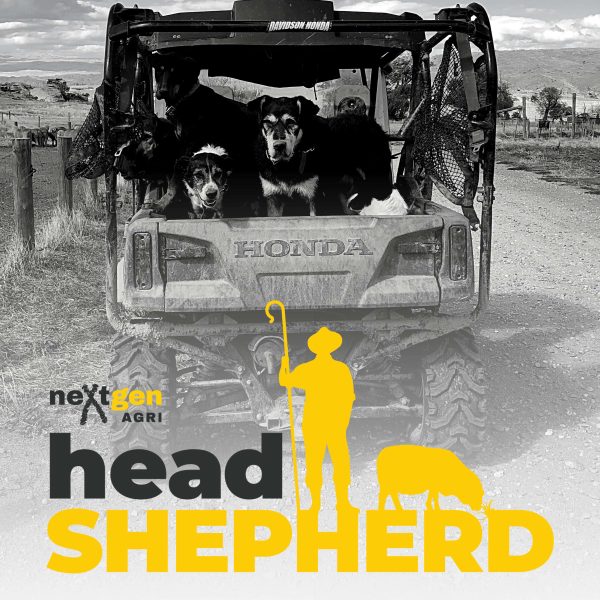
Head Shepherd
- Episodes
- 313
- Released
- weekly
- Latest episode
- Nov 8, 2026
About the podcast
Mark Ferguson from neXtgen Agri brings you the latest in livestock, genetics, innovation and technology. We focus on sheep and beef farming in Australia and New Zealand, and the people doing great things in those industries. To learn more about neXtgen Agri, visit www.nextgenagri.com.
Contributors
- Mark FergusonHost
Episodes 313
Heavier calves, more cows and better grass with Halter
There’s been plenty of talk about Halter across the sheep and beef industry. But how much more is it than simply "shifting" a mob of cows?Our guest this week, Toby Hurley, chats with Ferg to discuss how the …
Show notes
There’s been plenty of talk about Halter across the sheep and beef industry. But how much more is it than simply "shifting" a mob of cows?
Our guest this week, Toby Hurley, chats with Ferg to discuss how the technology is developing and the results customers are seeing in their productivity.
Toby is Director of Product at Halter, where he has worked for almost six years after moving across from commercial litigation. He started as the company’s first product manager and led the pasture side of the business before taking on the wider product role.
Halter began with virtual fencing, but their technology now gives farmers access to a much broader range of information about their livestock and pastures. Toby explains how and why that development has happened, and what farmers are starting to achieve with it.
One Queensland beef operation has increased its breeding cow carrying capacity by 30% since adopting Halter. There are also some interesting flow-on effects for calf and lamb weaning weights, as better grazing control changes how feed is used across the entire farm.
Ferg also asks the question many sheep farmers will be interested in: could Halter eventually work for sheep?
Head Shepherd is brought to you by neXtgen Agri International Limited.
We help livestock farmers get the most out of the genetics they farm with. Get in touch with us if you would like to hear more about how we can help you do what you do best: [email protected].
Thanks to our sponsors at MSD Animal Health and Allflex, Heiniger Australia and New Zealand, and ProWay Livestock Equipment. Please consider them when making product choices, as they are instrumental in enabling us to bring you this podcast each week.
Check out the MSD range HERECheck out Allflex products HERE
Check out Heiniger's product range HERE
Check out ProWay's product range HERE
Breeding cattle for performance and adaptability at Ben Nevis Angus
Are we sometimes too focused on chasing the top end of individual traits rather than removing the bottom end? At Ben Nevis Angus, Erica Halliday combines performance data, visual assessment and generations of …
Show notes
Are we sometimes too focused on chasing the top end of individual traits rather than removing the bottom end? At Ben Nevis Angus, Erica Halliday combines performance data, visual assessment and generations of cattle breeding experience to get their genetic bell curve moving in the right direction.
In this episode, Ferg catches up with Erica to hear how Ben Nevis Angus has evolved since her father established the stud in 1947. Now running the business with her husband Stu, Erica shares the thinking behind their breeding programme, including the move towards selling yearling bulls and the role genomics is playing in their selection decisions. They also talk about how technologies such as IVF and virtual fencing are changing the way they operate.
Erica was recently elected to the board of Cattle Australia and shares why she wanted to take on the role, along with her thoughts on the future of the beef industry.
Head Shepherd is brought to you by neXtgen Agri International Limited.
We help livestock farmers get the most out of the genetics they farm with. Get in touch with us if you would like to hear more about how we can help you do what you do best: [email protected].
Thanks to our sponsors at MSD Animal Health and Allflex, Heiniger Australia and New Zealand, and ProWay Livestock Equipment. Please consider them when making product choices, as they are instrumental in enabling us to bring you this podcast each week.
Check out the MSD range HERECheck out Allflex products HERE
Check out Heiniger's product range HERE
Check out ProWay's product range HERE
Animal health planning for sheep and beef farms with Dr Dave Robertson
Dave Robertson is a large animal vet at Oamaru’s Vet Centre, with a lifelong interest in sheep breeding and a particular focus on helping sheep and beef farmers understand and improve all elements of animal …
Show notes
Dave Robertson is a large animal vet at Oamaru’s Vet Centre, with a lifelong interest in sheep breeding and a particular focus on helping sheep and beef farmers understand and improve all elements of animal health.
Growing up in a fifth-generation farming family in West Otago, Dave developed an early interest in sheep genetics, starting with ten Romney sheep at the age of ten. After studying biochemistry at Otago, he went on to veterinary science, building experience across different farming systems and developing a particular interest in fine-wool sheep.
In this episode, Dave shares what he has learnt from years of working with farmers on some of the industry’s persistent challenges, including footrot and drench resistance. He outlines his five systems of worm control, explains why managing parasites requires more than choosing the right drench, and discusses the role of grazing management, monitoring and genetics in building healthier, more productive flocks.
Dave also talks about his own journey from breeding Southdowns to developing Rocket Rams, combining New Zealand and Australian terminal genetics to meet the needs of fine-wool and mid-micron sheep systems.If you're looking to get on top of footrot, rethink your worm control programme or understand where genetics fit into healthier flocks, make sure to tune in to this week's episode.
Head Shepherd is brought to you by neXtgen Agri International Limited.
We help livestock farmers get the most out of the genetics they farm with. Get in touch with us if you would like to hear more about how we can help you do what you do best: [email protected].
Thanks to our sponsors at MSD Animal Health and Allflex, Heiniger Australia and New Zealand, and ProWay Livestock Equipment. Please consider them when making product choices, as they are instrumental in enabling us to bring you this podcast each week.
Check out the MSD range HERECheck out Allflex products HERE
Check out Heiniger's product range HERE
Check out ProWay's product range HERE
Using carcass feedback to improve lamb production with Isabele Roberts
What can carcass feedback tell us about breeding better lambs? Our guest this week, Isabele Roberts, shares how six years of carcass data, research and on-farm trials have shaped her approach to lamb …
Show notes
What can carcass feedback tell us about breeding better lambs?
Our guest this week, Isabele Roberts, shares how six years of carcass data, research and on-farm trials have shaped her approach to lamb production.
Isabele runs Ridgehaven, a family sheep business in New South Wales that combines a stud, commercial lamb production and a research program. With her husband, sister and brother, she manages three properties covering 3,200 hectares, focusing on breeding sheep that meet the needs of businesses further along the supply chain.
Isabele has been involved in the Gundagai Lamb program since its early research work in 2020, using carcass feedback to understand how genetics, nutrition and management influence eating quality. The information has changed how Ridgehaven finishes lambs and selects rams, with different breeding priorities depending on the processor and the product required. She shares what the research has taught her about intramuscular fat, growth and the trade-offs involved in breeding lambs that can reach market specifications at a young age.
For Isabele, the aim is to work backwards from the end product, using performance data and visual assessment together to make better breeding decisions. She also sees producer and processor feedback as an opportunity for the wider lamb industry to improve production systems and deliver a more consistent product to consumers.
Head Shepherd is brought to you by neXtgen Agri International Limited.
We help livestock farmers get the most out of the genetics they farm with. Get in touch with us if you would like to hear more about how we can help you do what you do best: [email protected].
Thanks to our sponsors at MSD Animal Health and Allflex, Heiniger Australia and New Zealand, and ProWay Livestock Equipment. Please consider them when making product choices, as they are instrumental in enabling us to bring you this podcast each week.
Check out the MSD range HERECheck out Allflex products HERE
Check out Heiniger's product range HERE
Check out ProWay's product range HERE
Ferg's thoughts on replacement ewe selection
Selecting replacement ewe lambs is an opportunity to make more genetic progress in a flock, but how much are we missing when selection relies on visual assessment alone?In this episode, Ferg shares his thoughts …
Show notes
Selecting replacement ewe lambs is an opportunity to make more genetic progress in a flock, but how much are we missing when selection relies on visual assessment alone?
In this episode, Ferg shares his thoughts on improving replacement ewe selection. He explains how environmental effects can influence what we see in the yards, and why putting objective scores around those observations can lead to better selection decisions.
Ferg also explains how neXtRank accounts for environmental effects and trait heritability to rank animals against a flock's breeding objective, giving producers an opportunity to make better use of the information they collect without adding unnecessary cost or complexity to the process.
Get in touch today if you're interested in using neXtRank within your business
Head Shepherd is brought to you by neXtgen Agri International Limited.
We help livestock farmers get the most out of the genetics they farm with. Get in touch with us if you would like to hear more about how we can help you do what you do best: [email protected].
Thanks to our sponsors at MSD Animal Health and Allflex, Heiniger Australia and New Zealand, and ProWay Livestock Equipment. Please consider them when making product choices, as they are instrumental in enabling us to bring you this podcast each week.
Check out the MSD range HERECheck out Allflex products HERE
Check out Heiniger's product range HERE
Check out ProWay's product range HERE
Understanding immune competence and worm resistance in sheep with Emma Noble-Campbell
neXtResist can tell you which sheep are fighting off worms, even when worm numbers are low. Emma Noble-Campbell has been running the test for New Zealand breeders since she joined us in February.Emma grew up on …
Show notes
neXtResist can tell you which sheep are fighting off worms, even when worm numbers are low. Emma Noble-Campbell has been running the test for New Zealand breeders since she joined us in February.
Emma grew up on a sheep and beef farm in the North Island, studied agricultural science at Lincoln and did her honours on worm resistance and immunity in sheep. Since joining neXtgen, she has set up our "Spit Lab" (in Ferg's garage!) and is now running neXtResist, the SwabTec saliva test, for New Zealand breeders.
Emma and Ferg talk through how the test works. It measures the antibodies in a sheep's saliva against a protein worms release during infection, so it picks up variation between animals even when worm pressure is low, meaning it is not a requirement to push sheep to high egg counts to measure resistance.
Mark and Emma also discuss SHIELD, our new project on immune competence, worm resistance, whole body energy and hoof health. These are the four things we see going wrong most often on farms, and once one element fails, others tend to follow, and the sheep goes downhill. The aim is to breed sheep that are less likely to start down that path, without giving up production.
Tune in to hear more about SHIELD and how you can get involved.
Sign up to our newsletter to read more about SwabTec
If you would like to test your antibody levels with neXtResist, get in touch with Emma at [email protected]
Head Shepherd is brought to you by neXtgen Agri International Limited.
We help livestock farmers get the most out of the genetics they farm with. Get in touch with us if you would like to hear more about how we can help you do what you do best: [email protected].
Thanks to our sponsors at MSD Animal Health and Allflex, Heiniger Australia and New Zealand, and ProWay Livestock Equipment. Please consider them when making product choices, as they are instrumental in enabling us to bring you this podcast each week.
Check out the MSD range HERECheck out Allflex products HERE
Check out Heiniger's product range HERE
Check out ProWay's product range HERE
Pulling the future towards you with Gus Balbontin
Join us to celebrate our 300th episode! For anyone lucky enough to attend LambEx this year, Gus Balbontin was one of our favourite speakers. So, when he agreed to come on for our special 300th episode, we were …
Show notes
Join us to celebrate our 300th episode!
For anyone lucky enough to attend LambEx this year, Gus Balbontin was one of our favourite speakers. So, when he agreed to come on for our special 300th episode, we were beyond excited.
The messages Gus shared during his talk have stuck with many. He challenged (and succeeded) in getting us to think differently and to question any long-standing assumptions we'd had.
Gus grew up in sheep country in Patagonia before leaving Argentina at the age of 17 because of "a healthy disregard for the status quo". By 22, he'd dropped out of university, hitchhiked across South America, started his first business and landed his dream job at Lonely Planet, giving him a front-row seat to the disruption that came alongside the internet and ensuing technology boom.
These days, Gus is an investor, founder, advisor, and speaker, working across startups, AI, robotics, 3D-printed wheelchairs, and climate technology. Gus doesn’t claim to know exactly what the future will look like. Instead, he argues that we should be getting better at adapting to whatever comes next.
He talks about why successful businesses and farms can become comfortable with systems that have worked for years, which is why disruption often looks ridiculous before it becomes obvious.
His advice is to stop waiting for the future to become clear and start playing with it now. Try something unfamiliar. Follow a new idea down a rabbit hole. Make a small experiment. See what happens.
We couldn't have asked for a better guest for our 300th episode. We hope this gives you a chance to think about staying relevant, challenging assumptions and being willing to rethink things that have worked well for a long time.
Head Shepherd is brought to you by neXtgen Agri International Limited.
We help livestock farmers get the most out of the genetics they farm with. Get in touch with us if you would like to hear more about how we can help you do what you do best: [email protected].
Thanks to our sponsors at MSD Animal Health and Allflex, Heiniger Australia and New Zealand, and ProWay Livestock Equipment. Please consider them when making product choices, as they are instrumental in enabling us to bring you this podcast each week.
Check out the MSD range HERECheck out Allflex products HERE
Check out Heiniger's product range HERE
Check out ProWay's product range HERE
The changing role of breed societies with John Yates
John Yates has spent the past 18 years helping develop the British Texel Sheep Society, including bringing performance recording in house and building the iTexel database. Rather than relying on an external …
Show notes
John Yates has spent the past 18 years helping develop the British Texel Sheep Society, including bringing performance recording in house and building the iTexel database. Rather than relying on an external system, the Society has developed an evaluation around the information its breeders are collecting and the breeding goals of a terminal sire breed.
John chats with Ferg about that evolution and the thinking behind it. For him, breed development has to maintain focus on what commercial producers need from a terminal sire, which means making data easier for breeders to collect and use, putting economic value on traits, and using genomics to ensure accuracy within the breed.
With around a third of UK sires having texel genetics, this development has been quite influential for sheep producers there. It is an interesting concept, and worth a listen for anyone wondering what a breed society could be doing with the data it already holds.
Head Shepherd is brought to you by neXtgen Agri International Limited.
We help livestock farmers get the most out of the genetics they farm with. Get in touch with us if you would like to hear more about how we can help you do what you do best: [email protected].
Thanks to our sponsors at MSD Animal Health and Allflex, Heiniger Australia and New Zealand, and ProWay Livestock Equipment. Please consider them when making product choices, as they are instrumental in enabling us to bring you this podcast each week.
Check out the MSD range HERECheck out Allflex products HERE
Check out Heiniger's product range HERE
Check out ProWay's product range HERE
From the shearing shed to sheep genetics with Reece Michelle
Our newest consultant, Reece Michelle, took a slightly roundabout route into his new role with neXtgen Agri, from studying agricultural science at Lincoln and working with Headwaters to shearing and fencing …
Show notes
Our newest consultant, Reece Michelle, took a slightly roundabout route into his new role with neXtgen Agri, from studying agricultural science at Lincoln and working with Headwaters to shearing and fencing before moving across the Tasman.
Now splitting his time between neXtgen Agri and Murdoch University, Reece chats with Ferg about his move to WA, the work he’ll be doing with sheep breeders and researchers which includes the Smart Ewe project and heat tolerance work.
Get in touch at [email protected] if you'd like to know more about these projects or our new tool, neXtRank
Head Shepherd is brought to you by neXtgen Agri International Limited.
We help livestock farmers get the most out of the genetics they farm with. Get in touch with us if you would like to hear more about how we can help you do what you do best: [email protected].
Thanks to our sponsors at MSD Animal Health and Allflex, Heiniger Australia and New Zealand, and ProWay Livestock Equipment. Please consider them when making product choices, as they are instrumental in enabling us to bring you this podcast each week.
Check out the MSD range HERECheck out Allflex products HERE
Check out Heiniger's product range HERE
Check out ProWay's product range HERE
Maximising eating quality and profitability in sheep with David Packer
This episode comes from our Productivity & Profitability podcast, produced in partnership with Meat & Livestock Australia.How do you breed a lamb that consistently delivers a better eating experience?For …
Show notes
This episode comes from our Productivity & Profitability podcast, produced in partnership with Meat & Livestock Australia.
How do you breed a lamb that consistently delivers a better eating experience?
For decades, sheep producers have been selecting for traits they could easily measure, including growth, fertility and lean meat yield. But eating quality has remained far more difficult to quantify, despite being one of the biggest drivers of consumer satisfaction and long-term demand.
On this episode, Mark chats with David Packer, Program Manager – CarcaseValue at Meat & Livestock Australia, to explore how advances in meat science are changing that.
Whether you're interested in genetics, processing, meat science or producing lambs that better meet consumer expectations, this episode shows just how rapidly objective carcase measurement is reshaping sheep breeding.
Head Shepherd is brought to you by neXtgen Agri International Limited.
We help livestock farmers get the most out of the genetics they farm with. Get in touch with us if you would like to hear more about how we can help you do what you do best: [email protected].
Thanks to our sponsors at MSD Animal Health and Allflex, Heiniger Australia and New Zealand, and ProWay Livestock Equipment. Please consider them when making product choices, as they are instrumental in enabling us to bring you this podcast each week.
Check out the MSD range HERECheck out Allflex products HERE
Check out Heiniger's product range HERE
Check out ProWay's product range HERE
Redefining the Corriedale with Peter Blackwood
Most breeders pick one thing to improve. Peter Blackwood picked several. When he and his wife Claire took over a Corriedale stud in 2006, they committed to lifting fertility, carcass shape and wool fineness …
Show notes
Most breeders pick one thing to improve. Peter Blackwood picked several. When he and his wife Claire took over a Corriedale stud in 2006, they committed to lifting fertility, carcass shape and wool fineness - all at once - by using ASBVs.
Two decades later, they've lifted lambing from 110% to 150%, and reduced micron from 28 to 22-24. Peter also says his sheep are shorter and stockier, with better shape and cleaner points, including bare heads. Apparently 10 years on the crutching trailers will do that to a farmer!
The Performance Corriedale Group, which Peter helped found, conducted a three-year eating quality trial on more than 700 lambs, developing the first genomic tools to predict meat quality in Corriedales, which, as it turned out, had higher intramuscular fat on average than industry benchmarks at 4.6% and some lambs even reaching above 10% IMF.
Peter says he sees the Corriedale as an 'all-rounder' breed rather than a 'dual-purpose' breed. After 20 years of breeding for good structure, fertility, wool and carcase, Peter now sees an opportunity for the Corriedale in modern prime lamb systems, particularly where producers can make the wool pay for the sheep enterprise and let the lambs carry the remaining costs.
Tune in to hear how Peter and Claire proved you don't have to pick between traits. You can breed a sheep that does fertility, carcass and wool well, all at the same time.
Head Shepherd is brought to you by neXtgen Agri International Limited.
We help livestock farmers get the most out of the genetics they farm with. Get in touch with us if you would like to hear more about how we can help you do what you do best: [email protected].
Thanks to our sponsors at MSD Animal Health and Allflex, Heiniger Australia and New Zealand, and ProWay Livestock Equipment. Please consider them when making product choices, as they are instrumental in enabling us to bring you this podcast each week.
Check out the MSD range HERECheck out Allflex products HERE
Check out Heiniger's product range HERE
Check out ProWay's product range HERE
Questioning tradition in Merino breeding with Dom Hallam
Looking to change your Merino genetics? What actually happens when you switch types? For our guest this week, Dom Hallam, it started with his parents.Coming from a traditional fine wool background, they began …
Show notes
Looking to change your Merino genetics? What actually happens when you switch types? For our guest this week, Dom Hallam, it started with his parents.
Coming from a traditional fine wool background, they began looking for something different, eventually bringing sheep from New England into their flock. The change was rapid, and before long the sheep looked very different. His parents' willingness to try something new eventually led them into breeding their own rams and establishing the Cooee Merino stud.
A few years ago, Dom came across a type of Merino that caught his attention when 'browsing sheep on the internet', as one does. Those sheep were Konsortium Merinos. Originally from South Africa, they have been bred in Australia to become a very fertile, wrinkle-free Merino with great meat attributes. Dom travelled to see the sheep and decided he was bringing some home with him. Tune in to see how they've performed and how he's planning to cross them with his original flock.
Before he returned to the family farm, Dom spent time in the US studying horse dentistry. What he learnt about skull structure and dentition has stayed with him, and he now considers those same principles when breeding sheep. He has some unique insights into issues such as undershot jaws.
For Dom, the interesting part of breeding is that there is always another question to ask and another change to make. The best advice he learnt from his parents? 'You can't change unless you change.'
Ferg is out and about on the road over the coming weeks. Catch him at the following events:
- 28 August – Precision, productivity and profit (workshop)
- 8 September – Pooginook Poll Merino open day
- 9 September – Mumblebone open day
Head Shepherd is brought to you by neXtgen Agri International Limited.
We help livestock farmers get the most out of the genetics they farm with. Get in touch with us if you would like to hear more about how we can help you do what you do best: [email protected].
Thanks to our sponsors at MSD Animal Health and Allflex, Heiniger Australia and New Zealand, and ProWay Livestock Equipment. Please consider them when making product choices, as they are instrumental in enabling us to bring you this podcast each week.
Check out the MSD range HERECheck out Allflex products HERE
Check out Heiniger's product range HERE
Check out ProWay's product range HERE
Ferg’s thoughts on putting a dollar value on genetic change
What is a trait actually worth to a farming business?Ferg has spent much of his career talking about the value of genetics, but it hasn't always been easy to put that value into real dollar terms that …
Show notes
What is a trait actually worth to a farming business?
Ferg has spent much of his career talking about the value of genetics, but it hasn't always been easy to put that value into real dollar terms that apply to individual farming businesses.
In this episode, Ferg explains how we plan to work out the dollar value of genetic performance with the use of our new tool, neXtProfit.
Ferg explains that it's not as simple as putting a price on an extra lamb or another kilogram of wool, because each change has a whole range of small on-farm impacts. For example, the extra feed and pasture consumed by that additional animal, and the flow-on effects on labour and farm management; or the extra chemical and labour required to manage a daggier animal.
Tune in to hear how we're planning on helping farmers put a dollar value on genetic change.
Head Shepherd is brought to you by neXtgen Agri International Limited.
We help livestock farmers get the most out of the genetics they farm with. Get in touch with us if you would like to hear more about how we can help you do what you do best: [email protected].
Thanks to our sponsors at MSD Animal Health and Allflex, Heiniger Australia and New Zealand, and ProWay Livestock Equipment. Please consider them when making product choices, as they are instrumental in enabling us to bring you this podcast each week.
Check out the MSD range HERECheck out Allflex products HERE
Check out Heiniger's product range HERE
Check out ProWay's product range HERE
Data driven sheep breeding at Hannaton with Jonno Hicks
What's the difference between a sheep that looks "right" and a sheep that breeds "right"? Jonno Hicks from Hannaton Poll Merinos and White Suffolks, reckons he's finally found the answer.In this …
Show notes
What's the difference between a sheep that looks "right" and a sheep that breeds "right"? Jonno Hicks from Hannaton Poll Merinos and White Suffolks, reckons he's finally found the answer.
In this week's episode, Jonno talks through his shift from visual assessment to genomics and data-driven breeding, and why the first years weren't the easiest- despite employing a "guy in New Zealand he heard on a podcast".
At Hannaton, they now record fleece attributes, carcass traits, structural traits and much more, and make the most of that data by using genomics and neXtgen Agri indices to balance progress across all of them.
Tune in to hear a great yarn between two people who spend way too much time thinking about sheep genetics.
Head Shepherd is brought to you by neXtgen Agri International Limited.
We help livestock farmers get the most out of the genetics they farm with. Get in touch with us if you would like to hear more about how we can help you do what you do best: [email protected].
Thanks to our sponsors at MSD Animal Health and Allflex, Heiniger Australia and New Zealand, and ProWay Livestock Equipment. Please consider them when making product choices, as they are instrumental in enabling us to bring you this podcast each week.
Check out the MSD range HERECheck out Allflex products HERE
Check out Heiniger's product range HERE
Check out ProWay's product range HERE
How hoof overgrowth impacts bone structure and long-term lameness with Laura Deeming
Ever wondered what's actually happening inside an overgrown hoof? And can you fix it once the damage is done?Our guest this week looked into just that. Dr Laura Deeming did her PhD with Massey University …
Show notes
Ever wondered what's actually happening inside an overgrown hoof? And can you fix it once the damage is done?
Our guest this week looked into just that. Dr Laura Deeming did her PhD with Massey University and AgResearch on dairy goat hoof health. Many dairy goats are not hoof trimmed until their first lactation, which, at that point, feet can already be very overgrown.
One of her key questions was whether starting trimming earlier would help lifetime foot health. Laura worked with equine vets to X-ray the internal structures of overgrown hooves pre- and post-trimming. She found the joint angles and bone rotation inside the lower hoof were significantly affected by hoof overgrowth.
There is growing evidence, that prolonged hoof overgrowth and changes to the weight bearing surface of the hoof can result in bony growths and distortion within the hoof, which increases the risk of having chronically lame animals.
As part of her PhD, Laura also developed a 5-point gait scoring system to help identify lameness earlier so that these long-term issues wouldn't occur.
Initially, using the systems in place at the time, 81% of animals came back "normal". When she re-scored them using her scoring system that included an "uneven gait" category, only 36% were classified as "normal".
This allowed animals to be identified before they were severely lame or overgrown and long-term issues were caused, and it also proves that a more detailed scoring system improves the precision of measurement.
Mark and Laura also discuss the role of hoof colour, white line separation, foot baths, and the genetic component to hoof conformation.
A great listen for any foot-health nerds out there!
You can read Laura's thesis here:
https://mro.massey.ac.nz/items/d72eb0f2-8fa1-4516-9a1a-273a822b4d8e
Head Shepherd is brought to you by neXtgen Agri International Limited.
We help livestock farmers get the most out of the genetics they farm with. Get in touch with us if you would like to hear more about how we can help you do what you do best: [email protected].
Thanks to our sponsors at MSD Animal Health and Allflex, Heiniger Australia and New Zealand, and ProWay Livestock Equipment. Please consider them when making product choices, as they are instrumental in enabling us to bring you this podcast each week.
Check out the MSD range HERECheck out Allflex products HERE
Check out Heiniger's product range HERE
Check out ProWay's product range HERE
Adding more value to every wool clip with Willy McSkimming
Willy McSkimming is modernising the shearing industry with a new app and an improved focus on wool classing and quality. After 23 years running a major contracting operation with his wife Tess, he's now …
Show notes
Willy McSkimming is modernising the shearing industry with a new app and an improved focus on wool classing and quality. After 23 years running a major contracting operation with his wife Tess, he's now doing things differently. Not happy with being left behind in comparison to other industries, and considering theres an "app for everything", Willy decided to develop an app for the shearing industry whilst healing from a knee replacement.
Tune in to hear Willy explain what the app does, as well as his newly appointed Operations & People Lead, Nic Blanchard.
Check out the app here:
https://www.theshearingboard.app/
Head Shepherd is brought to you by neXtgen Agri International Limited.
We help livestock farmers get the most out of the genetics they farm with. Get in touch with us if you would like to hear more about how we can help you do what you do best: [email protected].
Thanks to our sponsors at MSD Animal Health and Allflex, Heiniger Australia and New Zealand, and ProWay Livestock Equipment. Please consider them when making product choices, as they are instrumental in enabling us to bring you this podcast each week.
Check out the MSD range HERECheck out Allflex products HERE
Check out Heiniger's product range HERE
Check out ProWay's product range HERE
Using genomics to pick better replacement heifers with Geoff Hayes
How do you actually pick which heifers to keep? For many, selecting the top ones is easy, but it's those middle ones that are hard to choose between. For this week's guest, Geoff Hayes, the answer is …
Show notes
How do you actually pick which heifers to keep? For many, selecting the top ones is easy, but it's those middle ones that are hard to choose between.
For this week's guest, Geoff Hayes, the answer is genomics. Geoff and his wife Belinda started their Angus stud just 5 years ago, but began their genomic journey early, not wanting to pick bulls on looks alone from the very beginning.
"I was hesitant just to go and pick them visually," Geoff explains. "We need to put some science into it."
They began with a base genomic test across a random selection of purchased cattle, which showed them that they were fine for IMF, but needed to increase ribeye area, and that became the main basis of their early selection focus.
Over time, that focus shifted. Rather than just chasing carcass traits, they started looking for sires out of cow families with longevity in the background. This introduced more of a focus on the maternal and stayability traits.
Geoff still tests his own weaners before deciding which ones to keep and that same mindset is now extending to heifers, with Geoff part of MLA's heifer PDS project. The project involves genotyping heifers, alongside visual measurements to help guide replacement decisions. This project is ongoing, and we will have results to share in the coming years.
Mark and Geoff finish by talking about where the beef industry is headed with record property and beef values, as well as the possibilities of new technology just around the corner.
Optimised Heifer Selection is a Producer Demonstration Site (PDS) project funded by Meat & Livestock Australia and facilitated by neXtgen Agri. Geoff Hayes is a core producer demonstration site for this project. If you would like to learn more about this PDS project, you can visit the Heifer Selection Hub page or contact: Georgia Pugh, neXtgen Agri M: +61 408 947 488 E: [email protected]
Head Shepherd is brought to you by neXtgen Agri International Limited.
We help livestock farmers get the most out of the genetics they farm with. Get in touch with us if you would like to hear more about how we can help you do what you do best: [email protected].
Thanks to our sponsors at MSD Animal Health and Allflex, Heiniger Australia and New Zealand, and ProWay Livestock Equipment. Please consider them when making product choices, as they are instrumental in enabling us to bring you this podcast each week.
Check out the MSD range HERECheck out Allflex products HERE
Check out Heiniger's product range HERE
Check out ProWay's product range HERE
The science of farming with Pete Fennessy
Pete Fennessy has spent more than fifty years involved in science, genetics and livestock production, helping shape many of the ideas that transformed New Zealand’s sheep and deer industries. Pete spent two …
Show notes
Pete Fennessy has spent more than fifty years involved in science, genetics and livestock production, helping shape many of the ideas that transformed New Zealand’s sheep and deer industries.
Pete spent two decades at Invermay before becoming General Manager of AgResearch’s Sheep, Deer and Equine Division, later founding AbacusBio alongside a group of colleagues and helping build it into an internationally recognised consultancy. More recently, his focus has turned to new challenges facing NZ agriculture, including methane, meat and the future direction of livestock production.
In this episode, Pete chats with Mark about the people, ideas and turning points that drove decades of productivity gains.
Head Shepherd is brought to you by neXtgen Agri International Limited.
We help livestock farmers get the most out of the genetics they farm with. Get in touch with us if you would like to hear more about how we can help you do what you do best: [email protected].
Thanks to our sponsors at MSD Animal Health and Allflex, Heiniger Australia and New Zealand, and ProWay Livestock Equipment. Please consider them when making product choices, as they are instrumental in enabling us to bring you this podcast each week.
Check out the MSD range HERECheck out Allflex products HERE
Check out Heiniger's product range HERE
Check out ProWay's product range HERE
The process of precision sheep farming with Joshua Barton
This week on the podcast we have Joshua Barton chatting to Mark about the benefits of precision sheep management and the results it can get you. Josh is currently stockman at Hillcroft Farms and recently shared …
Show notes
This week on the podcast we have Joshua Barton chatting to Mark about the benefits of precision sheep management and the results it can get you.
Josh is currently stockman at Hillcroft Farms and recently shared some great scanning results with us as the outcome of well-planned precision lambing. Josh shares these results as well as discussing how Hillcroft’s ultra-white breeding program has evolved.Josh and Mark also cover the HF Plus gene and what it is doing for fertility and why better data is the only way forward if you want to increase your production.
Head Shepherd is brought to you by neXtgen Agri International Limited.
We help livestock farmers get the most out of the genetics they farm with. Get in touch with us if you would like to hear more about how we can help you do what you do best: [email protected].
Thanks to our sponsors at MSD Animal Health and Allflex, Heiniger Australia and New Zealand, and ProWay Livestock Equipment. Please consider them when making product choices, as they are instrumental in enabling us to bring you this podcast each week.
Check out the MSD range HERECheck out Allflex products HERE
Check out Heiniger's product range HERE
Check out ProWay's product range HERE
Building resilient farming businesses to keep up with global demand, with Richard Green
How do Australian and New Zealand farmers stay competitive when the rest of the world is changing faster than ever?For our guest this week, Richard Green, it starts by accepting that yesterday's thinking …
Show notes
How do Australian and New Zealand farmers stay competitive when the rest of the world is changing faster than ever?
For our guest this week, Richard Green, it starts by accepting that yesterday's thinking will not solve tomorrow's problems.
"It frustrates the hell out of me when I hear us talk about 'We're the best farmers in the world.'" explains Richard. "And we may have been, but that's a moment in time. There's so much change, progress and disruption happening around the world. We're only as good as how we were yesterday, and every day we've got to improve."
Richard's recent travels gave him new insight into where the world and the red meat sector are going. He explains the concept of a hybrid consumer where some people are shopping for experiences and absolute luxury... And then there are the "normal" people who shop at the value end who still want quality, but want as much value within that as possible. And, as Richard explains, the "middle" has been completely hollowed out.
"Commit to volume and efficiency, or commit to a genuine premium value proposition. Half-measures won't cut it." explains Richard. "If you're competing on a commodity, compete hard and be exceptional at it. If you're not, build a differentiated supply chain with genuine partners - offshore, in-market, and at the processing end."
He explains how the South American commodity powerhouses have been doing it well, by scaling their surpluses into global supply chains and manufacturing, and how we could take some lessons from them.
Mark and Richard also cover Cultivate Ventures, the growth fund Richard chairs. Born partly from a goal he set himself, Richard realised money made in the industry wasn't going to flow to the farmers, it was going to flow to where the capital returns- aka the investors.. So they decided they had to invest in these disruptive businesses to ensure farmers got their share of the success.
They finish the conversation discussing the relationship between physical challenge and business mindset. Richard is no stranger to an intense physical challenge. He has run the Kepler, one of New Zealand's great walks (that usually takes 3 days) in a day, and ridden the length of both islands by bike.
"If I'm challenging myself physically, it helps me be more positive about life..." he explains. "It just realises that you are as an individual capable of a lot more, and if you realise that, then it helps you drive your businesses to be capable of a lot more too."
Head Shepherd is brought to you by neXtgen Agri International Limited.
We help livestock farmers get the most out of the genetics they farm with. Get in touch with us if you would like to hear more about how we can help you do what you do best: [email protected].
Thanks to our sponsors at MSD Animal Health and Allflex, Heiniger Australia and New Zealand, and ProWay Livestock Equipment. Please consider them when making product choices, as they are instrumental in enabling us to bring you this podcast each week.
Check out the MSD range HERECheck out Allflex products HERE
Check out Heiniger's product range HERE
Check out ProWay's product range HERE
Growing grass for sheep, stadiums and everything in between with George Fell
Long before performance recording became mainstream, George Fell's grandfather was building a sheep breeding programme around growth, efficiency and measured performance on pasture. Unable to find the …
Show notes
Long before performance recording became mainstream, George Fell's grandfather was building a sheep breeding programme around growth, efficiency and measured performance on pasture. Unable to find the genetics he wanted, he created them himself.
Today, that same mindset runs through everything at Fell's Yorkshire farming business. Alongside the Meatlinc sheep breeding programme, the family operates a diverse farming enterprise that includes Premier League-level turf production, free-range eggs and dairy beef finishing.
In this episode, George joins Mark to discuss the origins of the Meatlinc breed, the role performance recording has played in its development, and the current state of the UK sheep industry. They also discuss how a sheep breeding business evolved into one of the UK's leading turf producers and why the same principles of performance and continuous improvement underpin both enterprises.
George is also Chair of the Sheep Breeders Round Table and discusses this year's conference, where Mark will be a guest speaker.
UK Sheep Breeders Roundtable Conference 2026
Head Shepherd is brought to you by neXtgen Agri International Limited.
We help livestock farmers get the most out of the genetics they farm with. Get in touch with us if you would like to hear more about how we can help you do what you do best: [email protected].
Thanks to our sponsors at MSD Animal Health and Allflex, Heiniger Australia and New Zealand, and ProWay Livestock Equipment. Please consider them when making product choices, as they are instrumental in enabling us to bring you this podcast each week.
Check out the MSD range HERECheck out Allflex products HERE
Check out Heiniger's product range HERE
Check out ProWay's product range HERE
Turning grass into money - this time with cattle, with Joe Kerin
What does a cow actually cost to run?At Kerin Ag, every kilogram of utilisable feed has a value attached to it. That allows Joe Kerin and the team to measure whether an animal is genuinely paying its way.In …
Show notes
What does a cow actually cost to run?
At Kerin Ag, every kilogram of utilisable feed has a value attached to it. That allows Joe Kerin and the team to measure whether an animal is genuinely paying its way.
In this episode, Joe joins Mark to discuss how putting a dollar value on each kilogram of grass they grow led them to choose Wagyu over Angus. As any Kerin would, Joe has done the numbers and compared Wagyu cows with larger recipient cows, based on the weaning weight of their calves relative to the kg of dry matter consumed by the cows. And, as predicted, the moderate-sized cow is far more efficient than the larger Angus X recipients.
Joe also discusses the role of genomics in Wagyu breeding. As they are a breed with a very narrow gene pool and are bred for carcass-related attributes, genomics is incredibly important, and Joe utilises it to its fullest.
Tune in to learn how to turn grass into money - this time with cattle.
Head Shepherd is brought to you by neXtgen Agri International Limited.
We help livestock farmers get the most out of the genetics they farm with. Get in touch with us if you would like to hear more about how we can help you do what you do best: [email protected].
Thanks to our sponsors at MSD Animal Health and Allflex, Heiniger Australia and New Zealand, and ProWay Livestock Equipment. Please consider them when making product choices, as they are instrumental in enabling us to bring you this podcast each week.
Check out the MSD range HERECheck out Allflex products HERE
Check out Heiniger's product range HERE
Check out ProWay's product range HERE
Forty years at Wairere Romneys with Simon Buckley
Few people have had a front-row seat to the genetic improvement of New Zealand sheep quite like our guest this week, Simon Buckley.After growing up in Whangārei and starting his farming career at Castlepoint …
Show notes
Few people have had a front-row seat to the genetic improvement of New Zealand sheep quite like our guest this week, Simon Buckley.
After growing up in Whangārei and starting his farming career at Castlepoint Station, Simon joined Wairere Romneys and has never left. Four decades later, he has helped one of New Zealand's most influential sheep breeding programmes through the transition from visual selection and paper records to EID, genomics and data-driven breeding.
In this episode, Simon chats with Mark to discuss the history of Wairere and the long-term thinking required to make meaningful genetic progress. They also discuss maternal instinct, breeding sheep for commercial conditions, the challenge of balancing innovation with market demand, and the lessons he's learnt from those who have travelled through the "University of Wairere".
Grab a coffee and sit back and enjoy this one - it's a goodie!
Head Shepherd is brought to you by neXtgen Agri International Limited.
We help livestock farmers get the most out of the genetics they farm with. Get in touch with us if you would like to hear more about how we can help you do what you do best: [email protected].
Thanks to our sponsors at MSD Animal Health and Allflex, Heiniger Australia and New Zealand, and ProWay Livestock Equipment. Please consider them when making product choices, as they are instrumental in enabling us to bring you this podcast each week.
Check out the MSD range HERECheck out Allflex products HERE
Check out Heiniger's product range HERE
Check out ProWay's product range HERE
Refugia, resistance testing, and the future of worm management with Chloe Frank
Most sheep producers assume their drenches are working. Chloe Frank's job is finding out whether they actually are.After discovering how few producers in her region were monitoring worm burdens, Chloe …
Show notes
Most sheep producers assume their drenches are working. Chloe Frank's job is finding out whether they actually are.
After discovering how few producers in her region were monitoring worm burdens, Chloe launched Central Stock Health while still at university. She now travels from farm to farm delivering on-site worm egg counts and helping producers make better management decisions.
In this episode, Chloe joins Mark to discuss the challenge of drench resistance in Australia and why better information is often the missing piece in sheep management. She explains why the delays associated with traditional testing methods mean many producers still are not testing, and how her on-farm service is helping farmers access real-time results.
Chloe and Mark also discuss how she built a business from the ground up while still at university. Chloe also highlights the multiple opportunities available to young people in agriculture. However, in recording this podcast, it is obvious that her passion for making a positive, practical difference to the Ag industry has played a significant role in her success so far.If you want to get Chloe on your team, get in touch through her website here:
https://centralstockhealth.com/
Head Shepherd is brought to you by neXtgen Agri International Limited.
We help livestock farmers get the most out of the genetics they farm with. Get in touch with us if you would like to hear more about how we can help you do what you do best: [email protected].
Thanks to our sponsors at MSD Animal Health and Allflex, Heiniger Australia and New Zealand, and ProWay Livestock Equipment. Please consider them when making product choices, as they are instrumental in enabling us to bring you this podcast each week.
Check out the MSD range HERECheck out Allflex products HERE
Check out Heiniger's product range HERE
Check out ProWay's product range HERE
Data driven sheep breeding with James Trowbridge
This week on the podcast, Ferg introduces James Trowbridge, the newest consultant to join the neXtgen Agri team.James grew up in South Australia working alongside his parents, Margie and Bill Trowbridge, in …
Show notes
This week on the podcast, Ferg introduces James Trowbridge, the newest consultant to join the neXtgen Agri team.
James grew up in South Australia working alongside his parents, Margie and Bill Trowbridge, in both Merinos and the family artificial breeding business. After working across a range of farming and agribusiness roles around Australia, James now joins the neXtgen Agri team, bringing with him a strong practical background in sheep production and genetics.
If you want to get James on your team, get in touch at: [email protected]
Head Shepherd is brought to you by neXtgen Agri International Limited.
We help livestock farmers get the most out of the genetics they farm with. Get in touch with us if you would like to hear more about how we can help you do what you do best: [email protected].
Thanks to our sponsors at MSD Animal Health and Allflex, Heiniger Australia and New Zealand, and ProWay Livestock Equipment. Please consider them when making product choices, as they are instrumental in enabling us to bring you this podcast each week.
Check out the MSD range HERECheck out Allflex products HERE
Check out Heiniger's product range HERE
Check out ProWay's product range HERE
Genomic data management and the future of breeding values with Dan Garrick
What does it take to build the data systems that sit behind your genetic evaluations?This week on the podcast, Ferg catches up with Dan Garrick from Helical. Dan grew up on a sheep, beef and venison farm in the …
Show notes
What does it take to build the data systems that sit behind your genetic evaluations?
This week on the podcast, Ferg catches up with Dan Garrick from Helical. Dan grew up on a sheep, beef and venison farm in the Manawatu before moving to the US at 13, where he went on to complete a PhD in aerospace engineering at Iowa State University. He's the son of Professor Dorian Garrick, one of New Zealand's most respected animal breeding geneticists, and his grandfather was one of the world's leading experts on sharks, making Dan a third-generation PhD.
Dan explains how the same maths used to model fluid dynamics around rockets is used to generate breeding values, and how he ended up joining the family business in 2017 to help roll out some of the first production single step evaluations in the US for American Hereford and IGS. That work quickly revealed a major bottleneck in managing the genomic data flowing in from DNA testing labs. That's where Helical was born.
Ferg and Dan talk through how Helical now serves breed societies, genetics companies, universities and labs across beef, dairy, sheep, horses, dogs, aquaculture and forestry. They also look ahead at where things are going. From decision support tools and AI in commercial herds, to the potential for wearable devices like virtual fencing collars to generate entirely new breeding values nobody has thought of yet - both Dan and Ferg agree the future is bright for Agriculture.
Head Shepherd is brought to you by neXtgen Agri International Limited.
We help livestock farmers get the most out of the genetics they farm with. Get in touch with us if you would like to hear more about how we can help you do what you do best: [email protected].
Thanks to our sponsors at MSD Animal Health and Allflex, Heiniger Australia and New Zealand, and ProWay Livestock Equipment. Please consider them when making product choices, as they are instrumental in enabling us to bring you this podcast each week.
Check out the MSD range HERECheck out Allflex products HERE
Check out Heiniger's product range HERE
Check out ProWay's product range HERE
Lessons learned from LambEx with Jane Kellock
Jane Kellock joins Mark to talk through the production and business decisions that have shaped their Merino operation in South Australia’s Mid North. From running a non-mulesed flock for more than 20 years to …
Show notes
Jane Kellock joins Mark to talk through the production and business decisions that have shaped their Merino operation in South Australia’s Mid North. From running a non-mulesed flock for more than 20 years to building a breeding programme focused on lamb survival, Jane explains how genetics, condition scoring and lessons learned from attending previous LambEx conferences have helped their business through some brutal seasons.
Jane also discusses the importance of making strategic decisions before drought hits, why mixed farming regions risk losing livestock knowledge, and what producers can expect from LambEx26.
Tickets available here: https://www.lambex.org.au/tickets
Earlybird tickets finish Friday, the 15th of May.
Head Shepherd is brought to you by neXtgen Agri International Limited.
We help livestock farmers get the most out of the genetics they farm with. Get in touch with us if you would like to hear more about how we can help you do what you do best: [email protected].
Thanks to our sponsors at MSD Animal Health and Allflex, Heiniger Australia and New Zealand, and ProWay Livestock Equipment. Please consider them when making product choices, as they are instrumental in enabling us to bring you this podcast each week.
Check out the MSD range HERECheck out Allflex products HERE
Check out Heiniger's product range HERE
Check out ProWay's product range HERE
How to run a farm business your bank trusts, with Matt Hood
Matt Hood on farm succession, agribusiness banking, and building better farm businesses.Based in Marlborough, Matt has worked across sheep and beef, dairy, and viticulture businesses in both New Zealand and …
Show notes
Matt Hood on farm succession, agribusiness banking, and building better farm businesses.
Based in Marlborough, Matt has worked across sheep and beef, dairy, and viticulture businesses in both New Zealand and Australia, with a focus on succession planning, equity partnerships, and helping farm businesses make better decisions around people, capital, and structure.
Matt explains where he sees the gap between being good on the tools and being good in business. As businesses grow, priorities shift to managing people, finances, and decision-making, and that is often where performance stalls, especially during succession.
On that note, succession is a major passion for Matt. Not just how to transfer assets, but how to run the process properly by having early conversations and making sure there is actually a business worth passing on, alongside a strong emphasis on purpose, both for the next generation coming in and for those stepping back.
Matt also explains what the good, strong businesses he's come across consistently do well. It usually comes down to a good understanding of numbers, avoiding surprises, and keeping emotion out of decision-making.
Matt and Mark also discuss what "good" looks like from a banking perspective and how to build up a good relationship with your bank so that you can work together for the success of everyone.
This is an hour every farmer needs to listen to.
Head Shepherd is brought to you by neXtgen Agri International Limited.
We help livestock farmers get the most out of the genetics they farm with. Get in touch with us if you would like to hear more about how we can help you do what you do best: [email protected].
Thanks to our sponsors at MSD Animal Health and Allflex, Heiniger Australia and New Zealand, and ProWay Livestock Equipment. Please consider them when making product choices, as they are instrumental in enabling us to bring you this podcast each week.
Check out the MSD range HERECheck out Allflex products HERE
Check out Heiniger's product range HERE
Check out ProWay's product range HERE
Feet, finances and faster genetic gain with Chad Taylor from Mumblebone
You'd never ignore your interest rate, so why aren't you tracking your genetic gain? This week, Ferg catches up with Chad Taylor for an update on what has been happening at Mumblebone and the recent …
Show notes
You'd never ignore your interest rate, so why aren't you tracking your genetic gain?
This week, Ferg catches up with Chad Taylor for an update on what has been happening at Mumblebone and the recent work around footrot and feet structure they have been involved with as part of the 'Genetics of foot health in Merinos' project.
Ferg and Chad also discuss genetic gain at Mumblebone and how it is being pushed in practical terms. For example they are using ram lambs more heavily, joining ewe lambs, using genomics and utilising custom indexes in selection decisions.
Chad also explains why genetic gain should be tracked and questioned just as closely as interest rates, because both compound over time and have a direct impact on the long-term performance of the business.
Finally, Ferg and Chad discuss what supports all the progress they're making on-farm. Chad is very keen on building the right team and aligning people with the direction of the business, and he shares the impact of bringing staff into the bigger picture by "opening the books" so they know how the business operates financially.
It's always a pleasure to have Chad on the podcast. Tune in to hear a top operator's approach to breeding great sheep.
Links:
Precision Sheep HQ: https://www.precisionsheephq.com/feed
'Genetics of foot health in Merinos' project cull ram challenge: Email [email protected]
Mineral basics for healthier stock and higher returns: https://thehub.nextgenagri.com/c/events/mineral-basics-for-healthier-stock-and-higher-returns
Head Shepherd is brought to you by neXtgen Agri International Limited.
We help livestock farmers get the most out of the genetics they farm with. Get in touch with us if you would like to hear more about how we can help you do what you do best: [email protected].
Thanks to our sponsors at MSD Animal Health and Allflex, Heiniger Australia and New Zealand, and ProWay Livestock Equipment. Please consider them when making product choices, as they are instrumental in enabling us to bring you this podcast each week.
Check out the MSD range HERECheck out Allflex products HERE
Check out Heiniger's product range HERE
Check out ProWay's product range HERE
Turning lamb data into profit with Will Barton
This week, Mark catches up with Will Barton from Gundagai Meat Processors (GMP) to chat about what has changed since his last appearance on the podcast and where things are heading next for Gundagai.Gundagai …
Show notes
This week, Mark catches up with Will Barton from Gundagai Meat Processors (GMP) to chat about what has changed since his last appearance on the podcast and where things are heading next for Gundagai.
Gundagai has built a reputation for doing things differently, with a clear focus on eating quality and how that is measured and paid for.
Will explains how a focus on eating quality, particularly intramuscular fat, has shaped their grid, and why balancing that with lean meat yield and animal health has been critical to maintaining consistency. Will also explains their feedback loop between processor and producer. With full EID integration now in place, the ability to link on farm decisions directly to carcass outcomes is no longer theoretical and is now happening at scale.Head Shepherd is brought to you by neXtgen Agri International Limited.
We help livestock farmers get the most out of the genetics they farm with. Get in touch with us if you would like to hear more about how we can help you do what you do best: [email protected].
Thanks to our sponsors at MSD Animal Health and Allflex, Heiniger Australia and New Zealand, and ProWay Livestock Equipment. Please consider them when making product choices, as they are instrumental in enabling us to bring you this podcast each week.
Check out the MSD range HERECheck out Allflex products HERE
Check out Heiniger's product range HERE
Check out ProWay's product range HERE
These are the latest 40 of 313 episodes. You’ll find older episodes in the podcast’s feed.
Similar podcasts
More Education podcasts




Is this your podcast?
Confirm it with an entry in your feed: you get a code here, add it as podcast:txt to the channel of your feed, and we check it. Your podcast is then shown as “verified” on SoundNode.