

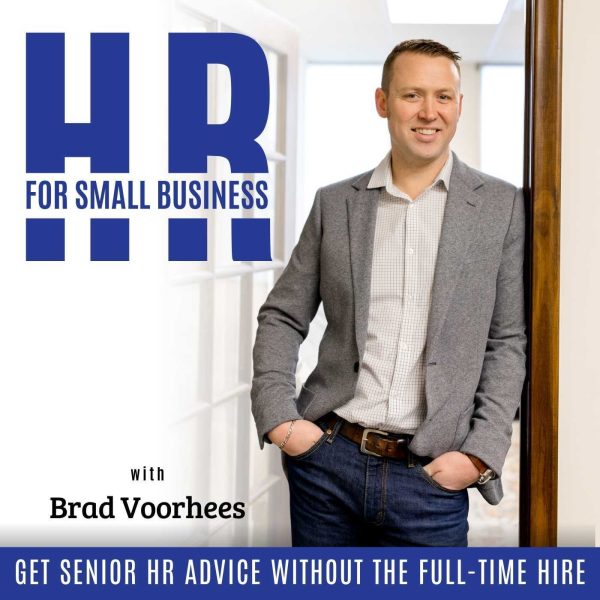
HR For Small Business I Human Resources, Onboarding, Benefits, Compliance, Hiring
- Episodes
- 49
- Released
- several times a week
- Latest episode
- Nov 12, 2026
About the podcast
Are you the one everyone comes to with HR questions… with no one to go to yourself?
You’re good at what you do. You run payroll, handle the onboarding, put out the fires. But somewhere along the way, you also became the person expected to set strategy, navigate compliance, coach managers through performance issues, and answer questions no one ever trained you for. And when you need a second opinion, the only one down the hall is a CFO or owner who’s hoping you have the answer.
That’s exactly why this podcast exists.
I’m Brad Voorhees, founder of ScaleTx HR Advisory, host of the HR For Small Business Podcast, and President of SHRM Detroit, Michigan's largest SHRM chapter. Since 2020, I’ve been the senior HR voice in the corner of HR Generalists, Specialists, and early-career HR leaders who’ve been handed the job of an HR Director without the experience, the mentor, or the playbook.
Every episode gives you practical, real-world HR guidance you can take back to work the same week, so you can stop improvising the hard calls, build the infrastructure your company is missing, and earn your seat as a strategic partner instead of the person who just keeps HR running.
If you’re tired of figuring it out alone and you’re ready to stop reacting to HR problems and start leading through them, this is for you.
Let’s elevate your HR.
Episodes 49
Episode 48 : If You Quit Tomorrow, Would Your Human Resources Department Survive?
If you were out for three weeks starting tomorrow, what's the first thing that would break — and who would find out first? Which of your judgment calls have you made so many times that you've never thought to …
Show notes
If you were out for three weeks starting tomorrow, what's the first thing that would break — and who would find out first?
Which of your judgment calls have you made so many times that you've never thought to write them down?
Does your leadership see what you've built, or only what you've handled?
Here's a question most HR generalists don't want to answer out loud.
If you quit tomorrow — or if life just took you out of the building for three weeks — would your company's HR still work?
Not "would people miss you." Of course they'd miss you. I mean: would new hires get onboarded correctly? Would the leave paperwork get filed? Would anyone know what to do when an employee walked into the owner's office with a complaint about their supervisor?
For a lot of you, the honest answer is no. And here's the part that might surprise you: that's not a compliment.
If HR only works because you're there, you don't have an HR department. You have an HR person. And everything that department is supposed to be — the processes, the calendar, the decisions, the history — is living in one place: your head.
That feels like job security. It isn't. It's a single point of failure. For the company, and for your career.
Today we're talking about infrastructure. And I promise this is not a boring episode about writing procedures. This is about the difference between an HR professional who handles things and an HR professional who builds things. Only one of those gets seen as strategic. Only one of those gets promoted.
You're going to hear a story about an HR generalist I'll call Devon, who found out exactly how much he was holding when he had to step away for three weeks. Then I'll give you five moves to get HR out of your head and into a system. Practical stuff you can start this month.
If your owner or your CFO has ever said, "I don't know, ask HR," and they meant you, personally, this one's for you.
Contact - > [email protected]
Podcast -> https://hrforsmallbusiness.podbean.com
Website - > scaletx.io
LinkedIn ->https://www.linkedin.com/in/bradleyvoorhees/
Next Steps:
Step 1: Follow me on LinkedIn, https://www.linkedin.com/in/bradleyvoorhees/, to get more Senior HR Advice without the full-time hire.
Step 2: Visit scaletx.io to book a call with me to learn more about how we can support your HR team.
Step 3: Sign up for my weekly newsletter by visiting my website, scaletx.io, and sign up!
Episode 47 : Self-Taught HR Is a Liability. Who's Mentoring You, HR Generalists?
What's one HR decision you made in the last ninety days that nobody with more experience than you ever reviewed? When you bring something to your boss, are you bringing a question or a recommendation — and what …
Show notes
What's one HR decision you made in the last ninety days that nobody with more experience than you ever reviewed?
When you bring something to your boss, are you bringing a question or a recommendation — and what would change if you only brought recommendations?
If the hardest call of your next quarter landed on your desk tomorrow, whose name would you dial first?
Let me say something that might sting a little.
If you learned HR by Googling it — by asking your CFO, by reading forum threads at eleven o'clock at night, by pulling up whatever the last person in your seat left in a shared drive — you are not failing. You are doing exactly what the job forced you to do.
But self-taught HR has a ceiling. And most HR generalists hit that ceiling without ever knowing it was there.
Here's what I mean. Somewhere in your company right now, there is a decision you made in the last few months that you would have made differently if someone with twenty years in this work had been sitting next to you. You probably don't know which one it is. That's the whole point. Nobody told you. Nobody checked.
That's not a talent problem. It's a mentorship problem. And it's one of the most common situations I walk into.
So today we're talking about mentorship. Not the warm, "go find someone to grab coffee with" version. I mean a very practical question: when you hit an HR situation you've never seen before, who is actually in your corner?
For a lot of you, the honest answer is your boss. And your boss is usually a CFO, a COO, or the owner of the company. Smart people. Well-intentioned people. People who want you to succeed. And people who were never trained to develop an HR professional, because that was never their job.
Here's what you're going to get from this episode. First, a story about an HR generalist I'll call Rachel, who did everything right on paper and still ended up holding a letter from an attorney. Then I'm going to walk you through five moves you can start this week to build the mentorship you don't have — whether or not you ever work with me. These are practical. You'll be able to do the first one before Friday.
If you're the only HR person in your building, or you're a couple of years into this and nobody has ever reviewed your judgment — not your work, your judgment — this one's for you.
Contact - > [email protected]
Podcast -> https://hrforsmallbusiness.podbean.com
Website - > scaletx.io
LinkedIn ->https://www.linkedin.com/in/bradleyvoorhees/
Next Steps:
Step 1: Follow me on LinkedIn, https://www.linkedin.com/in/bradleyvoorhees/, to get more Senior HR Advice without the full-time hire.
Step 2: Visit scaletx.io to book a call with me to learn more about how we can support your HR team.
Step 3: Sign up for my weekly newsletter by visiting my website, scaletx.io, and sign up!
Episode 46 : Stop Building Human Resources Around Whoever Happens to Be in the Room
If you didn't come in for the next month, what's the first thing that would break? And who would find out? What's one promise, arrangement, or exception at your company that exists only in someone's memory …
Show notes
If you didn't come in for the next month, what's the first thing that would break? And who would find out?
What's one promise, arrangement, or exception at your company that exists only in someone's memory, maybe yours?
Of the five builds, which one could you start this week, in thirty minutes or less?
Here's a question I ask almost every HR person I start working with.
If you didn't come in tomorrow, and you didn't come in for the next month, how much of HR at your company would keep running?
Not the stuff that's in the payroll system. Not the stuff that's in the handbook. I mean the real stuff. The deadlines you track in your head. The manager who needs a heads-up before every hard conversation. The renewal date you just know. The promise someone made to a long-time employee eight years ago that nobody wrote down.
Most people go quiet when I ask that. Then they laugh a little. Then they say some version of, "Honestly? Not much."
That's not a criticism. It's how HR gets built in small companies. It doesn't get designed. It accumulates. Around a person. Whoever happens to be in the room at the time.
And for a while, that works fine. The person is good. They remember everything. Things run.
Until that person leaves. Or gets sick. Or gets promoted. Or just gets so buried that the things they used to remember start slipping.
Then the company finds out that what it called "HR" was never really a department. It was one person's memory.
So today, I'm going to tell you about an HR generalist who inherited exactly that. A whole department that walked out the door with one person. And then I'm going to give you five things to build, starting this week, so HR at your company runs on structure instead of on whoever happens to be in the room. If you're an HR generalist, a specialist, or a newer HR manager, and you've ever thought, "If I got hit by a bus, this place would be in trouble"... this one's for you.
Contact - > [email protected]
Podcast -> https://hrforsmallbusiness.podbean.com
Website - > scaletx.io
LinkedIn ->https://www.linkedin.com/in/bradleyvoorhees/
Next Steps:
Step 1: Follow me on LinkedIn, https://www.linkedin.com/in/bradleyvoorhees/, to get more Senior HR Advice without the full-time hire.
Step 2: Visit scaletx.io to book a call with me to learn more about how we can support your HR team.
Step 3: Sign up for my weekly newsletter by visiting my website, scaletx.io, and sign up!
Episode 45 : Your HR Generalist Doesn't Need Another Certification. They Need a Mentor.
Think about the last performance issue a manager brought you. Did anyone ever ask the employee what changed? And if not, what might you have heard? When you make a heavy call, who checks your judgment, not just …
Show notes
Think about the last performance issue a manager brought you. Did anyone ever ask the employee what changed? And if not, what might you have heard?
When you make a heavy call, who checks your judgment, not just your knowledge? If the honest answer is "no one," what's that costing you?
If you went to your leadership tomorrow and said, "Here's what I know, and here's what I need," what would you ask for?
Let me start with something that might sound strange coming from me.
I love HR certifications. I've studied for them. I've watched people in our profession earn them and walk a little taller afterward. I'll cheer for every single person who sits for that exam.
But I've noticed a pattern in small companies, and I want to name it today.
When the HR person is struggling, leadership's first move is almost always the same. They buy a course. A certification. A webinar series. A conference ticket. And they say something like, "This will give you the confidence to make the big calls."
It's a generous move. It comes from a good place. The owner or the CFO genuinely wants their HR person to grow.
But here's what I've seen, over and over. The HR person comes back from that course knowing more. Absolutely. They know the law better. They know the frameworks. They can tell you what the handbook should say.
And then they go right back to making every hard call alone.
Because a certification gives you knowledge. It doesn't give you judgment. And judgment, the part where you look at a real situation with real people and figure out what's actually going on, that's something you mostly learn from someone who's done it before. Sitting next to you. Asking you the question you didn't think to ask.
That's what a mentor does. And most HR generalists in small companies don't have one.
So today I'm going to tell you about an HR generalist who did everything right on paper and still got it wrong. Then I'm going to give you five practical ways to build mentor-level judgment into your work, starting this week, whether or not you have a mentor yet. If you're an HR generalist, a specialist, or a newer HR manager, and somebody recently told you "you're certified now, you've got this"... this one's for you.
Contact - > [email protected]
Podcast -> https://hrforsmallbusiness.podbean.com
Website - > scaletx.io
LinkedIn ->https://www.linkedin.com/in/bradleyvoorhees/
Next Steps:
Step 1: Follow me on LinkedIn, https://www.linkedin.com/in/bradleyvoorhees/, to get more Senior HR Advice without the full-time hire.
Step 2: Visit scaletx.io to book a call with me to learn more about how we can support your HR team.
Step 3: Sign up for my weekly newsletter by visiting my website, scaletx.io, and sign up!
Episode 44 : Your HR Generalist Is Guessing. Your CFO Thinks They Know.
If you ran the K, G, L audit on your last ten decisions, how many would honestly be a K? And which G or L worries you most? If you asked the person you report to what they believe HR has "handled," how closely …
Show notes
If you ran the K, G, L audit on your last ten decisions, how many would honestly be a K? And which G or L worries you most?
If you asked the person you report to what they believe HR has "handled," how closely would their answer match yours?
When you hit a call you're genuinely unsure about, who do you actually call? And if the answer is "nobody," what would it take to change that this month?
There's a gap inside almost every small company I walk into. It doesn't show up on the org chart. It doesn't show up in the budget. But it's there, and it's usually the most dangerous thing in the building.
It's the gap between what the HR person is guessing... and what leadership thinks HR knows.
On one side, you've got the HR generalist. Smart, capable, working hard. Making dozens of calls a week. And if they're being honest, a lot of those calls are educated guesses. Good guesses. Usually right. But guesses.
On the other side, you've got the CFO. Or the controller, or the owner. Whoever HR reports to. And they're looking at that HR person and thinking, "Great. They've got it handled. I don't need to worry about that."
Neither one of them is wrong to feel that way. The HR person is doing their best with what they have. The CFO is trusting the person they hired. Nobody's being careless.
But nobody's checking either.
And the cost of that gap doesn't show up on the day somebody guesses. It shows up months later. In a letter from an attorney. In an audit. In a former employee who kept better notes than you did. And when it shows up, the first thing the CFO says is almost always the same sentence: "I thought you had all this."
I've heard that sentence in more conference rooms than I can count.
So today, I'm going to tell you about a client who found that gap the hard way, and what we built afterward. Then I'm going to give you five practical moves to close it, starting this week, without a budget and without new software. If you're an HR generalist, a specialist, or a newer HR manager, and you're the person in your building everyone assumes "just knows"... this one's for you.
Contact - > [email protected]
Podcast -> https://hrforsmallbusiness.podbean.com
Website - > scaletx.io
LinkedIn ->https://www.linkedin.com/in/bradleyvoorhees/
Next Steps:
Step 1: Follow me on LinkedIn, https://www.linkedin.com/in/bradleyvoorhees/, to get more Senior HR Advice without the full-time hire.
Step 2: Visit scaletx.io to book a call with me to learn more about how we can support your HR team.
Step 3: Sign up for my weekly newsletter by visiting my website, scaletx.io, and sign up!
Episode 43 : Your Boss Signs Off on Benefits. Who's Actually Coaching You?
The last time a big benefits decision was made at your company, did you bring a question or a recommendation? What would it take to bring a recommendation next time? What do you know about your employees that …
Show notes
The last time a big benefits decision was made at your company, did you bring a question or a recommendation? What would it take to bring a recommendation next time?
What do you know about your employees that your CFO or owner doesn't, and how could you put it in terms of cost, retention, or hiring?
Who, right now, is coaching you on the decisions you're responsible for? If the answer is nobody, who's one person you could ask this month?
The renewal lands in your inbox on a Thursday afternoon.
Your broker's email is polite. There's a spreadsheet attached. And right there in the summary is the number: medical premiums are going up fourteen percent.
You read it twice. You open the spreadsheet. There are three alternative plan options, a bunch of columns about deductibles and out-of-pocket maximums, and something about claims experience that you sort of understand.
So you do what most HR generalists in small companies do. You forward it to your CFO with a note that says, "Renewal came in. Let me know how you'd like to proceed."
And the CFO writes back: "What do you think we should do?"
And you realize nobody ever taught you how to answer that question.
If that moment feels familiar, you're in good company. In a lot of small businesses, HR reports to finance. The CFO or the controller or the owner signs off on benefits, because benefits are one of the biggest expenses the company has. That makes sense.
But here's what I want to talk about today. Your boss can approve the renewal. Your boss can sign the check. But that's not the same thing as someone teaching you how to think through plan design, how to weigh cost against what employees actually value, or how to stand in front of a hundred people during open enrollment and explain why their deductible just went up.
An approver and a coach are two very different things. And when HR reports into finance, a lot of HR people get the first and never get the second.
So in this episode, we're going to talk about why that gap exists, how to run a benefits renewal like a strategist instead of a paperwork processor, and how to walk into your boss's office with a recommendation instead of a question.
Contact - > [email protected]
Podcast -> https://hrforsmallbusiness.podbean.com
Website - > scaletx.io
LinkedIn ->https://www.linkedin.com/in/bradleyvoorhees/
Next Steps:
Step 1: Follow me on LinkedIn, https://www.linkedin.com/in/bradleyvoorhees/, to get more Senior HR Advice without the full-time hire.
Step 2: Visit scaletx.io to book a call with me to learn more about how we can support your HR team.
Step 3: Sign up for my weekly newsletter by visiting my website, scaletx.io, and sign up!
Episode 42 : Winging Compliance Works Until It Doesn't. What's Your Plan, HR?
If an agency or an attorney asked for your I-9s and your exempt classifications tomorrow, how confident would you feel handing them over? Has your company crossed a headcount threshold in the last three years? …
Show notes
If an agency or an attorney asked for your I-9s and your exempt classifications tomorrow, how confident would you feel handing them over?
Has your company crossed a headcount threshold in the last three years? If so, what changed when it did, and did anyone stop to ask?
Where does compliance knowledge live in your company right now? If you left tomorrow, would the next person be able to find it?
Nothing has gone wrong yet.
That's what I hear most often when I ask an HR generalist about compliance. Not "we're buttoned up." Not "we audit this every year." Just: "Nothing's gone wrong yet."
And I get it. I really do. When you're the only HR person in a company of eighty or a hundred and fifty people, compliance isn't the fire you're putting out today. Today it's the manager who won't document anything, the hiring push, the benefits question, the employee who's upset about their schedule. Compliance sits in the background. It's the binder on the shelf. The poster in the break room. The handbook somebody updated a while ago.
And because nothing has gone wrong, it feels like it's working.
But here's the thing about compliance in a small company. It rarely breaks all at once. It drifts. A law changes and the handbook doesn't. The company crosses a headcount threshold and nobody notices. The person who knew how the I-9 process worked leaves, and the new person does it a little differently. None of those things feel like a crisis. And then one day, an employee files a complaint, or an agency sends a letter, or an attorney asks for records, and all of that quiet drift shows up at once.
That's what winging it costs. Not today. Eventually.
So in this episode, we're going to talk about why compliance drifts in growing companies, the five areas most likely to be quietly out of date in your organization right now, and how to build a simple annual compliance calendar so you're not relying on memory and luck.
If you've ever looked at your compliance setup and thought, "I really should get to that," this episode is your nudge.
Contact - > [email protected]
Podcast -> https://hrforsmallbusiness.podbean.com
Website - > scaletx.io
LinkedIn ->https://www.linkedin.com/in/bradleyvoorhees/
Next Steps:
Step 1: Follow me on LinkedIn, https://www.linkedin.com/in/bradleyvoorhees/, to get more Senior HR Advice without the full-time hire.
Step 2: Visit scaletx.io to book a call with me to learn more about how we can support your HR team.
Step 3: Sign up for my weekly newsletter by visiting my website, scaletx.io, and sign up!
Episode 41 : Who Taught You Human Resources? For Most HR Generalists, Nobody Did
Who taught you HR? And if the honest answer is "nobody," what's one thing you've been carrying alone that you'd hand to a mentor tomorrow if you had one? Think about the last three HR situations you handled …
Show notes
Who taught you HR? And if the honest answer is "nobody," what's one thing you've been carrying alone that you'd hand to a mentor tomorrow if you had one?
Think about the last three HR situations you handled. Did you slow down on the ones that actually carried risk, or on the ones that just felt uncomfortable?
What's one thing you know is broken in your company that you haven't been able to get leadership to act on? How would you pitch it differently if you led with cost, risk, capacity, or retention?
Let me ask you something, and I want you to actually answer it in your head before I keep going.
Who taught you HR?
I don't mean where you went to school, and I don't mean which certification you studied for. I mean who actually taught you how to do this job.
Who sat with you the first time you had to walk someone through a termination? Who told you what to say when an employee came into your office, closed the door, and started crying? Who showed you how to push back, respectfully, on an owner who wanted to do something that was going to get the company in trouble?
For a lot of you, the honest answer is nobody.
You figured it out. You Googled it at eleven o'clock at night. You called a friend who does HR somewhere else. You read the handbook, and then a year later you rewrote the handbook. You made some calls you're proud of, and a few you still think about on the drive home.
Here's what I want you to hear right at the top of this episode: that is not a flaw in you. That's how human resources has worked in small business for a very long time. Somebody gets handed the keys, and everybody assumes they'll figure out how to drive.
And most of the time, they do. That's the remarkable part.
But figuring it out alone has a cost. Not a dramatic one. A quiet one. And that's what we're going to talk about today.
We're going to talk about what self-taught HR gets right, because it gets a lot right. We're going to walk through the three blind spots it almost always creates, even in really talented people. And we're going to talk about how you find senior guidance when there's nobody with a senior HR title sitting above you on the org chart.
If you've ever felt like you're doing this job without a net, this one's for you.
Contact - > [email protected]
Podcast -> https://hrforsmallbusiness.podbean.com
Website - > scaletx.io
LinkedIn ->https://www.linkedin.com/in/bradleyvoorhees/
Next Steps:
Step 1: Follow me on LinkedIn, https://www.linkedin.com/in/bradleyvoorhees/, to get more Senior HR Advice without the full-time hire.
Step 2: Visit scaletx.io to book a call with me to learn more about how we can support your HR team.
Step 3: Sign up for my weekly newsletter by visiting my website, scaletx.io, and sign up!
Episode 40 : What Happens When Recruiting Outpaces Your HR Generalist's Capacity
Has your HR generalist's actual bandwidth grown at the same rate as your headcount — or just her workload? Where's your earliest warning sign showing up: onboarding, performance consistency, or new-hire …
Show notes
Has your HR generalist's actual bandwidth grown at the same rate as your headcount — or just her workload?
Where's your earliest warning sign showing up: onboarding, performance consistency, or new-hire turnover?
If your growth rate stays the same for another twelve months, does your current HR setup hold — or does something break first?
Growth is supposed to feel like winning. More headcount, more revenue, more proof the business is working. But I want to talk today about the version of growth that quietly breaks companies from the inside: when recruiting outpaces the one person holding HR together.
If you've added a meaningful number of people in the last year and your HR generalist is the same one person she was before all that growth started — this episode is about what's actually happening underneath the surface, and why it doesn't look like a crisis until it very suddenly does.
Contact - > [email protected]
Podcast -> https://hrforsmallbusiness.podbean.com
Website - > scaletx.io
LinkedIn ->https://www.linkedin.com/in/bradleyvoorhees/
Next Steps:
Step 1: Follow me on LinkedIn, https://www.linkedin.com/in/bradleyvoorhees/, to get more Senior HR Advice without the full-time hire.
Step 2: Visit scaletx.io to book a call with me to learn more about how we can support your HR team.
Step 3: Sign up for my weekly newsletter by visiting my website, scaletx.io, and sign up!
Episode 39 : Stop Letting Your CFO Play Human Resources Director, Business Owners
In the last month, how many HR decisions landed on your desk that you weren't actually trained to make? If you added up the hours, what would this be costing your real job? Is your HR generalist growing into …
Show notes
In the last month, how many HR decisions landed on your desk that you weren't actually trained to make?
If you added up the hours, what would this be costing your real job?
Is your HR generalist growing into more judgment — or quietly learning that the real decisions always go through you anyway?
I want to start with a sentence I hear from CFOs constantly, almost word for word: "I don't know how I became the HR person around here."
Nobody hands a CFO that job on purpose. No offer letter says "also, you're now the senior HR leader." It just happens — one unanswerable question at a time, until finance is quietly running people decisions they were never trained, and never meant, to run.
Today's episode is for the business owners and CFOs who've found themselves there. Because the CFO Trap isn't a failure of anyone's competence. It's what happens by default when a company has an HR generalist but no senior HR leadership — and the most senior person left standing gets pulled in to fill the gap, whether they wanted the job or not.
Contact - > [email protected]
Podcast -> https://hrforsmallbusiness.podbean.com
Website - > scaletx.io
LinkedIn ->https://www.linkedin.com/in/bradleyvoorhees/
Next Steps:
Step 1: Follow me on LinkedIn, https://www.linkedin.com/in/bradleyvoorhees/, to get more Senior HR Advice without the full-time hire.
Step 2: Visit scaletx.io to book a call with me to learn more about how we can support your HR team.
Step 3: Sign up for my weekly newsletter by visiting my website, scaletx.io, and sign up!
Episode 38 : The Corporate Org Chart Lied About Who Owns HR Risk
If a manager made a risky HR call tomorrow, who would catch it before it went out the door — and how do you know? When was the last time anyone actually reviewed your HR policies, rather than just referenced …
Show notes
If a manager made a risky HR call tomorrow, who would catch it before it went out the door — and how do you know?
When was the last time anyone actually reviewed your HR policies, rather than just referenced them?
Is your HR generalist executing a system someone built for her — or building the system herself, in real time, while also running everything else?
Here's a question I ask every CFO before I ever open a laptop: if a manager makes a bad call on a termination tomorrow — the kind that gets a company sued — who catches it before it happens?
Most of the time, there's a long pause. And then an answer that isn't really an answer. "I mean… HR, I guess."
I guess.
That's the moment I know exactly what I'm walking into. Because on paper, every company has an org chart that says HR owns HR risk. In practice, almost none of them have built anything that actually catches it.
Today I want to talk about the gap between what your org chart says and what your org chart actually does. Because if you're a business owner, a CFO, or an HR generalist listening to this thinking "we're fine, nothing's on fire" — I want you to sit with this episode a little longer than usual. The companies that get burned aren't the ones with obvious HR problems. They're the ones who assumed the box on the chart was doing a job nobody actually built.
Contact - > [email protected]
Podcast -> https://hrforsmallbusiness.podbean.com
Website - > scaletx.io
LinkedIn ->https://www.linkedin.com/in/bradleyvoorhees/
Next Steps:
Step 1: Follow me on LinkedIn, https://www.linkedin.com/in/bradleyvoorhees/, to get more Senior HR Advice without the full-time hire.
Step 2: Visit scaletx.io to book a call with me to learn more about how we can support your HR team.
Step 3: Sign up for my weekly newsletter by visiting my website, scaletx.io, and sign up!
Episode 37 : This Is Why Your HR Compliance Issues Keep Coming Back (And How to Fix Them)
Think of the last compliance issue your company "fixed." Did you fix the condition, or did you fix the moment? Does your HR person have the actual organizational authority to stop a manager from cutting corners …
Show notes
Think of the last compliance issue your company "fixed." Did you fix the condition, or did you fix the moment?
Does your HR person have the actual organizational authority to stop a manager from cutting corners — or just the knowledge that they shouldn't?
If your HR person were out for a month, would your compliance process still hold — or does it only work because they're personally remembering to enforce it?
Here's a question I want you to sit with before we go any further: if your HR person already knows the rule, already fixed it once, already sent the reminder email — why did the same compliance issue show up again six months later?
Most leaders answer that question wrong. They think: our HR person missed it. Or: we need better training. Or — and this is the one that really gets me — we need a compliance checklist that's more thorough.
None of those are wrong, exactly. They're just not the real answer.
The real answer is this: your compliance issues aren't a compliance problem. They're a capacity problem wearing a compliance costume.
Today I'm going to show you why the same three or four issues cycle back through your company like clockwork — the same offer letter typo, the same missed I-9 deadline, the same manager who "forgot" to document a conversation before a termination — and why fixing it isn't about finding a smarter checklist. It's about understanding what your HR person is actually capable of doing with the hours they have, and why compliance is always the first thing to get sacrificed when capacity runs out.
By the end of this episode, you'll know exactly why compliance drift happens, how to spot it before it becomes a claim or a lawsuit, and what it actually takes to build a system that holds — even when your HR person is buried.
Contact - > [email protected]
Podcast -> https://hrforsmallbusiness.podbean.com
Website - > scaletx.io
LinkedIn ->https://www.linkedin.com/in/bradleyvoorhees/
Next Steps:
Step 1: Follow me on LinkedIn, https://www.linkedin.com/in/bradleyvoorhees/, to get more Senior HR Advice without the full-time hire.
Step 2: Visit scaletx.io to book a call with me to learn more about how we can support your HR team.
Step 3: Sign up for my weekly newsletter by visiting my website, scaletx.io, and sign up!
Episode 36 : The Biggest Threat to Human Resources Isn't AI—It's Irrelevance
When was the last major strategic decision made in my company where HR was in the room while it was being shaped — not just told the outcome afterward? Do we have a documented compensation philosophy and …
Show notes
When was the last major strategic decision made in my company where HR was in the room while it was being shaped — not just told the outcome afterward?
Do we have a documented compensation philosophy and workforce plan, or are we building those in real time under pressure?
If AI didn't exist at all, would our HR function still be at risk of being seen as pure overhead?
Everyone in HR right now is worried about the wrong thing.
Go to any HR conference, scroll any HR content feed, and it's the same conversation: is AI going to take our jobs? Is it going to automate recruiting, automate onboarding, automate the whole function? I understand why that conversation is everywhere. It's a real question. But it's not the question that should actually keep you up at night.
The real threat to HR isn't a piece of software. It's irrelevance. It's the slow, quiet drift of an HR function that only ever executes — that processes paperwork, runs onboarding, handles the handbook — while never being in the room where the strategic decisions actually get made. AI doesn't need to replace an HR department that's already been treated as administrative overhead for years. That department is already at risk, with or without a single line of code.
Today I want to talk about what actually makes HR irrelevant, why it has almost nothing to do with technology, and what building real strategic infrastructure looks like instead. If you're an HR leader who's felt like you're doing important work but somehow still not in the room when the big calls get made, this episode is for you. If you're a CFO or business owner who's been quietly wondering whether your HR function is more than a compliance checkbox, this is for you too.
By the end, you'll understand the difference between an HR department that executes and one that leads — and exactly what separates them.
Contact - > [email protected]
Podcast -> https://hrforsmallbusiness.podbean.com
Website - > scaletx.io
LinkedIn ->https://www.linkedin.com/in/bradleyvoorhees/
Next Steps:
Step 1: Follow me on LinkedIn, https://www.linkedin.com/in/bradleyvoorhees/, to get more Senior HR Advice without the full-time hire.
Step 2: Visit scaletx.io to book a call with me to learn more about how we can support your HR team.
Step 3: Sign up for my weekly newsletter by visiting my website, scaletx.io, and sign up!
Episode 35 : Why Recruiting Can't Save Your Burned-Out Managers
Is there a role in my company that's turned over more than once in the last two years — and have I honestly asked why? If my strongest manager left tomorrow, is their knowledge documented anywhere, or does it …
Show notes
Is there a role in my company that's turned over more than once in the last two years — and have I honestly asked why?
If my strongest manager left tomorrow, is their knowledge documented anywhere, or does it only exist in their head?
Does every manager in my company know exactly who to bring a hard decision to before they make it alone?
There's a decision I see companies make over and over again, and it feels productive right up until it isn't: a manager burns out, quits, and the company's immediate response is to open a req and go find a replacement.
Here's the problem. If the reason that manager burned out was structural — no support, no mentorship, no framework — hiring a new person into the exact same broken structure doesn't fix anything. It just resets the clock. You're going to be back here again in twelve to eighteen months, except now you've also absorbed the cost of turnover, the ramp-up time for the new hire, and the damage to team morale from watching a second manager struggle.
Today I want to walk through why recruiting is the wrong first move when a manager burns out, what's actually compounding underneath the surface when companies keep replacing instead of fixing, and what building real infrastructure looks like instead. This one's for HR leaders who are tired of backfilling the same role, and for CFOs who are quietly wondering why the turnover line keeps climbing even though every new hire looks great on paper.
This is a Cost of Winging It episode, which means we're going to talk about the kind of risk that doesn't show up all at once. It builds quietly, decision by decision, until one day it's a resignation letter or worse.
Contact - > [email protected]
Podcast -> https://hrforsmallbusiness.podbean.com
Website - > scaletx.io
LinkedIn ->https://www.linkedin.com/in/bradleyvoorhees/
Next Steps:
Step 1: Follow me on LinkedIn, https://www.linkedin.com/in/bradleyvoorhees/, to get more Senior HR Advice without the full-time hire.
Step 2: Visit scaletx.io to book a call with me to learn more about how we can support your HR team.
Step 3: Sign up for my weekly newsletter by visiting my website, scaletx.io, and sign up!
Episode 34 : Stop Ignoring Your Burned-Out Managers, Human Resources Leaders
Which manager on my team is currently "deciding and hoping" rather than deciding with backup — and how would I even know? Do we have a standing, proactive mechanism for reviewing hard calls with our managers …
Show notes
Which manager on my team is currently "deciding and hoping" rather than deciding with backup — and how would I even know?
Do we have a standing, proactive mechanism for reviewing hard calls with our managers, or does support only happen if they ask for it?
Is asking for help treated as a strength on our team, or does it quietly read as a manager who "can't handle it"?
Every company I've worked with has at least one manager who's about to break — and almost nobody in the building has noticed.
Here's the thing about burned-out managers: they don't look burned out. They look competent. They look like they've got it handled. They show up, they hit deadlines, they keep their team's morale afloat even when their own is sinking. And that's exactly why nobody catches it in time.
Today I want to talk about why your managers are burning out — and why it's usually not the reason you think. It's not workload. It's not headcount. It's isolation. It's the fact that your managers are making hard calls every single day with nobody senior in their corner to help them make those calls well.
If you're an HR leader, this episode is for you, because you're often the only person positioned to see it happening — and the only person who can do something about it before it costs you your best people. If you're a CFO or business owner, stick around too, because the fix isn't what you think, and it's a lot less expensive than replacing a manager who quits.
By the end of this episode, you'll understand the real mechanism behind manager burnout, what mentorship actually does that a raise or a "take some time off" never will, and three questions you can ask this week to find out who on your team is closer to the edge than you realize.
Contact - > [email protected]
Podcast -> https://hrforsmallbusiness.podbean.com
Website - > scaletx.io
LinkedIn ->https://www.linkedin.com/in/bradleyvoorhees/
Next Steps:
Step 1: Follow me on LinkedIn, https://www.linkedin.com/in/bradleyvoorhees/, to get more Senior HR Advice without the full-time hire.
Step 2: Visit scaletx.io to book a call with me to learn more about how we can support your HR team.
Step 3: Sign up for my weekly newsletter by visiting my website, scaletx.io, and sign up!
Episode 33 : Your HR Team Is Making a Compliance Mistake Right Now — Will You Catch It Before Legal Does?
When's the last time anyone reviewed your personnel files who wasn't the person who created them? Could you show a consistent, documented reason behind your last three performance-related decisions? If a former …
Show notes
When's the last time anyone reviewed your personnel files who wasn't the person who created them?
Could you show a consistent, documented reason behind your last three performance-related decisions?
If a former employee called an employment attorney tomorrow, what would that attorney find first?
I want to open with an uncomfortable claim: right now, today, there is very likely a compliance mistake sitting quietly inside your HR function. Not because your HR person is careless. Because compliance mistakes in small businesses almost never look dramatic while they're happening. They look like a policy nobody's revisited, a file that's missing one document, a conversation that should have been written down and wasn't.
Today I want to walk through why these mistakes hide in plain sight, why "nothing's gone wrong yet" is the most dangerous sentence in HR, and what it actually takes to catch these things before legal does — because by the time legal catches them, it's usually not a warning. It's a claim.
Contact - > [email protected]
Podcast -> https://hrforsmallbusiness.podbean.com
Website - > scaletx.io
LinkedIn ->https://www.linkedin.com/in/bradleyvoorhees/
Next Steps:
Step 1: Follow me on LinkedIn, https://www.linkedin.com/in/bradleyvoorhees/, to get more Senior HR Advice without the full-time hire.
Step 2: Visit scaletx.io to book a call with me to learn more about how we can support your HR team.
Step 3: Sign up for my weekly newsletter by visiting my website, scaletx.io, and sign up!
Episode 32 : Your HR Department Isn't Being Replaced by AI... It's Being Ignored
Who's actually deciding what's right before your AI tools execute it? Has your HR team gotten faster this year, or has your HR strategy actually gotten stronger? If a policy an AI tool generated caused a …
Show notes
Who's actually deciding what's right before your AI tools execute it?
Has your HR team gotten faster this year, or has your HR strategy actually gotten stronger?
If a policy an AI tool generated caused a problem a year from now, who would catch it first?
Everyone's asking the same question right now: is AI going to replace HR? I want to tell you upfront — that's the wrong question. It's not the one that's actually going to hurt your company.
The real risk isn't that AI replaces your HR department. It's that your HR department gets ignored — quietly deprioritized, handed a chatbot and a policy generator, and left to figure out strategy on their own while leadership assumes the tools are covering the gap. That's not replacement. That's neglect wearing a modern costume. Today I want to talk about the difference, because it's the difference between a company that scales well and one that scales into a mess it doesn't see coming.
Contact - > [email protected]
Podcast -> https://hrforsmallbusiness.podbean.com
Website - > scaletx.io
LinkedIn ->https://www.linkedin.com/in/bradleyvoorhees/
Next Steps:
Step 1: Follow me on LinkedIn, https://www.linkedin.com/in/bradleyvoorhees/, to get more Senior HR Advice without the full-time hire.
Step 2: Visit scaletx.io to book a call with me to learn more about how we can support your HR team.
Step 3: Sign up for my weekly newsletter by visiting my website, scaletx.io, and sign up!
Episode 31 : The Corporate Structure Question Every CFO Avoids Asking HR
Who does your HR person actually go to when a decision falls outside written policy? When's the last time you personally signed off on an HR call you weren't fully confident in? If your HR person disagreed with …
Show notes
Who does your HR person actually go to when a decision falls outside written policy?
When's the last time you personally signed off on an HR call you weren't fully confident in?
If your HR person disagreed with your gut read on a hard call, would she feel safe saying so?
There's a question almost every CFO of a growing company avoids asking out loud — because asking it means admitting something uncomfortable.
The question is simple: "Should HR still report to me?"
Not "is my HR person doing a good job." Not "do I trust them." Just — structurally, on the org chart — does it still make sense for HR to sit under Finance at this size, at this stage, with this much on the line?
Today I want to walk through why that one structural question matters more than almost any other decision a growing company makes about HR — and why avoiding it is quietly costing more than most CFOs realize. We'll talk about why HR generalists end up stretched thin under a well-meaning boss who isn't equipped to mentor them, why that's nobody's fault, and what it actually looks like to fix it. Let's get into it.
Contact - > [email protected]
Podcast -> https://hrforsmallbusiness.podbean.com
Website - > scaletx.io
LinkedIn ->https://www.linkedin.com/in/bradleyvoorhees/
Next Steps:
Step 1: Follow me on LinkedIn, https://www.linkedin.com/in/bradleyvoorhees/, to get more Senior HR Advice without the full-time hire.
Step 2: Visit scaletx.io to book a call with me to learn more about how we can support your HR team.
Step 3: Sign up for my weekly newsletter by visiting my website, scaletx.io, and sign up!
Episode 30 : Your Human Resources Team Isn't Failing — They're Out of Capacity
Does your HR person's actual day-to-day workload match the job description they were originally hired against? When your HR person hits a decision they've never faced before, who do they turn to — and are they …
Show notes
Does your HR person's actual day-to-day workload match the job description they were originally hired against?
When your HR person hits a decision they've never faced before, who do they turn to — and are they qualified to answer?
Are the "performance issues" you're seeing new behavior, or the same person doing more with no additional support?
If you've ever looked at your HR person and thought "something's just... off" — but you can't point to a single thing they've actually done wrong — I want you to consider a different diagnosis than the one you're probably running.
It's not a talent problem. It's a capacity problem. And those two things get treated the exact same way by most business owners — which is exactly why the good ones eventually burn out or leave.
Today I'm breaking down the difference between an HR person who's failing and an HR person who's simply out of runway — how to tell which one you're actually looking at, why the wrong diagnosis makes things worse, not better, and what to do instead. Because your HR generalist is probably working harder than anyone in the building already knows. This is about making sure that effort has somewhere to go.
Contact - > [email protected]
Podcast -> https://hrforsmallbusiness.podbean.com
Website - > scaletx.io
LinkedIn ->https://www.linkedin.com/in/bradleyvoorhees/
Next Steps:
Step 1: Follow me on LinkedIn, https://www.linkedin.com/in/bradleyvoorhees/, to get more Senior HR Advice without the full-time hire.
Step 2: Visit scaletx.io to book a call with me to learn more about how we can support your HR team.
Step 3: Sign up for my weekly newsletter by visiting my website, scaletx.io, and sign up!
Episode 29 : What Every CFO Should Know Before Mentoring Their HR Generalist
When your HR generalist has a hard call, who do they actually go to — and is that person trained to answer it? If someone asked you to produce the reasoning behind your last five HR decisions, could you? In …
Show notes
When your HR generalist has a hard call, who do they actually go to — and is that person trained to answer it?
If someone asked you to produce the reasoning behind your last five HR decisions, could you? In writing?
Is your HR generalist getting better at HR judgment — or just better at asking you faster?
If you're a CFO and you've ever found yourself giving your HR generalist advice on a comp decision, a termination, or a policy call — I want you to sit with this question for a second: where did you learn to do that?
Not finance. Not the CPA exam. Not the MBA.
Today I'm talking directly to CFOs and business owners who've quietly become the mentor for their HR person — without ever meaning to, and without the background to actually do it well.
Here's what you'll get out of this episode: you're going to hear exactly how that setup happens without anyone deciding it should, why it puts both you and your HR generalist at risk, and three specific things to do differently starting this week — whether or not you ever bring someone like me in.
Because here's the thing. Your HR generalist — sharp, capable, doing real work every day — didn't sign up to learn strategic HR by trial and error under someone who's also learning as they go. And you didn't sign up to be the answer to questions you were never trained to answer. Somewhere between the two of you, the status quo just... became this. Nobody built it on purpose. Let's talk about how to build something better.
Contact - > [email protected]
Podcast -> https://hrforsmallbusiness.podbean.com
Website - > scaletx.io
LinkedIn ->https://www.linkedin.com/in/bradleyvoorhees/
Next Steps:
Step 1: Follow me on LinkedIn, https://www.linkedin.com/in/bradleyvoorhees/, to get more Senior HR Advice without the full-time hire.
Step 2: Visit scaletx.io to book a call with me to learn more about how we can support your HR team.
Step 3: Sign up for my weekly newsletter by visiting my website, scaletx.io, and sign up!
Episode 28 : Why Your Best HR Generalist Might Quit Without a Senior Mentor
When was the last time your HR Generalist ran a hard decision by someone senior — and if the answer is "never," what does that tell you? Do you read your HR person's quiet competence as a good sign, or has it …
Show notes
When was the last time your HR Generalist ran a hard decision by someone senior — and if the answer is "never," what does that tell you?
Do you read your HR person's quiet competence as a good sign, or has it ever occurred to you it might be a warning sign?
If your best HR person resigned tomorrow, do you actually know what the real reason would be?
I want to ask you a question that most CFOs and business owners have never actually asked themselves: if your best HR person quit tomorrow, would you know why?
Not the exit-interview answer. The real answer.
Here's what I see over and over — the HR Generalists who leave aren't usually the weak ones. They're the strong ones. The ones who've been carrying real weight, making real calls, and getting good at the job with nobody senior in their corner to tell them they're doing it right, or catch them before they do it wrong.
Today's episode is about why your best HR person is actually your highest flight risk — not despite how good they are, but because of it. If you're a business owner or CFO who's thought "she's got this, I don't need to check in," this one's for you. If you're the HR Generalist listening and quietly exhausted — this one's for you too.
By the end, you'll understand exactly what a senior mentor gives an HR Generalist that a good salary and a "thank you" never will, and why the absence of that is the single most common reason strong HR people walk.
Contact - > [email protected]
Podcast -> https://hrforsmallbusiness.podbean.com
Website - > scaletx.io
LinkedIn ->https://www.linkedin.com/in/bradleyvoorhees/
Next Steps:
Step 1: Follow me on LinkedIn, https://www.linkedin.com/in/bradleyvoorhees/, to get more Senior HR Advice without the full-time hire.
Step 2: Visit scaletx.io to book a call with me to learn more about how we can support your HR team.
Step 3: Sign up for my weekly newsletter by visiting my website, scaletx.io, and sign up!
Episode 27 : The Compliance Problem That Grows Every Month You Skip an HR Mentor
If a compliance deadline was quietly slipping right now, would anyone in your company actually know before it became a problem? Is your compliance calendar owned by a specific person — or does "HR handles that" …
Show notes
If a compliance deadline was quietly slipping right now, would anyone in your company actually know before it became a problem?
Is your compliance calendar owned by a specific person — or does "HR handles that" count as your answer?
Has your HR person ever flagged something as outdated or at-risk that's still sitting unaddressed?
Here's a question I want you to sit with for a second: if a compliance issue was quietly building in your business right now, would anyone actually know?
Not "would it eventually surface." Would anyone know today.
Today's episode is about the compliance problems that don't announce themselves. They don't show up as a fire. They show up as a missed update, a policy nobody revisited, a decision that got made once and never got looked at again. And every single month that goes by without someone senior actually owning that — the risk doesn't stay flat. It compounds.
If you're an HR Generalist carrying this alone, this episode is for you. If you're a CFO or owner who's never had to think about who's watching it — this is especially for you.
By the end of this, you'll know exactly what "the compliance problem" actually looks like in a small business, why it grows specifically in the absence of a mentor rather than the absence of effort, and what to actually do about it starting this week.
Contact - > [email protected]
Podcast -> https://hrforsmallbusiness.podbean.com
Website - > scaletx.io
LinkedIn ->https://www.linkedin.com/in/bradleyvoorhees/
Next Steps:
Step 1: Follow me on LinkedIn, https://www.linkedin.com/in/bradleyvoorhees/, to get more Senior HR Advice without the full-time hire.
Step 2: Visit scaletx.io to book a call with me to learn more about how we can support your HR team.
Step 3: Sign up for my weekly newsletter by visiting my website, scaletx.io, and sign up!
Episode 26 : Why Your CFO Keeps Answering Corporate HR Questions They Weren't Hired For
In the last month, has your CFO or business owner made a call on an HR issue — leave, termination, comp — that was really a judgment call outside their training? If your HR generalist hit a question above their …
Show notes
In the last month, has your CFO or business owner made a call on an HR issue — leave, termination, comp — that was really a judgment call outside their training?
If your HR generalist hit a question above their experience level tomorrow, do they have anywhere to escalate it besides finance or leadership?
Has anyone in your leadership team ever said out loud that the current HR reporting structure isn't actually working — or has it just quietly stayed the same because it always has?
Somewhere in your building right now, there's a CFO answering a question they have no business answering. A leave-of-absence question. A comp question. A "can we fire this person today" question. And they're answering it not because it's their job — but because there's nobody else in the room qualified to.
Today I want to talk about how that happens, why it's more common in corporate small business environments than almost anyone admits out loud, and — this is the part that matters — why it's not actually the CFO's fault, and it's not actually the HR generalist's fault either. It's a structural trap. And once you see the shape of it, you can't unsee it.
Contact - > [email protected]
Podcast -> https://hrforsmallbusiness.podbean.com
Website - > scaletx.io
LinkedIn ->https://www.linkedin.com/in/bradleyvoorhees/
Next Steps:
Step 1: Follow me on LinkedIn, https://www.linkedin.com/in/bradleyvoorhees/, to get more Senior HR Advice without the full-time hire.
Step 2: Visit scaletx.io to book a call with me to learn more about how we can support your HR team.
Step 3: Sign up for my weekly newsletter by visiting my website, scaletx.io, and sign up!
Episode 25 : Why Your CEO Doesn't See Human Resources As Essential — A Fix For CFOs
If your CEO asked your HR function for its roadmap for the next twelve months, could you hand them one page — or would you be improvising an answer? When was the last time HR presented something to leadership …
Show notes
If your CEO asked your HR function for its roadmap for the next twelve months, could you hand them one page — or would you be improvising an answer?
When was the last time HR presented something to leadership in terms of business risk or growth capacity, rather than policy or process?
Is your HR person spending nearly all of their time reacting to what's already broken, with no protected time to build what would prevent the next one?
If your CEO doesn't see HR as essential, I want to tell you something that might sting a little: your CEO might be right. Not about HR — about your HR. About the version of HR that exists in your building right now.
Here's what I mean. In almost twenty years of doing this work, I have never once met a CEO who woke up and decided HR didn't matter. Not one. What I've met, over and over, is CEOs who've never actually seen HR do anything except react. Handle a complaint. Process a leave request. Put out a fire. And if that's all HR has ever done in front of them, then of course they don't see it as essential — they see it as administrative. Necessary, sure. Like the copier. Not strategic.
Today I want to walk you through why that perception exists, what it actually costs your company when it's true, and exactly what a CFO — because let's be honest, most of you listening are the ones actually managing this relationship — can do to change it. Not with a pitch. With infrastructure.
Contact - > [email protected]
Podcast -> https://hrforsmallbusiness.podbean.com
Website - > scaletx.io
LinkedIn ->https://www.linkedin.com/in/bradleyvoorhees/
Next Steps:
Step 1: Follow me on LinkedIn, https://www.linkedin.com/in/bradleyvoorhees/, to get more Senior HR Advice without the full-time hire.
Step 2: Visit scaletx.io to book a call with me to learn more about how we can support your HR team.
Step 3: Sign up for my weekly newsletter by visiting my website, scaletx.io, and sign up!
Episode 24 : Why CEOs Are Losing Confidence in Their HR Departments (And How to Win It Back)
Is your HR person brought into strategic conversations while decisions are still being shaped, or only after the decision is made, to handle compliance? If your CEO were asked today whether HR adds strategic …
Show notes
Is your HR person brought into strategic conversations while decisions are still being shaped, or only after the decision is made, to handle compliance?
If your CEO were asked today whether HR adds strategic value or just process oversight, which answer would they give honestly?
Has your HR person ever had a senior mentor walk them through a real strategic decision, or have they only ever had access to compliance training?
At SHRM's national conference this year, Johnny Taylor — the CEO of SHRM — told the room that in his personal conversations with Fortune 500 CEOs, roughly thirty percent of them told him they see little value in their HR function.
Let that land. These are HR departments with real budgets, real headcount, real seats at the leadership table — and a third of the CEOs running those companies still aren't convinced HR is pulling its weight.
Now if that confidence gap exists at that level, I promise you it exists in small businesses too — it just doesn't get said out loud in a keynote. It gets said quietly, in a CFO meeting, when someone asks why HR needs another tool, or why a project is taking so long, or why the HR generalist wasn't consulted on a decision that clearly involved people.
Today I want to talk directly to the business owners and CFOs listening, and to the HR generalists too, because this cuts both ways. I want to talk about why that confidence erodes in the first place, and exactly what it takes to rebuild it — not through more meetings or more reporting, but through something HR in small businesses almost never has: senior mentorship.
Contact - > [email protected]
Podcast -> https://hrforsmallbusiness.podbean.com
Website - > scaletx.io
LinkedIn ->https://www.linkedin.com/in/bradleyvoorhees/
Next Steps:
Step 1: Follow me on LinkedIn, https://www.linkedin.com/in/bradleyvoorhees/, to get more Senior HR Advice without the full-time hire.
Step 2: Visit scaletx.io to book a call with me to learn more about how we can support your HR team.
Step 3: Sign up for my weekly newsletter by visiting my website, scaletx.io, and sign up!
Episode 23 : Why Corporate America Is Quietly Eliminating HR Departments — Is Yours Next? Every Small Business Owner Needs to Know.
If your CFO asked what would actually break if your HR function were cut in half, could you give a strategic answer — or just a list of daily tasks? Can you name one piece of real HR infrastructure your team …
Show notes
If your CFO asked what would actually break if your HR function were cut in half, could you give a strategic answer — or just a list of daily tasks?
Can you name one piece of real HR infrastructure your team has built in the last year — a comp philosophy, a performance framework, a workforce plan — versus tasks they've simply executed?
Is your HR person's time currently protected for building anything strategic, or is it entirely consumed by the day-to-day queue?
At this year's SHRM conference, the CEO of SHRM himself — the guy who runs the largest HR organization on the planet — stood on stage in front of twenty thousand HR professionals and told them their profession is facing what he called extinction.
Not a slowdown. Not a rough quarter. Extinction.
He said HR has, in his words, lost the plot on the future of work. And he shared a number that I haven't been able to stop thinking about since — roughly a third of the Fortune 500 CEOs he's personally talked to told him they see little value in their HR function.
Now if that's happening at the Fortune 500 level, with fully staffed HR departments and seven-figure budgets, I want you to sit with what that actually means for a company your size — fifty, a hundred, two hundred employees — where HR might be one or two people doing everything from payroll to performance reviews to compliance, with no time left over to do anything that actually looks strategic.
Today I want to break down the real reason companies are starting to eliminate HR — and it's not the reason most people assume. It's not that leadership doesn't value people. It's that HR, as it's currently built in most small businesses, was never architected to prove that value in the first place.
Contact - > [email protected]
Podcast -> https://hrforsmallbusiness.podbean.com
Website - > scaletx.io
LinkedIn ->https://www.linkedin.com/in/bradleyvoorhees/
Next Steps:
Step 1: Follow me on LinkedIn, https://www.linkedin.com/in/bradleyvoorhees/, to get more Senior HR Advice without the full-time hire.
Step 2: Visit scaletx.io to book a call with me to learn more about how we can support your HR team.
Step 3: Sign up for my weekly newsletter by visiting my website, scaletx.io, and sign up!
Episode 22 : Your CFO Is Gambling on Compliance, do you know what's at risk? Every Small Business Owner Needs This Answer.
Can you name, with confidence, the specific test that determines whether a role is exempt or non-exempt in your company — or is it based on title and gut feel? When was the last time your employee handbook was …
Show notes
Can you name, with confidence, the specific test that determines whether a role is exempt or non-exempt in your company — or is it based on title and gut feel?
When was the last time your employee handbook was reviewed by someone with current, specialized compliance expertise?
When a borderline HR or compliance decision comes up in your company, does it get a second expert opinion before it's finalized — or does it get made once, in isolation, and filed away?
Here's the thing most business owners don't realize: your CFO is probably signing off on compliance decisions right now — leave policies, classification calls, handbook language — without the expertise to actually know if they're right. Not because they're careless. Because nobody ever told them that's what they were doing.
Today I want to walk you through what that gamble actually looks like inside a real small business, including a mistake I made myself, early in my career, that I still think about. I'll show you exactly where compliance risk hides in a company your size, and what it actually takes to stop gambling with it.
If you own a business between fifty and three hundred employees, this episode is built for you.
Contact - > [email protected]
Podcast -> https://hrforsmallbusiness.podbean.com
Website - > scaletx.io
LinkedIn ->https://www.linkedin.com/in/bradleyvoorhees/
Next Steps:
Step 1: Follow me on LinkedIn, https://www.linkedin.com/in/bradleyvoorhees/, to get more Senior HR Advice without the full-time hire.
Step 2: Visit scaletx.io to book a call with me to learn more about how we can support your HR team.
Step 3: Sign up for my weekly newsletter by visiting my website, scaletx.io, and sign up!
Episode 21 : Is Your Corporate Structure Setting Your HR Person Up to Fail? A Question Every CFO Should Ask.
In the last twelve months, has your HR person come to you with a strategic decision you genuinely didn't have the expertise to guide them through? Who is actually mentoring your HR person's judgment calls — not …
Show notes
In the last twelve months, has your HR person come to you with a strategic decision you genuinely didn't have the expertise to guide them through?
Who is actually mentoring your HR person's judgment calls — not approving their budget, but reviewing their reasoning before a decision becomes permanent?
If your HR generalist made a procedural mistake on a serious investigation tomorrow, would anyone in your company catch it before an attorney did?
Today I want to talk about something most CFOs have never actually questioned: the org chart itself. Not the person in the HR seat — the structure around them. Because I've sat in that HR seat, reporting up to a CFO, completely underwater, and nobody in the building knew it but me.
By the end of this episode, you're going to understand exactly why the structure that feels "normal" — HR reporting to Finance — is quietly setting your HR person up to fail, and what a better structure actually looks like, even if you're nowhere near ready to hire a full-time HR Director.
Contact - > [email protected]
Podcast -> https://hrforsmallbusiness.podbean.com
Website - > scaletx.io
LinkedIn ->https://www.linkedin.com/in/bradleyvoorhees/
Next Steps:
Step 1: Follow me on LinkedIn, https://www.linkedin.com/in/bradleyvoorhees/, to get more Senior HR Advice without the full-time hire.
Step 2: Visit scaletx.io to book a call with me to learn more about how we can support your HR team.
Step 3: Sign up for my weekly newsletter by visiting my website, scaletx.io, and sign up!
Episode 20 : What Happens to Recruiting When Your HR Mentor Has a Real System
Are your open roles staying open because the talent isn't there — or because your process is losing good candidates before you notice? If you filled your next role in five weeks instead of four months, what …
Show notes
Are your open roles staying open because the talent isn't there — or because your process is losing good candidates before you notice?
If you filled your next role in five weeks instead of four months, what would that actually be worth to your business?
Does your HR person dread every open req — or trust the process enough to run it with confidence?
Last episode, I walked you through the recruiting mistakes I see constantly in companies without a senior HR mentor. Today I want to show you the other side of that coin: what recruiting actually looks like once a real system is in place.
This isn't theoretical. This is the before-and-after I've watched happen inside real companies — same team, same budget, same market, completely different outcomes, because someone finally built the architecture around hiring instead of leaving it to instinct.
If you listened to last week's episode and thought, "okay, that's us" — this one's the roadmap out.
Contact - > [email protected]
Podcast -> https://hrforsmallbusiness.podbean.com
Website - > scaletx.io
LinkedIn ->https://www.linkedin.com/in/bradleyvoorhees/
Next Steps:
Step 1: Follow me on LinkedIn, https://www.linkedin.com/in/bradleyvoorhees/, to get more Senior HR Advice without the full-time hire.
Step 2: Visit scaletx.io to book a call with me to learn more about how we can support your HR team.
Step 3: Sign up for my weekly newsletter by visiting my website, scaletx.io, and sign up!
Episode 19 : Why Compliance Doesn't Fix Itself When Your HR Department Has No Leader
If an employee filed a complaint tomorrow, would your documentation actually hold up — or are you hoping it never gets tested? When's the last time anyone actually reread your employee handbook — not updated …
Show notes
If an employee filed a complaint tomorrow, would your documentation actually hold up — or are you hoping it never gets tested?
When's the last time anyone actually reread your employee handbook — not updated it, just reread it?
Is 'no news is good news' actually true for your HR compliance — or is it just risk you haven't been billed for yet?
Compliance is the part of HR nobody thinks about — until the day they think about nothing else.
Here's what I mean: most small businesses I meet aren't out of compliance because they don't care. They're out of compliance because nobody in the building has the authority, the time, or the training to own it as a real function. It's everyone's job a little, which means it's nobody's job fully. And that gap doesn't announce itself. It compounds quietly, for months, sometimes years — until a complaint, an audit, or a lawsuit forces the issue.
Today I want to talk about why compliance genuinely does not fix itself — no matter how capable your team is — when there's no senior HR leader steering it. And I'll walk you through exactly what that quiet compounding looks like in real companies.
Contact - > [email protected]
Podcast -> https://hrforsmallbusiness.podbean.com
Website - > scaletx.io
LinkedIn ->https://www.linkedin.com/in/bradleyvoorhees/
Next Steps:
Step 1: Follow me on LinkedIn, https://www.linkedin.com/in/bradleyvoorhees/, to get more Senior HR Advice without the full-time hire.
Step 2: Visit scaletx.io to book a call with me to learn more about how we can support your HR team.
Step 3: Sign up for my weekly newsletter by visiting my website, scaletx.io, and sign up!
These are the latest 40 of 49 episodes. You’ll find older episodes in the podcast’s feed.
Similar podcasts
More Business podcasts



Is this your podcast?
Confirm it with an entry in your feed: you get a code here, add it as podcast:txt to the channel of your feed, and we check it. Your podcast is then shown as “verified” on SoundNode.