

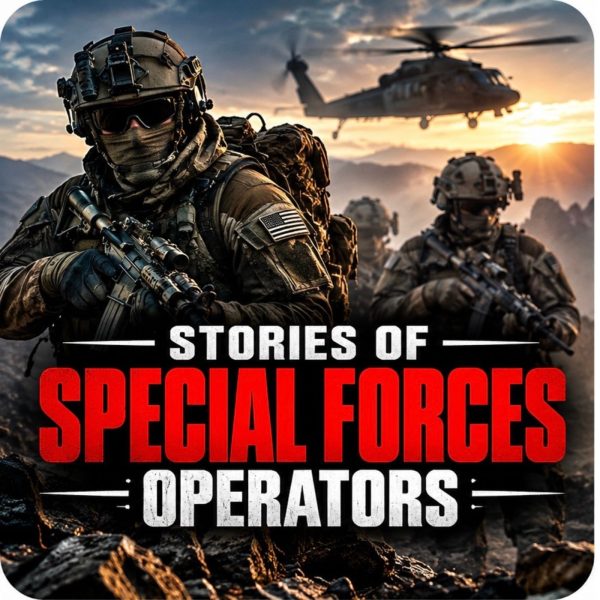
Stories of Special Forces Operators
- Episodes
- 246
- Released
- daily
- Latest episode
- Nov 11, 2026
Episodes 246
The Jedburgh Teams: The Secret Allied Commandos Who Operated Behind Nazi Lines
In the summer of 1944, small teams of American, British, and French special operations soldiers parachuted into Nazi-occupied France to organize resistance fighters, sabotage German communications, and disrupt …
Show notes
In the summer of 1944, small teams of American, British, and French special operations soldiers parachuted into Nazi-occupied France to organize resistance fighters, sabotage German communications, and disrupt enemy reinforcements following the Normandy invasion. Known as the Jedburgh teams, these three-man units operated deep behind enemy lines, relying on local resistance networks, clandestine radio communications, and unconventional warfare rather than conventional military firepower. This episode examines how these largely forgotten commandos helped prepare the battlefield for Allied advances and established principles that would later influence modern American Special Forces.Operation Barras: The British SAS Rescue Mission That Destroyed a Rebel Militia
In September 2000, British special forces launched a daring rescue operation deep inside Sierra Leone after an armed militia known as the West Side Boys captured eleven British soldiers. The mission brought …
Show notes
In September 2000, British special forces launched a daring rescue operation deep inside Sierra Leone after an armed militia known as the West Side Boys captured eleven British soldiers. The mission brought together the Special Air Service, Special Boat Service, and Parachute Regiment in a coordinated helicopter assault against heavily armed insurgents holding hostages in the jungle. This episode examines Operation Barras, the intelligence gathering, military planning, and extraordinary combat that turned a hostage rescue into one of Britain’s most celebrated modern special operations missions.Operation Oak: The Nazi Commandos Who Rescued Mussolini from an Italian Mountain Fortress
In September 1943, German commandos launched one of World War II's most audacious rescue operations, landing gliders on a remote Italian mountaintop to free imprisoned dictator Benito Mussolini. The mission …
Show notes
In September 1943, German commandos launched one of World War II's most audacious rescue operations, landing gliders on a remote Italian mountaintop to free imprisoned dictator Benito Mussolini. The mission involved Luftwaffe paratroopers, SS personnel, and Otto Skorzeny, a German officer who would later become one of Nazi Germany's most famous commandos. This episode examines Operation Oak, the extraordinary mountain assault, the deception that prevented a firefight, and how Nazi propaganda transformed a carefully coordinated military operation into the legend of one man.Operation Gunnerside: The Norwegian Commandos Who Sabotaged Hitler’s Atomic Ambitions
In February 1943, a small team of Norwegian commandos crossed the frozen mountains of occupied Norway to destroy a facility producing heavy water, a substance important to Nazi Germany’s nuclear research …
Show notes
In February 1943, a small team of Norwegian commandos crossed the frozen mountains of occupied Norway to destroy a facility producing heavy water, a substance important to Nazi Germany’s nuclear research program. Operating under British Special Operations Executive direction, the saboteurs infiltrated the heavily guarded Vemork industrial complex, planted explosives, and escaped without suffering a single casualty. This episode examines Operation Gunnerside, one of World War II’s most remarkable sabotage missions, and how a handful of specially trained resistance fighters disrupted a strategically important component of Germany’s nuclear ambitions.The Battle of Takur Ghar: When a Navy SEAL Mission Became a Fight for Survival
On March 4, 2002, a nighttime insertion into Afghanistan’s Shah-i-Kot Valley turned into one of the most desperate battles of the early war on terrorism. What began as an effort to establish a reconnaissance …
Show notes
On March 4, 2002, a nighttime insertion into Afghanistan’s Shah-i-Kot Valley turned into one of the most desperate battles of the early war on terrorism. What began as an effort to establish a reconnaissance position became a deadly engagement involving Navy SEALs, Army Rangers, Air Force combat controllers, and pararescuemen fighting against entrenched al-Qaeda militants. This episode examines the Battle of Takur Ghar, also known as the Battle of Roberts Ridge, and the intelligence failures, communications problems, and extraordinary acts of courage that cost seven Americans their lives.The Battle of Mirbat: When Nine SAS Soldiers Faced an Insurgent Army
On July 19, 1972, a small detachment of British Special Air Service soldiers and their Omani allies found themselves defending the coastal town of Mirbat against a much larger communist-backed insurgent force …
Show notes
On July 19, 1972, a small detachment of British Special Air Service soldiers and their Omani allies found themselves defending the coastal town of Mirbat against a much larger communist-backed insurgent force. Armed with rifles, machine guns, mortars, and an aging 25-pounder artillery gun, the defenders fought a desperate battle that would become one of the most celebrated engagements in SAS history. This episode examines the Dhofar Rebellion, the extraordinary actions of the defenders, and the tactical decisions that helped a small force withstand a determined assault.Operation Red Wings: What Really Went Wrong in Afghanistan?
In June 2005, four Navy SEALs entered the mountains of Afghanistan’s Kunar Province on a reconnaissance mission targeting a Taliban-aligned insurgent leader, only to encounter a devastating ambush that left …
Show notes
In June 2005, four Navy SEALs entered the mountains of Afghanistan’s Kunar Province on a reconnaissance mission targeting a Taliban-aligned insurgent leader, only to encounter a devastating ambush that left three members of the team dead. Operation Red Wings became one of the most widely discussed missions in American special operations history, raising difficult questions about intelligence, communications, terrain, and the decisions made under extraordinary pressure. This episode examines what the historical record reveals, where popular accounts diverge, and the tactical and leadership lessons that continue to shape discussions of special operations warfare.Introducing Operators Eyes : Special Forces Tactics Meet Hollywood's Most Intense Scenes
What would an experienced Special Forces operator notice when watching the gunfights, ambushes, and tactical confrontations in Hollywood’s biggest movies and television shows? Introducing Operators Eyes, a new …
Show notes
What would an experienced Special Forces operator notice when watching the gunfights, ambushes, and tactical confrontations in Hollywood’s biggest movies and television shows? Introducing Operators Eyes, a new podcast that analyzes close-quarters battle (CQB), situational awareness, combat psychology, and tactical decision-making in scenes from Heat, Sicario, The Terminal List, Better Call Saul, and more. Discover what Hollywood gets right, what it gets wrong, and how real-world tactical principles can change the way you understand your favorite action scenes.Operation Dead City: How Special Forces Would Contain an Outbreak
When a pathogen turns an urban population into vectors of lethal contagion, military doctrine ceases to be about conventional engagement and shifts entirely to brutal cordon sanitaires. This hypothetical …
Show notes
When a pathogen turns an urban population into vectors of lethal contagion, military doctrine ceases to be about conventional engagement and shifts entirely to brutal cordon sanitaires. This hypothetical operation examines the harsh collision between elite tier-one tactics, physiological human limits, and catastrophic system failures inside a quarantined metropolitan zone. From establishing uncompromised perimeters to navigating communication blackouts, special operators would not fight to clear the streets—they would deploy to buy time for the state to isolate the epicenter. This breakdown dissects the reality of modern military intervention when evacuation collapses, operational endurance breaks down, and biological containment demands absolute coldness.Tier-One Architecture: Deciphering the Distinct Doctrines of CAG, Green Berets, and SEALs
Within the modern United States Special Operations Command architecture, civilian culture routinely blurs distinct elite units into a single monolithic category of special operators. In reality, 1st Special …
Show notes
Within the modern United States Special Operations Command architecture, civilian culture routinely blurs distinct elite units into a single monolithic category of special operators. In reality, 1st Special Forces Operational Detachment-Delta, the Army Special Forces Green Berets, and the Navy SEALs were forged for fundamentally divergent strategic mandates. While popular media fixates on tactical overlaps and room-clearing raids, their operational structures diverge sharply across Direct Action, Foreign Internal Defense, and Clandestine Reconnaissance. Understanding these tier-separated capabilities reveals how military leadership allocates human capital to solve complex geopolitical crises, from training indigenous guerilla forces to executing surgical strikes behind denied borders.Introducing The Debrief: Seven Blood Samples new special forces fiction series
In 2009, six operators raided a compound in Afghanistan, and all six came home. Seventeen years later, a lab finds a seventh American blood sample at the scene that matches no one on the team. In *The Debrief …
Show notes
In 2009, six operators raided a compound in Afghanistan, and all six came home. Seventeen years later, a lab finds a seventh American blood sample at the scene that matches no one on the team. In *The Debrief: A Special Forces Fiction Series*, an Army CID agent reopens the case and finds a retired Master Sergeant with four minutes of that night he can't explain. Part 1 is out now, with Part 2 on Tuesday and Part 3 on Wednesday. Search for The Debrief wherever you listen.
Link-https://open.spreaker.com/A4NZ...Phantom Columns in the Green Hell: Orde Wingate’s Chindits and the Agony of Deep Penetration
In early 1943, Brigadier Orde Wingate led three thousand British, Gurkha, and Burmese soldiers deep into Japanese-occupied Burma to test an unproven military doctrine known as Long-Range Penetration. Severing …
Show notes
In early 1943, Brigadier Orde Wingate led three thousand British, Gurkha, and Burmese soldiers deep into Japanese-occupied Burma to test an unproven military doctrine known as Long-Range Penetration. Severing traditional ground lines of communication, these specialized units—designated the Chindits—relied entirely on wireless radios and perilous aerial supply drops to strike vital enemy infrastructure from the shadows. The resulting campaign proved that Allied troops could outmaneuver the Imperial Japanese Army within dense primary rainforest, permanently disrupting the aura of Japanese jungle invincibility. Yet this tactical breakthrough exacted an extraordinary human toll, forcing soldiers to endure starvation, relentless tropical diseases, and a crushing psychological isolation that pushed human endurance to its outer limits.Seconds on Target: Digital Forensics in the Breach
When an assault force clears a compound, the most dangerous phase of the raid begins the moment the shooting stops. In modern asymmetric warfare, capturing territory matters far less than capturing the digital …
Show notes
When an assault force clears a compound, the most dangerous phase of the raid begins the moment the shooting stops. In modern asymmetric warfare, capturing territory matters far less than capturing the digital networks connecting enemy cells across provinces. Document and Media Exploitation—known across the special operations community as DOMEX—turns seized laptops, hard drives, and burner phones into actionable targets before the dust settles. This episode breaks down how operators extract raw electronic intelligence under hostile fire to trigger the next strike.Bravo Two Zero: Did the SAS Fight the Battle That Made Them Famous?
In 1991, eight British SAS soldiers entered Iraq on a secret mission that became one of the most celebrated survival stories in military history. Their published accounts described extraordinary firefights …
Show notes
In 1991, eight British SAS soldiers entered Iraq on a secret mission that became one of the most celebrated survival stories in military history. Their published accounts described extraordinary firefights, dangerous escapes, and overwhelming enemy forces. But years later, an investigator returned to Iraq and uncovered eyewitness testimony that challenged some of the most dramatic claims. Was Bravo Two Zero the battle remembered by its survivors, or did the legend become larger than the historical evidence?The Teutoburg Ambush: How Terrain Defeated Roman Military Power
In 9 CE, Germanic forces used difficult terrain, surprise, and coordinated attacks to destroy three Roman legions. Their leader, Arminius, understood Roman military methods from his own service. Explore the …
Show notes
In 9 CE, Germanic forces used difficult terrain, surprise, and coordinated attacks to destroy three Roman legions. Their leader, Arminius, understood Roman military methods from his own service. Explore the historical battle and its enduring lessons about reconnaissance, mobility, and the dangers of fighting on an enemy’s terms.The Hidden Supply Chain Behind America’s Special Operations Forces
Special operations forces depend on sophisticated aircraft, surveillance systems, precision weapons, and communications equipment, but what happens when the materials needed to manufacture them become difficult …
Show notes
Special operations forces depend on sophisticated aircraft, surveillance systems, precision weapons, and communications equipment, but what happens when the materials needed to manufacture them become difficult to obtain? This episode examines how rare earth magnets and other critical minerals support military technology, why supply chain disruptions could affect long-term operational readiness, and how defense planners manage these risks. From reconnaissance drones to aircraft maintenance, we explore the industrial dependencies behind elite military operations.Navy SEAL vs. Olympic Water Polo Player: The Physiology of Elite Aquatic Performance
What happens when the physiological demands of a Navy SEAL combat diver are compared with those of an Olympic water polo player? Both must demonstrate exceptional cardiovascular conditioning, muscular …
Show notes
What happens when the physiological demands of a Navy SEAL combat diver are compared with those of an Olympic water polo player? Both must demonstrate exceptional cardiovascular conditioning, muscular endurance, and control in aquatic environments, yet their bodies adapt to dramatically different combinations of aerobic exercise, anaerobic exertion, and environmental stress. Explore the science of oxygen consumption, lactate metabolism, respiratory physiology, and muscular fatigue to understand what makes these two forms of aquatic performance so demanding.The Secret World of Combat Divers: The Soldiers Who Attack from Beneath the Sea
Some of the world's most dangerous military missions begin beneath the ocean's surface, where elite combat divers approach enemy territory without being seen. From World War II frogmen to modern Navy SEALs and …
Show notes
Some of the world's most dangerous military missions begin beneath the ocean's surface, where elite combat divers approach enemy territory without being seen. From World War II frogmen to modern Navy SEALs and clandestine maritime operations, combat divers have played an extraordinary role in military history. Discover how these underwater specialists train, survive, and operate in an environment where darkness, pressure, and a single mistake can become deadly.Viking Berserkers: Ancient Warrior Psychology and the Limits of Fear
Long before modern military training, Norse legends celebrated warriors who seemed capable of fighting without fear. The berserker tradition offers an intriguing historical lens through which to examine combat …
Show notes
Long before modern military training, Norse legends celebrated warriors who seemed capable of fighting without fear. The berserker tradition offers an intriguing historical lens through which to examine combat arousal, intimidation, group cohesion, and battlefield psychology. This episode separates the legendary accounts from what modern research tells us about human performance under extreme stress. Discover why controlling fear, rather than eliminating it, remains central to effective combat performance.Do Special Forces Operators Really Have GPS Chips Implanted in Their Bodies?
Hollywood often portrays elite soldiers carrying secret tracking devices implanted beneath their skin, allowing commanders to locate them anywhere in the world. But how realistic is this technology, and how do …
Show notes
Hollywood often portrays elite soldiers carrying secret tracking devices implanted beneath their skin, allowing commanders to locate them anywhere in the world. But how realistic is this technology, and how do military units actually track personnel during dangerous operations? This episode separates cinematic fiction from the science of GPS, battlefield communications, and operational security.Operation Eagle Claw: The Special Forces Disaster That Changed Everything
In April 1980, the United States launched a secret mission deep inside Iran to rescue 53 American hostages held in Tehran. Operation Eagle Claw brought together elite troops, aircraft, and months of planning …
Show notes
In April 1980, the United States launched a secret mission deep inside Iran to rescue 53 American hostages held in Tehran. Operation Eagle Claw brought together elite troops, aircraft, and months of planning, yet the rescue force never reached the hostages. The catastrophe at a remote desert landing site exposed weaknesses in how America’s special operations forces worked together and ultimately helped transform the way the United States conducts special operations.Inside Delta Force Selection: What Does It Actually Take to Get Selected?
Delta Force is one of the most secretive special operations units in the world, and simply reaching its selection process generally means a candidate has already demonstrated exceptional military ability. But …
Show notes
Delta Force is one of the most secretive special operations units in the world, and simply reaching its selection process generally means a candidate has already demonstrated exceptional military ability. But selection is designed to reveal qualities that physical fitness alone cannot measure: judgment, endurance, independence, and performance under extreme uncertainty. In this episode, we explore what is publicly known about Delta Force selection and the psychology behind finding people capable of operating when there may be no clear instructions and no easy answers.Operation Entebbe: The 90-Minute Raid That Changed Hostage Rescue
In 1976, more than 100 hostages were being held thousands of miles from Israel at Uganda’s Entebbe Airport. Israeli planners faced extraordinary problems involving distance, intelligence, surprise …
Show notes
In 1976, more than 100 hostages were being held thousands of miles from Israel at Uganda’s Entebbe Airport. Israeli planners faced extraordinary problems involving distance, intelligence, surprise, transportation and the possibility that the hostages could be killed before rescuers reached them. The resulting raid became one of history’s most studied long-range hostage-rescue operations.Green Beret to Civilian: Rod Graham's Journey After Special Forces
In this episode, Green Beret veteran Rod Graham sits down to talk through his time in Army Special Forces and what came after leaving that world behind. He shares firsthand insight into the training, mindset …
Show notes
In this episode, Green Beret veteran Rod Graham sits down to talk through his time in Army Special Forces and what came after leaving that world behind. He shares firsthand insight into the training, mindset, and demands of operating in an elite combat unit. The conversation moves into how that experience shaped his path once the uniform came off, and what the transition out of special operations actually looks like. It's a candid, personal account from someone who lived that world from the inside.The Angostura Files-Colombian special forces
For years, the second-most-wanted man in the Western Hemisphere ran a rebel state from inside the Amazon, protected by two borders and a government that looked the other way. Colombian intelligence spent months …
Show notes
For years, the second-most-wanted man in the Western Hemisphere ran a rebel state from inside the Amazon, protected by two borders and a government that looked the other way. Colombian intelligence spent months building a picture of his movements, his habits, and the camp he thought was untouchable. This is the story of how they found him.From Sensor to Weapon: The Small Drone Joins the Team
Imagery released Sept. 17 showed Green Berets from 5th Special Forces Group (Airborne) at Fort Campbell, Kentucky, preparing an explosive payload on a small drone during training on Aug. 14. Officials said the …
Show notes
Imagery released Sept. 17 showed Green Berets from 5th Special Forces Group (Airborne) at Fort Campbell, Kentucky, preparing an explosive payload on a small drone during training on Aug. 14. Officials said the event tested the capabilities and effects of explosive-ordnance small attack drones flown with first-person-view feeds. Technical details were withheld for operational security. The release fits a wider Army special operations push to treat low-cost drones as lethal tools, not just surveillance sensors.Dude 44’: How Air Force PJs and SEAL Team 6 Elements Helped Pull an F-15E Crew Out of Iran
After an F-15E Strike Eagle nicknamed “Dude 44” was shot down over Iran in April 2026, the weapons systems officer known as “Bravo” spent roughly 50 hours injured in the Zagros Mountains before rescue. CENTCOM …
Show notes
After an F-15E Strike Eagle nicknamed “Dude 44” was shot down over Iran in April 2026, the weapons systems officer known as “Bravo” spent roughly 50 hours injured in the Zagros Mountains before rescue. CENTCOM later said about 92 U.S. troops operated on Iranian soil for the recovery — including Air Force pararescue and elements of SEAL Team 6, supported by MC-130s and 160th SOAR MH-6 Little Birds. In a September 2026 *60 Minutes* interview, Bravo publicly described the shootdown, the wait, and the moment PJs reached him on a ridgeline.Behind the Uniform: Claudio Spinelli on Life in Italian Special Forces
In this conversation, we sit down with Claudio Spinelli, a veteran of Italy's special forces community, for an inside look at the world of elite military operations. He walks us through the mindset, training …
Show notes
In this conversation, we sit down with Claudio Spinelli, a veteran of Italy's special forces community, for an inside look at the world of elite military operations. He walks us through the mindset, training, and demands that come with serving in some of Italy's most selective combat units. The conversation covers what drew him to that path and the realities of operating at the highest level of military readiness. It's a rare, candid window into a side of special operations rarely heard outside Italy.America’s New Maritime Hunters: Inside the U.S. Coast Guard’s Special Missions Command
In May 2026, the United States Coast Guard announced the creation of a new Special Missions Command — a major restructuring designed to unify elite maritime units responsible for counterterrorism, drug …
Show notes
In May 2026, the United States Coast Guard announced the creation of a new Special Missions Command — a major restructuring designed to unify elite maritime units responsible for counterterrorism, drug interdiction, port security, disaster response, and high-risk operations. In this episode, we examine why the Coast Guard believes future threats will increasingly emerge through oceans, ports, shipping lanes, and gray-zone maritime conflict. Through the lens of special operations, geopolitical strategy, and modern asymmetric warfare, we explore how this new command may transform America’s maritime security posture for decades to come.Act of Valor: Real Operators, Scripted War
Act of Valor put active-duty SEALs and SWCC crews in front of the camera and filmed live-fire training as if it were the mission. The CQB flow and small-boat work look like the Teams because, in a lot of those …
Show notes
Act of Valor put active-duty SEALs and SWCC crews in front of the camera and filmed live-fire training as if it were the mission. The CQB flow and small-boat work look like the Teams because, in a lot of those frames, they are the Teams. This is what survived Naval Special Warfare’s TTP review—and what the script still forced through.
These are the latest 40 of 246 episodes. You’ll find older episodes in the podcast’s feed.
Similar podcasts
More Health & Fitness podcasts






Is this your podcast?
Confirm it with an entry in your feed: you get a code here, add it as podcast:txt to the channel of your feed, and we check it. Your podcast is then shown as “verified” on SoundNode.